Category Archives: Hampshire

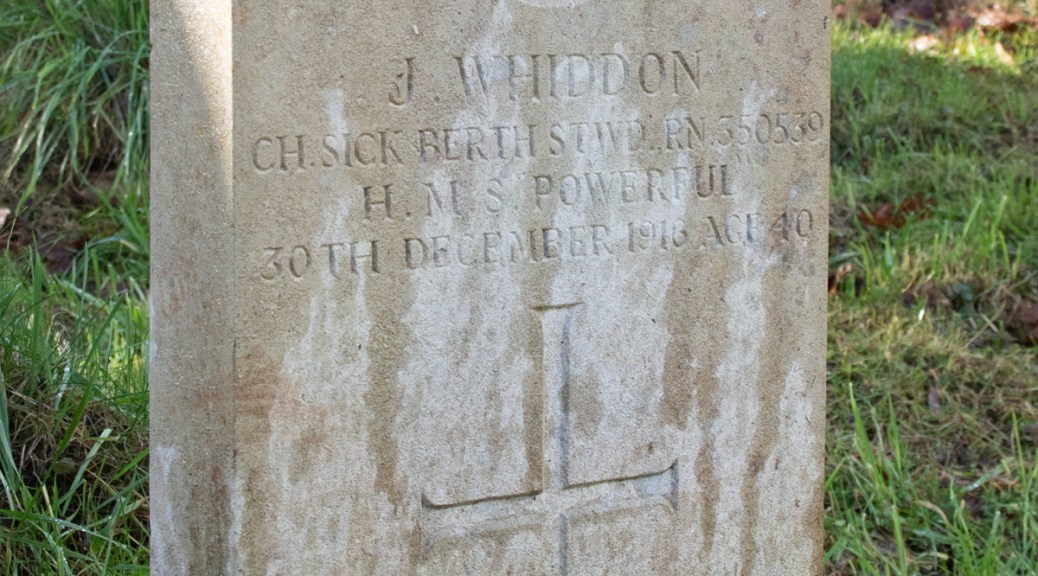
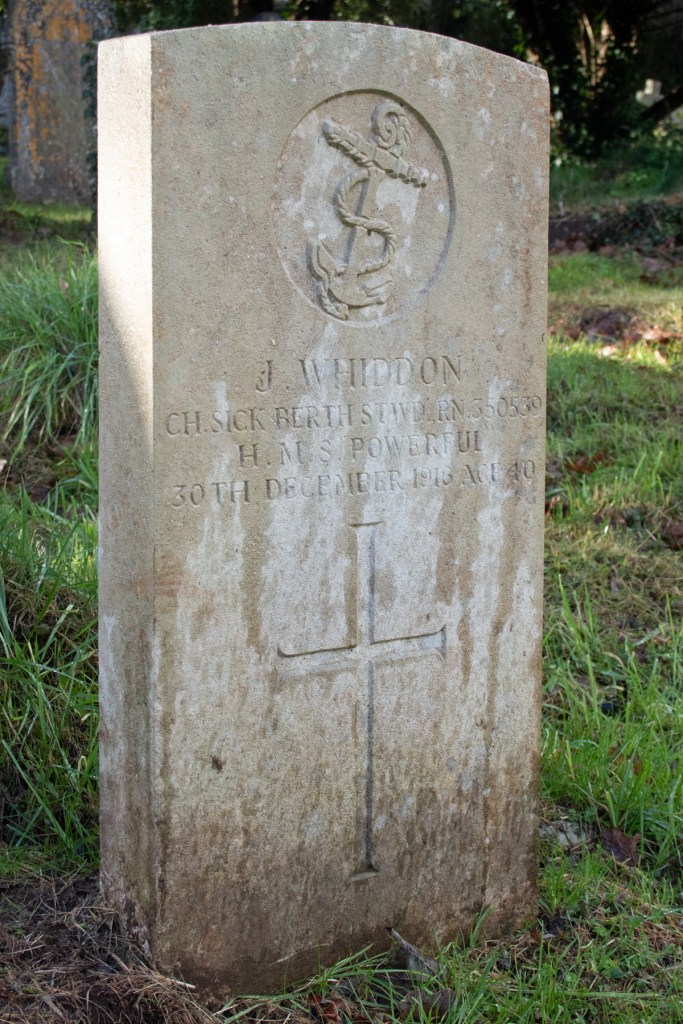
Chief Sick Berth Steward John Whiddon

Chief Sick Berth Steward John Whiddon

John Whiddon was born on 15th January 1876 in the Devon town of Ashburton and was one of seven children to John and Elizabeth Whiddon. John Sr was a general labourer, but when he left school, his son found work as a baker’s apprentice.

John was keen to better himself and so, at the age of 21, he enlisted in the Royal Navy. His service records confirm that he enlisted on 21st July 1897 for a period of 12 years. He was recorded as standing 5ft 6in (1.67m) tall, with light brown hair, blue eyes and a fair complexion.

John’s role was as a Sick Berth Assistant and, over the next few years he had a number of different postings. While some were on sea-going vessels, the majority of his time on shore. He served at the Haslar Hospital in Portsmouth, Plymouth Hospital and at HMS Vivid, the Royal Naval Dockyard in Devonport.

Sick Berth Assistant Whiddon certainly worked hard, though, and this paid off. In 1902 he was promoted to Sick Berth Steward and, in 1909, when his contract came to an end, he volunteered to stay on. Over the next seven years, John continued to do his duty, both on shore and at sea, and was again promoted, this time to Chief Sick Berth Steward.

At some point John married a woman called Catherine; sadly there is no information about her, other than that she had passed away by 1916.

In the autumn of 1916, John was serving on board HMS Powerful, when he contracted pneumonia. He was brought ashore and admitted to the Royal Naval Hospital in Plymouth, but sadly passed away from the illness on 30th December 1916. He was 40 years of age.

John Whiddon was brought back to Ashburton for burial. He lies at rest in the graveyard of St Andrew’s Church there.

Stoker 1st Class Frederick Cable

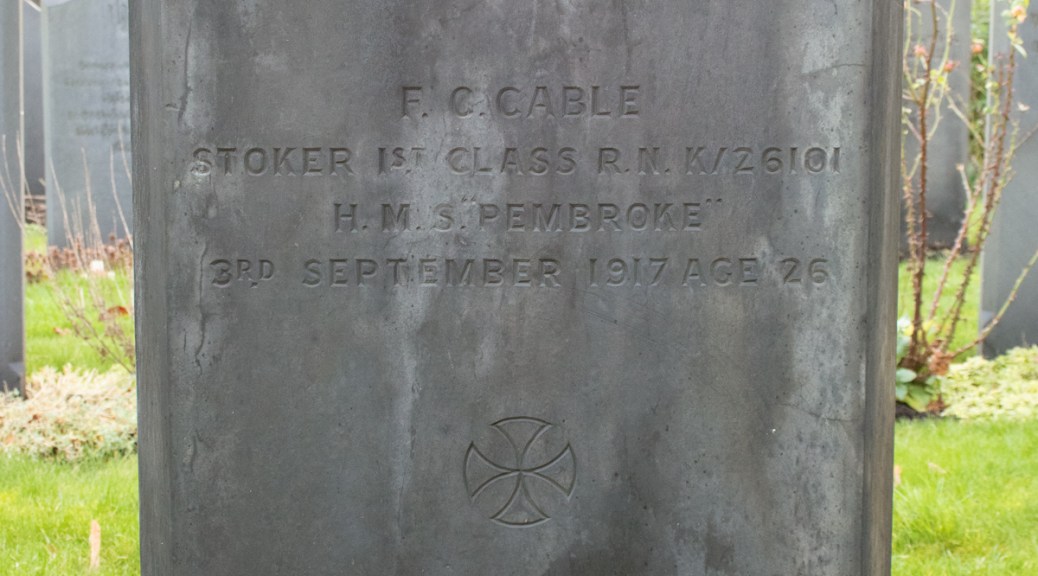
Stoker 1st Class Frederick Cable

Frederick Charles Cable was born on 22nd November 1890 in Eastbourne, West Sussex. He was the younger of three children to John and Louisa Cable, and the family lived on one floor of a three-storey house in the middle of the town.

When Frederick was born, John was working as a billiard marker, but it seems that this was a poor way to scratch together a living for a young father. The 1901 census found the family in London, where John had been born, and where he was not employed as a hotel waiter.

Sadly, the new set-up was not to last long: John died in 1905, leaving Louisa to raise her boys on her own. The next census record, in 1911, records the two of them living a five-room terraced house in East Finchley. They were not alone, however, as they were sharing it with a widow – Elizbeth Hickinbottom – and her 34-year old son, George.

A year later, George and Louisa married, and went on to have a daughter, also called Louisa. Frederick, meanwhile, was to find love of his own, and, in the spring of 1914, while working as a milkman, he married Dorothy Ada Laurence. They would go on to have a son, who they named after his father, a year later.

By this point, war was raging in Europe, and Frederick was called to do his duty in May 1915. His records show that he was 5ft 7ins (1.70m) tall, had dark brown hair, brown eyes and a dark complexion and was given the rank of Stoker 2nd Class.

Over the next couple of years, Frederick served on two ships – HMS Actaeon and HMS Weymouth – and it was on board the latter that he was promoted to Stoker 1st Class in April 1916. The majority of his time, however, was spent on shore-based establishments: HMS Victory in Hampshire and HMS Pembroke in Kent.

The Royal Naval Dockyard in Chatham (HMS Pembroke) was where he spent most of his time, and was where he returned to in the summer of 1917. It was a particularly busy place at that point in the war and temporary accommodation was set up. Frederick found himself billeted at The Drill Hall, away from the main barracks.

On the night of 3rd September 1917, Chatham suddenly found itself in the firing line, as the German Air Force launched a bombing raid. One of the bombs landed squarely on the Drill Hall, and Stoker Cable was killed instantly. He was just 26 years old.

Ninety-eight servicemen perished during the Chatham Air Raid that night. They were buried in a mass funeral at the Woodlands Cemetery in nearby Gillingham. This, too, is where Frederick Charles Cable was laid to rest.


Frederick’s brother John Cable also fought in the First World War. He served as a Sergeant in the 21st Battalion Middlesex Regiment and was killed at the Battle of St Quentin on 25th March 1918. He was 28 years old and left a widow and three children. #

Serjeant John Cable is commemorated on the Arras Memorial in Northern France.


Able Seaman Raymond Ellis

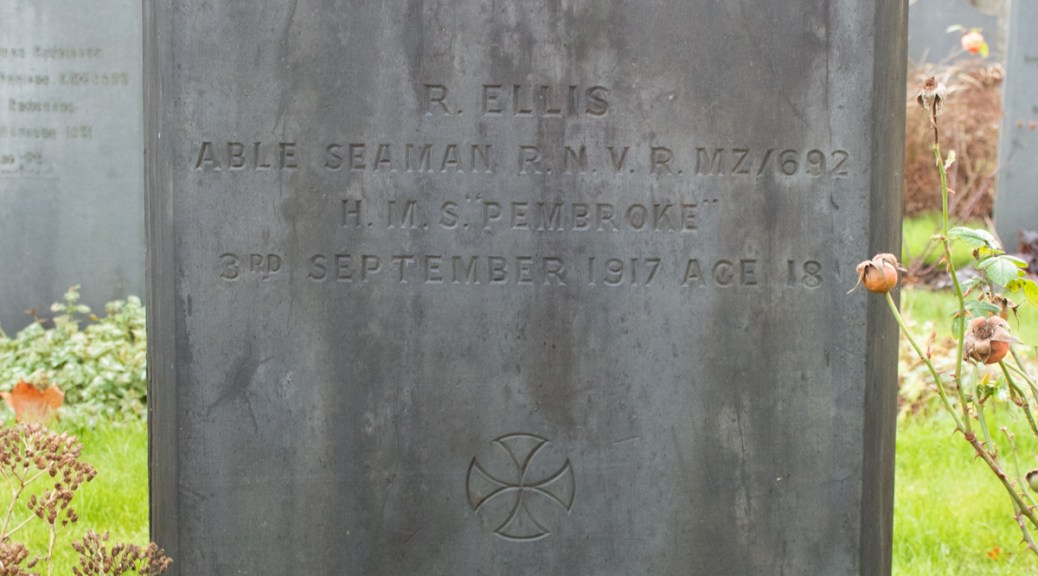
Able Seaman Raymond Ellis

Raymond Ellis was born on 10th August 1898, the youngest of eleven children to Thomas and Elizabeth. Thomas was a former army officer from North Wales. He had met and married Elizabeth Moseley while living in Worcestershire in the 1870s, before moving the family to Oxfordshire ten years later. By the time Raymond was born, the family had moved back to Wales again, and were living in Llandygai, not far from Bangor in Caernarvonshire, where Thomas was working as slate quarry inspector.

By the time of the 1911 census, Thomas had found other employment, and was working as the caretaker for a telephone exchange. This is where one of his daughters was employed, and was also where Raymond himself found work when he left school.

War was coming to Europe by this point, however, and, on 23rd September 1915, Raymond enlisted in the Royal Navy Volunteer Reserve for a period of three years. His service records show that he was 5ft 4.5ins (1.64) tall, had red hair, blue eyes and a fresh complexion. He was given the rank of Able Seaman and, after a month at HMS Victory – the Naval Dockyard in Portsmouth, Hampshire – was given his first posting, on board HMS Wallington.

Able Seaman Ellis came on shore at HMS Pembroke, the Royal Naval Dockyard in Chatham, Kent, on 17th July 1917. The base was a particularly busy place at that point in the war and additional accommodation was desperately needed. Raymond found himself billeted at Chatham Drill Hall, away from the main barracks.

On the night of 3rd September 1917, Chatham suddenly found itself in the firing line, as the German Air Force launched a bombing raid. One of the bombs landed squarely on the Drill Hall, and Able Seaman Ellis was killed. He was just 18 years old.

Ninety-eight servicemen perished during the Chatham Air Raid that night. They were buried in a mass funeral at the Woodlands Cemetery in nearby Gillingham. This, too, is where Raymond Ellis was laid to rest.


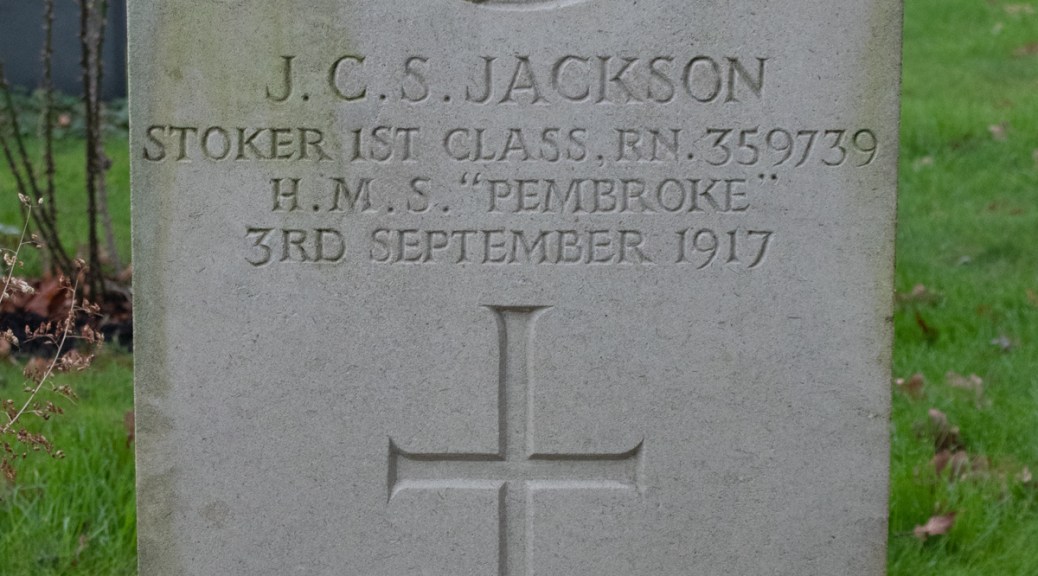
Stoker 1st Class Joseph Jackson

Stoker 1st Class Joseph Jackson

Joseph Charles Sackett Jackson was born in Rotherhithe, Surrey, on 4th May 1884, and was on of seven children. His father – post office worker Joseph Jackson Sr – died in 1895, leaving his mother, Eliza, to raise the family.

She soon married Matthew Newton, a widower himself, and the 1901 census found the couple living in Asylum Road, Peckham with eleven of their children and step-children. Joseph, who was 17 years old by this point, was one of only four of the household to be working, and was employed as a brass turner.

Keen to better himself, Joseph looked to a longer career and, in September 1901, he enlisted in the Royal Navy. His service records show that he was 5ft 3ins (1.6m) tall, had dark brown hair, brown eyes and a fresh complexion.

Initially underage, he served on the home front, Joseph was based at the shore establishments around the country – HMS President (London), HMS Pembroke (Chatham Dockyard, Kent) and HMS Victory (Portsmouth, Hampshire). In 1906, when he turned 23, he formally enlisted in the Royal Navy, and was given the rank of Stoker 2nd Class.

Over the next year, Joseph served on three vessels – HMS Hawke, HMS Dido and HMS Pathfinder – and was promoted to Stoker 1st Class. He continued his work at sea, but returned to HMS Pembroke in between voyages.

In the summer of 1913, Stoker Jackson was assigned to the battleship HMS Dominion, and it was here that he spent the next four years. He was promoted again, this time to Leading Stoker. He returned to HMS Pembroke in August 1917, although he was again given the rank of Stoker 1st Class.

Chatham Dockyard was particularly busy that summer, and the large number of extra servicemen meant that Joseph was billeted in temporary accommodation in Chatham Drill Hall.

On the 3rd September 1917, the first night air raid carried out by the German Air Force bombarded the town, and scored a direct hit on the Drill Hall; Stoker 1st Class Jackson was among those killed instantly. He was 33 years old.

Joseph Charles Sackett Jackson was laid to rest, along with the other victims of the Chatham Air Raid, in the Woodlands Cemetery, Gillingham.


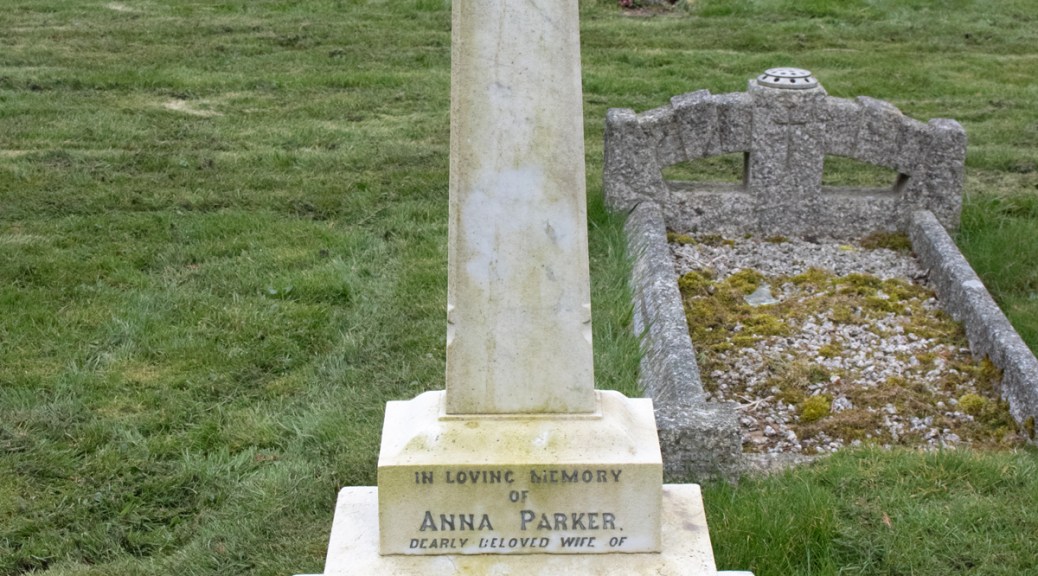
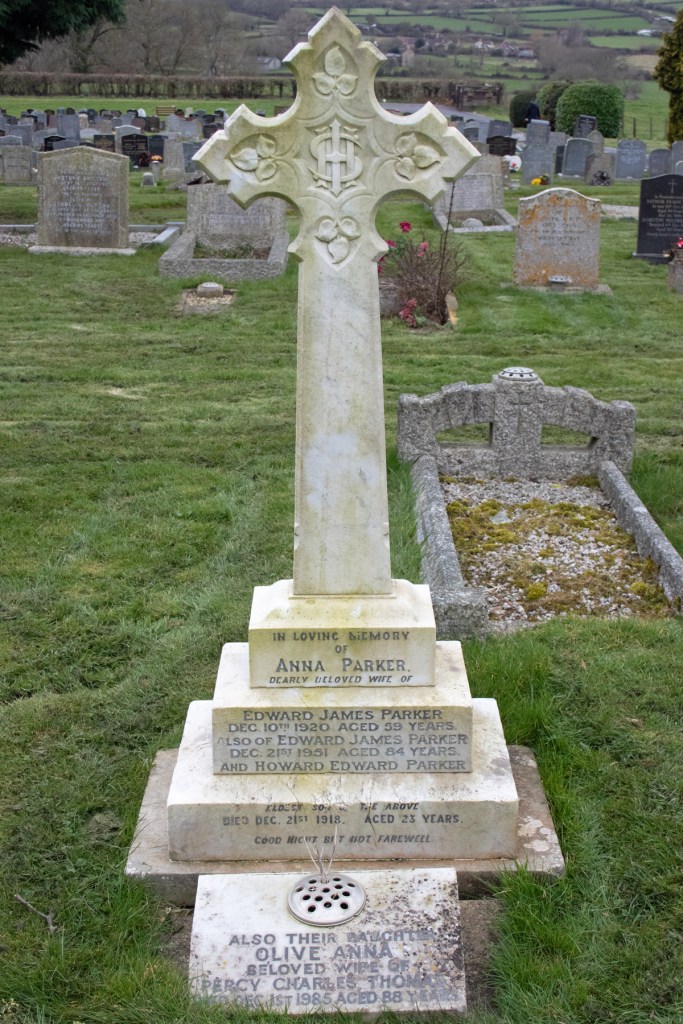
Serjeant Howard Parker

Serjeant Howard Parker

Howard Edward Parker was born in the summer of 1895 and was one of six children to Edward and Anna Parker. Edward was a tailor from Castle Cary, Somerset, and it was in his home town that he raised his young family. When he left school, Edward worked as his father’s clerk.

War was on the way, however, and Edward was keen to play his part. Unfortunately, details of his military service are limited, but from what little remains, it’s possible to piece some bits together.

Edward joined the Army Ordnance Corps at some point before June 1918. During his time in the army, he rose to the rank of Serjeant, but it is unclear whether he served on home soil or abroad.

The only other certain information is Serjeant Parker died in Southampton on 21st December 1918; the cause of his passing is unclear, and there is nothing in contemporary newspapers to suggest anything out of the ordinary. He was just 23 years of age.

Howard Edward Parker’s body was brought back to Somerset for burial. He was laid to rest in the family grave in Castle Cary Cemetery.


Serjeant Howard Parker
(from findagrave.com)

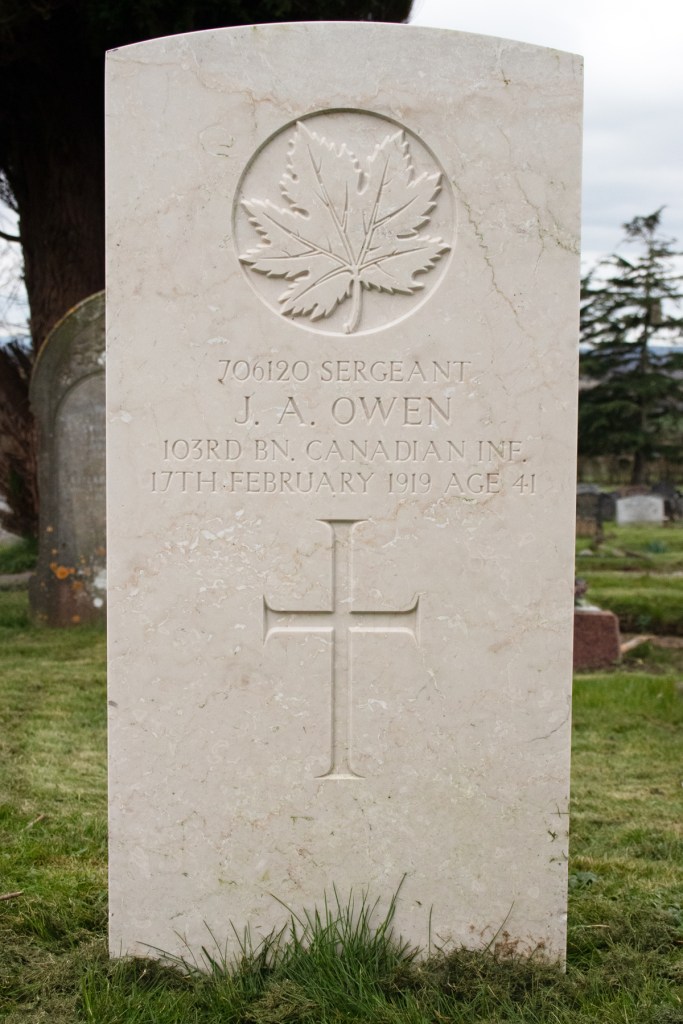
Sergeant James Owen

Sergeant James Owen

James Alfred Owen was born on 4th August 1877 and was the middle of three children to James and Sarah Owen. James Sr was a woodman from Herefordshire, who had moved the family to Radnor in mid-Wales.

James Jr’s early life has been lost to time, but by the time he turned 30, he had emigrated to Canada. He settled in the west coast town of Prince Rupert and found work as a salesman. On 28th January 1910 he married Hattie Whidden: the couple went on to have three children – Annie, Louisa and Dorothy.

War was coming to Europe, and James wanted to play his part for King and Country. He enlisted on 4th December 1915, joining the 103rd Battalion of the Canadian Infantry. His service records show that he stood 5ft 9ins (1.75m) tall and weighed 156lbs (70.8kg). His physical development was recorded as ‘average’, he had a ruddy complexion, brown hair and brown eyes. It was also noted that he had a birthmark in his left groin and his teeth were poor and required attention.

Private Owen departed for England in July 1916 and was assigned to the Oxney Camp in Hampshire. He was promoted to Corporal and then to Sergeant and, over the next few years, he remained in England. He was primarily based in barracks at Bramshott – also in Hampshire – though did spend time in Seaford in Sussex.

Sergeant Owen survived the war, but was admitted to the Ripon Military Hospital on 8th February 1919, having contracted bronchitis and malaria. The hospital didn’t have any specific expertise in contagious diseases, so it is likely that his move to Ripon was one stage of his move back to Canada.

Sadly, the conditions proved too much for James. He passed away on 17th February 1919, at the age of 41 years of age.

James Alfred Owen’s body was brought to Castle Cary in Somerset, where his sister Eleanor lived with her family. He was laid to rest in the town’s cemetery.


Air Mechanic Walter Naish

Air Mechanic Walter Naish

Walter Matthias Naish was born in the autumn of 1896, and was one of of five children to agricultural labourer Matthias Naish and his wife, Sarah Ann. Born in Lovington, near Castle Cary, Somerset, this is where the family is recorded as living for the 1901 and 1911 censuses.

When he left school, Walter found work as a cabinet maker; war was on the horizon, however, and he enlisted on 28th February 1916. He was immediately put on reserve, however, and was only mobilised in January 1917, when he was assigned to the Royal Flying Corps as an Air Mechanic.

Tragically, Walter’s military career was not to be a long one. He was admitted to the Connaught Hospital in Aldershot with conditions unknown, and passed away on 3rd March 1917, just 51 days after leaving home. He was just 20 years old.

Walter Matthias Naish’s body was brought back to Somerset for burial. He lies at rest in the Castle Cary Cemetery, not far from his home.


Private Gilbert Metters

Private Gilbert Metters

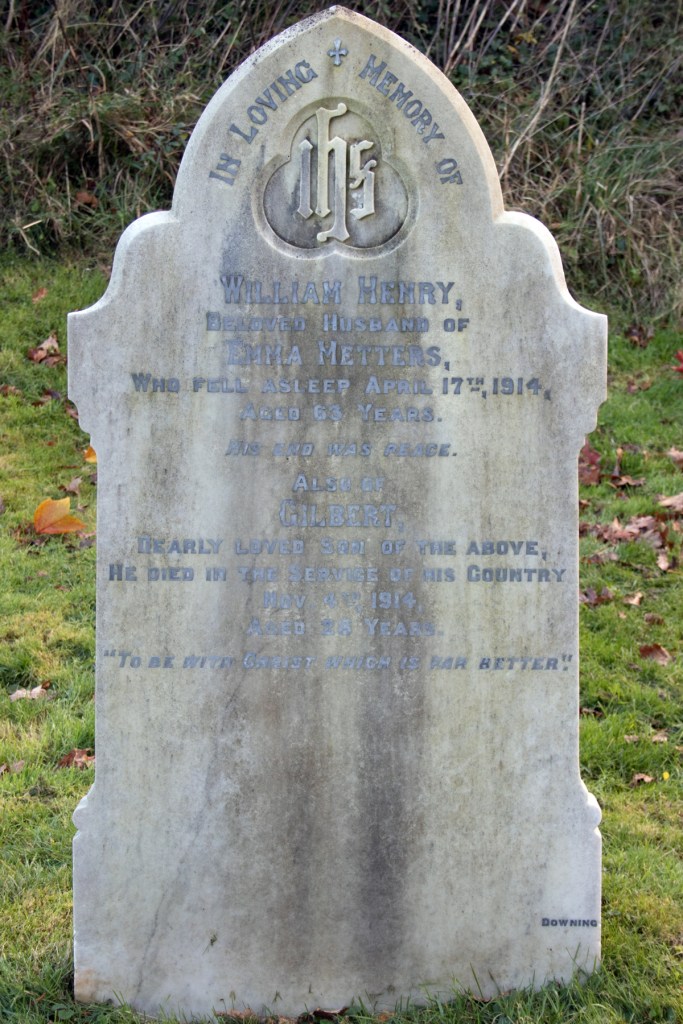
Gilbert Metters was born in Linkinhorne, Cornwall in March 1885, one of four children to William and Emma Metters. William was a farmer and haulier who moved his family to Chudleigh in Devon not long after Gilbert was born.

When Gilbert left school, he found work as a domestic gardener. By the time of the 1911 census, he was living with his parents, younger sister and Emma’s sister in Old Way, not far from the village centre. On 17th April 1914, William passed away, leaving Emma widowed.

When war broke out, Gilbert was one of the first from the town to sign up. He enlisted in the 8th Battalion of the Devonshire Regiment, and was soon off to Hampshire for training. Tragically, within weeks of arriving, Private Metters contracted tuberculosis, and passed away in the camp hospital. He was 29 years of age, breathing his last on 4th November 1914.

Gilbert Metters’ body was brought back to Chudleigh for burial, and was laid to rest alongside his father in the family grave.


The local newspaper reported on Gilbert’s funeral. It suggested that when enlisting “although not one of the strongest, he managed to pass the medical test.” It went on to say that:

He always assisted in every good cause in the town, and was very highly respected. He endeared himself with the officers and men of C Company.

Western Times: Friday 13th November 1914

Corporal Cyril Allen

Corporal Cyril Allen

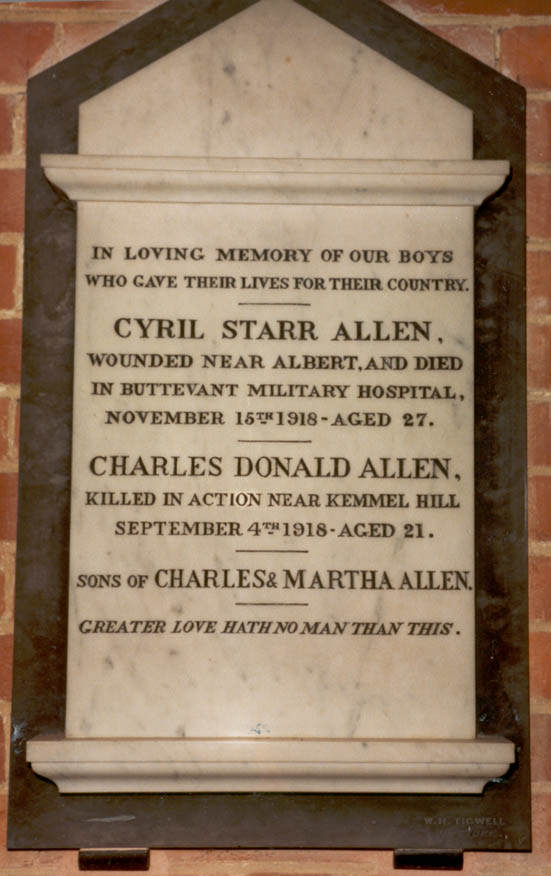
Cyril Starr Allen was born on 15th June 1891 in the village of Baughurst, near Tadley in Hampshire. He was the second youngest of five children to Charles and Martha Allen. Charles was a rate collector, and the family moved around the county during Cyril’s early years.

By the time Cyril left school, Charles had become an assistant bursar in Wootton, near Basingstoke. Cyril, meanwhile, had found similar administrative employment and was working as a clerk for a local land agent.

At the start of 1911, Cyril enlisted in the British Army. He joined the 4th Battalion of the Wiltshire Regiment as a Private and was soon based on Salisbury Plain. His service records confirm that he was 19 years and 7 months old, and stood at 5ft 5ins (1.65m) tall. Private Allen served for his initial term of four years, before being remobilised.

In November 1915, Cyril married Mabel Young. She was a printer’s daughter from Wiltshire, and the couple married in Salisbury, before settling down in Frome, Somerset. They went on to have a child, a daughter they called Kathleen.

Remobilised in the autumn of 1915 Private Allen received a series of promotions – to Lance Corporal, Corporal, Lance Sergeant and Sergeant, and, by June 1917, he found himself at the Front.

On 22nd April 1918, Cyril was injured, sustaining gunshot wounds to his shoulder and left arm. He was invalided back to England for treatment, and was hospitalised in the north of the country. He was then transferred to the Royal Welch Fusiliers with the rank of Corporal and sent to Ireland to continue his recovery and work light duties.

While in Ireland, Corporal Allen contracted influenza and was admitted to the Buttevant Hospital in County Cork. Sadly, in his weakened state, it was something he was to succumb to, and he passed away, with Mabel at his bedside, on 15th November 1918. He was just 27 years of age.

Cyril Starr Allen’s body was brought back to England; he was laid to rest in the graveyard of Christ Church in Frome, Somerset.


Corporal Cyril Allen (from ancestry.co.uk)

After the loss of her husband, Mabel went on to live her life. In 1923, she married James Burr, a draughtsman from Frome; they went on to have a child – a brother for Kathleen – called James.


Cyril’s two brothers, Winthrop and Charles, also fought in the First World War.

(from ancestry.co.uk)

Winthrop had emigrated to North America in 1911, but returned to Europe as part of the Canadian Expeditionary Force when war broke out.

Lance Corporal Charles Allen served with the 15th Battalion of the Hampshire Regiment. He fought on the Western Front and was killed near Kemmel Hill in Belgium on 4th September 1918. He was just 21 years old. Charles is commemorated at the Tyne Cot Memorial in Zonnebeke, Belgium.


Stoker 1st Class Robert Anderson

Stoker 1st Class Robert Anderson

Robert Anderson was born on 4th September 1889, one of ten children – of whom tragically only three survived – to James and Emily Anderson. James was a storekeeper from Belfast, who had moved his family to Preston, Lancashire, but who had subsequently moved them back to Northern Ireland after Robert had been born.

In 1911, while working as a town labourer, Robert had met and married Rebecca Barkley; the couple went on to have to children, Mary and Agnes.

War was coming to Europe, however, and Robert was keen to play his part. He enlisted in the 3rd Battalion of the Royal Irish Rifles and, according to a subsequent newspaper report, saw action at Mons and the Marne early in the conflict.

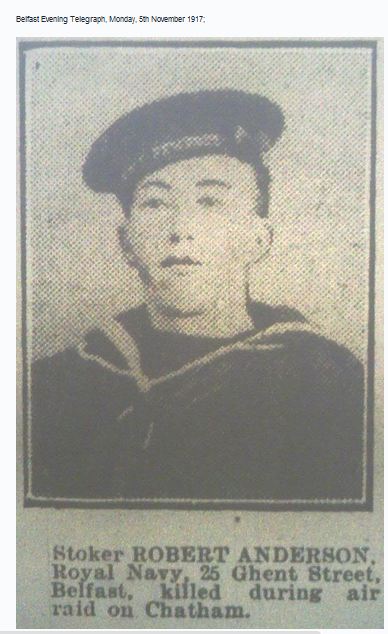
The Belfast Evening Telegraph reported that “He completed his time, and instead of re-enlisting in the Army, he joined the Navy.” [Thursday 4th October 1917] Given that Robert enlisted in the Royal Navy in the autumn of 1915, this raises the question of how he left the army at the height of the conflict, particularly given that the same report suggests that he had come through the major battles “unscathed“.

Either way, Private Anderson made the move to Stoker 2nd Class on 10th November 1915. He record show that he stood 5ft 5.5ins (1.66m) tall, had fair hair, brown eyes and a fresh complexion. On his arms he sported a number of tattoos; a lady, crossed flags and a ship on his right, and his initials on the left.

Robert’s first posting was HMS Pembroke, the Royal Naval Dockyard at Chatham, Kent, where he received a couple of months’ training. He was then assigned to HMS Egremont, also known as Fort St Angelo in Birgu, Malta, where he spent a couple of months. Stoker Anderson then returned to England, serving at HMS Victory, the Royal Naval Dockyard in Portsmouth, and gaining a promotion to Stoker 1st Class in the process.

By August 1917, he had returned to HMS Pembroke. The Dockyard was particularly busy that summer, and the large number of extra servicemen meant that Robert was billeted in temporary accommodation in Chatham Drill Hall.

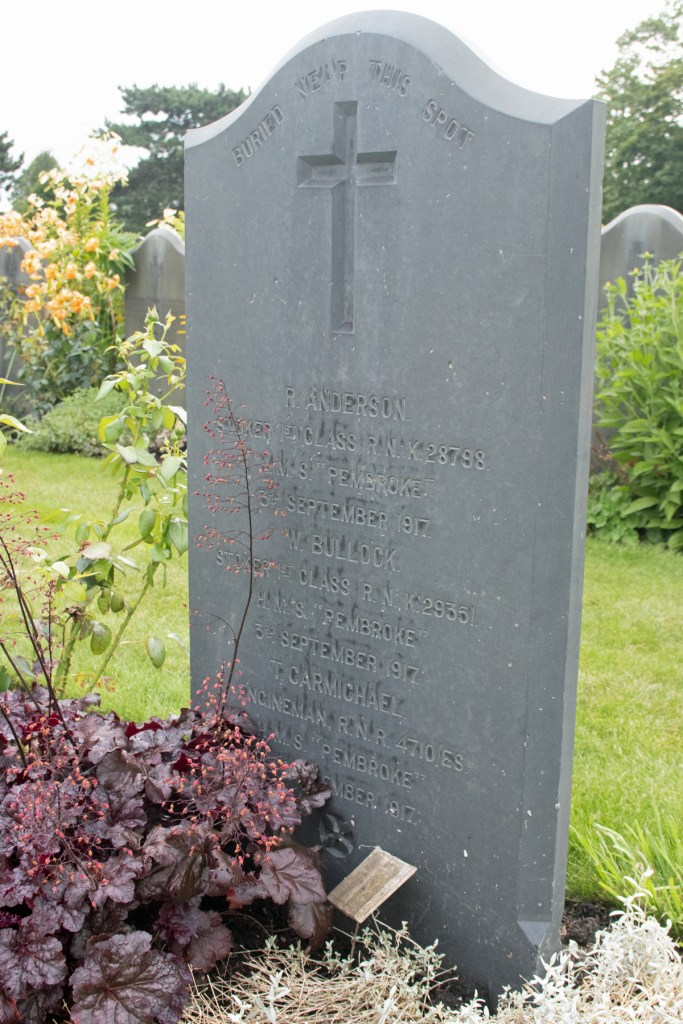
On the 3rd September 1917, the first night air raid carried out by the German Air Force bombarded the town, and scored a direct hit on the Drill Hall; Stoker 1st Class Anderson was among those killed instantly. He was a day short of his 28th birthday.

Robert Anderson was laid to rest, along with the other victims of the Chatham Air Raid, in the Woodlands Cemetery, Gillingham.


Larger memorial image loading...
Stoker 1st Class Robert Anderson
(from findagrave.com)