Category Archives: Hampshire

Ship’s Steward Archibald Wright

Ship’s Steward Archibald Wright

Archibald Thomas Victor Wright was born on 3rd August 1883 in Portsmouth, Hampshire. The second of six children – all boys – his parents were George and Alice Wright. George was a gunner and lieutenant in the Royal Navy, and the seafaring life was an obvious choice for his son to follow as well.

Archibald joined the Royal Navy as a Ship’s Steward Boy on 14th September 1898. Just fifteen years old, he was too young for formally enlist but was sent to HMS Pembroke, the Royal Naval Dockyard in Chatham, Kent, for his training.

Over the next three years, Archibald learnt the tools of his trade. He moved between establishments, from HMS Boscawen in Portland, Dorset, to HMS Excellent back in in Portsmouth. It was while on board the battleship HMS Glory, however, that he came of age, and was formally enlisted in the Royal Navy as a Ship’s Steward Assistant. His service records note that, on turning eighteen, he was 5ft 2in (1.58m) tall, with brown hair, dark brown eyes and a fresh complexion.

Ship’s Steward Assistant Wright’s contract was for twelve years, and during this time he would travel the world. By the summer of 1908 he had served on nine ships, returning to naval bases in Kent and Hampshire between voyages. On 15th June 1908 he was promoted to Acting Ship’s Steward, and just a few weeks later, he got married.

Ellen Osborne was born in Southampton just a month or so after her new husband. The daughter of a house furnisher’s clerk, by the time of the 1901 census she was employed as a boarding school teacher. After the couple married, she moved to Kent to be close to the Royal Naval Dockyard in Chatham (also known as HMS Pembroke), where Archibald would more frequently be based. The 1911 census return found her lodging with Lillie Calcutt at 112 Shakespeare Road in Gillingham, Kent.

Archibald’s career, meanwhile, was continuing apace. On 24th September 1909 he was promoted to Ship’s Steward proper, and in August 1913, when his original term of service came to an end, he quickly renewed it. By now, his service records show that he had had a few tattoos added to his arms: a girl on his right arm, a dragon on his upper left, and two cockerels on his lower left arm. Now 30 years of age, he stood 6ft tall (1.83m) tall, and, intriguingly, his eyes were now recorded as being blue.

Ship’s Steward Wright’s career trajectory does not seem to have been without its hiccups, however. Where his annual review up until 1909 have consistently given his character as very good, from hereon in, it dipped to just good. His ability also began to vary, from very good in 1909, to superior for the following couple of years, to just satisfactory in 1913 and 1915.

Archibald spent the last few years of the war split between HMS Pembroke and HMS Ganges – the training base just outside Ipswich, Suffolk. In January 1918, he was admitted to the Royal Naval Hospital in Chatham, following an epileptic fit. This was to prove fatal, and he passed away on 15th January. He was 34 years of age.

Interestingly, Ship’s Steward Wright’s pension ledger gives a damning insight into his health and mental well-being at the time of his passing. It noted the cause of his death as epilepsy aggravated by alcoholism, adding that the disease was neither contracted on nor aggravated by [active service], but due to his own serious negligence or misconduct.

Archibald Thomas Victor Wright was laid to rest in the military section of Woodlands Cemetery in Gillingham, Kent, not far from the dockyard he had called home.


Leading Seaman Frederick Tillier

Leading Seaman Frederick Tillier

Frederick Francis Charles Vizzard was born on 12th December 1894 in Ottershaw, Surrey. The younger of two children, his parents were nurseryman Frederick Vizzard and his wife, Frances.

Details of Frederick Jr’s life are a challenge to unpick. Frederick Sr had died in 1909, and is seems that from this point on, he used his mother’s maiden name, Tillier, as his own. He found work as a labourer, and this is what he was doing when war broke out.

By this point Frederick had moved to Reading, Berkshire, and he was living in a small terraced house at 12 Highgrove Street. He enlisted in the Royal Naval Division on 18th October 1915, and was mobilised six months later.

Frederick’s records show that he was 5ft 7.5ins (1.71m) tall, with brown hair and grey eyes. He joined as an Able Seaman, which would suggest some previous experience, although there are no records to confirm this.

Able Seaman Tillier’s time in the navy seems to have been spent on shore. He was initially sent to Portsmouth, Hampshire, where he served on HMS Victory and HMS Excellent. On 19th December 1916, Frederick was reassigned to the Royal Naval Volunteer Reserve as a Leading Seaman, and sent to HMS President, the unit’s shore base near Tower Bridge in London.

Frederick would remain attached to HMS President for the next couple of years. The next entry on his service papers states that he was admitted to the Cottage Hospital in Dartmouth, Devon, as he was very seriously injured. What those injuries were, and how he received them is unclear, but Leading Seaman Tillier would succumb to them on 26th May 1918. He was 23 years of age.

Frederick Frances Charles Tillier was laid to rest in the graveyard of St Clement’s Church in Dartmouth.


Leading Seaman Tillier
(from ancestery.co.uk)

Air Mechanic 2nd Class Jack Gauntlett

Air Mechanic 2nd Class Jack Gauntlett

Jack Wallis Gauntlett was born in Burbage, Wiltshire, in the spring of 1898. The oldest of four children, his parents were George and Florence Gauntlett. On Jack’s baptism record, George gives his trade as a yeoman, while later census records confirm he was a farmer.

Jack was baptised in St Mary’s Church in Stapleford, near Salisbury, some distance south of Burbage, and, given that his parents had no connection to that area, it seems that his father’s work took the family around the county. The 1901 census record found them Gauntletts back in Burbage, but by the time of the 1911 return, they had moved to Middleton Farm in Norton Bavant.

When war broke out, Jack stepped up to serve his country. He enlisted in the Royal Flying Corps in January 1917 and, as an Air Mechanic 2nd Class, was sent to Farnborough, Hampshire, for training.

Much sympathy is felt with Mr and Mrs FG Gauntlett, of Middleton Farm, in the loss they have sustained by the death of their eldest son, JW Gauntlett… He came home three weeks ago on leave before proceeding to France, and was then sickening for measles and had bronchitis. He was taken to Sutton Veny military hospital and died there on Friday from an attack of pneumonia.

[Wiltshire Times and Trowbridge Advertiser: Saturday 19th May 1917]

Jack Wallis Gauntlett was just 19 years of age when he died on 11th May 1917. He was buried in the family plot in All Saints’ Churchyard, Norton Bavant.


Lance Corporal Thomas Thorne

Lance Corporal Thomas Thorne

Thomas Thorne was born in Tiverton, Devon, in the spring of 1895. The older of two children, he was the only son to Thomas and Louisa Thorne. Thomas Sr was a carriage manufacture for a lace factory, and by the time of the 1911 census, the family of four were living in a small terraced house at 19 John Street in Tiverton.

At this point, Thomas Jr had completed his schooling, and had also found work at the lace factory. War was on the horizon, however, and things were to change.

On 6th December 1915, Thomas Jr made his way to Exeter to enlist. He joined the Devonshire Regiment as a Private, and his service records show that he was 5ft 4.5ins (1.63m) tall and weighed 112lbs (50.8kgs). He was of fair physical development, although there were issues with his teeth and he had a higher than normal heart rate.

Private Thorne was formally mobilised in July 1916. Initially assigned to the 13th (Works) Battalion, he spent his time on home soil. By the following spring, he transferred to the 311th Home Service Labour Company, and seems to have moved from Devon to Hampshire.

Thomas spent the next three years serving in the Labour Corps. By the winter of 1918/19, his health was becoming impacted, and he was admitted to the Shirley Warren Auxiliary Hospital in Southampton, suffering from a combination of influenza and pneumonia. The conditions were to prove fatal, and he passed away on 17th February 1919, aged just 24 years of age.

Thomas Thorne’s body was taken back to Devon for burial. He was laid to rest in Tiverton Cemetery, not far from the family home.


Interestingly, Thomas’ rank differs depending on the document you are looking at. I have used Lance Corporal, as this is what is recorded by the Commonwealth War Graves Commission, although his service papers state he was a Private.


Driver Thomas Dicker

Driver Thomas Dicker

Thomas Lockyer Dicker was born at the start of 1890 in Tiverton, Devon. One of six children, his parents were Thomas and Mary Dicker. Thomas Sr was a cab driver, and the family lived at 4 Back Lane in the town.

Thomas Jr’s later life is a challenge to pin down. He doesn’t appear on the 1911 census, and his service records have been lost to time. It is clear that he had enlisted before October 1919 – and, in all likelihood, while the war was being fought. Assigned to the Royal Field Artillery, he worked as a driver, and again it is possible that he served overseas at some point.

Thomas Lockyer Dicker died at the Queen Alexandra Hospital in Cosham, Hampshire, on 12th April 1920, although the cause of his passing is unclear. He was 30 years of age. His body was taken back to Devon for burial, and he was laid to rest in Tiverton Cemetery, not far from the family home.


Private Havelock Webber

Private Havelock Webber

It was with painful regret that the inhabitants of Bratton Fleming heard of the death of Private Havelock Webber… who passed away at Hursley, near Winchester, on Tuesday in last week. On being called to the Colours a few weeks ago, he was attached to the 3/6th Devons. Previous to joining up he followed the occupation of a tailor, and was also a part-time postman. Deceased was well-known and highly respected. He was closely connected with every movement at the Village Hall, and was a member of the Committee of Management.

[North Devon Journal: Thursday 11th May 1916]

Havelock Webber was born in Bratton Fleming early in 1878. There is no information available for his parents, but the 1891 census recorded him as living with his paternal grandparents, George and Grace Webber. At 13 years old, Havelock was already learning the tailoring trade.

Havelock doesn’t appear in the 1901 census, and the 1911 return gives little information away either. At this point he is boarding in a house with either the Bale or Musworthy family (his is a separate record, with those two families adjoining his).

Beyond this, there is little information available about Private Webber’s life or military service. He died from peritonitis on 2nd May 1916 in the Hampshire Camp. He was 38 years of age.

Havelock Webber’s body was brought back to Devon for burial. He was laid to rest in the graveyard of St Peter’s Church in his home village of Bratton Fleming, Devon.


Rifleman Thomas Telford

Rifleman Thomas Telford

Thomas Telford was born in Bacchus Marsh, Victoria, Australia, on 31st July 1873. The fifth of eleven children, his parents were James and Mary Telford.

There is little additional information about Thomas’ early life. By the time war broke out, he had moved to New Zealand, and was working as a bushman, based out of Whanganui on the south coast of North Island.

Thomas enlisted on 18th January 1916, and would be assigned to the New Zealand Rifle Brigade. His service records show that, at 42 years of age, he was 5ft 5ins (1.65m) tall, and weighed 149lbs (67.6kg). A Roman Catholic, he had iron grey hair, blue eyes and fair hair.

Rifleman Telford’s unit left New Zealand in the spring of 1916. After five weeks in Egypt, he arrived on British soil on 7th August, marching from Southampton, Hampshire, to the Sling Camp in Wiltshire.

By 20th August, Thomas was in France, fighting on the front line. He was injured less than three weeks later and, after initial treatment in France, he was medically evacuated to Britain at the end of September.

Rifleman Telford spent time convalescing in a military home in Hornchurch, Essex, before being transferred to the ANZAC base in Codford, Wiltshire. That winter he contracted pneumonia, and he was admitted to the No. 3 New Zealand General Hospital on the outskirts of the village.

Sadly, the lung condition was to prove the better of Thomas. He passed away on 2nd February 1917, at the age of 43 years old.

Thousands of miles from home, Thomas Telford was laid to rest in the graveyard extension to St Mary’s Church in Codford, not far from where he had breathed his last.


Private George Whiteway

Private George Whiteway

George William John Whiteway was born in Paignton, Devon, on 4th February 1893. The youngest of three children, and the only son, his parents were William and Sarah Whiteway.

William was a journeyman painter, and from at least when his son was born, the family lived in a small terraced house, 9 Tower Road, on the outskirts of the town centre.

By the time of the 1911 census, George had completed his schooling, and was working as an apprentice painter. It is unclear whether this was under his father’s tutelage, as he gave his employment as verger and caretaker of the local parish church.

When war broke out, George stepped up to play his part. He enlisted in Torquay on 1st December 1915, and his service records note that he was of good physical development, stood 5ft 6.25ins (1.68m), and weighed 126lbs (57.2kg). He was also recorded as having light brown hair, brown eyes and a fair complexion.

Initially assigned to the Duke of Cornwall’s Light Infantry, Private Whiteway was transferred to the London Regiment and attached to the 3rd/21st Battalion. By the summer of 1916 George had transferred to the 1st/21st (County of London) Battalion, also known as the First Surrey Rifles. On 15th June his unit was sent to France, and he soon found himself in fighting on the Somme.

Private Whiteway’s time in France was to be a brief one. Caught up in the Battle of Flers-Courcelette, he was wounded in the back and neck, and, after initial treatment on site, he was medically evacuated to Britain.

It is unclear where George was first admitted, but by February 1917, he was being tended to in the Voluntary Aid Detachment Hospital in his home town, Paignton. He remained there for a couple of month, before being released back to duty.

Private Whiteway’s time fighting was over. He was transferred to the 619th Home Service Employment Company of the Labour Corps, and would spend the next year in and around Winchester, Hampshire. It is evident, however, that George’s health had been impacted. By March 1918 he was in hospital again, this time close to his army base. Suffering from a combination of peritonitis and tuberculosis, the contagious nature of the latter condition would lead to his dismissal from military service, and he was formally stood down on 29th April 1918.

At this point, George’s trail goes cold. It seems likely that he returned home, as his death was recorded in Totnes, Devon. He breathed his last on 25th August 1918: he was 25 years of age.

George William John Whiteway was laid to rest in Paignton Cemetery, a short walk from his family home.


Petty Officer 1st Class James Brett

Petty Officer 1st Class James Brett

The early life of James Watt Brett is lost in the mists of time. He was born on 25th November 1880 in the Scottish village of Fochabers and when he finished his schooling, he found work as an apprentice draper. He sought bigger and better things, however, and, on 25th August 1896, he joined the Royal Navy.

At just fifteen years old, James was too young to formally enlist. He was given the rank of Boy 2nd Class, however, and dispatched to the training ship HMS Caledonia, for his basic instruction. He remained on board until October 1897, by which point he had been promoted to Boy 1st Class.

Over the next year, James served on two cruisers – HMS Blenheim and HMS Dido. His shore base became HMS Pembroke, the Royal Naval Dockyard in Chatham, Kent, and he would return here time and again in between assignments.

It was while James was serving on Dido that he came of age. Now given the rank of Ordinary Seaman, his records show that he was 5ft 1in (1.54m) tall, with fair hair, blue eyes and a fresh complexion. James would remain on board Dido until January 1902, by which time he had been promoted to the role of Able Seaman.

Over the initial twelve years of his service, James would spend time on eight vessels, and travel the world. His dedication to the navy is clear, although his career was not without its hiccups.

In April 1904, James was promoted again, to the rank of Leading Seaman. The following January he was made Petty Office 2nd Class, although this new role only lasted for a couple of weeks, before he was knocked back down to Able Seaman.

In April 1909, he was again made Leading Seaman and, promoted to Petty Officer 2nd Class once more in January 1910. By October that year, he had risen to Petty Officer 1st Class, by which point his initial contract came to an end.

James immediately re-enlisted, and retained his rank for the remainder of his naval career. At some point after the 1911 census, he married a woman called Annie, and the couple seem to have been based at Burnt Oak Terrace, Gillingham, Kent, although there is no further information about Petty Officer Brett’s new wife.

James seemed to have become more shore-based after his marriage, and he served at HMS Actaeon in Portsmouith, Hampshire, and HMS Pembroke and HMS Wildfire in Kent. By the summer of 1917, he was attached to the Dover Patrol, and assigned to HMS Attentive.

On 3rd March 1918, Petty Officer Brett’s service records note that he was accidentally killed by falling into [a] dry dock at Royal Albert Docks. No further information is available, although it is possible that the accident took place in London. He was 37 years of age.

The body of James Watt Brett was taken back to Kent for burial. He was laid to rest in the military section of the Woodlands Cemetery, Gillingham, not far from where his widow still lived.


Able Seaman Arthur Crisp

Able Seaman Arthur Crisp

Arthur Edward Crisp was born in 16th March 1899 in the Norfolk village of South Creake. The youngest of six children, his parents were blacksmith Henry Crisp and his wife, Sarah.

When war broke out across Europe, young Arthur had already had some experience of seamanship, and was keen to play his part. He joined the Royal Navy on 7th April 1915 and, given his age, he was assigned the rank of Boy 2nd Class. Initially sent to HMS Powerful, he was trained there for three months, rising to the rank of Boy 1st Class.

On 26th July 1915, Arthur was assigned to the battlecruiser HMS New Zealand, and would remain on board for the next two years. During this time, he came of age, and was formally inducted into the Royal Navy as an Ordinary Seaman. His service records show that he was 5ft 5ins (1.65m) tall, with brown hair, grey eyes and a fresh complexion.

His stint on New Zealand also exposed him to naval warfare, as she was heavily involved in the Battle of Jutland in May 1916. Ordinary Seaman Crisp came through, however, and remained part of the battlecruiser’s crew for a further year.

After a short time on shore, where he was based at HMS Victory, the Royal Naval Dockyard in Portsmouth, Hampshire, Arthur’s next posting was on board HMS Wallington. A former trawler, she had been converted to a boom defence vessel, she protected the dockyard in Grimsby. In November 1917, while based in the Lincolnshire town, Arthur was promoted again, rising to Able Seaman.

The following March, Arthur moved again, and was assigned to HMS Attentive, the shore base for the Dover Patrol. He would not remain there for long, however, and was admitted to the Royal Naval Hospital in Chatham, Kent. He passed away on 17th March 1918, from an intriguing combination of gunshot wounds to his chest and pneumonia. He had turned 19 years old the day before.

The body of Arthur Edward Crisp was taken to nearby Gillingham for burial. He was laid to rest in the military section of the town’s Woodlands Cemetery.


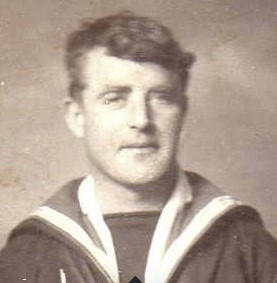
Able Seaman Arthur Crisp
(from findagrave.com)