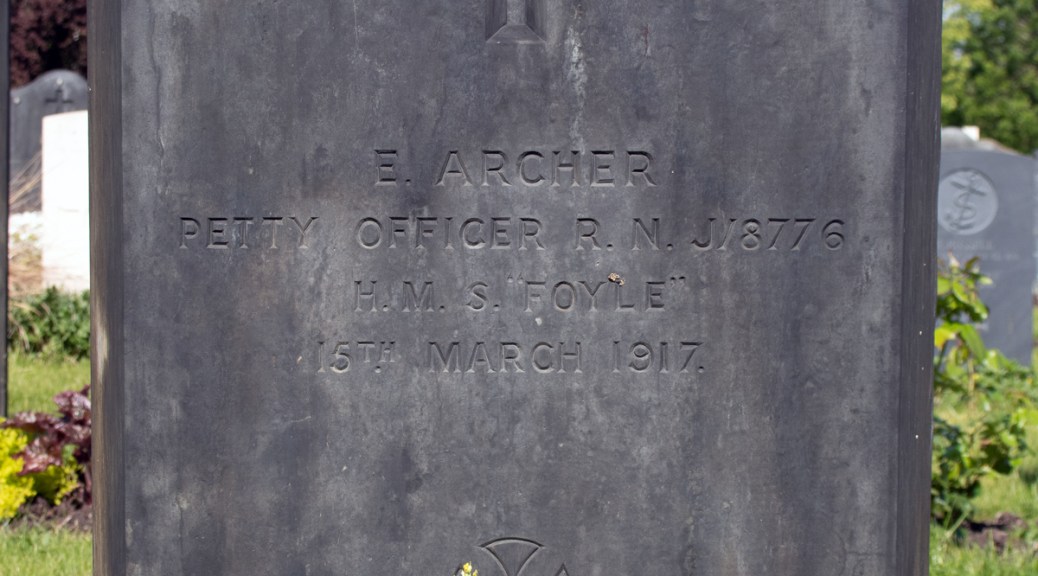
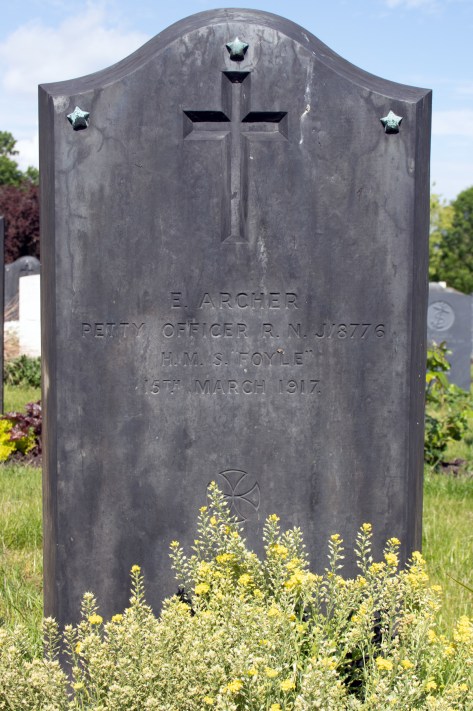
The life of Ernest Archer is challenging to piece together. His headstone, in Woodlands Cemetery, Gillingham, Kent, confirms he was a Petty Officer on HMS Foyle, which was a Royal Navy destroyer. She hit a mine in the English Channel off the Devon coast on 15th March 1917, and foundered while being towed to safety in Plymouth. A total of 28 crew members, Petty Officer Archer included, were killed.
Ernest’s service papers have been lost to time, but his Dependent’s Pension record gives his beneficiary as his aunt, Mrs H Greenhow, of 8 Kinmel Street, Liverpool. This would suggest that his parents had passed by 1917, but it’s not been possible to track her down through contemporary documents.
The same record notes that Ernest had a brother, James, and that he was an Able Seaman in the Howe Battalion of the Royal Naval Division. He was killed in action on 17th February 1917 – four weeks before his brother – and is commemorated on the Thiepval Memorial.
Further information on the lives of the siblings, however, is lost in the mists of time, Ernest Archer’s story taken to his grave with him.
William Amos Hallett was born on 2nd March 1867 in Pimlico, Middlesex. The oldest of six children, his parents were Charles and Rosa Hallett. Charles was a police inspector and, by the time of the 1871 census, the family has moved to Sheerness in Kent, where he worked.
In the summer of 1893, William married Emily Nokes. By this point he had been working for the Royal Navy for four years, initially as a Shipwright, then as a Leading Shipwright. His service records show that he was 5ft 8ins (1.73m) tall, with light brown hair, blue eyes and a fresh complexion.
Based out of HMS Pembroke, the Royal Naval Dockyard in Chatham, Kent, by June 1900 William had served on HMS Urgent, HMS Sphinx. Most of his time, however, had been spent between his Chatham base and its Sheerness counterpart, HMS Wildfire.
In November 1901 William was promoted to the rank of Carpenter. Over the next decade he served on eight vessels, and his service record for that time give an insight into his character. He was regularly commended for his hard-working and zealous nature: “[he] gets through more work in his time than any carpenter I’ve been shipmates with… He is excellent in every way.” His ability did not go unnoticed, another report noting his “special knowledge [in] geometrical drawing.”
In the summer of 1910, his superior, Captain Morgan, noted that Carpenter Hallett “worked well and zealously and has got a good deal of work done under somewhat difficult circumstances and with a small staff…” He was recommended for advancement, and it seemed that a promotion was in the offing.
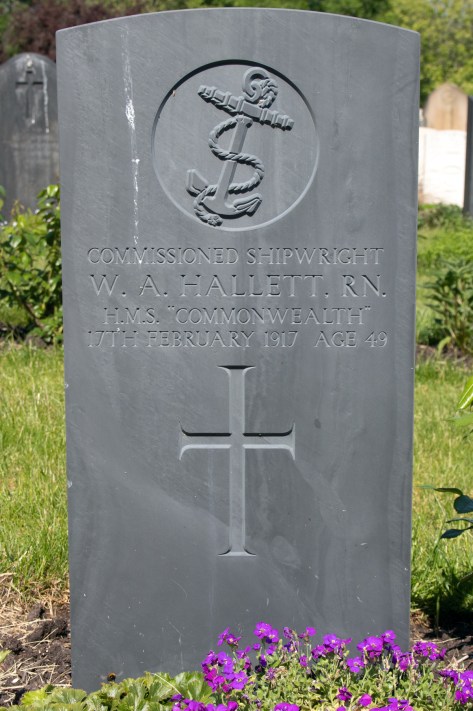
By the time war broke out, William was a Commissioned Shipwright. Details of his service are harder to trace, but by the end of 1916, he was assigned to the battleship HMS Commonwealth. The next record notes his passing:
HALLETT – On 17th February, at RN Hospital, Chatham, Chief Carpenter RN William Amos Hallett, aged 49 years, eldest son of the late Mr Charles Hallett, of Sheerness.
[Sheerness Guardian and East Kent Advertiser: Saturday 24th February 1917]
There is no further information about William Amos Hallett’s passing. He was laid to rest in the military section of Woodlands Cemetery, Gillingham, Kent, not far from HMS Pembroke, the dockyard he had for so long called home.
The early life of George John Ball is a challenge to piece together.
His naval records confirm that he was born in Bedminster, Somerset, on 11th October 1865. There are census records that link his name to parents coal miner Luke Ball and his wife, Ann, but these cannot be confirmed.
George’s papers show that he found work as a butcher when he finished his schooling. He was set on a life at sea, however, and, on 25th November 1880, he joined the Royal Navy. Given the rank of Boy 2nd Class, he was sent to the training base HMS Impregnable for his induction. The Devon establishment would remain his home for the next two years, and, during this time, he rose to the rank of Boy 1st Class.
On 10th October 1882, George was given his first sea-faring assignment, on board the armoured cruiser HMS Northampton. He stayed with her for the next two years, during which time he came of age. Now formally inducted to the Royal Navy, he was promoted to Ordinary Seaman. His service records from the time give an indication as to the man he had become. Short of stature, he was just 5ft 1.5ins (1.56m) tall, and had light brown hair, hazel eyes and a fresh complexion.
Ordinary Seaman Ball signed up for a ten-year contract. Over that time, he would serve on a total of eight vessels, rising to the rank of Able Seaman in January 1889. George’s slate was not completely clean, however, and his record notes three serious demeanours in that time.
In the spring of 1888 George spent 27 days in Canterbury Gaol for ‘breaking out of [the] ship’ he was then serving on, HMS Duncan. He was sent to the brig for a further fourteen days in January 1892 for an undisclosed crime.
Able Seaman Ball was also fined £3 10s (£575 in today’s money) for staying away beyond his allotted shore leave. His papers note an absence of seventeen weeks from 10th October 1893, and this time would have been added to the end of his contract.
George re-enlisted on 9th February 1894, and his service record noted that he had grown half and inch (1.3cm) since he enlisted. He had also had a number of tattoos in that time, including an anchor on his right arm and a bracelet and sailor on his left.
Over the next decade, Able Seaman Ball continued his steady progression through the ranks. He would serve on seven ships, returning to what had become his shore base – HMS Victory, the Royal Naval Dockyard in Chatham, Kent – in between assignments. In October 1897, George was promoted to Leading Seaman: by the following July he was given the rank of Petty Officer 2nd Class.
On 29th April 1904, after more than twenty years in service, George was formally stood down to reserve status. The next document for him – the 1911 census – gives an insight into his life away from the sea. By this point, George was living in a small terraced house at 234 Luton Road, Chatham, Kent.
The document confirms he had been married for fourteen years, to a woman called Sarah. The couple had a daughter – six-year-old Doris – and Sarah’s son from a previous marriage, Albert, was also living with them. George had not distanced himself too far from the sea, however. He was employed as a Ship’s Canteen Manager, a position his stepson also held.
When war came to Europe, George was called upon to play his part once more. Taking up the rank of Petty Officer 2nd Class again, he would be based at HMS Pembroke – Chatham Dockyard – and he remained in service for the next two years.
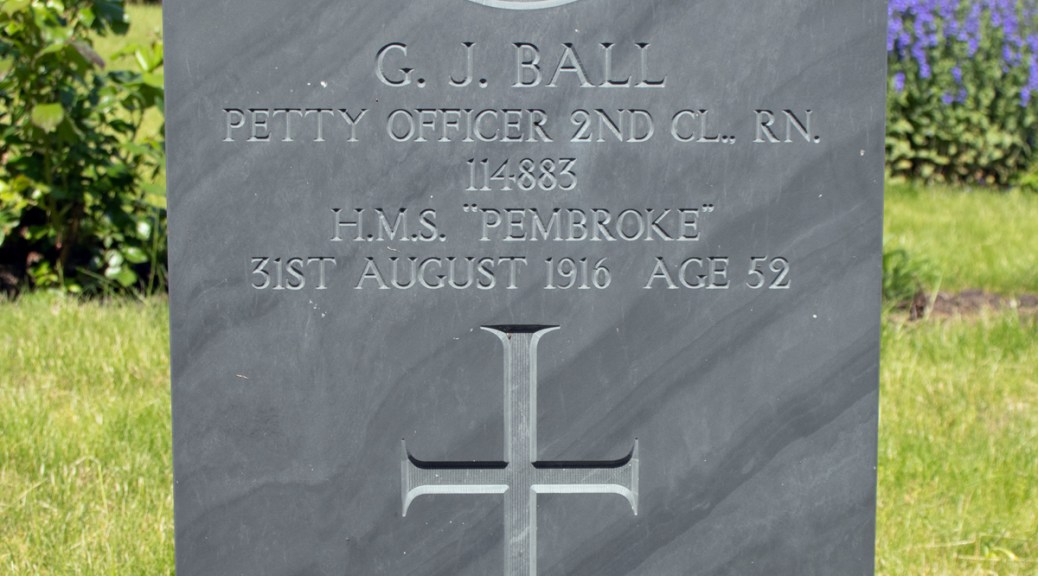
In August 1916, George was admitted to the Royal Naval Hospital in Chatham, with a combination of pychtis and a stricture. The conditions were to prove fatal: he breathed his last on 31st August 1916, at the age of 50 years old.
George John Ball was laid to rest in the military section of Woodlands Cemetery, Gillingham, Kent, not far from the dockyard that had been his home for many years.
Ernest James Dean was born in the autumn of 1898 in St Pancras, Middlesex. The older of two children, he was the only son to Ernest and Caroline Dean. Ernest Sr was a bootmaker, and the family lived at 51 Lismore Road.
Ernest Jr found work as a clerk when he completed his schooling. However, when war broke out, he was keen to play his part. He enlisted on 6th February 1917, joining the Royal Flying Corps as an Air Mechanic 3rd Class. His service record shows that he was 5ft 6ins (1.67m) tall, and he must have proven to be a keen student: within four months he had been promoted to Air Mechanic 2nd Class and was being trained as a wireless operator.
When the Royal Air Force was formed on 1st April 1918, Ernest’s transfer was automatic. It is unclear exactly where Air Mechanic Dean served, but he seems to have been based in Kent by that autumn.
In October, Ernest was admitted to the Lees Court Hospital in Faversham, Kent, having come down with pneumonia. The condition, sadly, was to prove fatal: he passed away on 29th October 1918, at the age of just 20 years old.
The body of Ernest James Dean was taken back to Middlesex for burial, and he was laid to rest in the majestic grounds of Highgate Cemetery.
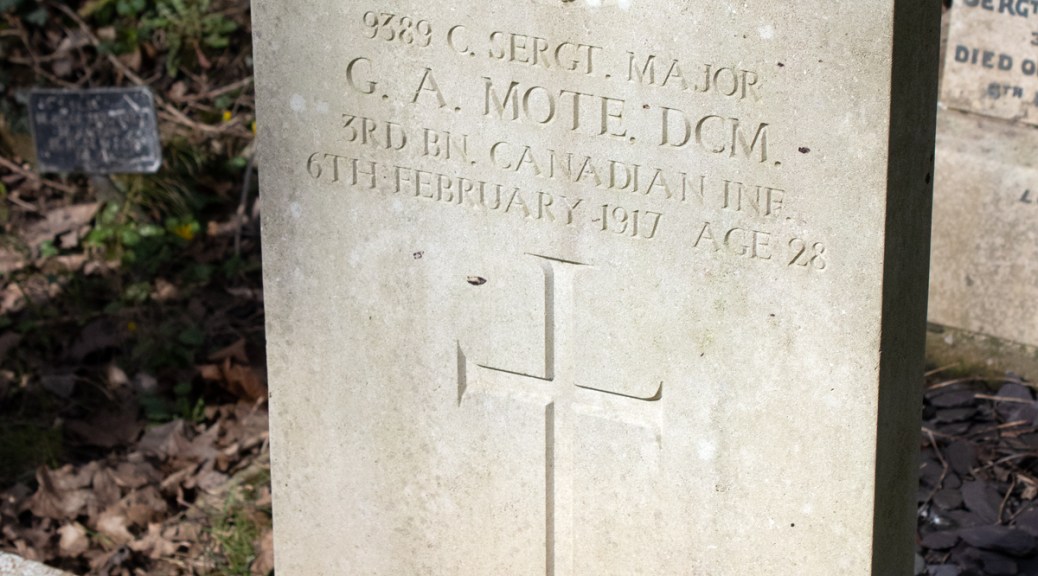
George Arthur Mote was born on the 25th August 1888 in Islington, Middlesex. The oldest of three children, his parents were Arthur and Norah Mote. The 1891 census recorded Arthur as a shoemaker’s finishing ink maker and the family had taken rooms at 45 Wyatt Road in Islington.
The next census return, taken in 1901, found that Arthur had been promoted, and was now a foreman or a leather dyer. The family had moved around the corner from the old address, and were living in rooms at 193 Blackstock Road.
At this point, George’s trail goes cold. By the autumn of 1914, he had emigrated to Canada, and was working as a corset cutter in Quebec. With war having broken out in Europe, it was here that he enlisted to serve his empire.
Goegre’s service records confirm the young man he had become. Standing 5ft 8ins (1.72m) tall, he had black hair, blue eyes and a dark complexion. A number of scars were also noted on his left forearm, the middle finger of his right hand, and on the left side of his neck.
While back in Britain, George had volunteered for the Middlesex Regiment, and this experience stood him in good stead, as he enlisted with the rank of Sergeant.
Attached to the 3rd Battalion of the Canadian Infantry, Sergeant Mote arrived in St Nazaire, France, on 11th February 1915. His unit was thrown into the deep end from the start, and George’s actions at the Second Battle of Ypres that spring won him the DCM. By the autumn, he had been promoted to Company Sergeant Major.
George continued to serve on the Western Front, but his luck was to change. On 5th June 1916, he was badly injured, receiving gunshot wounds to his right shoulder and back. Medically evacuated to Britain, he was admitted to Fort Pitt Hospital in Chatham, Kent. His medical records noted than he was paralysed, and, in October 1916, he was transferred to the Duchess of Connaught Hospital in Taplow, Berkshire.
Company Sergeant Major Mote spent the next four months admitted to the hospital, but his wounds would prove too severe to overcome. He passed away on 6th February 1917 at the age of 28 years old.
George Arthur Mote’s body was taken back to Middlesex for burial. He was laid to rest in the majestic Highgate Cemetery.
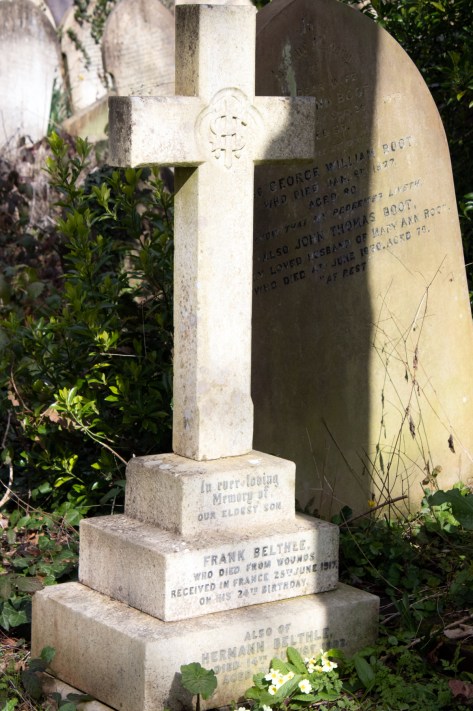
Frank Hermann Belthle was born in Dartford, Kent, on 25th June 1893. The oldest of four children, his parents were German-born Frederick Emil Hermann Belthle and his wife Elizabeth, who came from Surrey.
Frederick – who was better known as Hermann – was a manufacturer compressed tablets and pills. By the time of the 1901 census, he had moved his family to Aldrington, Sussex, were the set up home at 58 Westbourne Street. They had the house to themselves, unlike their neighbours, with two or three families sharing each property.
Hermann took the family to where work required him, and between 1903 – when Frank’s youngest sibling was born – and 1911, they relocated to London. Now seventeen years old, Frank was assisting his father in the business, and that business was obviously paying dividend: the Belthles’ new home was the 8-roomed house at 106 Barnsbury Road, Islington. Again, they occupied the whole building, while others in the street renting just a couple of rooms.
The outbreak of war must have had an impact on German national Hermann and his family. Frank looks to have stepped up to play his part, however, joining the Royal Army Medical Corps, possibly because of the medical training he had picked up through the family business.
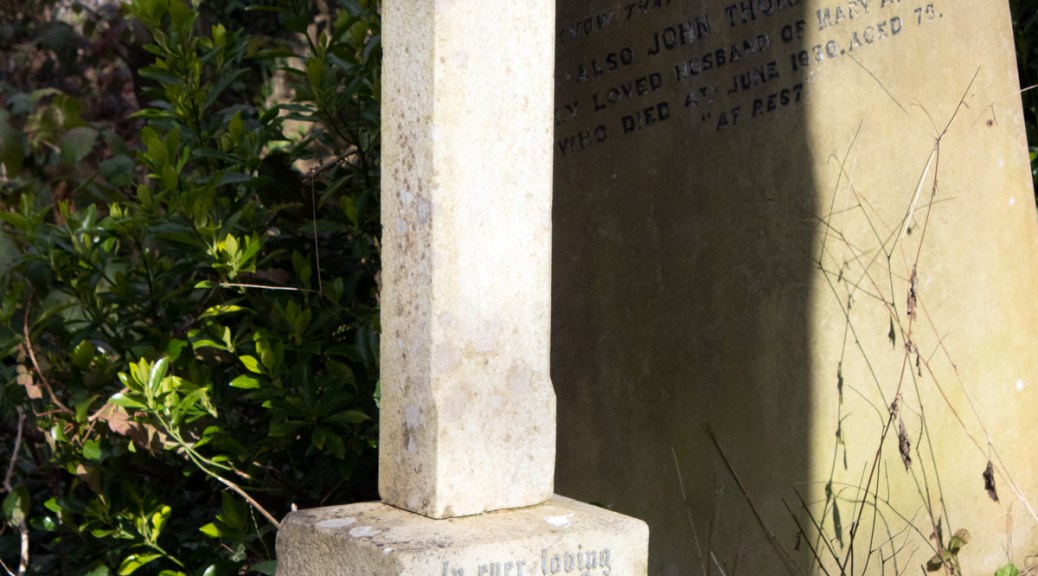
There is little documentation about Private Belthle service, although he was awarded the Military Medal. By the summer of 1917, his unit – the 14th Field Ambulance – was supporting troops at Arras. While here, on 9th May, he was badly wounded, and medically evacuated to Britain for treatment. His injuries were to prove too severe, however, and, on 25th June 1917, he passed away: it was his 24th birthday.
Frank Belthle was laid to rest in the majestic Highgate Cemetery.
After the war, Hermann continued with his business. Things were more difficult for the family, however and, while they had moved to the prestigious Lonsdale Square, Islington, they were one of six families taking rooms in the large Georgian terrace.
Hermann passed away in the autumn of 1932, at the age of 70: he was laid to rest alongside his son in Highgate Cemetery.
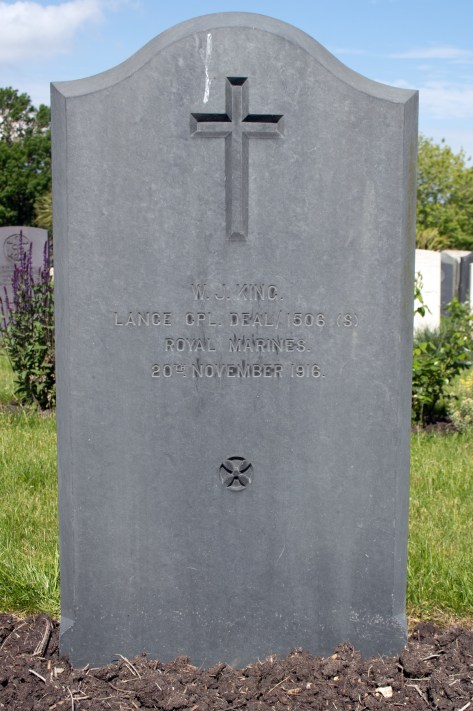
William James King was born on 7th March 1883 in Kensington, Middlesex. He was the fourth of eight children to bricklayer and builder’s labourer John King and his wife, Hannah.
There is little specific information available about William’s early life. The 1891 census found the family living at 16 Burlington Mews in Paddington, but he does not appear on any census returns after this date.
On 4th August 1906, William married Marion Oliver. Born in Chelsea, she was the daughter of a house painter, and the couple exchanged vows in St Luke’s Church, Paddington. The marriage certificate noted William’s trade as a bricklayer, and the couple went on to have two children: daughter Gwendoline, born in 1911, and son Henry, born two years later.
When war came to Europe, William was quick to step up and play his part. He enlisted on 5th October 1914, joining the Royal Marines. His service records show that he was 5ft 4ins (1,62m) tall, with brown hair, grey eyes and a fresh complexion.
Sent to Deal, Kent for training, Private King was initially assigned to the 2nd Field Company of the Mediterranean Expeditionary Force. Appointed to the rank of Lance Corporal he soon found himself ensconced at Gallipoli. On 15th May he was medically evacuated to Britain with an injury to his spinal cord. Admitted to Charing Cross Hospital, London, he was discharged from the army on 27th March 1916.
William’s treatment was ongoing, and by the autumn of 1916, he had been admitted to Gillingham Hospital in Kent. It was here that he would died, passing away on 20th November: he was 33 years of age.
William John King was laid to rest in Woodlands Cemetery, Gillingham, Kent.
Robert William Holdsworth was born on 11th February 1880 in Pilmoor, Yorkshire. The third of nine children, his parents were John and Fanny. John was a railway signalman, and, by the time of the 1891 census, the family had moved to Kirby Wiske, near Thirsk.
When he completed his schooling, Robert found work as a blacksmith. Moving away from home, by 1901, he was boarding at the Albion Foundry on New Street in Pocklington. The job, however, was a stepping stone to bigger things, and, on 28th July 1902, he enlisted in the Royal Navy.
Blacksmith’s Mate Holdsworth’s service records show that he was 5ft 6ins (1.68m) tall. He had dark brown hair, brown eyes and a dark complexion. It was also noted that he had a scar on his right elbow.
Robert was initially sent to HMS Pembroke, the Royal Naval Dockyard in Chatham, Kent, for his training. He would spend the next year at the base, and was promoted to Blacksmith proper in April 1903. Over the twelve years of his initial contract, he would serve on board seven ships, returning to Chatham in between assignments. The 1911 census recorded him as being one of 283 crew aboard HMS Patrol, a scout vessel moored in Harwich Harbour, Essex.
In the summer of 1916, Robert married Minnie Eames. Born in Kensal Rise, London, by the time of the nuptials, her family had moved to Gillingham, Kent, where her father James worked as a night watchman. Minnie was working as a shop assistant by this point, and was living with her parents and older brother at 35 Wyles Street.
Back at work, Blacksmith Holdsworth had renewed his contract. His annual reviews noted both very good conduct and superior ability, and he had added another string to his bow – the role of Diver – in the spring of 1912. In April 1913 he was assigned to HMS Astraea, on board which he would spend the next three years. The cruiser patrolled the seas off the eastern coast of Africa, bombarding Dar-es-Salaam in the autumn of 1914.
By the summer of 1916, Blacksmith Holdsworth was back at HMS Pembroke, where he would remain for the rest of the year, barring a couple of months’ on board HMS Royal Arthur. On 2nd December Robert was feeling unwell, and was moved the Hospital Ship Garth Castles. He had suffered a cardiac arrest, but his transfer would prove too late: he died that afternoon, at the age of 36.
The body of Robert William Holdsworth was laid to rest in Woodlands Cemetery, Gillingham, not far from the naval base he had called home, and within walking distance of where his widow still lived.
Blacksmith Robert Holdsworth (from ancestry.co.uk)
The epitaph on Robert’s headstone reads: In loving memory of Robert William Holdsworth, 1st Class Petty Officer (Blacksmith & Diver). There is no evidence in his service records for the PO rank, although this may have been an informal nod to his dual roles.
Alfred John Reed was born in St Pancras, Middlesex, on 29th September 1865. One of twelve children, his parents were Charles and Eliza Reed. Charles was a carman, possibly working out of the nearby railway stations, and the 1871 census found the family taking rooms at 70 Aldenham Street.
Details of Alfred’s life is a little sketchy. By the time of the 1881 census he had finished his schooling and was employed as a coach painter, again probably connected to the railways. At some point shortly after this, however, he enlisted as a Private in the Royal Marine Light Infantry. It is likely that he was still a teenager when he made this move, as he seems to have lied about his age to get in – later records give his date of birth as 8th June 1863.
We next pick up Private Reed in the 1901 census. By this point, he was assigned to the floating battery HMS Terror, which was based in Bermuda, under the remit of Captain Thomas McGill.
Alfred appears to have served his contract, as by 1911 he was living at 56 Northview Road, Hornsey, Middlesex. Employed as a house painter, the census records him as being having been married to Clara Emily for nine years. This may have been for the sake of appearance, as the formal record of the couple’s marriage suggests that exchanged vows in the summer of 1914. The census showed that the couple had a son – Alfred John Reed – who was two years old.
When war broke out, Alfred was 49 years old. While over the age to formally enlist, it seems that he did re-join the Royal Marines. By the spring of 1917, he was attached to HMS Spey, an old gunboat, which served in the River Medway, close to Chatham Dockyard.
On the 7th March 1917, she was accidentally rammed by a sludge vessel carrying 1000 tons of sewage. The Spey sank in the shallow water, and one of the crew – Private Alfred Reed – was drowned. He was 51 years of age.
The body of Alfred John Reed was laid to rest in the naval section of Woodlands Cemetery, Gillingham, not far from the Royal Naval Base in which he had been helping.
The 1921 census sheds more light onto the family that Alfred had left behind.
Clara had re-married, her new husband being motor fitter George Comer. The couple had a daughter, eighteen-month-old Eileen, and George was noted as being stepfather to Alfred and Clara’s children, Alfred and Ernest (who was born in 1911).
There is another mystery, however, as the census gives the name of 18 year old Louie Reed. She may also have been Alfred and Clara’s daughter, although she is not recorded as being so on the 1911 census. She may, therefore, have been Clara’s child from a former relationship, then adopted by Alfred.
Frederick Dennington was born in Wrentham, Suffolk, on 18th February 1877. The youngest of eleven children, his parents were William and Eliza Dennington. William was a house painter, and the family lived in a cottage on Southwold Road on the outskirts of the village.
Frederick was not to follow his father’s trade, and when he completed his schooling he found employment as a groom. Working with horses was one thing, but he wanted to make a bigger splash in the world, and so, on 28th April 1892, he joined the Royal Navy.
Too young to formally enlist, Frederick was given the rank of Boy 2nd Class, and was sent to HMS Impregnable, the training ship moored at Queensferry on the Firth of Forth, for his induction. Over the next three years, Boy Dennington would learn the tools of his trade, and spent time on another training vessel – HMS Lion – and at HMS Pembroke, the Royal Naval Dockyard in Chatham, Kent.
In June 1893, Frederick was promoted to Boy 1st Class, and the following January he was assigned to HMS Satellite. She was a composite screw corvette, and would remain his home for the next three years. During this time, he proved he came of age, and was formally inducted into the Royal Navy.
Give the rank of Ordinary Seaman, Frederick’s service papers give an insight into the man he was becoming. Short of stature – he was noted as being 5ft 1.5ins (1.56m) tall – he had dark brown hair, grey eyes and a fair complexion. He was also noted as having tattoos on both of his forearms, and rings tattooed on the fingers of his his right hand.
Ordinary Seaman Dennington seemed to impress his superiors and on 5th December 1895 – just ten months after coming of age – he was promoted to the rank of Able Seaman. His contract had tied him to the navy for twelve years, and during that time, Frederick would serve on five further ships. In between each of his assignments, he returned to Chatham, and this would become his longer-term base.
Frederick’s term of service came up for renewal in February 1907, and he immediately re-enlisted. His papers show that he was now 5ft 8ins (1.72m) tall, and his eyes were more grey-blue than grey. While he remained at the rank of Able Seaman, his character was always noted as being very good, and his ability as superior.
Able Seaman Dennington went on to serve on five ships over the next nine years, including three years of HMS Blenheim, and the same length of time on board HMS Duncan. By the autumn of 1916, with war raging across Europe, Frederick had clocked up 24 years in naval service.
By this point, Frederick was unwell. He was admitted to the Royal Naval Hospital in Chatham, Kent, with a stricture of the urethra. This was to be a condition that that he would succumb to, and he passed away on 9th December 1916, at the age of 39 years old.
The body of Frederick Dennington was laid to rest in Woodlands Cemetery in Gillingham, Kent, not far from the naval base that has become his second home.
Frederick never married. His probate record confirms that his effects – totalling £147 2s (worth £16,350 in today’s money) – was left to his father, William.








 Death and Service