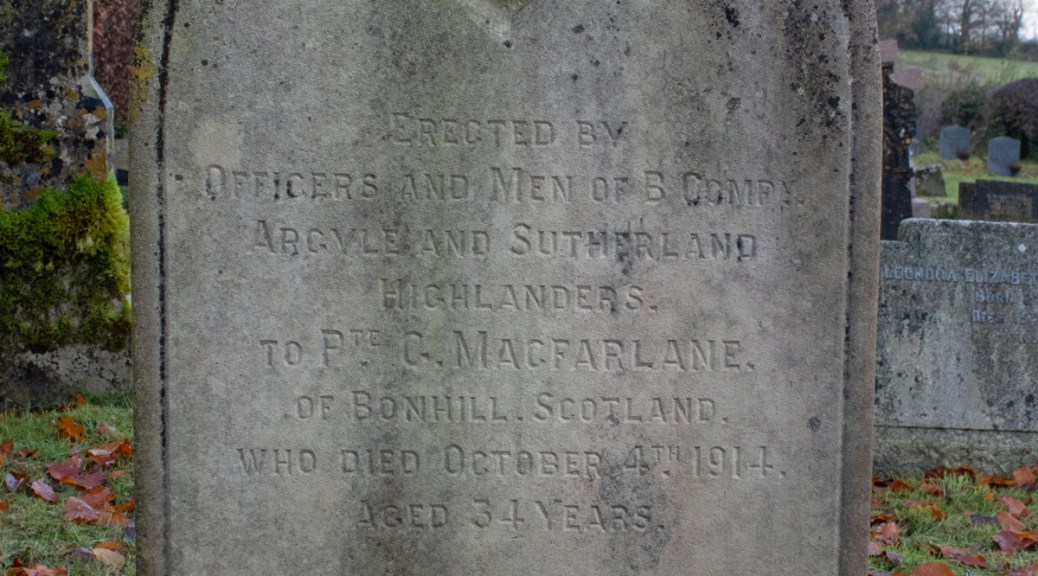
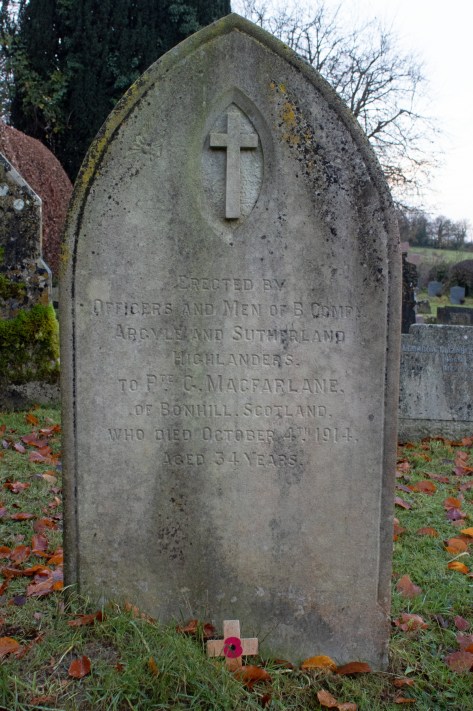
George McFarlane was born in Alexandria, Dumbartonshire, in 1879, and was the third of four children to George and Jane.
There is little concrete information about George Jr’s life, and most of that information comes from his army service records. These confirm that he was working as a printfield worker, employed by the local dye works to produce printed cloth.
The service papers also confirm that George had married Christina Kerr on 19th April 1905, and that they had four children: Irene, William, Christina and George. Christina had also had a son, Richard, from a previous relationship.
George had readily answered the call to serve his country when war broke out. He enlisted on 18th September 1914, and was assigned to the Argyll and Sutherland Highlanders. He is recorded as being 5ft 7ins (1.69m) tall and 135lbs (61.2kg), with auburn hair, grey eyes and a fresh complexion.
Private McFarlane was sent to Wiltshire for his training, and was barracked near the village of Boyton. His time there was to prove tragically short. Within a matter of weeks he contracted pneumonia, and succumbed to the condition on 4th October 1914. He was just 34 years of age, and had been in the army for 16 days.
Christina was unable to cover the cost of bringing her husband back to Scotland. Instead, George McFarlane was laid to rest in Boyton Cemetery, his headstone paid for by the men of his regiment.
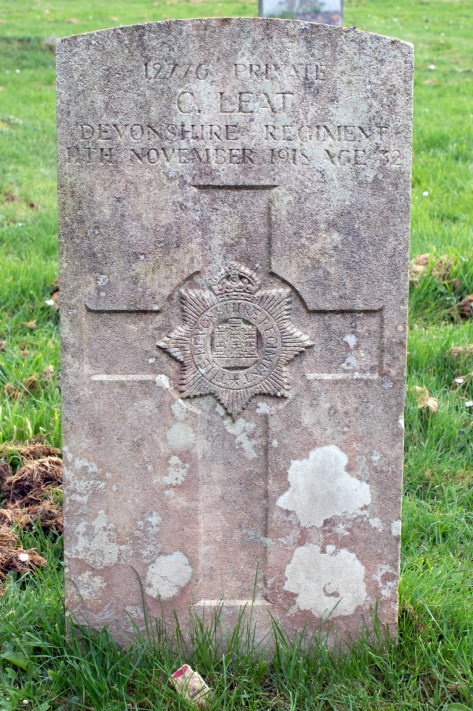
Charles Leat was born at the start of 1888 in Tiverton, Devon. One of thirteen children, his parents were Sidney and Ann Leat. Sidney worked as a lace maker, and the family lived in a crowded cottage on St Andrew Street to the south of the town centre.
When Charles left school, he found work as a grocer’s errand boy. Sidney died in 1897, Ann had to take on lace work herself. The house was too small for the growing family, and so the 1901 census found Charles and his brother Arthur living with his maternal aunt, Mary.
Things had moved on as the new century progressed. By 1911, Charles had moved to South Wales, and was living with his older brother, James, and his family in Glamorgan. James was a house painter, but his sibling had taken on work as a railway porter, and the family lived in terraced house at 57 Tydfil Street, Barry.
When war hit Europe, Charles seemed keen to play his part. Sadly, full details of his military service have been lost to time, but it is clear that he initially enlisted in the opening weeks of the conflict. Joining the Devonshire Regiment, he was assigned to the 11th Battalion.
A later newspaper report suggests that he “had been through most of the fightingon the Western Front… [and] was seriously wounded in 1915.” [Western Times – Friday 15 November 1918] It was after he had recuperated that Private Leat was reassigned to the regiment’s Labour Corps.
By the summer of 1918, Private Leat was serving on Salisbury Plain, Wiltshire. While here, he fell ill, and was eventually admitted to the Amesbury Military Hospital. His condition, pneumonia, was to prove too severe for his body to take, however, and he passed away from the condition on 11th November 1918, Armistice Day. He was 30 years of age.
Charles Leat’s body was taken back to Devon for burial. He was laid to rest in Tiverton Cemetery, not far from where his family still lived.
Herbert James Newman was born at the start of 1891, the fourth of five children – all sons – to Charles and Mary Newman. Charles was a general labourer, and the family lived on Well Head, to the north of Mere, Wiltshire.
Charles died when Herbert was just a boy, and Mary was left to raise the family on her own. By the time of the 1901 census, the family had moved to a cottage on Old Hollow, and she had taken work as a charwoman. Herbert’s older brother, Theodore and William, had also taken jobs to help with money.
In 1911, her boys had all grown up and were moving on, and Mary found more secure employment as a live-in servant to 80-year-old Anna Collard, a single woman who was living on her own means.
Herbert, meanwhile, had left Wiltshire for the capital, and was working as a compositor. He was boarding with widow Mary Ann Day and her two children, all living relatively comfortably at 41 St Thomas’ Road in Finsbury Park, Middlesex. Amongst the other lodgers were Jeweller John Tipping, conductor Wilfred Mustill and cycle mechanic Lester Rule.
When war came to Europe, Herbert stepped up to play his part. Full details of his military service have been lost to time, but it is clear that he had enlisted by December 1917. Initially joining the Tank Corps, It seems likely that Private Newman had seen service overseas, although there is nothing to confirm this either way.
As the conflict drew into its closing months, the now promoted Serjeant Newman seems to have been based in Dorset. In the spring of 1918, he fell ill, and was admitted to the Military Hospital in Wareham. The cause of his illness is unclear, but it would prove fatal: he passed away on 18th May 1918, at the age of 27 years old.
The body of Herbert James Newman was taken back to Wiltshire for burial. He was laid to rest in Mere Cemetery, on the outskirts of the town he had called home.
Interestingly, Serjeant Newman’s Pension Ledger Index Card gives his beneficiary as his mother, Mary. The British Register of Soldiers’ Effects, however, suggests his next-of-kin was his widow, Lucy, although there appears to be no record of Herbert having married.
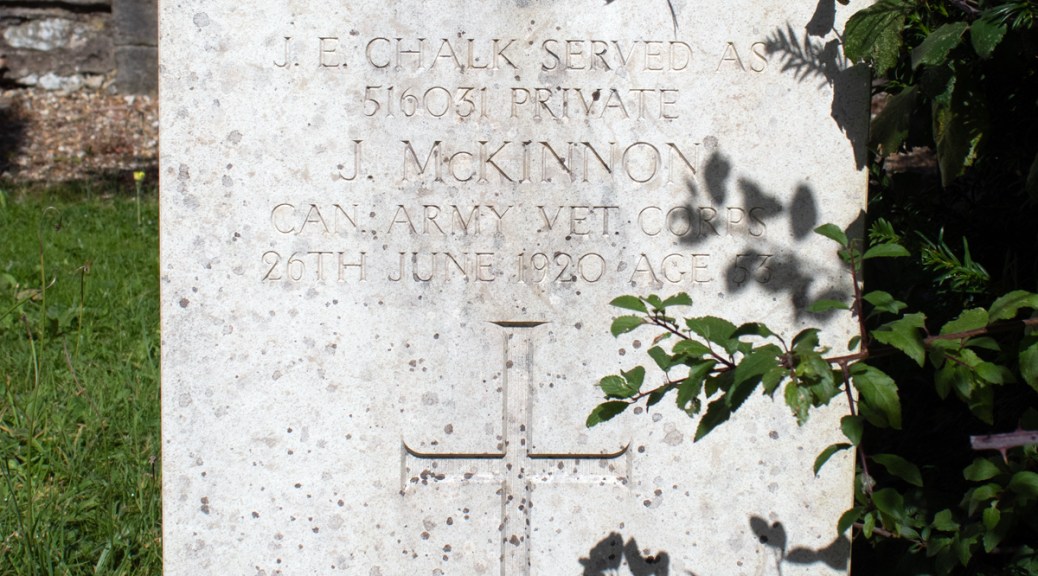
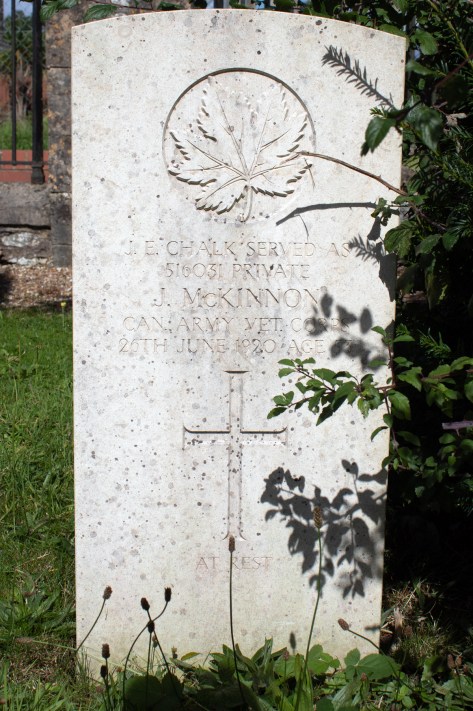
In Mere Cemetery, Wiltshire, is a headstone dedicated to JE Chalk, who served as Private J McKinnon in the Canadian Army Veterinary Corps. He died on 25th June 1920, and gives his age as 53 years old.
Private McKinnon’s service records suggest, however, that he was born on 14th October 1874 in Inverness, Scotland, and give his army name as John. The Commonwealth War Graves Commission give his other name as James Edward Chalk. James seems to have been keen to disguise his background, and it is only with some digging that the real story comes out.
James was the youngest of five children to Edward and Mary Chalk. Edward was a carpenter from Mere, and this is where the family were born and raised.
When he finished his schooling, James found work as a booking clerk. Edward died in the 1880s, and the 1891 census found James living at home with his mother, who had taken on laundry work to help with their finances.
By 1901, Mary and James were living on Water Street, to the south of the town centre. There’s was now an extended household, and included James’ sister Olive. James is noted as being married, and while no marriage records exist, it would seem that his wife, Mary, and their daughter, Ivy, were also living there.
The next census, taken in 1911, suggests James’ life had taken a different turn. Employed as a railway foreman, he was now living with his older sister, Olive, in her home. He is noted as being married with a child, but neither Mary nor Ivy appear in the same census.
At some point in the next five years, James took the decision to move overseas, and create himself a new identity.
John McKinnon was living in Montreal when the call came to join up. He enlisted on 29th April 1916, by which point he was 41 years of age. Assigned to the Canadian Army Veterinary Corps, his service records confirm that he was 5ft 9ins (1.75m) tall, with greying brown hair, grey eyes and a sallow complexion. He was noted as having scars on both legs, and another on the second toe of his right foot.
Private McKinnon’s unit were quick to be dispatched to Britain, and he arrived in Shornecliffe, Kent, on 29th June. He spent the next five months at the army base, and had two spells of a month each in hospital during that time: the first for asthma, the second for bronchitis.
In November 1916, John moved along the coast to Shoreham, West Sussex. His health was badly impacted, though, the medical report stating that ‘his chest is of the emphysematous type but at present free from bronchitis. He will not do well in England.’ John was formally discharged from the army on 15th November 1916.
At this point, John’s already sparse trail goes cold once more. It is possible that he moved to Wiltshire to be nearer to family, although nothing can be confirmed.
James Edward Chalk, who serves as Private John McKinnon, died on 26th June 1920: His service records suggest that he was 45, but he was, in fact, 53 years of age. He was laid to rest in Mere Cemetery, on the outskirts of the town he had called home for so long.
Arthur Norris was born on 24th February 1897 in the Wiltshire town of Mere. The seventh of nine children, he was one of four sons to Fred and Mary Norris. Fred was a domestic groom, and the family lived on Castle Street on the western edge of the town.
By the time of the 1911 census, Arthur had left school, and had found work as an errand boy. He had moved out of the family home, and was living with his older sister, Beatrice, and her husband. Piecemeal work wasn’t something Arthur was keen on, however, and in September 1913, he found himself a career.
That autumn, Arthur enlisted in the Royal Navy. Just 16 years of age, he was too young to formally join up, and so he was given the rank of Boy 2nd Class. He was sent to HMS Impregnable, the training ship based in Devonport, Devon, for his induction, and seemed to make an impression.
On 14th May 1914 Arthur was promoted to Boy 1st Class, and was assigned to the depot ship HMS Gibraltar. On 24th February he came of age, and officially joined the Royal Navy. His service records show that he was 5ft 5ins (1.65m) tall, with dark brown hair, brown eyes and a fresh complexion. He was noted as having a mole on his left shoulder blade.
The now Ordinary Seaman Norris remained on Gibraltar for most of the year. After a couple of weeks back in Devonport, he was assigned to the Armed Merchant Cruiser Oropesa, and remained on board for the next twelve months. During his time there, Arthur was promoted again, gaining the rank of Able Seaman.
Over the next three years, Arthur served on three further vessels: HMS Excellent from March 1916; HMS Woolwich from April 1916 to June 1918; and HMS Columbine from July 1918.
While attached to the Columbine, Arthur fell ill. He contracted pneumonia, and passed away on 16th October 1918. He was 21 years of age.
The body of Arthur Norris was taken back to Wiltshire for burial. He was laid to rest in Mere Cemetery, not far from where his grieving family were still living.
The death occurred at the Voluntary Aid Detachment Red Cross Hospital last week of Private John Thompson, aged 38 years, of the 10th Battalion Gloucester Regiment. The deceased was admitted to the Hospital about two months since with injuries which developed into hemorrhage [sic] of the brain.
[Salisbury and Winchester Journal: Saturday 19th December 1914]
The life of John Thompson is a challenge to unpick. Full service details are lost to time, but his Pension Ledger Card confirms that he was married to a Mary Ellen, who lived in Ladywood, Birmingham, and that the couple had a daughter, Florence May, who was born on 4th October 1903.
The family do not appear on the 1911 census return, and there are no marriage records for John and Mary. It is uncertain whether the couple had wed before the time of the 1901 census, and without a definite place of birth, John’s name is too common to provide an accurate search before then.
The British Army Register of Soldiers’ Effects suggests that he had served with the Gloucestershire Regiment for less than six months, and, given the date of his death, it is probable that he enlisted shortly after war was declared, falling ill soon after that.
The 10th (Service) Battalion was based on Salisbury Plain when Private Thompson first became unwell, and it seems likely that he was camped near Mere, Wiltshire, as this is where the VAD hospital was situated.
John Thompson died on 9th December 1914, at the age of 38 years old. He was laid to rest in Mere cemetery on the outskirts of the town.
The death of Driver G Messenger, aged 20, of the 18th Divisional Ammunition Column, stationed at Heytesbury, took place at the Red Cross Military Hospital on Friday, the 11th inst. Messenger was a native of Lower Braithwaite, Carlisle, and was admitted to the hospital in the middle of May suffering from consumption. Deceased joined upon the commencement of the war.
[Salisbury and Winchester Journal: Saturday 19th June 1915]
George Messenger was born in 1895 and was the third of seven children. His parents, George and Sarah, were farmers, and the family grew up in Mealsgate, on the edge of the Lake District. Sarah died in 1901, and by the time of the 1911 census, George Jr and his siblings were helping their father on the farm.
When war broke out, George Jr was quick to enlist. Details of his military service are sparse, but what does remain confirms that he had enlisted no later than December 1914, which backs up the details in his obituary.
Driver Messenger joined the Royal Field Artillery, but it seems unlikely that he spent any time overseas. He seems to have been sent to a camp on Salisbury Plain, Wiltshire, for training and this is where he became ill. Contracting tuberculosis, probably from the cramped environment of the army barracks, George was admitted to the Voluntary Aid Detachment Hospital in the town of Mere. He passed away from the lung condition on 11th June 1915: he was just 20 years of age.
Rather than being taken back to Cumbria, George Messenger was instead laid to rest in Mere Cemetery.
Horace Ralph Welch was born in Mere, Wiltshire, in the autumn of 1884. The middle of seven children, his parents were John and Ellen Welch. John was a silk drier, and the family lived in Water Street, close to the town centre.
John died in 1895, and Ellen was left to bring up the family on her own. Her older children found work, and Horace was employed by John Runtz, stock broker and Justice of the Peace. The family lived at 131 Lordship Road, Stoke Newington and employed two live-in servants other than Horace, who worked as a page.
On 11th November 1916, Horace married Beatrice Batchelor. Born in Watford, Hertfordshire, she was the daughter of an engine driver and, at the point she exchanged vows, she was working as an assistant in a boot shop. Horace was now employed as a butler, and the couple set up home in Watford. They went on to have a daughter, Eileen, in the summer of 1917.
By this point, Horace has stepped up to play his part in the conflict that was raging across Europe. He enlisted on 12th December 1916 – just four weeks after marrying Beatrice – and was initially assigned to the Kent Cycle Corps.
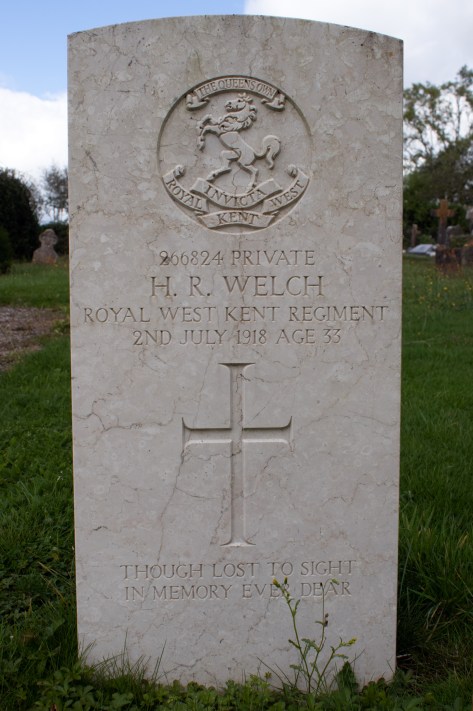
Private Welch would spend the best part of two years on home soil, before being shipped off to France in April 1918. By now he had been transferred to the Queen’s Own (Royal West Kent Regiment).
Horace was only overseas for a matter of a fortnight, before he became unwell. Medically evacuated to Britain for treatment, he was admitted to the Voluntary Aid Detachment Hospital in his home town, Mere. Suffering from appendicitis, he was operated on, but died from peritonitis soon afterwards. Private Welch passed away on 2nd July 1918: he was 33 years of age.
Horace Ralph Welch was laid to rest in Mere Cemetery, on the outskirts of the town.
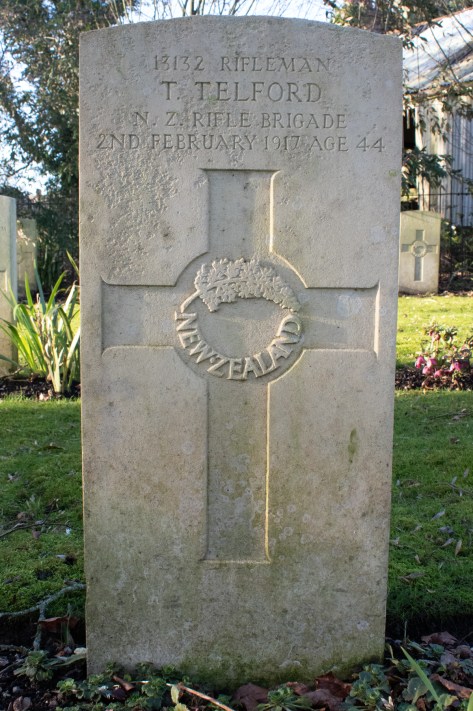
Thomas Telford was born in Bacchus Marsh, Victoria, Australia, on 31st July 1873. The fifth of eleven children, his parents were James and Mary Telford.
There is little additional information about Thomas’ early life. By the time war broke out, he had moved to New Zealand, and was working as a bushman, based out of Whanganui on the south coast of North Island.
Thomas enlisted on 18th January 1916, and would be assigned to the New Zealand Rifle Brigade. His service records show that, at 42 years of age, he was 5ft 5ins (1.65m) tall, and weighed 149lbs (67.6kg). A Roman Catholic, he had iron grey hair, blue eyes and fair hair.
Rifleman Telford’s unit left New Zealand in the spring of 1916. After five weeks in Egypt, he arrived on British soil on 7th August, marching from Southampton, Hampshire, to the Sling Camp in Wiltshire.
By 20th August, Thomas was in France, fighting on the front line. He was injured less than three weeks later and, after initial treatment in France, he was medically evacuated to Britain at the end of September.
Rifleman Telford spent time convalescing in a military home in Hornchurch, Essex, before being transferred to the ANZAC base in Codford, Wiltshire. That winter he contracted pneumonia, and he was admitted to the No. 3 New Zealand General Hospital on the outskirts of the village.
Sadly, the lung condition was to prove the better of Thomas. He passed away on 2nd February 1917, at the age of 43 years old.
Thousands of miles from home, Thomas Telford was laid to rest in the graveyard extension to St Mary’s Church in Codford, not far from where he had breathed his last.
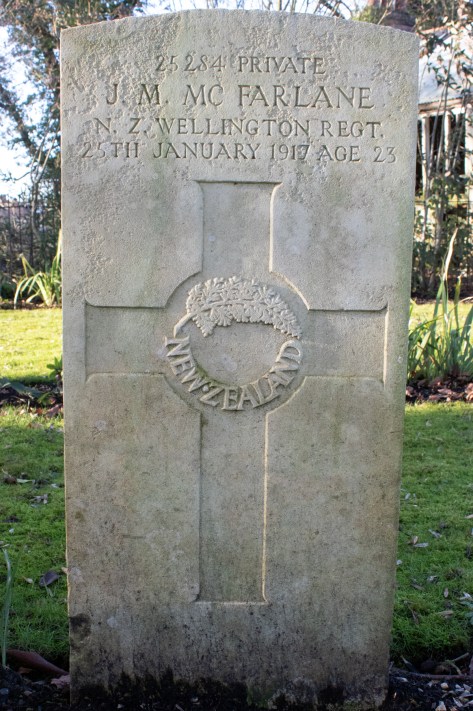
James Malcolm McFarlane was born in Christchurch, New Zealand, on 24th April 1893. Little is known about his early life, although his parents are recorded as Peter and Helen.
When he completed his schooling, James found work on a farm. By the time war broke out, he was employed as a shepherd for Patrick Burke of Woodgrove, in the country’s Canterbury region.
James gave up his work to join the army, enlisting on 24th March 1916. He would have cut a striking figure, standing 6ft 3.5ins (1.92m) tall, and weighing 184lbs (83.5kg). He had dark brown hair, grey eyes and a fresh complexion. His records note that he had a small scar on his right shin, from an old pellet wound.
Assigned to the New Zealand Wellington Regiment, Private McFarlane spend three months in Trentham, on the North Island, for his training. His unit boarded the SS Maunganui and left Wellington for Europe on 26th June 1916. The troop ship arrived in Devonport, Devon, in late August, and James and his colleagues were sent to their camp in Sling, near Bulford, Wiltshire, arriving after a 4-day march.
Private McFarlane would not see any enemy action. In November 1916 he was moved to the ANZAC base near Codford, Wiltshire, and he was admitted to the No 3 New Zealand General Hospital located there. Suffering from pleurisy, he would remain there for the next two months. James passed away from pneumonia on 25th January 1917: he was just 23 years of age.
James Malcolm McFarlane was buried alongside his comrades in the newly extended graveyard attached to St Mary’s Church, Codford.