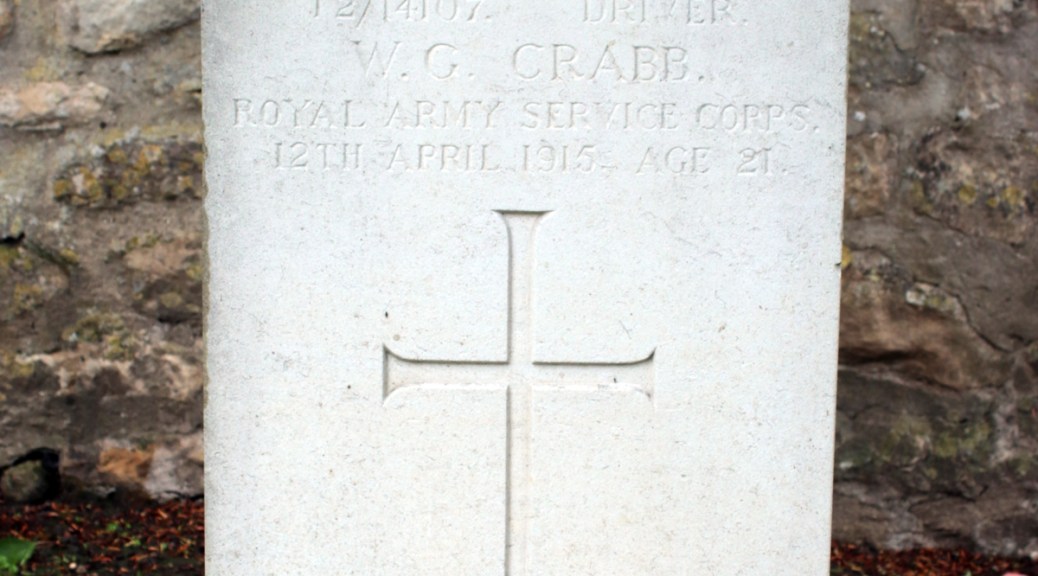
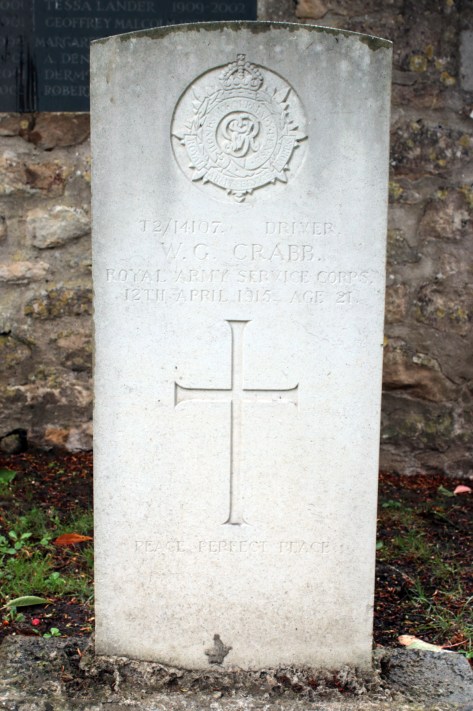
Walter George Crabb was born in the spring of 1893 in the Castleton area of Sherborne, Dorset. The oldest of ten children, his parents were Fred and Selina Crabb. Fred was a sawyer, but when Walter completed his schooling, he found employment as a bricklayer’s labourer. The 1911 census recorded the family as living in a 5-roomed cottage on Long Street.
When war came to Europe, Walter was quick to step up and play his part. His service records have been lost to time, but it is clear that he had enlisted by October 1914. As a Driver, he was attached to the 108th Horse Transport Company and, by the following spring, was barracked at Curragh Camp, to the south west of Dublin.
The next record for Driver Crabb is his entry in the British Army Register of Soldiers’ Effects. This confirms that he passed away in Curragh Hospital on 12th April 1915. The cause of his death is not recorded, but he was just 21 years of age.
The body of Walter George Crabb was taken back to Dorset for burial. He was laid to rest in the peaceful surroundings of St Mary Magdalene Churchyard, Castleton.
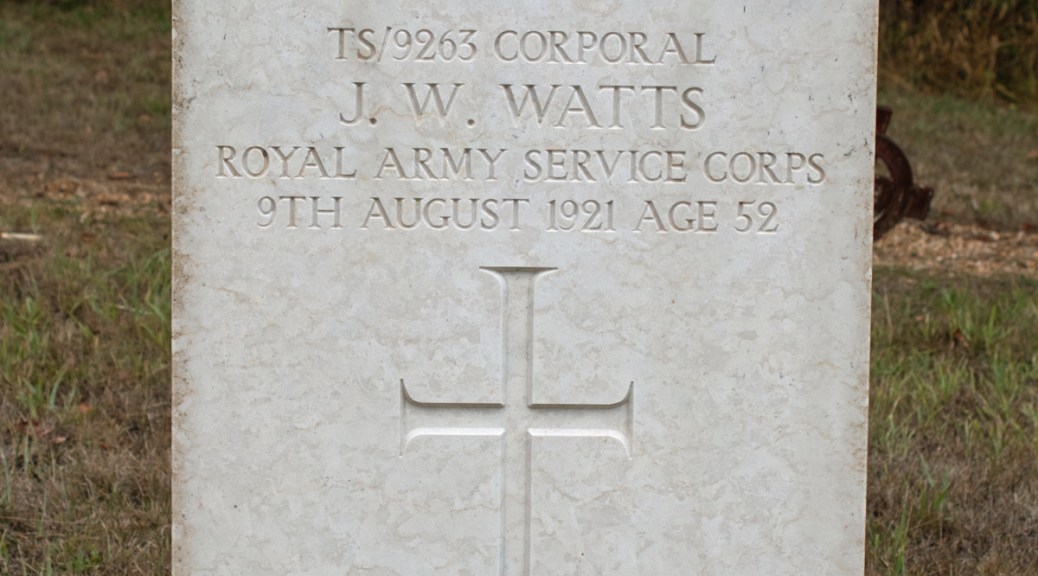
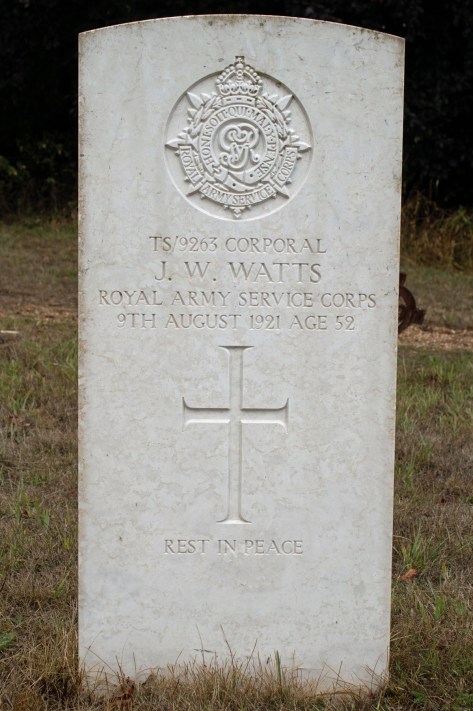
John William Watts was born in the summer of 1869, the youngest of six children to Reuben and Maria Watts. Reuben was a sawyer from Haselbury Brian, Dorset, and it was her that the Watts family were born and raised.
John seemed keen to progress himself, and found employment as a police constable. The 1891 census recorded him as living at the station in Blandford Forum. Three years later, he married Elizabeth Hallett, a shoemaker’s daughter from Lyme Regis. The couple would go on to have eight children before Elizabeth’s untimely death in 1912.
By this point, John’s career had taken a sharp turn: in 1901, when the family were living in Sturminster Newton, he was working as a blacksmith. The next return, taken in 1911, found them at 19 Church Street in the village, where John was employed as a journeyman shoeing smith.
With young children to raise, John took a new wife, marrying widow Rose Yeatman on 3rd August 1914. His oldest daughter, Elsie, and her father, Tom Bleathman, acted as witnesses. John and Rose would go on to have a daughter of their own, Muriel, the following year.
When war broke out, John stepped up to play his part. His service papers have been lost to time, but it is clear that he enlisted in the Royal Army Service Corps, and, presumably because of his age and experience, was assigned the rank of Farrier Corporal There is no indication that he served time outside of Britain, and it seems likely that he would have overseen the preparation of horses and training of blacksmiths for the Western Front.
Farrier Corporal Watts survived the conflict, but was medically discharged with malaria on 16th May 1919. The 1921 census found him living with Rose and five of his children and step-children in their Church Street home. He was employed as a bricklayer’s labourer, and was working for builder and contractor Mr J Silverthorne.
John’s health was suffering now, though, and he would only last until the summer. He passed away at home on 9th August 1921: he was 52 years of age.
The body of John William Watts was laid to rest in Sturminster Newton Cemetery, a short distance from his grieving family’s home.
George Twiselton was born in Milton Malsor, Northamptonshire, in the spring of 1878. The third of nine children, he was the second of two sons to Reuben and Eliza Twiselton. Reuben was a general labourer, working for the local railway and brewer, and his son was to follow suit, taking up employment as a drayman.
In 1903, George married Annie Branson. She was a cooper’s daughter from Northampton, and it seems likely that George and his future father-in-law knew each other through their combined work. By the time the young couple married, Annie was working as a domestic servant for the Burnham family, and was living at 50 Middle Street, Bradwell, Buckinghamshire (now part of Milton Keynes).
The 1911 census found George and Annie living in Milton Malsor. They had four children by this point: Edith, Doris, Reuben and Clara. George was still employed as a brewer’s drayman, and this would stand him in good stead when war broke out a few years later.
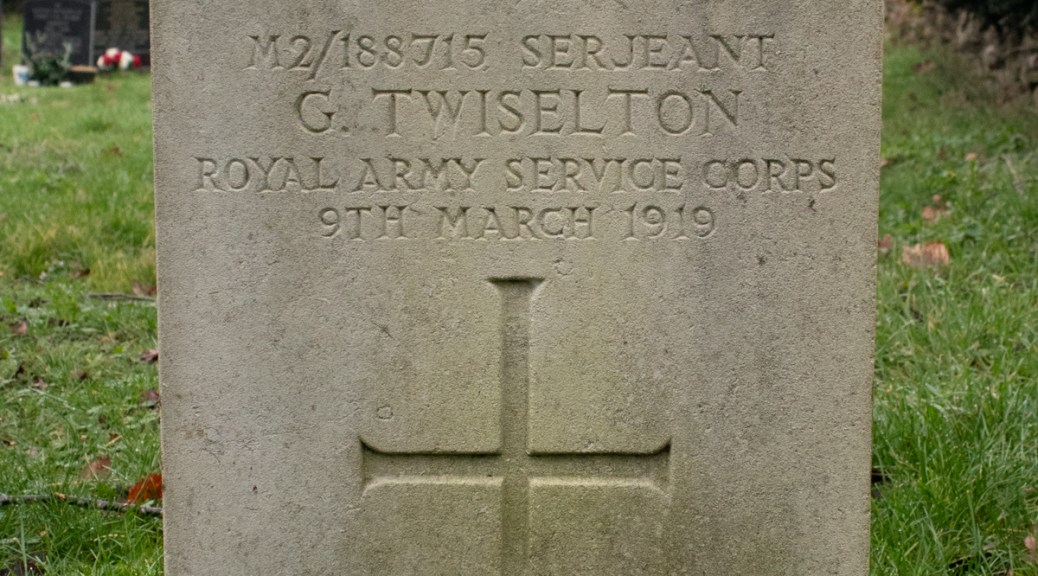
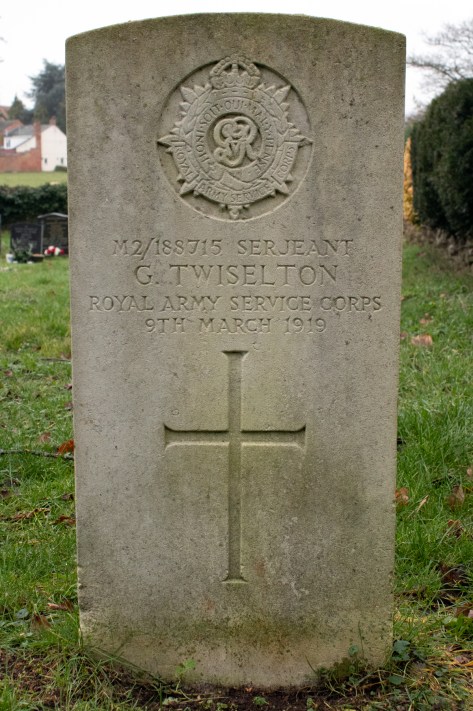
Details George’s time in the army have been lost to time, but it is clear that he had enlisted by 1916, and was assigned to the Royal Army Service Corps. His previous time with horses led him to be attached to the 381st Mechanical Transport Company, and he spent time in France, eventually rising to the rank of Serjeant.
George survived the war, and returned home after the Armistice. However, he contracted influenza early in 1919, and would succumb to the condition on 9th March: he was 40 years of age.
The body of George Twiselton was laid to rest with full military honours in the graveyard of Holy Cross Church, in his home village of Milton Malsor.
Serjeant George Twiselton (from miltonmalsorhistory.org.uk)
With her husband dead, and six children to raise, Annie had to find the strength to continue. The 1921 census found her living with her four youngest – including her only son, Reuben. She was employed on home duties, while her 13-year-old boy was working as a farm servant.
Reuben’s story is a testament to his father’s determination:
At the outbreak of WW2 Reuben, the only son of George, joined his father’s old RASC regiment and went to France as an ambulance driver with the British Expeditionary Force. Along with many others, he withdrew to the Dunkirk beaches but turned down evacuation back to the UK, choosing instead to stay behind and give assistance to the many wounded. He was later taken prisoner and held a Prisoner of War for 5 years until released by American soldiers in 1945. He died in 1988 aged 81 years.
Charles Albert Frost was born in Daventry, Northamptonshire, at during the winter of 1882/3. The third of eight children, his parents were William and Louisa Frost. William was a foreman at a shoe factory in Northampton and, at the time of the 1891 census, the family were living at what looks to be 47 Ardington Road or Abington Road (the return is not clearly legible).
Charles also found work in the shoe trade when he completed his schooling, but his is not a career he wanted to make for himself. Instead he was drawn to the army and, on 26th January 1900, he joined up. The now Driver Frost’s service records show that, at 18 years of age, he was 5ft 4.5ins (1.63m) tall and weighed 127lbs (57.6kg). He had brown hair, blue eyes and a fresh complexion.
Assigned to the Army Service Corps, Charles spent the next few years on home soil. Attached to the 17th Company, he would work hard and that dedication would pay off. He was promoted to Lance Corporal in April 1902, and 2nd Corporal just six months later. By January 1903 he had risen to Corporal, extending his term of service the same month.
Interestingly, in March 1904, Charles reverted to the role of Driver at his own request. He would remain at that rank until for the next four years, when he was stood down to reserve status.
The 1911 census found Charles living back home with his parents and siblings. By this point there were six adults and three children living at 74 Hood Street, Northampton, a seven-roomed terraced house on the east of the town centre. Charles had found work as a blouse cutter in a local factory, and with his father and older siblings all involved in factory work in some way.
Life on civvy street seemed not to appeal, however, and in November 1911 Charles was re-engaged with the Army Service Corps. This was initially planned to be for four years, but he would remain in the army for nearly twice that long.
In August 1914, Driver Frost was shipped out to France. and, barring leave, he would remain there for the next three years. In the summer of 1915, he returned home briefly, marrying Daisy Harris at St Edmund’s Church in Hardingstone, Northamptonshire, when he did so. He was soon sent back out to France, however, and remained on the other side of the Channel until April 1917.
Back on home soil, Charles’ career had taken a surprising turn. In January 1915 he was promoted to Acting Corporal, rising to Acting Sergeant just four months later. By November 1916 he had been promoted to Acting Quartermaster Sergeant, a role that was formalised just four months later.
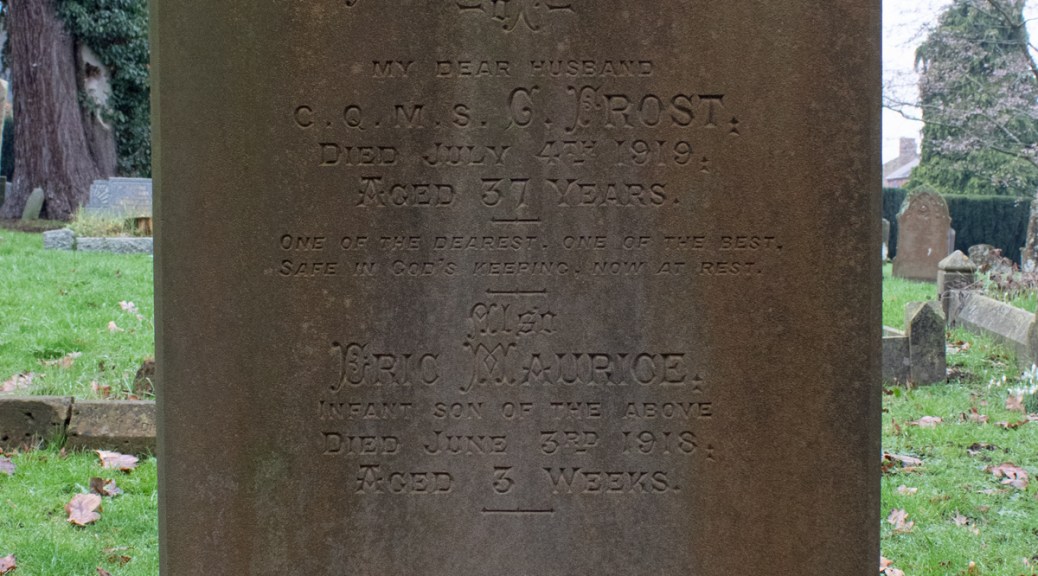
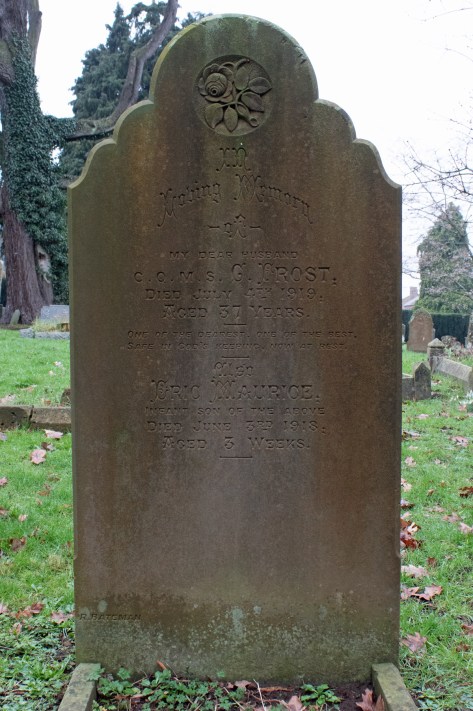
In May 1918, Daisy gave birth to their first – and only – child, a boy they called Eric. Tragically, he passed away just three weeks later, from a combination of pemphigus and asthma: with Charles away, Daisy had to register the death.
Quartermaster Sergeant Frost survived the war, but was admitted to the Mill Road Hospital in Liverpool, Lancashire, on 28th June 1919. He was suffering from a cerebral tumour, but his treatment would prove ineffectual. He died at 3:20am on 4th July 1919: he was 37 years of age.
The body of Charles Albert Frost was taken back to Northamptonshire for burial. He was laid to rest in the graveyard of St Edmund’s Church, Hardingstone, alongside Eric: a father and son reunited.
Daisy had not lost her son and husband in just over a year. The 1921 census found her back living with her father and sister, carrying out home duties while they worked.
William Garrett was born in Warminster, Wiltshire, on 18th October 1880. The fourth of seven children, he was the fourth son to Henry and Mary Garrett. Henry was a groom, and the family lived at 80 Portway, a Victorian villa to the north of the town centre.
The 1901 census records the family having moved from No. 80. The document notes their address as 14 Portway and with this move, there appears to have been a change of circumstances. At some point in the previous ten years, Henry had given up working with horses, and had gone into baking instead. This too had taken a back seat, however, as the census confirms his employment as former baker. William, now 21 years of age, was still living with his parents, and was working as a printer for a local newspaper.
On 5th August 1905, William married Kate Macey. A labourer’s daughter from Bishopstrow, Wiltshire, the couple exchanged vows in her parish church. They settled in a house on Deverill Road, Warminster, and went on to have five children,
When war broke out, William would eventually be called upon to play his part. “He was previously employed at the ‘Warminster Journal’ office as monotype caster and operator, and served his apprenticeship at the office. It was very largely through his services that the ‘Journal’ was forced to suspend publication and though he might have obtained further exemption from military service, he preferred to leave civil employment and enter into the service of his country” [Wiltshire Times and Trowbridge Advertiser: Saturday 25th May 1918]
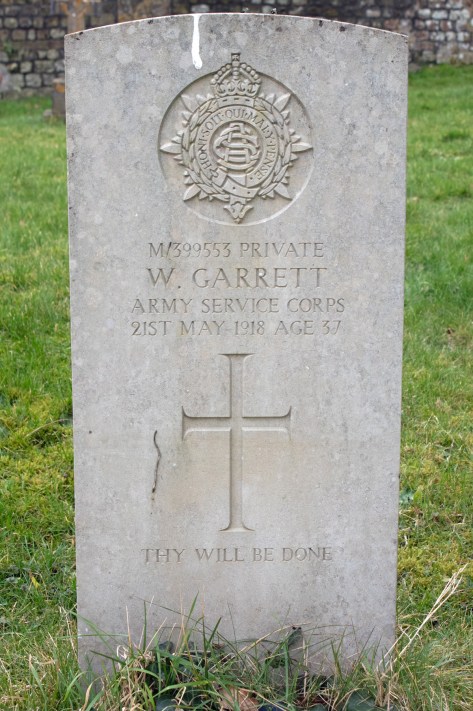
William enlisted in the Army Service Corps on 1st May 1918. As a Private, was attached to the Mechanical Transport Depot in Sydenham, Kent. His service records show that he was 5ft 3ins (1.59m) tall and weighed 126lbs (57.2kg). His medical records note that he was of good physical development.
The newspaper report continued:
[Private Garrett] left Warminster only a week or two ago and was billeted at Sydenham, being apparently in the best of health and spirits. On Tuesday his wife… received the following telegram from an officer: “I regret to have to inform you your husband died suddenly in his billet around 1:30pm today. All ranks convey deepest sympathy.”
The distressing news was confirmed by a letter from a comrade, Pte. Manley, who is a native of Taunton. He wrote “It is with extreme sorrow I write this letter to you. Your husband and I arrived here the same day and he slept in my room with two others – very nice fellows. We all send you our heartfelt sympathy in your sorrow. He spoke to me today about 1.10pm and then fell forward. I and others did everything possible for him but he was beyond human aid from the start. He only lived about two minutes and suffered no pain. We all liked him very much in our bedroom and indeed in the billet. I am sure he would have proved a credit to the ASC.”
[William] was a member of the Oddfellows Society and filled all the local lodge offices, and was also a member of the committee of the Co-operative Society. He belonged to the Warminster Volunteer Training Corps, and jus as he left to join the regular army he was about to be promoted.
[Wiltshire Times and Trowbridge Advertiser: Saturday 25th May 1918]
The inquest into Private Garrett’s death found he had died of natural causes. He was 37 years of age when he passed away on 21st May 1918. He had been in the army for just 20 days.
The body of William Garrett was taken back to Wiltshire for burial. He was laid to rest in the graveyard of Christ Church, Warminster.
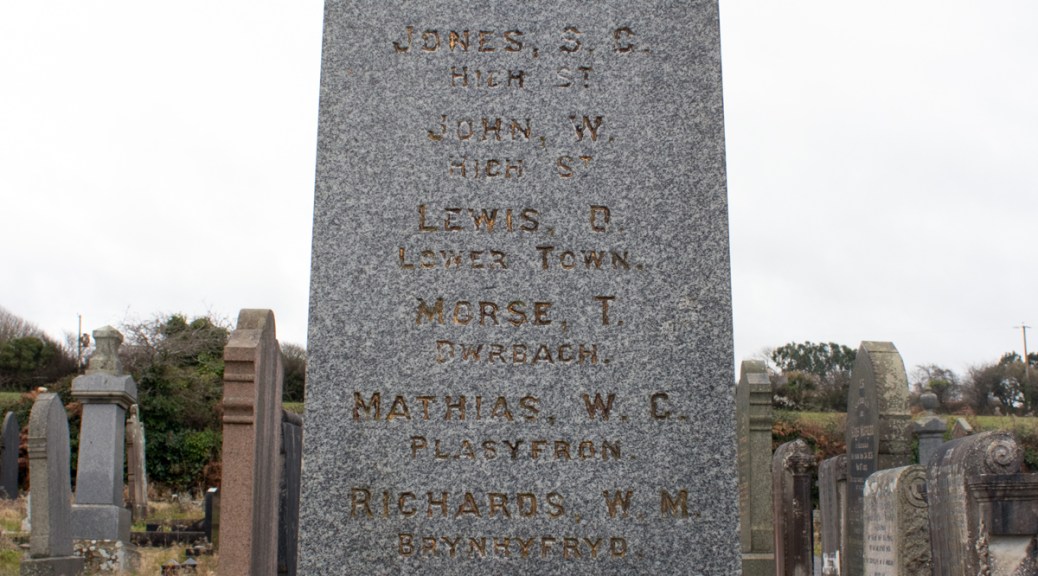
Thomas Morse was born in St Nicholas, Pembrokeshire, in the summer of 1885. One of thirteen children, his parents were Thomas and Mary Morse. Thomas Sr was an agricultural labourer, but when he completed his schooling, his son found work as a mason and, by the time of the 1911 census, he was boarding with his older sister Maria and her family.
When war broke out, Thomas Jr – who was better known as Tom – stepped up to play his part. Full details about his service have been lost to time, but it is clear that he enlisted in the Royal Army Service Corps. It is unclear whether he spent any time overseas, but towards the end of the war, he found himself based in Essex in the Mechanical Transport Division.
In the autumn of 1918, Tom, who had risen to the rank of Acting Corporal, fell ill. He came down with pneumonia, and was admitted to Colchester Hospital. The condition would prove fatal, and he passed away on 26th October 1918: he was 33 years of age.
The body of Thomas “Tom” Morse was brought back to Pembrokeshire for burial. He was laid to rest in the Hermon Baptist Burial Ground in Fishguard.
Intriguingly, the Commonwealth War Graves Commission have Tom’s rank as Serjeant. What remains of his service papers, however, all suggest he was an Acting Corporal.
Equally intriguing are the details of Tom’s dependents. His entry on the Army Register of Soldiers’ Effects gives his father, Thomas Sr, as his beneficiary. His Dependents’ Pension Record, however, gives his mother, Mary, and Miss M Nicholas, who is listed as the guardian of his illegitimate child. There no further information on them.
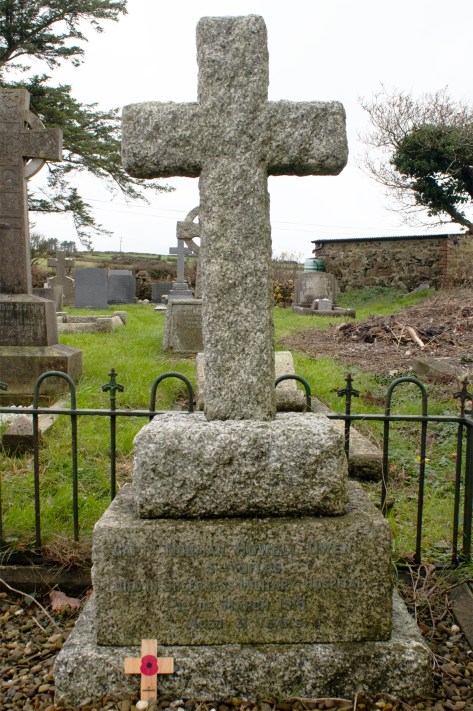
Norman Howell Owen was born in the spring of 1888, and was the third of four children – all boys – to John and Elizabeth. John was a surgeon from Pembroke Dock, Pembrokeshire, but the family were raised in Fishguard, where his practice was based.
Norman was an educated young man and, in 1906, attended the Sir Isaac Pitman & Son Phonetic Institute in Bath Somerset. He was studying shorthand, passing an examination in the subject after just three months. He passed an entrance exam for the National and Provincial Bank the following year, and, by the time of the 1911 census, he was working in the Fishguard branch and living back with his parents.
When war came to Europe, Norman was called upon to play his part. Full details of his service have been lost to time, but what remains paints an interesting picture of his time in the army. He appears to have enlisted in the King’s Liverpool Regiment as a Private, before transferring to the Labour Corps, then the Army Ordnance Corps.
By 1918 the Pembrokeshire Voters List noted Norman and two of his brothers as absentee voters – serving in the army, so not at home. Norman is recorded as being a Captain in the Army Service Corps, having received a commission on 8th February 1915. His older brother John is recorded as being a Captain in the Royal Army Medical Corps, while his younger brother, Lionel, was a Captain in the Royal Field Artillery.
The mystery of Norman continued: he survived the conflict, but by February 1919 had been admitted to the Broadway Military Hospital in Sheerness, Kent. He passed away on 1st March, the cause of his passing not readily available. Captain Owen was 31 years of age.
The body of Norman Howell Owen was taken back to Pembrokeshire for burial. He was laid to rest in Fishguard Church Cemetery.
Norman died intestate: his family went through probate, and his effects – totalling £1003 8s 10d (approximately £67,000 today) were left to his father.
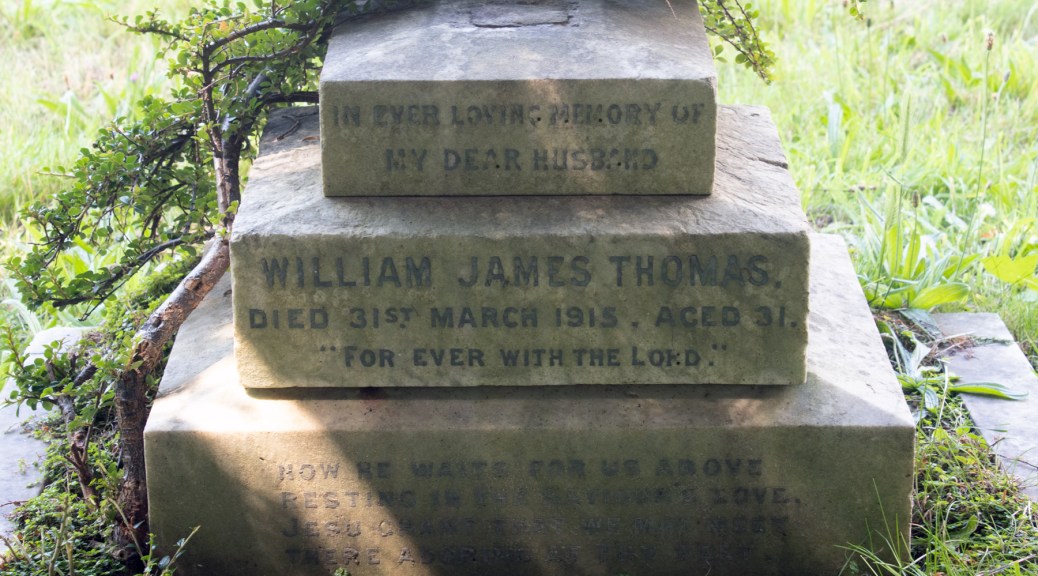
William James Thomas was born in Manordeifi, Pembrokeshire, in 1894. The older to two children his parents were Benjamin and Ellen Thomas. Benjamin was a groom, and, at the time of the 1891 census, the family were living at Cilwendeg Lodge at the entrance to the Welsh estate.
The family moved to Aberporth on the Cardigan coast by the 1901 census. Benjamin had become a farmer, and William, now 17 years of age, was helping out.
Something changed dramatically for William, however, and by 1914, he was living in the West Sussex village of Ferring, some 200 miles (320km) from his birthplace. By this point he was working as a motor driver and, on 25h March, he married Winifred May Knight at St Mary’s Church in Goring-by-Sea.
William stepped up to serve his country when war broke out, enlisting on 18th February 1915. His service records show that he was 5ft 4ins (1.63m) tall, and weighed 138lbs (62.6kg). He was noted as having a mole on his right cheek, and that several teeth were missing. The document confirms his marriage to Winifred, but also gives details of a child, Evelyne Winifred, who had been born in 1905: there is nothing to confirm whether she was his, or was born to Winifred before the couple met.
Private Thomas was assigned to the Army Service Corps Mechanical Transport Division, and sent to nearby Worthing for his training. His time in the army was to be tragically brief, as within a fortnight he had been admitted to the town’s Red Cross Hospital, suffering from cerebrospinal fever.
On 23rd March, William was transferred to Worthing Civil Infections Hospital, but any treatment he was receiving was to prove ineffective. He passed away on 31st March 1915, at the age of 31 years old.
The body of William James Thomas was laid to rest in the graveyard of St Mary’s Church, Goring, where just over a year before he and Winifred had been married.
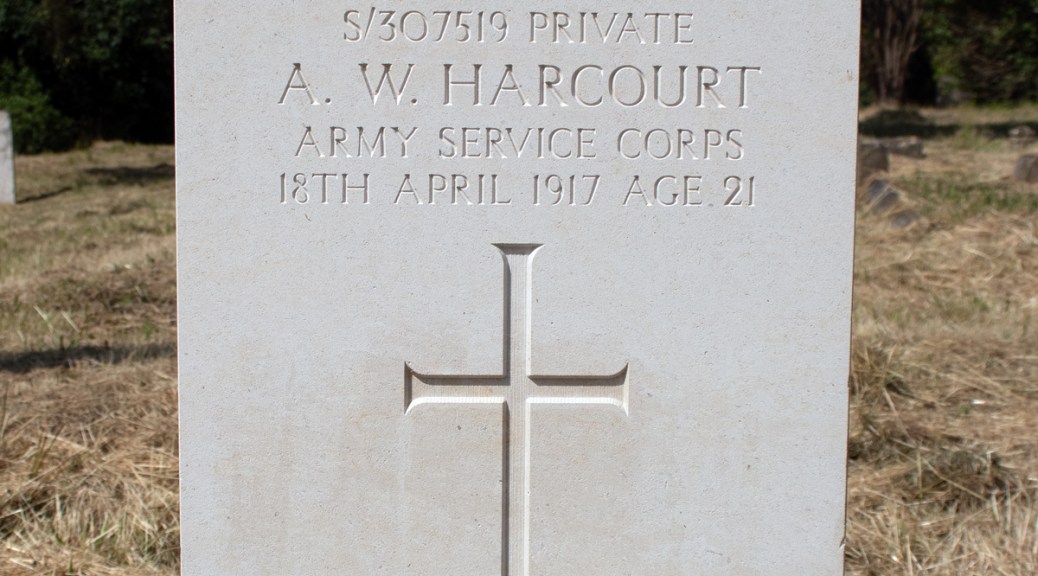
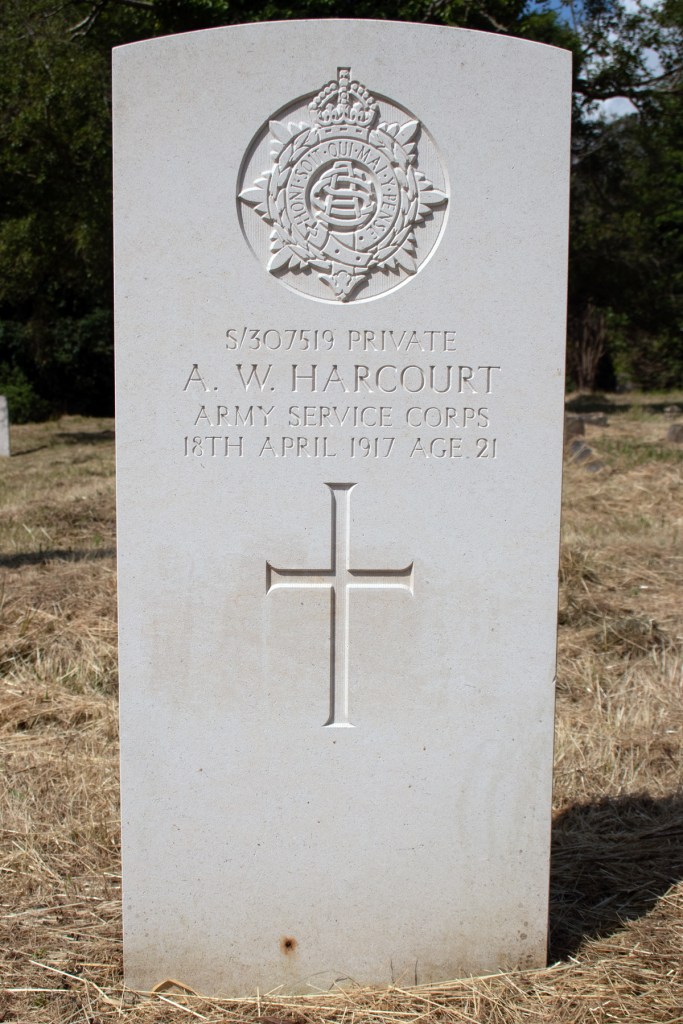
Arthur Wellesley Harcourt was born on 18th June 1895 in Brentford, Middlesex. He was the youngest of five children to Charles and Eliza Harcourt.
The son of a Baptist minister, Charles was a banker’s clerk, but “practically the whole of [his] leisure in a busy life [was] spent in mission work, mainly in Middlesex…” [Middlesex & Surrey Express – Saturday 13 October 1900] When he died in 1900, at the age of 57, Eliza was left to raise her younger children alone.
Arthur’s young life was to be one of travel. The 1901 census, taken just six months after his father’s death, found him living in Walton le Soken (now Walton-on-the-Naze), Essex. Eliza had taken rooms for the family in a lodging house at 9 New Pier Street, yards from the town’s stony beach.
The next record for Arthur is from 1908. Surprisingly, for the grandson of a Baptist minister and the son of a missionary, he seems not to have been baptised when he was born. The document shows that he was christened on 26th April, at St Mary’s Church in the village of Sporle with Palgrave in Norfolk. There is nothing to confirm why he was in Norfolk, or why he chose to be baptised there: the 1911 census found Eliza and his siblings living back in Middlesex.
By this point, Arthur was on the move again. Now fifteen years of age, the same census found him visiting George and Amelia Kerswill at their home in Exeter, Devon. George was a retired nurseryman and florist from Hendon, and it seems likely that the couple were friends of the family.
By the time war broke out, the Harcourts had moved once again, this time setting up home in Reculver, Kent. Arthur was working as a surveyor’s assistant, but felt drawn to play his part. On 8th March 1917, he enlisted, joining the Army Service Corps as a Private. His records show that he was 5ft 4.5ins (1.61m) tall, and weighed 96lbs (43.5kg). He was of fair physical development, but it was noted that he had an understandard chest, but was deemed fit for military service.
Private Harcourt was sent to Somerset for training. Tragically, however, his health was to take a dramatic downturn. Admitted to the Bath War Hospital on 1st April with influenza, this quickly developed into double pneumonia and pleurisy. The strain was to be too much for his young body to bear: Arthur passed away on 18th April 1917, at the age of just 21 years old.
Surprisingly, Eliza, whilst able to live on her own means, did not chose to lay her son to rest close to home. Instead, Arthur Wellesley Harcourt was buried in Locksbrook Cemetery, Bath, not far from the hospital in which he had breathed his last.
Alfred Edward Wallis was born on 7th February 1876, the youngest of five children to Charles and Mary. Charles was a carpenter and joined from Bruton in Somerset, but the family were born and raised in the Walcot area of Bath.
By the time of the 1901 census, Alfred was the only one of the Wallis siblings to remain living with his parents. They were living at 14 Belgrave Crescent, to the north of the city, and, at 25 years of age, Alfred had taken on work as a printer’s compositor.
On Christmas Day 1907, Alfred married Caroline Little. She was a farmer’s daughter from Cheltenham, Gloucestershire, and, at the time of their nuptials, the young couple were living at 8 Seymour Road, the next road over from his parents.
Alfred and Caroline would go on to have three children: Harold, Winifred and Lilian. The 1911 census found that they had moved again, and were now settled in a small terrace at 22 Cork Street, in the Weston area of Bath.
War broke out across Europe in the summer of 1914, and, in on 19th December 1915, Alfred enlisted in the Army Service Corps. His records noting that he was 39 years and 10 months old, stood 5ft 5ins (1.65m) tall, and weighed 128lbs (58kg).
Private Wallis was not formally mobilised until the August 1916. Attached to the 19th Company, he was sent for duty to the Queen Mary’s Military Hospital in Whalley, Cheshire. Full details of his duties are unclear, although he would remain in the area for the next couple of years.
As the war progressed, it is likely that Alfred was exposed to the illness with which the patients were being admitted. In October 1918, he became unwell, and was admitted to hospital with a combination of influenza and pneumonia. The hospital he was sent to was the King’s Lancashire Military Convalescent Hospital in Blackpool, Lancashire, so it is likely that he had left Whalley by this point.
Private Wallis’ illness was to prove too much for his body to bear. He passed away while still admitted, on 29th October 1918. He was 42 years of age.
The body of Alfred Edward Wallis was brought back to Somerset for burial. He was laid to rest in the majestic setting of Bath’s Locksbrook Cemetery.







 Death and Service