Category Archives: Role

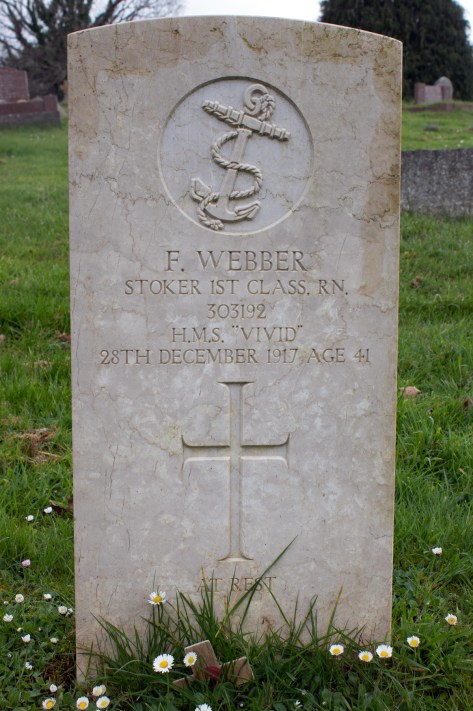
Stoker 1st Class Frederick Webber

Stoker 1st Class Frederick Webber

Frederick Webber, of Westexe-south, Tiverton, stoker in the Royal Navy, has died at the age of 40. He had been in the Navy 15 years, and was on board HMS Dartmouth when she was torpedoed, and on HMS Sylvia when she sank a submarine. While home on leave in November he was taken ill. He partially recovered, but had a relapse and died on December 28th.

[Tiverton Gazette (Mid-Devon Gazette): Tuesday 1st January 1918]

The early life of Frederick Webber is a challenge to piece together, as his is not an uncommon name for the area and period.

His widow is recorded as Elizabeth Webber, and marriage record from August 1907 suggests his father’s name was also Frederick. Stoker Webber’s entry on the military pension ledger confirms two children – Frederick and Frank.

When he enlisted on 10th February 1903, he gave his date of birth as 26th December 1880 and his place of birth as Exeter, Devon.

This combination of details doesn’t give any definite results from the 1891 or 1901 census, so it’s not possible to confirm the early stages of his life.

Based on Frederick’s naval records, he was working as an engine driver when he joined up. He was 5ft 4ins (1.63m) tall, with dark brown hair, hazel eyes and a fresh complexion. He was also noted as having a tattoo on his right forearm

Stoker 2nd Class Webber was sent to HMS Vivid – the Royal Naval Dockyard in Devonport. Enlisting for an initial period of 12 years, he would spend that time serving on a total of ten ships, returning to his Devon base in between voyages.

Frederick’s career seems to be one of doing just enough to satisfy his superiors. His annual reports noted his character and ability as being good or satisfactory, and he spent three periods of time in the brig – for three days in 1904, 14 days in 1906 and five days in 1910.

Frederick’s was promoted to Stoker 1st Class in July 1906 and, unusually, he remained at that rank for the rest of his career. It may be that promotion didn’t come his way, or simply didn’t appeal to him, and he was happy doing what he was doing.

Stoker Webber came down with bronchitis while he was on leave in November 1917. Based on his service records, he had just turned 47 years of age when he passed.

Frederick Webber was laid to rest in Tiverton Cemetery, not far from his grieving family’s home.
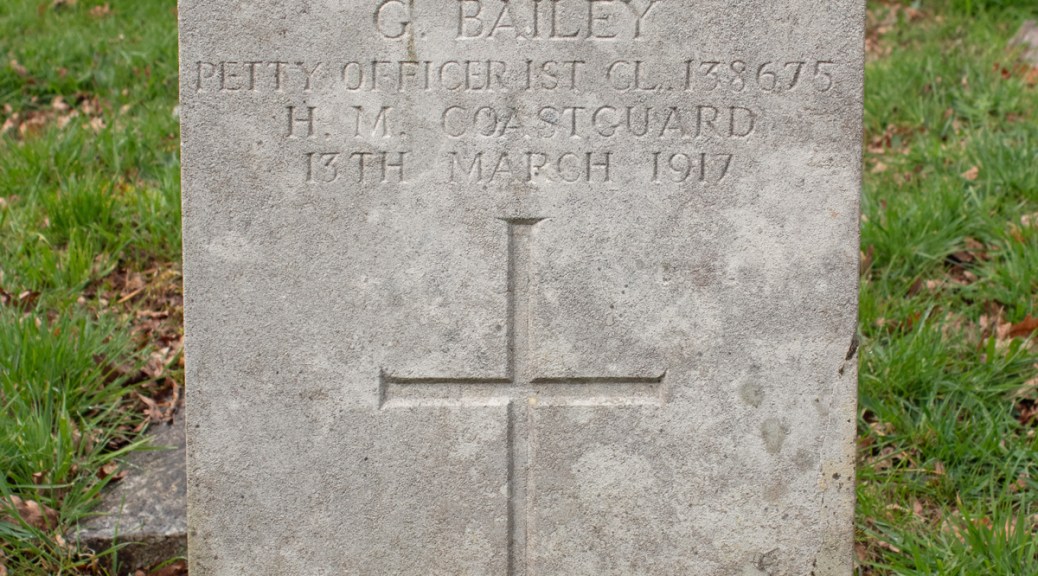

Petty Officer 1st Class George Bailey

Petty Officer 1st Class George Bailey

George Bailey was born in Bedminster, Somerset, on 20th August 1871. One of six children, his parents were George and Anna (or Hannah) Bailey. George Sr was a labourer and, when he died in 1876, Anna moved the family to Clifton, near Bristol.

The 1881 census found the family living in a small cottage at 5 Crosby Row in the then village. Hannah was listed as a late general labourer’s wife, while her three older children were all working for a dairy.

When George finished his schooling, he sought out a career. Joining the Royal Navy, this would prove a long-term role, bringing in a relatively decent wage for him and his family, but also gave him some adventure, not surprising given the number of ships he would have seen going to and fro from Bristol.

George was only 15 years old when he joined up on 25th September 1886, and so was below the age to formally enlist in the navy. Taken on with the rank of Boy 2nd Class, he was sent to HMS Impregnable, the training ship based in Devonport, Devon. Over the next three year he learnt his craft, and served on a few ships, including the battleship HMS Iron Duke.

In October 1887, George was promoted to Boy 1st Class and, on 20th August 1889, while assigned to the Iron Duke, he came of age, and was formally inducted into the Royal Navy. Ordinary Seaman Bailey’s service records show that he was 5ft 5.5ins (1.66m) tall, with auburn hair, blue eyes and a fresh complexion. He was also noted as having a spot tattooed between the finger and thumb of his left hand, a scar on his left leg and another in the centre of his back.

Over the next seven years, George served on a total of ten ships, and saw the world. In between voyages he returned to HMS Vivid, the Royal Naval Dockyard in Devonport. In 1895 he married Elizabeth Bull, from Burrington, Somerset, and the couple went on to have six children.

George’s naval career continued, and he rose through the ranks, to Able Seaman in September 1890, Leading Seaman in June 1895, and to Petty Officer 2nd Class and 1st Class the following year.

In January 1899, George’s life took a different direction. After some time training at HMS Collingwood in Hampshire, he joined the Coastguard service, and would spend the next twelve years serving on the coast of Southern Ireland. This opportunity allowed him to have his family with him, and his and Elizabeth’s four youngest children were born in County Clare and County Cork.

By 1911, the family returned to Britain, setting up home in Brixham, Devon. That year’s census found the Baileys living at 6 Coastguard Station on the waterfront. The family remained there through to October 1913, when George was transferred to the Royal Naval Reserve, having served for 26 years.

George found work as the caretaker of the Electric Theatre in Tiverton, Devon, and this is where he and Elizabeth settled down.

Petty Officer Bailey’s time out of active service was to be limited, however, as, just nine months later, war was declared. Called back into action, he was sent to Western Stack Fort in Milford Haven, Pembrokeshire.

An interesting personality has passed away in First-Class Petty Officer George Bailey, who died suddenly on Tuesday… He came home about a fortnight ago on sick leave, and seemed to be improving in health, and on Tuesday went out for a walk. After retiring to bed his death came suddenly as a result of heart failure.

[Crediton Gazette: Saturday 24th March 1917]

George Bailey died on 13th March 1917: he was 45 years of age. He was laid to rest in Tiverton Cemetery.


Private Arthur Candey

Private Arthur Candey

Pte. Arthur Candey, of the Devon (Cyclists) Territorials, was found shot at Rotterdam, Talland, near Polperro, early on Friday morning. About six weeks ago Candey was drafted to Polperro from Looe and had been engaged in watching the coast, and the deceased and Pts. C Harris went on patrol duty. At Rotterdam Cottage, Candey complained of feeling tired and unwell. so Harris told him to remain in a hut close by while he went on alone and met the other patrol. While on the return journey Harris heard the report of a gun, and deceased was found dead with a bullet wound in the head. Death must have been instantaneous. Pte. Harris was away from the deceased for fifty minutes altogether…

At the inquest at Talland… the jury… returned a verdict that Candey took his life while temporarily insane.

[West Briton and Cornwall Advertiser: Monday 21st June 1915]

Arthur Candey was born in the spring of 1897 in Tiverton, Devon. One of thirteen children, and the youngest surviving son, his parents were Richard and Ellen Candey. Richard was a lace maker, and the family lived in a small terraced house in John Street, to the west of the town.

There is little information available about Arthur’s life. The 1911 census showed that he was still in school, and his army service records have been lost to time. It is clear that he enlisted in the 2nd/7th (Cyclist) Battalion of the Devonshire Regiment, and the newspaper report confirms that he served in Cornwall.

Private Arthur Candey was just 18 years of age, when he died on 18th June 1915. His body was taken back to Devon for burial. He was laid to rest in Tiverton Cemetery, a short walk from where his grieving family still lived.


Bombardier Frank Sloman

Bombardier Frank Sloman

Frank Sloman was born in the autumn of 1887, and was the youngest of five children to Frank and Emma. Frank Sr was a mason from Jersey, in the Channel Islands, but it was in Tiverton, Devon, that he and Emma made their home and raised their family. The 1891 census found the family living on Castle Street, but by 1901 they had moved down the road to St Peter’s Street.

Frank Jr found work as a painter when he finished his schooling, but he sought adventure and a career. He was already a volunteer for the Devonshire Regiment, and, on 7th May 1904, he officially enlisted as a paid member of the troop. Private Sloman’s records show that he was 5th 10.5ins (1.79m) tall, and weighed 129lbs (58.5kg). He was noted as having brown hair, grey eyes and a fresh complexion.

Private Sloman spent two years on home soil. He quickly extended his contract, and this led to more opportunities. By December 1906 his unit was in India, and he would go on to spend five and a half years there.

In December 1907, Frank transferred to the Royal Garrison Artillery. He initially held the rank of Gunner, before being promoted to Bombardier in January 1912, and Corporal just three months later. In October, Frank returned to Britain, and was stood down to reserve status. He returned to Tiverton, and found work as a porter at the local station.

War was on the horizon, however, and when conflict broke out, Frank was called upon to play his part once more. Initially taking up the rank of Corporal in the Royal Field Artillery, he reverted to the role of Gunner at his own request. By this point, his unit was in France, and he would remain there for the next eight months.

On 6th May 1915, Frank returned to Britain, and was attached to 2B Reserve Brigade. He was based at the training facility in Bettisfield Park in Clwyd, and would spend the next eighteen months there. In June 1916, he was once again promoted to the rank of Bombardier.

Love was on the cards, and, on 17th June 1916, Frank married Frances Hadlow. There is little information available for her, but the couple exchanged vows at the Register Office in Windsor, Berkshire.

By the autumn of 1916, Frank’s health was becoming an issue. He contracted phthisis, or tuberculosis, and was sent to the the south coast for recuperation. His condition would ultimately render him unfit for continued military service, and Bombardier Sloman was discharged from the army on 17th December 1916.

His papers show that he had grown to 6ft 2.5ins (1.89m) in height, and, while physically unfit, he was a steady, sober and reliable man. He and Frances had taken rooms at 7 Hawley Street, Margate, Kent, but it seems that the couple soon moved back to Devon. Their new home was a small cottage at 3 Westbrook Place in Tiverton.

At this point, Frank’s trail goes cold. It is unclear whether he took up work again – or was able to do so – but his lung condition was ultimately to get the better of him. He passed away on 3rd June 1918, at the age of 30 years old.

Frank Sloman was laid to rest in Tiverton Cemetery, on the outskirts of the town in which he had grown up.


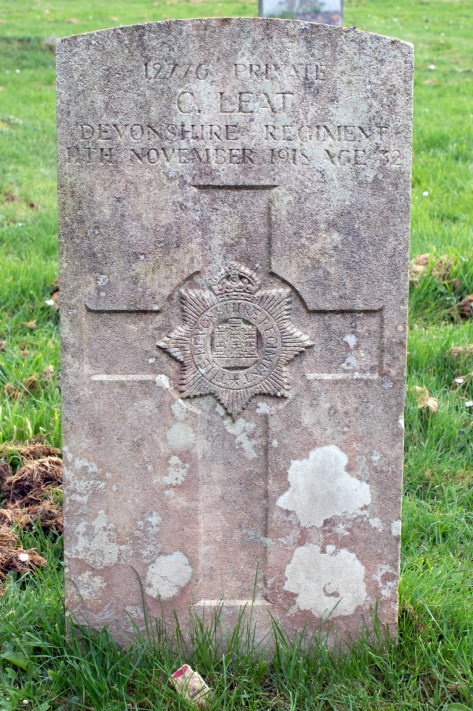
Private Charles Leat

Private Charles Leat

Charles Leat was born at the start of 1888 in Tiverton, Devon. One of thirteen children, his parents were Sidney and Ann Leat. Sidney worked as a lace maker, and the family lived in a crowded cottage on St Andrew Street to the south of the town centre.

When Charles left school, he found work as a grocer’s errand boy. Sidney died in 1897, Ann had to take on lace work herself. The house was too small for the growing family, and so the 1901 census found Charles and his brother Arthur living with his maternal aunt, Mary.

Things had moved on as the new century progressed. By 1911, Charles had moved to South Wales, and was living with his older brother, James, and his family in Glamorgan. James was a house painter, but his sibling had taken on work as a railway porter, and the family lived in terraced house at 57 Tydfil Street, Barry.

When war hit Europe, Charles seemed keen to play his part. Sadly, full details of his military service have been lost to time, but it is clear that he initially enlisted in the opening weeks of the conflict. Joining the Devonshire Regiment, he was assigned to the 11th Battalion.

A later newspaper report suggests that he “had been through most of the fighting on the Western Front… [and] was seriously wounded in 1915.” [Western Times – Friday 15 November 1918] It was after he had recuperated that Private Leat was reassigned to the regiment’s Labour Corps.

By the summer of 1918, Private Leat was serving on Salisbury Plain, Wiltshire. While here, he fell ill, and was eventually admitted to the Amesbury Military Hospital. His condition, pneumonia, was to prove too severe for his body to take, however, and he passed away from the condition on 11th November 1918, Armistice Day. He was 30 years of age.

Charles Leat’s body was taken back to Devon for burial. He was laid to rest in Tiverton Cemetery, not far from where his family still lived.


Petty Officer William Clark

Petty Officer William Clark

William George Clark was born on 23rd November 1884, and was the oldest child to John and Harriet. John was an agricultural labourer from Exminster, Devon, and this is where the family were born and raised.

When he completed his schooling, William found work as a gardener. However, he wanted bigger and better things for himself, and sought out a career at sea. On 12th March 1900 he enlisted in the Royal Navy: being under the formal age to enlist, he was given the rank of Boy 2nd Class.

William was sent to HMS Impregnable, the training establishment in Devonport, for his induction. Over the next two years – until he turned 18 in November 1902 – Boy Clark started to learn his trade. He was promoted to Boy 1st Class in October 1900, and spent time on the frigate HMS Agincourt and the cruiser HMS Melampus.

When William came of age, he was formally inducted into the Royal Navy as an Ordinary Seaman. His service records show that he was just under 5ft 1in (1.55m) tall, with black hair, blue eyes and a fair complexion. He was also noted as having a tattoo of an anchor in his left arm.

Over the next five years, William served on three further ships, returning to HMS Vivid – the Royal Naval Dockyard in Devonport – in between voyages. He travelled the world and, in May 1904, was promoted to the rank of Able Seaman.

Away from the navy, love blossomed. In May 1907, William married Louisa Cosway in Tiverton, Devon. She was a few months older than her husband, and the couple would go on to have one child, William, who was born the following spring.

Back at sea, and Able Seaman Clark’s career continued. In November 1911 he was promoted to Leading Seaman, reaching the rank of Petty Office in January 1917. During his eighteen year career, he would serve on a total of eleven ships, but in the closing months of the war, William’s health was beginning to suffer. On 9th May 1918, he was medically discharged from service, suffering from heart disease.

William returned home to Tiverton. His time with his family was to prove tragically brief: he passed away from mitral disease and pneumatic fever on 13th May 1918, at the age of 33 years old.

William George Clark was laid to rest in Tiverton Cemetery. His grave was just a 15min walk from where his widow and son lived on Fore Street, in the town centre.


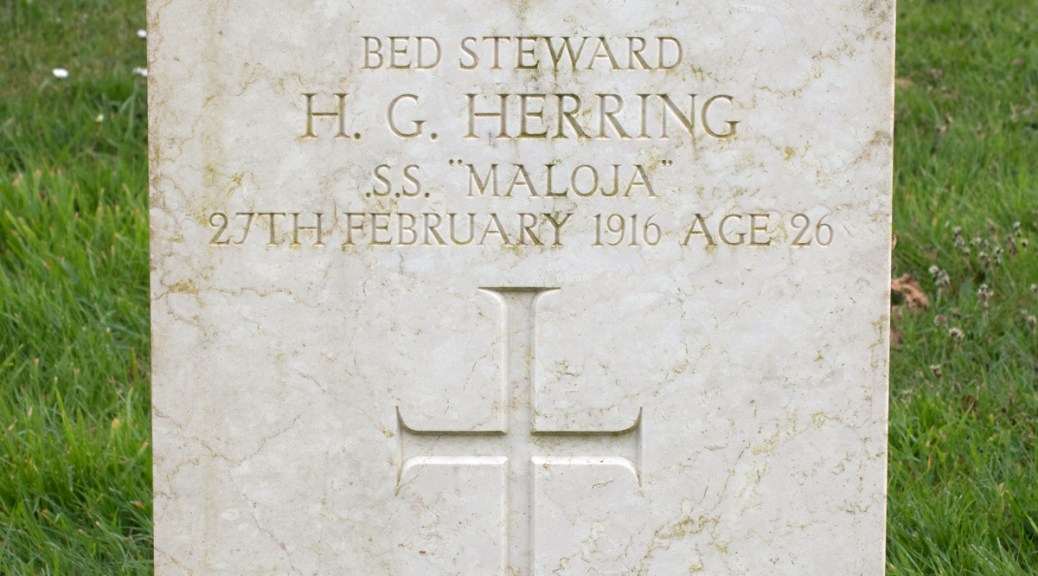
Bed Steward Henry Herring

Bed Steward Henry Herring

Henry George Herring – also known as Harry – was born on 10th November 1889. The second of six children, his parents were Thomas and Mary Herring. Thomas was a tailor from Tiverton, Devon, and the family lived at 131 West Exe South in the town.

Henry sought a life of adventure, and joined the Merchant Navy. Sadly, details of his service have been lost to time, so it is not possible to get a clear picture of his time at sea. Certainly he had moved out of the family home by the time of the 1911 census, though it is unclear whether he had enlisted by this point.

By the start of 1916, Henry was serving as a Bed Steward on board the SS Maloja, a passenger steamship that travelled between Britain and India. On 26th February she left Tilbury, Essex, bound for Bombay, with a crew of 301 and 122 passengers on board.

The following morning, Maloja was sailing through the Strait of Dover when she hit a mine. There was a large explosion and she faltered. The Canadian ship Empress of Fort William was only a short distance behind, and she steamed forward to assist, but she also struck a mine just 1km (0.6miles) away.

The Maloja’s lifeboats were readied to launch and passengers started to board, but the ships engine room had flooded, and she began to list. Three of the four lifeboats were unable to launch, and, as she was unable to stop, no rescue ships could come alongside.

The Maloja sank 24 minutes after hitting the mine. Many of the crew and passengers ended up in the water: most were rescued, but 44 bodies – including that of Bed Steward Herring – were recovered and around 100 people were unaccounted for.

Henry George Herring’s body was taken to shore: he was just 26 years old when he died. He was taken back to Devon for burial and laid to rest in Tiverton Cemetery, not far from where his grieving family still lived.


Driver Thomas Dicker

Driver Thomas Dicker

Thomas Lockyer Dicker was born at the start of 1890 in Tiverton, Devon. One of six children, his parents were Thomas and Mary Dicker. Thomas Sr was a cab driver, and the family lived at 4 Back Lane in the town.

Thomas Jr’s later life is a challenge to pin down. He doesn’t appear on the 1911 census, and his service records have been lost to time. It is clear that he had enlisted before October 1919 – and, in all likelihood, while the war was being fought. Assigned to the Royal Field Artillery, he worked as a driver, and again it is possible that he served overseas at some point.

Thomas Lockyer Dicker died at the Queen Alexandra Hospital in Cosham, Hampshire, on 12th April 1920, although the cause of his passing is unclear. He was 30 years of age. His body was taken back to Devon for burial, and he was laid to rest in Tiverton Cemetery, not far from the family home.


Boy George Hunt

Boy George Hunt

The funeral took place at the Tiverton Cemetery, on Tuesday afternoon, of George Hunt, 17… a member of the Devon band, who died in Ireland as a result of an illness brought on by exposure. Pte. Hunt visited Tiverton for the last time at Christmas. On the return journey to Ireland he, with several others, were drafted to camp to await the arrival of a steamer. Whilst in camp he contracted a severe chill which he was unable to throw off and his parents recently received a message stating that his condition was giving rise to some anxiety. Mr and Mrs Hunt journeyed to Ireland and satisfied themselves that everything possible was being done to save their son. In spite of all efforts he died on Thursday, June 16th.

[Tiverton Gazette (Mid-Devon Gazette): Tuesday 28th June 1921]

George Cockram Hunt was born on 15th January 1904, and was the youngest of five children to William and Emily Hunt. William was a carpenter and joiner from Tiverton in Devon, and this is where the family were born and raised.

There is little additional available about young George’s life. He had enlisted in the army by the middle of 1920, and, as a Band Boy, was attached to the 1st Battalion of the Devonshire Regiment. Given his age, it is unlikely that he spent any time overseas before the Armistice but, as the report of his funeral suggests, he was stationed in Ireland at the time of his death.

Boy Hunt died in barracks in Queenstown – now Cobh – in the south of Ireland. His body was brought back to Devon for burial.

George Cockram Hunt was laid to rest in Tiverton Cemetery, on the outskirts of the town he had called his home for less that two decades.


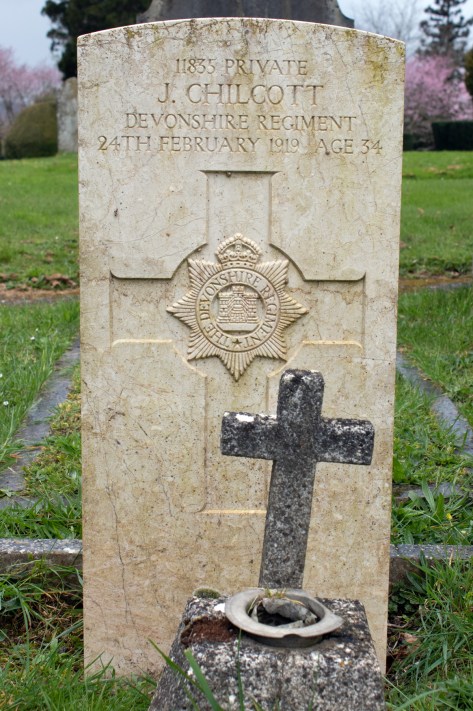
Private James Chilcott

Private James Chilcott

James Chilcott was born in Eccles, Lancashire, in the autumn of 1885. One of twelve children, his parents were William and Mary Chilcott. William seemed to be able to turn his hand to most things: the 1891 census recorded him as a hawker of fish, while ten years later he was employed as an insurance agent.

The Chilcotts had moved to Tiverton in Devon in around 1891, setting up home on St Andrew’s Street, to the south of the town centre. James initially found work as a bookseller’s assistant when he left school, but things were to change.

In the autumn of 1908, James married Mabel Candey. The couple moved to Nottinghamshire, settling in the village of Cresswell, where they lived in a small cottage at 6 John Street. James had found work as a coal miner in the area, which had taken the couple away from the comfort of Devon.

Over the next four years, James and Mabel would have four children, all of whom died before they celebrated their first birthday. The series of tragic events may have driven a need for Mabel to be with family, and by 1913, the couple had moved back to Tiverton. Daughter Dorothy was born in 1914.

When conflict his Europe the following year, James stepped up to play his part. Full details of his military service hare long since lost, but it is clear that he enlisted in the Devonshire Regiment, and had done so at the beginning of the war.

Attached to the 2nd Battalion, Private Chilcott was in France by 9th February 1915. Over the next few years, the unit saw fighting in most areas of the Western Front, including the Somme and Ypres. It is unclear how much of this James was involved in, but it is unlikely that he would have come away completely unscathed.

Pte. James Chilcott, of the 2nd Devons, who went through the dispersal camp at Fovant on February 20, died at Exeter on Monday from influenza. A son of Mr WH Chilcott, of St Andrew-street, Tiverton, he joined up at the beginning of the war, and had seen considerable service. He leaves a widow and one child.

[Western Times: Wednesday 26th February 1919]

James Chilcott died on 24th February 1919: he was 33 years of age. His body was taken back to Tiverton for burial, and he was laid to rest in the town’s cemetery.


“He leaves a widow and one child” does no justice to the pain that Mabel had to go through, having lost four children and her husband in a matter of six years. The 1921 census recorded her living on St Andrew Street with Dorothy, and showing she was undertaking home duties. She had two lodgers, who helped bring in a little more money.

Mabel Chilcott never remarried: she passed away in Tiverton in January 1946, at the age of 62.