Category Archives: Private

Private George Wallace

Private George Wallace

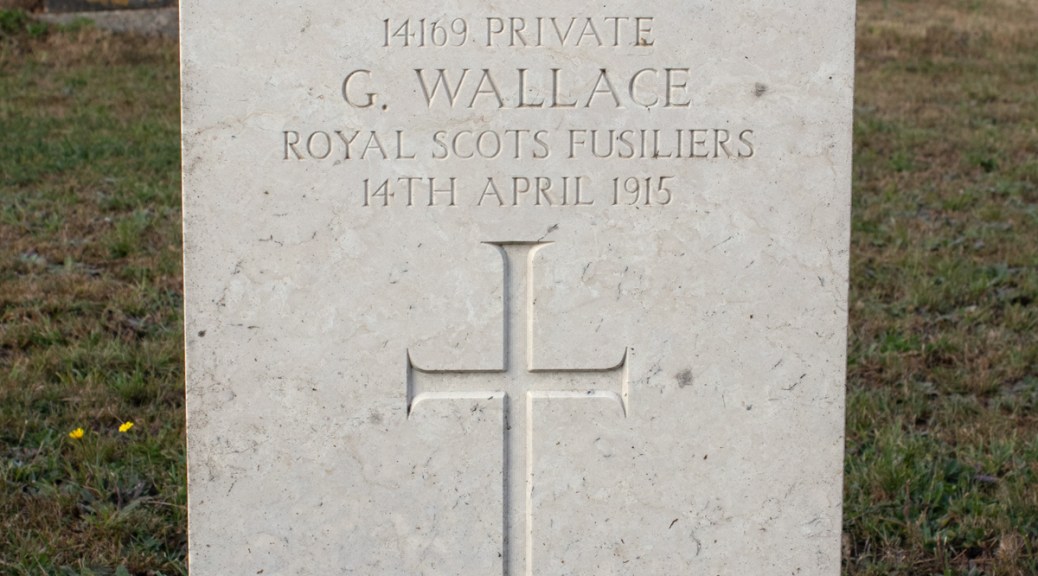
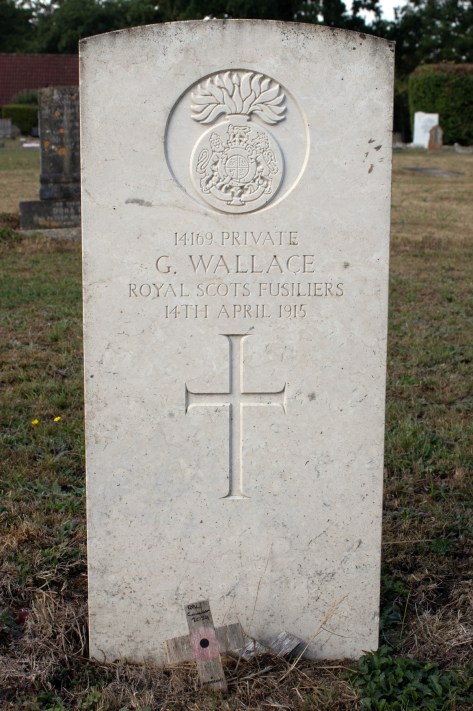
In the town cemetery of Gillingham, Dorset, is the grave of Private G Wallace of the Royal Scots Fusiliers, who died on 14th April 1915. His entry in the British Register of Soldiers’ Effects confirms his first name as George, and that he died on the town’s Leatham Red Cross Hospital. Private Wallace was recorded as being in the 8th Battalion, and his beneficiary was noted as being his father, James.

Unfortunately, beyond this, there is little concrete information about George’s early life: his regiment would suggest that he was born north of the border, but, without a year or location of birth, it is impossible to narrow down the documentation.

A newspaper report does, however, confirm how his life came to an end:

An inquest was held at the Drill Hall on Friday morning, on the body of Private George Wallace, of the Royal Scots Fusiliers, who died at the Gillingham Red Cross Hospital as a result of injuries by the kick of a horse at Codford Camp… Corporal James Doig, of the 12th Argyll and Sutherland Highlanders, said the accident occurred on the Wednesday, April 7th. The stable was only an open shed, and deceased was going up the near side of the horse when it let our and kicked Wallace in the pit of the stomach and knocked him over. He fell in towards the stall among the feet of the horse, which let out again and caught him in the head. While witness went to the horse’s head another witness Private O’Neil, hauled Wallace our. When Wallace was pulled out O’Neil took him to the field hospital, where he managed to walk with some assistance. Lieutenant WE Hopkins, RAMC, proved attending to the deceased as far as possible. There were no facilities for serious cases, and, thinking it was only a case of slight concussion, he had the deceased sent to the Gillingham Red Cross Hospital. If he had been aware it was a fracture of the skull, he should have sent the case to Salisbury Infirmary. The field hospital was only a detention ward, with no hot or cold water supply and no instruments. He cleaned the wound in the head as far as possible. Dr Huntly said he examined the deceased at the Gillingham Hospital. The skull was fractured, and everything was done for him by himself and Dr Morgan, but he died from septic inflammation. If the wound had been “sweet” it would have given him a better chance after the operation was performed. A verdict of “Accidental death” was returned.

[Southern Times and Dorset County Herald: Saturday 24th April 1915]

The body of George Wallace was laid to rest in Gillingham Cemetery, not far from the hospital in which he had died.


Private Harry Mildenhall

Private Harry Mildenhall

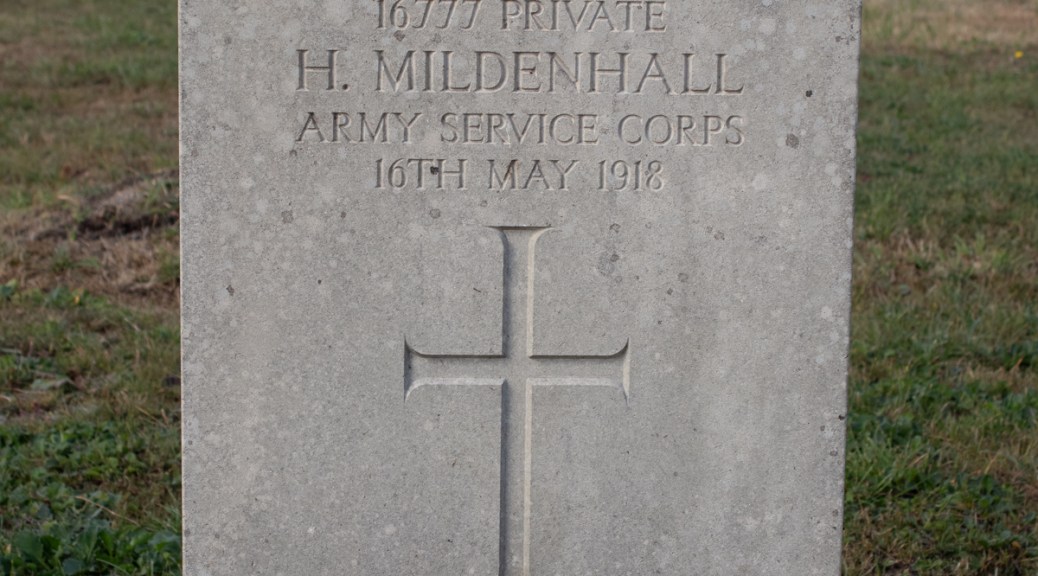
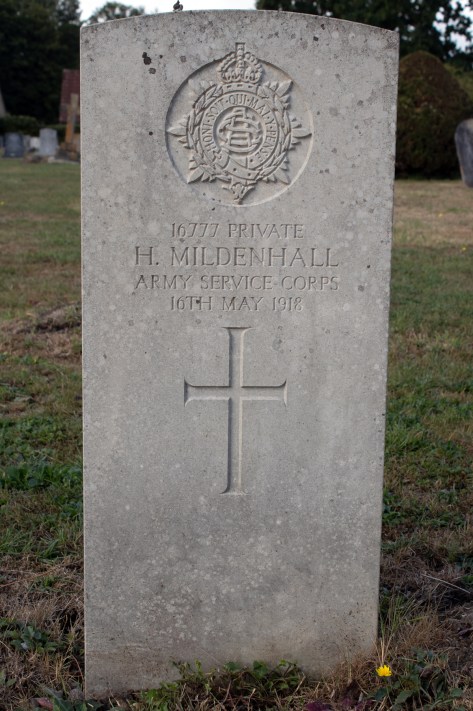
Harry Mildenhall was born in the autumn of 1873 in Eton, Buckinghamshire. The third of six children, his parents were Henry and Harriet Mildenhall. Henry was a groom, and the family lived on first on Mill Lane, before moving to Alma Road in nearby Boveney, by the time of the 1891 census.

The next census return, taken in the spring of 1901, recorded Harry as having left home. Initially apprenticed to house painter Glen Rowland, the document found him as boarding with his employer at 1 Thames View, Clewer, on the outskirts of Windsor, Berkshire.

It was not long before Harry would set out on his own. On 14th April 1906, he was living on Speedwell Street, Oxford. It was on that day that he married Annie Berridge in the parish church. Seven years her new husband’s junior, Annie was a labourer’s daughter, with a history of her own:

Annie Berridge (19), domestic servant, Peterborough, was charged with obtaining 4s. by false pretences from Martha Withers on Feb. 4th. The evidence showed that Berridge had been residing with Mrs Knighton of Wellington-street, who was known to Mrs Withers. On Monday week she visited the latter’s house at Oundle-road and stated that Mrs Knighton wanted to borrow 6s. In consequence Mrs Withers gave her 4s., but afterwards discovered that Mrs Knighton had never sent for the money. Accused pleaded guilty, electing to be dealt with summarily. The Bench gave defendant a chance to retrieve her character by dealing with her ad a first offender and binding her over to come up for judgment when called upon.

[Peterborough Standard: Saturday 16th February 1901]

But Annie was not done with the law just yet:

Annie Berridge (19), single soman, of no fixed abode, was charged with stealing from 11, City-road, a pair of shoes, value 4s. 6d., the property of Elizabeth Ryall, on the 24th. She was further charged with stealing from 7, Perseverance Cottages, Star-lane, money to the amount of 1s., the property of Ethel Norman, on the 18th. In the first care Elizabeth Ryall stated that accused asked for lodgings. She stayed one day and went out the following morning. As accused did not return witness looked round and missed a pair of shoes (produced), an old pair being left in their place. Detective-Sergeant Smith stated that he saw accused in Broadway on the 25th wearing the shoes missed by the previous witness. Accused, who cried bitterly, elected to be dealt with summarily, and pleaded guilty. The Chief Constable stated that a fortnight ago the accused was before the Bench and was then bound over to be of good behaviour. The Bench retired, and on their return into Court the Chairman stated that it appeared leniency was no good. That had been tried a fortnight previously, and a sentence of two months’ imprisonment would now be passed. The second charge was not proceeded with.

[Peterborough Standard: Saturday 2nd March 1901]

The 1902 census, taken just a month later, recorded Annie’s fate: she was imprisoned in Northampton Prison. Meeting Harry may have been what helped Annie back on the rails. After their wedding the couple took rooms at 6 Mill Street, Kidlington, Oxfordshire, and went on to have three children: Edward, Albert and Annie.

War came to Europe in the summer of 1915, and, despite his age, Harry would step up to play his part. He enlisted in the Army Service Corps on 16th September 1915, his papers confirming that he was of Church of England by faith, and was 5ft 5.5ins (1.66m) tall.

Private Mildenhall was sent to France within a fortnight of enlisting, although his exact role is unclear. He certainly remained overseas until April 1917, when he returned home for three months. He returned to the fray in July 1917, transferring to the Labour Corps.

Harry next returned to Britain in May 1918. By this point, however, he had fallen ill, and was admitted to Station Road Hospital in Gillingham, Dorset, suffering from bronchitis. Any treatment proved to be too little, too late: Private Mildenhall died from heart failure at 8:15pm on 16th May 1918, at the age of 44 years old.

The body of Harry Mildenhall was laid to rest in Gillingham Cemetery, not far from the hospital where he had breathed his last.


Of Annie there is no further record. The 1921 census records the three children boarding with separate families: Edward and Albert were living with the Bowd family at 35 Gracious Street, Whittlesey, Cambridgeshire. Annie, meanwhile, was living with Joseph and Harriett Wing, just around the corner from her brothers at 5 Whitmore Street. The census records note that the children’s father was dead, but their mother alive.


Private William Thick

Private William Thick

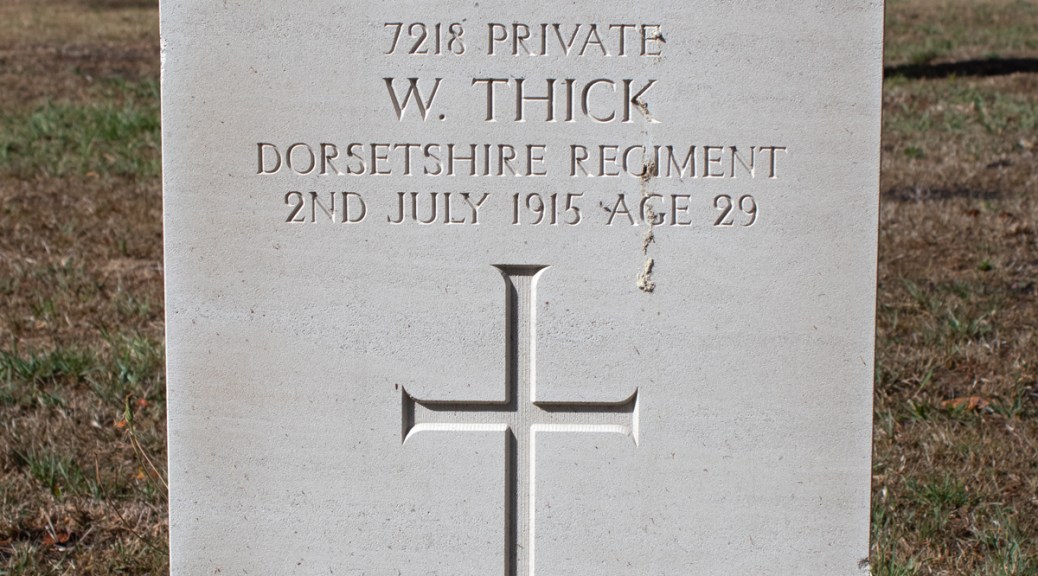
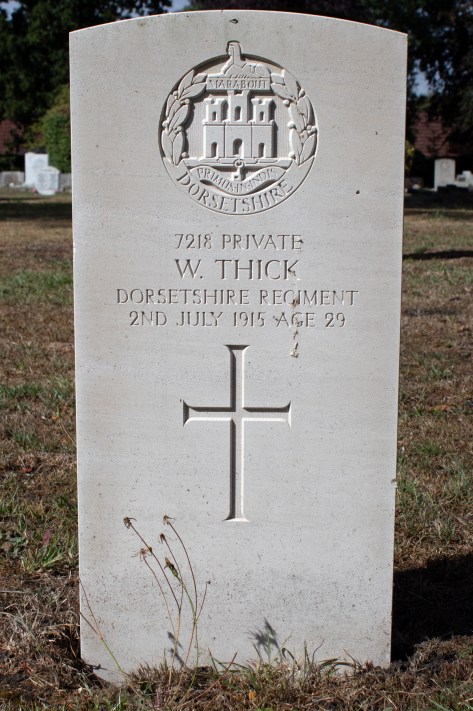
William Thick was born in Gillingham, Dorset, in the autumn of 1885, and was the oldest of four children to Henry and Emma Thick (who also went by the names Harriett and Fanny). Henry was a general labourer, and the family lived in a cottage at Culvers Corner, on the western outskirts of the town.

William initially found work as a mason, but he sought bigger and better things. Already a volunteer in the local militia, on 19th April 1904, he formally enlisted in the army. Taking the rank of Private in the Dorsetshire Regiment, he was attached to 2nd Battalion. His service papers note that he was 5ft 5ins (1.65m) tall and weighed 129lbs (58.5kg). He was recorded as having dark brown hair, hazel eyes and a fresh complexion. His medical report also notes a lateral curvature of his spine.

Private Thick spent the first two years of his service on home soil. In February 1906, however, his unit was sent to India, and he would spend the next five years in and around Poona. William completed an initial seven years’ service in April 1911: stood down to reserve status, he returned home.

In the spring of 1914, William married Eliza Belgin. There is little information available for her, but she gave birth to the couple’s only child, daughter Hettie, the following January.

By this point, war had broken out, and Private Thick was called into action once more. Attached to the 1st Battalion, he was sent to France within days of the outbreak of hostilities. Within the first six months of the conflict, William’s unit was involved in the battles of Mons, the Marne, the Aisne, Messines and Armentières, some of the fiercest fighting of the conflict.

By the summer of 1915, Private Thick was suffering from rheumatism. He was admitted to the No. 1 Canadian General Hospital in Boulogne, but was soon transferred to Britain, as he contracted pleurisy. Sent to the Norfolk War Hospital in Norwich, his condition deteriorated, and he passed away on 2nd July 1915: he was 29 years old.

The body of William Thick was taken back to Dorset for burial: he was laid to rest in Gillingham Cemetery, not far from where his family were living.


Eliza had been widowed just six months after having Hettie. The only other record for her is the Commonwealth War Graves Commission’s record that she had moved to Harold Road, Roath, South Glamorgan.


Gunner Robert Dobson

Gunner Robert Dobson

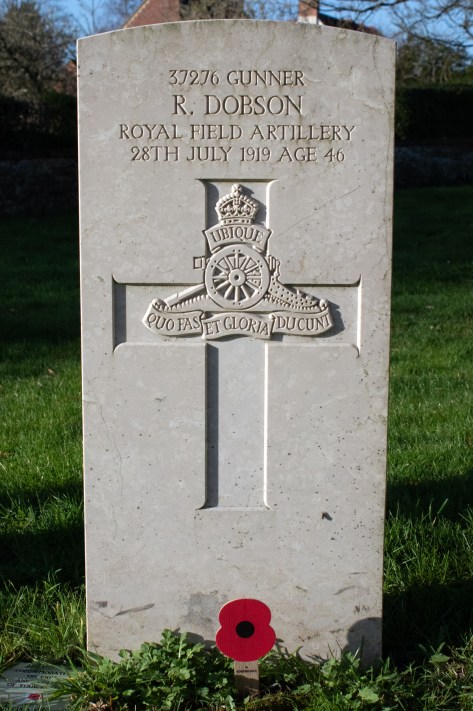
In the graveyard of St Mary’s Church in Steeple Ashton, Wiltshire, is a headstone dedicated to the memory of Gunner R Dobson of the Royal Field Artillery. The early life of Robert Dobson, however, is a challenge to unpick.

Born in Kilbride, County Wicklow, in 1873, he was the son of John Dobson and, according to his later service papers, he had three brothers: William, John Jr and Richard.

When he finished his schooling, Robert found work as a gamekeeper, but he wanted more adventure, and, on 27th April 1891, he enlisted in the Royal Artillery. Given the rank of Gunner, his papers note that he was a little over 5ft 6ins (1.68m) tall, and weighed 150lbs (68kg). A Presbyterian, he had brown hair, blue eyes and a fresh complexion.

Gunner Dobson signed up for a period of seven years, and during this time he travelled the world. From March 1893, he was based in India, but was invalided home for reasons unclear in November 1894. He would remain on home soil for the next three years, and was stood down to reserve status in April 1898.

While back on home soil, love had blossomed and, on the 14th May 1898, Robert married Mary Bull. A labourer’s daughter from Steeple Ashton, the couple wed in the parish church. Robert gave his address as the same village, and, given the proximity of the garrison town of Trowbridge, it is likely a local posting is how the couple met.

On 3rd November 1899, Gunner Dobson was called into duty once more. Attached to the 3rd Battalion of the Royal Field Artillery, his unit headed to South Africa, and he was quickly caught up in the Boer War. He would remain overseas until the spring of 1901, at which point he returned to Britain once more.

After a total of twelve years’ service, Robert was formally stood down from army service on 26th April 1903, returning to Steeple Ashton and Mary. The 1911 census – the only one of the four returns taken during his lifetime on which he appeared – found the couple living in a cottage on Common Hill, to the north of the village centre. Robert, now 38 years old, was working as a farm labourer.

When war broke out in Europe, Robert stepped up to serve his country once more. He initially re-joined his old unit, but seems to have transferred over the Labour Corps, and was attached to the 95th Company. His service records for this period have been lost, so it is unclear when or how he served.

Robert survived the conflict, but would pass away on 28th July 1919. The cause of his passing is unclear, but he was 46 years of age when he died.

The body of Robert Dobson was laid to rest in the peaceful graveyard of St Mary’s Church in Steeple Ashton.


Private George Manaton

Private George Manaton

It is with deep regret we record the death of Mr G Aubrey Manaton, son of Mr and Mrs William Manaton, of Braunton, who had just passed away at his home in Braunton. Mr Manaton was a young journalist of brilliant prospects, his scholarly attainments and aptitude for the profession being such that he made rapid steps for one so young. Having served his articles on a Barnstaple weekly newspaper, he went to London and joined the staff of one of the Newsagencies, and subsequently that of “The Times.” For a short while he was a war correspondent for the latter paper in France, and during that period made most able contributions to the paper, notably among them being a graphic account of the sinking of a large warship off the French coast, of which he was an eye witness in the early days of the war. He served for a short time with the Inns of Court Officers’ Training Corps, from which he was invalided on account of ill-health. Besides being naturally gifted in his literary capacity, Mr Manaton had a wealth of charm of personality and character, and his death, at the early age of 26, is deeply regretted, especially among his intimate friends, of whom he had a great many. He was unmarried. In their bereavement, the parents, whose eldest son was killed in the war some time since, will have a measure of sympathy both full and sincere. One of deceased’s brothers, Lieut. Arthur Manaton, is serving in France with the Yorks and Lancs Regt.

[Western Times: Tuesday 30th July 1918]

George Aubrey Manaton was born on 9th June 1892 in Braunton, Devon. The second of five children, his parents were William and Sarah Manaton. William was a tailor and outfitter, and the family lived in a nine-roomed house – Hillside – on Church Street, to the north of the town centre.

George was working as a journalist by the time of the 1911 census. When war broke out, his work took him to France, but by the summer of 1915, he felt he could no longer remain a mere observer. Back in London, on 17th June, he enlisted in the army, and was assigned to the Inns of Court Officers’ Training Corps.

Private Manaton was sent to Berkhamsted, Hertfordshire, for his training. His time in the military, however, was to be a short one, and he was discharged for being unlikely to become an efficient soldier on medical grounds on 26th November 1915.

At this point, George’s trail goes cold. His older brother, Fred, a Private in the 9th (Service) Battalion of the West Yorkshire Regiment, had survived Gallipoli, but was killed during the Battle of the Somme in September 1916. He was laid to rest in Puchevillers British Cemetery in Picardie.

George Aubrey Manaton passed away on 25th July 1918: he had turned 26 just a few weeks before. He was laid to rest in the Methodist Chapelyard of his home town, Braunton.


Private Cecil White

Private Cecil White

Cecil George White was born in Cardiff, Glamorganshire, in the summer of 1899. The youngest of four children, his parents were called William and Mary. William was a stevedore and, at the time of the 1901 census, the family lived at 6 Whitchurch Road, to the north of the city centre.

The 1911 census shows things had changed significantly for the White family. They had left Wales, and had set up home in the Devon village of Croyde. William and Mary were now employed as farmers, with Cecil’s older sisters, Cordelia and Lilian, also helping out on the farm.

Europe descended into war in the summer of 1914, and while Cecil was initially too young to serve, he would eventually be called upon to play his part. Full details of his time in the army have been lost to time, but it would seem that he joined the South Wales Borderers, but was attached to the Monmouthshire Regiment.

Private White’s trail is tantalisingly sparse. The one document relating to his passing notes that he died of sickness in Barnstaple, Devon, on 12th November 1918 – the day after the Armistice was signed. Given the town’s proximity to the family home, it is fair to assume that he had been home on leave when he fell ill.

The body of Cecil George White – just 19 years of age when he died – was taken the short distance back to Croyde for burial. He was laid to rest in the family plot in the village’s Baptist Chapelyard, alongside his sister, Lilian, who had passed a few weeks before.


The family would be reunited in death: William was buried alongside his children when he died in 1946, at the age of 78. Mary died in 1960, at the age of 91, and was interred with her family.


Stoker 1st Class William Payne

Stoker 1st Class William Payne

William John Payne was born on the 29th November 1896. The second youngest of ten children, his parents were Alfred and Alice. Alfred was a cab driver from St John’s Wood, Middlesex, but the family were born and raised in Paddington. The 1901 census recorded them lodging in a shared house at 100 Woodchester Street, but by 1911, they had taken two rooms around the corner at 89 Cirencester Street. Both were within easy reach of both Paddington Station and the Grand Union Canal.

When he completed his schooling, William found work as a van guard, possibly for the railway. On 19th July 1915, with war raging across Europe, he stepped up to serve his country, and enlisted in the Royal Navy. His papers show that he was 5ft 5ins (1.65m) tall, with light brown hair, grey eyes and a fresh complexion. He was recorded as having a scar on the back of his right hand, and tattoos on both forearms.

Stoker 2nd Class Payne was sent to HMS Pembroke, the Royal Naval Dockyard in Chatham, Kent, for his training. On 13th October 1915, he was given his first posting, on board the depot ship HMS Tyne. Based in the Firth of Forth, she provided support to the naval fleet patrolling the area.

Tyne remained William’s home for the next year, and, during this time, he was promoted to Stoker 1st Class. After a short spell back in Chatham in September 1916, William was reassigned to HMS Wallington. She was a shore base on the River Humber, and from here he would have had short postings on local patrols in the area.

By the spring of 1917, however, Stoker Payne was back at Pembroke. The dockyard was a busy and overcrowded place at this point in the war: the sinking of HMS Vanguard in July led to its replacement crew being stuck at the base while awaiting new assignments. In addition to this, an outbreak of spotted fever meant that sailors’ bunks had to be spaced out in an attempt to slow the spread of the disease. As a result, William found himself billeted in temporary accommodation in the dockyard’s Drill Hall.

On the night of the 3rd September 1917, the German Air Force carried out a daring raid on North Kent. Chatham was in the line of fire, and two bombs landed squarely on the Drill Hall. The glass roof shattered, raining shards down on the sleeping men beneath. Stoker 1st Class Payne was one of the dozens killed in the explosions: he was 20 years of age.

The body of William John Payne was taken back to London for burial. He was laid to rest in Paddington Cemetery, just a short walk from where his family were still living.


William was not the only one of his siblings to be killed during the war. His older brother Walter enlisted in the opening weeks of the conflict and, as a Private, he was attached to the 2nd Battalion of the King’s Royal Rifle Corps.

Private Payne quickly found himself on the Western Front, his unit fighting at Ypres in 1914, and Loos the following year. In April 1916 he was badly wounded, and admitted to a hospital near Béthune. His wounds would prove too severe, however, and he succumbed to them on 4th April: he was 25 years of age.

The body of Private Walter Payne was laid to rest in Béthune Town Cemetery.


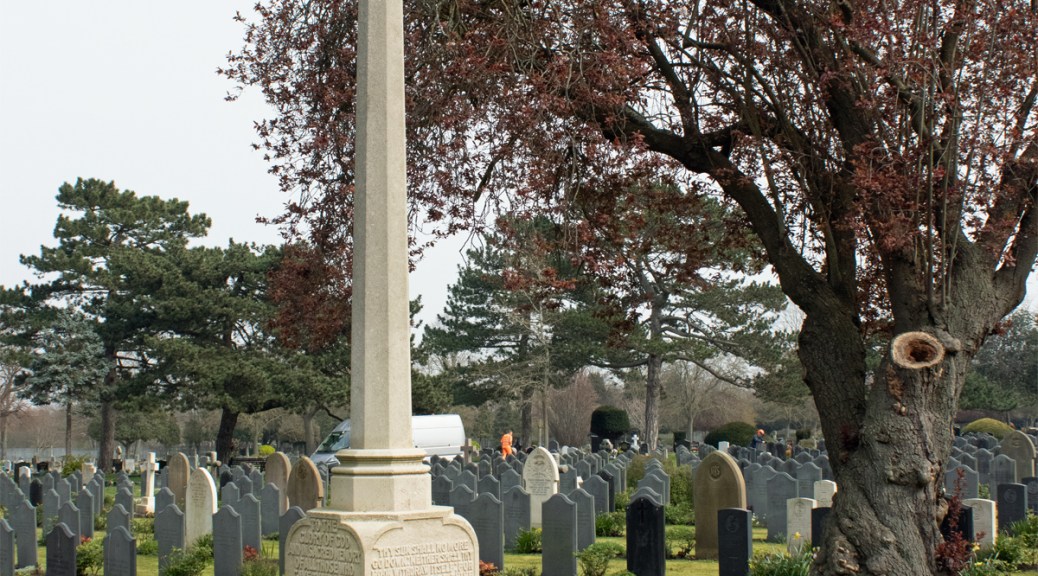
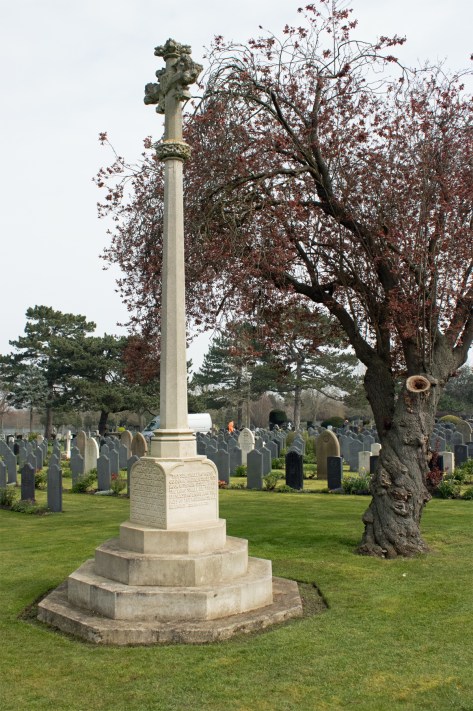
[Note: the photo above is of the memorial to the Chatham Air Raid victims, close to the mass grave for those whose bodies were not identified, in Woodlands Cemetery, Gillingham, Kent.]


Lance Corporal Hugh Parmiter

Lance Corporal Hugh Parmiter

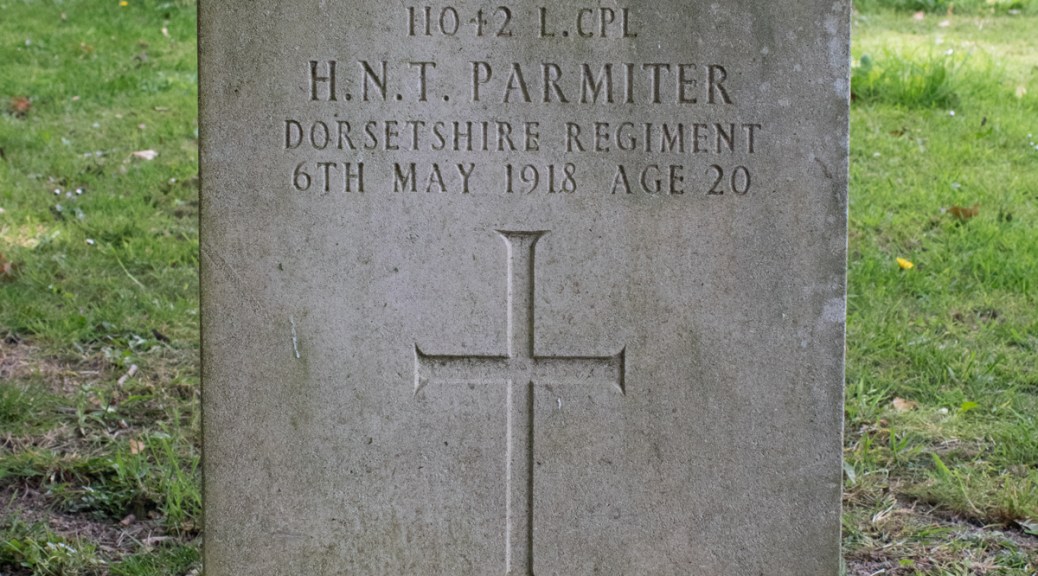
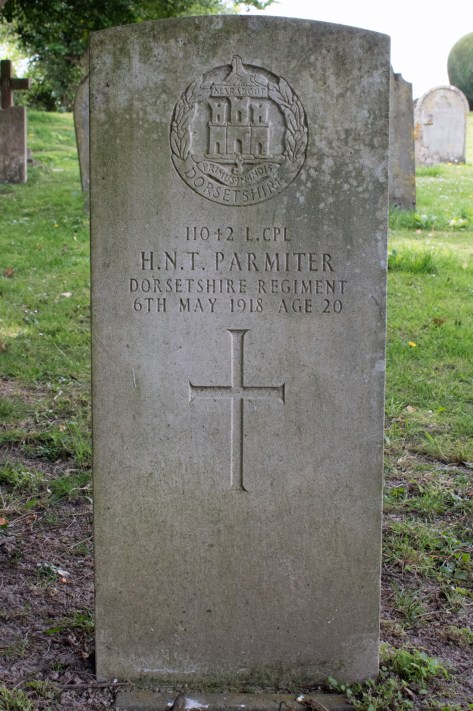
Hugh Norman Trivick Parmiter was born on 21st February 1898, and was the sixth of ten children. His father, James, was a Sergeant in the Dorsetshire Regiment, and the family travelled to where the army needed him. Hugh was the third of the children to be born in Bangalore, India, while his mother, Annie, gave birth to his oldest two siblings in Egypt.

By 1900 the Parmiters had returned to Britain, Annie and the children living in family barracks in Dorchester, while James was being trained in Hythe, Kent.

The 1911 census records the family living in the rural Dorset village of Gussage St Michael. Having been pensioned from the army, James was employed as a dairyman, and the family lived in a modest village cottage. At thirteen years of age, Hugh was still attending school, growing up in the peaceful surroundings of the Dorset countryside.

When war broke out, Hugh stepped up to play his part. Full details of his service have been lost to time, but from what remains it is clear that he enlisted in the Devonshire Regiment in the opening weeks of the war. By 11th July 1915, Private Parmiter’s unit was ensconced in the Balkans.

Hugh was caught up in the fierce fighting at Gallipoli, and rose to the rank of Lance Corporal. He would not come out unscathed, however, and was medically evacuated to Britain for treatment. While details of his injuries are unclear, they were severe enough for him to be medically discharged from the army: he was formally stood down on 17th January 1916, a week after the final evacuations from the Dardanelles Strait.

At this point, Hugh’s trail goes cold. James had passed away in 1914, and Annie had moved to Pimperne, a village on the outskirts of Blandford Fordham. Hugh’s health still dogged him however, and he passed away on 6th May 1918: he was 20 years of age.

The body of Hugh Norman Trivick Parmiter was laid to rest in St Peter’s Churchyard in Pimperne.


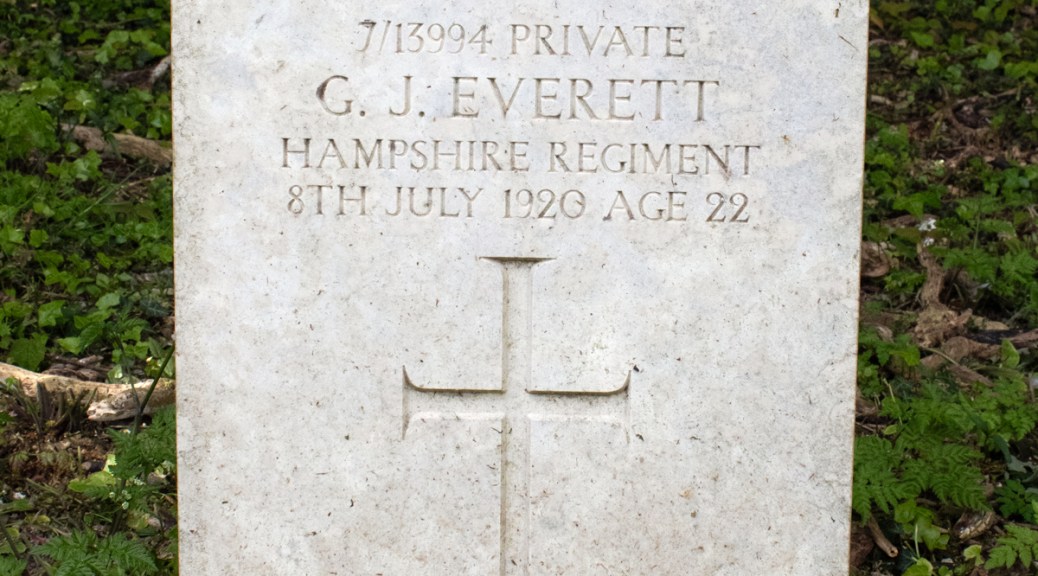
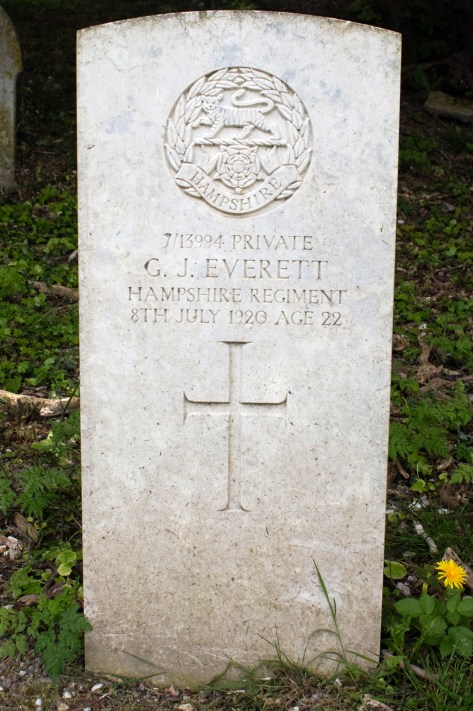
Private George Everett

Private George Everett

George James Everett was born in Fordington, Dorset, on 3rd July 1898. The fifth of six children, his parents were Frank and Jane Everett. Frank was a shepherd, and farm work was a trade into which at least two of George’s older siblings went.

George was only sixteen at the outbreak of the First World War, and so had to bide his time before he could serve his country. This he did, however, enlisting in the Hampshire Regiment on 24th July 1916. Assigned to the 52nd (Graduated) Battalion, he was sent to Canterbury, Kent for his training.

Private Everett’s time in the army was not to be as much of an adventure and he might have hoped. He spent his time on home soil, and, by the end of 1917, his health wasn’t standing up to the rigours of army life. George had contracted tuberculosis, and the contagious health condition led to his discharge from the military service on 5th December.

At this point, George’s trail goes cold. He returned to home to recuperate, and back at home, he fell in love. Amelia Aylen had been born in Beckenham, Kent, and it seems that she may have moved to Dorset to live with her brother, , Thomas, who had found farm work there. George and Amelia married in Blandford Forum on 3rd March 1919, and had a son, George Jr, that September.

George’s health would ultimately get the better of him. He passed away from tuberculosis and exhaustion on 8th July 1920: he had turned 22 years old just a few days before.

The body of George James Everett was laid to rest in the graveyard of St Peter’s Church in the village of Pimperne, to the north of Blandford.


As George and Amelia had been married after his discharge from the army, she was not eligible for his war pension. The 1921 census found her working as a servant for a retired army major in Wiltshire, while George Jr was being raised by her brother’s family.


Private Frank Tucker

Private Frank Tucker

Frank Tucker was born in the Devon village of Georgeham on 7th June 1890. The youngest of seven children, his parents were farmers Charles and Mary Tucker.

When Frank completed his schooling, he joined his older siblings helping on the farm. The 1911 census recorded all but one of the Tucker household doing agricultural work, Frank’s older sister Hannah being the exception, as she was working as an elementary school teacher.

War broke out in the summer of 1914, and Frank would be called upon to play his part. He did not enlist until 21st June 1918, however, when he joined the Royal Marine Artillery as a Private. His service papers note that he was 5ft 10ins (1.77m) tall, with fair hair, blue eyes and a fair complexion.

Private Tucker was sent to the Royal Marine depot in Eastney, Hampshire, for this training, but his time there was not to be a lengthy one.

It is with regret that we have to record the death from pneumonia, of Pte. Frank Tucker (RMA) son of Mr and Mrs C Tucker, or Darracott, which occurred at Haslar Hospital, Gosport, on Tuesday in last week after a brief illness. Deceased, aged 28, had been serving with the colours just a month, and his death came as a sad blow to his many friends and relatives resident in Braunton and district.

[North Devon Journal: Thursday 25th July 1918]

The body of Frank Tucker was taken back to Devon for burial. He was laid to rest in the graveyard of St George’s Church in his home village.