Category Archives: Sergeant

Serjeant William Shanly

Serjeant William Shanly

William Michael Shanly was born in Hampstead, Middlesex, in the summer of 1892. The fourth of eight children, of whom three died in infancy, he was the eldest son to Michael and Mathilde Shanly. Michael was the owner of a coffee and refreshment company.

The Shanly family lived at 78 Sumatra Road, Hampstead, but by the time he was nine years old, William had been sent to Sussex, and was boarding at the Xavarians Brothers School in Uckfield.

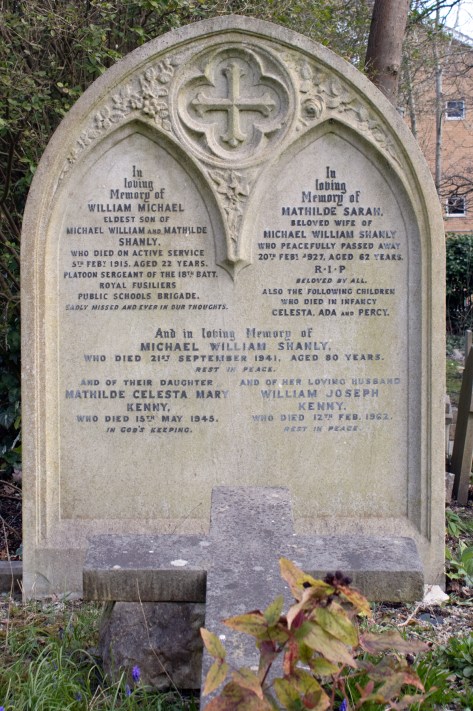
There is little further information available about William’s life. His epitaph on the family headstone suggests that he died on active service and was a Platoon Sergeant of the 18th Battalion of the Royal Fusiliers. His unit was also known as the 1st Public Schools, although exactly what role he held is unclear. His entry on the Commonwealth War Graves Commission Grave Index suggests that he was attached to the 15th (Reserve) Battalion, but his military records no longer exists, so it isn’t possible to confirm either way.

Serjeant Shanly died on 5th February 1915, aged 22 years of age. He had had an operation for appendicitis five days earlier, but had succumbed to peritonitis.

William Michael Shanly was laid to rest in the family plot in Highgate Cemetery, not far from where his grieving family were living.


Serjeant Richard Ford

Serjeant Richard Ford

Richard Oscar Ford was born in Williamstown, Australia, in July 1891. The oldest of four children – and the only son – his parents were Anthony and Mary Ford. Anthony was a soldier, but Richard chose a different route and took work as a labourer when he completed his schooling.

There is little information available about Richard’s early life, but when war broke out, he stepped up to play his part. He enlisted in the Australian Imperial Force on 9th November 1914.

By this point he was working as a bushman, and his service papers reveal something of the man he had become. Standing 5ft 7ins (1.7m) tall, he weighed 140lbs (63.5kg), Private Ford had auburn hair, blue eyes and a fair complexion.

Assigned to the Light Horse Regiment, Richard left Australia for Europe on in March 1915. His unit arrived on the Gallipoli Peninsula on 15th July, and he would remain there for the next five months.

In December 1915, Richard came down with a bout of influenza, and was medically evacuated to the island of Mudros, then on to Alexandria, Egypt. In January 1916, he was admitted to hospital again, this time suffering from gonorrhoea and, after treatment, he re-joined his unit on 2nd February.

Private Ford’s unit spent that spring training in Egypt, but on 29th May, they set sail for the Western Front. Within a week they had disembarked in the French port of Marseilles and headed north to Etaples.

The next couple of years would prove a little disjointed. Richard switched units in August 1916, and given the rank of Gunner, but within two months his role had changed to Driver. His service records suggest that he managed to avoid injury during the fighting he was involved in, but that did not mean that he avoided hospital completely.

In January 1917 Driver Ford was admitted to the 51st General Hospital with a heart murmur, returning to his unit on 16th March. He had a second spell in hospital in February 1918, having come down with laryngitis.

In July 1918, having spent some time at the 4th Army Corporal School, Richard was reassigned to the 3rd Australian Field Artillery. This move seemed to have been the focus he needed. Initially promoted to Bombardier, within a month he rose to Lance Corporal, and by December 1918 he was a full Sergeant.

After the Armistice was signed, Richard was given three weeks’ leave, which he spent in Britain. By January 1919, however, his health was becoming an issue again, and he was admitted to the military hospital in Fovant, Wiltshire, suffering from influenza. The condition worsened, and Sergeant Ford passed away from bronchopneumonia on 4th February 1919. He was 27 years of age.

Richard Oscar Ford was laid to rest in Highgate Cemetery, Middlesex. While there seems to be no direct connection between the location and the man, his father, Anthony, had been born in Hackney, so it can be assumed that there was a family link to the area.


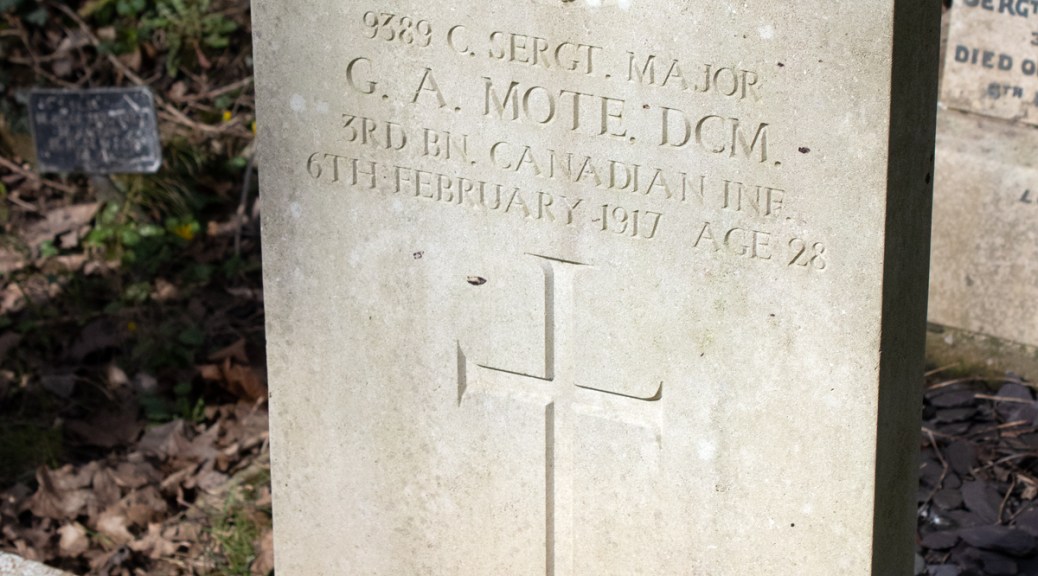
Company Sergeant Major George Mote

Company Sergeant Major George Mote

George Arthur Mote was born on the 25th August 1888 in Islington, Middlesex. The oldest of three children, his parents were Arthur and Norah Mote. The 1891 census recorded Arthur as a shoemaker’s finishing ink maker and the family had taken rooms at 45 Wyatt Road in Islington.

The next census return, taken in 1901, found that Arthur had been promoted, and was now a foreman or a leather dyer. The family had moved around the corner from the old address, and were living in rooms at 193 Blackstock Road.

At this point, George’s trail goes cold. By the autumn of 1914, he had emigrated to Canada, and was working as a corset cutter in Quebec. With war having broken out in Europe, it was here that he enlisted to serve his empire.

Goegre’s service records confirm the young man he had become. Standing 5ft 8ins (1.72m) tall, he had black hair, blue eyes and a dark complexion. A number of scars were also noted on his left forearm, the middle finger of his right hand, and on the left side of his neck.

While back in Britain, George had volunteered for the Middlesex Regiment, and this experience stood him in good stead, as he enlisted with the rank of Sergeant.

Attached to the 3rd Battalion of the Canadian Infantry, Sergeant Mote arrived in St Nazaire, France, on 11th February 1915. His unit was thrown into the deep end from the start, and George’s actions at the Second Battle of Ypres that spring won him the DCM. By the autumn, he had been promoted to Company Sergeant Major.

George continued to serve on the Western Front, but his luck was to change. On 5th June 1916, he was badly injured, receiving gunshot wounds to his right shoulder and back. Medically evacuated to Britain, he was admitted to Fort Pitt Hospital in Chatham, Kent. His medical records noted than he was paralysed, and, in October 1916, he was transferred to the Duchess of Connaught Hospital in Taplow, Berkshire.

Company Sergeant Major Mote spent the next four months admitted to the hospital, but his wounds would prove too severe to overcome. He passed away on 6th February 1917 at the age of 28 years old.

George Arthur Mote’s body was taken back to Middlesex for burial. He was laid to rest in the majestic Highgate Cemetery.


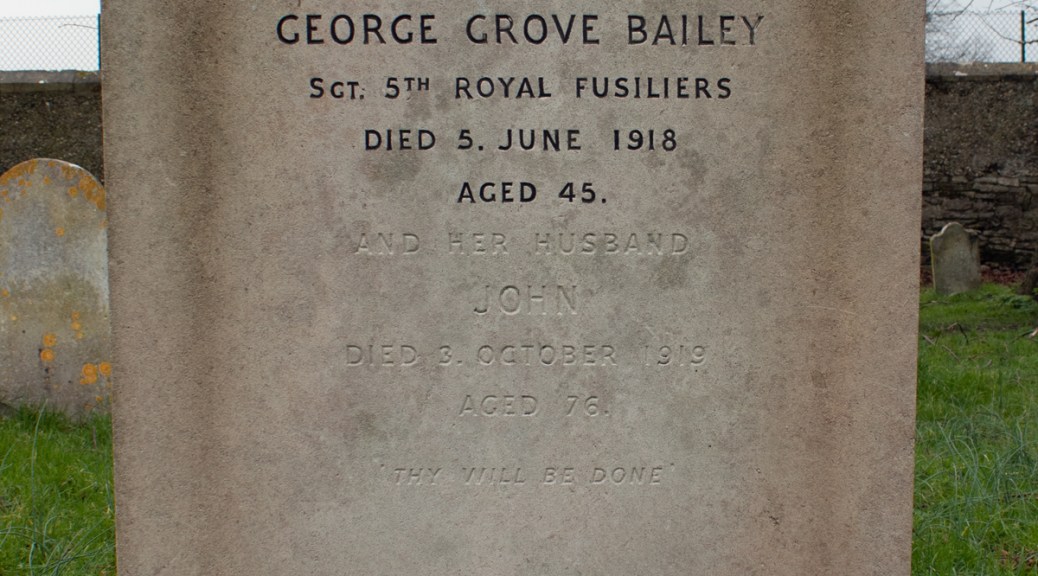
Serjeant George Bailey

Serjeant George Bailey

George Grove Bailey was born towards the end of 1873, in the Hampshire town of Lymington. He was the second of two children to John and Emma Bailey. John was a butler, but when Emma died when their youngest boy was just two years old, he seems to have changed career. The 1881 census found the family living at 45 High Street, Lymington, not far from the school and the Church of St Thomas the Apostle.

While he had the support of domestic servant Mary Ann, John was still young and, in 1884, he married again. His new bride was Sarah Woodman, and the couple would go on to have a daughter, Edith, two years later.

George falls off the radar at this point, and it is only from a newspaper report of his funeral in June 1918 that we are able to fill in some of the details:

The funeral took place on Monday afternoon of Sergt. George Bailey, youngest son of Mr John Bailey, of Highfield, Lymington, who passed away in the military hospital at Brighton, following a short illness. The deceased, who was 45 years of age, and was recently married, served in the South African War, and joined up at the commencement of the present war, being for some twelve months in the Fusiliers at the front. He was wounded, and since his return to this country has been acting as sergt.-instructor.

[Hampshire Advertiser: Saturday 15th June 1918]

George’s new wife was Winifred Mary Bailey, but there is little additional information about her. His regiment – the 5th Battalion of the Royal Fusiliers – was based on home soil, and would not have been the unit with which he had served on the Western Front. It’s not possible, therefore, to determine where he fought, or how he was wounded.

George Grove Bailey was buried in the family plot in the graveyard of St Thomas’ Church, Lymington, not far from where his father’s shop had been. John, who had been working as a poor rate collector, died a year after his son, and was laid to rest alongside his wife and youngest child.


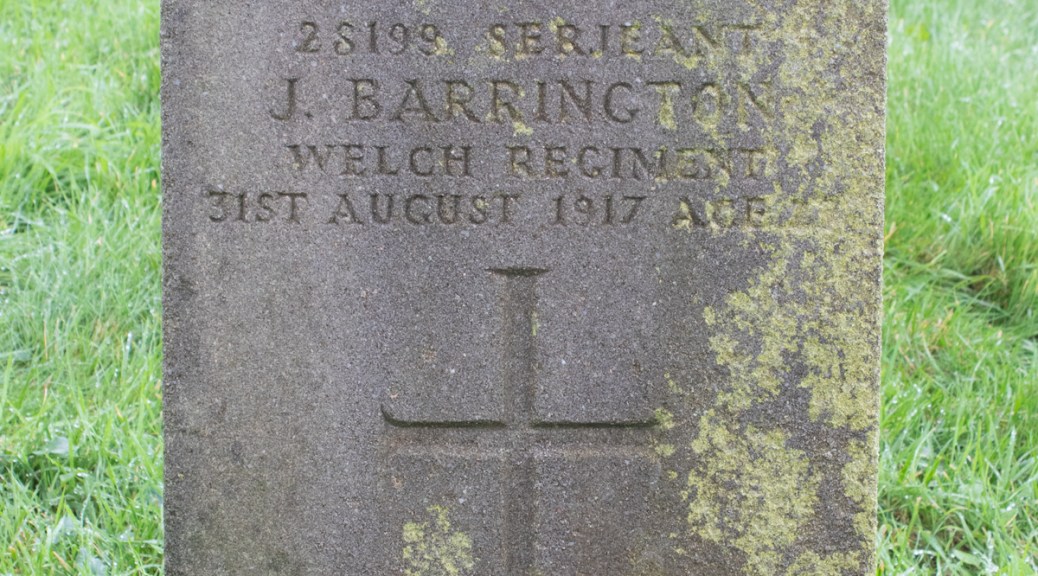
Serjeant James Barrington

Serjeant James Barrington

James Barrington was born in Westminster, Middlesex, on 1st June 1890. One of twelve children, his parents were Alfred and Hetty Barrington. Alfred worked in a soap factory, and the family seemed to move around: the 1891 census found them living in rooms at 3 Charles Buildings, St Martin-in-the Fields, while a decade later there were at 6 Lyric Place in Kennington, Surrey.

With so many mouths to feed, Alfred and Hetty were keen to get their children to work. The 1911 census found James working as a cowman on a farm in Mathry, Pembrokeshire, which must have come as a huge culture shock.

James soon settled in, however, and, on 9th November 1912, he married Elizabeth Thomas, the daughter of a labourer from nearby. The couple had a daughter, Hilda, who was born the following February.

When war broke out, James was called upon to play his part. There is little concrete information about his service, but he was assigned to the Welch Regiment, as was attached to the 18th (Service) Battalion (2nd Glamorgan). He had attained the rank of Sergeant by the summer of 1917.

Sergeant Barrington’s unit fought in some of the key battles of the early stages of the conflict, including the Battle of the Ancre in 1916, and the German retreat to the Hindenburg Line the following spring. It was during fighting on the Western Front that summer, though, that he was wounded, and medically evacuated to Britain for treatment.

James was admitted to a hospital in London, but his wounds would prove too severe: he passed away on 31st August 1917, at the age of 27 years old.

The body of James Barrington was taken back to Wales for burial. He was laid to rest in Mathry Church Cemetery, not far from where his widow still lived.


Serjeant Alfred Martin

Serjeant Alfred Martin

FATAL EXPLOSION IN NEW FOREST

Inquests have been held by Mr PB Ingoldby, County Coroner, on the bodies of Sergt. S Pickett, aged 36, and Sergt. A Martin, aged 29, whose deaths occurred recently as the result of an explosion in the New Forest.

The evidence showed that Sergt. Martin was killed. Sergt. Pickett was found insensible from shock, and died five hours later in hospital. In both cases the verdict was that death took place accidentally, and that no blame was attached to anybody.

[Hampshire Independent: Saturday 3rd March 1917]

The life of Sergeant A Martin is a challenge to piece together. While no service papers remain, the few documents that are available don’t provide enough information to unpick the his details.

His entry in the Army Register of Soldiers’ Effects confirms his name as Alfred Albert Martin, and that he served in the 3rd Battalion of the Hampshire Regiment. The document also gives his beneficiary as his mother, Philaidah.

Sergeant Martin’s pension ledger card gives his mother’s name as Louisa Martin, of 64 Bedford Street, Kingstone Road, Portsmouth. It also provides details of a brother, Sergeant Arthur Theodore of the Devonshire Regiment, who also died during the conflict.

The newspaper report suggests Alfred would have been born in around 1888, but there is no definite evidence of him, Philaidah/Louisa or Arthur in census records from 1891 to 1911.

Alfred’s Medal Roll Index Card confirms that he served in the Balkans, and arrived there on 25th April 1915. It gives his rank only as Sergeant, which would suggest that he may have had some military background before the First World War.

Sadly, there are too many pieces to the jigsaw of Sergeant Martin’s life missing to be able to build a better picture. Killed by an accident, he was laid to rest in Lyndhurst Cemetery, not far from where he died.


Serjeant Herbert Newman

Serjeant Herbert Newman

Herbert James Newman was born at the start of 1891, the fourth of five children – all sons – to Charles and Mary Newman. Charles was a general labourer, and the family lived on Well Head, to the north of Mere, Wiltshire.

Charles died when Herbert was just a boy, and Mary was left to raise the family on her own. By the time of the 1901 census, the family had moved to a cottage on Old Hollow, and she had taken work as a charwoman. Herbert’s older brother, Theodore and William, had also taken jobs to help with money.

In 1911, her boys had all grown up and were moving on, and Mary found more secure employment as a live-in servant to 80-year-old Anna Collard, a single woman who was living on her own means.

Herbert, meanwhile, had left Wiltshire for the capital, and was working as a compositor. He was boarding with widow Mary Ann Day and her two children, all living relatively comfortably at 41 St Thomas’ Road in Finsbury Park, Middlesex. Amongst the other lodgers were Jeweller John Tipping, conductor Wilfred Mustill and cycle mechanic Lester Rule.

When war came to Europe, Herbert stepped up to play his part. Full details of his military service have been lost to time, but it is clear that he had enlisted by December 1917. Initially joining the Tank Corps, It seems likely that Private Newman had seen service overseas, although there is nothing to confirm this either way.

As the conflict drew into its closing months, the now promoted Serjeant Newman seems to have been based in Dorset. In the spring of 1918, he fell ill, and was admitted to the Military Hospital in Wareham. The cause of his illness is unclear, but it would prove fatal: he passed away on 18th May 1918, at the age of 27 years old.

The body of Herbert James Newman was taken back to Wiltshire for burial. He was laid to rest in Mere Cemetery, on the outskirts of the town he had called home.


Interestingly, Serjeant Newman’s Pension Ledger Index Card gives his beneficiary as his mother, Mary. The British Register of Soldiers’ Effects, however, suggests his next-of-kin was his widow, Lucy, although there appears to be no record of Herbert having married.


Serjeant Samuel Dymond

Serjeant Samuel Dymond

Samuel John Dymond was born in Broadhempston, Devon, in 1878. The son of Samuel and Jane Dymond, his childhood appears to have been disjointed: the 1881 census found him living with his uncle and aunt, while a decade later he was under his grandmother’s roof.

This background may have driven him to a more stable life and, on 22nd May 1896, he enlisted in the army. Joining the Devonshire Regiment, his service records show that he was 5ft 5.5ins (1.66m) tall and weighed 126lbs (57.2kg). He had fair hair, grey eyes, a fresh complexion and two scars on his right kneecap.

Private Dymond spent the first couple of years on home soil. In February 1898, however, he journeyed overseas, serving in the East Indies and South Africa, for which he was awarded the South Africa Medal, with a clasp for the defence of Ladysmith. By January 1902, Samuel was on the move again, and he spent the next two years in India.

At the beginning of 1904, Samuel returned to Britain. He remained on home soil until his contract came to an end on 21st May 1912.

Away from the army life, love beckoned. Samuel married Alice Reynolds on 9th October 1904 in the parish church at Marldon, Devon. The couple went on to have three children: Dorothy, Annie and Albert.

By the time of the 1911 census, Samuel was working as a labourer, and the family were living at Vine Cottage on Church Street, Paignton, Devon.

When war broke out, Samuel was called into service once more but, frustratingly, it is at this point that his trail goes cold. Returning to the Devonshire Regiment, he was certainly in France by 11th December 1914. Later on in the war he transferred across to the regimental depot, but whether this was on home soil of overseas is unclear.

The next record for Samuel is that of his passing. He died in a military hospital in Devonport on 13th January 1920, the British Record of Soldiers’ Effects only at that point confirming that he had reached the rank of Serjeant. He was 42 years of age.

Samuel John Diamond was laid to rest in Paignton Cemetery, overlooking the town that had become his home.


Serjeant Edwin Huxtable

Serjeant Edwin Huxtable

Edwin Huxtable was born in the summer of 1863, the youngest of eight children to William and Sarah. William was a tailor and Sarah a dressmaker, and they raised their family in their home village of South Molton, Devon.

William’s two younger sons followed him into tailoring, although the family disappears from records for more than 20 years. William passed away in 1889, and a later newspaper report suggests that Edwin enlisted in the army in some capacity, serving in South Africa during the Second Boer War.

Back in Britain, Edwin married Hester Cole in 1904. She was a dressmaker from South Molton as well: the couple set up home and their business at 10 Broad Street in the village. They had two children: Sidney was born in 1905, and Herbert in 1906, although their younger boy passed away when just a babe-in-arms.

When war broke out, Edwin was called back into service. Details of his military career have been lost, but it is clear from what remains that he enlisted in the Devonshire Regiment, and served in the 11th (Reserve) Battalion. His previous time in the army was taken into account, and he was given the rank of Serjeant.

It is unclear whether Edwin saw any time overseas as part of the First World War, but his age and health were against him. Suffering from pneumonia, he was admitted to a hospital in Torquay. The lung condition got the better of him, however, and he passed away on 14th April 1915. He was 52 years of age.

Taken back to South Molton for burial, Edwin Huxtable was laid to rest in the village’s cemetery.


The 1921 census showed that Hestor was keeping up the family business. She was living in East Street, South Molton, and listed as a dressmaker and employer.


Sergeant Reginald Brown

Sergeant Reginald Brown

Reginald William Brown was born in South Molton, Devon, the summer of 1873. The second of four children – all boys – his parents were William and Mary Brown. William died when Reginald was just a child, and the 1881 census found Mary supporting her children by working as a mangler.

Details of Reginald’s early life are sparse. In the autumn of 1898 he married Elizabeth Mayne and the couple set up home at 13 Cook’s Cross. The couple went on to have six children, and Reginald supported his family with work as a gardener.

Alongside his gardening work, Reginald volunteered for army service. Again, full details are unclear, but he was attached to the Devonshire Regiment from 1908. Initially for a year’s contract, he seemed to renew this on-and-off for the next six years.

When war broke out, Reginald was formally called into service. HIs time in the army resulted in him being given the rank of Sergeant, and by October 1914, his unit – the 4th Battalion – was sent to India.

Reginald spent the next couple of years overseas, before being posted back to Britain in the spring of 1916. That November he spent six weeks admitted to the Manor County of London War Hospital in Epsom, Surrey, suffering from bronchitis. This was the result of malaria, and he would continue to suffer from lung complaints for the next few years.

In September 1917, Elizabeth passed away, and Reginald was left, at a distance at least, to raise his children. By now, his health was being severely impacted, and in April 1919, he was medically discharged from army service.

Reginald returned home, but he would quickly succumb to illness. He passed away at 43 South Street, South Molton, on 22nd April 1919. He was 45 years of age.

Reginald William Brown was laid to rest in South Molton Cemetery. His was a family plot, and he was reunited with his beloved Elizabeth.