Tag Archives: 1918

Bombardier Frank Sloman

Bombardier Frank Sloman

Frank Sloman was born in the autumn of 1887, and was the youngest of five children to Frank and Emma. Frank Sr was a mason from Jersey, in the Channel Islands, but it was in Tiverton, Devon, that he and Emma made their home and raised their family. The 1891 census found the family living on Castle Street, but by 1901 they had moved down the road to St Peter’s Street.

Frank Jr found work as a painter when he finished his schooling, but he sought adventure and a career. He was already a volunteer for the Devonshire Regiment, and, on 7th May 1904, he officially enlisted as a paid member of the troop. Private Sloman’s records show that he was 5th 10.5ins (1.79m) tall, and weighed 129lbs (58.5kg). He was noted as having brown hair, grey eyes and a fresh complexion.

Private Sloman spent two years on home soil. He quickly extended his contract, and this led to more opportunities. By December 1906 his unit was in India, and he would go on to spend five and a half years there.

In December 1907, Frank transferred to the Royal Garrison Artillery. He initially held the rank of Gunner, before being promoted to Bombardier in January 1912, and Corporal just three months later. In October, Frank returned to Britain, and was stood down to reserve status. He returned to Tiverton, and found work as a porter at the local station.

War was on the horizon, however, and when conflict broke out, Frank was called upon to play his part once more. Initially taking up the rank of Corporal in the Royal Field Artillery, he reverted to the role of Gunner at his own request. By this point, his unit was in France, and he would remain there for the next eight months.

On 6th May 1915, Frank returned to Britain, and was attached to 2B Reserve Brigade. He was based at the training facility in Bettisfield Park in Clwyd, and would spend the next eighteen months there. In June 1916, he was once again promoted to the rank of Bombardier.

Love was on the cards, and, on 17th June 1916, Frank married Frances Hadlow. There is little information available for her, but the couple exchanged vows at the Register Office in Windsor, Berkshire.

By the autumn of 1916, Frank’s health was becoming an issue. He contracted phthisis, or tuberculosis, and was sent to the the south coast for recuperation. His condition would ultimately render him unfit for continued military service, and Bombardier Sloman was discharged from the army on 17th December 1916.

His papers show that he had grown to 6ft 2.5ins (1.89m) in height, and, while physically unfit, he was a steady, sober and reliable man. He and Frances had taken rooms at 7 Hawley Street, Margate, Kent, but it seems that the couple soon moved back to Devon. Their new home was a small cottage at 3 Westbrook Place in Tiverton.

At this point, Frank’s trail goes cold. It is unclear whether he took up work again – or was able to do so – but his lung condition was ultimately to get the better of him. He passed away on 3rd June 1918, at the age of 30 years old.

Frank Sloman was laid to rest in Tiverton Cemetery, on the outskirts of the town in which he had grown up.


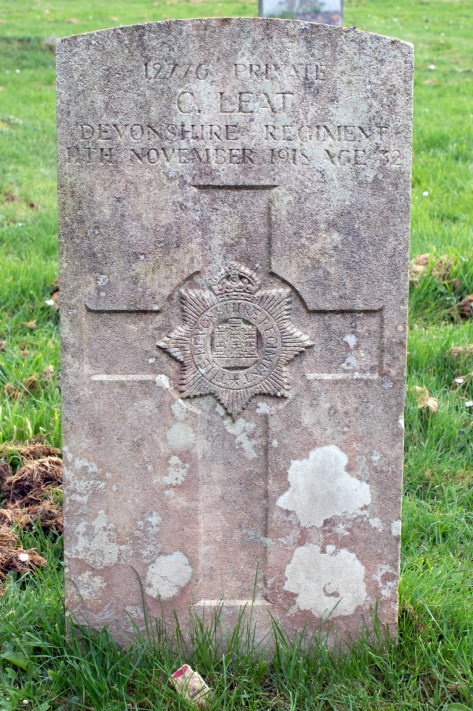
Private Charles Leat

Private Charles Leat

Charles Leat was born at the start of 1888 in Tiverton, Devon. One of thirteen children, his parents were Sidney and Ann Leat. Sidney worked as a lace maker, and the family lived in a crowded cottage on St Andrew Street to the south of the town centre.

When Charles left school, he found work as a grocer’s errand boy. Sidney died in 1897, Ann had to take on lace work herself. The house was too small for the growing family, and so the 1901 census found Charles and his brother Arthur living with his maternal aunt, Mary.

Things had moved on as the new century progressed. By 1911, Charles had moved to South Wales, and was living with his older brother, James, and his family in Glamorgan. James was a house painter, but his sibling had taken on work as a railway porter, and the family lived in terraced house at 57 Tydfil Street, Barry.

When war hit Europe, Charles seemed keen to play his part. Sadly, full details of his military service have been lost to time, but it is clear that he initially enlisted in the opening weeks of the conflict. Joining the Devonshire Regiment, he was assigned to the 11th Battalion.

A later newspaper report suggests that he “had been through most of the fighting on the Western Front… [and] was seriously wounded in 1915.” [Western Times – Friday 15 November 1918] It was after he had recuperated that Private Leat was reassigned to the regiment’s Labour Corps.

By the summer of 1918, Private Leat was serving on Salisbury Plain, Wiltshire. While here, he fell ill, and was eventually admitted to the Amesbury Military Hospital. His condition, pneumonia, was to prove too severe for his body to take, however, and he passed away from the condition on 11th November 1918, Armistice Day. He was 30 years of age.

Charles Leat’s body was taken back to Devon for burial. He was laid to rest in Tiverton Cemetery, not far from where his family still lived.


Petty Officer William Clark

Petty Officer William Clark

William George Clark was born on 23rd November 1884, and was the oldest child to John and Harriet. John was an agricultural labourer from Exminster, Devon, and this is where the family were born and raised.

When he completed his schooling, William found work as a gardener. However, he wanted bigger and better things for himself, and sought out a career at sea. On 12th March 1900 he enlisted in the Royal Navy: being under the formal age to enlist, he was given the rank of Boy 2nd Class.

William was sent to HMS Impregnable, the training establishment in Devonport, for his induction. Over the next two years – until he turned 18 in November 1902 – Boy Clark started to learn his trade. He was promoted to Boy 1st Class in October 1900, and spent time on the frigate HMS Agincourt and the cruiser HMS Melampus.

When William came of age, he was formally inducted into the Royal Navy as an Ordinary Seaman. His service records show that he was just under 5ft 1in (1.55m) tall, with black hair, blue eyes and a fair complexion. He was also noted as having a tattoo of an anchor in his left arm.

Over the next five years, William served on three further ships, returning to HMS Vivid – the Royal Naval Dockyard in Devonport – in between voyages. He travelled the world and, in May 1904, was promoted to the rank of Able Seaman.

Away from the navy, love blossomed. In May 1907, William married Louisa Cosway in Tiverton, Devon. She was a few months older than her husband, and the couple would go on to have one child, William, who was born the following spring.

Back at sea, and Able Seaman Clark’s career continued. In November 1911 he was promoted to Leading Seaman, reaching the rank of Petty Office in January 1917. During his eighteen year career, he would serve on a total of eleven ships, but in the closing months of the war, William’s health was beginning to suffer. On 9th May 1918, he was medically discharged from service, suffering from heart disease.

William returned home to Tiverton. His time with his family was to prove tragically brief: he passed away from mitral disease and pneumatic fever on 13th May 1918, at the age of 33 years old.

William George Clark was laid to rest in Tiverton Cemetery. His grave was just a 15min walk from where his widow and son lived on Fore Street, in the town centre.


Serjeant Herbert Newman

Serjeant Herbert Newman

Herbert James Newman was born at the start of 1891, the fourth of five children – all sons – to Charles and Mary Newman. Charles was a general labourer, and the family lived on Well Head, to the north of Mere, Wiltshire.

Charles died when Herbert was just a boy, and Mary was left to raise the family on her own. By the time of the 1901 census, the family had moved to a cottage on Old Hollow, and she had taken work as a charwoman. Herbert’s older brother, Theodore and William, had also taken jobs to help with money.

In 1911, her boys had all grown up and were moving on, and Mary found more secure employment as a live-in servant to 80-year-old Anna Collard, a single woman who was living on her own means.

Herbert, meanwhile, had left Wiltshire for the capital, and was working as a compositor. He was boarding with widow Mary Ann Day and her two children, all living relatively comfortably at 41 St Thomas’ Road in Finsbury Park, Middlesex. Amongst the other lodgers were Jeweller John Tipping, conductor Wilfred Mustill and cycle mechanic Lester Rule.

When war came to Europe, Herbert stepped up to play his part. Full details of his military service have been lost to time, but it is clear that he had enlisted by December 1917. Initially joining the Tank Corps, It seems likely that Private Newman had seen service overseas, although there is nothing to confirm this either way.

As the conflict drew into its closing months, the now promoted Serjeant Newman seems to have been based in Dorset. In the spring of 1918, he fell ill, and was admitted to the Military Hospital in Wareham. The cause of his illness is unclear, but it would prove fatal: he passed away on 18th May 1918, at the age of 27 years old.

The body of Herbert James Newman was taken back to Wiltshire for burial. He was laid to rest in Mere Cemetery, on the outskirts of the town he had called home.


Interestingly, Serjeant Newman’s Pension Ledger Index Card gives his beneficiary as his mother, Mary. The British Register of Soldiers’ Effects, however, suggests his next-of-kin was his widow, Lucy, although there appears to be no record of Herbert having married.


Able Seaman Arthur Norris

Able Seaman Arthur Norris

Arthur Norris was born on 24th February 1897 in the Wiltshire town of Mere. The seventh of nine children, he was one of four sons to Fred and Mary Norris. Fred was a domestic groom, and the family lived on Castle Street on the western edge of the town.

By the time of the 1911 census, Arthur had left school, and had found work as an errand boy. He had moved out of the family home, and was living with his older sister, Beatrice, and her husband. Piecemeal work wasn’t something Arthur was keen on, however, and in September 1913, he found himself a career.

That autumn, Arthur enlisted in the Royal Navy. Just 16 years of age, he was too young to formally join up, and so he was given the rank of Boy 2nd Class. He was sent to HMS Impregnable, the training ship based in Devonport, Devon, for his induction, and seemed to make an impression.

On 14th May 1914 Arthur was promoted to Boy 1st Class, and was assigned to the depot ship HMS Gibraltar. On 24th February he came of age, and officially joined the Royal Navy. His service records show that he was 5ft 5ins (1.65m) tall, with dark brown hair, brown eyes and a fresh complexion. He was noted as having a mole on his left shoulder blade.

The now Ordinary Seaman Norris remained on Gibraltar for most of the year. After a couple of weeks back in Devonport, he was assigned to the Armed Merchant Cruiser Oropesa, and remained on board for the next twelve months. During his time there, Arthur was promoted again, gaining the rank of Able Seaman.

Over the next three years, Arthur served on three further vessels: HMS Excellent from March 1916; HMS Woolwich from April 1916 to June 1918; and HMS Columbine from July 1918.

While attached to the Columbine, Arthur fell ill. He contracted pneumonia, and passed away on 16th October 1918. He was 21 years of age.

The body of Arthur Norris was taken back to Wiltshire for burial. He was laid to rest in Mere Cemetery, not far from where his grieving family were still living.


Private Horace Welch

Private Horace Welch

Horace Ralph Welch was born in Mere, Wiltshire, in the autumn of 1884. The middle of seven children, his parents were John and Ellen Welch. John was a silk drier, and the family lived in Water Street, close to the town centre.

John died in 1895, and Ellen was left to bring up the family on her own. Her older children found work, and Horace was employed by John Runtz, stock broker and Justice of the Peace. The family lived at 131 Lordship Road, Stoke Newington and employed two live-in servants other than Horace, who worked as a page.

On 11th November 1916, Horace married Beatrice Batchelor. Born in Watford, Hertfordshire, she was the daughter of an engine driver and, at the point she exchanged vows, she was working as an assistant in a boot shop. Horace was now employed as a butler, and the couple set up home in Watford. They went on to have a daughter, Eileen, in the summer of 1917.

By this point, Horace has stepped up to play his part in the conflict that was raging across Europe. He enlisted on 12th December 1916 – just four weeks after marrying Beatrice – and was initially assigned to the Kent Cycle Corps.

Private Welch would spend the best part of two years on home soil, before being shipped off to France in April 1918. By now he had been transferred to the Queen’s Own (Royal West Kent Regiment).

Horace was only overseas for a matter of a fortnight, before he became unwell. Medically evacuated to Britain for treatment, he was admitted to the Voluntary Aid Detachment Hospital in his home town, Mere. Suffering from appendicitis, he was operated on, but died from peritonitis soon afterwards. Private Welch passed away on 2nd July 1918: he was 33 years of age.

Horace Ralph Welch was laid to rest in Mere Cemetery, on the outskirts of the town.


Private Bernard King

Private Bernard King

Bernard Gale King was born in the spring of 1881, the seventh of eleven children to Charles and Charity King. Charles was a bookseller from Huntingdonshire, but he and Charity had moved to Wolborough, Devon by the time Bernard was born.

The 1901 census found that the family had moved again and Charles had set up shop in the Tormoham area of Torquay. By this point Bernard and his older sister, Florrie, were helping their father with the business, which was located at 99 Union Street .

On 5th March 1904, Bernard married Lilian Potter at the Wesleyan Chapel in Brixham. Sadly, there is little information available for her, but she was a year older than her husband, and had been born in Exeter. The couple set up home on Rock Road, Torquay, and had three children: Frederick, William and Gladys.

By the time of the 1911 census, Bernard had moved away from selling books, and had become a photographer. Storm clouds were brewing over Europe, however, and things were to change.

When war broke out, Bernard stepped up to play his part. He enlisted on 11th December 1915, and joined the Devonshire Regiment. His service records show that the family had moved along the coast, and were living at 22 Winner Street in Paignton.

Private King was notes as being 5ft 7ins (1.7m) tall and weighing 119lbs (54kg). He had dark brown hair, blue eyes and a pale complexion. Initially assigned to the 4th Battalion, by October 1916, he had transferred to a home service unit, and remained on home soil during his time in the army.

In the spring of 1917, Bernard contracted tuberculosis. The contagious nature of the illness meant that he was deemed no longer fit for any service, and he was medically discharged on 7th April 1917.

At this point Bernard’s trail goes cold. He seemed to have returned home, but would ultimately succumb to the lung condition he had contracted in the army. He passed away on 21st October 1918: he was 37 years of age.

Bernard Gale King was laid to rest in Paignton Cemetery, overlooking the town in which his grieving family still lived.


Gunner Alfred Potter

Gunner Alfred Potter

The early life of Alfred John Potter is a challenge to piece together. The second of four children – and the only son – to John and Alice, he only appears on the 1911 census. This shows him living with his grandparents, William and Sarah Endacott, at 3 Lawrence Terrace in Paignton, the town in which he was born. Alfred was 16 at this point, and was employed as a mason’s apprentice.

The same census return found Alfred’s parents and siblings were also living in Paignton, but in a 5-roomed cottage on Polsham Road. There is nothing to confirm why he had moved out, although with three sisters, his grandparents may have offered the space and privacy he wanted.

Details of Alfred’s time in the army are similarly lacking. That he had enlisted by March 1918 is clear. He joined the Royal Field Artillery and was assigned to the Command Depot in Ripon, North Yorkshire.

By the late summer of 1918, Gunner Potter had contracted pneumonia. He died on 6th September at the age of 23 years old. Records state that he passed away in Torquay and, given the proximity to his home town, it is likely that he had been admitted to a hospital or convalescent home in the area.

Alfred John Potter was laid to rest in Paignton Cemetery, overlooking his home town.


Private Thomas Legg

Private Thomas Legg

Thomas John Gladstone Legg was born in Dunster, Somerset, on 30th July 1898. The fourth of six children, his parents were John and Louisa Legg. John was a baker, and the family lived on West Street in the village.

By 1911, the Leggs had moved south, settling in Winsford, on the outskirts of Exmoor. Thomas was still in school, but his two older brothers were helping their father with the bakery business, and they had taken in a boarder – road worker John Jeffrey – to help bring in a bit of additional income.

When war broke out, Thomas stepped up to play his part. There is little information available about his military service, but it is clear that he had enlisted in the Devonshire Regiment by the spring of 1918.

Private Legg was assigned to the 15th Battalion, although he soon transferred to the 474th Agricultural Company of the Labour Corps.

The profound sympathy of parishioners goes out to Mr and Mrs J Legg… who have sustained a double bereavement. On October 22nd their daughter, Miss Ivy Marion Legg, aged 23, succumbed to pneumonia. Their son, Pte J Legg, came home from training to attend his sister’s funeral, and he was attacked by pneumonia and died in a few days. Amid general tokens of respect and sympathy, the interments were made in Highbray Churchyard. Both father and mother have been seriously ill, but are now recovering. There are still several critical cases of complications following influenza in the parish.

[North Devon Journal: Thursday 14th November 1918]

Thomas passed away on 2nd November 1918: he was 20 years of age. He was laid to rest alongside his sister in All Saints’ Churchyard, High Bray.


Private Willie Howells

Private Willie Howells

In the peaceful Congregational Chapelyard of Berea, St Davids, Pembrokeshire, is a headstone dedicated to Willie Howells, grandson of Benjamin and Mary. The inscription – in Welsh – confirms that he died on 26th November 1918, at the age of 23.

The 1901 census records the couple living at Rhos y Gorse with four of their eleven children and two of their grandchildren, including William. There is no documentation to confirm which of their children was his parent.

Tragically, Willie’s military records are also lost to time. The Commonwealth War Graves Commission give his name as Private BW Howells. They suggest that his first regiment was the South Wales Borderers, and that he transferred to the Northern Command Labour Centre of the Labour Corps. His service numbers for both units draw a blank, however.

The life of Willie Howells is destined to remain a mystery, one of the many whose stories were buried with them.