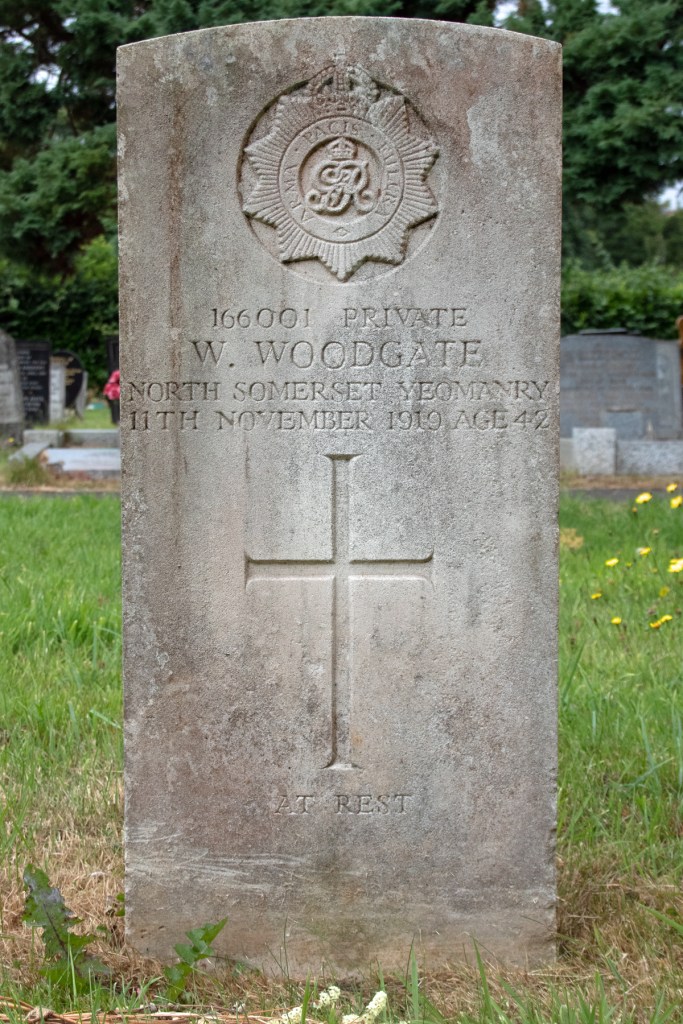
Much of William Woodgate’s life seems destined to remain a mystery. He was born in Dunsford, Devon, in around 1877, and was the son of Lewis Woodgate.
By the age of 14, he was living on a farm on Bovey Tracey, working as an agricultural labourer for the farm owners, Thomas and Betsy Dayment. Ten years later, William had made the move to Wellington in Somerset, where he was lodging with the Denner family, and working as a carter.
On 20th June 1903, William married Mary Jane Grinter, a signalman’s daughter from Wellington; the couple went on to have three children, Lewis, Leonard and Francis. The young family set up home in North Street, near the centre of the town. By the 1911 census, William had changed profession, and was working as a fish salesman.
War was about to descend on Europe, and, in May 1916, William signed up to play his part. He was enlisted as a Private in the North Somerset Yeomanry, and was assigned to the 2nd/1st Battalion. His service record shows that he was 5ft 2.5ins (1.59m) tall, and weighed 117lbs (53kg), and had a fair physical development.
Private Woodgate did not see any service abroad: his battalion became part of the 6th Cyclist Brigade, and he was based in East Anglia and, for a short while, in Northumberland.
There is little further detail about Private Woodgate’s life. He survived the war, and was transferred to the Army Reserve on 9th February 1919, having served for just under three years.
At this point, William’s trail goes cold. He returned home to Somerset, and passed away nine months later, on 11th November 1919. He was 42 years of age.
William Woodgate was laid to rest in Wellington Cemetery, not far from where Mary and their children lived.
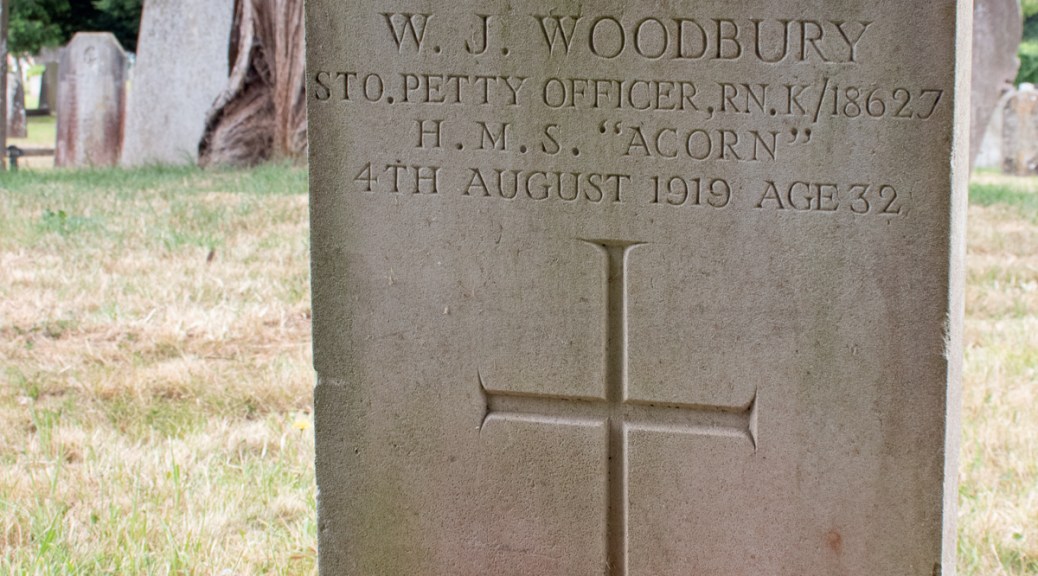
Wilson John Woodbury was born on 8th December 1888, and was the third of seven children to Daniel and Elizabeth Woodbury. Daniel was a chair maker from Wellington, Somerset, and this is where the family – including six boys and one girl – were raised.
By the time of the 1901 census, Daniel had had a change of career – he was now working as an oil presser. His and Elizabeth’s oldest three boys, Wilson included, had also found work, and were employed as wool spinners.
Elizabeth passed away in 1906, when Wilson was just seventeen years old. This may have pushed him to bigger and better things, and a career. On 13th August 1908, at the age of 19, he enlisted in the Royal Navy as a Stoker 2nd Class. His service record shows that he was 5ft 7.5ins (1.71m) tall, had light brown hair, blue eyes and a fresh complexion. It also noted that he had a tattoo of a cross on his right forearm.
Stoker Woodbury was initially trained at HMS Vivid – the naval dockyard at Devonport. On 9th February 1909, however, he was given his first posting, on board HMS Defence. He spent two years on board the armoured cruiser, and, gained a promotion to Stoker 1st Class.
During the remainder of his initial service, Wilson served on two further ships – HMS Sentinel and HMS Bellona – returning to Devonport between each posting. When he completed his five-year contract, Wilson voluntarily signed up for a further seven years with the Royal Navy.
As war came to Europe, Stoker Woodbury was given a number of assignments, on the battleships HMS Caesar and Lord Nelson, the cruisers HMS Blake and Apollo, and the depot ship HMS Blenheim. Further promotions followed – Leading Stoker in 1915 and Stoker Petty Officer two years later.
Wilson’s oldest brother, James, was serving in the Labour Corps during the conflict. Based in Northern France, he was assigned to the 720th Company, although further details are unclear. He almost survived the war unscathed, but contracted an illness of some description and died on 3rd November 1918, aged 34 years old. He was laid to rest in the Terlincthun British Cemetery in Wimille, France.
Stoker Petty Officer Woodbury returned home on leave in July 1919. The plan was to meet up with his fiancée who lived in Rockwell Green, near Wellington, but he instead turned up unexpectedly at his brother Fred’s home instead. Wilson said he had returned to Somerset because his girlfriend had broken off the engagement the previous week: the couple had been due to marry when he next came home on leave.
Fred told Wilson that she was not worth it, and they had gone drinking with a friend. Fred later said that on his previous leaves his brother had taken to drinking more than was good for him, but on that evening – Saturday 2nd August 1919 – he did not get drunk.
The following Monday, Stoker Petty Office Woodbury had taken himself down to the railway at Wellington, and been hit by a train. The action was deliberate, as, about his person were three letters. The first was to Daniel.
To My Dear Father,
Sorry to cause you any inconvenience or trouble, and please don’t worry about me, as I’m not fit to worry about. I have had this in mind for about a week. I can’t sleep and can’t eat, as I am broken-hearted, but not insane. This is through love. Now I must exit myself, and I am in great pain. Written at 4:15pm Sunday afternoon…
This is all I have to say in this world. Hoping you and my dear sister will soon forget their broken-hearted
Wilson John Woodbury.
Wilson’s second letter was to his only sister, Ivy. This included details of a parcel left on board his ship, in which was the ring he had given to his fiancée, which he asked that Ivy wear as a memory of him.
Knowing the implications of what he was doing, the third letter was addressed to the jury of the inquest.
My leave expires at 1pm, and my life expires just before by my own hand. I wait to get the chance to put a stop to my life. This would not have happened to bring disgrace on my relations. I am quite sane. Written at 2pm.
On the afternoon of Monday 4th August 1919, Wilson made his way to the Woodford crossing, a short distance from Wellington Railway Station.
…he waited by the side of the line at the crossing for a train, and as the Northern express approached he laid down with his head on the metals, being practically decapitated.
Taunton Courier and Western Advertiser: Wednesday 13th August 1919
The fiancée in question did attend Wilson’s inquest, although the Coroner did not think it was necessary to call her. The newspaper report referred to her, but not by name. She will remain a mystery.
Despite the evidence of his own hand, the inquest found that Stoker Petty Officer Woodbury had committed suicide while temporarily insane. He was just 30 years of age.
Wilson John Woodbury was laid to rest in the cemetery of his home town, Wellington.
Frederick William Twist was born in around 1884, the older of two children to William and Clara Twist. William had been born in Faversham, Kent, and was a labourer in the cement works there.
Frederick did not follow his father’s trade, however, and, on leaving school, he found work in the printing office of the Faversham News, before moving on to Filmer Bros., a local nursery and bulb grower. He was a keen member of the Salvation Army, and played in the local Corps’ band. After more than a decade at Filmer Bros., Frederick took up new employment with Salvation Army Insurance, and worked out of the Whitstable office.
In the spring of 1909, Frederick married Helen Bedster, a bargeman’s daughter from Faversham. At the time of their wedding, she was working as a servant for a brewer manager in the town. The couple settled down in a terraced house in the centre of the town, and went on to have two children.
When war broke out, Frederick was called upon to play his part, but his time in military service was to be a troubled one. A contemporary newspaper expanded on this:
The toll of war continues through nearly a year has elapsed since the war practically ceased… [following] the death of Lance Corporal Frederick William Twist, 16th Lancers, a Faversham man, who passed away at the Military Hospital Woolwich, after a great deal of suffering.
Lance Corporal Twist enlisted under the Derby Scheme and being called up in May 1916, he joined the 16th Lancers and was sent to Ireland. At the end of that year he was drafted to France but in the following May he was invalided home with trench fever.
On his discharge from hospital in Devonshire he returned to Ireland. Then in March of last year there came the great offensive on the Western Front and for the second time deceased was drafted to France. He was not, however, at all fit, and the result was that he was obliged to fall out.
After a further spell in hospital and convalescent camp at the base he was employed on light duty – stores keeping and clerical work – to which he stuck with dogged spirit until in June last he again broke down and was once more in hospital.
Later he was transferred to the Royal Herbert Hospital, Woolwich, where he died on October 7th – a fine example of a British soldier who had struggled, even against weakness and suffering, to do his duty to the very last.
Faversham News: Saturday 18th October 1919
Lance Corporal Frederick William Twist was 35 years of age when he passed. He was laid to rest in the Borough Cemetery of his home town, Faversham.
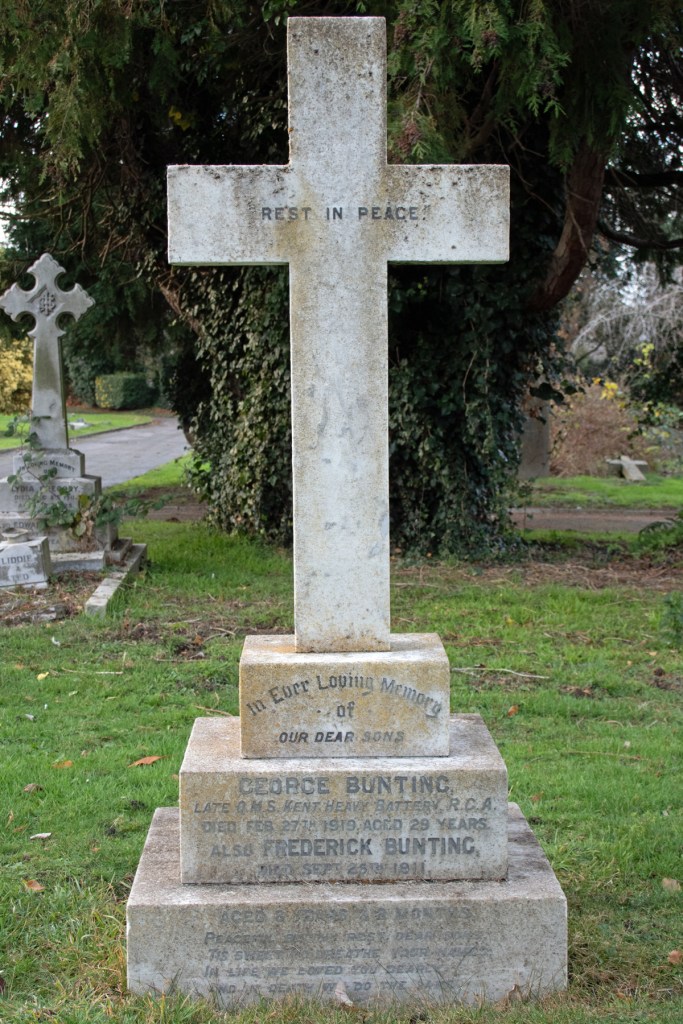
George William Willis Bunting was born in Faversham, Kent, in the spring of 1889. The middle of eleven children to George and Mary Ann Bunting, he was also the oldest boy. George Sr was a labourer in the town’s munitions works, and his son followed suit, and was recorded as a cordite labourer there in the 1911 census.
When war came to Europe, George Jr was keen to play his part. He enlisted in the Royal Garrison Artillery, and was assigned to the 343rd Siege Battery. While full details of his service are not available, George’s life was laid out in a newspaper report following his death:
The death has occurred in quite pathetic circumstances of Battery Quartermaster Sergeant George William Bunting, 1st Kent Heavy Battery, Royal Garrison Artillery… who, after serving throughout the war, and coming unscathed through more than three years service in France, though he had several narrow escapes, had died of pneumonia at his home, just as he was anticipating return to civil life.
BQMS Bunting joined the Faversham Volunteer Corps (in which his father also formerly served) some seven years before the war, and when was broke out he was at the annual training with the Battery. War service immediately followed and in 1915 he went to France and, except for leave, had been out there ever since until a few weeks back when he returned for demobilisation. He was not feeling at all well when he arrived home, indeed he seems to have been so unwell that when he got indoors he remarked “I’m done.”
His words, unhappily, were only too prophetic, for he never left the house again, pneumonia developing and culminating in his death on February 27th, only nice days after his arrival.
Prior to the war the deceased, who was in his 30th year and unmarried, had been employed at the Cotton Powder Works ever since he left school. At the commencement of his war service, he was a Corporal, but his keenness at his work steadily gained him promotion and eventually he reached the rank of Battery Quarter Master Sergeant. Keen and conscientious himself, he expected the same in others, and it says much for his example and influence that he was held in the very highest regard by the men of his Battery, while to his officers he was a greatly valued NCO.
Faversham News: Saturday 15th March 1919
Quartermaster Serjeant George William Willis Bunting died at his Faversham home on 27th February 1919. He was just 29 years of age. He was laid to rest in the town’s Borough Cemetery.
Frank Harold Ely was born in November 1889, and was the oldest of four children. His parents were coal porter Frank Ely and his wife, Florence. They were both born in Kent, and raised their family in their home town of Faversham.
When Frank Jr left school, he found work as a bottler, but he had his eyes set on bigger adventures. In January 1908, at the age of 18, he enlisted in the 1st Battalion of the Rifle Brigade. His service records show that he was 5ft 5.5ins (1.66m) tall and weighed 109lbs (49.5kg). Rifleman Ely had brown hair, grey eyes and a fair complexion. He was also noted as having a scat on his right knee.
Rifleman Ely’s early service was wholly territorial, but not without incident: in 1909 he was treated for tonsillitis, two years later, he received treatment for syphilis.
He was also not one to toe the line. In August 1911, he was reprimanded for not appearing at the 6:30am parade. On 9th March 1912, he was severely reprimanded for ‘improper conduct in town, at about 11:35pm’. On 25th September 1913, he was reprimanded once again, this time for irregular conduct – using the officers’ latrines.
When war came to Europe, the Rifle Brigade were soon in the thick of it. On 26th August 1914, Frank was wounded in the hand during fighting at Ligny, France, and was then captured and held as a prisoner of war in Hamelin until the spring of 1918.
Moved to the Netherlands, Rifleman Ely was finally released after the Armistice was signed, and returned to England on 19th November 1918. He was demobbed the following March, but re-enlisted within weeks, was given the rank of Serjeant and was due to be shipped to India to continue his service.
However, while at an army camp in Aldershot, Frank contracted pneumonia. The struggles the previous few years had had on his health proved too much for him, and, on 26th August 1919 – five years to the day that he had been shot and captured – Serjeant Ely passed away. He was 40 years of age.
Frank Harold Ely was brought back to his home town for burial. He was laid to rest in Faversham Borough Cemetery.
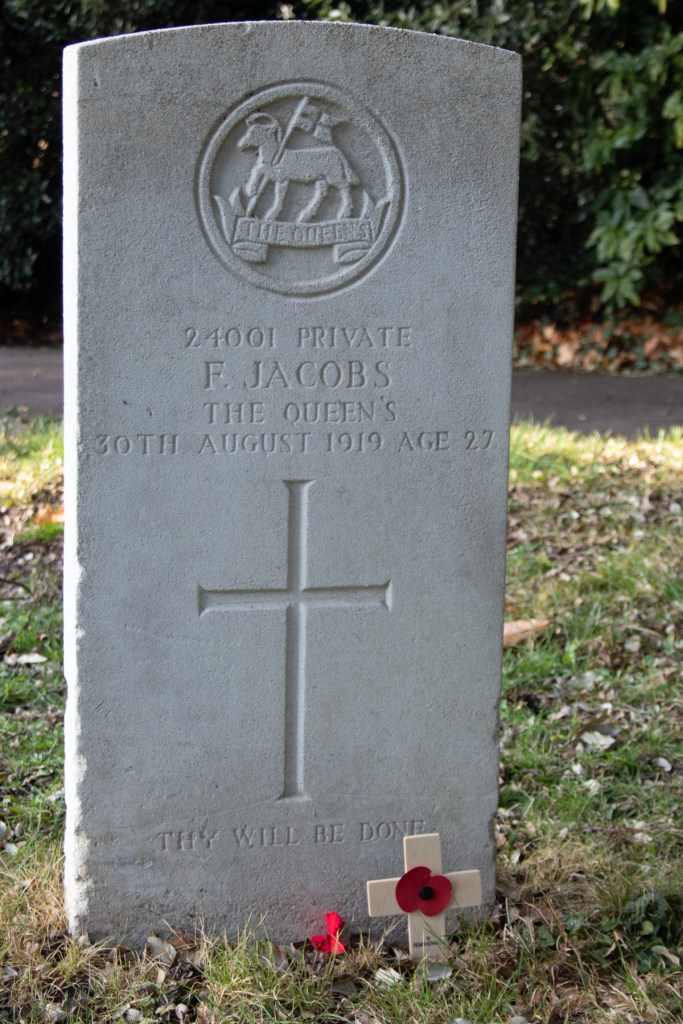
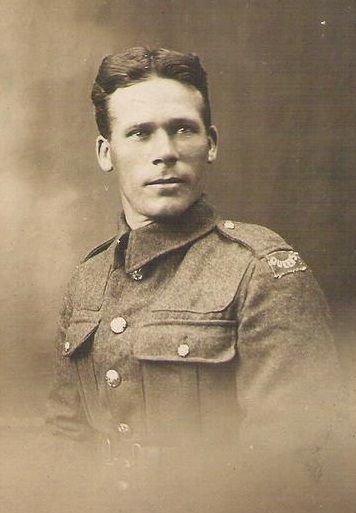
Frank Jacobs was born on 17th March 1892, and was one of fifteen children to George and Amelia Jacobs. George was a machine worker from Ashford in Kent, but the family moved around the county, presumably for work, as the years went on. Frank was born in Riverhead, near Sevenoaks, but within a few years, the family had settle in Faversham.
George and Amelia appear to have separated when Frank was in his early teens. There are no death records for George until the 1920s, but Amelia had a son with her maiden name in 1905 and, by the time of the 1911 census, she was married to a George Appleton, and had been for just under a year.
The same census recorded the Appletons living in Faversham with five of Amelia’s children, including Frank, who was employed in a local tannery.
On 25th October 1913, Frank married Ivy Clark, the Faversham-born daughter of a cement works labourer. The couple went on to have two children, Ronald and Eileen, in 1915 and 1916 respectively.
When was broke out, Frank was keen to play his part. He initially enlisted as a Private in the 10th (Service) Battalion of The Queen’s (Royal West Surrey Regiment), but at some point was transferred across to the Labour Corps. He served throughout the conflict, and was based on home soil for the duration.
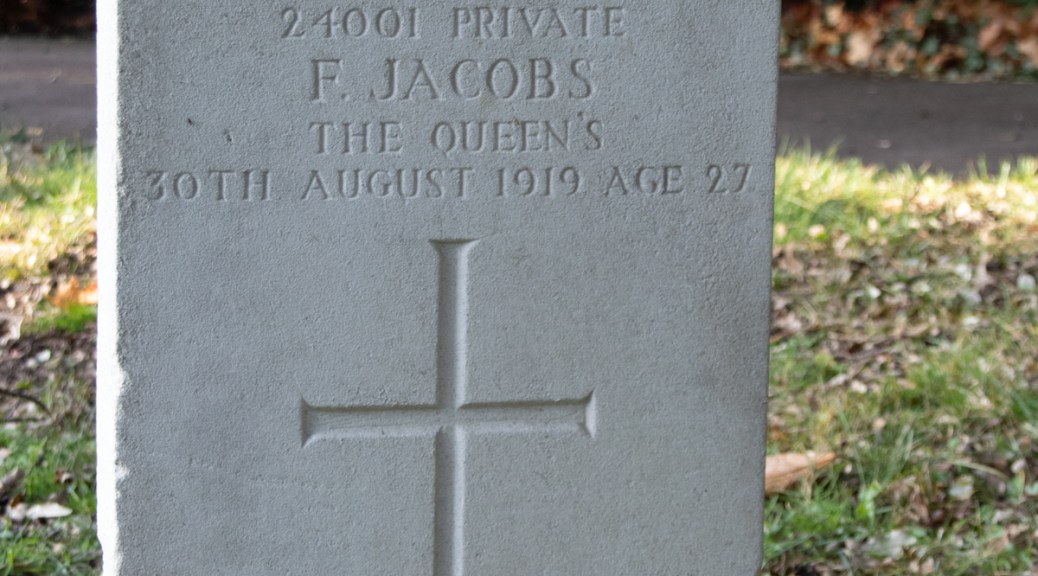
Private Jacobs remained on active service through to the summer of 1919. By this point he had returned home to Kent, but the war had taken its toll, and he fell ill. He was admitted to the Military Hospital in Chatham, but died from his illness – possibly one of the lung conditions prevalent at the time – on 30th August 1919. He was 27 years of age.
Frank Jacobs was laid to rest in the Borough Cemetery near his family home in Faversham.
Private Frank Jacobs (from findagrave.com)
Tragedy was to strike again for the Jacobs family. When the Second World War broke out, Frank and Ivy’s son Ronald enlisted. He joined The Buffs (Royal East Kent Regiment) and, towards the end of the conflict, he was among those fighting in Italy.
Private Ronald Jacobs was killed on 19th April 1945, aged just 30 years old. He was buried in Argenta, Emelia-Romagna.
While Ronald had not left a widow or any children, his mother, Ivy, had now lost her husband and only son to European conflict.
William Reeves was born in the summer of 1896, one of eleven children to James and Ruth Reeves. James was a house painter from Henfield in West Sussex, and it was there that he and Ruth raised their growing family.
When war came to Europe, William was keen to play his part. He enlisted as a Gunner in the Royal Garrison Artillery, and, by October 1915, was in France.
Little information survives about Gunner Reeves’ military service, but by the time he was demobbed, he had earned the Victory and British Medals, the 1915 Star and the Silver War Badge. The latter award was given to those servicemen who had been honourably discharged from service due to wounds or sickness.
William returned to Sussex, but to a quieter home, James having passed away in the spring of 1916. William was also suffering with his health. He had contracted tuberculosis while in the army, and this is the condition to which he finally succumbed. He passed away on 16th December 1919, aged just 23 years old.
William Reeves was laid to rest in Henfield Cemetery, within walking distance of his family home.
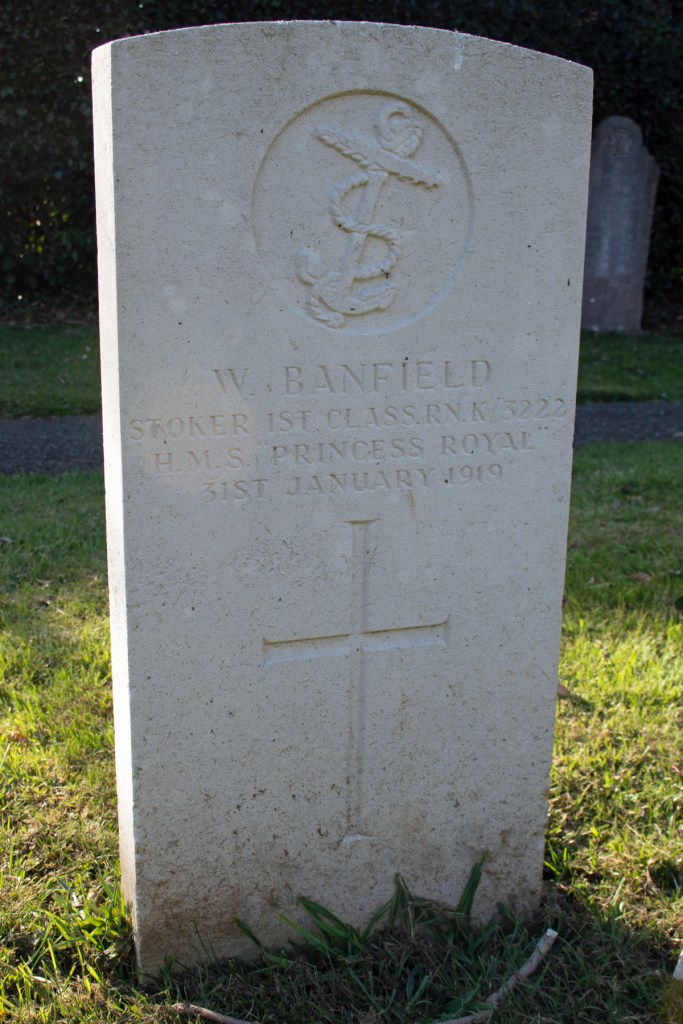
William Banfield was born on 7th November 1890, in Henfield, near Horsham, West Sussex. He was the second youngest of seven children to George and Ellen Benfield. George was a carpenter, and this was a trade his two sons – William and his older brother, George – were initially both to follow as well.
William had a longing for the sea, however, and, on 11th June 1909, he enlisted in the Royal Navy as a Stoker 2nd Class. His service records show that he was 5ft 7.5ins (1.71m) tall, had brown hair, blue eyes and a fair complexion.
Stoker Banfield was based out of HMS Victory, the Royal Naval Dockyard in Portsmouth, Hampshire, but, over the eventual decade of his service, he spent no more than seven months ashore. Instead, he served on a total of nine ships. This included the battleship HMS Exmouth where, during the eighteen months he spent on board, he was promoted to Stoker 1st Class, and also spent 14 days in the brig, for reasons undisclosed.
On 27th September 1915, William was assigned to HMS Princess Royal. He served aboard for nearly three and a half years, patrolling the North Sea, coming under fire during the Battle of Jutland, and providing support during the Second Battle of Heligoland Bight.
Towards the end of January, Stoker 1st Class Benfield fell ill, and was admitted to the Edinburgh City Hospital. Suffering from encephalitis, sadly the condition proved too much for his system to bear and he passed away at the hospital on 31st January 1919. He was 28 years of age.
William Banfield was brought back to Sussex for burial. He was laid to rest in the cemetery of his home town, Henfield.
William’s older brother, George, was also to fall victim to the First World War. He had enlisted in the Royal Navy three years before his younger sibling, and also served as a Stoker 2nd Class (subsequently being promoted to Stoker 1st Class in 1907).
George was also based out of HMS Victory, and, in April 1911, was stood down to the Royal Naval Reserve, having completed an initial five years’ service.
When war broke out, George was called back into service, and was assigned to HMS Good Hope, travelling from English shores to Nova Scotia, before heading to South America and into the Pacific.
Caught up in the Battle of Coronel on 1st November 1914, the Good Hope was sunk by the German cruiser SMS Scharnhost. All souls on board – all 926 of them – were lost; this included Stoker 1st Class George Banfield. He was only 27 years of age.
Walter Stanley Chapman was born in the summer of 1897, the younger of two boys to William and Sarah (known as Annie) Chapman. William was a carter on a farm in North Cadbury, near Yeovil, Somerset, and this is where the young family grew up.
When he left school, Walter became apprenticed to a local carpenter, but war was on the horizon. His older brother Frederick was quick to enlist, joining the Royal Marine Light Infantry as a Private. He served on HMS Hood during the Battle of Jutland in the spring of 1916, and was killed during the fighting. He was buried at sea, and was just 23 years old when he died.
The loss of his brother may have spurred Walter into action. He enlisted as well, joining the 1/4th Battalion of the Somerset Light Infantry as a Private. Details of his service are limited, but his battalion served in Mesopotamia during the conflict, and it is likely that he spent some time in the region.
Private Chapman survived the war, and returned to Somerset on furlough, waiting to be demobbed. Sadly, he passed away during this time, breathing his last on 19th April 1919, at the age of just 21 years old. William and Annie had lost both of their sons because of the conflict.
Walter Stanley Chapman was laid to rest in the graveyard of St Michael’s Church in his home village of North Cadbury. His gravestone also commemorates the passing of his older brother.
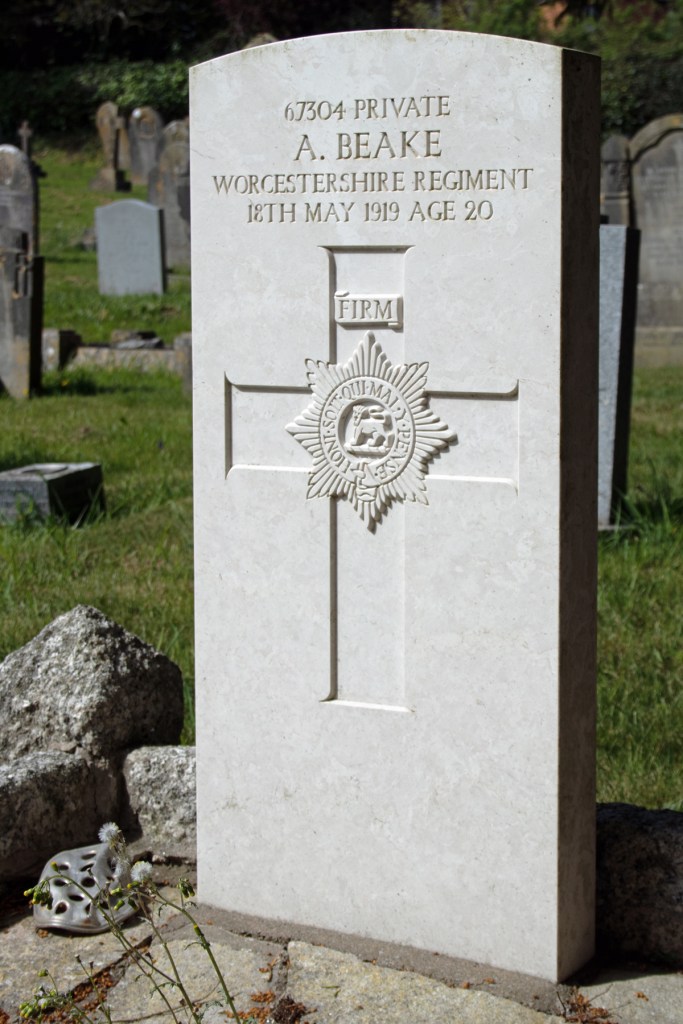
Alfred Beake was born in December 1898 and was one of nine children to Alfred and Charlotte Beake. Alfred Sr was a baker from Westonzoyland in Somerset, but it was in Chard that he and Charlotte had set up home and raised their family.
There is little documented about Alfred’s life. He played his part in the First World War, and had joined the Worcestershire Regiment by November 1918. His troop – the 5th (Reserve) Battalion – was a territorial force, and he would have split his time between Harwich, Essex, and Plymouth, Devon.
Private Beake survived the war and, by the spring of 1919 had been moved to Dublin. It was here on 18th May that he met with colleagues Private Simpson and Swindlehurst in the centre of the city. The trio caught a tram to the coastal town of Howth for a day out, where tragedy struck.
The Dublin Evening Telegraph reported on what happened next:
Private Sydney Simpson, Royal Engineers, stated… when they got to Howth, they walked along the Cliff Walk for about a mile, when they saw some seagulls down the cliff. [Beake and Swindlehurst] went out of witness’s sight for a while, when he heard a shout from Swindlehurst for help. On hurrying back, he saw Swindlehurst looking towards the sea, and he said the deceased had slipped down. The cliff was so steep that, although they tried to get down, they could not do so. Witness sent for help. None of the party had taken any drink.
Private Swindlehurst… said that he and deceased climbed down the grassy slope to get some seagulls’ eggs, but that the deceased suddenly slipped down. There was no horseplay going on at the time when the accident took place.
Captain Wynne, Royal Army Medical Corps, who made a post mortem examination, described the terrible injuries which the deceased had sustained. Death must have been instantaneous.
Dublin Evening Telegraph: Wednesday 21st May 1919
Private Beake had suffered a fractured skull from the fall. He was just 20 years of age.
Alfred Beake’s body was brought back to Somerset for burial. He was laid to rest in the family plot in Chard Cemetery.
Alfred’s oldest brother, Walter George Beake, had also served in the First World War.
Private Beake fought with the 7th Battalion of the Somerset Light Infantry, and was involved in some of the key skirmishes of the Somme. But it was at Ypres that he was buried alive during an attack, and the resulting shell shock left him totally incapacitated.
Walter was discharged from the army on medical grounds in September 1916. He returned home to try and piece his life together again. He never married, and passed away in December 1978, at the age of 87 years old.