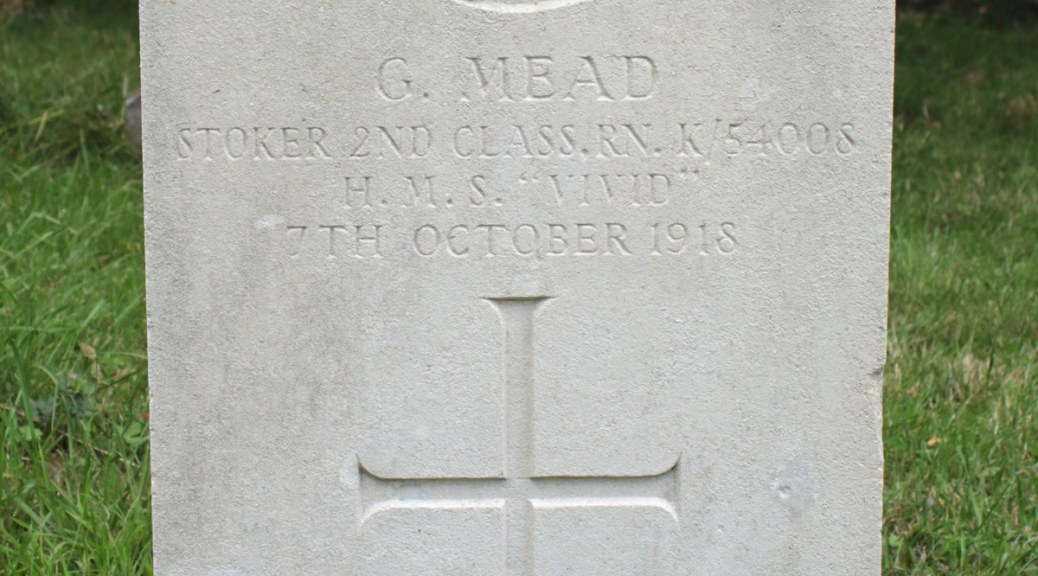
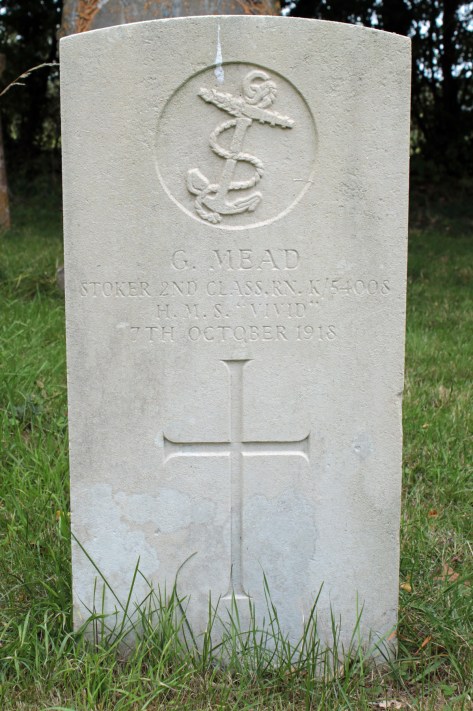
George Mead was born on 18th September 1900 in the Wiltshire village of Semley. The youngest of eleven children, his parents were police sergeant George Mead and his wife, Rebecca.
The 1911 census recorded the Mead family as having moved to Chapmanslade, near Westbury. George Sr and Rebecca were set up in a five-room cottage, Forest View, with George Jr and two of his older sisters – Edith and Margaret – also living there.
Rebecca passed away when her youngest was just sixteen years of age and, on 12th March 1917, George Jr’s older brother Charlie, a Private in the Worcestershire Regiment, was killed in action while fighting in France. It seems that his younger sibling was keen to prove his mettle before peace was declared and, on the day after his eighteenth birthday, he gave up his job as a carter and enlisted in the Royal Navy.
Stoker 2nd Class Mead’s service records show that he was 5ft 10.5ins (1.79m) tall, with brown hair, blue eyes and a fresh complexion. He was sent off to HMS Vivid – the Royal Naval Dockyard in Devonport, Devon – for his training.
Tragically, George Jr’s time in the navy was to be short. He contracted pneumonia and as admitted to the naval hospital in Plymouth. The illness was to prove too severe, and he passed away on 7th October 1918: he was eighteen years of age, and had been in the Royal Navy for just 18 days.
The body of George Mead Jr was taken back to Wiltshire for burial. He was laid to rest in the extension to St Margaret’s Church, Corsley, not far from where his grieving father still lived.
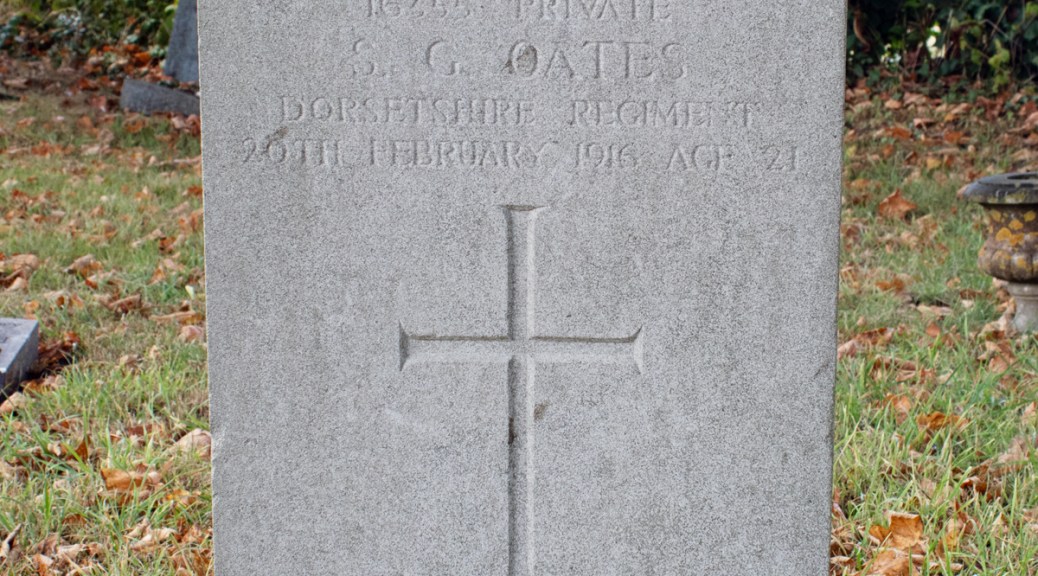
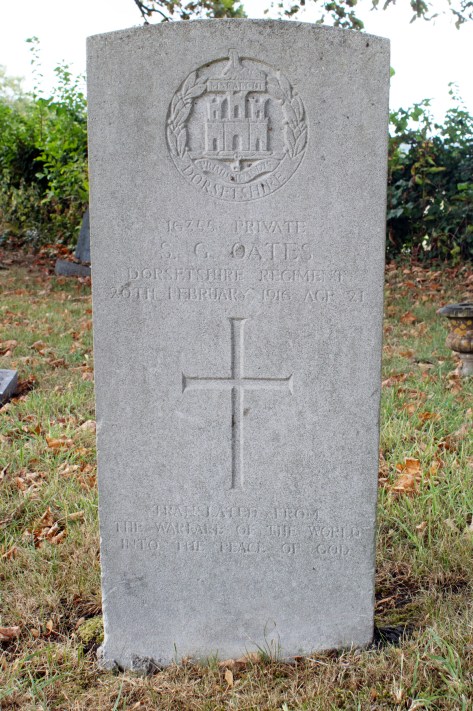
Sidney George Oates was born in the spring of 1895, and was the oldest of three children – all boys – to John and Eliza Oates. John was a general labourer from Parkstone, Dorset, but it was in the village of Odcombe in Somerset that the family were born and raised.
Eliza died in 1899, and John was left to raise three young children on his own. He re-married, to a Lucy Moores, but the a split of the family followed the wedding. Sidney’s younger brothers stayed with their father and his new wife, while Sidney himself was looked after by his maternal grandparents. Job and Elizabeth Green lived in Buckhorn Weston, a village to the west of Gillingham, Dorset.
When he finished his schooling, Sidney was apprenticed to a carpenter. War was on the horizon, however, and he soon stepped up to play his part. As with many others, his service papers have been lost to time, but it is clear that he had enlisted in the Dorsetshire Regiment no earlier than August 1915.
Private Oates was assigned to the 7th (Reserve) Battalion and sent to a training camp near Wool, Dorset. While there, however, he caught pneumonia, and was admitted to a military hospital in the village. The condition was to prove fatal: he passed away on 20th February 1916, aged just 21 years old.
The body of Sidney George Oates was taken back to Buckhorn Weston for burial. He was laid to rest in the village’s cemetery.
Sidney’s younger brother Edward also served in the First World War. A Pioneer in the Royal Engineers, he was killed in action in northern France on 12th April 1917. He was buried in Mory Abbey Military Cemetery to the north of Bapaume.
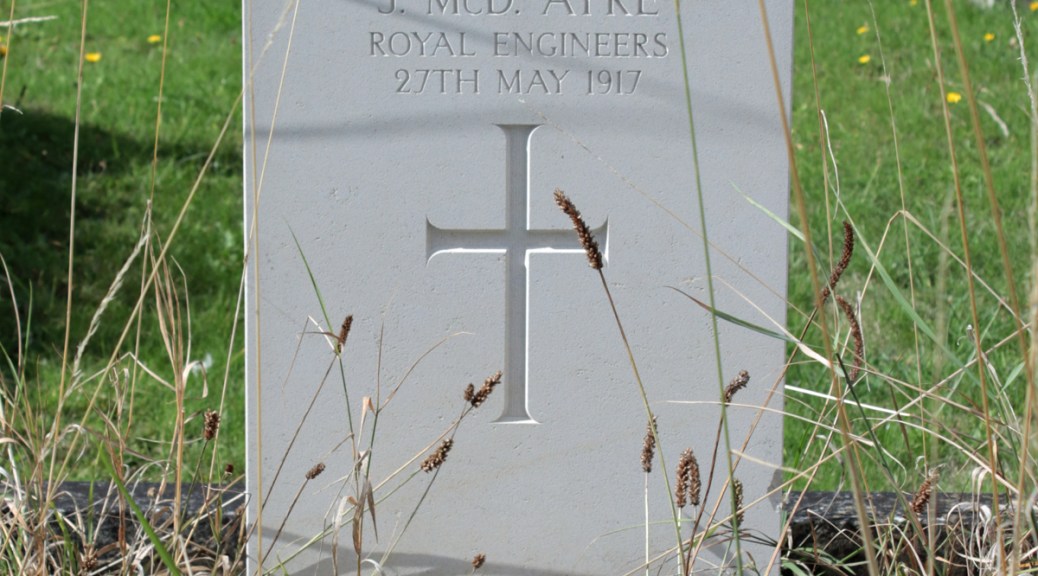
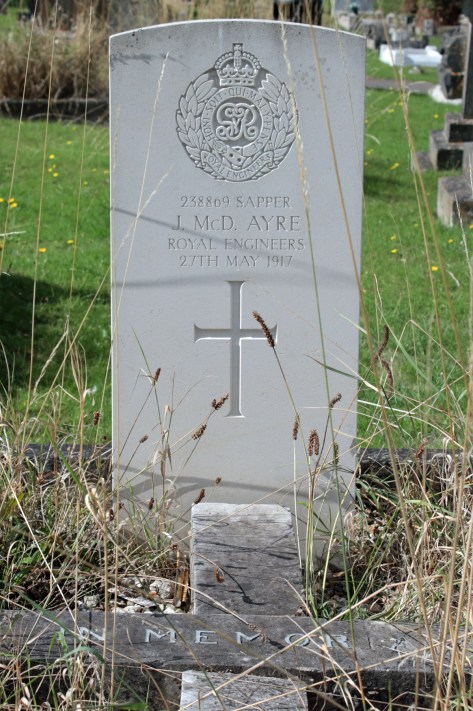
John MacDonald Ayre was born in Hemel Hempstead, Hertfordshire, in 1891. His father – also John MacDonald Ayre – had been born in Edinburgh, but had moved south to take up a job as a passenger clerk for the railways. He had met his wife, Rosa, there, and they had married in 1890. John Jr was their eldest child, and they would go on to have five more although, tragically, only three survived childhood.
John Jr also found employment with the railway company when he finished his schooling. The 1911 census found him working as a goods clerk, and he was living with his family at 16 Bridge Road in Hemel Hempstead town centre.
On 8th September 1915, John Jr married Mabel Langdon. She was a postman’s daughter from Westbury, Wiltshire, and, at the time of the 1911 census, she was working as an under-housemaid for Edward Innes, a barrister in her future husband’s home town. The couple married in Westbury Parish Church.
When war broke out, John Jr was called upon to play his part. Little information is available about his time in the army, but is it clear that he had enlisted by the end of 1916, and had joined the Royal Engineers as a Sapper. His background made him ideal for the regiment’s Railway Operating Division.
There is no evidence that Sapper Ayre spent any time overseas, and, by the spring of 1917, he was based in Shropshire. He had been unwell and was admitted to a military hospital in Shrewsbury, suffering from tuberculosis. The condition was to get the better of him, and he passed away on 27th May, at the age of 26 years old.
The body of John MacDonald Ayre was taken back to Wiltshire for burial. He was laid to rest in Westbury Cemetery.
Tragically, Mabel was pregnant when her husband died. She gave birth to their son, who she named John, on 14th July 1917.
Ernest Henry Mitchell was born in the autumn of 1889 in Worthing, West Sussex. The second of five children, he was the eldest son of Frederick and Rhoda Mitchell. Frederick was a baker and confectioner, and the family lived in and around the town centre. The 1891 census found them at 29 West Buildings; ten years later they were living at 7 Clifton Road; the 1911 census recorded the family at 62 Chapel Road.
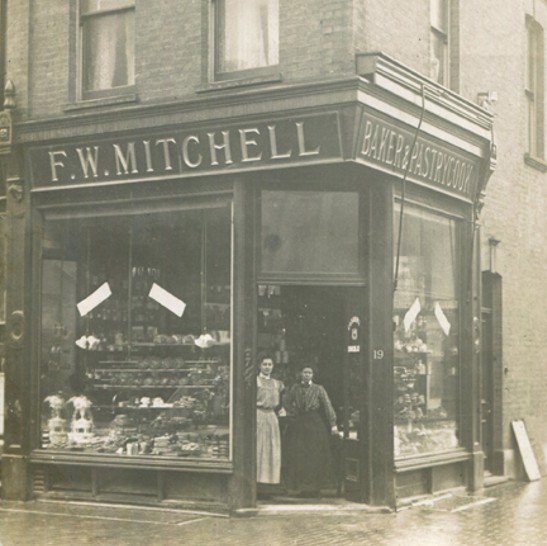
By this point, FW Mitchell’s was a well known bakery, and would remain so through to the 1960s. The Chapel Road shop was bombed during the Second World War, and the family moved the business to North Road.
The 1911 census showed what the bakery has become. Frederick and Rhoda were running the business, while their three sons – Ernest, Reginald and Frederick Jr – were also involved. Their eldest daughter, Rhoda Jr, was an elementary school teacher, while their youngest child, Edgar, was still at school. The Chapel Road property was a bustling affair: the Mitchells employed four live-in servants: Emily Lyon, Annie Dannage, and Mabel Swan as shop assistants, and Edith Blunden as a domestic.
FW Mitchell’s bakery, Worthing
Away from work, Ernest showed other talents. “He was possessed of musical inclinations, and was at one time a member of the Choir of the Congregational Church, as well as of the Choral Society.” [Worthing Gazette: Wednesday 31st October 1917]
In January 1913, Ernest married Constance Banwell. She was the eldest daughter of nurseryman Henry Banwell and his wife, Ellen, and lived on Christchurch Road, not far from the Mitchells’ shop.
When war broke out, Ernest stepped up to serve his country. His service records show that, while he enlisted on 9th December 1915, he was not formally mobilised until March 1917. As a Trooper, he was assigned to the Household Battalion, and, after a brief period of training, he soon found himself in the thick of things.
The Household Battalion fought at Arras in the spring of 1917, but it was at Passchendaele that Ernest’s war was to come to an end. Wounded in the leg on 6th October – just three months after arriving in France – he was medically evacuated to Britain for treatment. Admitted to No. 2 War Hospital in Birmingham, he initially recuperated, but pneumonia took over and Trooper Mitchell succumbed. He passed away on 26th October 1917, at the age of 28 years old.
The body was removed from Birmingham, arriving in Worthing at midnight on Monday; and the internment took place at the Cemetery yesterday afternoon [20th October]. Among those who attended the ceremony were two soldier brothers of the deceased – RA Mitchell, who is in the Royal Flying Corps; and FE Mitchell, of the Middlesex Regiment. Still another brother is serving his Country in a Military capacity. This is Fred Mitchell, formally Organist of the Congregational Church, who is in the Army Service Corps, and was unable to be present yesterday, for he is now in Hospital in Wiltshire.
[Worthing Gazette: Wednesday 31th October 1917]
Ultimately, Ernest Henry Mitchell would be the only one of his siblings to pay the ultimate price while serving his country. He was laid to rest in the family plot in Broadwater Cemetery, on the then outskirts of the home town.
Ernest’s headstone also pays tribute to Alan Frederick Gill, who died in April 1925. This was his sister Rhoda’s child, who died at just four-and-a-half years old.
Charles William Harris was born in Wingham, near Canterbury, Kent, on 19th July 1879. The fourth of eleven children, his parents were Charles and Kate Harris. Charles Sr was a carpenter and builder, and his son was to follow in his stead.
By the time of the 1901 census, however, Charles Jr had stepped out on his own. He had moved to London, and was boarding with the Hurley family, in rooms at 408 Bethnal Green Road, Middlesex.
On 1th June 1902, Charles Jr, now a plumber, married Esther Danton. An engine driver’s daughter from Kent, she was four years her new husband’s senior. The couple set up home at 5 Leatherdale Street in Mile End, and had two children: daughter Lilian was born in 1905, with son George following three years later.
When war broke out, Charles was called upon to play his part. He enlisted in the Royal Naval Air Service as an Air Mechanic, and was quickly promoted to Leading Mechanic. His service records show that, when he joined up on 15th June 1916, he was 5ft 7.5ins (1.71m) tall, with light brown hair, blue eyes and a fresh complexion.
Leading Mechanic Harris would be based out of HMS President, the umbrella name for the Royal Navy’s London bases. He spent time working at Wormwood Scrubs, and, in February 1917, was moved to Kingsnorth, Kent.
What happened next is summed up in a simple statement on Charles’ service papers: “26th May 1917 Accidentally killed by explosion of gas holder.” There is no further information, and nothing in the media about the incident. Leading Mechanic Harris was 37 years of age.
The body of Charles William Harris was taken to the Woodlands Cemetery, Gillingham, Kent. He was laid to rest in the naval section of the burial ground.
Tragedy was to strike again just two years later, when Charles and Esther’s daughter also passed away:
Much sympathy and respect were shown at Holy Trinity Church, Springfield, when the funeral of Lily Harris, the fourteen-year-old daughter of Mrs and the late Mr CW Harris took place. Deceased’s father, who was chauffeur to the Bishop of Chelmsford, lost his life in the war while serving with the RNAS, and this fact added to the regret felt by the parishioners at the further sad loss sustained by his widow, who is now left with only one little boy. The funeral procession included a large number of the scholars of the Springfield Day and Sunday Schools, with Mr R Coward of the day school, and practically every child carried a floral tribute. There was also a large attendance of neighbours and friends, including children, assembled at the church. The Bishop of Chelmsford officiated… [and] gave a touching address to the church, speaking particularly to the children; and his lordship also performed the last sad rites at the graveside.
[Essex Newsman: Saturday 29th November 1919]
There is no evidence of any connection between Charles and the Bishop of Chelmsford: as far as the records show, he was never a chauffeur, working as a builder, plumber and gas fitter before enlisting.
Charles James Welling was born on 23rd October 1860, and was the oldest of three children to Charles and Ann Welling. The Wellings were a military family, Charles Sr employed as a Serjeant Instructor of Musquetry in the Parkhurst Barracks on the Isle of Wight when his son was born.
Ann had been born in South Africa while her Irish parents were based out there. She and Charles Sr married in Farnham, Surrey, presumably where the families were based by that point.
Charles Jr’s mother died in 1863, just a month after giving birth to his youngest sibling. His father married again, to Sarah Ash, and by 1871, the Wellings were living in barracks at the School of Musketry in Hythe, Kent.
Being his father’s son, Charles Jr was set to make his own mark on the world and, on 21st January 1876, he joined the Royal Navy. Too young to formally enlist, he was given the rank of Boy 2nd Class, and sent off to HMS Impregnable, the shore base in Devonport, Devon, for his training.
Over the next eighteen months, Boy Welling learnt his trade, spending time at HMS Ganges – another shore base near Ipswich, Suffolk – and the sloop HMS Penguin. It was here that Charles came of age in 1878, and he officially joined the Royal Navy with the rank of Ordinary Seaman. His service papers show that he was just 4ft 10.5ins (1.49m) tall, with light brown hair, blue eyes and a fair complexion.
Ordinary Seaman Welling career was to take a turn in 1880, when he began training as a signaller. His initial contract with the navy was for ten years, and, by the time that came to an end in May 1889, he had served on eight ships in all, rising through the ranks from Signalman 3rd Class, to Signalman 2nd Class in August 1881 and Qualified Signalman seven years later.
When Charles’ term of service came to an end, he immediately renewed it, and with the new contract came a promotion to Leading Signalman. The next decade saw him travel the world, returning to HMS Pembroke, the Royal Naval Dockyard in Chatham, Kent, in between voyages. His commitment to the role paid off: in March 1894 he was promoted to 2nd Class Yeoman of Signals. Just eight months later he took the rank of Yeoman of Signals.
It was around this time that Charles married the love of his life, Harriet Carlaw. Born in London, the couple exchanged vows in St Pancras, Middlesex, on 13th January 1894 and had a son, also called Charles, the following year.
Charles’ naval career continued its upward trajectory, and on 1st March 1898, he was awarded the rank of Chief Yeoman of Signals. By this point HMS Pembroke had become his permanent base and, at the end of his contract in 1899, he was stood down to reserve status.
The 1901 census shows what may have been a downward step for the Wellings: it recorded the family living in rooms at 136 Bayham Street, Camden, Middlesex, where Charles was working as a messenger.
Opportunities come in the most unexpected of places, however, and the following census found them living at Pier House, Sunderland, Tyne and Wear, where Charles was employed as a lighthouse keeper.
By this point, Charles had been invalided out of the navy for medical reasons. The writing on his service papers is unclear, and his dismissal seems to have been as a result of disease of gestes, possibly the neurological disorder dystonia.
When war broke out in 1914, however, anyone with experience was called upon to play their part. Given his age at the time, it seems likely that Charles volunteered for service, reporting to HMS Pembroke on 2nd August 1914. He was given his old rank of Chief Yeoman of Signals, and remained at the naval base for the next two years.
Charles’ health was definitely suffering by this point, and he was admitted to the Royal Naval Hospital in Chatham, in September 1916. Suffering from the heart condition endocarditis, this would take his life. He passed away on 16th September, at the age of 55 years old.
With Harriet still living in Sunderland, Charles’ body was laid to rest in Woodlands Cemetery, Gillingham, Kent, not far from the base he had called home for so long.
Charles and Harriet’s son had also stepped up to play his part when war broke out. Enlisting in the Royal Engineers, Pioneer Welling soon found himself in the Middle East. While serving in Palestine, he contracted malaria, and passed away from the condition on 16th October 1918. Charles was just 23 years of age, and was laid to rest in Haifa War Cemetery.
It is tragic to note that Harriet had lost her husband and her son within two years.
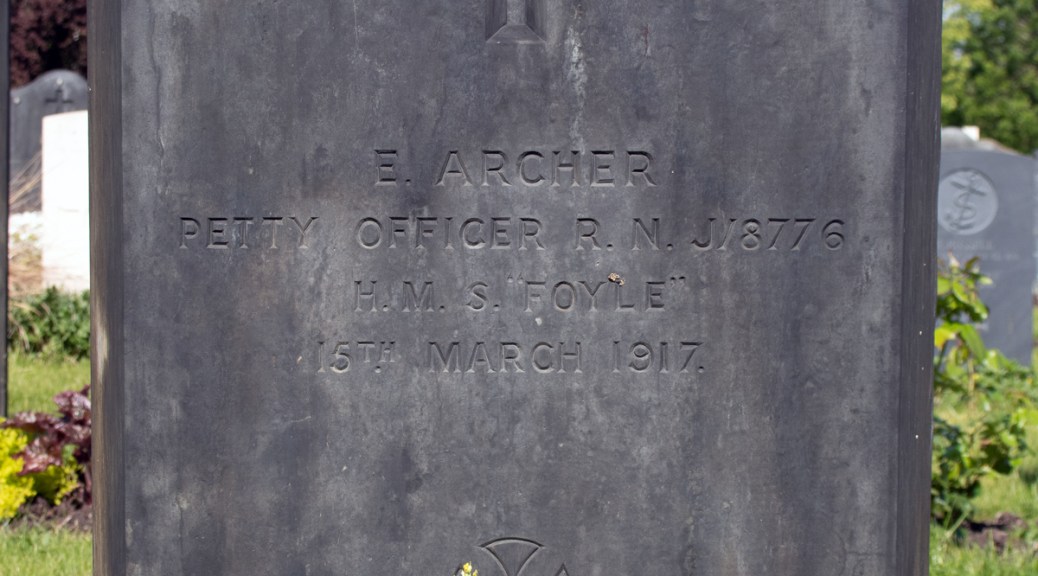
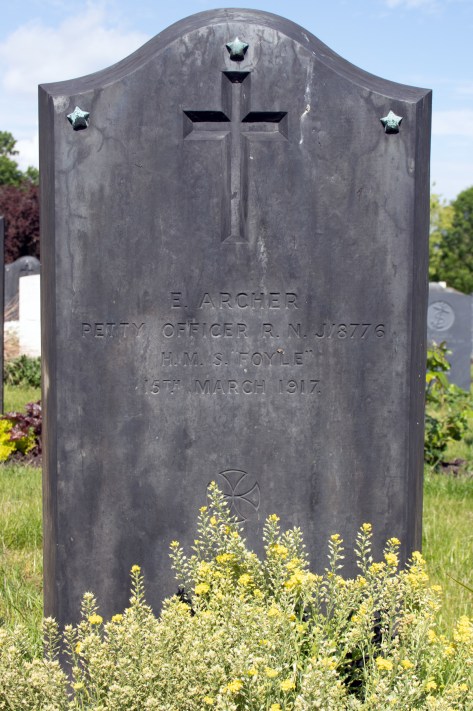
The life of Ernest Archer is challenging to piece together. His headstone, in Woodlands Cemetery, Gillingham, Kent, confirms he was a Petty Officer on HMS Foyle, which was a Royal Navy destroyer. She hit a mine in the English Channel off the Devon coast on 15th March 1917, and foundered while being towed to safety in Plymouth. A total of 28 crew members, Petty Officer Archer included, were killed.
Ernest’s service papers have been lost to time, but his Dependent’s Pension record gives his beneficiary as his aunt, Mrs H Greenhow, of 8 Kinmel Street, Liverpool. This would suggest that his parents had passed by 1917, but it’s not been possible to track her down through contemporary documents.
The same record notes that Ernest had a brother, James, and that he was an Able Seaman in the Howe Battalion of the Royal Naval Division. He was killed in action on 17th February 1917 – four weeks before his brother – and is commemorated on the Thiepval Memorial.
Further information on the lives of the siblings, however, is lost in the mists of time, Ernest Archer’s story taken to his grave with him.
Alfred John Reed was born in St Pancras, Middlesex, on 29th September 1865. One of twelve children, his parents were Charles and Eliza Reed. Charles was a carman, possibly working out of the nearby railway stations, and the 1871 census found the family taking rooms at 70 Aldenham Street.
Details of Alfred’s life is a little sketchy. By the time of the 1881 census he had finished his schooling and was employed as a coach painter, again probably connected to the railways. At some point shortly after this, however, he enlisted as a Private in the Royal Marine Light Infantry. It is likely that he was still a teenager when he made this move, as he seems to have lied about his age to get in – later records give his date of birth as 8th June 1863.
We next pick up Private Reed in the 1901 census. By this point, he was assigned to the floating battery HMS Terror, which was based in Bermuda, under the remit of Captain Thomas McGill.
Alfred appears to have served his contract, as by 1911 he was living at 56 Northview Road, Hornsey, Middlesex. Employed as a house painter, the census records him as being having been married to Clara Emily for nine years. This may have been for the sake of appearance, as the formal record of the couple’s marriage suggests that exchanged vows in the summer of 1914. The census showed that the couple had a son – Alfred John Reed – who was two years old.
When war broke out, Alfred was 49 years old. While over the age to formally enlist, it seems that he did re-join the Royal Marines. By the spring of 1917, he was attached to HMS Spey, an old gunboat, which served in the River Medway, close to Chatham Dockyard.
On the 7th March 1917, she was accidentally rammed by a sludge vessel carrying 1000 tons of sewage. The Spey sank in the shallow water, and one of the crew – Private Alfred Reed – was drowned. He was 51 years of age.
The body of Alfred John Reed was laid to rest in the naval section of Woodlands Cemetery, Gillingham, not far from the Royal Naval Base in which he had been helping.
The 1921 census sheds more light onto the family that Alfred had left behind.
Clara had re-married, her new husband being motor fitter George Comer. The couple had a daughter, eighteen-month-old Eileen, and George was noted as being stepfather to Alfred and Clara’s children, Alfred and Ernest (who was born in 1911).
There is another mystery, however, as the census gives the name of 18 year old Louie Reed. She may also have been Alfred and Clara’s daughter, although she is not recorded as being so on the 1911 census. She may, therefore, have been Clara’s child from a former relationship, then adopted by Alfred.
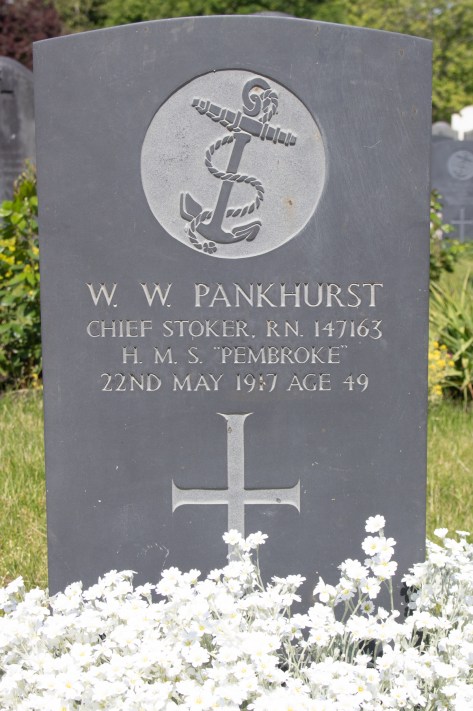
Walter William Pankhurst was born on 21st March 1867, and was the third of four children – and the only son – to Thomas and Harriet Pankhurst. Thomas was a farm labourer from Staplehurst, Kent, but he and Harriet raised their family in Murston, to the east of Sittingbourne.
Walter initially followed his father into farm work, but he sought a bigger and better life and, on 3rd December 1888, he enlisted in the Royal Navy. His service records show that, at 21 years of age, he was 5ft 7ins (1.7m) tall, with dark hair, hazel eyes and a ruddy complexion.
Given the rank of Stoker 2nd Class, Walter was sent to HMS Pembroke, the Royal Naval Dockyard in Chatham, Kent, for his training. In the summer of 1889 he was given his first posting, on board the gunboat HMS Pigmy, and she would remain his home for the next three-and-a-half years.
When he joined up, Walter had committed to twelve years’ service, and this time was not wasted. By the time his contracted came up for renewal, he had served on three further ships, returning to Chatham in between voyages. He had also progressed through the tanks, to Stoker 1st Class in January 1890, Leading Stoker 2nd Class in March 1897 and, with the renewal of his service, to Leading Stoker 1st Class in February 1901.
On 15th June 1904, Walter married Ellen Goddard. A gardener’s daughter from Eastling, Kent, by the time of their wedding, she was working as a domestic servant for a chemist in Hampstead, Middlesex. The couple exchanged their vows in St Stephen the Martyr’s Church, Hampstead, Ellen’s sister Susan acting as one of the witnesses.
Back in the Navy, Walter’s career continued its progression. Regularly noted as being of very good character, within three months of his wedding he was promoted to Acting Chief Stoker. By October 1905 the role was formalised, and he would end his naval career in December 1910 as Chief Stoker.
Stood down to reserve status, Walter made the move to civilian life. The 1911 census found him and Ellen living at 95 Glencoe Road, Chatham, a small terraced house with just four rooms. The couple had had three children by this point, and Susan was also living with them. A naval pensioner, Walter was still employed by the navy, and was working as a bootmaker’s labourer in the dockyard.
When war was declared in the summer of 1914, Chief Stoker Pankhurst was called into service once more. For the next couple of years he would be based at HMS Pembroke, either working in the dockyard’s boiler rooms or training new recruits.
In the spring of 1917, Walter was taken ill. He was suffering from haematemesis, and the condition was to prove his undoing. He passed away on 22nd May 1917, at the age of 50 years old.
The body of Walter William Pankhurst was laid to rest in the naval section of Woodlands Cemetery, Gillingham, a few miles from where Ellen was now living on Luton Road, Chatham.
By the time Walter passed, he and Ellen had had four children. His widow never remarried, but when she died, on 7th April 1961, she was buried alongside her husband. She was 90 years of age.
The couple’s eldest daughter, Nancy, remained a spinster throughout her life, initially supporting her mother after Walter died. Nancy was buried with her parents, when she died in 1995: she was also 90 years old.
James Chilcott was born in Eccles, Lancashire, in the autumn of 1885. One of twelve children, his parents were William and Mary Chilcott. William seemed to be able to turn his hand to most things: the 1891 census recorded him as a hawker of fish, while ten years later he was employed as an insurance agent.
The Chilcotts had moved to Tiverton in Devon in around 1891, setting up home on St Andrew’s Street, to the south of the town centre. James initially found work as a bookseller’s assistant when he left school, but things were to change.
In the autumn of 1908, James married Mabel Candey. The couple moved to Nottinghamshire, settling in the village of Cresswell, where they lived in a small cottage at 6 John Street. James had found work as a coal miner in the area, which had taken the couple away from the comfort of Devon.
Over the next four years, James and Mabel would have four children, all of whom died before they celebrated their first birthday. The series of tragic events may have driven a need for Mabel to be with family, and by 1913, the couple had moved back to Tiverton. Daughter Dorothy was born in 1914.
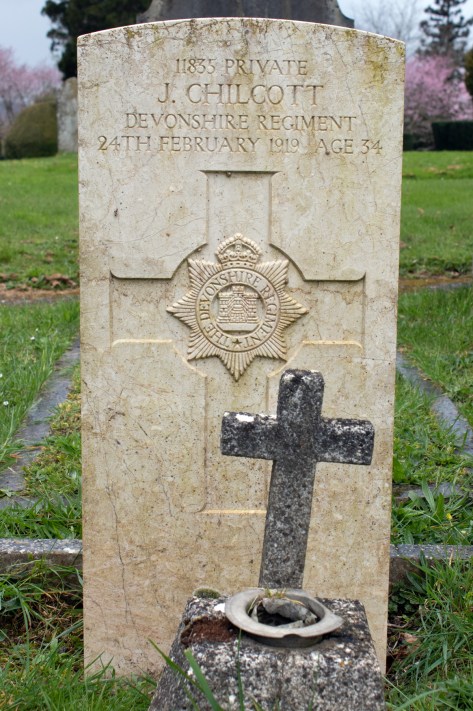
When conflict his Europe the following year, James stepped up to play his part. Full details of his military service hare long since lost, but it is clear that he enlisted in the Devonshire Regiment, and had done so at the beginning of the war.
Attached to the 2nd Battalion, Private Chilcott was in France by 9th February 1915. Over the next few years, the unit saw fighting in most areas of the Western Front, including the Somme and Ypres. It is unclear how much of this James was involved in, but it is unlikely that he would have come away completely unscathed.
Pte. James Chilcott, of the 2nd Devons, who went through the dispersal camp at Fovant on February 20, died at Exeter on Monday from influenza. A son of Mr WH Chilcott, of St Andrew-street, Tiverton, he joined up at the beginning of the war, and had seen considerable service. He leaves a widow and one child.
[Western Times: Wednesday 26th February 1919]
James Chilcott died on 24th February 1919: he was 33 years of age. His body was taken back to Tiverton for burial, and he was laid to rest in the town’s cemetery.
“He leaves a widow and one child” does no justice to the pain that Mabel had to go through, having lost four children and her husband in a matter of six years. The 1921 census recorded her living on St Andrew Street with Dorothy, and showing she was undertaking home duties. She had two lodgers, who helped bring in a little more money.
Mabel Chilcott never remarried: she passed away in Tiverton in January 1946, at the age of 62.








 Death and Service