Tag Archives: London

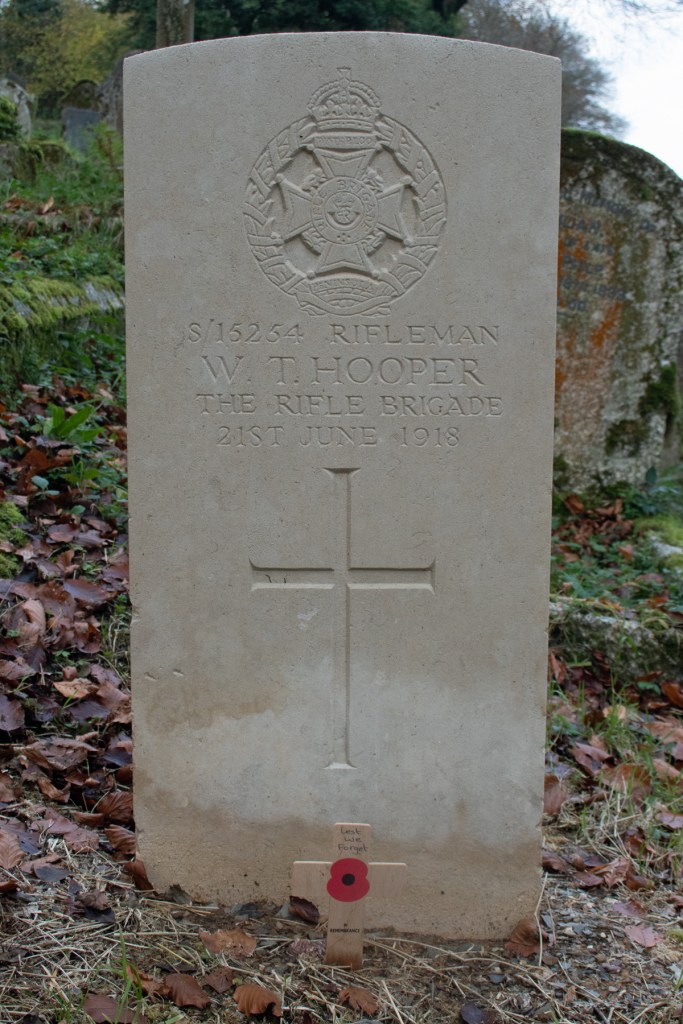
Rifleman William Hooper

Rifleman William Hooper

William Thomas Hooper was born in St Breock, near Wadebridge, Cornwall, in the summer of 1890. One of three children his parents were gardener William Hooper and his wife, Sarah.

When he left school, William Jr found work as a warehouseman and salesman, up in London, but when war broke out, he stepped up to play his part. He enlisted in December 1915, joining the Rifle Brigade, but was not formally mobilised for another couple of months.

Little detail of Rifleman Hooper’s military service survives, but records confirm that he was 5ft 6ins (1.68m) tall, and weighed 124lbs (56.3kg). It also notes that his left testicle had not descended, but that his condition was not severe enough for William to be refused for military service.

Rifleman Hooper’s was initially assigned to the 5th Battalion, based on the Isle of Sheppey, Kent, as part of the Thames & Medway Garrison. By the spring of 1916, however, he had been transferred to the 1st Battalion, and sent to France. He was involved in the Battle of Albert, and returned to the UK in August 1916 .

William appears to have been transferred back to the 5th Battalion and, in the spring of 1917, was hospitalised for three month, suffering from trench foot and rheumatism. By September that year, however, he was back with his unit.

Rifleman Hooper’s service documents become a little confused at this point. One record suggests that he was discharged from the army on 2nd January 1918 as being no longer medically fit for duty, while a second entry confirms that he passed away while on leave pending discharge.

Either way, William was back at home in St Breock when, on 21st June 1918, he passed away from a combination of pericarditis and pericardial effusion. He was just 27 years of age.

William Thomas Hooper was laid to rest in the wooded graveyard of St Breoke’s Church, in his home village.


An entry in the local newspaper confirmed that “Mr and Mrs Hooper and family… and Miss Ive Jones, London” [Cornish Guardian: Friday 18th June 1918] offered their thanks for the sympathy they had been shown in the bereavement. This suggests that, when he passed, William had been courting, his loss felt further.

Guardsman John Boucher

Guardsman John Boucher

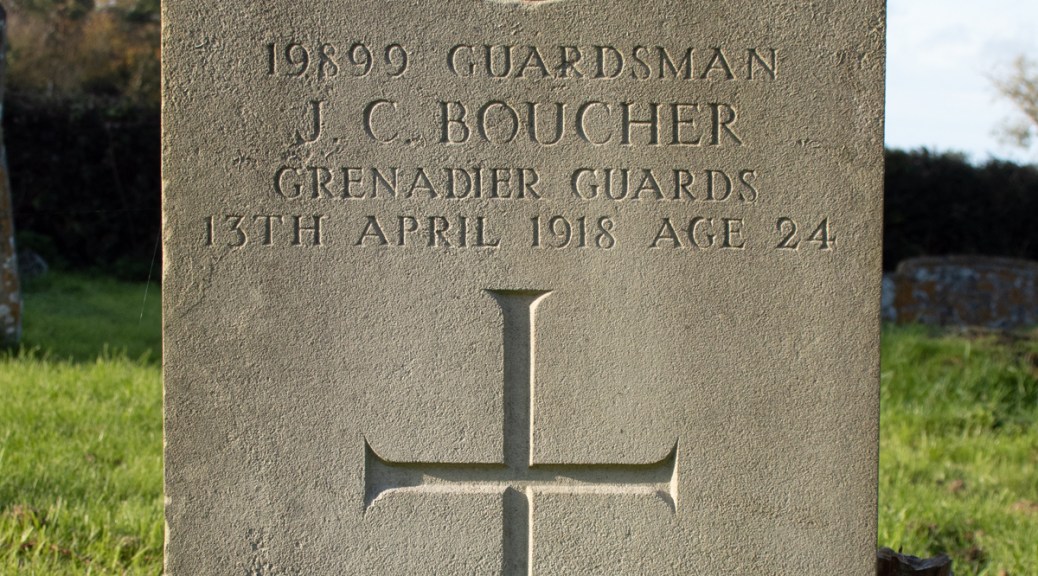
John Charles Boucher was born in East Coker, Somerset, in the spring of 1894. The youngest of five children, he was the son of Charles and Ann Boucher. Charles worked on the railways as a plate layer, while John found work in a local textile factory as a yarn dyer when he left school. He was a sporty young man, and became a prominent member of the nearby Stoford Football Club.

Ann died in 1914 and, when war was declared, John was keen to play his part. He had enlisted in the Grenadier Guards by the summer of 1917 and was assigned to the 5th Battalion. Full details of Guardsman Boucher’s military service are lost to time, but it is clear that he served abroad, and was wounded twice in the fighting.

John was based at Guards barracks in Kensington, London. It was here that he met Elsie Louise Vaughan, who was the daughter of a local insurance agent. The couple married at the Holy Trinity Church in Paddington on 28th June 1917.

Guardsman Boucher was soon sent to the Western Front again, however, and, in the spring of 1918, he was caught up in the Battles of the Lys. Wounded for a third time, he was medically evacuated to Britain, and admitted to the Military Hospital in Sidcup, Kent. Sadly, it was to be third time unlucky for John: his wounds proved too severe, and he died of his injuries on 13th April 1918. He was just 24 years of age.

John Charles Boucher was brought back to Somerset for burial. He was laid to rest in the cemetery of his home village, East Coker.


Tragically, just three weeks after John’s death, Elsie gave birth to their first, and only, child, a son she named after his father. She went on to marry again in the spring of 1919, to a John Bellamy. The couple would go on to have a child of their own – a daughter called Iris – the following year. John Jr died in 1972, and Elsie followed five years later, at the age of 83 years old.


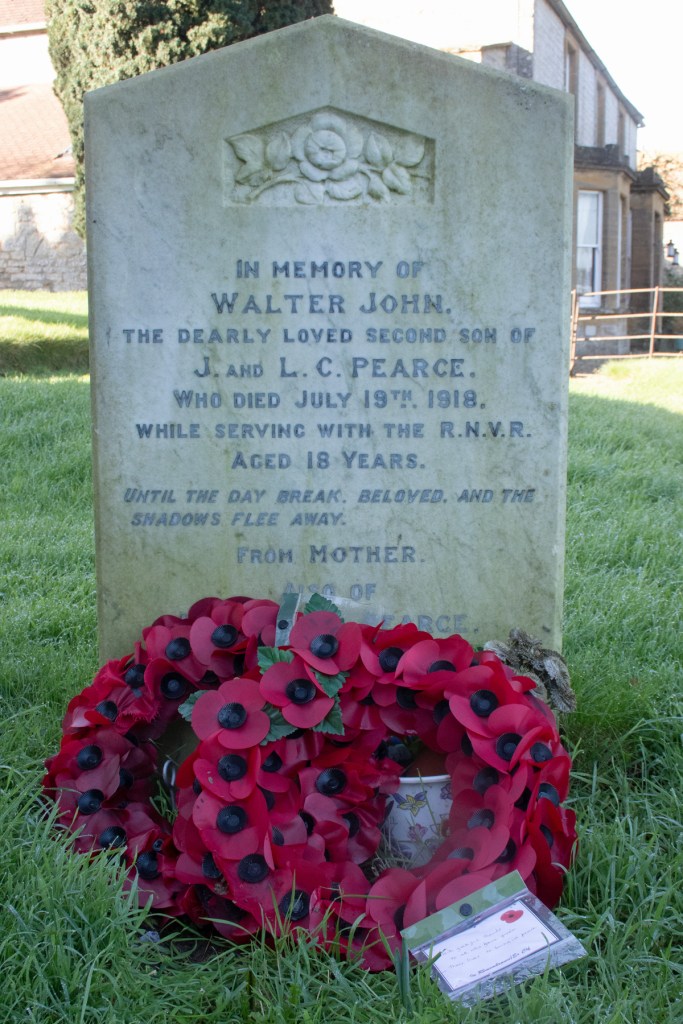
Ordinary Seaman Walter Pearce

Ordinary Seaman Walter Pearce

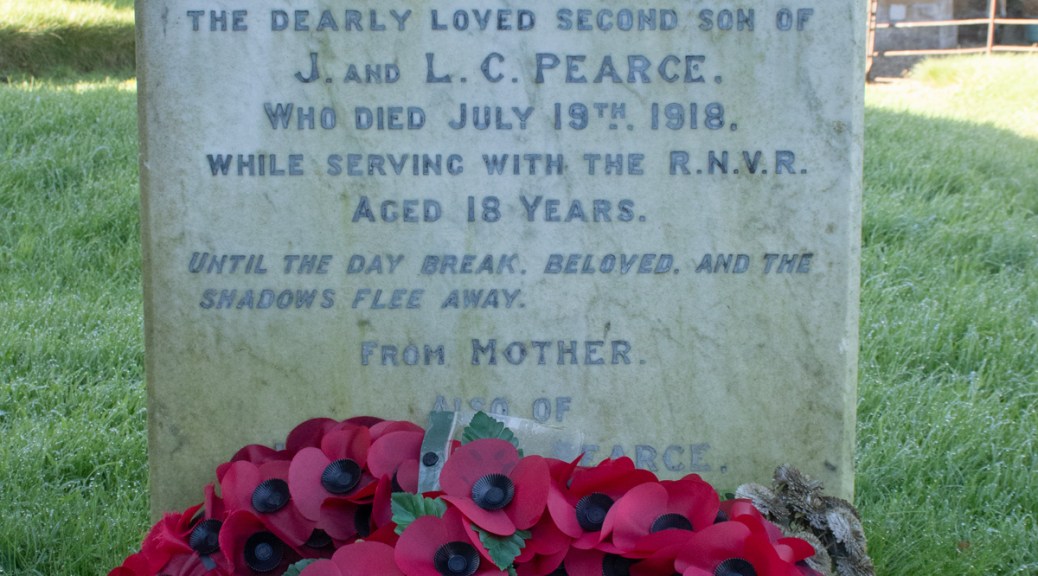
Walter John Pearce was born on 15th June 1900 in Clapton, East London. One of ten children, his parents were James and Lily Pearce. Both were from Somerset, but cowman James went where the work was and they soon moved back to the South West, where he and Lily were from.

When he finished school, Walter found work as an errand boy for a grocer, but war was coming to Europe and, while he was too young when the conflict began, it was clear that he wanted to play his part as soon as he was able.

Walter enlisted in June 1918, joining the Royal Naval Volunteer Reserve. His service records show that he was 5ft 8ins (1.73m) tall, and had brown hair, hazel eyes and a fresh complexion. Ordinary Seaman Pearce was sent to HMS Crystal Palace in South London for training, arriving there on 17th June 1918.

Tragically, Walter’s service was to be short. Being billeted in close proximity to other men and boys from across the country, meant that disease was readily transmitted, and Walter contracted pneumonia. Admitted to the nearby Norwood Cottage Hospital, the lung condition was to prove fatal: Ordinary Seaman Pearce died on 19th July 1918. He was just 18 years of age, and had been in active service for just 33 days.

Walter John Pearce was brought back to Somerset – where his parents were now living – for burial. He was laid to rest in the peaceful graveyard of St Mary’s Church in Mudford.


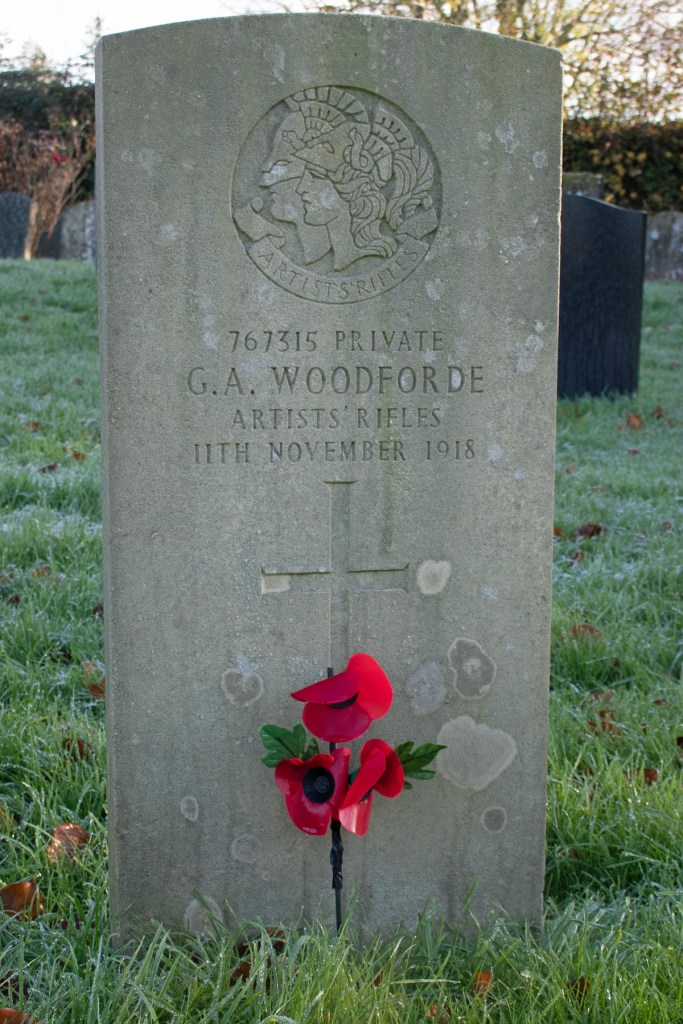
Private George Woodforde

Private George Woodforde

George Augustus Woodforde was born on 21st April 1892 in Leyton, Essex. He was one of six children to George and Harriet Woodforde, although, tragically, George had died shortly before his son was born.

George Sr had been born in Ansford, Castle Cary, Somerset and this is where he was laid to rest. He was a theological student in his twenties and, according to the 1891 census, he was living on his own means. This is something that Harriet was fortunate enough to be able to do once she was widowed.

George Jr studied into his late teens and, by the time war was declared in 1914, he was employed as a schoolmaster. He enlisted in April 1916, but was not mobilised until 17th November 1917. He served as part of the 28th Battalion (Artists’ Rifles) of the London Regiment and his records show that he was 5ft 8ins (1.73m) tall and was of a slight build, weighing in at only 110lbs (50kg).

Private Woodforde soon found himself in France, and fought on the front line for a while. He was caught up in the Battle of the Canal du Nord in late September 1918, and was badly wounded. He was medically evacuated to England, and admitted to the East Leeds War Hospital. He had received gunshot wounds to both thighs and feet, and had fractured the tarsal and metatarsals of his right foot.

Private Woodforde’s left leg became infected, and he then developed double pneumonia. It was this lung condition that he was to succumb to: he passed away at the hospital on 11th November 1918 – Armistice Day. He was just 26 years of age.

George Augustus Woodforde was laid to rest in the graveyard of St Andrew’s Church in Ansford, Somerset, close to where his father had been buried all those years before.


Private Frederick Johnson

Private Frederick Johnson

Frederick Leonard Johnson was born in the spring of 1898, in Wandsworth, South London. His parents are recorded as Frederick and Catherine Johnson, although no other information about his early life remains.

On 16th February 1918, Frederick married Winifred Peters. She was a dock labourer’s daughter from Aberavon in Glamorganshire, and the couple wed at the parish church in the town. The marriage certificate confirms that Frederick was living in Port Talbot and working as a carpenter. It also notes that his father had died by this point.

It seems likely that the young couple married because Winifred was pregnant. The couple had a son, who they called Frederick, on 1st August 1918.

Frederick had enlisted in the army by this point. While his service records no longer exist, he joined up at some point towards the end of the war – no earlier than May 1918 – and was assigned to the 3rd (Reserve) Battalion of the Gloucestershire Regiment. This was a territorial force, and Private Johnson would have been based in Kent as part of the Thames and Medway Garrison.

Little else is known about Frederick’s service. The only other thing that can be confirmed is that he was admitted to the Preston Hall Military Hospital in Aylesford, Kent, in the autumn of 1918, suffering from a combination of influenza and pneumonia. Sadly, the lung conditions were to get the better of him and he passed away on 27th November 1918, at the age of just 20 years old.

Frederick Leonard Johnson was laid to rest in the graveyard of St Peter and St Paul’s Church, Aylesford, not far from the hospital in which he had passed. It is unclear whether he ever met his son.


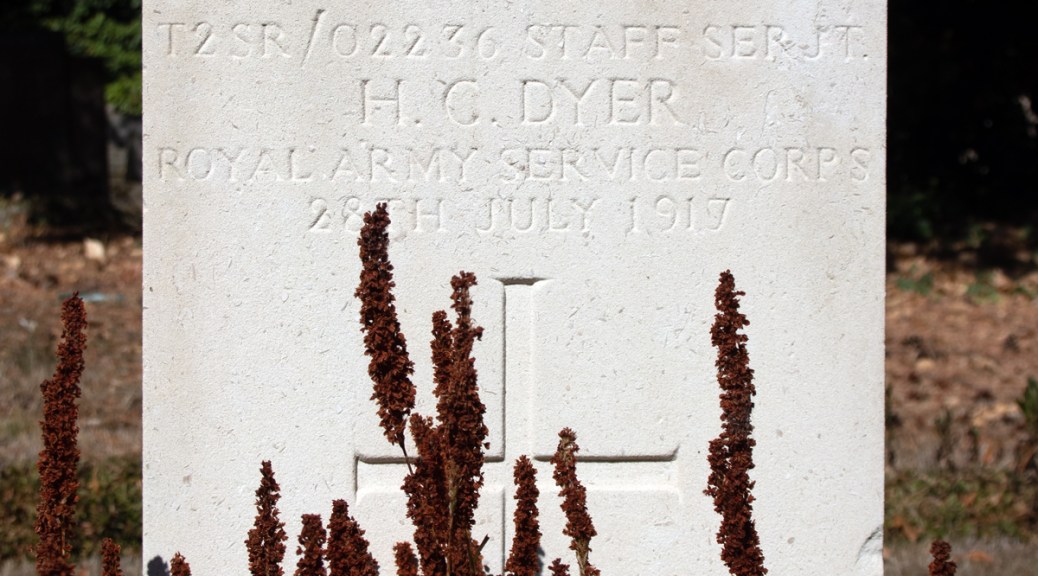
Staff Serjeant Henry Dyer

Staff Serjeant Henry Dyer

Henry Charles Dyer was born in January 1865 in the Devon town of Ivybridge. The oldest of five children, his parents were carpenter James and dressmaker Mary Dyer. When he left school, Henry found work as a cordwainer’s apprentice but, after James died in 1886, he sought out a career that would help support his mother.

Henry enlisted in the Army Service Corps on 10th July 1886 and, by the time of the next census was based at barracks in Woolwich, South London. His service records note that he was 5ft 4.5ins (1.64m) tall and weighed 124lbs (56.25kg). He had a dark hair, grey eyes and a dark complexion. He was also noted as having a tattoo of a cross on his left forearm.

Private Dyer served in the regiment on home soil for more than thirteen years, qualifying as a horse collar maker and saddler during this time and rising through the ranks. He was made a Driver in 1889, Corporal in 1895 and Staff Sergeant in October 1899.

Trouble was afoot on the other side of the world by this time and his promotion was linked to Henry being sent to South Africa. He was there for eighteen months, and was awarded the Queen’s South Africa Medal, as well as clasps for service at Tugela Heights, the Relief of Ladysmith, Laing’s Nek, Transvaal and Orange Free State.

Staff Sergeant Dyer went back to Britain in April 1901, where he remained for a further six years. On 4th July 1907, reached the end of his term of service and having completed 21 years with the Army Service Corps he returned to civilian life.

Henry moved back to Devon, moving back in with his mother and younger brother. Mary had remarried after James passed, but her second husband had also passed away, and so having two of her sons home would have been of comfort to her. The 1911 census records the family as living in three rooms of a house in Grenville Street, Plymouth. They shared the property with the Smith family, a husband, wife and two children. Henry was recorded as an army pensioner (saddler), while his brother Ernest was listed as being a watchmaker, while also in the army reserve.

War was on the horizon again, and, Henry was one of the first to step up when it was declared. He was 49 years old by this point, and so technically exempt from enlisting, but as an army life had served him well before, it must have seemed fit for him to serve King and Country once more.

Staff Sergeant Dyer’s new service records noted that he was formally employed as a saddler, and that he had put on 18lbs (8kg) since he initially signed up.

Henry was based firmly on home soil this time round, and while he was initially based in Aldershot, Hampshire, he seems to have been moved to barracks in Kent. He served for more than two and a half years, but his health seems to have been suffering by this point. At a medical on 24th July 1917, he was deemed to be no longer fit enough for war service and was discharged from the army.

It is likely that this discharge came while he was admitted to the Preston Hall Military Hospital in Aylesford. While Staff Sergeant Dyer’s earlier military service is fairly detailed, his later career is not. What is clear is that, four days after being discharged, he passed away. He was, by this time, 52 years of age.

A lack of funds may have prevented Mary from bringing her son home to Devon. Instead Henry Charles Dyer was laid to rest in the graveyard of St Peter and St Pauls Church in Aylesford, not far from the Kent hospital in which he passed.


Serjeant Albert Rumbelow

Serjeant Albert Rumbelow

Albert Edward Rumbelow was born in 1879 in Wycombe Marsh, Buckinghamshire. One of eleven children, his parents were Suffolk-born paper maker Philip Rumbelow and his wife, Jane.

Little information is available about Albert’s early life, although by the time of the 1901 census, he is recorded as being a Private in the Rifle Brigade. The family had moved to the village of Little Chart in Kent by this point, where his father was still continuing in the manufacture of paper.

Private Rumbelow’s military service is evidenced in later documents. He served with the 1st Battalion from 1895 to 1907, was awarded the South Africa medals for 1901 and 1902: he was also granted the clasp for his involvement in the defence of Ladysmith. He appears to have been wounded at this point, and was invalided out of full military service and placed on reserve.

In 1904, Albert was back in England, and living in London. That year he married Ellen Sillis, a cordwainer’s daughter from Norfolk. The couple set up home in Fulham, and went on to have five children: Abert Jr, Iris, Florence, Doris and Hilda.

By the time of the 1911 census, Albert was working at the local Public Hall, as a labourer, hall attendant and cleaner. The family were living at 9 Crabtree Lane in Fulham, sharing the property with the Fitzgerald family.

War was closing in on Europe by this point, and, once again, Albert stepped up to plat his part. He enlisted within days of conflict being declared, and within weeks had been given the rank of Corporal. His service records note that he was 5ft 10ins (1.78m) tall, weighed 156lbs (70.8kg), had brown hair and blue eyes. He was also recorded as having a tattoo of crossed rifles and a crown on his right forearm, and scared on his left calf, knee and eyebrow.

By the spring of 1915, Albert had been promoted again, to the rank of Serjeant. He was sent to France on 19th May, having been assigned to the 7th (Service) Battalion. Serjeant Rumbelow was involved at the Somme and was awarded the Distinguished Conduct Medal “for conspicuous gallantry” on 3rd June 1916. “He exposed himself to machine-gun and rifle fire when going across the open to rescue a wounded man. Later he went under fire to fetch a stretcher.”

Serjeant Rumbelow appears to have been injured in the skirmish, and was invalided to the UK later that month. When he recovered he was posted again, this time to the 18th (London) Battalion of the Rifle Brigade.

The following February he made the transfer across to the Labour Corps, and by March 1917, Serjeant Rumbelow was back in France. In August he was promoted to Company Sergeant Major, but was invalided back to England with bronchitis in February 1918.

When he recovered Albert was assigned to the 364th Area Employment Coy. in Kent, and seems to have voluntarily taken a drop in rank – back to Serjeant – in doing so. His health was dogging him by this point and in the late summer of 1918, he was admitted to Preston Hall Military Hospital in Aylesford, suffering from VDH, or heart disease.

Sadly, the strain of his military service was to be his undoing. He passed away from the heart condition on 21st September 1918, at the age of 39 years of age.

Albert Edward Rumbelow was laid to rest in the graveyard of St Peter & St Paul’s Church in Aylesford, not far from the hospital where he had breathed his last.


Now widowed, Ellen was left with the unenviable task of raising five young children on her own. She married again, to Private William Lake, on 8th June 1919, and the family moved to Essex. She lived until the age of 79, and was laid to rest in Sutton Road Cemetery in Southend.


Saddler Henry Evans

Saddler Henry Evans

Henry Evans was born in Newport, Monmouthshire, in the summer of 1883. Little concrete information remains about his early life, but it is clear that he was boarding with a dock labourer and his family in the town by the time of the 1901 census.

Henry married Margaret Jane Garner in Pontypridd on 14th March 1909. Within a couple of years, the young couple had moved to Llangollen in Denbighshire, and had had two children, Horace and Emlyn. Henry was now working as a saddler.

War was coming to Europe and, in November 1915, Henry enlisted in the Royal Army Service Corps. His previous trade saw him well, as he was assigned to the regiment’s 1st Company with the rank of Saddler. His service records show that he was 5ft 8.5ins (1.74m) tall, had no distinctive marks, and that his was Wesleyan in his beliefs.

After a few weeks on home soil, Saddler Evans was sent to the Western Front, arriving there just before Christmas 1915. For the next year, he worked in France, returning to Britain 366 days after he left for the continent. By this point, however, his health seems to have been suffering, and it was to prove to be the beginning of the end for him.

Saddler Evans was suffering from transverse myelitis, an inflammation of the spinal cord. Symptoms can be wide-ranging, but in Henry they were severe enough to be viewed as a permanent ailment. At the end of May 1917, while admitted to the Queen Alexandra Hospital on Millbank, London, he was recommended for immediate military discharge.

Unfortunately, as is often the way with bureaucracy, the discharge papers went missing. In July 1917, Henry was moved to the Croesnewydd Hospital in Wrexham, and is was here, a month later, that his documents caught up with him. Saddler Evans was finally discharged from military service on 4th August 1917.

Sadly, his army status was not to have any kind of effect on his health: at 9:30am on 17th August Henry passed away while still admitted to the Wrexham hospital. He was just 34 years of age.

Brought back to Llangollen for burial, Henry Evans was laid to rest in a plot in the town’s Fron Cemetery. He was to be reunited with his family in time: Horace died in 1940, Margaret in 1956 and Emlyn in 1963, and all were laid to rest in the same grave.


Lieutenant Hugh Punchard

Lieutenant Hugh Punchard

Hugh Punchard was born in February 1895, the oldest of three children to William and Jane Punchard. William was a civil engineer from London, and Hugh was born in Surbiton.

The 1901 census recorded the family living in the 14-room house, Pope’s Garden, in Twickenham. Along with the family, there were four members of staff – a governess, housemaid, cook and a nurse. By the time of the next census, sixteen-year-old Hugh was away at school, boarding with more than 400 others at Haileybury College in Hertfordshire.

War was coming to Europe by this point, and Hugh was keen to play his part. He enlisted in the Royal Navy on 20th October 1914 and, while he was only there for a short period, his records shed some light onto the man he had become. He enlisted as a mechanic, and was noted as being 6ft 4ins (1.93m) tall, with dark brown hair, grey eyes and a fair complexion.

Hugh remained in the Royal Navy for only a month, and, while full details of his service are no longer available, it would seem that it was at this point that he transferred to the Royal Garrison Artillery. He appears to have performed his duties well, and achieved the rank of Lieutenant. He also made another transfer, when he was attached to the Tank Corps.

Lieutenant Punchard was based in Dorset by the last year of the war, and it was while he was serving there that he became unwell. He contracted pneumonia, and was admitted to Wareham Military Hospital. Sadly, the condition was to take his life, and he passed away on 31st October 1918, at the age of just 23 years old.

Hugh Punchard’s paternal grandparents lived in Devon, and, as William had passed away two years earlier, the decision was to lay him to rest in Totnes Cemetery.


Hugh’s will left his estate to his mother, Jane. When he passed, she became the beneficiary of his effects, totally some £3,600 7s 6d (around £250,000 in today’s money).

Jane stayed living in Twickenham: when she passed away on 29th July 1937, she was brought to Devon for burial, and was laid to rest with her son.


A number of documents relating to Hugh give his name as R Hugh Punchard. Sadly, I have not been able to unearth details of what his official first name might have been.


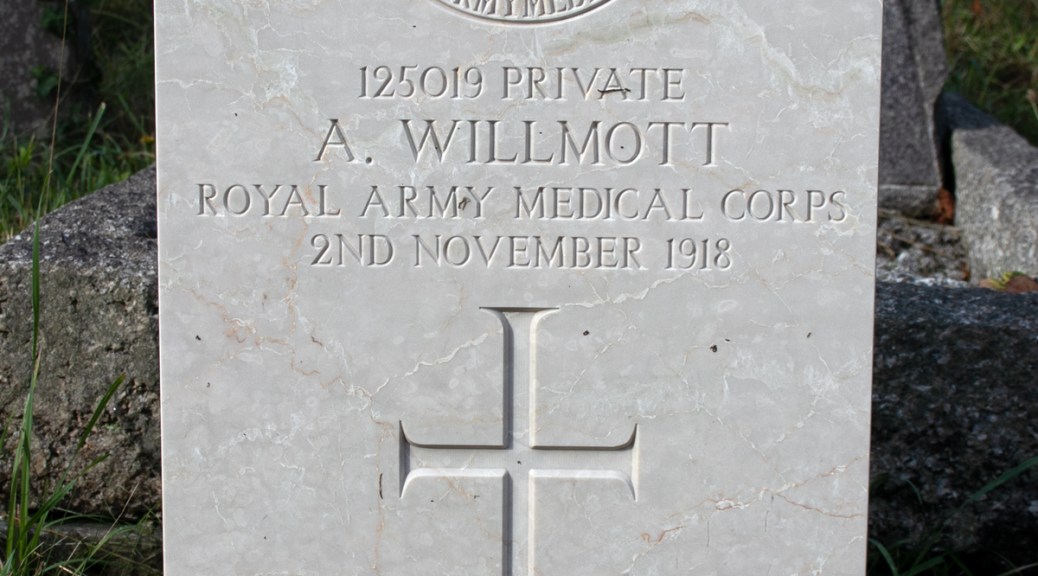
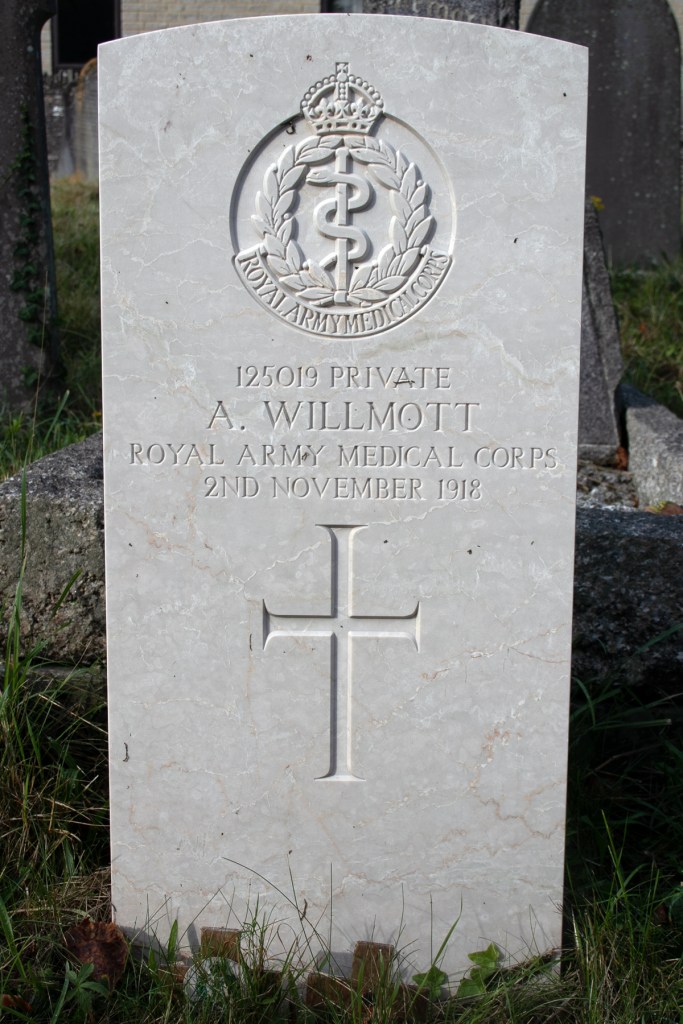
Private Alec Willmott

Private Alec Willmott

Alec William Willmott was born in 1886 and was one of six children to Henry and Ellen Willmott. Henry was a farm labourer from Oldland in Gloucestershire, and this is where the family were raised.

When he left school, Alec found work making shoes and boots at a local factory – this was work most of the Willmott children went into. On 24th April 1916, he married Elsie Frost in the local church. The couple set up home in Keynsham, and went on to have a son, Cecil, who was born in August 1917.

Alec played his part during the war. Full service details are not available, but it is clear that he had enlisted in the Royal Army Medical Corps by the spring of 1918. There is no confirmation of whether Private Willmott served at home or overseas, but, by October 1918, he had been admitted to the 2nd London General Hospital in Chelsea, suffering from a combination of influenza and pneumonia.

Sadly, these conditions put a strong pressure on his heart: Private Willmott passed away from cardiac failure on 2nd November 1918, at the age of just 32 years old.

Alec William Willmott was brought back to Gloucestershire for burial. He was laid to rest in the graveyard of St Anne’s Church in his home village, Oldland.