Tag Archives: Middlesex

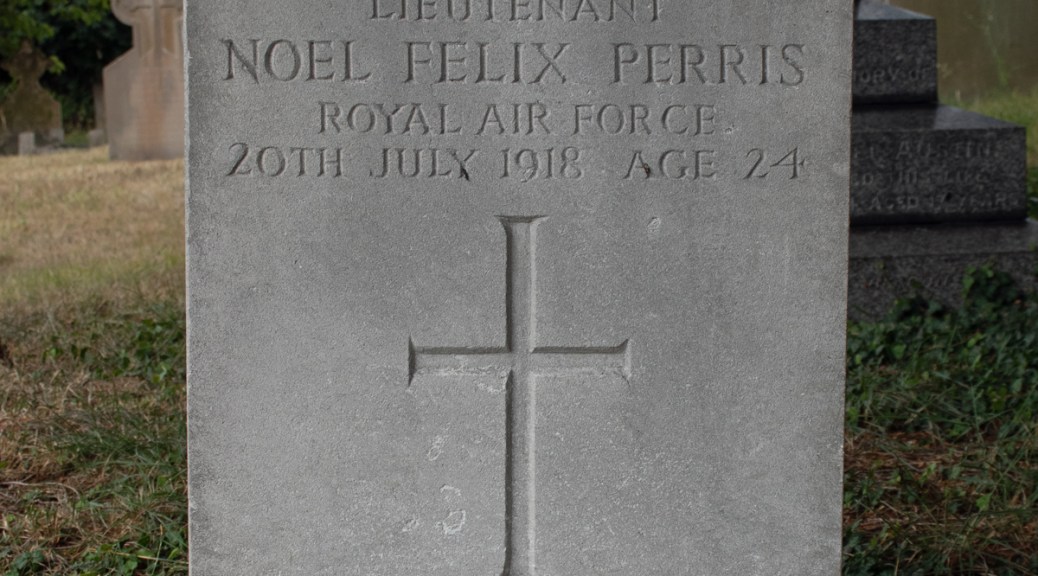
Lieutenant Noel Perris

Lieutenant Noel Perris

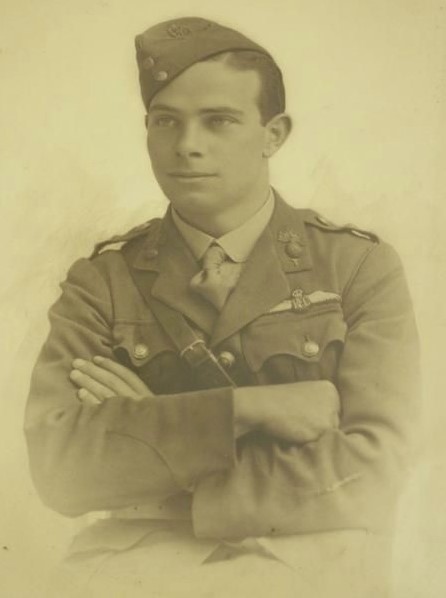
Noel Felix Perris was born early in 1894 in Chiswick, London and was the oldest of three children to George and Mary Perris. George was from Liverpool, and he and Yorkshire-born Mary made the move to south in the late 1880s.

Noel went on to study science at school, but when war broke out, he clearly felt a duty to play his part. George used his writing skills to become a war correspondent with the French army, while his son joined the 2nd London Regiment.

Quickly promoted to the rank of Lieutenant, Noel served in France and Egypt. In 1916, he was badly injured at Hébuterne, to the south of Arras, and returned to England to recuperate. When he had recovered, he transferred to the Royal Flying Corps, subsequently gaining his wings in the newly-formed Royal Air Force.

Lieutenant Perris was based in Kent as part of 143 Squadron. On the morning of 20th July 1918, he took off from Detling Airfield as part of a normal patrol flight. His aircraft – a single-seater RAF SE5a – collided with another plane, piloted by Lieutenant Thomas Wright, and both crashed to the ground in flames. Both piloted were killed on impact.

An inquest found that the cause of the pilots demise was accidental death. Lieutenant Perris was just 24 years old.

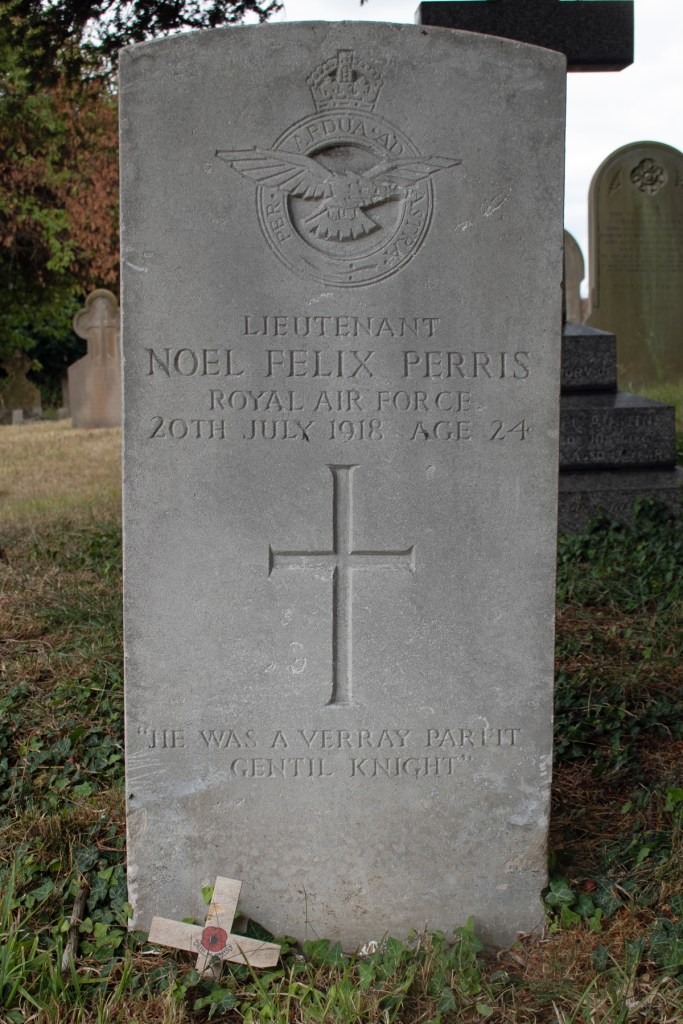
Thomas Wright’s body was taken home to Fleetwood, Lancashire, for burial. Noel Felix Perris was laid to rest in the quiet graveyard of St Martin’s Church in Detling, not far from the base.


Lieutenant Noel Perris
(from findagrave.com)

The epitaph on Noel’s headstone comes from Geoffrey Chaucer’s The Knight’s Tale.

He was a verray parfit gentil knight

A modern day translation might be “He was a true, perfect knight of noble character.”


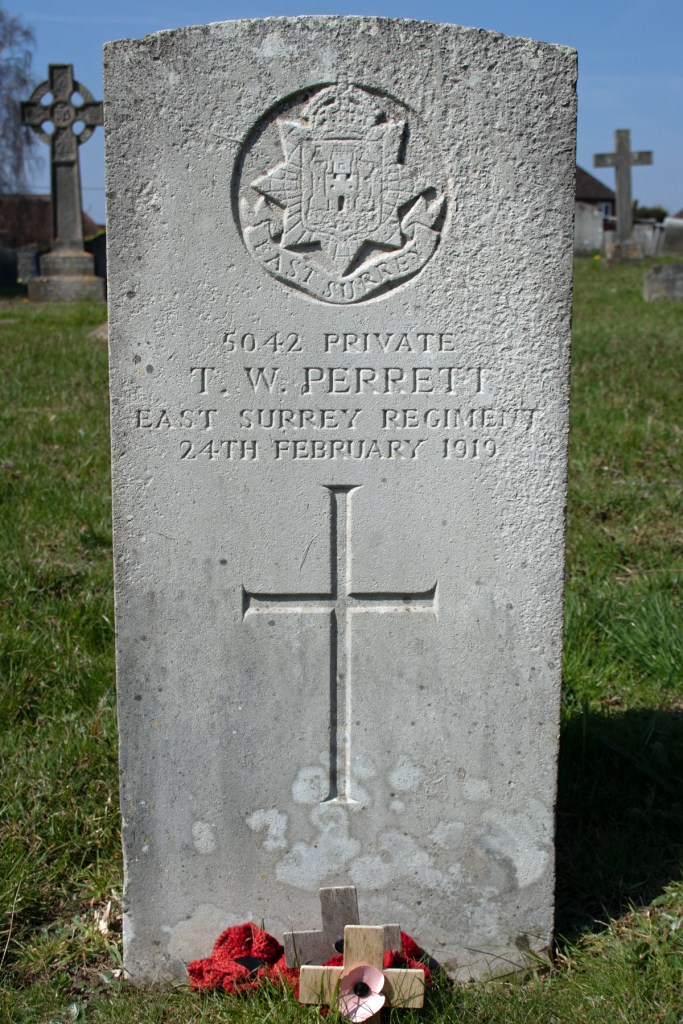
Private Thomas Perrett

Private Thomas Perrett

Thomas William Perrett was born in October 1878, the seventh of eight children to Lewin and Ann Perrett. Lewin was an agricultural labourer from Wiltshire, and it was in Aldbourn, near Marlborough, that the family were raised.

Initially finding work as a farm labourer, Thomas was soon drawn to the bright lights and big city. By the early 1900s he had moved to London, and it was here that he met, and in 1909 married, Mary Sterry, a labourer’s daughter from Middlesex. The couple went on to have three children, Elsie, Rose and Alice.

Thomas, by this point, had found work on the railways: the 1911 census records him as a railway porter, presumably at Paddington Railway Station, which was within a few minutes’ walk of where the Perrett family were living.

War came to Europe, and Thomas was keen to play his part. Full details of his service are not available, but he enlisted in the East Surrey Regiment, where he was assigned to the 2nd/5th Battalion. This was a second line unit, and Private Perrett remained on home soil for the duration of the war.

This territorial role was reinforced when he transferred across to the 696th Agricultural Company of the Labour Corps. Details of his work are not available, but it seems likely that he was assigned to farm work in the mid-Sussex area.

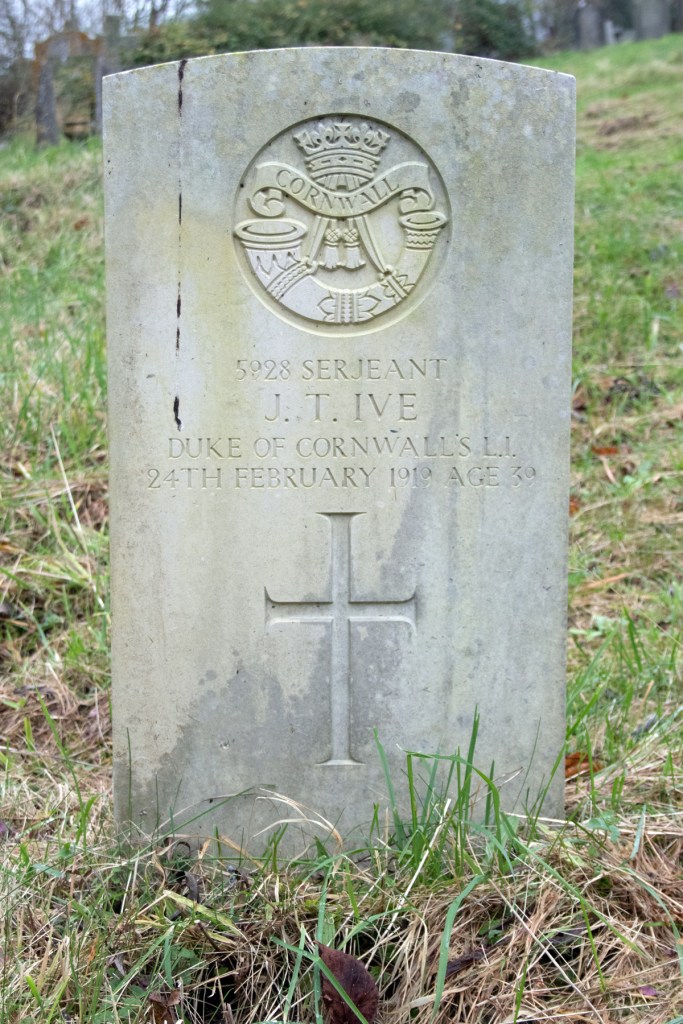
This too is where Private Perrett remained after the war and where, on 24th February 1919, he was to pass away. Details of his death are vague and the cause is unknown, but he was 40 years of age.

Thomas William Perrett was laid to rest in the cemetery in Cuckfield, West Sussex.


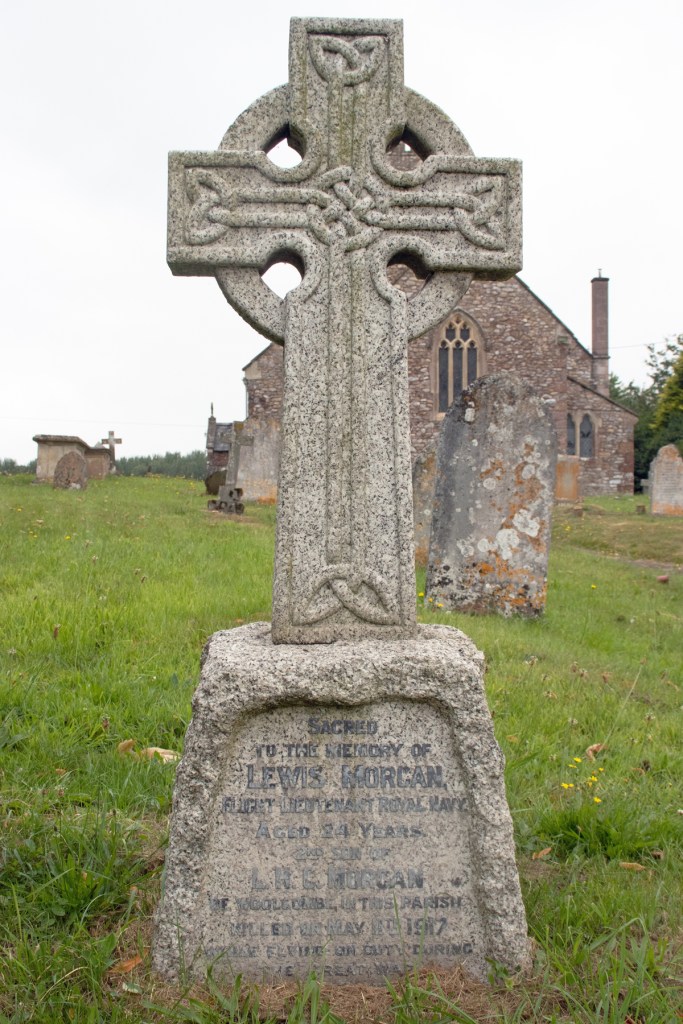
Flight Lieutenant Lewis Morgan

Flight Lieutenant Lewis Morgan

Lewis Morgan was born on 22nd May 1892 in Plymouth, Devon. He was one of six children to former army officer and rector Lewis Harold Gilbert Morgan and his wife, Mary.

Growing up in Plymouth, it seems inevitable that the sea life would take hold in Lewis Jr. He first took up a post in the Merchant Navy, rising to Second Mate in December 1911.

By this point, however, he had set his sights on something more formal and soon enlisted in the Royal Navy. He served on a number of vessels over the years, and was re-engaged when war broke out. By the summer of 1915, he transferred to the Royal Naval Air Service, earning his wings on 5th August that year.

The now Flight Lieutenant Morgan’s service grew as the war continued. The life of air crew at this point in the era of flight was notoriously dangerous, and Lewis was to meet his own fate. On 11th May 1917, he was flying with Probationer Flight Officer Randolph Seed around Edmonton, Middlesex, when an accident occurred. The local newspaper reported on the incident and the subsequent inquest:

Flight-Lieutenant Mitchell gave a graphic account of the accident. He said that about eight o’clock in the evening he was flying at a height of 1,000 feet, and the machine containing the deceased officers was just ahead, but 500 feet higher. The flying conditions were good, and at the time both machines were going steadily. Glancing upwards he notices that the other machine suddenly appeared to collapse, the front extension of the main plane crumpling up. The machine nose-dived, and a black object fell out of it. The machine continued its descent and fell into the Edmonton Sewage Farm… The machine was so entirely broken up that it was impossible to theorise upon the cause of the accident. Morgan was said to have fallen on a concrete path. The deaths were instantaneous.

Taunton Courier and Western Advertiser: Wednesday 23rd May 1917

Lewis Morgan was just 24 years old, and days away from his 25th birthday. His body was brought back to Somerset, and laid to rest in the graveyard of Holy Cross Church in Sampford Arundel. By this point, his parents were living in the nearby Woolcombe House, so their son was, in a way, brought home.


The newspaper article went on to report that Flight Lieutenant Morgan was the third and last son to Lewis and Mary.

Francis Morgan – five years Lewis’ senior – enlisted in the Royal Field Artillery when war broke out. He rose to the rank of Captain, and was mentioned in Despatches for his actions. He was killed in the Dardanelles – potentially at Gallipoli – on 2nd May 1915, at the age of 28 years old.

Walter Morgan was a year younger than Lewis. He also played his part in the First World War, joining the South Lancashire Regiment, and rising to the rank of Second Lieutenant. Walter was also sent to fight in Gallipoli, and this is where he also lost his life. He was killed just three months after Francis, on 9th August 1915. He was just 22 years of age.

The loss of three sons in two years was to take a further toll on the Morgan family. Mary had suffered from poor health for a while, and the deaths of Francis, Walter and Lewis was to prove too much. She passed away at home on 15th July 1917, aged just 56 years old.


Flight Lieutenant Lewis Morgan

Stoker 1st Class Sidney Seymour

Stoker 1st Class Sidney Seymour

Sidney Seymour was born on 5th April 1895 in Islington, London, the son of Elizabeth Seymour. Sadly, as his was a common name in the area, there is little concrete information about his early life, and is it not until his military service that anything specific can be confirmed.

Sidney was working as a clockmaker when he signed up. He enlisted on 29th April 1913, joining the Royal Navy as a Stoker 2nd Class on a twelve year contract.

Sidney was initially sent to HMS Pembroke, the Royal Naval Dockyard in Chatham, Kent. He trained for nine months at the dockyard, before being given his first posting on board the battleship HMS Dominion. Stoker Seymour spent more than three years on board: during this time he was promoted to Stoker 1st Class, but also spent two weeks in the cells for an unrecorded reason.

In July 1917 Sidney returned to HMS Pembroke; that summer was a busy time for the base, and Stoker 1st Class Seymour found himself billeted in overflow accommodation set up in the barracks’ Drill Hall.

On the night of 3rd September, Chatham came under attack from a German air raid, and the Drill Hall received a direct hit. Stoker Seymour was injured, and died of his injuries in hospital the following day. He was 22 years of age.

Sidney Seymour was laid to rest in the Woodlands Cemetery in Gillingham, Kent, alongside the other victims of the Chatham Air Raid.


Serjeant John Ive

Serjeant John Ive

John Tucker Ive was born on 30th January 1882, one of eleven children to George and Emily Ive. George was a stone dresser from Harefield, Middlesex, and this is where the family were born and raised.

John was evidently after a life of adventure and, on leaving school, he enlisted in the Duke of Cornwall’s Light Infantry. There is little documented about his military career, but he was based in Devonport and spent a couple of years in South Africa during the Second Boer War.

When he returned to England, John met Amy Ethel Staunton, from Stonehouse in Devon. The couple married in 1905 and went on to have a son, also called John, the following year.

When his military service came to an end, John found work as a butler, and he and Amy were employed by the same household. John Jr, meanwhile, was brought up by his maternal grandmother in Plymouth.

Global conflict was on the horizon, by now, and John soon felt the need to play his part once again. He rejoined the 2nd Battalion of the Duke of Cornwall’s Light Infantry, and was given the rank of Serjeant. He was shipped to France in August 1914, where his battalion fought at Ypres and at Mons, and he was injured during both battles.

By the time the conflict ended, Serjeant Ive had transferred to the regiment’s Labour Corps; at the start of 1919, he was preparing to be discharged from the army, but contracted pneumonia. Admitted to the Alexandra Hospital in Cosham, Hampshire, the lung condition sadly got the better of him: he passed away on 24th February 1919, at the age of 37 years old.

John Tucker Ive was brought back to Devon for burial; he was laid to rest in the graveyard of St Mary’s Church in Wolborough, Newton Abbot.


Two of John’s brothers also died in the conflict.

Private George Robert Ive served with the 2nd Battalion of the Royal Fusiliers. He died at Gallipoli on 28th June 1915, at the age of 34 years old.

Gunner Edward Ive served with the Royal Garrison Artillery. He died in the Persian Gulf on 1st May 1916, aged just 30 years old.


Stoker 1st Class William Ferrett

Stoker 1st Class Robert Ferrett

William Robert Ferrett (known as Robert) was born on 14th December 1889, and was the oldest of three children to William and Annie. William was a farm labourer from Dorset; Annie was born in Camberwell, South London, but, by the time Robert was born, the couple had settled in Kingsbury, Middlesex, where they raised their family.

Robert also took up labouring work in a washhouse when he left school, and had left home by the time of the 1911 census. He was recorded as boarding with James and Sarah Kemp in Willesden Green. There may have been an ulterior motive for him as, that summer, he married their daughter, Daisy. There may have been an ulterior motive for the marriage as well as, later that year, the couple had the first of their two children, who they named William.

War was on the horizon and, in the spring of 1915, Robert enlisted, joining the Royal Navy as a Stoker 2nd Class. His service records show that he stood just 5ft 1.5ins (1.56m) tall, had brown hair, brown eyes and a medium complexion. He was also noted as having tattoos on both arms and a scar on his forehead.

Stoker Ferrett’s first posting was at HMS Pembroke, the Royal Naval Dockyard in Chatham, Kent. After three months’ training, he was assigned to the battleship HMS Vanguard, on board which he spent the next two years. While he was promoted to Stoker 1st Class during this time, it was not all plain sailing. The records show that Robert spent two separate periods of time in the brig – 14 days in December 1916, and a further 14 days in June 1917 – although his misdemeanours are unclear.

In June 1917, soon after his second imprisonment, Stoker Ferrett was transferred back to HMS Pembroke. The dockyard was particularly busy that summer and Robert found himself billeted in temporary accommodation in Chatham Drill Hall.

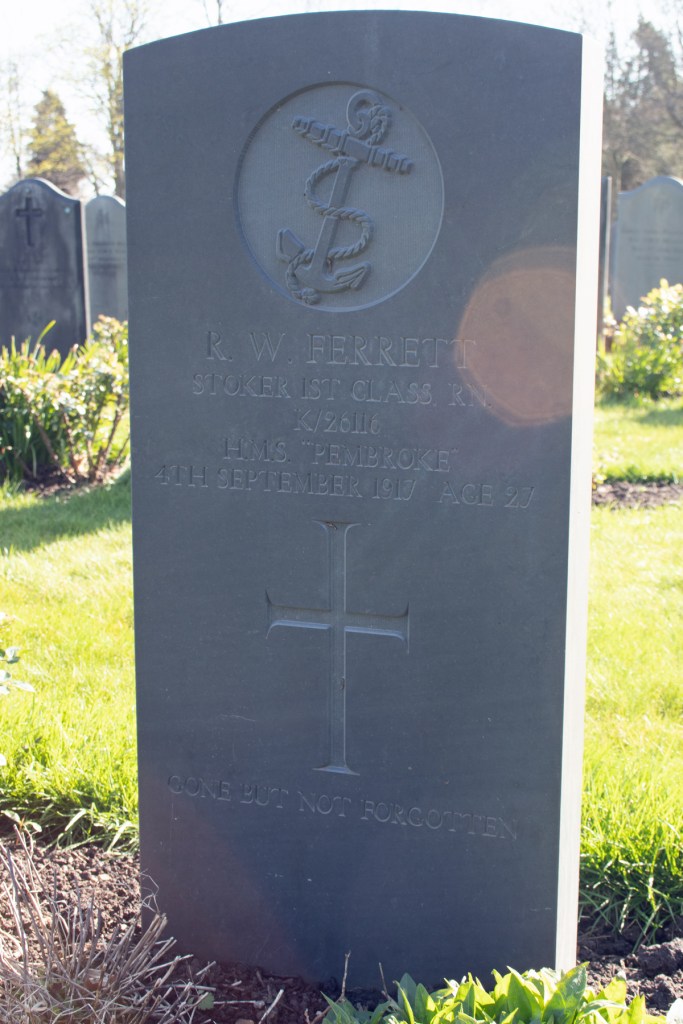
On the night of the 3rd September, the German Air Force conducted the first night time raid on England. Chatham came in the firing line, and the Drill Hall received a direct hit. Stoker 1st Class Ferrett was badly wounded and was taken to the Royal Naval Hospital in the town. His injuries proved too severe, however, and he passed away the following day. He was 27 years of age.

Robert Ferrett was laid to rest in the Woodlands Cemetery in nearby Gillingham, along with the other victims of the Chatham Air Raid.


Robert’s younger brother, Robert Frederick Ferrett, also fought in the Great War. He served as a Private in the 7th Battalion of the London Regiment, but was killed at the Somme on 23rd July 1918, aged just 21 years old. He was laid to rest in the Pernois Cemetery in Picardie.


Ordinary Seaman George Butler

Ordinary Seaman George Butler

George Butler was born in Willesden, Middlesex, on 16th January 1899 and was the oldest of three children. His father, George Sr, was a bricklayer, while his mother, Sarah, worked as a laundress to help bring in some extra money.

Sadly, because of his age, there is little concrete information on George Jr’s early life. What can be confirmed is that, on 21st March 1917, having not long turned 18 years of age, and with the Great War well under way, he was keen to play his part for King and Country. He joined the Royal Navy for the duration of the conflict and was given the rank of Ordinary Seaman.

George’s service records show that he was 5ft 10ins (1.78m) tall, had brown hair, grey eyes and a fair complexion. It was also noted that he had a scar on his left leg. The document also confirms that he was employed as a bus washer.

Ordinary Seaman Butler was based at HMS Pembroke, the Royal Naval Dockyard in Chatham, Kent. It was a busy place that summer, and temporary accommodation was needed quickly. Chatham Drill Hall was brought into service, and George found himself billeted there.

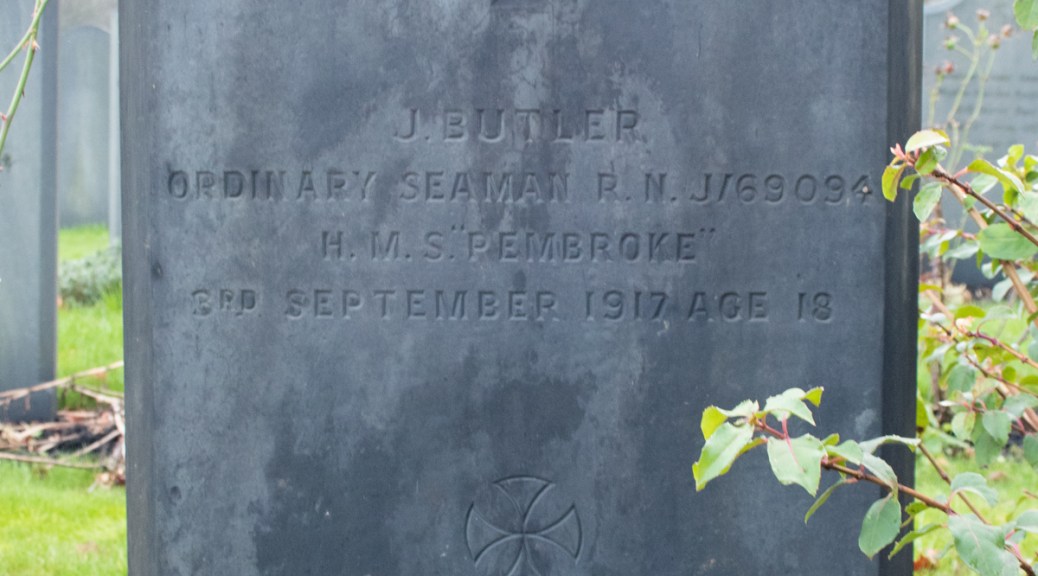
On the 3rd September 1917, the German Air Force carried out its first night air raid: Chatham was heavily bombed and the Drill Hall received a direct hit; Ordinary Seaman Butler was among those killed instantly. He was just 18 years of age.

George Butler was laid to rest, alongside the other victims of the Chatham Air Raid, in the Woodlands Cemetery, Gillingham.


George’s headstone gives the incorrect initial, but the location is correct.


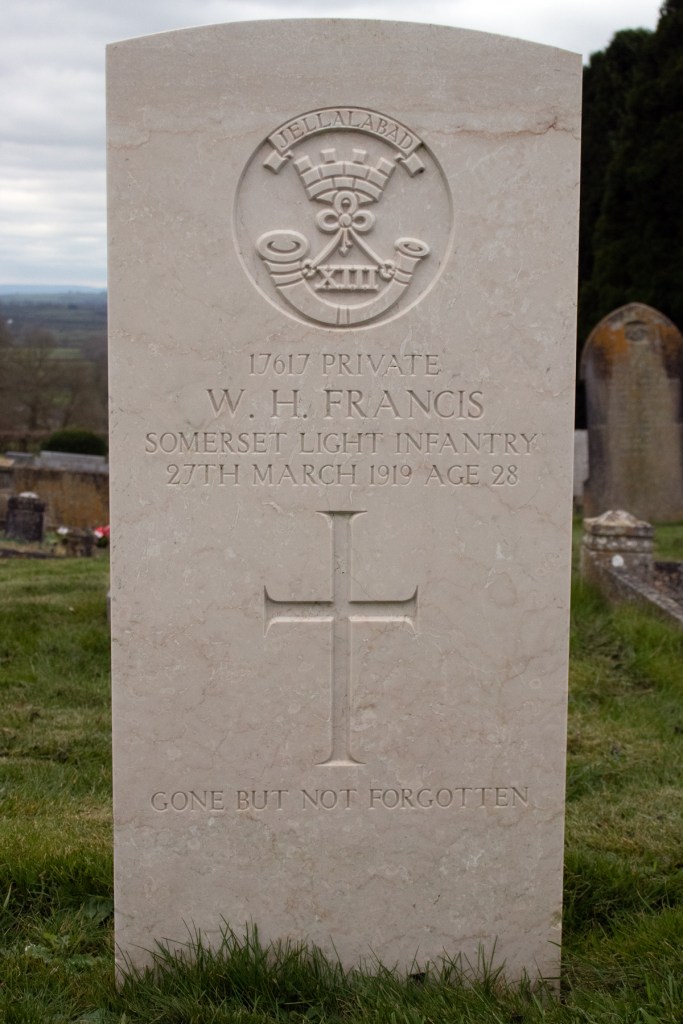
Private Wilfred Francis

Private Wilfred Francis

Wilfred Harry Francis was born in October 1890 in Castle Cary. He was the oldest of eight children to Edward and Rosina Francis, both of whom had also been born in the Somerset Town. Edward was a baker in his younger days, but, by the 1911 census he was employed as a builder’s labourer. Wilfred was recorded in the same document as a tailor.

War was coming to Europe, and Wilfred enlisted. He had been a volunteer in the Somerset Light Infantry, but on 6th April 1915, he made this a formal role. His service records show that he stood 5ft 6ins (1.68m) tall had light blue eyes and light brown hair.

Private Francis was assigned to the 6th Battalion and sent to France in the summer of 1915. His battalion was immediately thrown into the thick of the fighting at Ypres. The intensity of the battles of Hooge and Bellewaarde seemed to impact Wilfred as, on 7th October, he was admitted to the 4th London General Hospital, suffering from shell shock.

Wilfred was discharged after two weeks, and signed off as fit for light duties. It seems that he didn’t return to the Western Front, but instead was transferred to the 3rd (Reserve) Battalion of the regiment, based in Devonport.

The memories still seemed to haunt Private Francis, however. He was admitted to hospital again – this time the County of Middlesex Hospital in Napsbury, near St Albans – with mania. This time his ‘mental deficiency’ proved to much for the army, and he was discharged from military service on 18th July 1916. His discharge papers show that he gave the hospital as his address and recommended that he be admitted to a civil asylum.

Wilfred’s trail goes cold for the next few years. He seems to have been brought back to Somerset for ongoing treatment, but passed away in Wells on 27th March 1919; the cause of his passing is not known. He was 28 years of age.

Wilfred Harry Francis was laid to rest in the Castle Cary Cemetery, hopefully finding peace at last.


Private Hector Parks

Private Hector Parks

Hector Joseph Parks was born in the spring of 1885, the youngest of five children to William Jacob and Mary Ann Parks. William was a ship’s steward who, when Mary died in 1895, remarried, giving Hector a further two half-siblings.

With William employed at sea, Hector spent a lot of time with his paternal grandparents and, in fact, both the 1891 and 1901 censuses recorded him as living in East London with them. That later document shows that Hector had left school, and was working as a carman for a delivery company.

The next available record for Hector comes thirteen years later, when it is evident that he was among the first to volunteer for war service. He enlisted in the Middlesex Regiment and, while full details of his army career are not available, he soon found himself in the thick of things, arriving in France on 14th August 1914.

Private Parks’ battalion – the 4th – was caught up in skirmishes from the outset of war, fighting at Le Cateau, Marne, Aisne and Hooge. Over the next few years, the Middlesex Regiment found itself at The Somme and Ypres and, while it is not possible to place Hector directly in these conflicts, it seems likely that he would have been involved in a lot of them.

In January 1918, Private Parks was back on home soil, having been admitted to the Auxiliary Hospital at Ashcombe House in Weston-super-Mare, Somerset. Sadly, the cause of his return to England is lost to time, but he was to succumb, passing away on 20th January 1918, at the age of 32 years old.

Hector Joseph Parks was laid to rest in Somerset – he is buried in the Milton Road Cemetery in Weston-super-Mare.


Stoker 2nd Class Alfred Watts

Stoker 2nd Class Alfred Watts

Alfred Watts was born on 16th April 1897 in Marylebone, Middlesex. His mother was called Polly, but there is little further information about his early life.

When he left school, he became a seaman, although in what capacity is not entirely evident. What can be confirmed is that, on 24th November 1915, with war raging across Europe, he decided to make this his full career, and enlisted as a Stoker 2nd Class in the Royal Navy.

Alfred’s military records show that he stood 5ft 4ins (1.63m) tall, had brown eyes, dark brown hair and a fresh complexion. He was also noted as having a birthmark on his right breast.

Alfred’s first posting was at HMS Pembroke, the Royal Naval Dockyard in Chatham, Kent. He spend four months training here, before being assigned to HMS Wallington, a depot shop that served in the Humber Estuary.

On 6th September 1916, in the column marked Discharged is one word: Run. It seems that, for whatever reason, he deserted his post, and having been rounded up nearly three weeks later, he was taken back to Chatham under police guard. He was imprisoned, and only returned to his duties on 30th October.

Stoker Watts was given another posting, on board the battleship HMS Dominion, but again absconded in June 1917, and was detained for a further three weeks, this time at HMS Victory, the dockyard in Portsmouth.

Within a month, Alfred was transferred back to Chatham. HMS Pembroke was a busy place that summer and temporary accommodation was put in place. Chatham Drill Hall was brought into service for this purpose, and Alfred found himself billeted there.

On the 3rd September 1917, the German Air Force carried out its first night air raid: Chatham was heavily bombed and the Drill Hall received a direct hit. Stoker 2nd Class Watts was among those badly injured. He was taken to hospital, but died of his wounds two days later. He was just 20 years of age.

Alfred Watts was laid to rest, alongside the other victims of the Chatham Air Raid, in the Woodlands Cemetery, Gillingham.