Tag Archives: Petty Officer

Petty Officer William Feldon

Petty Officer William Feldon

William Feldon was born on 16th October 1878, the middle of three children – and the only son – to William and Jessie Feldon. William Sr was a carpenter from Highgate, Middlesex, but it was south of the Thames, in Lambeth, Surrey, that the family were raised.

When he finished his schooling, William Jr found work as a general labourer. He was drawn to bigger and better things, however, and a life at sea was to catch his eye. In June 1894, he enlisted in the Royal Navy as a Boy 2nd Class. His service records noted that he was 5ft 2ins (1.57m) tall, with brown hair, brown eyes and a fresh complexion.

By the time William had completed his initial training, he had been promoted to Boy 1st Class. He was then moved to HMS Pembroke, the Royal Naval Dockyard in Chatham, Kent.

By October 1895, he was given his first posting, on board the torpedo cruiser HMS Archer, and he would remain assigned to her for the next two years. During this time, William came of age and was formally inducted into the Royal Navy, and was given the rank of Ordinary Seaman. His commitment to the service was pretty clear, and, within seven months he had been promoted again, to Able Seaman.

After a short spell back at Pembroke, William was assigned to HMS Wildfire, another shore establishment just along the coast in Sheerness. He remained there for nine months, during which time he was promoted again, to the rank of Leading Seaman.

In May 1899, William was moved to another posting, on board the gunboat HMS Partridge. This assignment provide him with the route to further promotion: he remained on board until July 1901, having risen to Petty Office 2nd Class on 1st July 1899 and Petty Officer 1st Class on 23rd September 1900.

Over the remainder of his initial term of service, William served on six further vessels. The sea was in his blood by this point, and when his contracted ended on 15th October 1908, he re-enlisted without any hesitation.

Away from the Navy, William fell in love. On 23rd October 1909, he married Ada Plumpton, who was 25 years old, and who lived in Battersea, Surrey. The couple exchanged vows at St Faith’s Church in Southwark, but settled down in the village of Dovercourt, Essex. They went on to have two children, Doris, who was born in 1910, and Elsie, who came along the following year.

Back at sea, Petty Officer Feldon was assigned to the cruiser HMS Boadicea. He spent two years on board, before moving to another cruiser, HMS Blonde, for another two years. In between voyages, William returned to the Royal Naval Dockyard in Chatham.

On 13th January 1914, Petty Officer Feldon was posted to the battleship HMS Formidable, part of the Channel Fleet patrolling the seas of the southern coast of Britain.

Early on the morning of 1st January 1915, while off the Dorset coast, she was torpedoed by the German submarine U-24. Other ships in her convoy came to help, but after a couple of hours – and another torpedo strike – the damage was too great and she sank. 120 members of the crew were saved, but more than 540 officer and crew – including Petty Officer Feldon – were lost. He was 36 years of age.

William Feldon’s body was one of those recovered and identified. He was laid to rest in a communal grave in Lyme Regis Cemetery, in the hills above the Dorset town where he had been brought ashore.


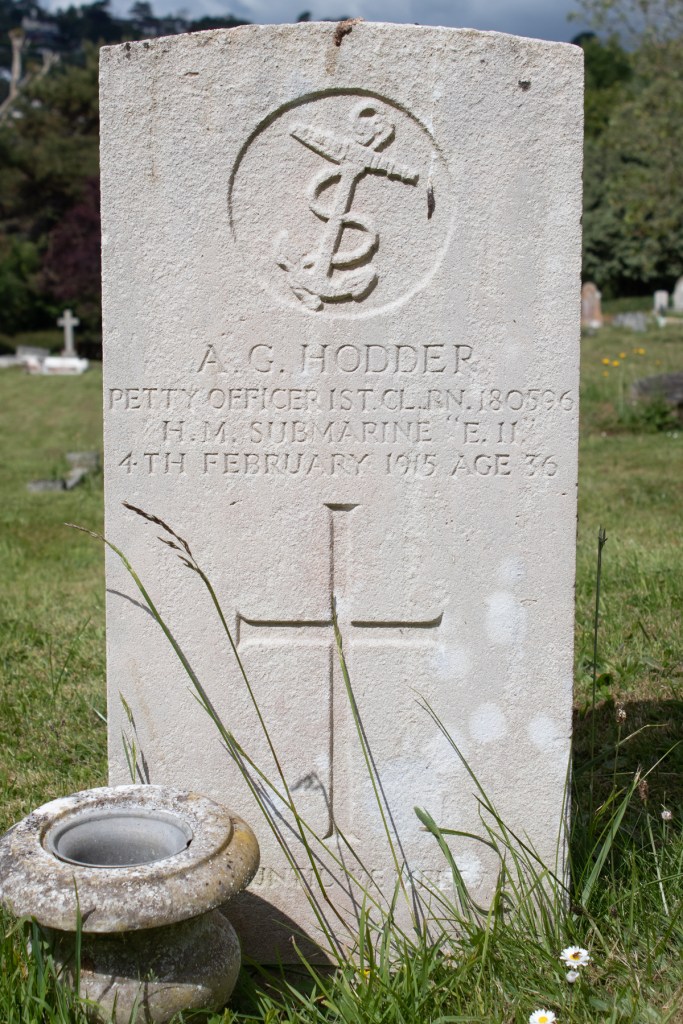
Petty Officer 1st Class Albert Hodder

Petty Officer 1st Class Albert Hodder

Albert George Hodder was born on 27th December 1878 in Lyme Regis, Dorset. The oldest of three children, his parents were Samuel and Ellen Hodder. Samuel was a general labourer who died in 1886, when he was 35 years of age. By the time of the 1891 census, Albert had given up school, and was working as a live-in cowboy in the nearby Devon village of Uplyme, bringing in what would be the only wage for him, his mother and his two younger brothers.

Working on a dairy farm would not bring in the money the his family would need. So, on 7th August 1894, Albert sought out more of a career and enlisted in the Royal Navy. His service records confirm that he was 5ft 4ins (1.62m) tall with brown hair, grey eyes and a ruddy complexion.

Albert was under the age to formally enlist, and so was given the rank of Boy 2nd Class. He was sent to the training ship HMS Boscawen, and, over the next eighteen months he received a basic education and naval induction. By the end of July 1895, he had been promoted to the rank of Boy 1st Class.

On 12th November 1895, Boy Hodder was assigned to the ironclad ship HMS Alexandra, and his naval career began. Over the next nearly two decades, he would serve on twelve separate ships, rising through the ranks as he did so.

When Albert came of age, on 27th December 1896, he was serving on board HMS Gibraltar. Formally inducted into naval service, he was given the rank of Ordinary Seaman. He spent more than three years on board Gibraltar, and rose to Able Seaman on 1st January 1899.

From here his career continued: He was promoted to Leading Seaman on 18th May 1903, Petty Officer 2nd Class on 1st April 1905 and Petty Officer 1st Class just two years later.

In the autumn of 1912, Albert’s career changed course. He was assigned to HMS Maidstone, a submarine depot ship, and a life under the ocean waves started to appeal. On 28th March 1914, Petty Officer Hodder was sent to HMS Dolphin, home of the Royal Navy Submarine Service, where he was trained up for new duties. By October that year he was to be found serving on board the newly-commissioned submarine E11.

Over the next few months he served in the North Sea, Baltic Sea, and the E11 was involved in a minor way in the defence of Scarborough in December 1914 and the Cuxhaven Raid ending on Christmas Day that year.

At this point, Petty Officer Hodder’s trail goes cold. He remained on the E11 until early February, by this time she was based off the Norfolk coast.

An inquest was held on Friday on the body of Albert George Hodder… of Lyme Regis, Dorset, a member of the crew of one of HM vessels, who died from the effect of immersion.

Evidence showed that at 9.20 on the previous Thursday night a petty officer heart the shout of “Man overboard.” He got on to a collier moored in the river and saw a black object float past. Unable to reach it, he jumped ashore and got into the ferry boat. He was then able to reach the object, which he found was the deceased. He held his head above the water while the ferryman pulled the boat to the quay. The deceased was got out in an insensible condition, a doctor sent for, and artificial respiration tired. Efforts were persisted till breathing was established, and he was then wrapped in blankets, with hot water bottle; but he succumbed to the effects of immersion and shock shortly after eleven. No one saw how the deceased fell overboard.

A verdict of “Accidental death” was returned.

[Diss Express: Friday 12th February 1915]

Petty Officer 1st Class Albert George Hodder was just 35 years of age when he died on 4th February 1915. His body was taken back to Dorset for burial, and he was laid in Lyme Regis Cemetery.


Ship’s Corporal Thomas Berry

Ship’s Corporal Thomas Berry

Details of the civilian life of Thomas Joseph Berry are a challenge to piece together. He is not recognisable in any census returns, and baptism records don’t tally either.

The main resource for building a picture of Thomas’ life is the service record for his time in the Royal Navy. This provides his date of birth – 6th May 1882 – and suggests that he was born in Hornsey, Middlesex. He was working as a cabinet maker when he enlisted, the document also confirming that he was 5ft 4ins (1.62m) tall, with brown hair, brown eyes and a fresh complexion.

Thomas began his naval career on 29th July 1898. Below the age to formally enlist, he was given the rank of Boy 2nd Class. Over the next eighteen months, his time was split between two training ships based in Devonport, Devon, HMS Impregnable and HMS Lion. In April 1899 he was promoted to Boy 1st Class.

In February 1900, Thomas moved to HMS Vivid, the Royal Naval Dockyard in Devonport. On 6th May he came of age, and was formally enrolled in the navy, receiving the rank of Ordinary Seaman. From this point his career took off and, over the next sixteen years, he would go on to serve on board fifteen ships, seeing the world.

At his annual reports, Thomas’ conduct was regularly identified as Very Good, and his commitment was reflected in the progress he made through the ranks. By June 1901, he had been promoted to Able Seaman Berry. The summer of 1907 saw him move up to Leading Seaman, and three years later, Thomas was a Petty Officer. In November 1911 he was made Ship’s Corporal 2nd Class, and by the following spring he had been promoted again, this time to Ship’s Corporal 1st Class.

Away from the Royal Navy, Thomas’ personal life was developing. Again there is little documentation to provide any specifics, but he married a woman called Albertine Elizabeth in the early 1910s. The couple went on to have a son, Bernard, who was born on 15th January 1913, and the family seemed to settle down in Paignton, Devon – a later record giving Albertine’s address as 3 Alma Terrace, Well Street.

When war broke out in the summer of 1914, Ship’s Corporal Berry was serving on board the protected cruiser HMS Blake. In February 1916, he was assigned to the battleship HMS Revenge which served in the English Channel.

By this point, Thomas’ health seemed to be taking a downturn. He was posted back to HMS Vivid on 7th March, but was then transferred to Devon County Asylum in Exminster, suffering from “general paralysis of the insane“. His condition worsened and he passed away on 29th April 1916: he was days away from his 34th birthday.

Thomas Joseph Berry’s body was brought back to Paignton for burial. He was laid to rest in the town’s cemetery.


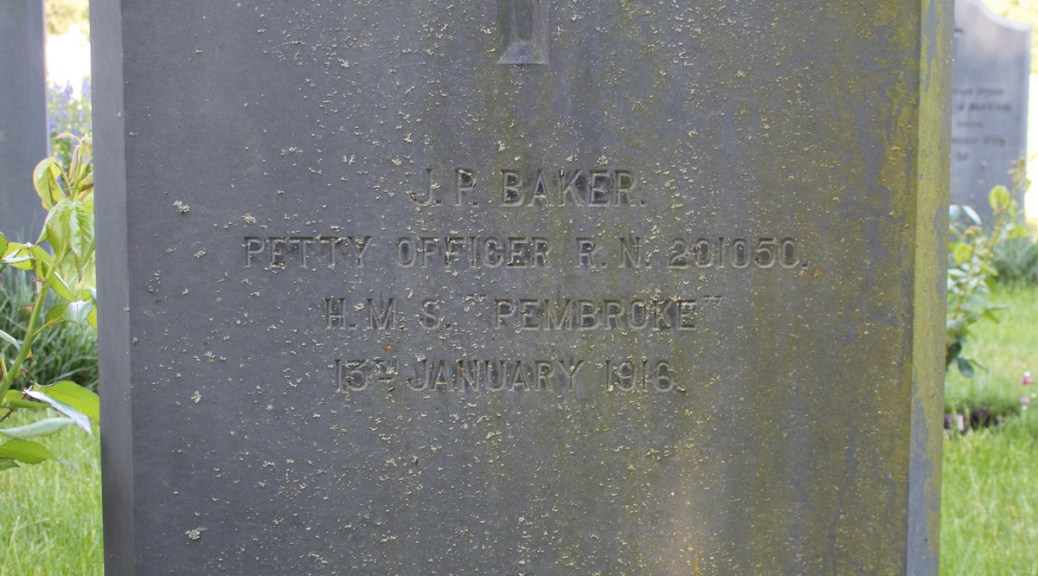
Petty Officer John Baker

Petty Officer John Baker

John Patrick Baker was born on 20th March 1883, the only child to Henry and Mary Baker. Henry was naval pensioner-turned-labourer from Belfast, Ireland, while Mary was born in Queenstown, Ireland. By the time of the John’s birth, however, they had moved to Kent, settling in the village of Cheriton.

John is noticeable by his absence in the coming years. The 1901 census return found his parents living in the same home, but the only other resident was boarder Jesse Fuller.

The 1911 census, however, helps explain this disappearance. The document records John as being one of more than 500 crew on board the cruiser HMS Highflyer. He was notes as being a Leading Seaman and, on the day that the census was taken, the ship was in the Laccadive Sea, off the coast of western India, to the south of Goa.

John is also noted as being married, and it seems that he wed a woman called Adela the previous year. Her entry in the 1911 census noted she was living in a room at 206 Risboro Lane in Cheriton, Kent. The house was also occupied by the Leach family – William, Hannah and daughter Margaret – and a Christina Hawkes, who was also married. Whether they were all related is unclear, but Adela, at 30 years of age, was working as a domestic servant to pay her way.

Adela and John would go on to have two children: John Jr was born on 31st July 1911 – just four months after the census. His younger brother Ernest was born on 21st May 1914, four months before the outbreak of war.

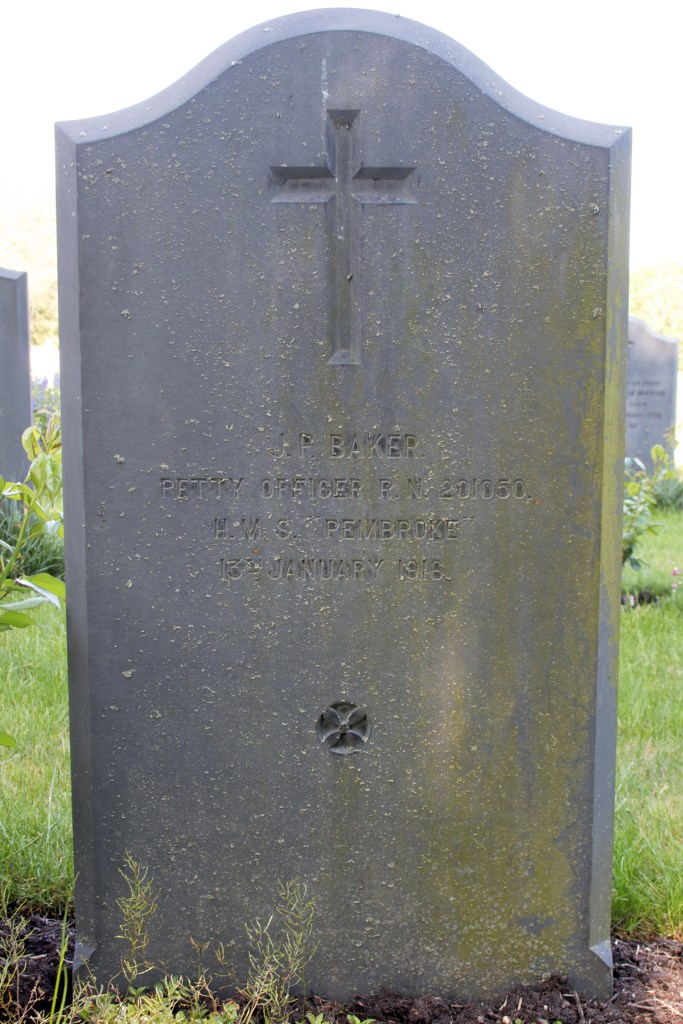
There is little further information available on the Baker Family. John progressed in his naval career, and had risen to the rank of Petty Officer by the end of 1915. That winter he became unwell, although the condition is not readily documented. He was posted at HMS Pembroke, the Royal Naval Dockyard in Chatham, Kent, by this point, and he may well have been admitted to the nearby Naval Hospital.

His illness was to prove fatal, however, and Petty Officer Baker passed away on 13th January 1916. He was 32 years of age.

John Patrick Baker was laid to rest in the Roman Catholic section of the Woodland Cemetery in Gillingham, Kent, not far from the base he had known so well.


Petty Officer Ellis Sayer

Petty Officer Ellis Sayer

Much of the life of Ellis Edward Sayer seems destined to remained shrouded in the mists of time. Born in Attleborough, Norfolk on 31st January 1888, the only census return he appears on dates from 1891. This records him as living with his grandmother, Maria Simons, who was noted as being married and working as a laundress. Ellis’ 16-year-old uncle, William, was also living there and employed as a groom.

Jumping forward a few years and, on 31st December 1907, Ellis enlisted in the Royal Navy. His service records note that he had previously been employed as a messenger, and there seems to have been some previous marine connection. The document shows that he was 5ft 8ins (1.72m), with dark brown hair, blue eyes and a fresh complexion. He was also noted as having tattoos of a dragon, a rose and the word ‘unity’ on his left forearm.

As an Ordinary Seaman, Ellis was initially sent to HMS Pembroke, the Royal Naval Dockyard in Chatham, Kent, for his training. He was only there for a matter of weeks before being assigned to the HMS Cochrane then HMS Natal.

On 7th April 1908, Ordinary Seaman Sayer was attached to the cruiser HMS Lancaster, and he was to remain with her for close to two years. Promoted to Able Seaman on 26th November 1909, his time on board came to a close in May 1910.

Over the next few years, Ellis continued his progress in his naval career. After a year on shore in Chatham, he was assigned to HMS Blonde, and was promoted to Leading Seaman in August 1912. He returned to HMS Pembroke the next month, and remained attached to the dockyard for the next year and a half: his experience likely being used to support newer recruits.

On 6th March 1914, Leading Seaman Sayer was assigned to the battleship HMS Commonwealth. Over the next three years she patrolled the North Sea, from the Norwegian coast and Shetland in the north to Dogger Bank in the south. On 1st August 1915, Ellis receive a further promotion, holding the rank of Petty Officer for the remainder of his time on board Commonwealth.

On 18th February 1917, Ellis’ life came to an abrupt end. There is little information available about his passing, one record stating that he died from an injury to his kidney which was as a result of an accident, while another states ‘rupture of kidney caused through [a] fall’. HMS Commonwealth seems to have been moored in Chatham, however, as he passed away in the town’s Royal Naval Hospital. He was 29 years of age.

Petty Officer Sayer’s next-of-kins were noted as his sister, Mrs J Andrews, who lived in Norwich, and a friend, Mrs Ethel Hampton, who lived in Gillingham, Kent.

Ellis Edward Sayer’s body was laid to rest in the Woodlands Cemetery, Gillingham, not far from the dockyard he had called home for so long.


Lieutenant Albert Bendell

Lieutenant Albert Bendell

The life Albert Bendell is one of dedication to naval service. Born in Portsmouth on 28th May 1865, his parents were Master at Arms John Bendell and his Jersey-born wife, Eliza.

The family had moved to St Martin, Jersey, by the time of the 1871 census. Given the amount of time her husband spent at sea, it would seem likely that Eliza, who had three young children to raise on her own, wanted to be close to her family.

Albert was keen to follow in his father’s footsteps and, on 6th December 1880 he enlisted in the Royal Navy. Just fifteen years old, his service records show that he was just 5ft 1.5ins (1.56m) tall, with blue eyes, light hair and a fair complexion.

Albert’s dedication to the role was obvious: starting off as Boy 2nd Class, he steadily – and rapidly – rose through the ranks. Over the next twelve years, he served on seven ships and shore bases. He was promoted to Boy 1st Class in September 1891, while serving on the training ship HMS St Vincent.

When he came of age in May 1883, he was given the rank of Ordinary Seaman: within a year he had risen to Able Seaman, and achieved the role of Leading Seaman in January 1888. Just three months later, Petty Officer Bendell was beginning a two-year service on board HMS Fearless.

In April 1893, Albert received a further promotion, and a change in direction within the Royal Navy. He was now a Gunner, a standing officer’s role, permanently attached to HMS Duke of Wellington – returning to the first ship he had been assigned to nine years earlier.

On 17th September 1900, Albert married Amelia Renouf, the daughter of a land proprietor from St Martin, Jersey. The couple wed in St Helier, Albert giving his profession as Warrant Officer. At 37, Amelia was a year older than her new husband: the couple would not go on to have any children.

Albert’s rise through the ranks continued. The 1911 census found him moored in Malta. He was Chief Gunner on HMS Egmont: the importance of his role on board highlighted by the fact that he was the 11th person out of 188 to be recorded on the document.

When war came to Europe, Albert served his King and Country proud. He was promoted to the rank of Lieutenant and, in June 1919, he was awarded the MBE “for valuable services as Officer-in-Charge, Defensively Armed Merchant Ships, Southampton.” [The Edinburgh Gazette, 1st July 1919]

This distinguished life was beginning to take its toll, however, and, on 16th March 1920, after nearly 40 years in naval service, Albert was medically stood down. Suffering from dyspepsia, he returned to Jersey, and his home, La Rosaye, in St Martin.

Albert Bendell’s health was to get the better of him. He passed away on 26th April 1920, at the age of 54 years of age. He was laid to rest in the peaceful graveyard of St Martin’s Church, Jersey.


Amelia remained on the island for the remainder of her life. She passed away on 31st August 1943, at the height of Jersey’s German occupation, at the age of 80 years old. She was laid to rest with Albert, husband and wife reunited after more than 23 years.


Petty Officer Thomas Slade

Petty Officer Thomas Slade

Thomas Charles Slade was born in Bristol, Gloucestershire, on 13th March 1880. One of twins, he and his sibling Ernest were two of nine children to Charles and Elizabeth Slade. Not long after the twins were born, the family had moved to Minehead, Somerset, where both Charles, who was a mason and bricklayer, and Elizabeth had hailed from.

Whilst Ernest seemed content to remain in Somerset – going on to become a poultry farmer – Thomas sought a life of adventure. Foregoing his gardening job, he enlisted in the Royal Navy, setting his sights on a life at sea.

Thomas’ service records show that he joined up on 12th November 1895. He stood just 5ft 2ins (1.57cm) tall, with brown hair, blue eyes and a ruddy complexion. As he was to young to formally join up, he was give the rank of Boy 2nd Class, and sent to HMS Impregnable, the shore-based training establishment in Devonport, Devon.

Boy Slade seemed to create a good impression. He was promoted to Boy 1st Class in July 1896, and the follow February was given his first posting, on board the battleship HMS Benbow. This was the ship he was serving on when he turned 18 and, having come of age, he was officially inducted into the navy, and given the rank of Ordinary Seaman.

And so began a glittering career for young Thomas. Over the twelve years of his contract, he served on nine different ships, returning to HMS Vivid – the Royal Naval Dockyard in Devonport – between voyages.

Small in stature, Thomas appears to have been a dedicated young man. His annual reviews noted his character was ‘very good’ every year, and his ability was either ‘very good’, ‘superior’, or ‘excellent’. He was promoted to Able Seaman in September 1898, just eighteen months after becoming an Ordinary Seaman. By June 1906 he rose in rank again, ending his initial term of service as a Leading Seaman.

Thomas was not done with the navy yet, however. He immediately re-enlisted and, over the ensuing years served on a further four vessels. He spent more and more time on board HMS Defiance, the torpedo and mining school ship in Devonport. Whether this was because he was being taught, or was supporting incoming students is unclear, but by September 1912, he had been promoted again.

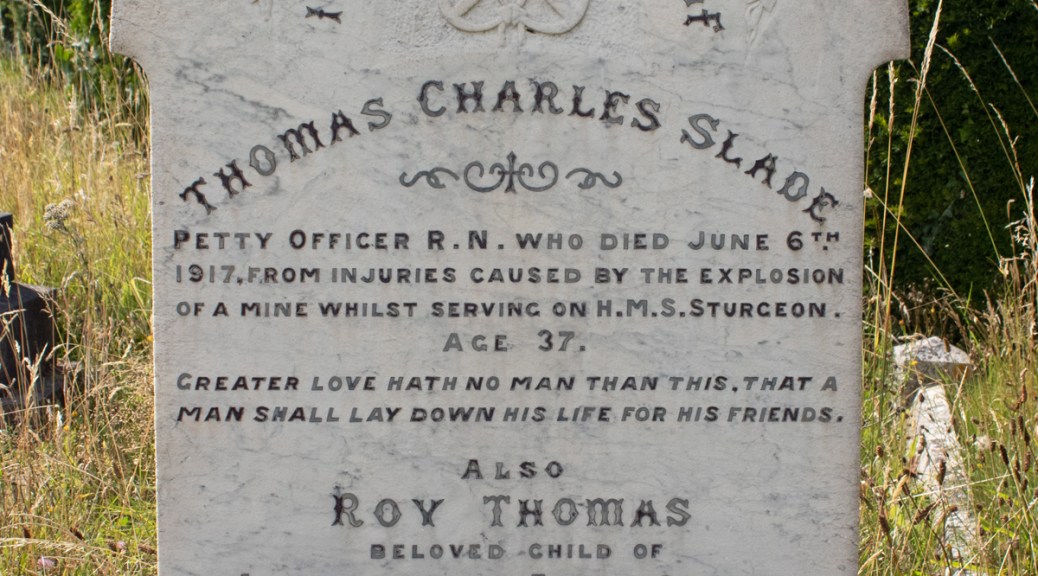
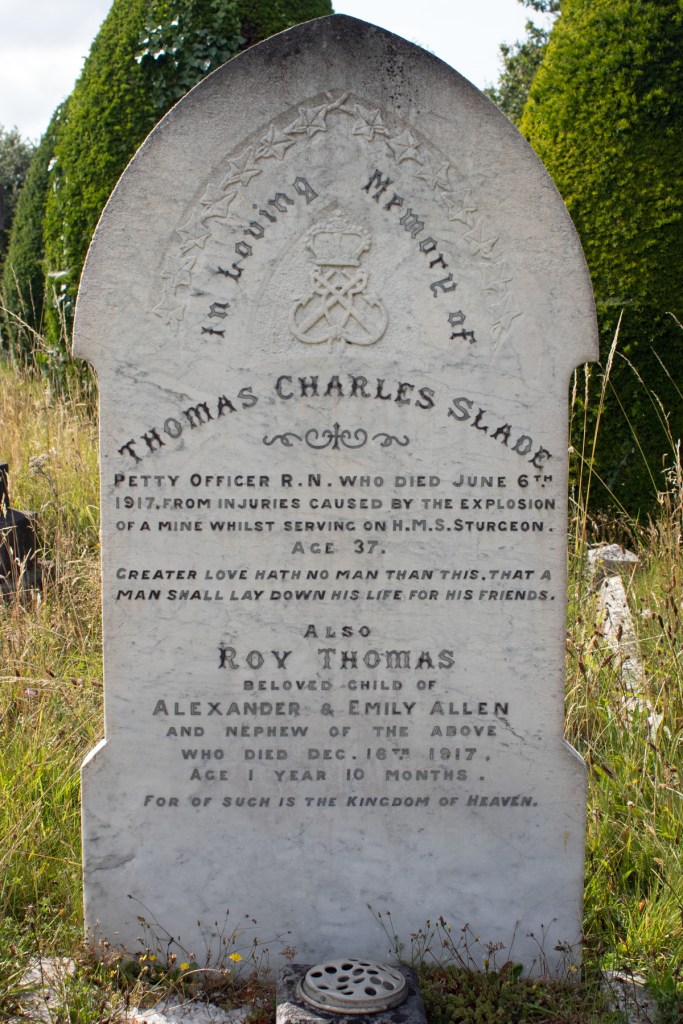
In November 1915, the now Petty Officer Slade had moved to the depot ship HMS Dido. His new posting supported the Tenth Destroyer Flotilla in the North Sea, patrolling the waters off the East Anglian coast. In February 1917 he moved to another of the support vessels, HMS Sturgeon.

In June 1917, a mine exploded on board, injuring a number of the crew, including Petty Officer Slade. The wounded were transferred to a hospital near Ipswich, and it was here that Thomas was to pass away. The only one of those caught up in the incident to die, he was 37 years of age.

Thomas Charles Slade was brought back to Somerset for burial. He was laid to rest in the sweeping Minehead Cemetery, close to the grave of his mother, Elizabeth, who had passed away nine years before.


Thomas’ headstone also includes an inscription to Roy Thomas Allen, who died six months after him. Roy was the young son of Thomas’ younger sister Emily: an uncle and nephew reunited.


Serjeant Algernon Spurge

Serjeant Algernon Spurge

Algernon Carlyle Graham Spurge was born on 27th August 1891 in Bath, Somerset. The middle of five children, his parents were Algernon and Ida Spurge.

Algernon Sr was a portrait photographer, based in the Twerton area of the city, and this was very much a family business. The 1901 census recorded the Spurges as living in Victoria Road, Bath, with Ida’s brother, Tom Leaman, who was working as a photographic reloader.

Later that year, however, things were to take a turn for the worst. Algernon Sr seems to have been having some business worries and, on the morning of 16th December, he set off for work as usual. His and Ida’s daughter, also called Ida, arrived at the studio to find her father in some distress, a bottle of potassium cyanide – used as part of the photographic process at the time – next to him. He asked Ida to fetch him some water and salt, but when she returned, he declared it was too late, and lost consciousness. A doctor was called, but Algernon passed away shortly after he arrived.

A note was found, which read “My dearest wife, I really cannot stand the worry and anxiety of another day, to say nothing of weeks and perhaps months. Ask Mr Ashman and Mr Withy to be kind enough to help you straighten out matters a little. My best love to you and all my dear ones. AS” [Somerset Guardian and Radstock Observer – Saturday 21 December 1901] Ashman and Withy were family friends, who were also in the photography business.

An inquest was held and a verdict of suicide while temporarily insane was recorded.

The family rallied round, and Algernon’s widow and children moved in with Ida’s widowed mother in Bristol. Algernon’s daughter Ida continued working in photography, and Algernon Jr also took up the business. The 1911 census found him boarding with, and working for, his uncle Tom in Bath.

War was closing in on Europe by this point and, when it was declared, Algernon stepped up to play his part. He enlisted in the Royal Naval Air Service on 4th June 1915 as a Leading Mechanic (Photography). His service records show that he was 5ft 5ins (1.66m) tall, with dark brown hair, brown eyes and a dark complexion.

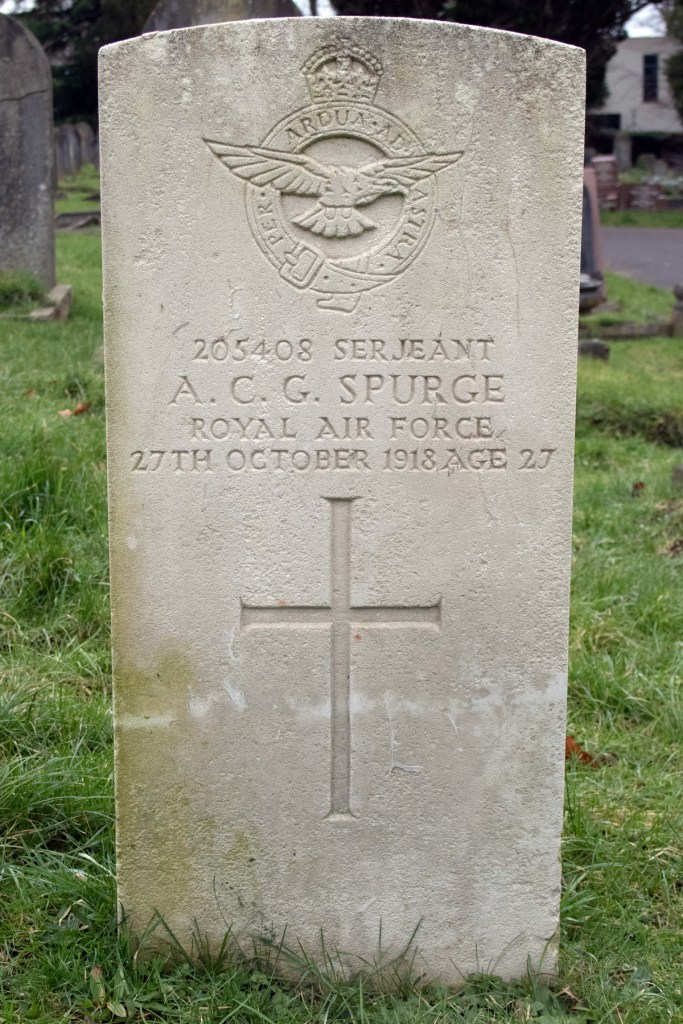
Algernon was initially assigned to the shore establishment HMS President in London for three years, rising to the rank of Petty Officer Mechanic (Photography). In April 1918, when the Royal Air Force was created he transferred across to HMS Daedalus in Lee-on-Solent, Hampshire, and rising to the rank of Sergeant Mechanic.

That autumn, with the end of the war in sight, Algernon fell ill. He contracted influenza, and this developed into pneumonia. He was admitted to the Military Hospital in York, but the conditions were to prove too much for his body to take. He died on 27th October 1918, aged just 27 years old.

The body of Algernon Carlyle Graham Spurge was brought back to Somerset for burial. He was laid to rest in St James Cemetery, Bath, not far from his father. When Ida passed away in 1926, she was buried in the same cemetery, father, mother and son reunited once more


Serjeant Algernon Spurge
(from ancestry.co.uk)

Petty Officer 1st Class Samuel Bailey

Petty Officer 1st Class Samuel Bailey

Samuel Inkerman Bailey was born in the summer of 1861 in Bath, Somerset. The youngest of five children, his parents were James and Mary Bailey. James was an ostler, or groom, but he died in August 1862, when his son was barely a year old.

Mary was left a widow, with a young family to raise and, as so many women in her position did in Victorian Britain, she remarried. She wed tailor Robert Lankesheer, a widower with four children of his own. The couple went on to have three further children – three half-siblings to Samuel.

While the 1871 census suggests that Robert welcomed Mary’s youngest into the family home, it seems that things were not so comfortable for Samuel. On 22nd May 1878, he enlisted in the Royal Navy, destined for a life at sea. He was only 16 years old at this point – although, interestingly, his service records give his date of birth as 27th March 1862. They also note that he was 5ft 2.5ins (1.59m) tall, with light brown hair, blue-grey eyes and a fair and fresh complexion.

As he was too young to formally enlist, Samuel was given the rank of Boy 2nd Class and sent to HMS Impregnable for training. Just over a year later, he was promoted to Boy 1st Class and, on 10th January 1880 he was given his first posting, on board the sloop HMS Dryad.

It was while Samuel was on board the Dryad that he came of age, and was officially inducted into the Royal Navy. He signed up for ten years service, and was given the rank of Ordinary Seaman 2nd Class. Samuel was certainly a dedicated young man: within three months he was again promoted, this time to Ordinary Seaman. He remained on Dryad until February 1884, by which time he had been promoted again, to Able Seaman.

Samuel ended up serving until 31st March 1900. During his time with the Royal Navy, he continued to distinguish himself, his character being noted as Very Good on each of his service reviews. He served on thirteen vessels, and was promoted through the ranks, to Leading Seaman (in August 1885), Petty Office 2nd Class (in January 1894) and Petty Officer 1st Class (in September 1897).

When he was stood down to the naval reserve, Samuel returned to Somerset. He found a job as a superintendent at the public baths in Bathwick and, on 15th April 1901, he married former housemaid and agricultural labourer’s daughter, Alice Clarke. As Samuel’s house came with his job, the couple set up home there, and went on to have five children: Samuel Jr, Emma, James, Alice and Joseph.

When war broke out, Samuel has been stood down from reserve status for more than two years. This did not stop him from stepping up to play his part again, however, and as Petty Officer 1st Class, he took up a training role at HMS Victory, the Royal Naval Dockyard in Portsmouth. He served for just over fourteen months, before he became ill, passing away from intestinal disease – which an inquest identified as ptomaine poisoning – at the city’s Royal Naval Hospital. He was 54 years of age.

Reporting on his death, the local newspaper recognised his fifteen years’ service at the public baths, as well as picking up on the fact that his unusual middle name was given to him in recognition of the death of his great uncle in the battle of that name during the Crimean War.

The same report outlined his dedicated naval career, although not always being correct with all of the details. It did note, however “two years or more on the Royal Yacht ‘Victoria & Albert,’ when used by Queen Victoria, a testament to the reliance placed in his trustworthiness.” [Bath Chronicle and Weekly Gazette: Saturday 16th October 1915] The then Able Seaman Bailey’s service records do note that he served aboard the Victoria & Albert, from 18th March to 11th May 1885, although whether the Queen sailed on her during this time is not known.

Samuel Inkerman Bailey was brought back to Somerset for burial. He was laid to rest in the Smallcombe Vale Cemetery in Bathwick, the community he had served for so long.


Petty Officer 1st Class Samuel Bailey
(from ancestry.co.uk)

Boatswain James Kirby

Boatswain James Kirby

James Kirby’s life is one of intrigue and speculation. Born in Laytown, Ireland on 30th August 1867, the earliest documents relating to him are his Royal Naval Service Records.

He enlisted on 1st March 1883, while just fifteen years old, and was assigned the rank of Boy 2nd Class. Over the next couple of years, he served on two ships – HMS Lion and HMS Briton – and was promoted to Boy 1st Class.

On 30th August 1885, James came of age, and was formally enrolled in the Royal Navy. He enlisted for ten years’ service, and his records show that he stood 5ft 3ins (1.60m) tall, had brown hair, blue eyes and a fresh complexion. He was also noted as having a tattoo of an anchor on the back of his left hand.

Over the next ten years, Ordinary Seaman Kirby served on nine different vessels, and was obviously committed to his work. He rose through the ranks, making Able Seaman in January 1886, Leading Seaman (1889), Petty Officer (also 1889) and Chief Petty Officer (1895).

When his initial contract ended, he voluntarily continued with the Royal Navy, although his service record ends on 14th June 1896, at the point that he was promoted to Acting Boatswain.

A second service record picks up James’ details from 5th December 1902. Still serving as a Boatswain, he was assigned to the cruiser HMS Lancaster. His health, by this point, was beginning to suffer, and, it seems, his life was beginning to unravel.

In August 1904, he was injured in an accident involving a “hook rope” and “slightly amoral judgement”. Over the next couple of years his behaviour became increasingly erratic.

In December 1910, he was admitted to Shotley Hospital near Durham, suffering from acute mania and gonorrhoea, and was not be be fit for duty for a few weeks.

Just before Christmas that year, Boatswain Kirby was again admitted to hospital, this time in Chatham, Kent, remaining there for a number of months. He was deemed unfit for further service in March 1911, and was medically discharged with neurasthenia.

However, when war broke three years later, James volunteered his services once more, and was again employed by the Royal Navy. Tragically, this was a decision that would prove to be fatal.

The extraordinary death of a naval boatswain names James Kirby, aged 47, was the subject of an inquest at the Royal Naval Hospital, Chatham… Deceased, whose home was at Dublin, had retired, but had volunteered for service and was anxious to go to sea. On Friday evening [28th August 1914] he was watching a game of billiards in the warrant officers’ mess at the Royal Naval Barracks, Chatham, and appeared perfectly rational and sober. Suddenly he was observed to disappear through an open window beneath which he had been sitting. He went down, as one witness stated “with a smile on his face,” and called out “Good-bye.” A crash of glass below indicated that he struck the dining room window as he fell.

Kent Messenger & Gravesend Telegraph: Saturday 5th September 1914

The article gave further information about the injury James sustained previously: “It transpired that deceased fell out of a window at the Hospital eight years ago through walking in his sleep. He was then suffering from neurasthenia and had delusions.

The inquest concluded that Boatswain James Kirby had committed suicide during temporary insanity. He was laid to rest in the Woodlands Cemetery, Gillingham, not far from the dockyard at which he was based.


James Kirby’s grave is maintained by the Commonwealth War Graves Commission on behalf of the Royal Navy Admiralty. However, as the naval authorities did not confirm Boatswain Kirby was a war casualty – possibly because of the nature of his death – he was never formally commemorated with a Commonwealth War Grave. However, I have included his story as it remains as pertinent as those of his contemporaries.