Cecil George White was born in Cardiff, Glamorganshire, in the summer of 1899. The youngest of four children, his parents were called William and Mary. William was a stevedore and, at the time of the 1901 census, the family lived at 6 Whitchurch Road, to the north of the city centre.
The 1911 census shows things had changed significantly for the White family. They had left Wales, and had set up home in the Devon village of Croyde. William and Mary were now employed as farmers, with Cecil’s older sisters, Cordelia and Lilian, also helping out on the farm.
Europe descended into war in the summer of 1914, and while Cecil was initially too young to serve, he would eventually be called upon to play his part. Full details of his time in the army have been lost to time, but it would seem that he joined the South Wales Borderers, but was attached to the Monmouthshire Regiment.
Private White’s trail is tantalisingly sparse. The one document relating to his passing notes that he died of sickness in Barnstaple, Devon, on 12th November 1918 – the day after the Armistice was signed. Given the town’s proximity to the family home, it is fair to assume that he had been home on leave when he fell ill.
The body of Cecil George White – just 19 years of age when he died – was taken the short distance back to Croyde for burial. He was laid to rest in the family plot in the village’s Baptist Chapelyard, alongside his sister, Lilian, who had passed a few weeks before.
The family would be reunited in death: William was buried alongside his children when he died in 1946, at the age of 78. Mary died in 1960, at the age of 91, and was interred with her family.
Christina Jack was born in Thurso, Caithness, Scotland, on the 19th December 1882. One of eight children, her parents were Donald and Margaret Jack. Donald was a merchant and rope maker, and the family lived on Bank Street, to the north of the town centre.
Margaret died in 1907, by which point Christina had taken a job in nursing. The 1911 census found her in Govan, Lanarkshire, where she was employed as a registered general nurse. When war broke out, she volunteered to do her duty, and joined the Queen Alexandra’s Imperial Military Nursing Service.
Sister Jack remained on home soil, and was attached to the 1st Birmingham War Hospital in Rednal. Nursing staff were vulnerable to the infections and diseases of the men they were treating, and it appears that Christina was not immune to this. She passed away on 22nd October 1918, at the age of 35 years old.
The body of Christina Jack was taken back to Caithness for burial. She was laid to rest in Thurso Cemetery, on the outskirts of the town in which she had been born and raised.
Alexander McDougall Westgarth was born in Newcastle-upon-Tyne on the 28th June 1885. The middle of five children, and the only son, his parents were James and Janet Westgarth. James was a mariner, and the family moved to the village of Carlton Colville, on the outskirts of Lowestoft, Suffolk, in the late 1880s.
Alexander found work as a fitter’s apprentice when he finished school, but the sea was in his blood. Janet died in 1903, and by the time of the next census, taken in 1911, her son had enlisted in the Royal Navy and was a Stoker 1st Class. The document found him as part of the crew of the battleship HMS Russell, moored in a harbour on Malta.
On 31st October 1915, Alexander married Mabel Liffen. The daughter of a gas stoker, she also lived in Carlton Colville. She had a daughter, Irene, but there is no evidence that she was Alexander’s, nor that Mabel had a previous marriage.
At this point, Alexander’s trail goes cold. By the summer of 1917, he was based at HMS Pembroke, the Royal Naval Dockyard in Chatham, Kent. It was a particularly overcrowded base by this point in the conflict, with the planned replacement crew for the sunk HMS Vanguard waiting for new assignments, and an outbreak of meningitis meaning space was at an absolute premium. In the midst of this, Stoker 1st Class Westgarth was billeted in temporary accommodation in the dockyard’s Drill Hall.
On the night of the 3rd September 1917, Chatham was hit by an unexpected German air raid. Two bombs landed squarely on the Drill, shattering its glass roof, and killing dozens of men. Stoker Westgarth was badly injured, and was rushed to the Royal Naval Hospital in the town. His injuries would prove fatal and he passed away the day after the attack: he was 32 years of age.
The body of Alexander McDougall Westgarth was taken back to Suffolk for burial: he was laid to rest in Kirkley Cemetery, Lowestoft.
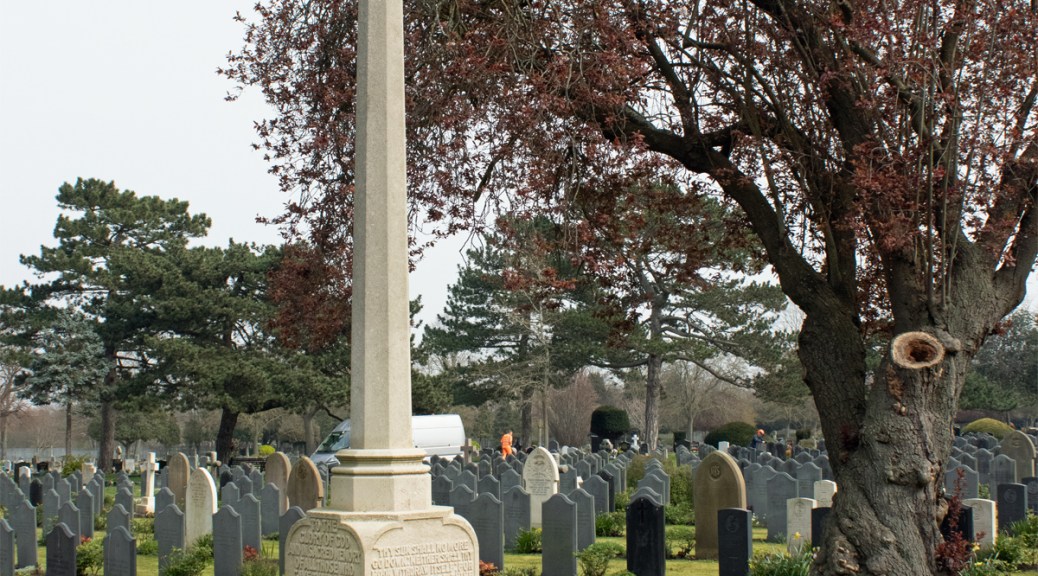
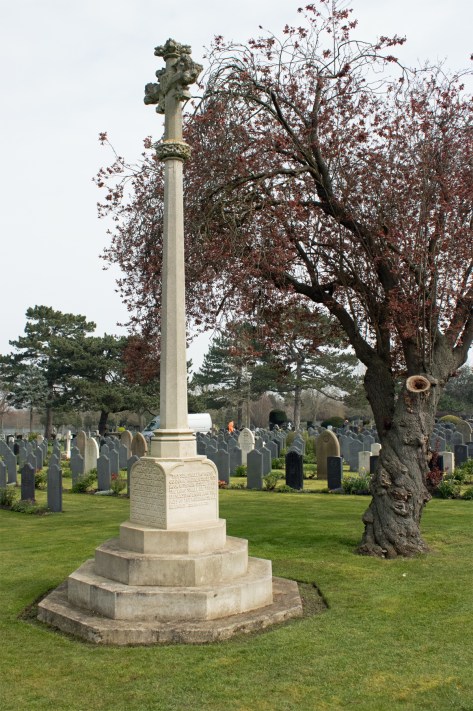
[Note: the photo above is of the memorial to the Chatham Air Raid victims, close to the mass grave for those whose bodies were not identified, in Woodlands Cemetery, Gillingham, Kent.]
The funeral of John William Venney (27), a trimmer in the minesweeping section of the RNR, who was one of the victims in the Chatham air raid, took place on Saturday afternoon with full naval honours. A contingent of men from the minesweepers formed an escort, and with the body resting on a gun-carriage, covered by the Union Jack, the cortege attracted a lot of sympathetic interest as is proceeded from deceased’s home, at No. 40 Elliston-street. A large number of people assembled at the cemetery, and, after the body had been committed to the grave, the naval firing party paid the last honours to their comrade. Deceased was one of a number of Grimsby men who were accommodated at Chatham. Several of them were killed but all, with the exception of Venney, were buried at Chatham.
[Grimsby News: Friday 14th September 1917]
John William Venney was born on 6th July 1890 in Grimsby, Lincolnshire. The oldest of eight children, of which five survived childhood, his parents were William and Ann Venney. William was a sailor, and, when he finished his schooling, John also went to sea, taking work as a ship’s fireman.
In 1914, John married Florence Johnson. There is little information about her life: she was born in Lincoln, Lincolnshire, in the summer of 1892, but there is no further documentation for her. The couple went on to have a daughter, Ivy, in October 1916.
By this point, war was raging across Europe, and John would be called upon to play his part. Assigned to the Royal Naval Reserve as a Trimmer, his service papers show that he was 5ft 6ins (1.67m) tall, with blue eyes and a sallow complexion.
Formally enlisted on 13th June 1917, Trimmer Venney spent the next three months at the Royal Navy’s shore bases in Chatham (HMS Pembroke) and Sheerness (HMS Actaeon), Kent. Pembroke was a particularly busy and overcrowded place at this point in the war, and John found himself billeted in temporary accommodation in the Drill Hall.
On the night of the 3rd September 1917, the German Air Force carried out a bombing raid on the North Kent coast. Chatham found itself in the firing line, and the Drill Hall received two direct hits. Dozens of sleeping men died in the explosions that followed, Trimmer Venney among them. He was 27 years of age.
The body of John William Venney was taken back to Lincolnshire for burial. He was laid to rest in Cleethorpes Cemetery.
[Note: the photo above is of the memorial to the Chatham Air Raid victims, close to the mass grave for those whose bodies were not identified, in Woodlands Cemetery, Gillingham, Kent.]
William Edward Sullivan was born in Newport, Monmouthshire, on the 9th November 1898. He was one of seven children to John and Mary Sullivan. John was an iron dresser at a local foundry, but also worked as a grocer. The 1901 census found the family living at 15 Church Street, to the south of the town centre, but by 1911 they had moved to a larger property, 2 Scard Street.
When William finished his schooling, he took up work as a clerk. War broke out in the summer of 1914, and he would be called upon to play his part. On the 18th September 1916, he enlisted in the Royal Navy, taking the rank of Ordinary Seaman. His service papers show that he was 5ft 6.5ins (1.69m) tall, and that he had light brown hair, brown eyes and a fair complexion.
Ordinary Seaman Sullivan was sent to HMS Victory, the Royal Naval Dockyard in Portsmouth, Hampshire, for his training. By the end of May 1917, however, he had been transferred to HMS Pembroke, which was also known as Chatham Dockyard.
The base was a busy and overcrowded place by this point in the war, with a number of factors leading to temporary accommodation being set up in the dockyard’s Drill Hall. This is where William, who appears to have been waiting for his first formal posting, was billeted.
On the 3rd September 1917, the German air force carried out a daring night time raid on the North Kent coast. Chatham was in the firing line, and two bombs scored direct hits on the Drill Hall. Its glass roof shattered, raining shards down on the sleeping men. Dozens were killed in the explosions, and tens more, including Ordinary Seaman Sullivan, were wounded.
William was taken to the Royal Naval Hospital in Chatham for treatment, but his wounds would prove to be too severe. He passed away on the 4th September 1917, aged just 18 years old.
The body of William Edward Sullivan was taken back to Wales for burial. He was laid to rest in St Woolos’ Cemetery, a short walk from where his family still lived.
[Note: the photo above is of the memorial to the Chatham Air Raid victims, close to the mass grave for those whose bodies were not identified, in Woodlands Cemetery, Gillingham, Kent.]
William James Steed was born on 3rd August 1897 in the village of Reculver, near Herne Bay, Kent. The oldest of three children, he was the only son to Gilbert and Edith Steed. Gilbert was a platelayer for the South Eastern and Chatham Railway, and the family lived in the hamlet of Hillborough.
When he finished his schooling, William took up work as a general labourer. “…he worked for Mr Hardy in the building of the King’s Hall at Herne Bay, and on the Herne and Reculver Sewage Works, and subsequently at the colliery at Westbere.” [Herne Bay Press: Saturday 15th September 1917]
Gilbert died in September 1912 and, when war broke out, William stepped up to serve his country. He enlisted in the Royal Navy on 9th November 1915, taking the role of Stoker 2nd Class. His service records show that he was 5ft 10.5ins (1.79m) tall, and had light brown hair, brown eyes and a fresh complexion. He was also noted as having a linear scar on the dorsum on [his left] index finger.
Stoker Steed was sent to the Royal Naval Dockyard in Chatham, Kent – also known as HMS Pembroke – for his training. Within a couple of months he was given his first posting, on board the battlecruiser HMS Inflexible. She “took part in the Battle of Jutland. He came safely through this; but later was the victim of an accident, and was for some time in hospital.” [Herne Bay Press: Saturday 15th September 1917]
Details of the accident have been lost to time, but William, who had been promoted to Stoker 1st Class on 1st June 1916, returned to HMS Pembroke to recuperate. He was given a short period of leave, during which he returned home, but was back on base by the end of July 1917.
Pembroke was a busy and overcrowded place by this point in the war. The battleship HMS Vanguard had been sunk, and its planned replacement crew were left in the dockyard to await new postings. In addition, an outbreak of meningitis meant that additional accommodation was set up, in an attempt to slow the spread of infection. Stoker 1st Class Steed was among those to be billeted in temporary digs in the dockyard’s Drill Hall.
Britain’s improving defences meant that daytime raids by the German sir force were being thwarted. They changed tack, and, on 3rd September 1917, they attempted a night time raid on the North Kent coast. Chatham bore the brunt of the attack, and two bombs landed direct hits on the Drill Hall. Its glass roof shattered, raining shards down on the sleeping men below. Dozens were killed in the explosions, including Stoker 1st Class Steed: he had not long turned 20 years of age.
The body of William James Steed was taken back to Reculver for burial. He was laid to rest in the graveyard of St Mary’s Church, the newspaper reporting that “All who knew him speak of him as a good living young fellow, who won the respect of all, and his mother and sisters have lost a good son and brother.” [Herne Bay Press: Saturday 15th September 1917]
[Note: the photo above is of the memorial to the Chatham Air Raid victims, close to the mass grave for those whose bodies were not identified, in Woodlands Cemetery, Gillingham, Kent.]
Sydney Gordon Rigden was born in Whitstable, Kent, on 29th June 1897. One of six children, his parents were William and Annie Rigden. William was a fishmonger, and the family lived above the shop, at No. 43 High Street.
When Sydney finished his schooling, he took work as a general labourer. He was called upon to serve his King and Country, however, and, on 27th June 1916, he was conscripted into the Royal Navy. Stoker 2nd Class Rigden’s service papers note that he was 5ft 6ins (1.68m) tall, with brown hair, grey eyes and a fresh complexion.
Sydney was sent along the coast to HMS Pembroke, also known as Chatham Dockyard, for his training. He remained there for a couple of months, before being given his first and only posting, on board the light cruiser HMS Dartmouth. A seasoned ship, she had already seen action in Africa and the South Atlantic and, in the year before Stoker Rigden joined her, she formed part of the support for the Gallipoli campaign.
Stoker Rigden spent seven months with Dartmouth, much of that serving in the Adriatic. On 1st May 1917 he was promoted to Stoker 1st Class, and he returned to Britain towards the end of that month.
In the summer of 1917, Sydney married his childhood sweetheart, Annie Mount. The daughter of a carter, by the time of the 1911 census, she had taken up work as a domestic servant for retired commercial traveller Alexander Paterson and his family. Just 14 years old at this point, she lived with the family, at 186 Lower Clapton Road, London.
After the wedding, Stoker 1st Class Rigden returned to duty, and to HMS Pembroke. The base was a particularly overcrowded place by this point in the war, and temporary additional accommodation was set up. Sydney was one of those to be billeted in the dockyard’s Drill Hall.
On the night of the 3rd September 1917, Chatham came under fire during a daring German air raid. Two of the bombs that were dropped landed squarely on the Drill Hall, shattering its glass roof, and killing dozens of men who were sleeping below. This included Stoker 1st Class Rigden: he was just 20 years of age.
The body of Sydney Gordon Rigden was taken back to Whitstable for burial. He was laid to rest in the town’s cemetery.
Annie was now widow after just a couple of months’ marriage. Sadly, she disappears from the records, so it is unclear what became of her.
[Note: the photo above is of the memorial to the Chatham Air Raid victims, close to the mass grave for those whose bodies were not identified, in Woodlands Cemetery, Gillingham, Kent.]
James Richards was born in Liverpool, Lancashire, on 4th September 1891. The second of nine children, his parents were John and Christina Richards. John was a carter for the local railway and, according to the 1901 census, the family had rooms at 41 Paget Street, to the north of the city centre.
James sought a more permanent career for himself, and enlisted in the Royal Navy. Sadly, his service record has been lost, but the 1911 census return found him listed as one of the 786 crew of the battleship HMS Inflexible. Captained by Charles Napier, at the time of the census, she was moored off Howth Head, near Dublin, Ireland.
By the summer of 1917, Stoker 1st Class Richards found himself at HMS Pembroke, the Royal Naval Dockyard in Chatham, Kent. The base was busy and overcrowded at that point in the war: the battleship HMS Vanguard had been sunk, and its replacement crew were barracked in Chatham, waiting for new assignments. Add to this an outbreak of spotted fever, and temporary accommodation was set up to help space out the billets and slow its transmission. It was in this accommodation – set up in Pembroke’s Drill Hall, that James found himself sleeping.
On the night of the 3rd September 1917, the German air force carried out a daring raid on the North Kent coast. Chatham came under fire, and two bomb scored direct hits on the Drill Hall. Dozens of sleeping men were killed, while countless others, including Stoker 1st Class Richards, were injured.
James was taken to the Royal Naval Hospital in the town, but his wounds would prove too severe. He passed away on 4th September 1917, his 26th birthday.
The body of James Richards was taken back to Liverpool for burial. Strict Roman Catholics, John and Christina laid their son’s body to rest in the city’s Ford Cemetery.
[Note: the photo above is of the memorial to the Chatham Air Raid victims, close to the mass grave for those whose bodies were not identified, in Woodlands Cemetery, Gillingham, Kent.]
The loss of another Gorleston man in the service of King and Country is recorded this week in the death of Chief-Engineer John Edmund Raven, RNR, of 46, John-road, Gorleston, who was among the victims of the air raid at Chatham on September 3rd. Chief-Engineer Raven, who was 43 years of age, had been in the Service nearly three years, and was sailing from this port. Some seven weeks ago he was taken ill and went to Chatham to undergo an operation, following which he was allowed home for a few days and returned to Chatham Naval Barracks on the sick list, where he was on the night of the raid. He was very popular with his comrades at the Naval Base at Gorleston, and his loss is much regretted by the crew of his ship. To his widow and two children every sympathy has been extended in this heavy blow which follows hard on the loss a few weeks ago of her daughter after a brief illness.
[Yarmouth Mercury: Saturday 15th September 1917]
John Edmund Raven was born on 28th December 1872 in Caister, Norfolk. The middle of six children, he was the youngest of three sons to Robert and Ann Raven. Robert was a farm labourer-turned-fisherman, and, after his untimely death in 1883, it was the sea to which his son turned to support his widowed mother.
In the autumn of 1902, John married Eliza Casey. A milkman’s daughter from Gorleston, Norfolk, she was employed as a domestic servant when the couple exchanged vows. They set up home at 46 John Road, Gorleston, and went on to have three children: Elsie (who would pass shortly before her father), Gladys and Jack.
Little further information is available about John’s life. As the newspaper report suggests, he joined the Royal Naval Reserve as an Engineman towards the end of 1914, and was based out of HMS Pembroke, the Royal Naval Dockyard in Chatham, Kent.
On the night of the 3rd September 1917, Engineman Raven was billeted in temporary accommodation set up in the dockyard’s Drill Hall. That night, an audacious raid by German bombers landed two explosives directly on the building, shattering its glass roof, and killing dozens of the men sleeping within. John was one of those to be killed. Contrary to what the newspaper reported, he was actually 45 years of age.
The body of John Edmund Raven was taken back to Norfolk for burial. He was laid in the family plot, reunited with his daughter, Elsie, far too soon.
[Note: the photo above is of the memorial to the Chatham Air Raid victims, close to the mass grave for those whose bodies were not identified, in Woodlands Cemetery, Gillingham, Kent.]
George William Rae was born on 7th February 1883 in South Shields, Country Durham. The youngest of five children, he was one of four sons to Henry and Elizabeth Rae. Henry was a boatman, and it seemed inevitable that George would follow in his father’s footsteps.
There are big gaps in George’s timeline: the 1891 census found him living with his aunt and uncle. The next record for him confirms his marriage to Mary Elizabeth Smith in January 1904. There is little information about her, but the couple had five children, three of whom died before they reached their first birthday.
Tragedy followed tragedy: George’s father died in 1908, and his mother passed the following year. Mary died shortly after the birth of her and George’s last child, also named George, in 1911. The census taken that year recorded George Sr as a fireman aboard the coal hulk Haytian, which was moored in Portland Harbour, Dorset. He was one of the vessel’s sixteen crew members.
Now a widower, George had two children to support. In the summer of 1913, he married a second time, to Elizabeth Flood. Again, there is little information available about her, but the couple went on to have a child, daughter Emily, who was born in the summer of 1914.
Conflict was closing in on Europe by this point, and on 24th March 1916, George formally joined the Royal Naval Reserve. His service record shows that he was 5ft 4ins (1.63m) tall, with blue eyes and a fair complexion. He was also noted as having a tattoo of a woman and two flags across his chest.
Engineman Rae was assigned to the gunboat-turned-minesweeper HMS Halcyon. She remained his home for the next eighteen months, patrolling off the coast of East Anglia. By the summer of 1917, George became shore-based, initially at HMS Actaeon in Portsmouth, Hampshire, then at HMS Pembroke, the Royal Naval Dockyard in Chatham, Kent.
Pembroke was a busy and overcrowded place at this point in the war. The battleship HMS Vanguard had sunk, and its replacement crew – who were stationed in Chatham – were left in limbo while new postings were found for them. The base also suffered an outbreak of meningitis, and temporary accommodation was set up to space out the servicemen and, hopefully, slow the spread of the disease. Engineman Rae found himself in one of these speedily-created barracks in the dockyard’s Drill Hall.
On the night of the 3rd September 1917, four German aircraft carried out a daring raid on the North Kent coast. Chatham came under fire, and two explosives landed a direct hit on the Drill Hall. Dozens of men were killed while they were sleeping, and many more – including Engineman Rae – were injured.
George was taken to the Royal Naval Hospital in Chatham for treatment, but his wounds would ultimately prove fatal. He succumbed to them on 11th September 1917, at the age of 34 years old.
The body of George William Rae was taken back to County Durham for burial. He was laid to rest in South Shields’ Harton Cemetery.
Tragedy would continue to haunt the Rae family. Elizabeth died a year after her husband, leaving three children – two from George’s first marriage, and one from his second – orphans. Sadly, there is little additional informational about what happened to them – none appear in the 1921 census.
[Note: the photo above is of the memorial to the Chatham Air Raid victims, close to the mass grave for those whose bodies were not identified, in Woodlands Cemetery, Gillingham, Kent.]



 Death and Service