Tag Archives: Surrey

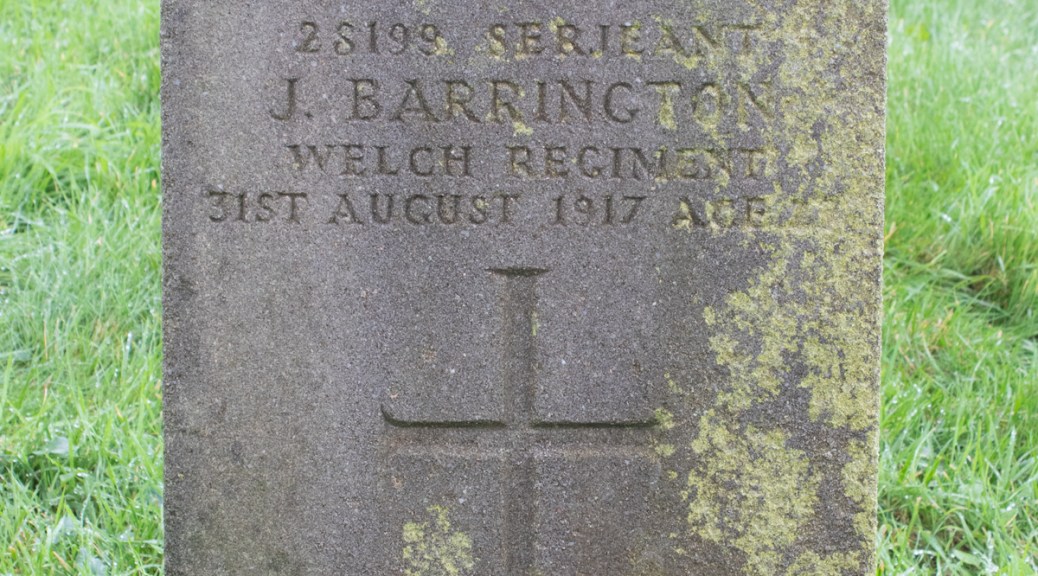
Serjeant James Barrington

Serjeant James Barrington

James Barrington was born in Westminster, Middlesex, on 1st June 1890. One of twelve children, his parents were Alfred and Hetty Barrington. Alfred worked in a soap factory, and the family seemed to move around: the 1891 census found them living in rooms at 3 Charles Buildings, St Martin-in-the Fields, while a decade later there were at 6 Lyric Place in Kennington, Surrey.

With so many mouths to feed, Alfred and Hetty were keen to get their children to work. The 1911 census found James working as a cowman on a farm in Mathry, Pembrokeshire, which must have come as a huge culture shock.

James soon settled in, however, and, on 9th November 1912, he married Elizabeth Thomas, the daughter of a labourer from nearby. The couple had a daughter, Hilda, who was born the following February.

When war broke out, James was called upon to play his part. There is little concrete information about his service, but he was assigned to the Welch Regiment, as was attached to the 18th (Service) Battalion (2nd Glamorgan). He had attained the rank of Sergeant by the summer of 1917.

Sergeant Barrington’s unit fought in some of the key battles of the early stages of the conflict, including the Battle of the Ancre in 1916, and the German retreat to the Hindenburg Line the following spring. It was during fighting on the Western Front that summer, though, that he was wounded, and medically evacuated to Britain for treatment.

James was admitted to a hospital in London, but his wounds would prove too severe: he passed away on 31st August 1917, at the age of 27 years old.

The body of James Barrington was taken back to Wales for burial. He was laid to rest in Mathry Church Cemetery, not far from where his widow still lived.


Naval Instructor George Carter

Naval Instructor George Carter

George Leslie Lewis Carter was born at the start of 1891 in New Cross, Kent. The oldest of three children, his parents were laundry managers William and Isabel Carter.

The Carters’ work seemed to take them across South London and the 1891 census found them living in Hammersmith. George’s two siblings had been born by this point, one in Gravesend, Kent, the other in Richmond, Surrey.

By 1911, William and Isabel had moved the family to Kingston-upon-Thames, Surrey. That year’s census recorded them as living at 142 London Road, which was noted as being a 12-roomed property. The couple were managing a laundry – possibly living in at the laundry itself. George was recorded as being a university student, while his younger brother Lionel was at school. The family also had a housekeeper, Frances Stoke, living with them.

When George finished his studies, he found employment as an Assistant Paymaster with the Royal Naval Reserve. On 15th February 1916, he married Ada Ritchie. She was a merchant’s daughter from Long Ditton, Surrey, and the couple exchanged vows in her local parish church.

At this point, George’s trail goes cold. He became attached to the Royal Naval College in Dartmouth, Devon – also known as HMS Pomone – and took on the role of Naval Instructor. It is unclear what type of instructing he was doing, but it seems likely to have been connected with the administration or financial part of the Royal Navy.

The funeral of Naval Instructor George Leslie Lewis Carter, Royal Naval College, Dartmouth, who died on Monday from pneumonia following an attack of influenza, took place on Wednesday morning…

The mourners were Mrs Carter (widow), Mrs Carter, Surbiton (mother), Mr Carter (brother), and Mr Jamieson Ritchie, London (brother-in-law)…

[Dartmouth & South Hams Chronicle: Friday 2nd August 1918]

Naval Instructor Carter was 27 years of age when he died on 29th July 1918. The newspaper article’s distinction between Ada and Isabel would suggest that Ada may have been living in Dartmouth at the time as well.

George Leslie Lewis Carter was laid to rest in the graveyard of St Clement’s Church in Dartmouth, Devon.


Leading Seaman Frederick Tillier

Leading Seaman Frederick Tillier

Frederick Francis Charles Vizzard was born on 12th December 1894 in Ottershaw, Surrey. The younger of two children, his parents were nurseryman Frederick Vizzard and his wife, Frances.

Details of Frederick Jr’s life are a challenge to unpick. Frederick Sr had died in 1909, and is seems that from this point on, he used his mother’s maiden name, Tillier, as his own. He found work as a labourer, and this is what he was doing when war broke out.

By this point Frederick had moved to Reading, Berkshire, and he was living in a small terraced house at 12 Highgrove Street. He enlisted in the Royal Naval Division on 18th October 1915, and was mobilised six months later.

Frederick’s records show that he was 5ft 7.5ins (1.71m) tall, with brown hair and grey eyes. He joined as an Able Seaman, which would suggest some previous experience, although there are no records to confirm this.

Able Seaman Tillier’s time in the navy seems to have been spent on shore. He was initially sent to Portsmouth, Hampshire, where he served on HMS Victory and HMS Excellent. On 19th December 1916, Frederick was reassigned to the Royal Naval Volunteer Reserve as a Leading Seaman, and sent to HMS President, the unit’s shore base near Tower Bridge in London.

Frederick would remain attached to HMS President for the next couple of years. The next entry on his service papers states that he was admitted to the Cottage Hospital in Dartmouth, Devon, as he was very seriously injured. What those injuries were, and how he received them is unclear, but Leading Seaman Tillier would succumb to them on 26th May 1918. He was 23 years of age.

Frederick Frances Charles Tillier was laid to rest in the graveyard of St Clement’s Church in Dartmouth.


Leading Seaman Tillier
(from ancestery.co.uk)

Private Gilbert Smyth

Private Gilbert Smyth

Gilbert Rowland Locke Smyth was born in the summer of 1897, and was the oldest of three children to Charles and Elizabeth. Charles was a postman and bootmaker and both he and his wife came from North Molton in Devon. The 1901 found the young family taking rooms in Dobbs Cottage on East Street, midway between two pubs: the Poltimore Arms and the Miner’s Arms.

Gilbert – who was better known as Roy – found work as a clerk she he finished his schooling. By the time war broke out, he was had moved to East Sheen, Surrey, and was employed by the civil service. He was keen to play his part, and enlisted in the army on 10th December 1915.

Initially assigned to the Suffolk Regiment, Private Smyth’s service records give an insight into the young man he had become. At eighteen years of age, he was 5ft 8.5ins (1.74m) tall, and weighed 112lbs (50.8kg). While he had worn spectacles for a couple of years, he was noted as being of fair physical development. The document confirms that he had a mole on the top of his right arm.

Roy was not formally mobilised until October 1916. After four months’ training on home soil, his unit, the 14th Battalion, was sent to France. Private Smyth remained overseas for nearly a year, during which time he transferred to the 12th Battalion of the York & Lancashire Regiment.

At the end of July 1918 Roy was caught up in a German gas attack, and this would have a long-term effect on his health, particularly his eyesight. He returned to Britain on 30th November 1918, and, after a couple more months spent in France, he was formally discharged from the army on medical grounds on 5th April 1919.

The deepest sympathy is extended to Mr and Mrs C Smyth in the loss of their eldest son, Roy… Deceased, who was employed in London in the Civil Service, was taken ill with pneumonia, and died before his father could arrive.

[Exeter and Plymouth Gazette: Friday 6th August 1920]

Gilbert Rowland Locke Smyth died on 3rd August 1920: he was 22 years of age. He was brought back to Devon for burial, and was laid to rest in All Saints’ Churchyard in his home village of North Molton.


Corporal Alexander Sturrock

Corporal Alexander Sturrock

Alexander Albert Sturrock was born in the autumn of 1877. The second of two children, he was the only son of Alexander and Elizabeth Sturrock. Alexander Sr was a plasterer from Scotland, while his wife had been born in Bristol. It was in the Pimlico area of Middlesex, however, that the couple would raise their two children: Alexander and his older sister Eleanor.

The 1891 census found the family living at 253 Wellington Buildings, on Ebury Bridge Road. According to the next census, however, they had taken rooms at 52 Warriner Gardens, south of the Thames in Battersea.

By 1901, the Sturrocks had moved north again, and were living at 7 Fulham Place in Paddington. One of three families in the house, Alexander Sr and Elizabeth shared the rooms with their son and Eleanor’s son, Leslie. Alexander Sr was still working as a plasterer, while his son was now employed as a clerk.

Alexander Jr married Edith Concanen in 1910. A widow, she had a son, Douglas, and the three of them lived in her family home on Camden Road, Sutton, Surrey. Alexander was working as a commercial accountant, and at some point in the next five years, the family moved to Paignton, Devon.

When war came to Europe, Alexander stepped up to play his part. He enlisted in Exeter on 17th November 1915, and joined the Devonshire Regiment. His service records note that he was 5ft 11ins (1.8m) tall and weighed 185lbs (83.9kg). He was also recorded as having Edith’s name tattooed on his left forearm.

Private Sturrock was mobilised the following June, and was attached the 3rd (Reserve) Battalion. He was promoted to Lance Corporal in August 1916, and transferred to the 8th (Service) Battalion. Shipped to France in December, he would spend the next eighteen months overseas.

Alexander had ongoing issues with his health, however, and was hospitalised at least three times with diarrhoea. In July 1918, he was transferred to the Labour Corps, and reassigned to home soil. Promoted to Corporal by this point, he was attached to the 114th unit, although it is unclear where he served.

Corporal Sturrock’s health continued to dog him. The Armistice signed, he was medically discharged with nephritis on 14th June 1919, and returned home. Sadly, his reunion with Edith was not to be a lengthy one. Alexander passed away on 25th July 1919: he was 41 years of age.

Alexander Albert Sturrock was laid to rest in Paignton Cemetery, overlooking the town he had most recently called home.


Sergeant Reginald Brown

Sergeant Reginald Brown

Reginald William Brown was born in South Molton, Devon, the summer of 1873. The second of four children – all boys – his parents were William and Mary Brown. William died when Reginald was just a child, and the 1881 census found Mary supporting her children by working as a mangler.

Details of Reginald’s early life are sparse. In the autumn of 1898 he married Elizabeth Mayne and the couple set up home at 13 Cook’s Cross. The couple went on to have six children, and Reginald supported his family with work as a gardener.

Alongside his gardening work, Reginald volunteered for army service. Again, full details are unclear, but he was attached to the Devonshire Regiment from 1908. Initially for a year’s contract, he seemed to renew this on-and-off for the next six years.

When war broke out, Reginald was formally called into service. HIs time in the army resulted in him being given the rank of Sergeant, and by October 1914, his unit – the 4th Battalion – was sent to India.

Reginald spent the next couple of years overseas, before being posted back to Britain in the spring of 1916. That November he spent six weeks admitted to the Manor County of London War Hospital in Epsom, Surrey, suffering from bronchitis. This was the result of malaria, and he would continue to suffer from lung complaints for the next few years.

In September 1917, Elizabeth passed away, and Reginald was left, at a distance at least, to raise his children. By now, his health was being severely impacted, and in April 1919, he was medically discharged from army service.

Reginald returned home, but he would quickly succumb to illness. He passed away at 43 South Street, South Molton, on 22nd April 1919. He was 45 years of age.

Reginald William Brown was laid to rest in South Molton Cemetery. His was a family plot, and he was reunited with his beloved Elizabeth.


Captain Robert Graves

Captain Robert Graves

Robert Kennedy Grogan Graves was born on 1st January 1878. An announcement in the local newspaper confirmed that “at Baronne Court, County Tipperary, the wife of Lieutenant-Colonel W. Grogan Graves, 82nd Regiment, of a son (prematurely).” Robert was the older of two children, while his parents were William Graves, a Justice of the Peace in Ireland, and his wife, Georgianna Graves.

William died in 1890, and Georgianna moved the family to London. The 1891 census found her residing at the Golden Hotel in St Martin in the Fields, while her two boys, Robert and his younger brother, Geoffrey, were boarding students at Francis Napier’s classics school on Shooter’s Hill Road in Kidbrooke, Kent.

Robert found his calling through education. He studied medicine, and by January 1896 he was a student at St George’s Hospital in Tooting, Surrey.

By 1906 Robert had set himself up in an infirmary on Southgate Street in Gloucester, Gloucestershire. That same year, he married Kathleen Schofield: the couple went on to have two children, Robert Jr in 1912, and Bernard the following year.

Graves, Robt. Kennedy Grogan, Scison Lodge, Clevedon, Somerset (Tel. 11 Y Clevedon) – MRCS, LRCP London 1904; (St Geo.); Hon, Med, Off. Clevedon Cott. Hosp.; Med. Off Mutual Insur. N.Y. & Clevedon Hydro. Estab.; late Sen. Ho. Surg. & Asst. Ho. Surg., & Surg. Gloucester Co. Infirm., & Asst. Med. Regist. & Obst. Clerk St Geo. Hosp.

[The Medical Directory, 1910]

Robert had set himself up well during his life. The 1911 census found him and Kathleen – who was better known by her middle name, Gladys – living in their 17-room house on Linden Road in Clevedon. They afforded themselves three servants, including a housemaid, a cook and a motor driver. By the outbreak of war, Robert has an entry in the town’s Kelly’s Directory, and seemed to be a focal member of the community, joining the local Grand Lodge in September 1908.

Robert’s time in the army, is hard to piece together. He joined the Royal Army Medical Corps as a Captain, and appears to have been connected to the air force. His headstone suggests that he served in Mesopotamia, but when and exactly where, however, is lost to time.

After the war, Robert returned to Britain. Leaving the Somerset coast, however, he and Kathleen appear to have set themselves up in Dorset. He died, through causes not detailed, on 12th December 1920, at 42 years of age. His entry on the probate register states:

GRAVES Robert Kennedy Grogan of 1 Charnwood Chambers Seabourne-road West Southbourne Hampshire died 12 December 1920 at The Grange Buckfastleigh Devonshire…

It is unclear whether Charnwood Chambers was his working address, with The Grange being the family’s official home, or if Buckfastleigh served as a place of convalescence.

Robert Kennedy Grogan Graves left an estate totalling £370 14s 7d (approximately £21,100 today) to Kathleen. He was buried in the graveyard of Holy Trinity church, Buckfastleigh.


Sergeant James Gard

Sergeant James Gard

James Gard was born on 8th March 1889 in the Devon village of Rose Ash. One of fourteen children, he was the fourth of six sons to George and Mary Gard. George was a poultry dealer, but when both he and Mary died within two months of each other in 1897, their children were suddenly left as orphans.

The 1901 census found 12-year-old James visiting the Cole family, farmers who lived a few miles away in Bishops Nympton. James’ older brother Philip had plans, however, and in 1907, the two of them set out for a new life in Canada.

Boarding the SS Saxonia in Liverpool, they arrived in Boston with 50s (approx. £390 in today’s money) between them. Their final destination was to be Winnipeg in Manitoba, but the soon moved further north, setting up neighbouring homes in the town of Fisher Branch.

Both siblings found farming work, but when war broke out in Europe, James stepped up to play his part. On 24th February 1916 he enlisted in the Canadian Expeditionary Force, and was assigned to the Canadian Infantry. His service records show that he was 6ft (1.83m) tall and weighed 155lbs (70.3kg). He had dark brown hair, blue eyes and a ruddy complexion.

Private Gard set sail for Britain within a matter of weeks, arriving in Shorncliffe, Kent, on 12th May 1916. His unit – the 44th Battalion – moved to their base in Bramshott, Hampshire, and this is where he would receive his training.

James’ unit was involved in the fighting at the Somme and Ancre, and his commitment was rewarded when, on 20th January 1917, he was promoted to the rank of Sergeant. Just days later, however, he was badly injured.

A high explosive shell exploded near Sergeant Gard that day, bursting both of his eardrums. Initially treated on site, he was medically evacuated to Britain for treatment, and was admitted to the Military Hospital in Tooting, Surrey. He developed mastoiditis in both ears, and this, combined with septicaemia, lead to his ultimate death. He passed away on 1st April 1917, at the age of 28 years of age.

The body of James Gard was taken back to Devon for burial. He was laid to rest in the graveyard of St Peter’s Church in his home village, Rose Ash.


Sergeant James Gard
(from findagrave.com)

Able Seaman Christopher Spratt

Able Seaman Christopher Spratt

Christopher Templar Spratt was born on 23rd August 1889 in Streatham, Surrey. The youngest of three children, his parents were James and Elizabeth. James was an electrician by trade, and the 1891 census recorded the family as living at 58 Limes Road, between Selhurst and West Croydon.

The Spratts seem to have been a divided family. By the time of the 1901 census, James appears to have emigrated to Australia, presumably to earn money in the burgeoning country. Elizabeth and their younger two children were visiting Worthing, West Sussex.

At this point, and the decision seems to have been made for them to move to Sussex permanently, as the 1911 census found her and Christopher living at 87 Westcourt Road, Worthing. Elizabeth was noted as living on her own means; Christopher was working as a solicitor’s clerk, and they had a boarder, governess Nettie Buckler, to help bring in some additional money.

In January 1912, Christopher married Edith Green, a dressmaker from just along the coast in Goring-by-Sea. The couple moved in with Elizabeth, and went on to have two children: Florence, who was born that June; and Christopher Jr, who was born in November 1916.

By this point, war was raging across Europe, and Christopher stepped up to serve his King and Country. He had enlisted the Royal Naval Volunteer Reserve on 9th December 1915, but was not formally mobilised until the following June. Given the rank of Ordinary Seaman, Christopher’s service records note that he was 5ft 9ins (1.75m) tall, with dark brown hair, grey eyes and a fair complexion. He was also noted as having a mole on his left thigh.

Christopher was assigned to the Nelson Battalion of the Royal Naval Division, and sent to Dorset for training. While details of his service as more haphazard than usual, it seems that he served time overseas, and was promoted to Able Seaman on 1st October 1916. He became unwell in February 1917, as was admitted to the 18th General Hospital in Dannes-Camiers, on the French coast.

Suffering from cellulitis, Able Seaman Spratt was medically evacuated to Britain for treatment, and ended up as a patient in the 2nd Western General Hospital in Manchester. The condition was to prove fatal: he passed away on 12th February 1917, at the age of 27 years old.

The body of Christopher Templar Spratt was brought back to Sussex for burial. He was laid to rest in the churchyard of St Mary’s in Goring-by-Sea.


Elizabeth went on to re-marry and, by the time of the 1921 census, was living in East Preston, Sussex, with her new husband, Edward Neal, Christopher Jr and her new daughter, Enid. There is no evidence of Elizabeth’s older daughter, Christopher, although there is a Florence Spratt recorded as a patient in White Oak Schools (Homes for Ophthalmic Children) in Swanley, Kent.

Christopher Jr went on to marry Phyllis Bennett in the autumn of 1946. They remained in the Worthing area until his death in March 1993: he was laid to rest alongside the father he would not have remembered, in St Mary’s Churchyard. When Phyllis died seven years later, she was buried alongside her husband and father-in-law.


Private Thomas Reed

Private Thomas Reed

Thomas William Reed was born in 1883 and was one of nine children to George and Catherine. George was a general labour and he and his wife were born in Alton, Hampshire. It was in South London, however, that they raised their family.

Thomas found work as a house painter when he completed his schooling. The 1911 census recorded him as being the only one of his siblings still living in the family home, 16 Valentine Row in Blackfriars.

When war came to Europe, Thomas stepped up to play his part. Full service records have been lost to time, but from what remains it is clear that he had enlisted in the army in the opening months of the conflict. Private Reed was assigned to the Manchester Regiment and, as part of the 2nd Battalion, would have quickly found himself on the Western Front.

Thomas’ time in the army was to be tragically brief. By the spring of 1915 he was back in Britain, hospitalised in Devon with nephritis, or inflamed kidneys. His condition worsened, and he passed away on 23rd May: he was 32 years of age.

Thomas William Reed was laid to rest in Paignton Cemetery, not far from the Devon hospital in which he had breathed his last.