Tag Archives: Surrey

Sapper Walter Wigginton

Sapper Walter Wigginton

Walter Wigginton was born in the Leicestershire village of Illston-on-the-Hill in the summer of 1880. The second of seven children, his father John was a grazier, managing cows over a six-acre pasture. His mother, Rebecca, who was also born in Leicestershire, raised the family and managed the home.

Walter turned his hand to carpentry, and, by the time of the 1901 census, he was boarding with a widow in Frimley, Surrey, employed for his woodworking skills. By 1905, his journeyman life had taken him to the Somerset village of Trull. It was here that he met and married Annie Oaten, and here that the couple settled down to raise their family. They had two children, Dorothy, born in 1906, and Winifred, who was born two years later.

War was closing in on Europe and, by the summer of 1916, Walter had joined up to play his part. Initially assigned to the 65th Training Reserve Battalion, he had not long transferred across to the Royal Engineers as a Sapper when he fell ill.

Sapper Wigginton was admitted to the Kinmel Park Military Hospital near Abergele on the North Wales coast, suffering from bronchial pneumonia. Sadly, this lung condition was to get the better of him, and he passed away at the hospital on 29th December 1916, at the age of 36 years old.

Walter Wigginton’s body was brought back to Somerset for burial. He was laid to rest in the graveyard of All Saints’ Church in Trull, where his widow and children still lived.


Private Robert Creasey

Private Robert Creasey

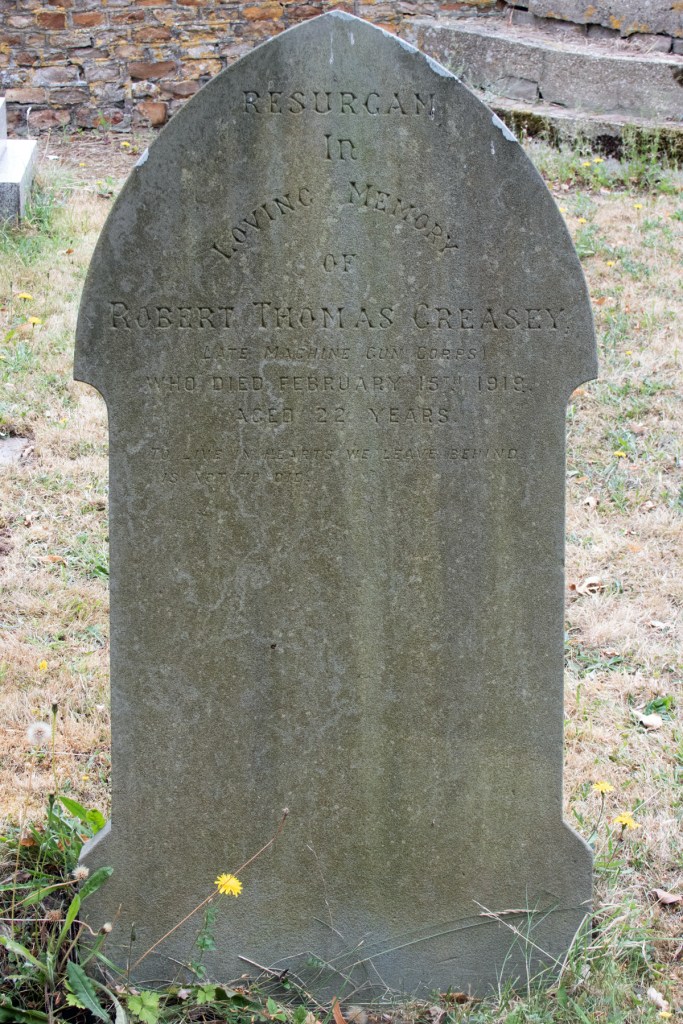
Robert Thomas Creasey (also known as Thomas Robert Creasey) was born in the village of Ash, near Farnham in Surrey, on 3rd January 1896. He was the youngest of four children to Edwin and Elizabeth Creasey. Edwin was the landlord of the Standard of England public house in the village.

When he died in 1902, Elizabeth moved her family to Somerset, where she had been born and where she still had relatives living. With four young children to raise, she married again in April 1903, to local dairy farmer Frederick Gould.

Robert was working as a farmer when war was declared, but was one of the first to step forward and volunteer. He enlisted in the Somerset Light Infantry and in the autumn of 1915 was involved in the fighting in Gallipoli.

In July 1916 Private Creasey transferred to the Machine Gun Corps. Sadly, little further information about his military life is available, but he survived the war, and returned home to Somerset on furlough, before being demobbed.

This is where Robert’s trail ends. He passed away at home on 15th February 1919, presumably from one of the lung conditions running rampant across a war-torn continent. He was just 23 years of age.

Robert Thomas Creasey was laid to rest in the graveyard of St Michael and All Angel’s Church in Angersleigh, Somerset, not far from where his mother lived.


Private Herbert Macklin

Private Herbert Macklin

Herbert Macklin was born in Lambeth, Surrey, on 14th August 1897, the youngest of six children to Enos and Sarah Macklin. Enos was a general labourer and, after his mother died in 1909, Herbert worked around his school as a baker’s errand boy, to bring in a little more money for his family.

After Enos passed away in 1912, and with his older sisters all having families of their own, Herbert and his older brother William did what they could to survive, getting some support from the local poor school.

The outbreak of war gave the brothers a sense of purpose, and both enlisted. William joined the Royal Field Artillery, and was sent to France in September 1915.

Herbert, being six years younger than his brother, enlisted later than his sibling. He joined the Middlesex Regiment, on 10th May 1916, and his service records show that he was 5ft 4.5ins (1.64m) tall, 126lbs (57.2kg) in weight and had a fair physical development. While Herbert had a fair physical development, he was also recorded as having flat feet, which somewhat limited his army service.

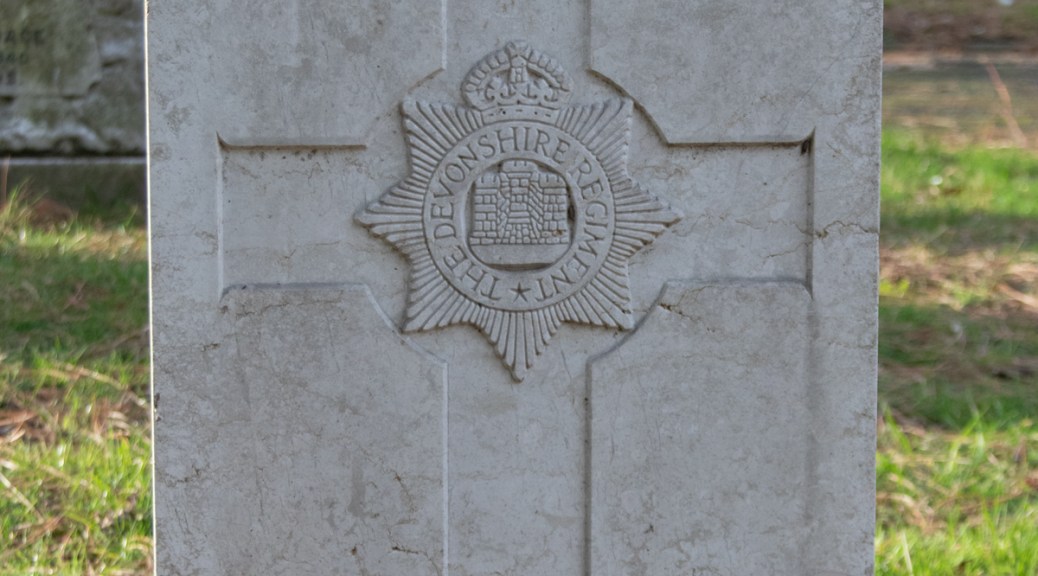
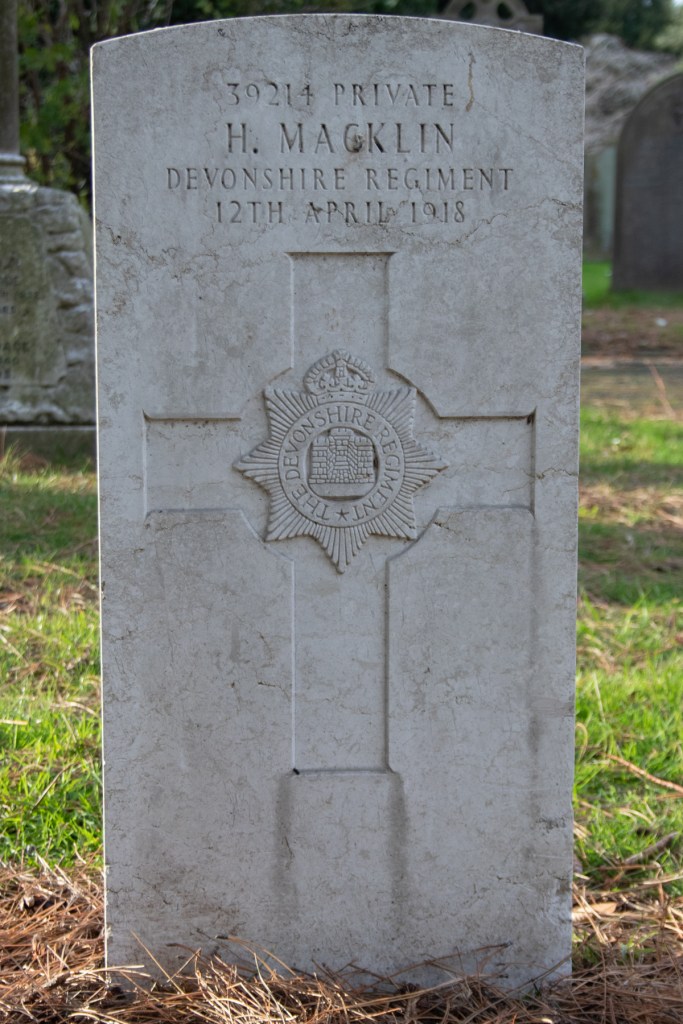
Private Macklin transferred across to the Devonshire Regiment a few months after enlisting. He was then assigned to the regiment’s Labour Corps in the summer of 1917, and remained with them for the rest of his service.

While William was serving abroad, Herbert remained on home soil for the duration. By the spring of 1918, he was working in Kent, but was admitted to hospital in Faversham, suffering from acute tonsillitis. Sadly, this was to prove too much for Private Macklin’s body to take: he suffered cardiac failure, and died on 12th April 1918. He was 21 years of age.

Herbert Macklin was laid to rest in the Borough Cemetery of the town in which he passed, Faversham.


Tragedy was to strike again for the Macklin brothers: as the war moved into its closing months, Driver William Macklin was based in Salonika, Greece. He was not to see England’s shores again, sadly: he passed away on 23rd November 1918, aged just 27 years old.


Private Thomas Wilson

Private Thomas Wilson

Thomas Charles Wilson was born in the summer of 1897 in South London, His parents were John and Ellen Wilson, and they appear to have passed away when their son was still young. He had a sister – also called Ellen – but there is little more concrete information about Thomas’ early life.

In fact, the bulk of the information available about Thomas comes from the newspaper article reporting on his funeral:

The death occurred at The Mount Hospital [Faversham] of Private Thomas Charles Wilson of the [3rd Battalion of The Queen’s (Royal West Surrey Regiment)]. The deceased was a medical case admitted from Fort Pitt Hospital, Chatham, on July 1st. He had not been to the Front; as a matter of fact he only enlisted in April, and was only 19 [sic] years of age.

The deceased, who belonged to Bermondsey, seems to have had very few friends. His nearest relative, a sister, is at present in a hospital.

Faversham News: Saturday 31st July 1915

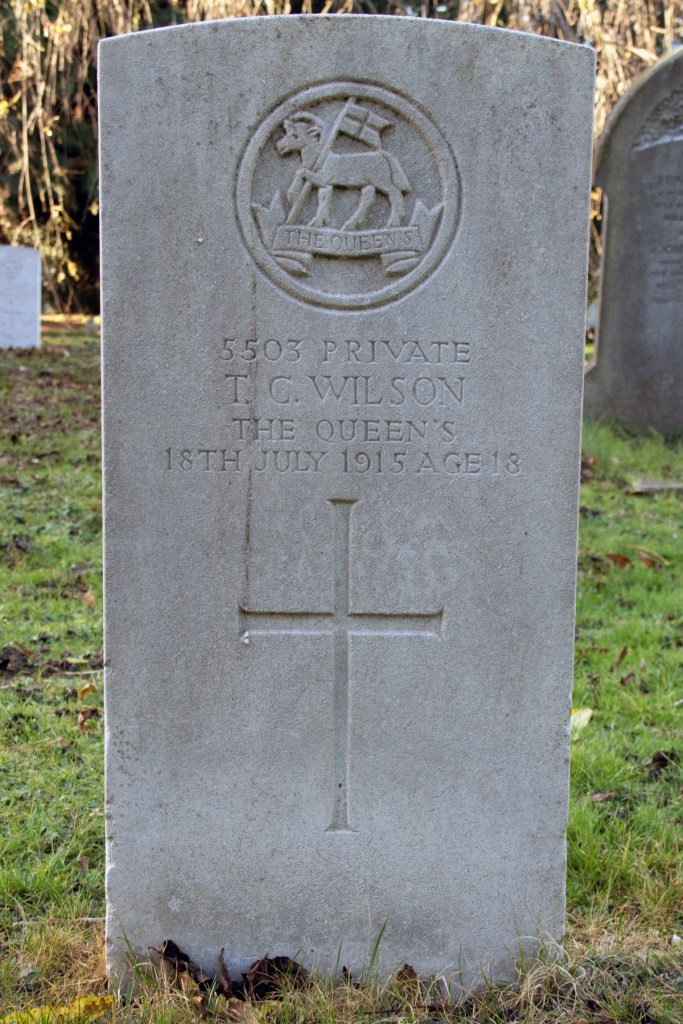
There is little further detail to add to this life cut short. Private Wilson seems to have been a loner, with no family other than his sister, and the army may have been an opportune escape from his life. He passed away on 18th July 1915, and was just 18 years of age.

Thomas Charles Wilson was buried in the Borough Cemetery of the town in which he passed away, Faversham, Kent. The newspaper report does not mention many mourners, but he would have been proud to have been afforded full military honours as he was laid to rest.


Private George Dove

Private George Dove

George Dove was born in Wincanton, Somerset, on 4th December 1883. One of five children, his parents were farm labourer George Dove and his wife, Jane.

George Jr did not follow his father into farm work: the 1901 census found him boarding with a family in Radstock, working in one of the coal mines in the area. Ten years later, he was living back with his family, employed as a groom.

His work with horses stood him in good stead when war was declared. George enlisted early on, and was assigned to the 19th (Queen Alexandra’s Own Royal) Hussars as a Private. By October 1914, he was in France, returning to England with his squadron the following spring.

At some point during the conflict, Private Dove transferred to the Reserve Regiment of Cavalry. He was posted to the 5th Regiment, which trained men for the Northumberland Hussars and Yorkshire Dragoons, amongst others.

Further details of George’s life are scarce; at some point, he married a woman called Emily, although records of the couple’s wedding no longer exist. The only thing that can be confirmed is that George was admitted to the Bermondsey Military Hospital in Surrey, where he passed away on 24th October 1918. He was 34 years old.

The body of George Dove was brought back to Somerset for burial. He lies at rest in the cemetery in his home town, Wincanton.


Stoker 1st Class John Green

Stoker 1st Class John Green

John Green was born in Putney, London, on 9th September 1895. He was one of eight children to cab driver Albert Green and his wife, Bridget. When he left school, John found work as an errand boy, but clearly wanted bigger and better things.

On 8th October 1913, he enlisted as a Stoker 2nd Class in the Royal Navy. His naval records confirm that he was 5ft 4ins (1.62m) tall, had brown hair, brown eyes and a fresh complexion. He was also noted as having a scar on the side of his right eye.

While John’s service records confirm his date of birth as that above, other documents suggest that his year of birth was 1897. This would have meant he would have been to young to enlist in the Royal Navy when he did, although it was not unusual for keen sailors to add a year or so to their age to ensure they were accepted.

Stoker 1st Class Green was initially sent to HMS Pembroke – the Royal Naval Dockyard in Chatham, Kent – for training. He spent six months there, before being assigned to the dreadnought battleship HMS Vanguard. He spent three-and-a-half years on board her, and gained a promotion to Stoker 1st Class in the process.

In August 1917, John returned to Chatham Dockyard. HMS Pembroke was a busy and cramped place that particular summer, and he was billeted to temporary accommodation set up in Chatham Drill Hall.

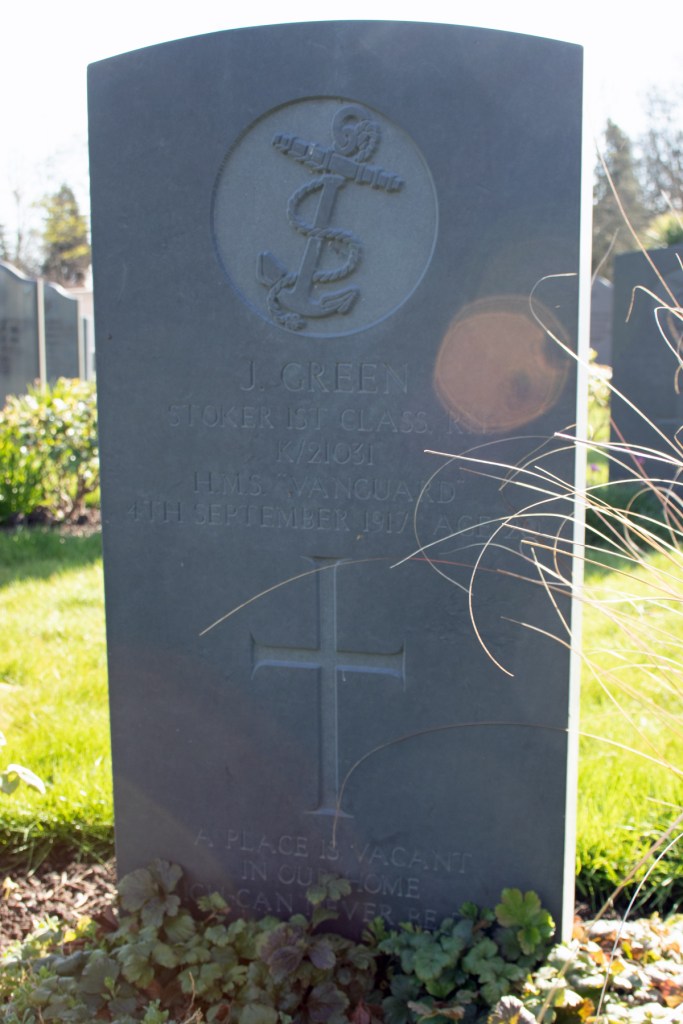
On the night of 3rd September, the town came under attack from a German air raid, and the Drill Hall received a direct hit. Stoker Green was badly injured and admitted to the Chatham Naval Hospital; he succumbed to his injuries the following day, days short of (officially) his 22nd birthday.

John Green was laid to rest in the Woodlands Cemetery in Gillingham, Kent, alongside the other victims of the Chatham Air Raid.


Senior Reserve Attendant George Cain

Senior Reserve Attendant George Cain

George Cain was born on 27th December 1896, and was one of eleven children to Edward and Florence Cain. Edward was a house painter from Richmond in Surrey, who passed away when George was a child, leaving Florence to raise the family. She found work as a shopkeeper in the town, and, when he left school, George was apprenticed to a printer to help bring in some extra money.

He had moved on to compositing – setting type – when war broke out. With conflict raging in Europe, George felt the need to play his part and, on 31st July 1915, he enlisted in the Royal Navy. His records show that he was 5ft 7ins (1.7m) tall, had dark brown hair, brown eyes and a pale complexion.

George was given the rank of Junior Reserve Attendant, supporting medical staff in the navy’s sick bays. After a couple of weeks at HMS Pembroke, the Royal Naval Dockyard in Chatham, Kent, he was posted to the town’s main hospital, where he remained for just under two years, and where he received a promotion to Senior Reserve Attendant.

In July 1917, George was reassigned to HMS Pembroke. That summer was particularly busy for the base, and temporary accommodation was set up in the Drill Hall; this is where George found himself billeted.

On the night of 3rd September 1917, Chatham suddenly found itself in the firing line as a wave of German aircraft bombed the town. The Drill Hall received a direct hit, and Senior Reserve Assistant Cain was injured. He was admitted to the hospital at which he had worked just weeks before, but died of his wounds the following day. He was just 20 years old.

George Cain was laid to rest in the Woodlands Cemetery in nearby Gillingham, along with the other servicemen who had perished during the Chatham Air Raid that night.


Painter 2nd Class Arthur Voice

Painter 2nd Class Arthur Voice

Arthur Edward Voice was born on 14th August 1895, the youngest of five children to Albert and Jane. Albert was a painter from Sussex, who had set up home in Horley, Surrey, and this is where Arthur and his siblings were born.

When he left school, Arthur followed in his father’s footsteps, becoming a painter and decorator. This was something he continued doing through to the outbreak of war. He was called up to the Royal Naval Volunteer Reserve in February 1916, but was initially excused from duty.

On 1st February 1916, he married Winifred Leppard, from Redhill in Surrey; the couple went on to have a son, Raymond, that September.

Arthur was called up again on 5th December, this time as a Painter 2nd Class in the Royal Navy. His service records show that he was 5ft 5ins (1.65m) tall, had fair hair, grey eyes and a fresh complexion.

Painter Voice was stationed at HMS Pembroke – the Royal Naval Dockyard in Chatham, Kent – and his services seem to have been put to use on shore, rather than at sea.

HMS Pembroke was a generally bustling place, but by the summer of 1917, it had exceeded capacity to the point where temporary accommodation was set up. Arthur found himself billeted at The Drill Hall, away from the main barracks.

On the night of 3rd September 1917, Chatham suddenly found itself in the firing line, as the German Air Force launched a bombing raid. One of the bombs landed squarely on the Drill Hall, and Painter Voice was killed instantly. He was just 22 years old.

Ninety-eight servicemen perished during the Chatham Air Raid that night. They were buried in a mass funeral at the Woodlands Cemetery in nearby Gillingham. This, too, is where Arthur Edward Voice was laid to rest.


Painter 2nd Class Arthur Voice
(from findagrave.com)

Ordinary Seaman George Shuttle

Ordinary Seaman George Shuttle

George James Henry Shuttle was born in Brentford, Middlesex, on 12th July 1899. His mother was Helen (or Ellen or Nellie) Shuttle, but he does not seem to have had a close connection to her and, according to the records, there was no father on the scene. Initially fostered out to Noah and Carmina Scott as a nurse child, by the time of the 1911 census, the couple had adopted him.

When he left school, George worked as a milk boy, but he seemed to know that a life of adventure awaited him. In June 1915, he joined the Royal Navy; being only 15 at the time, he was given the rank of Boy 2nd Class.

His initial posting was on board the cruiser HMS Powerful, and his training there paid off, as he quickly rose to Boy 1st Class. After a couple of months’ at HMS Victory – the Royal Naval Dockyard in Portsmouth – George was assigned to his second ship, HMS Malaya. Within weeks, the brand new battleship had cut her teeth in the Battle of Jutland, during which 65 of her crew were killed.

George spent more than eighteen months on Malaya; his time on board saw him turn eighteen, and gain the rank of Ordinary Seaman. His service records at the time show that he was 5ft 3.5ins (1.61m) tall, had brown hair, grey eyes and a fresh complexion.

By August 1917 Ordinary Seaman Shuttle had returned to shore, and was assigned to HMS Pembroke, the Royal Naval Dockyard in Chatham, Kent. The base was particularly busy when he arrived. Temporary accommodation at Chatham Drill Hall had been set up, and George found himself billeted there for the summer.

On the 3rd September 1917, the German Air Force carried out one of the first night-time air raids on England: an unprepared Chatham was heavily bombed and the Drill Hall received a direct hit. Ordinary Seaman Shuttle was badly injured and died of his wounds in hospital the following day.

George James Henry Shuttle was laid to rest, along with the other victims of the Chatham Air Raid, in the Woodlands Cemetery, Gillingham.


George’s mother, Helen, had continued with her life. A year after George was born, she had another son, Cyril, but he also seems to have been fostered out to enable her to work.

In 1903, she married musician Harry Burgiss-Brown, and the couple set up home in Richmond, Surrey. They went on to have two children, and Helen seemed focused on her new life, rather than the one she had before marrying.

Helen died in 1949, just short of her 70th birthday.


Ordinary Seaman Victor Duckett

Ordinary Seaman Victor Duckett

Victor Rous Duckett was born in Margate, Kent, on 2nd September 1887, the youngest of seven children to publican and stonemason Charles Duckett and his wife, Emily. Tragically, both of Victor’s parents died when he was young: Charles passed away on 31st October 1891, while managing the Clifton Arms public house; Emily passed away just four months later.

Victor’s brothers Charles and William took over the running of the pub, and, understandably, took on the responsibility for the family. The 1901 census records that he was one of eight boys boarding at a ‘private school’ in a house in Stanley Road, within walking distance of the Clifton Arms. The school was managed by James and Mary Hawkins and had one master, Alexander Smith.

When he left school, Victor found work as a compositor, setting type for a local printer. In the meantime, while his brothers were still running the pub, his three sisters had set up a ladies’ outfitters in Broadstairs, where they employed an assistant, Amy Leggett. Victor and Amy became close and the couple married in Sussex – where Amy was from – in the spring of 1911. They set up home in Croydon, and went on to have twin daughters, Caroline and Dorothy, the following year.

War was on the horizon, and Victor was called up on 27th February 1917. He enlisted in the Royal Navy as an Ordinary Seaman, and was sent to HMS Pembroke, the shore-based establishment in Chatham, Kent. His service records show that he stood at 5ft 10.5ins (1.79m) tall, had brown hair, blue eyes, and a fresh complexion.

HMS Pembroke was extraordinarily busy when Ordinary Seaman Duckett arrived there. Temporary accommodation at Chatham Drill Hall had been set up, and Victor found himself billeted there for the summer.

On the 3rd September 1917, the German Air Force carried out one of its first night-time air raids on England: Chatham was heavily bombed and the Drill Hall received a direct hit. Ordinary Seaman Duckett was badly injured and died of his wounds in hospital the following day. He had celebrated his thirtieth birthday just two days before.

Victor Rous Duckett was laid to rest, along with the other victims of the Chatham Air Raid, in the Woodlands Cemetery, Gillingham.


Ordinary Seaman
Victor Duckett
(from ancestry.co.uk)