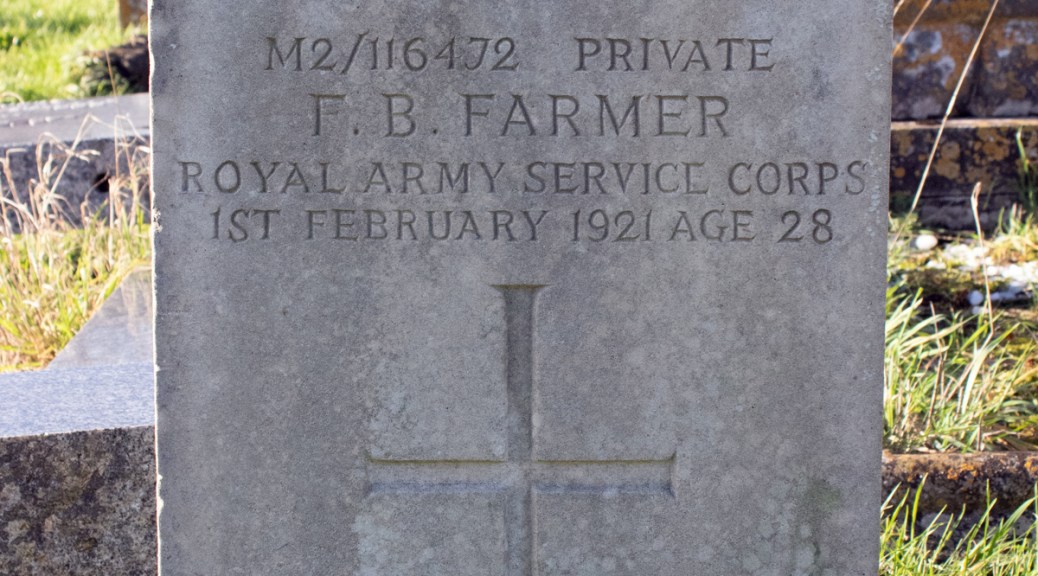
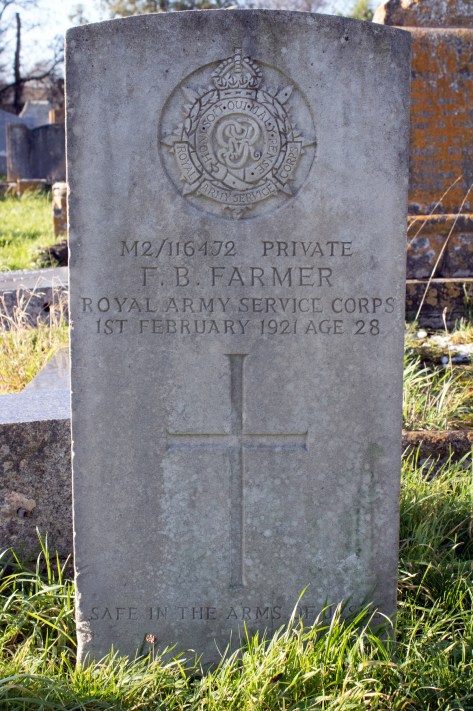
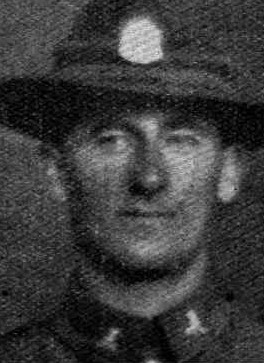
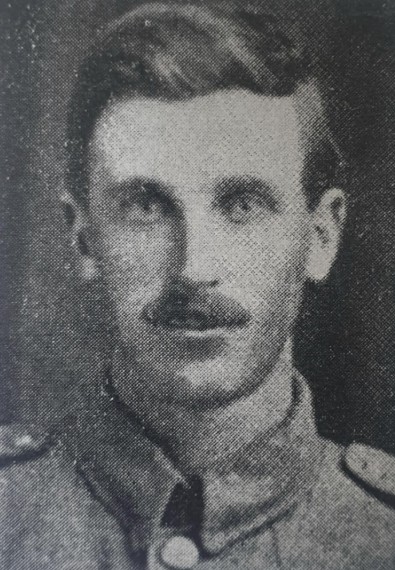
Frank Baden Farmer was born in the summer of 1892 in the Wiltshire village of Semington. The twelfth of thirteen children, his parents were groom and gardener John Farmer and his wife, Jane.
When he completed his schooling, Frank – who was known as Toby to his family and friends – found work as a labourer in a local iron foundry. War broke out in the summer of 1914, and he gave up his job to enlist. He joined the Army Service Corps as a Private and, by early August 1915, he was in France.
Details of Private Farmer’s life in the army have been lost to time, but he certainly survived the war, and returned home to Wiltshire. At this point, Frank’s trail goes cold. The next documents for him relate to his passing – from disease, on 1st February 1921. He was 27 years of age.
The body of Frank Baden Farmer was laid to rest in the graveyard of St George’s Church in his home village of Semington.
Interestingly, The Wiltshire News of the 18th February (thirteen days after Frank’s funeral) included a photograph of the newly installed war memorial tablet in St George’s. Unveiled the week before, it is likely that Private Farmer’s passing came to late for his name to be included on it.
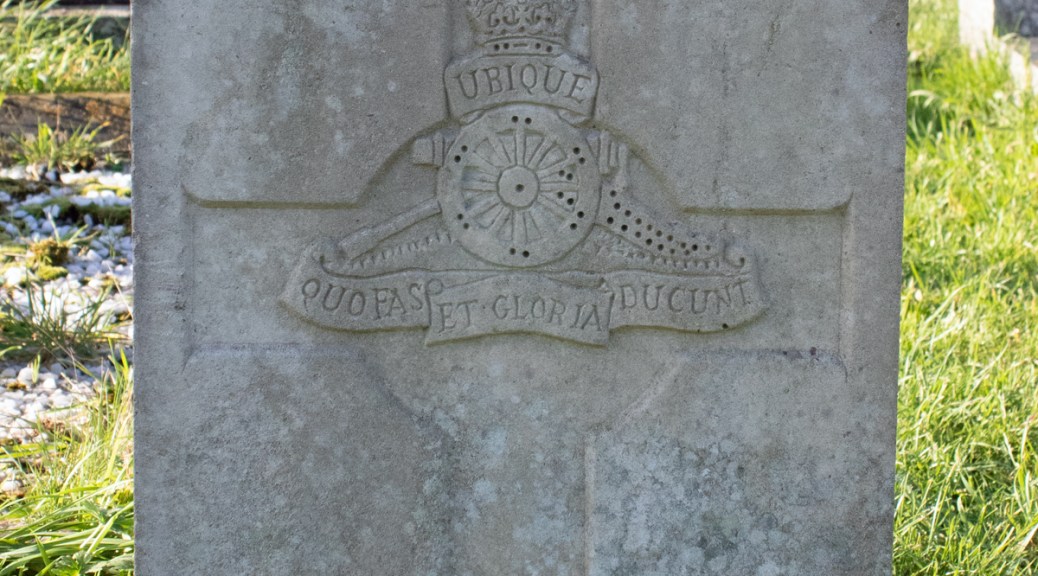
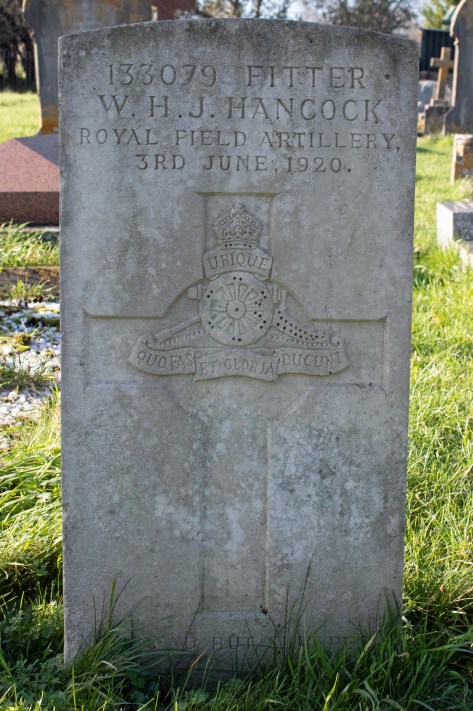
William Henry John Hancock was born in the autumn of 1896 in the Wiltshire village of Semington. One of three children – although one of his siblings had died before he was born – his parents were Henry and Alice Hancock. Henry’s line of work seemed to change over time: William’s baptism record notes he was a baker; the 1901 census suggests he was a poulterer and fishmonger; by 1911 he is recorded as being a market gardener.
William was recorded in census records as John, although his family and friends called him Jack. The 1911 document confirms that, at 14 years of age, he had completed his schooling and was employed as a rubber worker at the local India Rubber factory. His older brother, Richard, was also working, though as a wood trellis maker in a local saw mill. The Hancock family had also taken in two lodgers: William Haines was also a rubber worker, while Herbert Reynolds was employed at the saw mill as well.
When conflict broke out in Europe, William – Jack – was called upon to play his part. Full details of his service have been lost to time, but it is clear that he enlisted in the Royal Field Artillery as a Fitter, and was assigned to B Battery of the 2nd Reserve Brigade. A territorial unit, it seems likely that he was assigned to them while recovering from an illness contracted overseas. By 21st December 1918, Fitter Hancock had been discharged from service, as he was physically unfit to continue.
Jack returned home to Wiltshire, and is likely to have tried to pick up on his previous life. His health had been impacted, however, and he passed away after “a short illness” [Wiltshire Times and Trowbridge Advertiser: Saturday 12th June 1920] on 3rd June 1920: he was 23 years of age.
The body of William Henry John Hancock – Jack to his friends – was laid to rest in the graveyard of St George’s Church in his home village.
As an interesting aside, a newspaper reported on a luck escape that Henry had had back in 1911:
Last week Mr Hancock, of Semington, on going to the fowl cote found a snake quite a yard and a half long, and as thick as one’s arm. It had a toad in is mouth, and was seen to make a hasty meal of this. Mr Hancock killed the unwelcome visitor with a hay-fork
[Devizes and Wilts Advertiser: Thursday 13th July 1911]
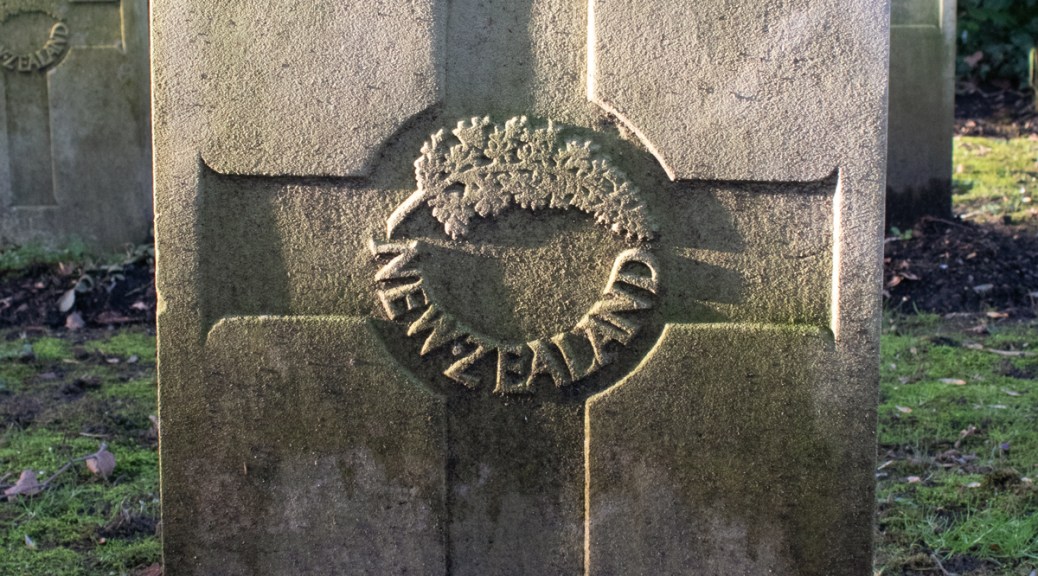
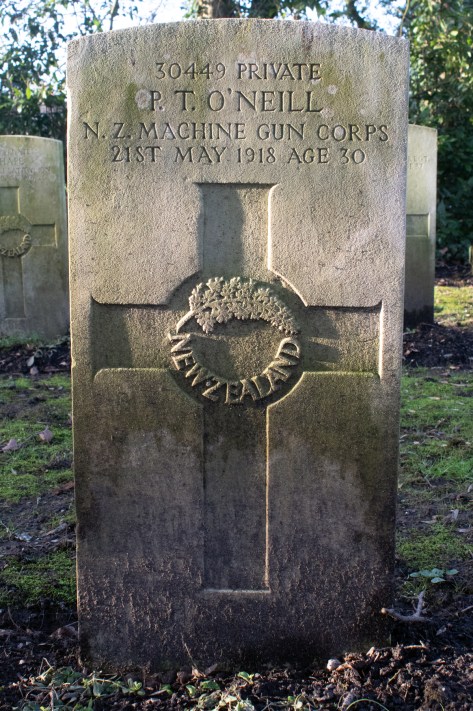
Patrick Thomas O’Neill was born in Wellington, New Zealand, on 2nd March 1888. Little information is available about his early life, but the Commonwealth War Graves Commission confirms he was the son of Jane O’Neill, and the family lived at 151 Taranaki Street.
When he completed his schooling, Patrick found work as a driver for Munt, Cotterell & Co. A large transport and cartage company, when the First World War broke out, they became involved in transporting supplies to the military camp at Trentham. Because of this connection, many of the company’s workers – Patrick included – enlisted.
Patrick’s service papers show that he joined up 22nd August 1916. His medical confirms that he was 5ft 4.5ins (1.64m) tall and had fair hair, blue eyes and a fair complexion.
After his training at Trentham, Private O’Neill’s unit – the New Zealand Machine Gun Corps – left Wellington for Europe. After a week’s break in Simon’s Town, South Africa, their ship – the Walmer Castle – arrived in Devonport, Devon, on 27th March 1917. During the second part of the voyage, Patrick was admitted to the ship’s hospital, for an infestation of pubic lice.
The voyage from New Zealand to Britain had taken nearly three months, so when the regiment finally arrived at their camp in Sling, Wiltshire, it must have been something of a relief. For Private O’Neill, however, it marked the beginning of a regular pattern of misdemeanours.
In April 1917, Patrick moved to a base in Tidworth. A matter of weeks later, he went AWOL, and forfeited three days’ pay as a result. Private O’Neill was then sent to Grantham, Lincolnshire, where the ANZAC united had their machine gun training base. Over the next two months, he went AWOL on four separate occasions, resulting in him losing a total of 10 days’ pay and, for the final absence, 96 hours’ detention.
Private O’Neill disappearances seem to have been those of a lad about town: a couple of days after his final return, he was admitted to the venereal section of the camp hospital in Grantham. His condition – and probably his behaviour – was such that he was transferred back to Wiltshire, and admitted to the No. 3 New Zealand General Hospital near Codford.
Private O’Neill was not done, however. On 6th December 1917, and having been discharged back to his unit just a day before, he went AWOL again, this time in spectacular fashion. He was arrested by military police in Edinburgh on 14th January 1918. Taken in handcuffs back to Codford, he forfeited 71 days’ pay – plus a 2s fine for his arrest – and punished with 90 days in the cells.
Patrick’s imprisonment began on the 1st March 1918, but it was a sentence he would not complete. On 16th May, he was taken from his cell and admitted to the camp hospital, once again to the venereal section. Less than a week later, he was dead, having suffered an embolism. Private O’Neill was 30 years of age when he passed, on 21st May 1918.
The body of Patrick Thomas O’Neill was laid to rest in the extension to St Mary’s Church, Codford, not far from the base in which he had been incarcerated and hospitalised.
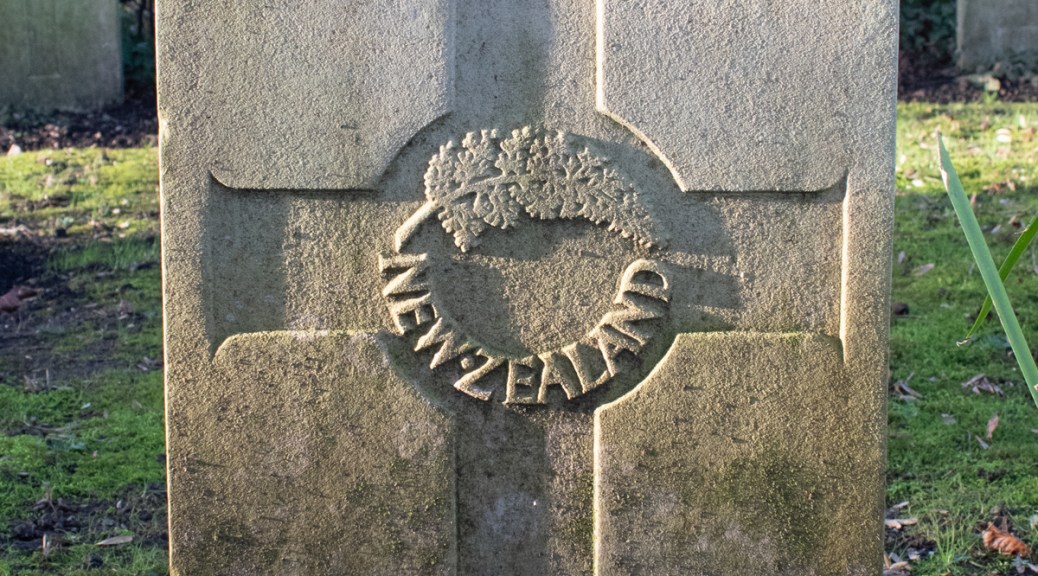
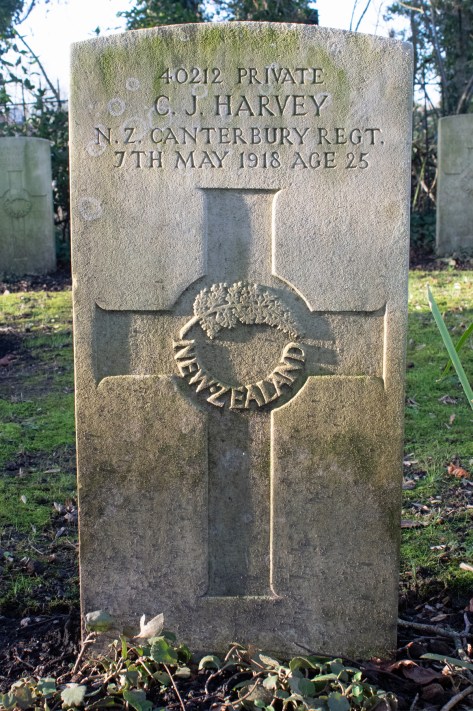
Charles John Harvey was born in Nelson, New Zealand, on 30th May 1892. Little information is available about his early life, but documents give his parents as George and Eleanora Harvey.
Charles was working as a general labourer when war broke out, and was called upon to play his part on 19th October 1916. Attached to his country’s Canterbury Regiment, his medical report showed that he was 5ft 6ins (1.68m) tall, and weighed 11st 2lbs (70.8kg). An Anglican, he was recorded as having dark brown hair, blue eyes and a dark complexion. He was noted as having no vaccination marks.
This fact that Private Harvey hadn’t been vaccinated would come back to haunt him. Sent to an army camp in Trentham, near Wellington, within a matter of weeks he was hospitalised with measles. He remained admitted until 13th December 1916, when he was discharged back to his unit.
It was not until 2nd April 1917, that Private Harvey would set sail for Britain. The journey from Wellington to Devonport would take ten weeks, and Charles was marched in to camp at Sling, Wiltshire, on 10th June that year.
Assigned to the 2nd Company of the 2nd Battalion, Private Harvey finally arrived in France on 27th August 1917. He served on the Western Front for a couple of months, before falling ill again. This time it was influenza that had incapacitated him, and he was admitted to a hospital in Le Tréport for a month while he received treatment.
Charles’ recovery was to be a slow one and, in the end, he was medically evacuated to Britain for ongoing medical support. By February 1918, he had spent time in four different hospitals and, intriguingly, had forfeited three days’ pay for going AWOL while a patient in a medical facility in Hornchurch, Essex. By the start of April 1918, Private Harvey was discharged to the ANZAC camp in Codford, Wiltshire.
His health issues were not over, however, and, on 21st April, Charles was taken in to the No. 3 New Zealand General Hospital in near the Codford camp. He was suffering from acute nephritis, and this would ultimately prove fatal. Private Harvey died on 7th May 1918: he was 25 years of age.
The body of Charles John Harvey was laid to rest in the graveyard extension of St Mary’s Church, Codford.
Thomas Patrick Perwick was born in Balfour, a town on New Zealand’s South Island, on 19th August 1889. There is little information available about his early life, but his parents were Australian Alfred Perwick and his Irish-born wife, Catherine.
When Thomas completed his schooling, he took up agricultural work, and was working as a farmer when he received the call up to join the New Zealand Expeditionary Force.
Private Perwick’s service records show that he enlisted on the 18th October 1916. Standing 5ft 10ins (1.78m) tall, he weighed 11st (69.9kg). His medical report shows that he had light brown hair, blue eyes and a fair complexion. The papers also note Thomas’ religion as Roman Catholic.
Sent to Trentham for training, Private Perwick would be assigned to the New Zealand Otago Regiment. His unit left Wellington on 15th February 1917, making the ten-week voyage to Britain. Thomas disembarked in Devonport, Devon, on 2nd May, and was marched in to camp in Sling, Wiltshire, the same day.
Private Perwick was attached to the 2nd Battalion, and was sent to France on 9th June. Straight into the fray, his unit fought at Messines, but was wounded in the head and arm during fighting at Passchendaele. Medically evacuated to Britain for treatment, he was admitted to hospital in Brockenhurst, Hampshire, before being moved back to the Wiltshire ANZAC camps at Sling and Tidworth.
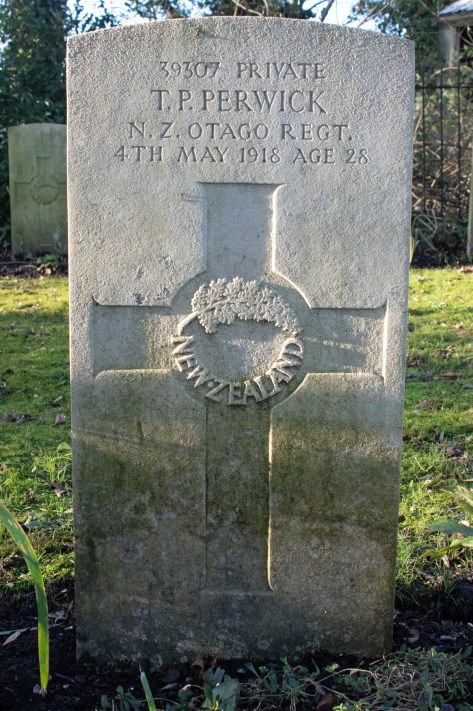
Thomas was discharged to duty on 7th January 1918, but was not out of the woods. He fell ill with mumps, and was sent to the No. 3 New Zealand General Hospital in Codford, Wiltshire, for treatment. While admitted, he contracted tuberculosis, and, over the next four months, his health deteriorated. Private Perwick’s body finally succumbed on 4th May 1918: he was 28 years of age.
Thousands of miles from his home, Thomas Patrick Perwick was laid to rest in the graveyard extension of St Mary’s Church, Codford, not far from the hospital in which he had breathed his last.
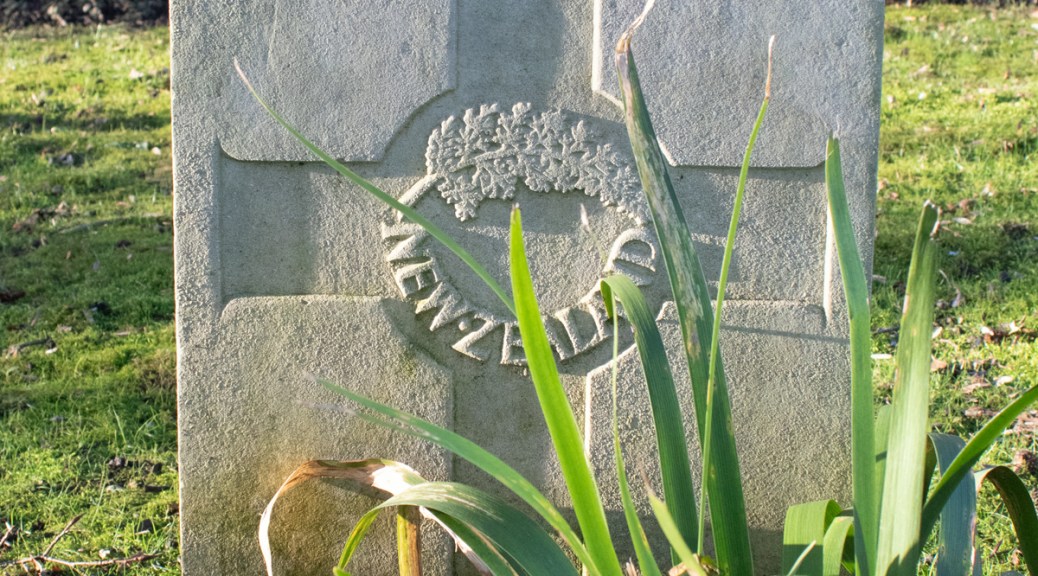
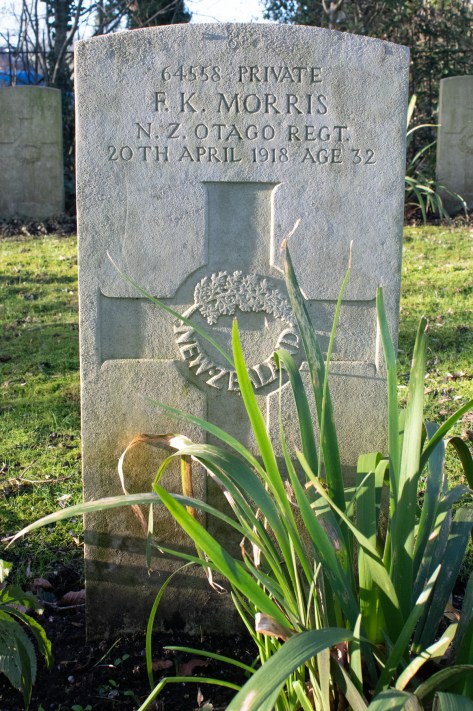
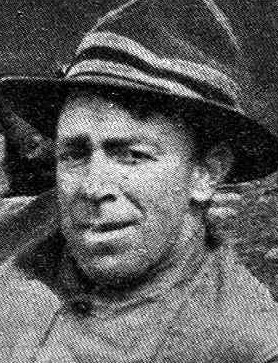
Francis Kemp Morris was born in Auckland, New Zealand, on 29th September 1884. The older of two children, his parents were William and Fanny Morris. London-born Fanny, had been married twice before, and Francis – who was better known as Frank – had two half-siblings from each of those marriages.
There is little information about Frank’s early life. On 22nd March 1910, he married Lavinia Edwards. The couple went on to have three children – Albert, Ivy and Mavis – and Lavinia had had a son, William, two years before their wedding.
Fanny died in February 1915, at the age of 63. Tragically, Lavinia would also pass away in December 1916: she was just 26 years of age. Frank now had children to raise. He was employed as an engineer, but was called upon to serve his King the following summer.
Assigned to the New Zealand Otago Regiment, Private Morris’ service papers note that he was 5ft 8ins (1.73m) tall, and weighed 148kbs (67.1kg). He was recorded as having dark hair, brown eyes and a dark complexion. He had a scar in the middle of his back, and tattoos on both of his forearms and his left knee. Deemed fit for service, Frank was sent to Trentham, near Wellington for training.
On 21st November 1917, Frank’s unit left New Zealand for the ten week voyage to Britain. Arriving in Liverpool, Lancashire, on 8th January 1918, he was marched in to Sling Camp, Wiltshire, the same day, in preparation for his unit’s move to France.
Private Morris, however, would not spend any time fighting the enemy. On 12th April 1918, he was admitted to a military hospital in Tidworth, Wiltshire, suffering with hypertrophy of the tonsils. The following day he was moved to the No. 3 New Zealand General Hospital near Codford with gonorrhoea. Over the coming days he contracted bronchitis, and this would be the condition that ultimately claimed his life. Frank died on 20th April 1918, at the age of 33 years old.
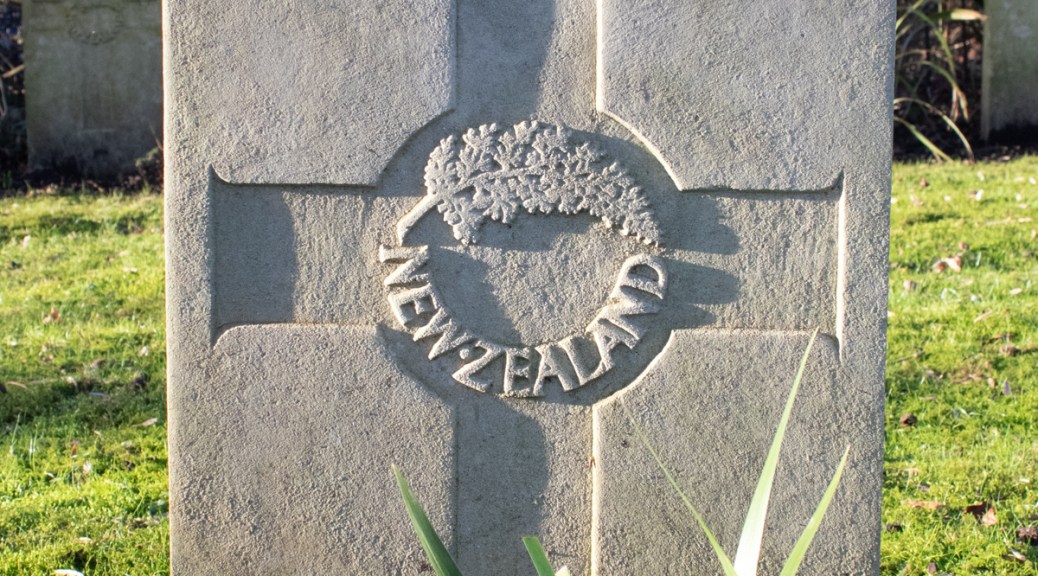
Thousands of miles from home, Francis – Frank – Kemp Morris was laid to rest in the graveyard extension to St Mary’s Church, Codford, not far from the hospital in which he had spent the last few weeks of his life.
Frank’s next of kin was noted as a friend, E Biddle, while his war pension was given to Henry Holbrook of St Mary’s Industrial School, Auckland, the guardian of the now orphaned children.
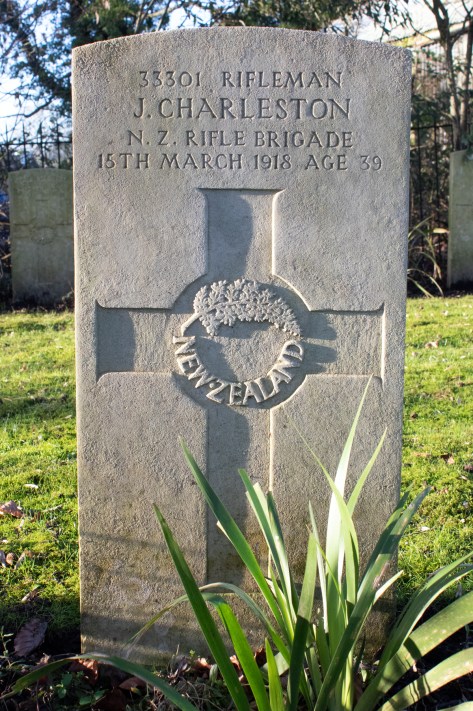
The early life of John Charleston is a challenge to unpick. Later documents confirm his parents as being John and Clare Charleston from Cardiff, Glamorganshire, although there are no baptism or census records to provide additional detail.
Much of the information about John’s life comes from his New Zealand Expeditionary Force service papers. These confirm that he was born in Liverpool, Lancashire, on 1st April 1887. The document suggests that he had spent nine years in the Royal Navy, and that, at the point he enlisted, on 19th September 1916, he was working for the shipping company Shaw, Savill & Albion.
By this point, John was living in Wellington, New Zealand, and had been there for at least a decade. He had married Mary Agnes Sykes in the city on 6th February 1906, and they had four children: Clarence, Phyllis, Arthur and Kenneth.
John joined the New Zealand Rifle Brigade, and was passed as medically fit: his medical noted he was 5ft 2.5ins (1.59m) tall, with brown hair, grey eyes, and a fresh complexion.
Rifleman Charleston spent the next three months training at barracks in Trentham. This time was not without incident, however, and he spent two separate period in hospital – for a growth on his tongue in October 1916, and appendicitis a month later. By the middle of January, however, his unit boarded HMNZT 75 bound for Britain.
The journey back to the UK took ten weeks, and it would not be until 28th March 1917 that Rifleman Charleston marched into Sling Camp in Wiltshire. He would remain there for two months as preparations were made to go to France. During this time, John went AWOL for three days. On his return he was confined to barracks for a week, and docked that three days’ pay.
Rifleman Charleston’s unit arrived in France on 26th May 1917. John, however, would not see much, if any, fighting. Within a couple of days he was admitted to hospital with syphilis, a condition which would keep recurring over the coming months. John was sent back to Britain, spending four separate periods of time receiving treatment over the next eight months.
John’s last admission was in the No. 3 New Zealand General Hospital in Codford, Wiltshire, on 23rd January 1918. This time, his condition would prove to be too severe. Rifleman Charleston passed away from syphilitic meningitis on 15th March 1918: he was a fortnight short of his 41st birthday.
The body of John Charleston was laid to rest in the graveyard extension of St Mary’s Church, Codford, not far from where he had breathed his last.
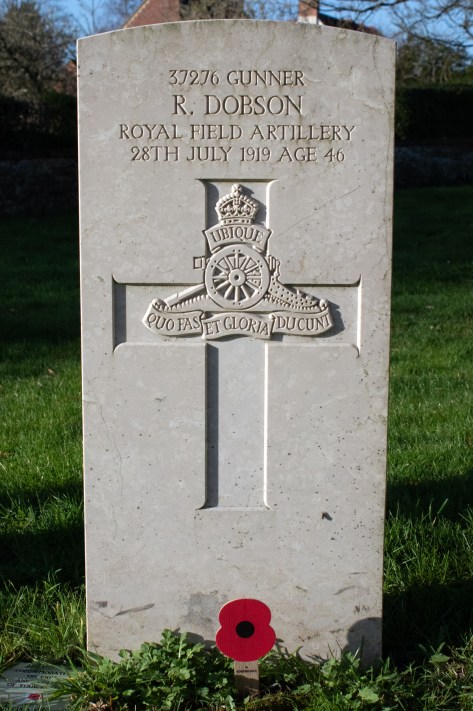
In the graveyard of St Mary’s Church in Steeple Ashton, Wiltshire, is a headstone dedicated to the memory of Gunner R Dobson of the Royal Field Artillery. The early life of Robert Dobson, however, is a challenge to unpick.
Born in Kilbride, County Wicklow, in 1873, he was the son of John Dobson and, according to his later service papers, he had three brothers: William, John Jr and Richard.
When he finished his schooling, Robert found work as a gamekeeper, but he wanted more adventure, and, on 27th April 1891, he enlisted in the Royal Artillery. Given the rank of Gunner, his papers note that he was a little over 5ft 6ins (1.68m) tall, and weighed 150lbs (68kg). A Presbyterian, he had brown hair, blue eyes and a fresh complexion.
Gunner Dobson signed up for a period of seven years, and during this time he travelled the world. From March 1893, he was based in India, but was invalided home for reasons unclear in November 1894. He would remain on home soil for the next three years, and was stood down to reserve status in April 1898.
While back on home soil, love had blossomed and, on the 14th May 1898, Robert married Mary Bull. A labourer’s daughter from Steeple Ashton, the couple wed in the parish church. Robert gave his address as the same village, and, given the proximity of the garrison town of Trowbridge, it is likely a local posting is how the couple met.
On 3rd November 1899, Gunner Dobson was called into duty once more. Attached to the 3rd Battalion of the Royal Field Artillery, his unit headed to South Africa, and he was quickly caught up in the Boer War. He would remain overseas until the spring of 1901, at which point he returned to Britain once more.
After a total of twelve years’ service, Robert was formally stood down from army service on 26th April 1903, returning to Steeple Ashton and Mary. The 1911 census – the only one of the four returns taken during his lifetime on which he appeared – found the couple living in a cottage on Common Hill, to the north of the village centre. Robert, now 38 years old, was working as a farm labourer.
When war broke out in Europe, Robert stepped up to serve his country once more. He initially re-joined his old unit, but seems to have transferred over the Labour Corps, and was attached to the 95th Company. His service records for this period have been lost, so it is unclear when or how he served.
Robert survived the conflict, but would pass away on 28th July 1919. The cause of his passing is unclear, but he was 46 years of age when he died.
The body of Robert Dobson was laid to rest in the peaceful graveyard of St Mary’s Church in Steeple Ashton.
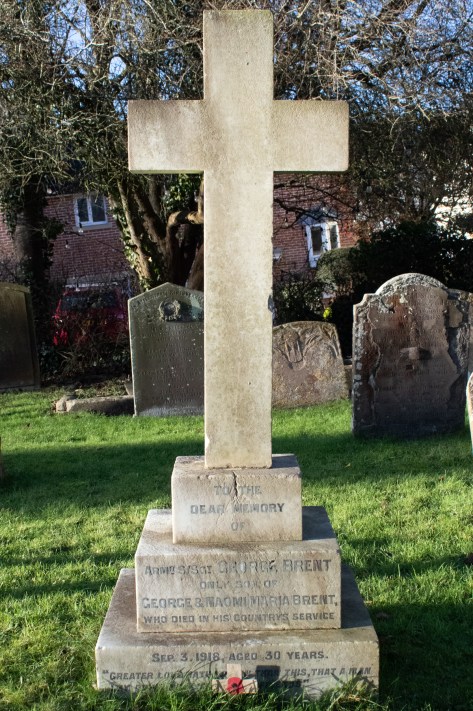
George Brent was born in the autumn of 1887 in Bratton, Wiltshire, and was the only child to George and Naomi Brent. Census records humbly record George Sr was a wool carder, although he actually ran Luccombe Mill, the family living in the substantial Luccombe House.
George had been widowed in the 1870s, and was thirty-four years older than his second wife, Naomi. When he died in 1900, she was left to raise her teenaged son. She was not on her own, however, the 1901 census recording her as living on her own means, and with servant Eliza Whately to support her.
Education was important to Naomi, and by the time of the 1911 census, George was working as a draughtsman and designer for an engineering company. War was on the horizon, however, and he would step up to serve his country.
George enlisted in the Army Ordnance Corps, and served in the Balkans from October 1915. Full details of his time in the army have been lost, but he rose through the ranks and, by the summer of 1918, he was a Staff Serjeant.
At some point love blossomed and, George married a woman called Edith. Sadly, her life is destined to remain a mystery: she is noted as being George’s widow on his probate record and his beneficiary in the Army Register of Soldiers’ Effects.
Staff Serjeant Brent’s health seems to have suffered after three years in the eastern Mediterranean. He was admitted to the military hospital in Mansfield, Nottinghamshire, although his condition is unclear. He passed away on 3rd September 1918, at the age of 30 years old.
The body of George Brent was taken back to Wiltshire for burial. He was laid to rest in Bratton Baptist Chapelyard, not far from Luccombe House.
George left an estate of £978 16s 6d (approx. £58,000 in today’s money) to his widow. Naomi must have taken some comfort in Edith’s presence: the 1921 census found them living in Luccombe House.
The census sheds some light on Edith’s background, noting that she was born in Grangemouth, Stirlingshire. Interestingly, she and Naomi have two visitors: widow Helen Harrower (aged 65) and Helen Georgina Harrower (aged 32). The younger Helen was also born in Grangemouth, and it appears that the visitors were Edith’s mother and sister.
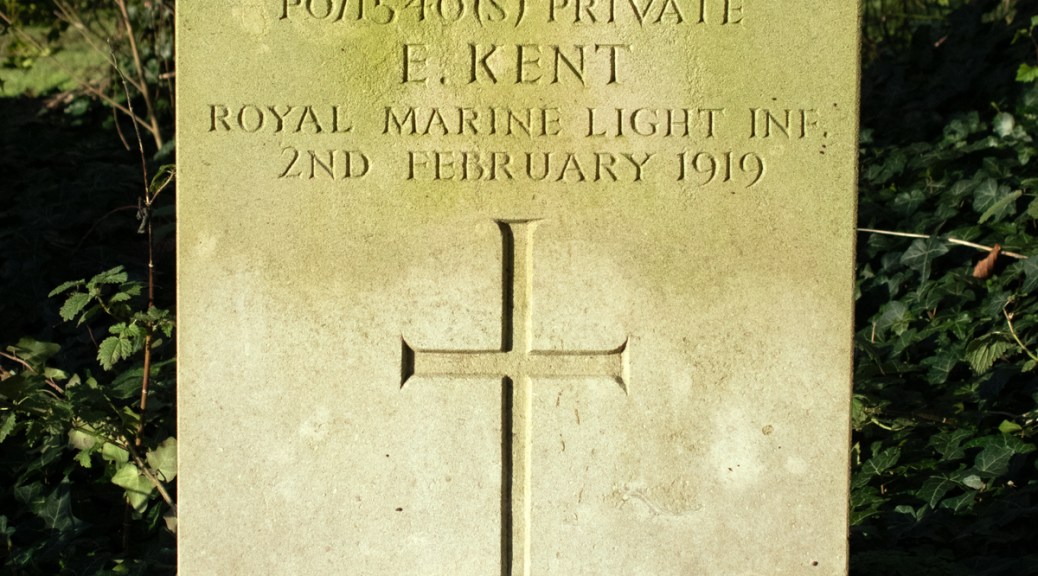
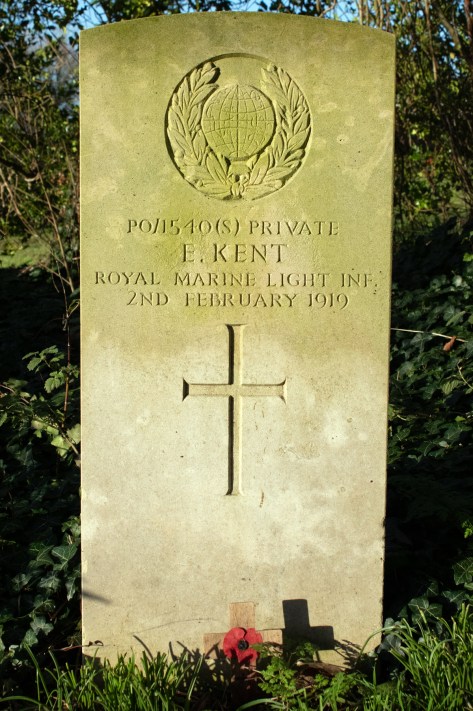
Edward Kent was born in the Berkshire village of Little Coxwell on 8th December 1887. One of fourteen children, his parents were John and Agness Kent. John was a mason’s labourer, and by the time of the 1901 census, the family had relocated to Fisherton de la Mare in Wiltshire.
Edward found work as a general labourer when he completed his schooling, but when war broke out, he was called upon to serve his country. Conscripted in the spring of 1916, he enlisted in the Royal Marine Light Infantry as a Private. His service papers show that he was 5ft 6.5ins (1.69m) tall, with brown hair, brown eyes and a fresh complexion. He was also noted as having a scar on the back of his neck.
Private Kent was sent to Deal, Kent, for his training, but by September 1916, he had moved to Portsmouth, Hampshire. Change was afoot, however, and in November Edward was assigned to the 3rd Battalion and sent to the Aegean, where he would remain for the rest of the conflict.
Edward returned to Portsmouth in January 1919, and was admitted to the Haslar Hospital, suffering from pneumonia. The condition would prove fatal, however, and he passed away on 2nd February 1919: he was 31 years of age.
The body of Edward Kent was taken back to Wiltshire for burial. He was laid to rest in the graveyard of St Nicholas’ Church, Fisherton de la Mere.