Lot Hayward was born in November 1897 in the Somerset village of West Coker. The seventh of eight children, his parents were Walter and Elizabeth Hayward. Walter was a twine maker at a local factory, but when Lot left school – and after Elizabeth died in 1908 – he found work as a farm labourer.
Lot was seeking bigger and better things in life, however, and on 18th August 1913, he enlisted in the Royal Marine Light Infantry. His service records confirm that he was 5ft 6ins (1.67m) tall, had light brown hair, brown eyes and a pale complexion. It also confirms that he lied about his age – giving his year of birth as 1895 in order to be accepted for service.
Private Hayward joined up at the recruitment depot in Deal, Kent, and, after training there, he was sent to Plymouth in Devon, arriving there in June 1914. Over the next couple of years, he moved between Devon and HMS Victory, the Royal Navy Dockyard in Portsmouth, Hampshire.
When war was declared, Lot also served overseas, fighting at Antwerp, Alexandria and in Turkey. While there in the summer of 1916, he fell ill, contracting pulmonary tuberculosis. He returned to Plymouth, and was admitted to the Royal Naval Hospital in the city.
His lung condition meant that Private Hayward could no longer perform his duties as a soldier. He was medically discharged from the navy on 10th June 1916.
Lot returned home, but his condition grew steadily worse. He eventually succumbed to it, passing away on 18th November 1917, at the tender age of just 20.
Lot Hayward was laid to rest in the graveyard of St Martin’s Church in his home village of West Coker. Reunited with his mother, Lot’s father, Walter, was also laid to rest in the family plot when he passed away in 1920.
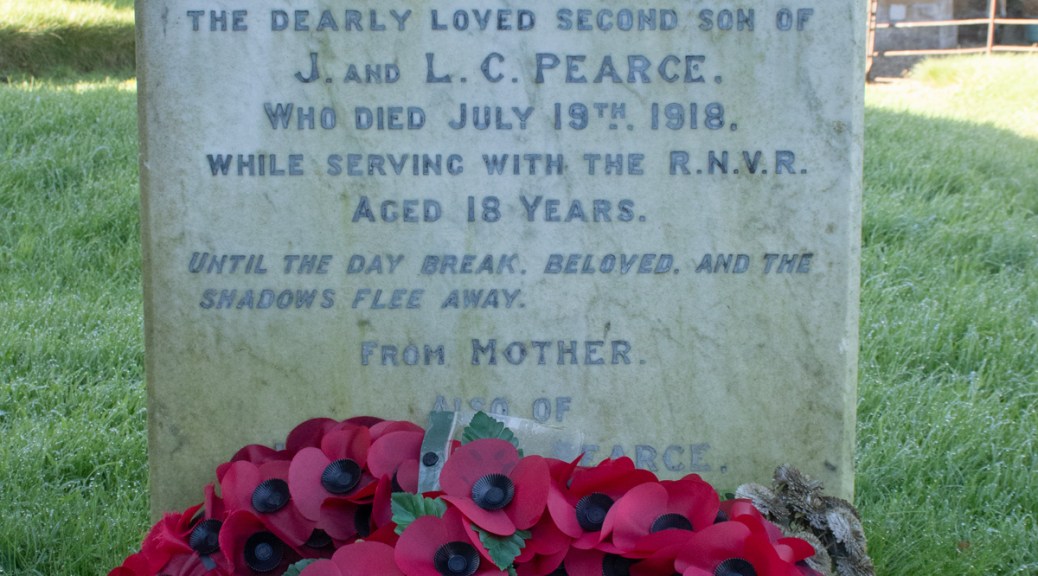
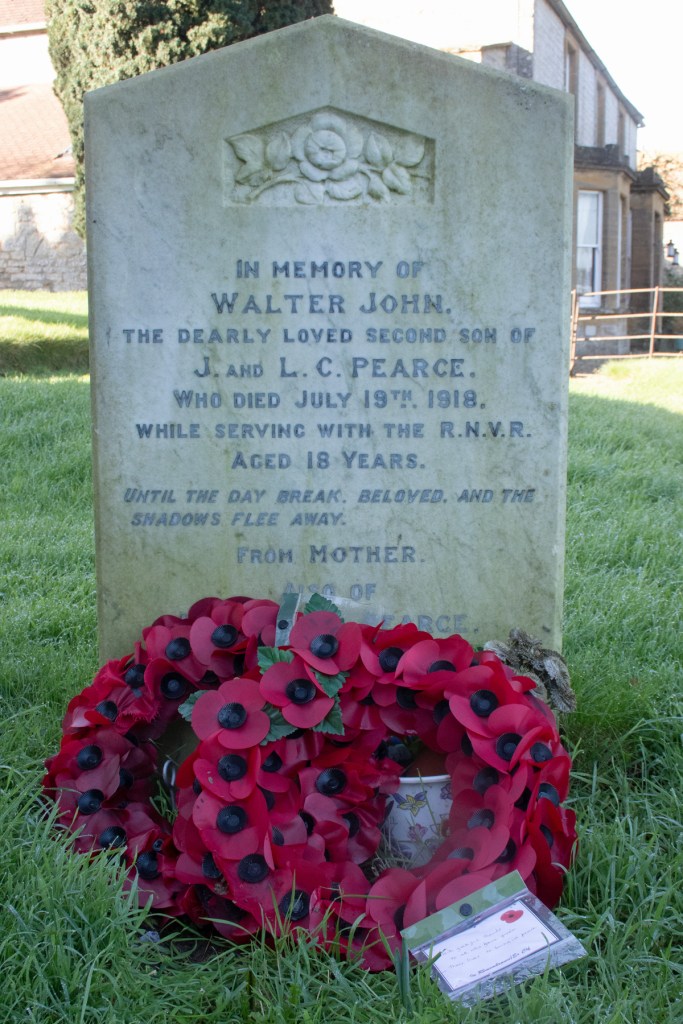
Walter John Pearce was born on 15th June 1900 in Clapton, East London. One of ten children, his parents were James and Lily Pearce. Both were from Somerset, but cowman James went where the work was and they soon moved back to the South West, where he and Lily were from.
When he finished school, Walter found work as an errand boy for a grocer, but war was coming to Europe and, while he was too young when the conflict began, it was clear that he wanted to play his part as soon as he was able.
Walter enlisted in June 1918, joining the Royal Naval Volunteer Reserve. His service records show that he was 5ft 8ins (1.73m) tall, and had brown hair, hazel eyes and a fresh complexion. Ordinary Seaman Pearce was sent to HMS Crystal Palace in South London for training, arriving there on 17th June 1918.
Tragically, Walter’s service was to be short. Being billeted in close proximity to other men and boys from across the country, meant that disease was readily transmitted, and Walter contracted pneumonia. Admitted to the nearby Norwood Cottage Hospital, the lung condition was to prove fatal: Ordinary Seaman Pearce died on 19th July 1918. He was just 18 years of age, and had been in active service for just 33 days.
Walter John Pearce was brought back to Somerset – where his parents were now living – for burial. He was laid to rest in the peaceful graveyard of St Mary’s Church in Mudford.
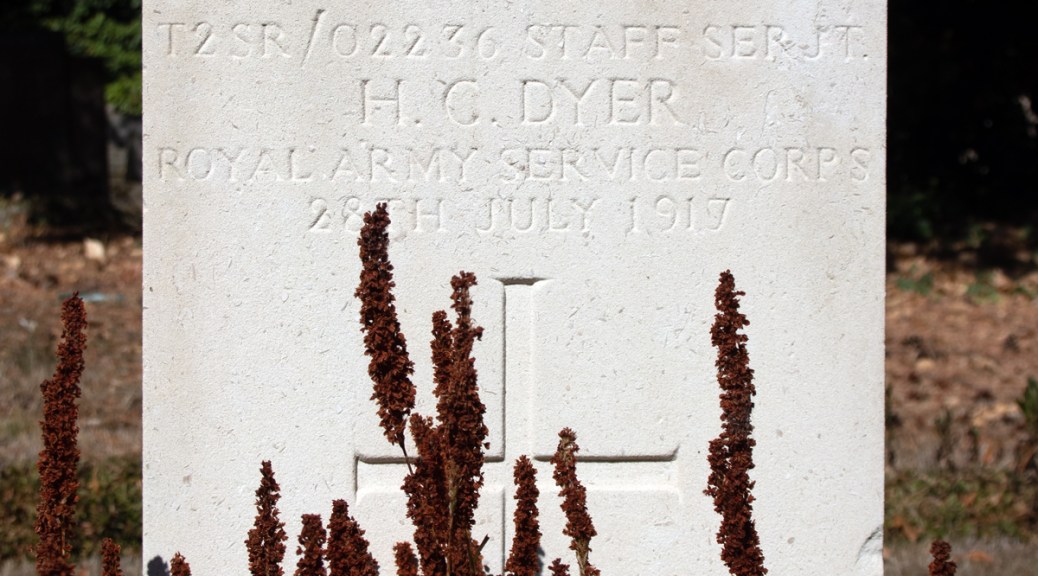
Henry Charles Dyer was born in January 1865 in the Devon town of Ivybridge. The oldest of five children, his parents were carpenter James and dressmaker Mary Dyer. When he left school, Henry found work as a cordwainer’s apprentice but, after James died in 1886, he sought out a career that would help support his mother.
Henry enlisted in the Army Service Corps on 10th July 1886 and, by the time of the next census was based at barracks in Woolwich, South London. His service records note that he was 5ft 4.5ins (1.64m) tall and weighed 124lbs (56.25kg). He had a dark hair, grey eyes and a dark complexion. He was also noted as having a tattoo of a cross on his left forearm.
Private Dyer served in the regiment on home soil for more than thirteen years, qualifying as a horse collar maker and saddler during this time and rising through the ranks. He was made a Driver in 1889, Corporal in 1895 and Staff Sergeant in October 1899.
Trouble was afoot on the other side of the world by this time and his promotion was linked to Henry being sent to South Africa. He was there for eighteen months, and was awarded the Queen’s South Africa Medal, as well as clasps for service at Tugela Heights, the Relief of Ladysmith, Laing’s Nek, Transvaal and Orange Free State.
Staff Sergeant Dyer went back to Britain in April 1901, where he remained for a further six years. On 4th July 1907, reached the end of his term of service and having completed 21 years with the Army Service Corps he returned to civilian life.
Henry moved back to Devon, moving back in with his mother and younger brother. Mary had remarried after James passed, but her second husband had also passed away, and so having two of her sons home would have been of comfort to her. The 1911 census records the family as living in three rooms of a house in Grenville Street, Plymouth. They shared the property with the Smith family, a husband, wife and two children. Henry was recorded as an army pensioner (saddler), while his brother Ernest was listed as being a watchmaker, while also in the army reserve.
War was on the horizon again, and, Henry was one of the first to step up when it was declared. He was 49 years old by this point, and so technically exempt from enlisting, but as an army life had served him well before, it must have seemed fit for him to serve King and Country once more.
Staff Sergeant Dyer’s new service records noted that he was formally employed as a saddler, and that he had put on 18lbs (8kg) since he initially signed up.
Henry was based firmly on home soil this time round, and while he was initially based in Aldershot, Hampshire, he seems to have been moved to barracks in Kent. He served for more than two and a half years, but his health seems to have been suffering by this point. At a medical on 24th July 1917, he was deemed to be no longer fit enough for war service and was discharged from the army.
It is likely that this discharge came while he was admitted to the Preston Hall Military Hospital in Aylesford. While Staff Sergeant Dyer’s earlier military service is fairly detailed, his later career is not. What is clear is that, four days after being discharged, he passed away. He was, by this time, 52 years of age.
A lack of funds may have prevented Mary from bringing her son home to Devon. Instead Henry Charles Dyer was laid to rest in the graveyard of St Peter and St Pauls Church in Aylesford, not far from the Kent hospital in which he passed.
Joseph Leonard Roe was born on 16th February 1892 in Totnes, Devon. The older of two children, his parents were Francis and Mary Roe. Mary died in 1898, when Joseph was only six years old, leaving Francis, who was a traveller for a wholesale grocer, to raise his sons. Tragically, he also passed away in 1902, and it seems that Joseph and his brother were left in the care of their paternal grandmother.
Hope was to come out of adversity – the 1911 census recorded Joseph as boarding in a school in Tiverton, while his brother, who was called Francis, found work as a clerk at a chartered accountant. He was living with his grandmother Mary and aunt Marian in Weston-super-Mare, Somerset.
Joseph followed in his father’s footsteps, finding work as a chemist’s merchant, and this took him travelling across the country. When war broke out, he was living in Wallasey, Merseyside, and it was from here that, on 28th August 1914, he was to enlist.
Joseph’s service records show that he was 5ft 11ins (1.80m) tall, was of good physical development and had good vision. He was accepted for enlistment into The King’s (Liverpool Regiment), and was assigned to the 10th (Scottish) Battalion.
After a coupe of months’ training, Private Roe set sail for France, arriving in Le Havre on 1st November 1914. His time overseas, however, was to be cut short, however, when he contracted a combination of myalgia, bronchitis and diarrhoea. He was medically evacuated back to Britain on 30th November, and given time to recover.
Private Roe remained on home soil for the remainder of his time in the army. However, he continued to suffer with his health. In the spring of 1916, he contracted tuberculosis and was at his grandmother’s home when he passed away on 4th April. He was just 24 years of age.
Joseph Leonard Roe was laid to rest in Totnes Cemetery, buried in the family grave, and reunited with his parents at last.
Francis, meanwhile, had also played an active part on the First World War. He joined the 2nd Battalion of the South Lancashire Regiment and fought on the Western Front.
While at Etaples, he was wounded, and succumbed to his injuries on 7th January 1916, aged just 21 years old. Second Lieutenant Francis Roe was buried at Etaples Military Cemetery in Northern France.
His sacrifice is also commemorated on the family monument in Totnes Cemetery.
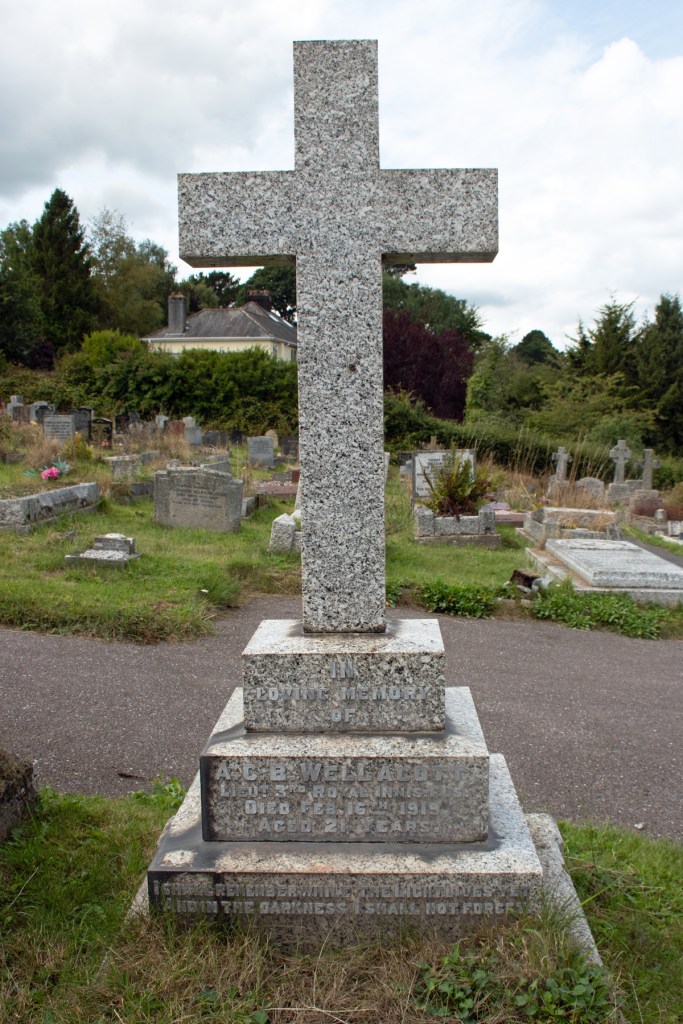
Arthur Cecil Baber Wellacott was born the summer of 1897, in the village of Bradworthy, North Devon. Ond of seven children, his parents were William and Ada Wellacott. William was the parish vicar and with his status came additional support for the family.
The 1901 census saw the vicarage employ three members of staff, and William was hosting two students as well as his and Ada’s own children. Ten years later, with Arthur and his younger brother William, boarding at a school in Bude, Cornwall, the Wellacott retinue remained in place.
On leaving boarding school, Arthur studied at Kelly College in Tavistock and, at around the same time his father took up a new post in Totnes. When Arthur left the college, he joined the 7th (Cyclist) Battalion of the Devonshire Regiment. He was subsequently given a commission in th 3rd Battalion of the Royal Inniskilling Fusiliers, and was based in Londonderry.
At Easter 1916, Lieutenant Wellacott took part in quelling the rebellion in Dublin, and was subsequently sent to France. In the battle for Contalmaison his platoon was gassed and buried, and Arthur was badly injured. Suffering from shell shock, the experience had a lasting impact on him “and from that time his health had given cause for anxiety…” [Western Morning News: Tuesday 18th February 1919]
Lieutenant Wellacott returned to England and he was billeted near Leeds. During the winter of 1918/1919, he contracted pneumonia, and was admitted to the Drax Hospital. Sadly, the condition was to prove too much for his already damaged lungs and he died on 16th February 1919. He was just 21 years of age.
Arthur Cecil Baber Wellacott was brought back to Devon for burial. He was laid to rest in the cemetery in Totnes, Devon.
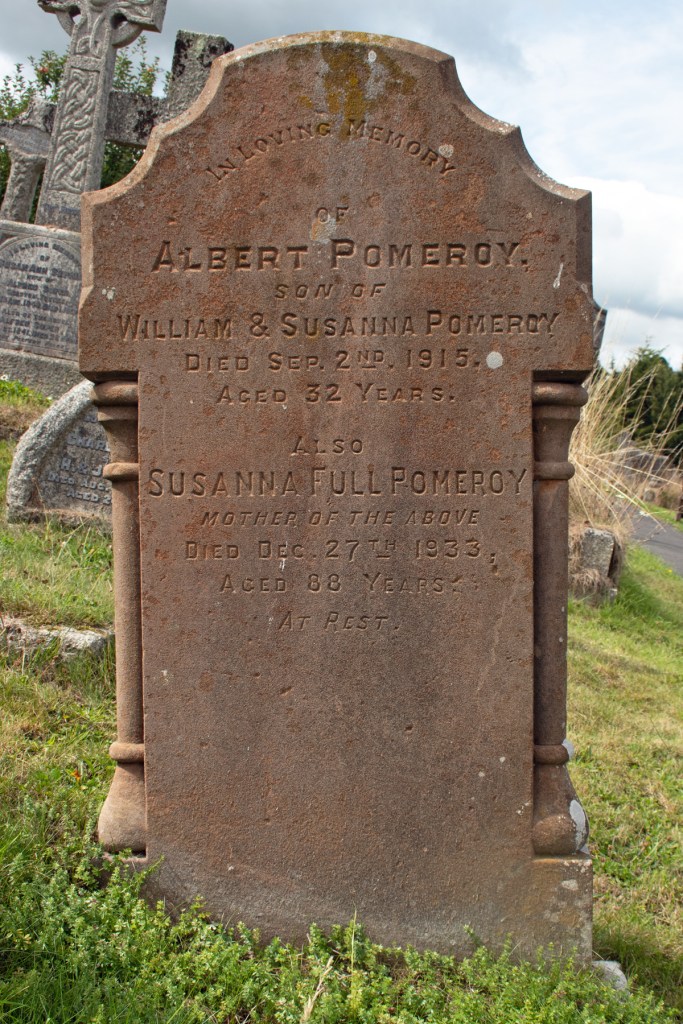
Albert Pomeroy was born on 22nd May 1882 in Totnes, Devon. The tenth of thirteen children, his parents were William and Susanna Pomeroy. William was a labourer at a cider store, and his son found work as a page when he left school. However, it is clear that he lusted after a life of adventure.
On 2nd September 1897, Albert enlisted in the Royal Navy. Aged just 15 years old, he was initially given the rank of Boy 2nd Class, and sent to HMS Impregnable, a training ship based in Devonport. He remained on board for just over a year, rising to Boy 1st Class in the process.
Boy Pomeroy moved to HMS Vivid, the Royal Naval Dockyard in Plymouth, in December 1898, and remained there until he was given his first formal sea-faring post nine months later. The cruiser HMS Terrible was to be his home from September 1899 until the spring of 1902.
On 22nd May 1900, during his time on board Terrible, Albert came of age, and he was formally enrolled into the Royal Navy. His service records confirm that he was 5ft 3in (1.60m) tall, had dark brown hair, grey eyes and a fresh complexion.
Albert was given the rank of Ordinary Seaman, but seems to have been well thought of as, just over a year later he was promoted to Able Seaman. Over the next eleven years, he served on a further ten ships, returning to HMS Vivid between voyages. On 21st May 1912, having completed the twelve years of his naval contract, Able Seaman Pomeroy was formally stood down to reserve status.
Albert’s trail goes cold for a few years. His father had passed away in 1910, so it seems likely that Albert returned home to Totnes to support his mother.
His time on reserve was not to be long, however, and, in August 1914, he was called back into duty. He received a promotion – to Leading Signalman – and assigned to the troop ship HMS Tamar. He moved to another troop ship – HMS Hardinge – in March 1915, but returned to Devonport a couple of months later.
In September, Leading Seaman Pomeroy was back in Totnes, possibly on leave, but had fallen ill. He contracted meningitis, and this was to prove fatal. Albert passed away at his mother’s home on 2nd September 1915, at the age of 33 years old.
Albert… was one of six brothers serving King and country, while another brother, who died some years ago, was in the 20th Hussars, and his late father was a naval pensioner. Albert Pomeroy saw service with Sit Percy Scott in South Africa, went to Pekin [sic] with the Naval Brigade, was engaged in operations in Somaliland, and until a few weeks ago was on active service with the British fleet.
Western Times: Tuesday 7th September 1915
Albert Pomeroy was laid to rest in the cemetery of his home town, Totnes, Devon.
Susanna went on to live into her eighties. Remaining in Totnes, when she passed away, on 27th December 1933, at the age of 88, she was reunited with her son in Totnes Cemetery.
Hugh Punchard was born in February 1895, the oldest of three children to William and Jane Punchard. William was a civil engineer from London, and Hugh was born in Surbiton.
The 1901 census recorded the family living in the 14-room house, Pope’s Garden, in Twickenham. Along with the family, there were four members of staff – a governess, housemaid, cook and a nurse. By the time of the next census, sixteen-year-old Hugh was away at school, boarding with more than 400 others at Haileybury College in Hertfordshire.
War was coming to Europe by this point, and Hugh was keen to play his part. He enlisted in the Royal Navy on 20th October 1914 and, while he was only there for a short period, his records shed some light onto the man he had become. He enlisted as a mechanic, and was noted as being 6ft 4ins (1.93m) tall, with dark brown hair, grey eyes and a fair complexion.
Hugh remained in the Royal Navy for only a month, and, while full details of his service are no longer available, it would seem that it was at this point that he transferred to the Royal Garrison Artillery. He appears to have performed his duties well, and achieved the rank of Lieutenant. He also made another transfer, when he was attached to the Tank Corps.
Lieutenant Punchard was based in Dorset by the last year of the war, and it was while he was serving there that he became unwell. He contracted pneumonia, and was admitted to Wareham Military Hospital. Sadly, the condition was to take his life, and he passed away on 31st October 1918, at the age of just 23 years old.
Hugh Punchard’s paternal grandparents lived in Devon, and, as William had passed away two years earlier, the decision was to lay him to rest in Totnes Cemetery.
Hugh’s will left his estate to his mother, Jane. When he passed, she became the beneficiary of his effects, totally some £3,600 7s 6d (around £250,000 in today’s money).
Jane stayed living in Twickenham: when she passed away on 29th July 1937, she was brought to Devon for burial, and was laid to rest with her son.
A number of documents relating to Hugh give his name as R Hugh Punchard. Sadly, I have not been able to unearth details of what his official first name might have been.
Francis John Henry Willis – who was known as Frank – was born in the summer of 1893 in Totnes, Devon. The youngest of three children, his parents were William Willis – a solicitor’s clerk turned accountant – and Susannah, who was the headmistress of a boarding school.
Education played a strong role in Frank’s upbringing, and, by the time of the 1911 census, he was recorded as being an student of architecture and surveying. (Interestingly, in the same census his older brother, William, was noted as having an infirmity, that of his being “delicate from birth.”)
When he completed his studies, Frank found employment in Newton Abbot, where he worked as an architect for Rowell, Son and Locke. War was coming to Europe, however, and in November 1915, he enlisted in the Royal Engineers.
Frank rose through the ranks, and was given a commission in the Royal Air Force when it was formed in April 1918. Based on Salisbury Plain, the now Second Lieutenant Willis became known as an expert shot, making numerous flights without incident.
On the 20th September 1918, however, that was to change. Taking off on a routine flight, the Avro 504K that he was flying stalled and spun into ground, catching fire. Second Lieutenant Willis was killed instantly. He was just 25 years of age.
Brought back to Devon for burial, Frank John Henry Willis was laid to rest in the cemetery of his home town, Totnes.
William Samuel King was born in the summer of 1880, and was one of four children to Richard and Elizabeth King. Richard was a railway worker from Totnes, Devon, and this is where the family were born and raised.
When he left school, William found work as a house painter, and this is a job he continued to do through to the outbreak of the Great War. On 8th June 1908 he married Minnie Edmunds: the couple went on to have a son, Leslie, who was born in 1912. William and Minnie had, by this point, moved to Swansea, West Glamorgan, presumably as work was more plentiful here than in their Devon home. His work as a decorator seems to have been recognised, and he was admitted to the National Association Partnership, Swansea South.
On 1st December 1915, William enlisted and his service records show that he was 5ft 2ins (1.57m) tall. While it is clear that he spent his time on home soil, his service seems a bit disjointed.
Private King wasn’t formally mobilised until September 1916, when he was assigned to the 2nd/2nd Battalion of the Monmouthshire Regiment. In December he was transferred to the Royal West Kent Regiment before returned to his original battalion in February 1917. A month later, he moved to the Bedfordshire Regiment, before moving to the Middlesex Regiment a few weeks later. This also seems to have been a temporary move as, three weeks later, he was assigned to the 337th Works Company of the Labour Corps (although this was still part of the Middlesex Regiment).
The potential reason behind Private King’s haphazard service seemed to become a little clearer when, in September 1917, he was referred to Fort Pitt Hospital in Rochester, Kent. He was noted as being “very talkative, noisy [and] in a state of mental disease… he has… exalted and grandiose ideas and is difficult to restrain.” His mental health was obviously suffering, and he was discharged from military service in December 1917.
William returned home, although it was not to be for long. He passed away on 13th April 1918, at the age of 37 years old. While no cause of death is evident, it seems likely to have been connected to his ‘mania’, which had been exacerbated by his army service.
William Samuel King was laid to rest in Totnes Cemetery, not far from his parental home.
David Coleman was born in the spring of 1880, one of nine children to Jeremiah and Mary Coleman. Jeremiah was a farmer from County Cork, Ireland, and it was in his home village of Killbrittain that the family were raised.
When David left school, he found work as a labourer and mechanic and, in the spring of 1896, he left Ireland for England in search of a bigger and better life for himself.
Things may not have gone quite to plan, however, and, on 17th March 1897, he enlisted in the Royal Navy. He was too young to enrol for full service at this point, however, and so he took on the rank of Boy 2nd Class. He was initially assigned to the training ship HMS Northampton and quickly made Boy 1st Class.
Over the next year, David served on two vessels – HMS Calliope and HMS Doris. When he turned eighteen, he was officially enrolled in the Royal Navy, and given the rank of Ordinary Seaman.
David remained on HMS Doris for nearly four years, and seemed to impress his superiors. By the end of his time on board, he had been promoted again, reaching the rank of Able Seaman.
Over the next nine years, Able Seaman Coleman served on ten different ships, each time returning to HMS Vivid, the Royal Naval Dockyard in Devonport. In March 1910, with his contract complete, he was stood down to reserve status.
The same year, he married Florence Tompkins, who had been born in Newton Abbot, Devon. The couple set up home in Totnes and went on to have three children. David found work as an electrician for the local electric light works.
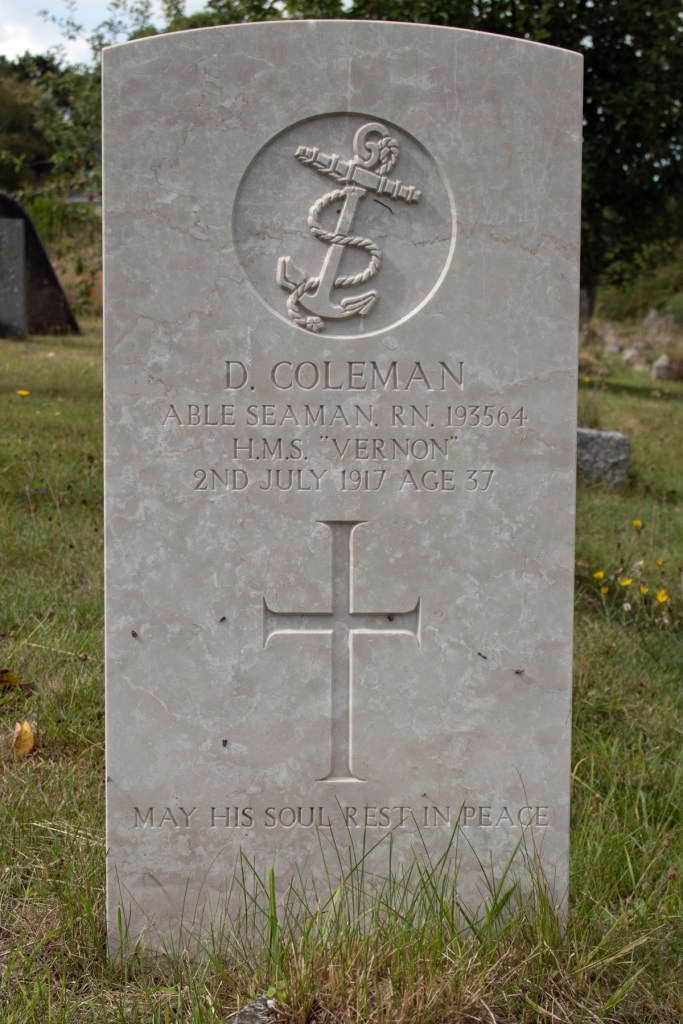
War was coming to Europe by this point and, in August 1914, Able Seaman Coleman was called back to duty. He served for two years on board the battleship HMS Caesar and, having previously been assigned to HMS Defiance, returned there again. In May 1916, he was assigned to HMS Vernon, one of the shore-based establishments in Portsmouth, Hampshire.
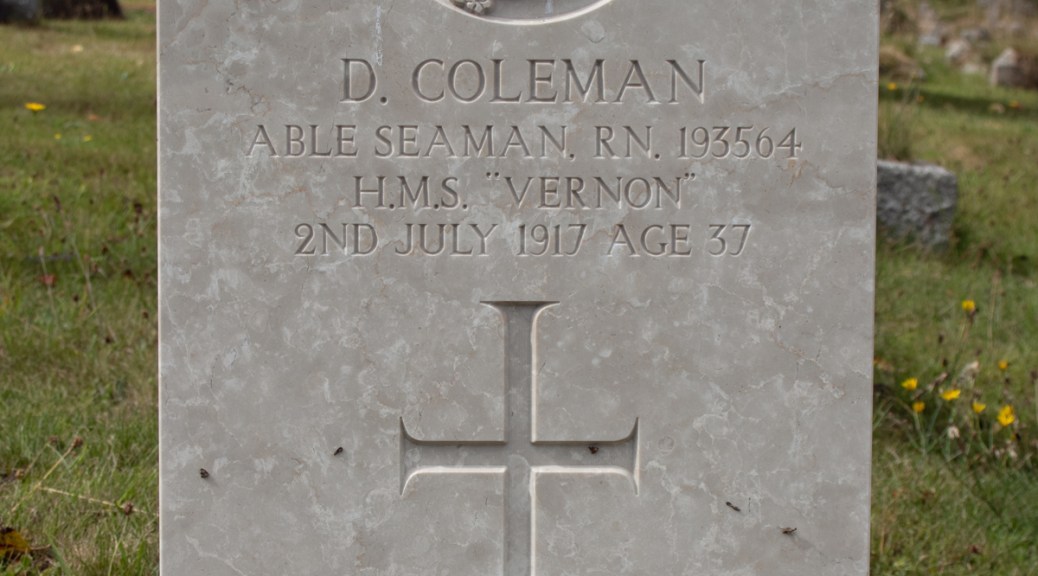
It was while he was in Portsmouth that he fell ill, and was admitted to the town’s Haslar Hospital. Details of his condition are unclear, but he was to succumb to it, passing away on 2nd July 1917, at the age of 37 years old.
David Coleman was brought back to Devon for burial: he was laid to rest in the town’s cemetery, not far from the family home.
Tragedy was to strike the Coleman family again when, early in 1918, both of David and Florence’s younger children – David, aged 5, and Mary, age 2 – passed away. Causes of death are again unclear, but it seems likely to have been one of the lung conditions that would ravage Europe as the war entered its final stage.








 Death and Service