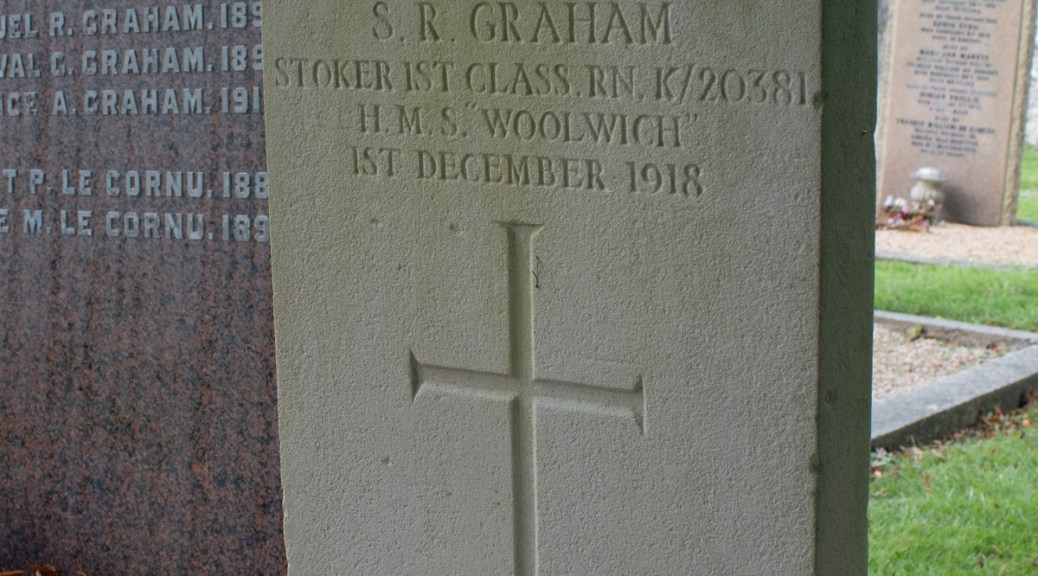
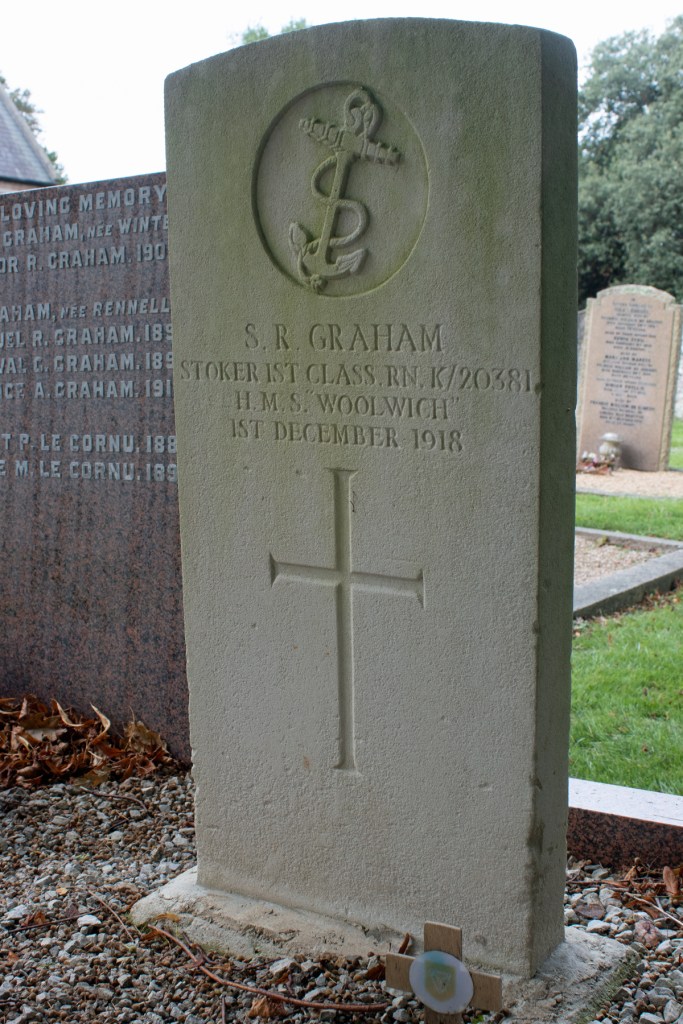
Samuel Robert Graham was born in Cork, Ireland, in 1895. He was one of six children to Samuel and Alice Graham. Samuel was a postman from Liverpool, while Alice had been born in St Helier, Jersey.
Information about Samuel Jr’s early life is scarce: the 1901 census found Alice and the children visiting her mother in Jersey, while he husband is missing from census records. The next return in 1911 recorded Samuel Sr, Alice and three of their children living in the Trinity area of Jersey, but Samuel Jr is missing.
On 9th September 1913, Samuel Jr enlisted in the Royal Navy. He had been working as a blacksmith, and sought a career at sea. His service records show that he was 5ft 5ins (1,65m) tall, with brown hair, hazel eyes and a fresh complexion.
Stoker 2nd Class Graham signed up for a period of twelve years’ service. Based at HMS Victory, the Royal Naval Dockyard in Portsmouth, Hampshire, his first formal posting was on board the cruiser HMS Bristol. He remained on board for nearly two years, and was promoted to Stoker 1st Class in the process.
During the First World War, Samuel served on two more ships and, by the end of the conflict, he was based at HMS Columbine, the naval base at Port Edgar on the Firth of Forth, Scotland. He fell ill while barracked there, and was admitted to the Royal Naval Hospital in nearby Queensferry. Whatever Stoker 1st Class Graham’s condition, it was to prove too severe: he passed away on 1st December 1918, at the age of 23 years old.
Samuel Robert Graham’s body was taken back to Jersey for burial. He was laid to rest in Trinity Churchyard, not far from where his family still lived.
William James Profitt was born on 20th August 1894 in Collingwood, Victoria, Australia. The oldest of ten children, his parents were Cornish-born Francis Profit and his Australian wife Mary.
Little information is available about William’s early life. When he finished his schooling, he found work as a salesman, and this is the work he was doing when war was declared in Europe.
William felt duty bound to serve his King and Empire, and, on 5th July 1915, he enlisted in the Australian Imperial Force. His service records confirm that he was just 5ft 2.5ins (1.59m) tall, weighing 8st 4lbs (52.6kg). He was noted as having cark brown hair, blue eyes and a fresh complexion: he had a scar on his left cheek.
After initial training, Private Profitt arrived in Alexandria, Egypt. He was assigned to the 23rd Battalion of the Australian Infantry and, by 30th March 1916, he was in France. William’s unit was one of the many to become entrenched at the Somme, having been evacuated from Gallipoli just weeks before he had arrived in Europe.
On 2nd August Private Profitt was admitted to a camp hospital in Boulogne with a sprained ankle. The medical report noted the injury as trivial, having occurred when, on ‘being relieved from trenches [he] slipped and fell into an old German dugout.’ By 21st August he was back with his unit, now based in Etaples.
Just a week later, William was sent to a casualty clearing station in Rouen, having been shot in his right elbow. Less trivial an injury this time round, he was medically evacuated to Britain for treatment, and was admitted to the Cambridge Military Hospital in Aldershot, Hampshire.
Private Profitt’s injury should not have been a life-threatening one, but septicaemia set in. His condition worsened, and he passed away on 25th October 1916. He was just 22 years of age.
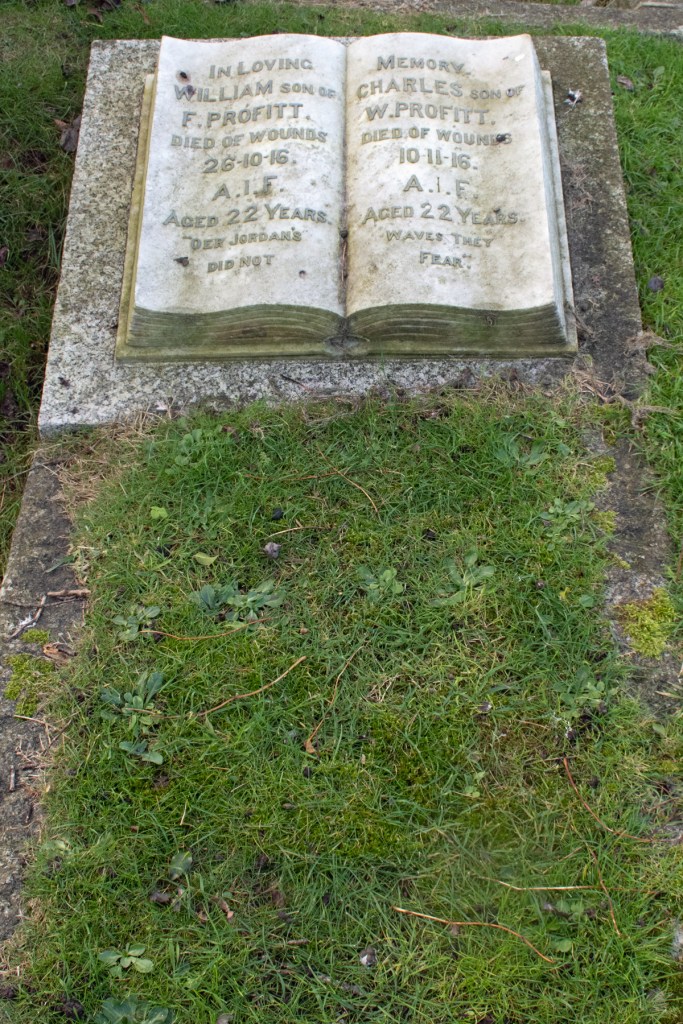
With William James Profitt’s family more than 10,000 miles (17,000km) away, it was not possible to him to be buried at home. Instead, his body was taken to the peaceful and picturesque graveyard of St Michael’s Church in Rock, Cornwall, close to where his father’s family still lived.
Private William Profitt (from findagrave.com)
William’s grave shares a dedication with Charles Profitt, who died just a fortnight after him.
John Walter Charles Profitt – better known as Charles – was born in the summer of 1894 Geelong, Victoria, Australia. The oldest of three sons to William and Harriet Profitt, it is likely that his father was William’s uncle, and that the two siblings had both travelled to Australia to earn their fortunes.
Working as a teacher at the time, Charles enlisted just days after his cousin, joining the 6th Field Ambulance unit. His service records show that he had dark brown hair, grey eyes and a fresh complexion, no dissimilar to William. Standing 5ft 8ins (1.73m) tall and weighing 10st 6lbs (66.2kg), it is clear that his side of the family had markedly different genes.
Private Profitt arrived in France on 27th March 1916, and his dedication to the role showed when he was promoted to the rank of Lance Corporal in August.
On 9th November he was badly wounded while carrying out his duties, receiving a severe gun shot wound to his abdomen. He was admitted to the 1st Anzac Medical Station, but died of his injuries just two days later. He was just 22 years of age.
Lance Corporal Charles Profitt was laid to rest in Heilly Station Cemetery to the south of Méricourt-l’Abbé. He is commemorated with his cousin, William, in St Michael’s Church, Rock.
Lance Corporal Charles Profitt (from findagrave.com)
Charles Leigh Hall and his twin Maud, were born on 3rd April 1878 in Clifton, Gloucestershire. Two of eight children, their parents were Pedro and Anne Hall. Pedro, whose full name was Pedro Henrique Sinclair Hall, was better known as Henry, and was a mathematics tutor and Assistant Master at Clifton College, and it goes without saying that the Hall children had a educated upbringing.
Charles was always to be destined for great things. By the time of the 1901 census, when he was 22 years of age, he was a Lieutenant in the Royal Marines Light Infantry. Based on the cruiser HMS Amphion, he travelled the Pacific and, on the night the return was taken, was moored in Vancouver, Canada.
On 15th June 1910, Charles married Sophia Elinor Veale. Born in Caledon, South Africa, the couple wed in the village of Littleham, Devon. They set up home in Gosport, Hampshire – presumably as the now Captain Hall’s work was based from the docks there – and went on to have two children, Anthony and Nicholas.
By September 1915, Charles had been promoted again, this time to the rank of Major. His wartime service included a lot of work in Africa, including in Cameroon in 1914 – for which he was mentioned in Dispatches – German East Africa (Burundi, Rwanda and Tanzania today) in 1915 and Saadani (Tanzania) in 1916.
In October 1916, he was invalided out of the Royal Marine Light Infantry for reasons that are unclear, and returned to Britain from Simonstown, South Africa. While Charles seems not to have gone to sea any more, his experience was still respected, and, on 15th January 1917, he was promoted to Brigade Major.
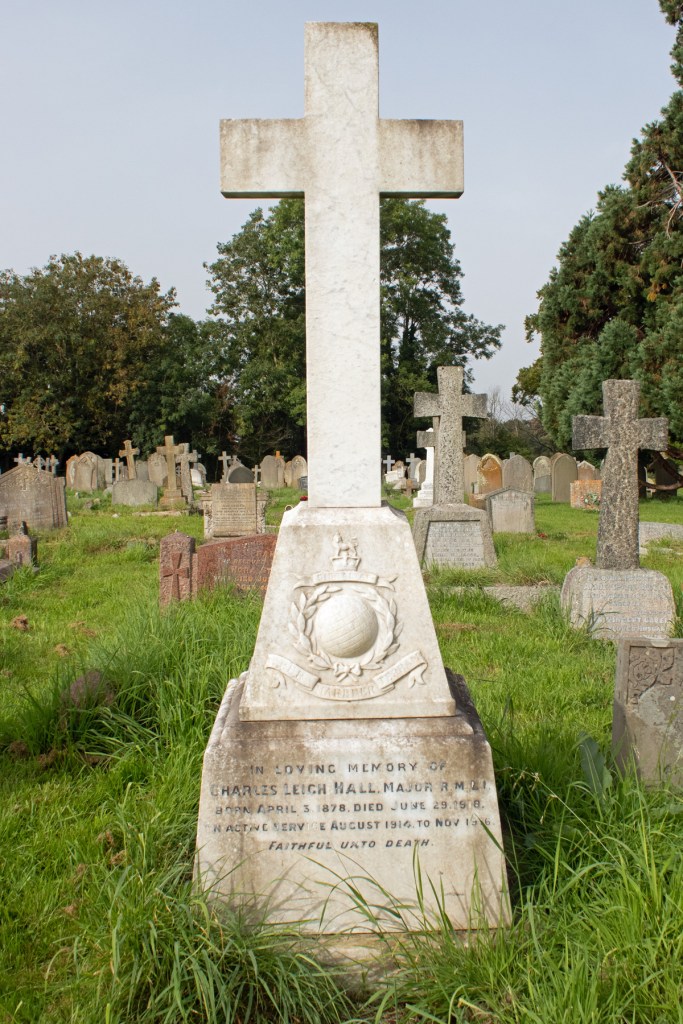
The family settled back down in Portsmouth, Hampshire, and remained there for the next eighteen months. By the summer of 1918, Charles was in Bristol – either based at the docks there, or hospitalised in the city – and passed away on 29th July 1918. He was 40 years of age.
Sophia and her boys were still in Portsmouth, but Charles Leigh Hall was laid to rest in the graveyard of St George’s Church in Easton-in-Gordano, Somerset. The headstone incorrectly gives the month of death as June. Charles’ will divided his estate – £4467 (£318,000 in today’s money) – between his brother, Arthur, and Charles Garnett, a barrister, possibly as a trust for his sons.
Alfred Pollard was born in the spring of 1869 in Hinton Charterhouse, Somerset. His early life seems to have been a little disjointed. The son of Harriett Pollard, who had him out of wedlock, his baptism record gives no details of his father.
The 1871 census found him living with his mother and her widowed father, Thomas Pollard. Ten years later, Harriett is living with her husband, Walter Hayden, and four children, including Alfred – who has also taken the name of Hayden. Thomas is also recorded as living with the family.
Alfred is missing from the 1891 census return. Harriett, however, is now listed as married and the head of the household. She and Walter had a further three children – their youngest, Percy, being just three months old. Times must have been tough for her: the same census recorded Walter as being an inmate of the Somerset and Bath Asylum, where he is listed as being a lunatic.
Harriett died at the start of 1892, aged just 46 years old: Walter died three years later, at the age of 55. Both are buried in the graveyard of St John the Baptist Church, Hinton Charterhouse.
The passing of his mother and the diminishing health of his stepfather seems to have spurred Alfred into building a career to support his siblings. Having been working as an engine driver, on 7th December 1892, he enlisted in the Somerset Light Infantry.
Alfred’s service records give his height as 5ft 7ins (1.7m) and his weight as 137lbs (62kg). He was noted as having black hair, bark eyes and a coarse complexion. He also had a number of tattoos, including a cross on his right forearm; a circle of dots on his right wrist; crossed flags, an anchor and Jubilee 1887 VR and crown on his left forearm; and a bracelet on his left wrist. The records also noted the loss part of the middle finger on his right hand.
Private Pollard quickly became a career soldier. Over 21 years, he rose through the ranks to Lance Corporal (July 1902), Corporal (April 1906), Lance Sergeant (November 1907) and Serjeant (June 1911). He spent more than 14 years in India, and was involved in the Mohmand Campaign of 1897. He was formally discharged on 6th December 1913, having served as a signaller for eleven years, and a Provost Sergeant for three. His discharge papers confirmed his exemplary character, and that he was “thoroughly hardworking, sober and reliable.“
Back on civvy street, Alfred found work as a labourer in an iron foundry. This was not to last long, however, as he stepped up once more when war was declared in the summer of 1914. Joining the Somerset Light Infantry on 12th October, he retook his previous rank of Serjeant.
Alfred served on home soil during this second period in the army. Initially attached to the 3rd (Reserve) Battalion, his unit was based in Devonport, Devon. In September 1916, Sergeant Pollard was transferred to the 2nd Garrison Battalion of the Devonshire Regiment, which was based in nearby Plymouth. In January 1917, he moved again, to the Hampshire Regiment. He spent most of the year with 18th (Home Service) Battalion in Aldershot, Hampshire, and by December had moved to the 3rd (Reserve) Battalion, which was based in Gosport.
Sergeant Pollard remained on active service until the end of February 1919, when he was formally demobbed. At this point, his trail goes cold, although he seems to have settled in Bath, Somerset. He went on to marry, although details of his wife are limited to the name Mrs AE Pollard and her date of birth, 15th March 1879.
Alfred Pollard died of cardiac failure on 7th March 1921: he was 52 years of age. He was laid to rest in the army section of Bath’s Locksbrook Cemetery.
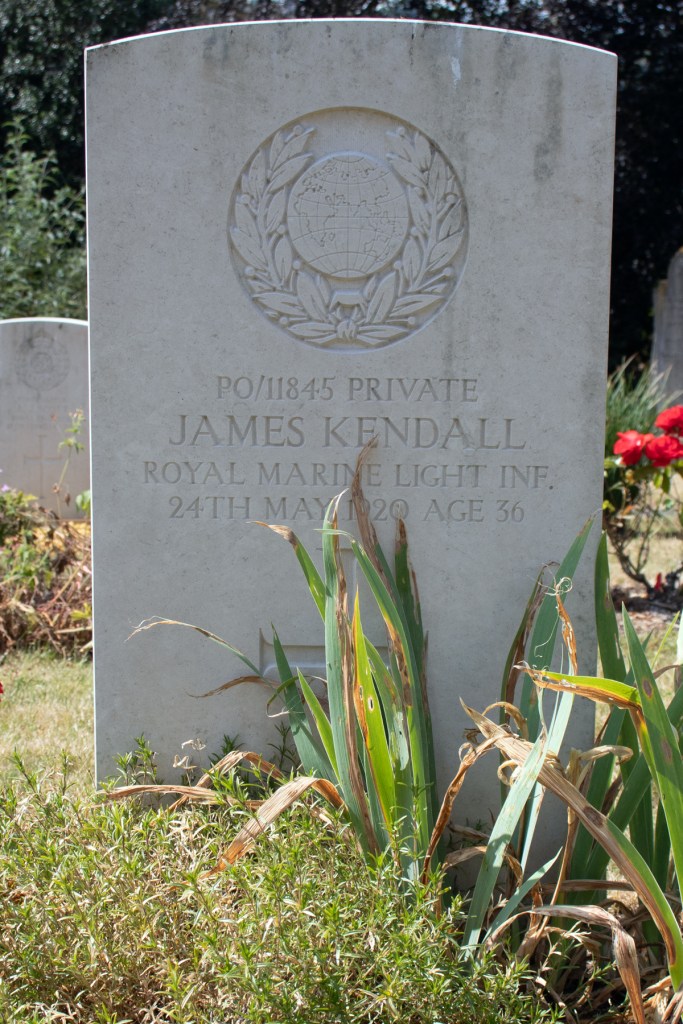
Much of the early life of James Kendall is destined to remain shrouded in the mists of time. Born on 10th June 1883 in Stalbridge, Dorset, his parents are recorded as James Kendall and Anna Louisa Yeatman.
The 1901 census recorded James as being the head of a household, despite being only 17 years old. He was working as an agricultural labourer, and was living with his maternal grandmother, Mary Ann Yeatman, and her daughter, Louisa (the census recorded her as James’ aunt, although she shared a name with his mother).
James sought a proper career, however, and, on 19th July 1901, he enlisted in the Royal Marine Light Infantry. His service records show that he was 5ft 6.5ins (1.69m) tall, with brown eyes, light brown hair and a fresh complexion.
Private Kendall was sent to Deal in Kent for his training: he remained here for nine months, before being transferred to Portsmouth, Hampshire. Over the next twelve years, he served on ten ships – including the HMS Duke of Wellington, HMS Egmont and HMS Renown – returning to the HMS Victory, the Royal Naval Dockyard in Portsmouth, in between each assignment.
James was billeted at HMS Victory when war was declared. During the conflict he remained based in Portsmouth, while being assigned to HMS Cornwall and HMS Birmingham for spells. It seems likely that his shore service helped support new recruits: Private Kendall’s experience would have been invaluable.
In 1915, James married a woman called Edith: there are no other details for her, other than that she his named as his next of kin on his service records.
When the armistice was declared, Private Kendall was serving on HMS President III, a shore base split between Bristol, Windsor and London. He returned to Portsmouth in the summer of 1919 and was formally stood down the following January, having been invalided out of the Royal Marines. He had served for more than eighteen years, and consistently received notices of high levels of character and ability.
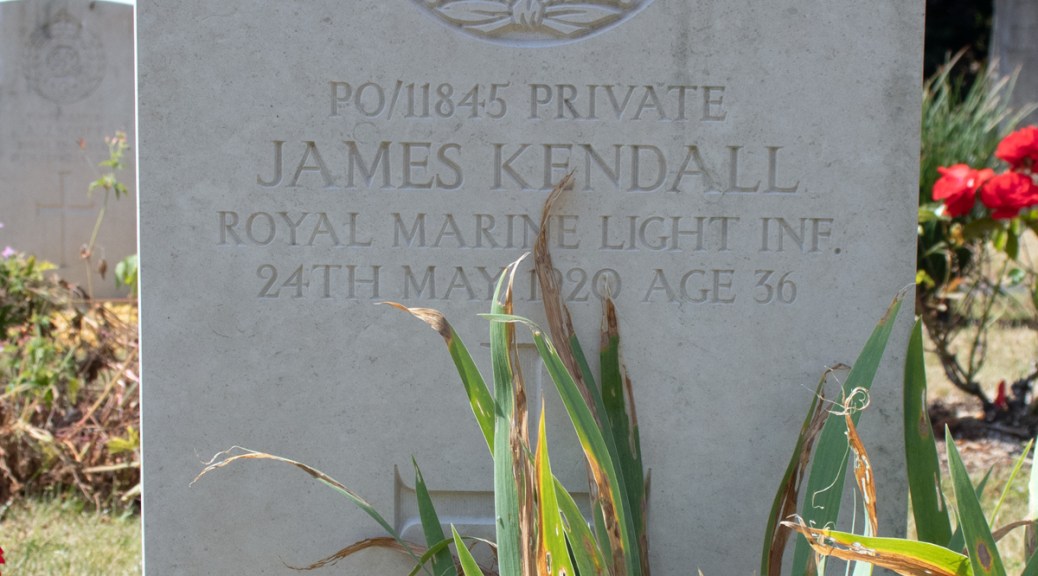
James’ dismissal from service was as a result of an unrecorded illness, likely to be one of the lung conditions prevalent at the time. The next record for him is that of his passing, on 24th May 1920, at Bath War Hospital, Somerset. He was 36 years of age.
James Kendall was laid to rest in the city’s Locksbrook Cemetery. He was interred in the military section on the graveyard, often reserved for those servicemen whose families were unable to afford to bring their loved ones home.
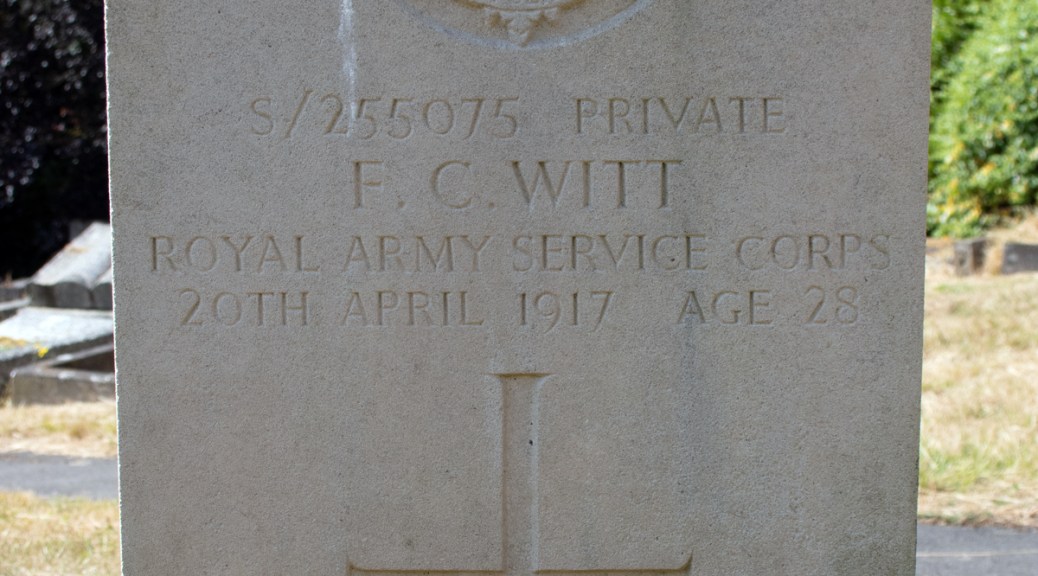
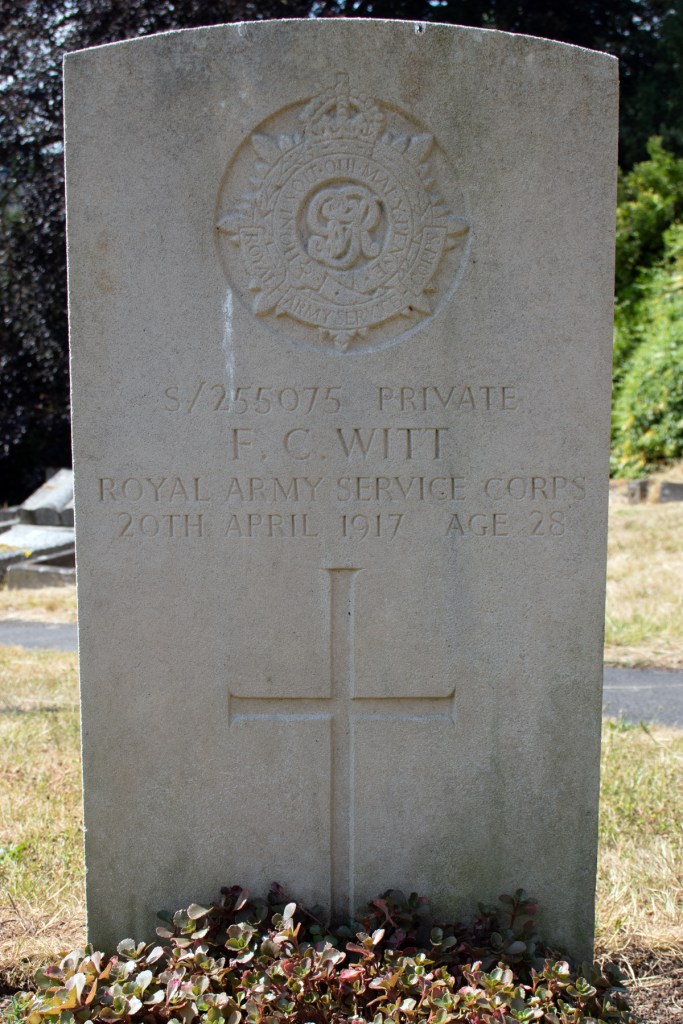
Frederick Charles Witt was born on 19th June 1888 in Amesbury, Wiltshire. The second youngest of eight children, his parents were journeyman baker Richard Witt and his wife, Elizabeth.
By the time of the 1901 census, Richard had set up a bakery in North Tidworth, ten miles north-east of Amesbury, with Frederick’s older brother, Alfred, helping out. This was a line of work that Frederick was also to go into when he completed his schooling: the next census return, in 1911, noted him as being his father’s assistant.
On 26th December 1912, Frederick married a woman called Kate Howard. The marriage took place at St Luke’s Church, Enfield, Middlesex. Kate was living in Enfield at the time, while hew new husband was based in Southampton, Hampshire. How a connection was made between the two is unclear, but the couple settled back in Southampton, and went on to have two children: Ivy and Doris.
When war was declared, Frederick was called upon to play his part. Full details of his service are unclear, but he had joined the Royal Army Service Corps by the start of 1917. Private Witt was attached to the Reserve Supply Personal Depot in Bath, Somerset, but, soon after enlisting, he contracted pneumonia.
Frederick was admitted to the Bath War Hospital in April 1917, but the condition was to prove too severe. He passed away on 20th April, at the age of 28 years old.
Frederick Charles Witt was laid to rest in Bath’s sweeping Locksbrook Cemetery. Interestingly, a newspaper report of his funeral did not mention the attendance – or existence – of Kate or their children; instead his parents seemed to take centre stage.
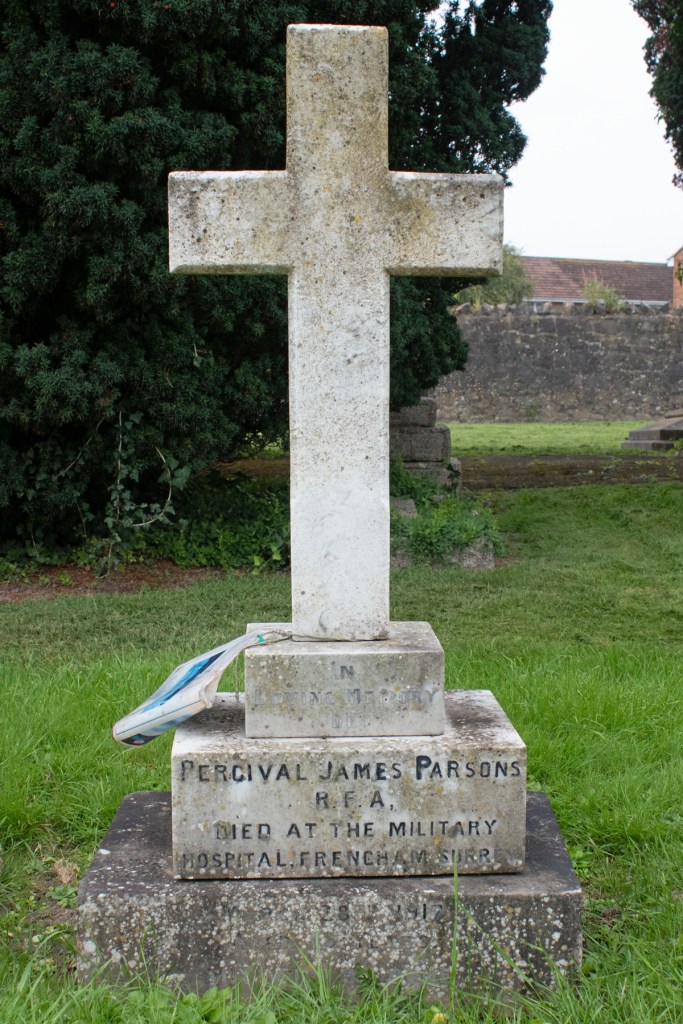
Percival James Parsons was born in the summer of 1898, and was the fourth of eight children to Henry and Emily. Henry was a railway labourer from Chilton Burtle, Somerset, and it was in the neighbouring hamlet of Chilton on Polden (now Chilton Polden) that the family were born and raised.
There is little documented about Percival’s short life. When war came to Europe, he was just 16 years of age. He was keen to play his part, however, probably spurred on by seeing his older brothers or friends step up.
Percival enlisted as soon as he turned 18 years old. He joined the Royal Field Artillery and was sent to Hampshire for training. Gunner Parsons was attached to E Battery of the 7th (Reserve) Brigade, a unit based ultimately in India during the confluct.
Gunner Parsons, however, was not to see service abroad. While he was training, he became unwell, contracting pneumonia. Admitted to the Frensham Hill Military Hospital, he was to succumb to the condition, passing away on 28th March 1917. He was just 18 years of age.
Percival James Parsons’ family had moved to Highbridge by this point, and it was here that Henry and Emily’s boy was taken for burial. He was laid to rest in the town’s cemetery.
Henry Gibbs was born in Wiveliscombe, Somerset at the start of 1871. The youngest of five children, he was the second son to John and Emma Gibbs. John was a farm labourer, but when he finished his schooling, Henry went in a different direction.
By the time of the 1891 census, Henry was boarding with his sister Lucy and her husband and young son. The extended family were living in Taunton, Somerset, where Henry was employed as a boot and shoemaker. This appears not to have satisfied him, however, and he soon found other work, enlisting in the Royal Field Artillery. While his army records are lost to time, he seems to have spent twelve years in service.
By the early 1900s Henry living back in Somerset, settling in Bishops Lydeard, to the west of Taunton. On 2nd May 1906, he married a young woman called Florence Gange. Fifteen years his junior – she was 20 years old to her husband’s 35, even though the marriage certificate gave his age as 30 – she a labourer’s daughter from the village, who was working at the Lethbridge Arms public house at the time of their marriage. The couple set up home in a small cottage, and went on to have four children: Ernest, Florence, Mabel and Arthur.
Henry’s work seems to have been transient. On his marriage certificate, he was noted as being a groom, but the next census return, taken in 1911, gave his employment as a labourer for a corn miller.
When war came to European shores, despite his growing family, Henry felt the pull to serve once more. He enlisted in the Royal Army Service Corps in the summer of 1915, with the rank of Driver. As with his previous time in the army, details are scarce, but Henry seems to have been based in Aldershot, Hampshire, or at least this is where he was based towards the end of the conflict.
Driver Gibbs had become unwell by this point, and he was suffering from oesophageal cancer. He was admitted to the military hospital in Farnham Hill, but was to succumb to the condition. He passed away on 1st September 1918, at the age of 47 years of age.
Henry Gibbs was brought back to Somerset for burial. He was laid to rest in the quiet graveyard of St Mary’s Church in his adopted home village, Bishops Lydeard.
Herbert Griffith was born in the summer of 1883 in the Somerset village of Crowcombe. One of eight children, his parents were coachman James Griffith and his wife, Selina.
Herbert’s early life is a challenge to piece together. The 1901 census recorded him as living at Weacombe House, West Quantoxhead, where he was employed as a footman.
On 16th December 1909, Herbert married Selina May Davies. Also born in Crowcombe, she was the daughter of a tailor. The couple’s marriage certificate confirms the wedding was conducted at the village church. The couple went on to have two children, Dorothy in 1912, and Geoffrey four years later.
Herbert, at this point, was living in Farnborough, Warwickshire, where he was employed as a valet. (While no document remains to confirm this, it seems possible that this was actually Farnborough Hall, home to generations of the Holbech family.)
When war broke out, Herbert seemed keen to serve his country. He enlisted in the Royal Army Medical Corps, although his full service records no longer remain, so it is not possible to confirm whether he served on home soil or overseas.
The next record relating to Private Griffith is that of his passing. He died in Southampton, Hampshire, on 22nd February 1916, as a result of a combination of bronchitis, asthma and cardiac failure. He was 32 years of age, and would never get to meet his son, who was born two weeks later.
The body of Herbert Griffith was taken back to Somerset for burial. He was laid to rest in the peaceful surroundings of the Church of the Holy Ghost in his home village, Crowcombe.
George Bartraham was born in the autumn of 1868 in the Somerset village of Sampford Brett. One of seven children, his parents were George and Sarah Bartraham. George Sr was a farm labourer and, while his son initially followed suit, he sought a life of adventure in the wilder world.
George Jr had found work as a tailor, and was apprenticed to a Charles Taylor, who lived in the village. That bigger and better life was niggling away, however, and, on 11th June 1888, he enlisted in the Royal Engineers. His service records show that he was 5ft 5.5ins (1.66m) tall, with black hair, dark eyes and a fair complexion. Sapper Bartraham was also noted as having a scar on his left foot.
George initially signed up for seven years’ service, with an additional 5 years on reserve status once that was completed. The 1891 census recorded him as being based at Fort Blockhorse in Alverstoke, Hampshire. Early in 1894, he married Mary Bowden, in Portsmouth: the couple would go on to have two children, George and Albert. The following year, Sapper Bartraham opted to remain on full service with the Royal Engineers, partially, it is fair to assume, as the pay would be better to support his family than on reserve.
By 1901, George had been moved to barracks in Pembroke Docks, Wales. Mary and the children remained in Hampshire, living with her parents in Unicorn Street, close to the town’s naval base. Wales was not to be the last stop for George, however, and in October 1902, he was sent to Ceylon, where he remained for the next three years.
During his time in the army, George did not sit on his laurels. He received a certificate as a master tailor, became skilled in submarine mining, and also received a qualification in signalling. He was promoted to Lance Corporal in 1899, and full Corporal four years later.
George returned to Britain in January 1906, and seems to have returned to a base in Hampshire. It was here, on 28th December 1908, that an altercation led to him being convicted of assault. He was charged with ‘unlawfully and maliciously wounding one Albert Edward Bartraham, by stabbing him with a pair of scissors, at Aldershot… and counts for assault occasioning actual bodily harm and common assault’ [Calendar of Prisoners, 1868-1929]
Albert was George’s older brother, and he was convicted to six months’ hard labour for the assault. Corporal Bartraham returned to base on 6th June 1909, and was discharged a few days later, having completed 21 years’ service in the Royal Engineers.
The next census record, taken in 1911, found a family divided by work or circumstance. Mary and the children remained firmly ensconced in Portsmouth with her parents, while George was living in Aldershot, where he was employed as a tailor. His employer is noted as being the Government, so it seems likely that he was still connected to the army camp there.
When war came to Europe, George was called upon to play his part once more. Promoted to the rank of Serjeant, he was attached to the 136th Fortress Company of the Royal Engineers. He arrived in Egypt in June 1915, although it is unclear how long he remained overseas.
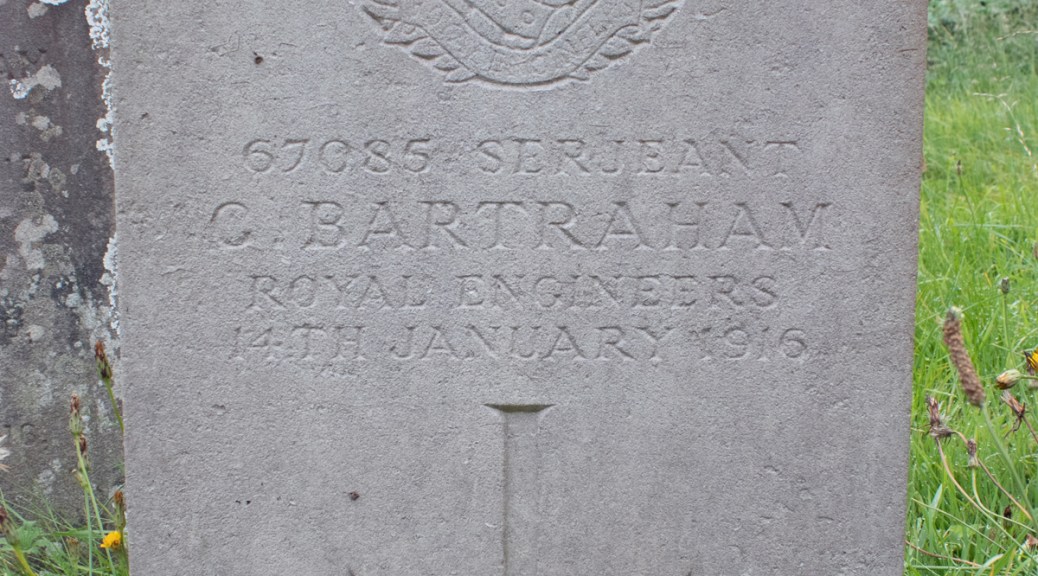
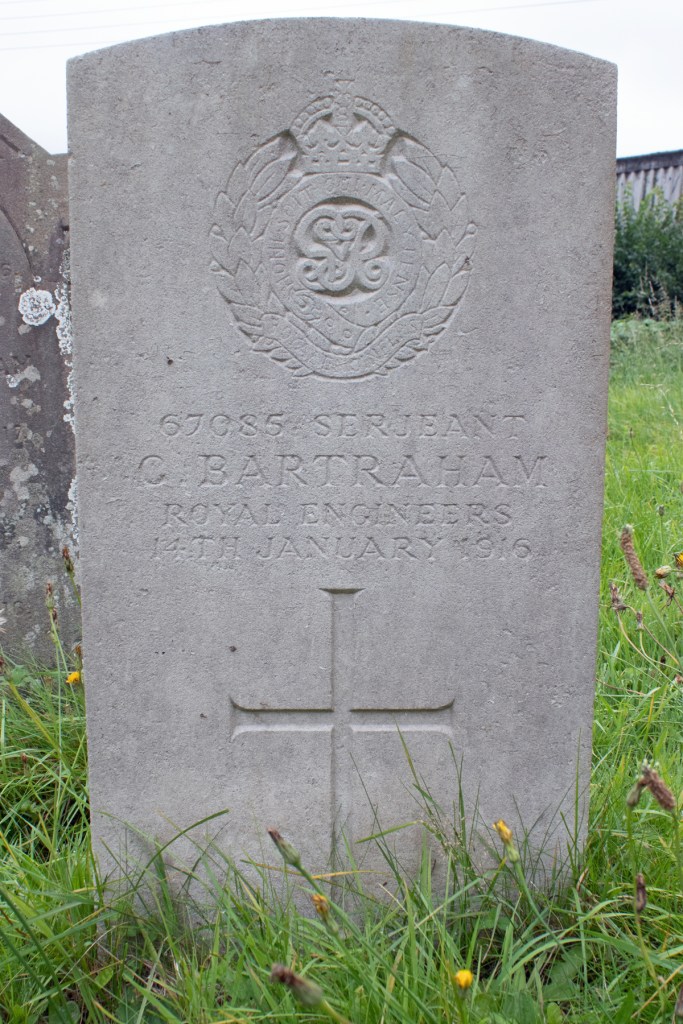
By the start of 1916, Serjeant Bartraham was back in Britain, primarily because of ill health. He had come down with nephritis, or inflamed kidneys. Admitted to hospital in South London, he died from the condition on 14th January 1916, at the age of 47 years old.
Brought back to Somerset, George Bartraham was laid to rest in the peaceful graveyard of St George’s Church in the village of his birth, Sampford Brett.
This was a time of tragedy for the Bartraham family.
George’s father, George, had died around the same time as his son, and was buried near him.
George and Mary’s son, George, had enlisted in the Hampshire Regiment when war was declared and, by the summer of 1916, was based in Iraq. He died on 23rd September 1916, through causes unclear, and was laid to rest in Baghdad War Cemetery.
Three generations of Bartrahams, all called George, had passed away within nine months.
In the summer of 1917, Sarah Bartraham also passed away. She was laid to rest with her husband and son in St George’s Churchyard.







 Death and Service