Little concrete documentation remains about the life of William Henry Jackson. He was born in Bedford, Bedfordshire, on 6th February 1872, although it is not possible to identify who his parents were.
He married a woman called Edith in 1903, and the couple settled in her home town of Beeston, Nottinghamshire. By the time of the 1911 census, he was recorded working as an electrician’s labourer at the local telephone works, while Edith, who was five years his senior, earned extra money as a blouse finisher.
Information about William’s wartime efforts are also limited. He enlisted in the Royal Marine Light Infantry, and was assigned to the Chatham Division. He was given the rank of Private and based at the Royal Naval Dockyard in the Kent town.
The only other information available for Private Jackson is that he died on 16th September 1916, having contracted a combination of pneumonia and tuberculosis. He was 44 years of age.
William Henry Jackson was laid to rest in Woodlands Cemetery, Gillingham, not far from the dockyard in which he had served. His headstone gives the initial H, rather than W, although no documents suggest he went by any name other than William.
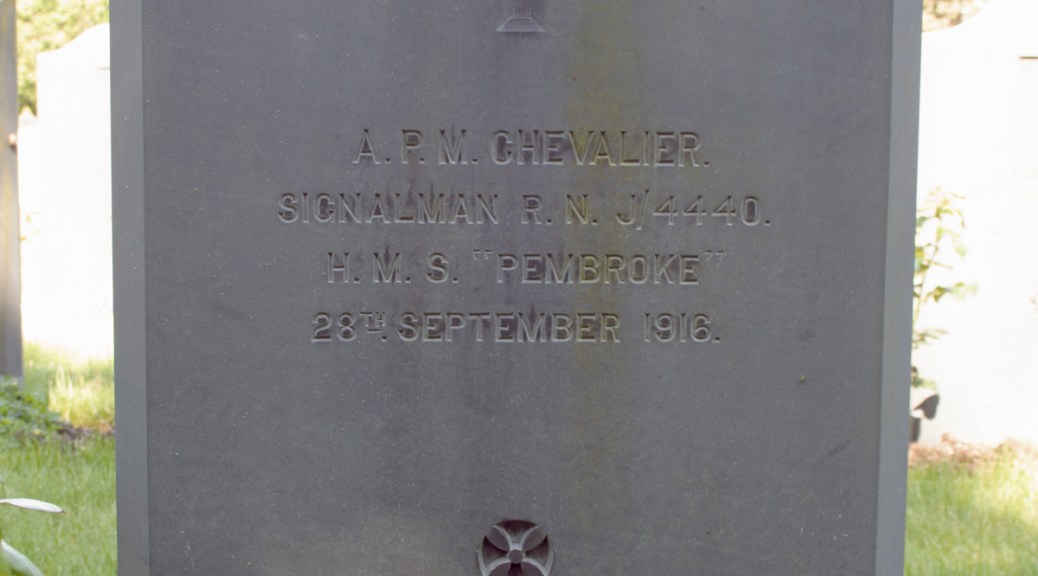
Albert Patrick Michael Chevalier was born in India on 16th June 1893. There is little definitive information about his early life, although his mother was called Georgina, and the family may have moved back to England when Albert was just a child.
When he left school, Albert found work as an errand boy in an office. But he wanted bigger and better things and, on 4th May 1909, aged just fifteen years old, he enlisted in the Royal Navy. Because of his age, he was given the rank of Boy 2nd Class, and for the first eighteen months, he was assigned to training bases – HMS Ganges and HMS Impregnable.
After only a few months, Albert was promoted to Boy 1st Class and, after a month at HMS Pembroke – the Royal Naval Dockyard in Chatham, Kent – he was given his first sea-going appointment on board the cruiser HMS Minerva.
Albert spent eighteen months on Minerva, during which time he came of age. He seems to have had an understanding of basic technology, as he was given the rank of Ordinary Signalman. After some more time in Chatham, Albert went to sea again, this time on board another cruiser, HMS Cressy. At the start of 1913 he was promoted again, and given the rank of full Signalman.
Signalman Chevalier went on to serve on a number of different vessels, primarily the battleship HMS Swiftsure, where he served for nearly three years, plying the waters between Britain and India. By the spring of 1916 he was back in Chatham, however, and it was here that things took a turn for the worse.
Albert was admitted to the Royal Naval Hospital in the town, suffering from pleurisy. Sadly, the condition was to get the better of him and he passed away the hospital on 28th September 1916, at the age of just 23 years of age.
Albert Patrick Michael Chevalier’s body was laid to rest in Woodlands Cemetery, Gillingham, not far from the dockyard from which he had made so many of his voyages.
Albert’s mother Georgina had not settled in England for long. The army pension record gives her as Albert’s beneficiary, but notes her address as Victoria Street, Daylesford, Victoria, Australia.
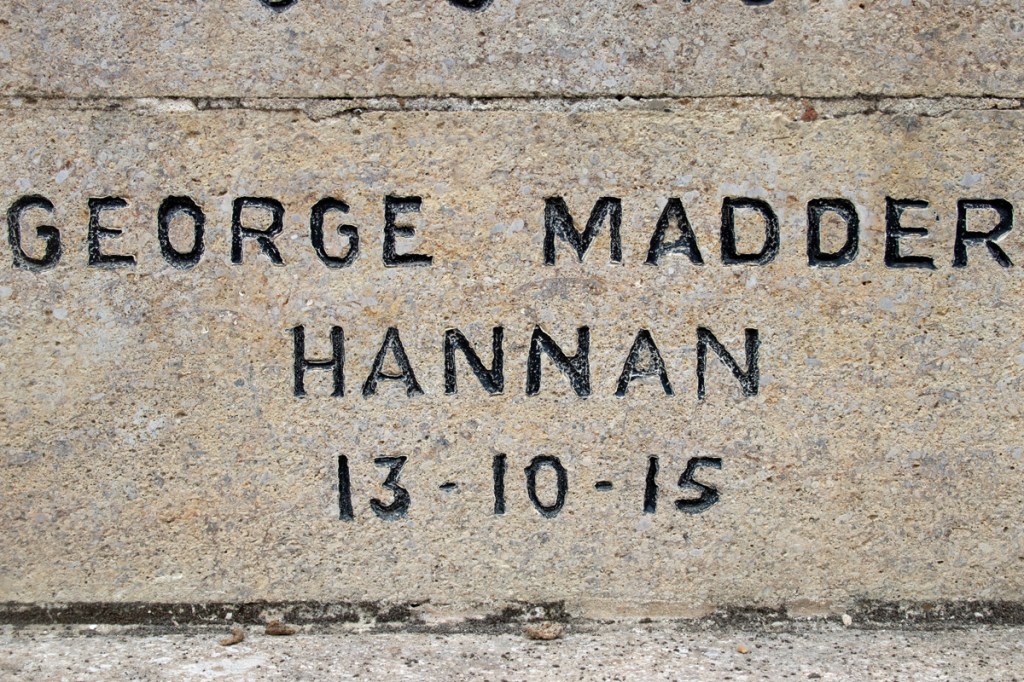
George Madder Hannan was born in Dublin in 1861, the son of banker Benjamin Hannan. There is little concrete information about his early life, but what can be pieced together produces the story of a well-travelled man.
On 22nd January 1896, George was initiated into the Lodge of Otago, a freemason’s collective in Dunedin, New Zealand. He is listed as being a Master Mariner.
George’s marriage certificate records that he wed Mary Carlisle on 27th October 1898. The wedding took place at St Jude’s Church in Kensington, London, and the groom was listed as a Gentleman. Mary was the daughter of a paper manufacturer, and had been born in Lancashire.
The next document for George is the 1911 census. This notes that he ad Mary were still living in Kensington, along with their only child – daughter Grace, who had been born in 1900 – and two servants. This time he is listed as being an army major, a special reserve officer.
Moving forward a few years, the next record for George is the notice of his funeral, in October 1915:
We regret to announce the death of Major Madder-Hannan, which occurred at May Bank on Wednesday morning. Major Madder-Hannan, who had only resided in the village [of Bearsted, Kent] for the past few months, held his commission in the 9th Service Battalion Cameronians. He had been an invalid since taking up his residence here.
Kent Messenger & Gravesend Telegraph: Saturday 16th October 1915
Sadly, no documentation remains about George’s time with the Cameronians. He passed away, presumably through illness, on 13th October 1915, at the age of 54 years of age.
Unusually, given the main family home was in Kensington, George Madder Hannan was buried in the village where he died. He was laid to rest in Holy Cross Churchyard, Bearsted.
Thomas David William Denny was born on 26th December 1890 in Glasgow, Lanarkshire. There is little information on his early life, other than that his parents were Thomas and Annie Denny.
By the time of the 1911 census, Thomas Jr was serving as a Lance Corporal in the 2nd Battalion of the Gloucestershire Regiment, and was based at the Verdola Barracks in Malta.
When war broke out, the battalion was called back to mainland Europe. By 19th December 1914, Thomas found himself in France; two years later, he was in Salonika, Greece.
Thomas’ bravery was not in doubt. While serving in France, he received the Military Medal for conspicuous gallantry. This went hand in hand with a promotion to Sergeant. In 1917, he received a commission as Second Lieutenant and was moved to the regiment’s 3rd Battalion.
In the spring of 1918, Second Lieutenant Denny married Elsie, a woman from Bearsted, near Maidstone in Kent. Sadly, little else is known of her, and even a later newspaper report only referred to her as “a Bearsted lady” [East Kent Gazette: Saturday 15th March 1919].
By early 1919, Thomas was back in Britain. Whether he had been demobbed is unclear, but is seems more likely that he had returned home for medical treatment. On 6th March, he passed away in Maidstone. He was just 28 years of age.
Thomas David William Denny was laid to rest in the graveyard of Holy Cross Church in Bearsted close to where the now-widowed Elsie must have lived.
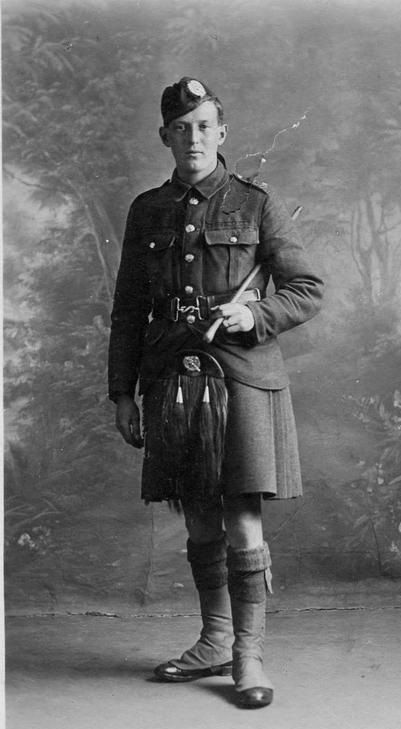
Thomas Merrall Rice was born on 4th January 1894, one of thirteen children to William and Martha. William was from Northamptonshire, but it was in Bearsted, near Martha’s home town of Maidstone, where the couple raised their family.
Little detail of Thomas’ early life remains. What is clear is that, by the summer of 1916, he was living in Plumstead, South East London and was working as a valet. He had met Annie Jane Rix by this point, and the couple married on 17th June 1916 at All Saints Church in Plumstead.
Thomas was called up for military duty not long after this and, on 1st November 1916, he enlisted in the 14th Battalion of the London Regiment, also known as the London Scottish. His service records show very specifically (although seemingly incorrectly) that he was 25 years and 300 days old. It was also noted that he stood 5ft 5.5ins (1.64m) tall and was, by this time, employed as an explosives worker at Woolwich Arsenal.
After his initial training, Private Rice was sent to France at the end of May 1917. His service overseas was not to be a long one, as, within a couple of months, his battalion had been the victims of a gas attack. Thomas was admitted to a field hospital but quickly developed pleurisy and tuberculosis, and was medically evacuated back to Britain in August, and discharged from the army as no longer fit for active duty just a couple of months later.
His failing health meant that Thomas was not able to actively work, and it seems that he had moved out of London and back to his family’s home on the outskirts of Maidstone. It is unclear whether Annie went with him, but, as they had a son, Albert, who had been born shortly before he was sent to France, it seems likely that they would have moved as a family unit.
William, Thomas’ father, died in the summer of 1919, and was laid to rest in the graveyard of Holy Cross Church, Bearsted. Sadly, Thomas was to follow him, passing away on 15th January 1920, a victim of the lung conditions that had dogged him since France. He had just turned 26 years of age.
Thomas Merrall Rice was laid to rest alongside his father in the quiet Holy Cross Churchyard.
Albert Septamus Smith was born in Maidstone, Kent, on 12th January 1881. The oldest of three children to George and Frances Ditcher, he may has been born before the couple married, and seems to have retained his mother’s maiden name throughout his life.
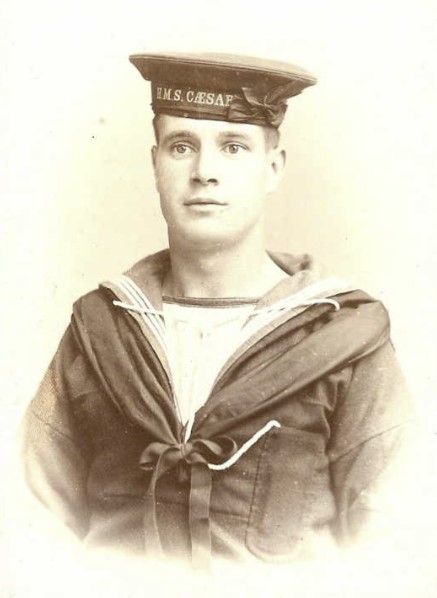
When he left school, Albert sought a life at sea, joining the Royal Navy as a Boy 2nd Class on 12th January 1898, when he was just fifteen. Albert’s naval career was a long and varied one which began on board HMS Impregnable, a training ship. After a month’s training, he was assigned to HMS Lion, where he spent more than a year, gaining a promotion to Boy 1st Class in the process.
In October 1897, Albert transferred to HMS Pembroke, the Royal Naval Dockyard in Chatham, Kent. In the four months that he spent on shore, he turned seventeen and, as a result, came of legal age to formally be enlisted in the navy. Ordinary Seaman Smith signed up for a period of twelve years, and his service records showed that he was 5ft 8ins (1.73m) tall, had brown hair, brown eyes and a dark complexion. He was also noted to have a scar on his right wrist, and a tattoo of a flower and bracelet on the same wrist.
Ordinary Seaman Smith was dedicated to his career. Over the next twelve years he served on board nine different vessels, and rose through the ranks, gaining promotion to Able Seaman (in May 1899), Leading Seaman (January 1903), and Petty Officer 2nd Class (September 1903). He returned to the rank of Leading Seaman, doing so in August 1906, but this seems to have been a deliberate choice, as his service record appears unblemished.
In 1910, Albert’s initial period of service came to an end and he chose not to renew his contract. He had married Ellen Miles on 6th October 1900, and, with four young children, it appears that family had become more important to him. Returning to Maidstone, he found work on the railways, joining the South East and Chatham company as a platelayer. The family home was in Bearsted, a village to the east of Maidstone, now part of its suburbs, and they shared is with Ellen’s sister, Dorothy.
Life was going well for the Smith family, but war was coming to Europe and, with his previous naval experience, Albert was to be called upon again. He was called out of reserve on 2nd August 1914 and, after an initial couple of weeks at HMS Pembroke, Leading Seaman Smith was soon back at sea.
After a couple of years on board the seaplane tenders HMS Engadine and Campania, Albert was promoted to Petty Officer again, and assigned to HMS Sandhurst, a fleet repair ship based at Scapa Flow. He was on board when an explosion in the boiler room killed seventeen seamen on 27th February 1917, although he was not hurt.
It was while Petty Officer Smith was on board HMS Sandhurst that he contracted tuberculosis. He returned to Chatham Dockyard, but the condition was severe enough for him to be medically discharged from active service in February 1918.
Albert returned to civilian life again, and his trail goes cold for a couple of years. His lung complaint continued to haunt him, however, and he passed away from tuberculosis on 4th March 1921. He was 40 years of age.
Albert Septamus Smith was laid to rest in the graveyard of Holy Cross Church in Bearsted, not far from his family home.
Harold Stanley Weston’s early life is destined to remain a mystery. He was born, according to his Royal Air Force service records, in Southgate, Middlesex in 1887 and, before war broke our, was working as a waiter before enlisting.
On 3rd August 1915, he married a woman called Gertrude in Hastings, Eat Sussex, and it appears that this is where the couple set up home. Harold has initially enlisted in the army, but transferred across to the Royal Flying Corps on 28th October 1915. Air Mechanic 2nd Class Weston’s service records show that he stood just 5ft 2.5ins (1.59m) tall.
Over the next three years, Harold rose through the ranks to Air Mechanic 1st Class, and served in France for nine months during 1916. He then returned to England, and was based at an airfield near Detling, Kent. When the Royal Flying Corps and the Royal Naval Air Service merged in April 1918, he transferred across to the newly-formed Royal Air Force, and was attached to 27 Squadron.
In November that year, Harold was admitted to the Military Hospital in Maidstone, also in Kent, having contracted influenza and pneumonia. Sadly, the lung conditions were to get the better of him, and he passed away on 1st November 1918, at the age of just 31 years old.
Air Mechanic 1st Class Harold Stanley Weston’s body was laid to rest in the quiet graveyard of St Martin’s Church in Detling, not far from the base at which he served. Gertrude posted her thanks to “all [their] friends for their kindness and sympathy shown to her in her sad bereavement, more especially Captain Saunders, RAF, Major Chapman, KCC [Kent County Council?], Sergeant Fowle, KCC, and Sergeant Weller, RAMC [Royal Army Medical Corps]” [Maidstone Telegraph: Saturday 9th November 1918]
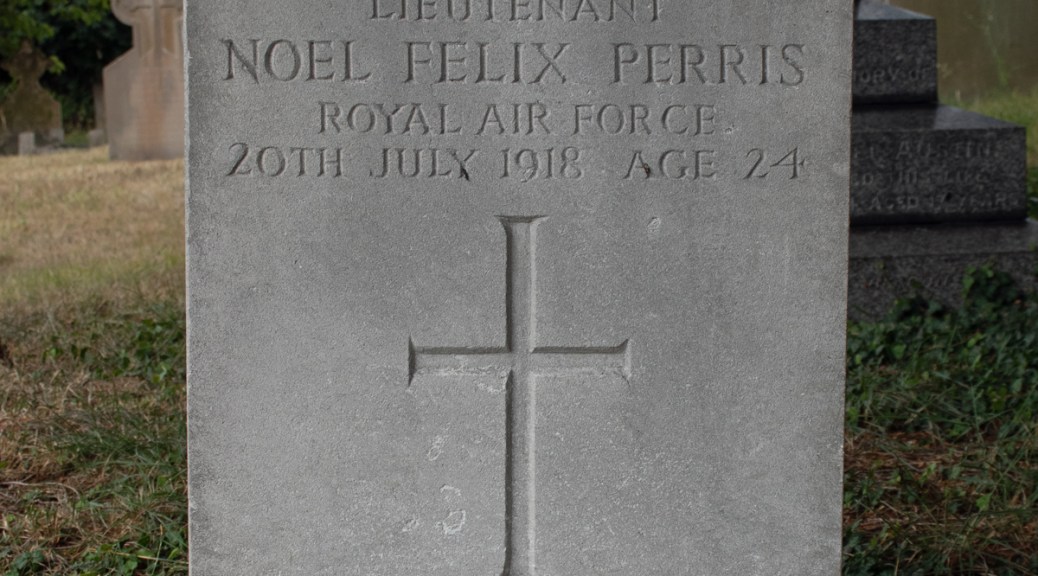
Noel Felix Perris was born early in 1894 in Chiswick, London and was the oldest of three children to George and Mary Perris. George was from Liverpool, and he and Yorkshire-born Mary made the move to south in the late 1880s.
Noel went on to study science at school, but when war broke out, he clearly felt a duty to play his part. George used his writing skills to become a war correspondent with the French army, while his son joined the 2nd London Regiment.
Quickly promoted to the rank of Lieutenant, Noel served in France and Egypt. In 1916, he was badly injured at Hébuterne, to the south of Arras, and returned to England to recuperate. When he had recovered, he transferred to the Royal Flying Corps, subsequently gaining his wings in the newly-formed Royal Air Force.
Lieutenant Perris was based in Kent as part of 143 Squadron. On the morning of 20th July 1918, he took off from Detling Airfield as part of a normal patrol flight. His aircraft – a single-seater RAF SE5a – collided with another plane, piloted by Lieutenant Thomas Wright, and both crashed to the ground in flames. Both piloted were killed on impact.
An inquest found that the cause of the pilots demise was accidental death. Lieutenant Perris was just 24 years old.
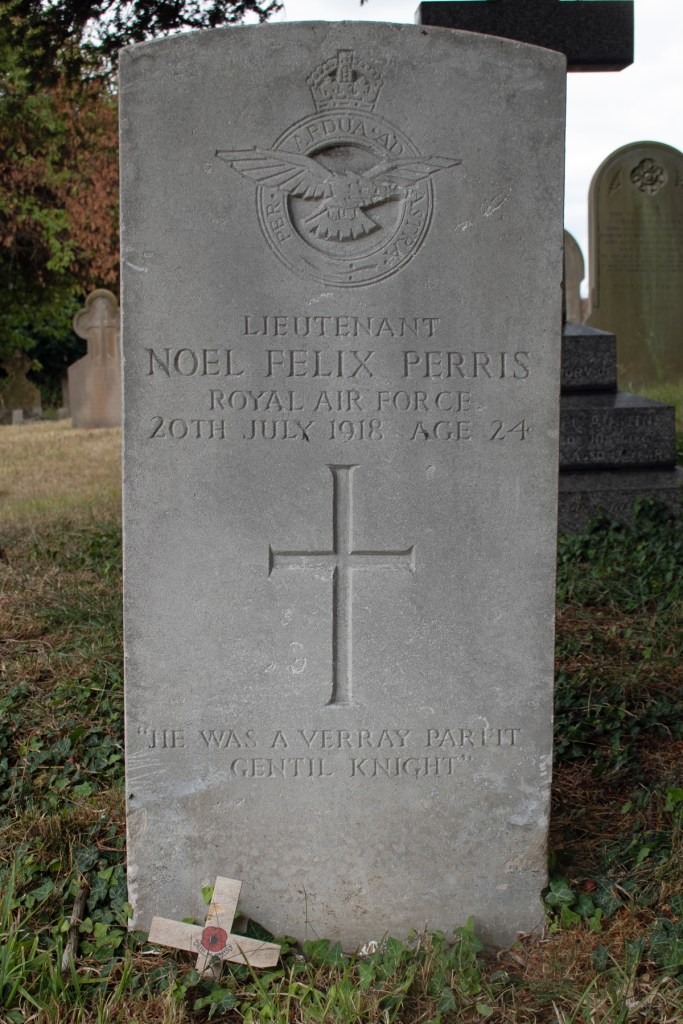
Thomas Wright’s body was taken home to Fleetwood, Lancashire, for burial. Noel Felix Perris was laid to rest in the quiet graveyard of St Martin’s Church in Detling, not far from the base.
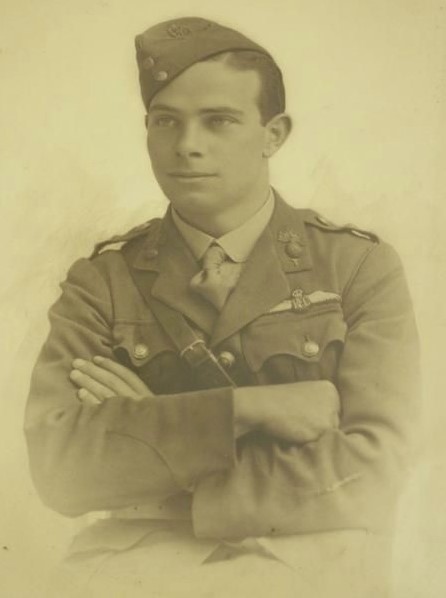
Lieutenant Noel Perris (from findagrave.com)
The epitaph on Noel’s headstone comes from Geoffrey Chaucer’s The Knight’s Tale.
He was a verray parfit gentil knight
A modern day translation might be “He was a true, perfect knight of noble character.”
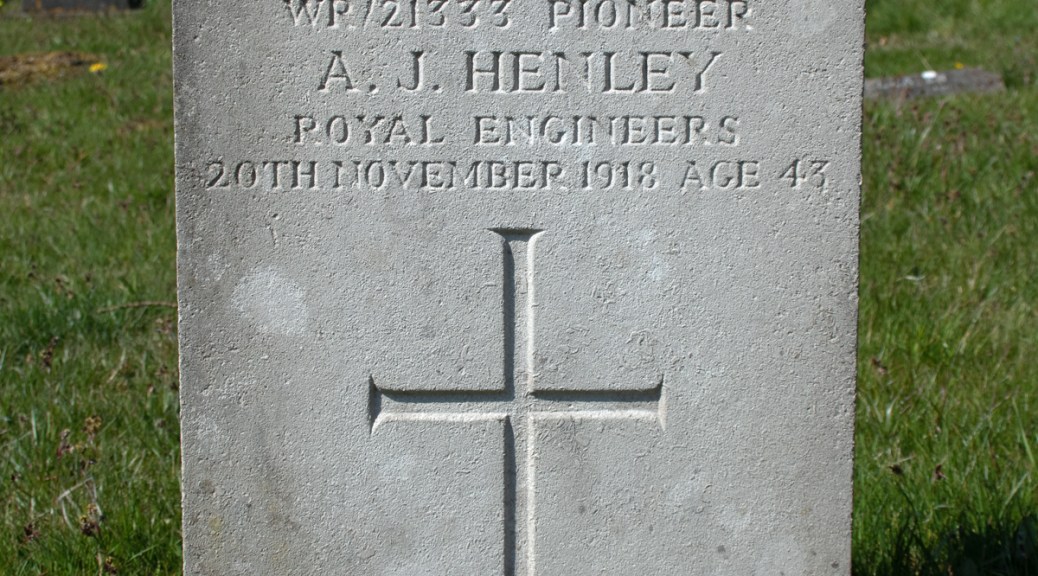
Albert James Henley was born in the spring of 1875, the youngest of nine children to Caleb and Ann Henley. Caleb was an agricultural labourer from Cuckfield, and it was in this West Sussex village that the Henley siblings were born and raised.
Albert found work on a farm when he left school, but soon found other employment as a bricklayer. On 15th August 1896 he married Sophia Leney: the couple went on to have four children – Kate, Minnie, Albert and William.
War came to Europe, but Albert was not initially called on to serve king and country because of his age. He did enlist, however, joining the Royal Engineers in January 1917. His service records suggest that he was a month short of his 45th birthday (which does not tie up with his baptism records) and stood 5ft 10.5ins (1.79m) tall. He is noted to have been of good physical development, weighing in at 159lbs (72.1kg).
Pioneer Henley was assigned to the 307th Road Construction Company and, after a month’s training was dispatched to France. He spent more than eighteen months overseas, before being medically evacuated to England in the autumn of 1918, having contracted bronchitis. Albert was admitted to hospital in Dover as soon as he had crossed the Channel, but died there the following day. He passed away on 20th November 1918 and was 43 years of age.
Albert James Henley was brought back to West Sussex for burial: he was laid to rest in the cemetery of his home village, Cuckfield.
A sad epilogue to Albert’s story is that his widow, Sophia, had to wait for his belongings to be returned to her. In a letter to the regiment on 14th December 1918, she wrote:
…it is nearly a month since he passed away, and I have not heard anything. When I came there on the 20th [November] they said his personal belongings would be sent on in a few days.
The Royal Engineers office responded that they were unable to forward his personal effects on until authority had been received from the War Office. It was to be another six months before Sophia finally got her late husband’s items – a purse, knife, notebook, letters, photo, gloves, watch (with case and chain), handkerchief, muffler and four coins – back.
Philemon Witheridge Richards was born on 9th July 1891 in Porthleven, Cornwall. He was one of at least seven children to George and Ann Richards. George was a sailor, as were he two oldest sons and, by the late 1890s, the family had made the move to Penarth in Glamorganshire.
When he left school, Philemon followed his father and older brothers into sailing. By the time he turned eighteen, George had passed away and Philemon wanted bigger and better things. On 16th July 1909, he enlisted in the Royal Garrison Artillery. His service records show that he stood 5ft 9.5ins (1.76m) tall, had good vision and was of good fitness.
Gunner Richards was posted to No. 6 Company and remained part of the territorial force. On 1st July 1911, after twenty months’ service, he was, at his own request, discharged from the army.
The trail goes cold for a while, and Philemon seems to have returned to a life at sea. This changed, however, when war broke out and, in October 1915, he was drafted into the Royal Naval Reserve as a Deck Hand.
Philemon’s time in service seems to have been shore-based however. After an initial posting to HMS Vivid, the Royal Naval Dockyard in Devonport, he moved to HMS Victory, which was the name given to the dockyard in Portsmouth, Hampshire. He moved on again in the autumn of 1916, by which point he was based at HMS Pembroke, the Royal Navy’s shore-base in Chatham, Kent.
It was here that Deck Hand Richards fell ill. It is unclear what the condition was, but he was admitted to the Military Hospital in Chatham on 20th October 1916. His illness worsened, and he passed away there on 2nd November. He was just 25 years of age.
Philemon Witheridge Richards was brought back to Glamorganshire for burial. He lies at rest in the graveyard of St Augustine’s Church in Penarth.
Philemon’s gravestone is also dedicated to his brother, Thomas Witheridge Richards. Eighteen years Philemon’s senior, Thomas had been a sailor, and, while no records remain, it seems likely that he may also have been called into service during the First World War. He died at home on 4th July 1918, at the age of 45 years old. He was laid to rest in the same plot as his younger brother.