Category Archives: London

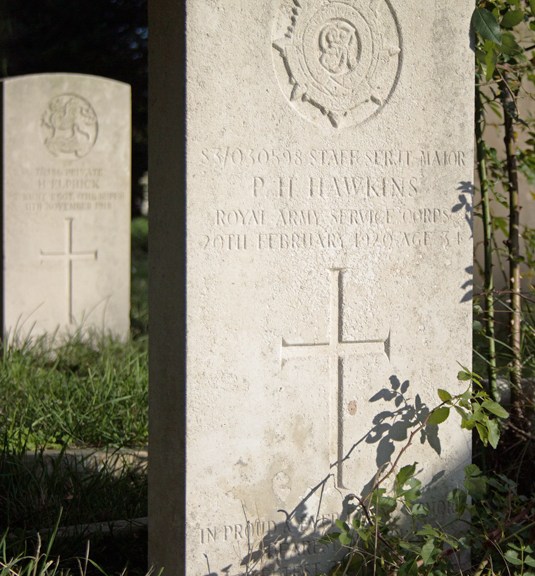
Serjeant Major Percy Hawkins

Staff Serjeant Major Percy Hawkins

Percy Harry Hawkins was born in Waltham Green, London, in 1886. One of five children, all boys, his parents were Frederick and Elizabeth Hawkins. Frederick initially worked as a brewer’s collector – collecting rent from tenant pub managers on behalf of the brewery – before working as a tobacconist.

In July 1908, Percy married Gladys Parnell. Sadly, tragedy was to strike and, over the next couple of years both Elizabeth and Frederick passed away in 1909 and 1910 respectively.

By the time of the following year’s census, Percy and Gladys were boarding with a dispensing doctor (or GP), and his wife. Percy listed his occupation as a ‘traveller’, was probably employed as some kind of salesman.

Tragedy was to strike Percy again. Months after the couple had their first child in July 1911, Gladys also passed away, leaving him as a widower and single parent at just 26 years old.

From his later military documentation, it seems that Percy married again in August 1915, this time to a woman called Mildred, and, by September 1919, he had gone on to have three children in total; one boy and two girls.

When war broke out, Percy was quick to enlist. He joined up in Birmingham on 10th August 1914, and gave his profession as a commercial traveller. His records show that he was 28 years and 120 days old, stood 5ft 6ins (1.69m) tall and weighed 131lbs (59.5kg).

After initially joining the Royal Warwickshire Regiment, Private Hawkins was transferred to the Royal Army Service Corps, and was assigned to one of the supply companies.

Over the four years of the war, Percy served on home soil, and was promoted a number of times, rising from Private to Lance Corporal, Staff Sergeant to Quartermaster Staff Sergeant. In September 1917, he was again promoted, this time to Staff Sergeant Major, a position he held for the remainder of the conflict, and on into 1919, when he volunteered for an extra year’s service, rather than being demobbed.

In February 1920, Staff Serjeant Major Hawkins fell ill; he was admitted to the military hospital that had been set up in Brighton Pavilion, Sussex. The diagnosis was heart failure, and, sadly, it was to this that he was to succumb. He passed away on 20th February 1920, aged just 34 years old.

Percy’s family was, by this time, living down the coast in Worthing; his body was brought there for burial and he lies at rest in the Broadwater Cemetery in the town.


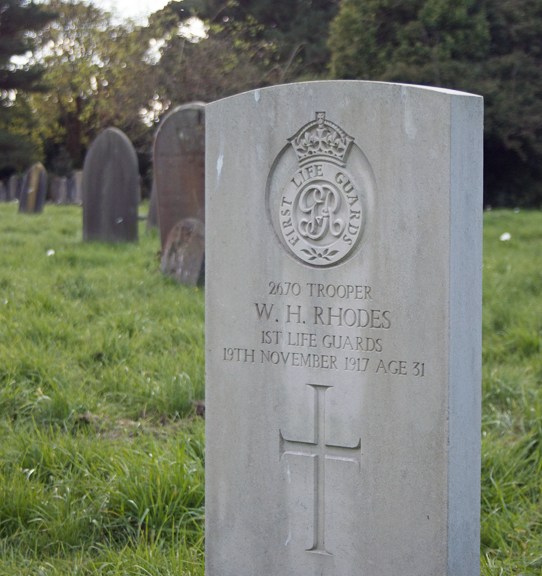
Trooper William Rhodes

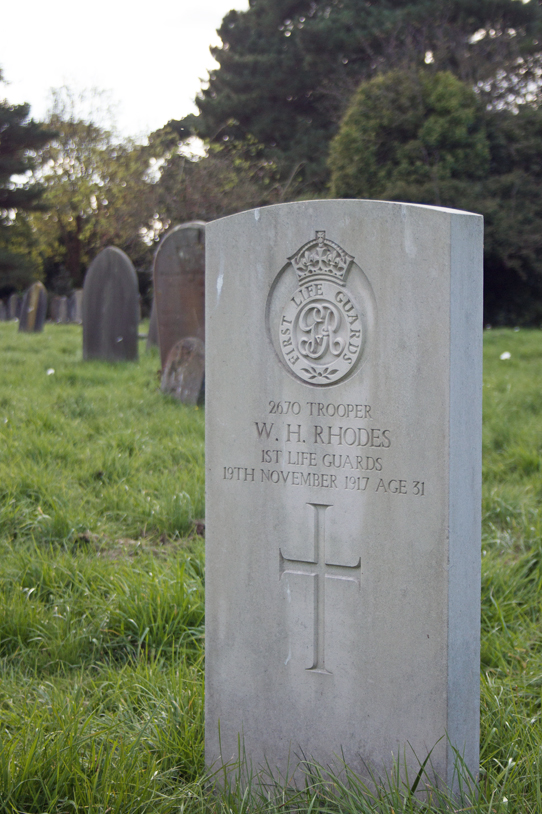
Trooper William Rhodes

William Henry Rhodes was born in the summer of 1886 and was the youngest of six children. His father Reuben was a gardener who, with his wife Ellen, raised their family in a small cottage near the central station in Worthing, West Sussex.

When he left school, William found work as an assistant in a bookshop. This was just a stepping stone, however, and his mind was on a life of adventures. In March 1908, he enlisted in the army, joining the Household Cavalry, and was assigned to the 1st Life Guards. William’s medical report showed that he stood at just under 6ft (1.83m) tall, and weighed 141lbs (64kg). He had a fresh complexion, grey eyes and brown hair.

Trooper Rhodes was initially based on home soil; his barracks were in London and he served in Hyde Park, Regents Park and at Windsor, where he would have been called upon to be involved in royal duties that would have taken place. This changed when the Great War broke out, however, and his division was sent out to northern France as part of the British Expeditionary Force.

The 1st Life Guards were involved in the First Battle of Ypres, and went on to fight in many of the fiercest battles of the conflict. His service record identifies that he was wounded in February 1915, when he received a gunshot wound to the head, although, surprisingly, there is nothing in his medical record that suggests any subsequent hospital admission.

In fact, Trooper Rhodes did receive hospital treatment during his military service; he was admitted for bronchial catarrh in April 1908 and May 1909 and headaches in June 1911. Four years later, he contracted tuberculosis while in action in France, and moved back to London for treatment.

William’s condition was serious enough for him to be medically discharged form the army; having spent more than a month in hospital, he was released from duty on 31st August 1915.

There is little further information about William’s life back home. The next document on him confirms that he died on 19th November 1917. While the cause is not noted, it seems likely to have been connected to the lung conditions he suffered during the war. William was 31 years of age.

William Henry Rhodes was laid to rest in Broadwater Cemetery in the town of his birth, Worthing, West Sussex.


Corporal Richard Cadenaci

Corporal Richard Cadenaci

Richard Edward Cadenaci was born in Sutton, Surrey, in around 1886. His father, who was also called Richard Edward Cadenaci, was a house painter and, with his wife Maria, had thirteen or fourteen children, of whom Richard Jr was the middle one.

Documentation on the Cadenaci family is scarce. On 5th April 1896, when Richard Jr was 10, he and three siblings were baptised together.

By the turn of the century, the family were living on Merton High Street, in Wimbledon. Richard Sr and Maria were there with their youngest five children.

Richard Jr seemed keen on a life of adventure – the 1911 census lists him as a Private in the 3rd Battalion of the Royal Fusiliers, and that he was based in Mauritius. His full military service records are not available, but it is likely that his term of service with the army was extended as war loomed.

Private Cadenaci was sent to France in January 1915 and, during his time in the Great War, he received the Victory and British Medals and the 1915 Star. At some point during the conflict he was transferred across to the Labour Corps, though the move came with a promotion to Corporal. Again, there is little further information about his service, but records suggest that he was discharged from the army – possibly through health reasons – on 20th September 1918.

Here, Richard’s trail goes cold. He died on 23rd March 1920, just eighteen months after the end of this military service, at the age of 32. There is no record of the cause of his passing and nothing to connect him to the town in which he was buried, Worthing, West Sussex.

It is possible that Corporal Cadenaci left the army for medical reasons, and his move out of London was for cleaner air, but this is only presumption on my part, and there is nothing to confirm this either way.

Richard Edward Cadenaci lies at rest in the Broadwater Cemetery in Worthing.


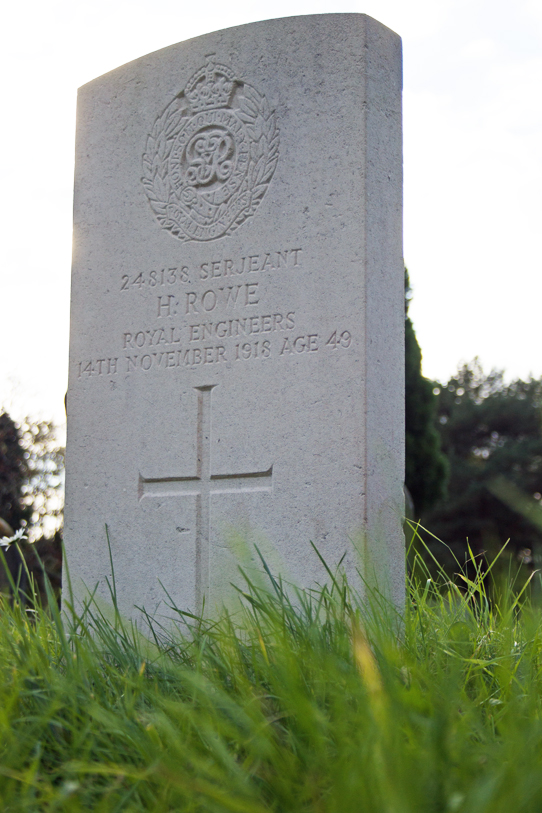
Serjeant Henry Rowe

Serjeant Henry Rowe

Henry Samuel Rowe was born in Shoreditch, London, on 18th August 1873. He was one of three children to Henry and Amelia Rowe. Henry Sr was a stonemason, who died in 1876, when Henry was only three years old.

Amelia moved her and her children to the Sussex Downs, and married again in 1883. Her new husband was John Herrington, and the couple went on to have three further children, Henry’s half-siblings. John was a farm labourer, and his stepson followed in his footsteps when he left school.

Henry soon sought other accomplishments, however, and, in October 1895, he joined the King’s Royal Rifles. During his twelve years’ service, he travelled the world, from Mauritius, to India, South Africa to Sri Lanka. He returned home in December 1903 serving on home soil until the end of his contract in 1907.

On 23rd April 1905, he married a widow, Amelia Routledge, in Brighton. There is no confirmation of the couple going on to have children.

Once demobbed, Henry found employment with the railways, and, by the time of the 1911 census, was working as a signalman. The document records him as boarding in a house in the village of Rudgwick, near Horsham; Amelia, meanwhile, was lodging with a family in South East London.

War was on the horizon, and, in August 1914, Henry volunteered. His time with the King’s Royal Rifles, stood him in good stead; after initially enlisting as a Private in the Royal Sussex Regiment, he was quickly promoted to Corporal and, by November 1914, had transferred to the Royal Engineers and attained the role of Sergeant.

Henry had spent just over a year in France, when he was shot in the right arm on 18th July 1916. Medically evacuated to England, he spent three months recuperating, before heading back into the fray in October the same year.

Henry served another eighteen months on the Front Line, before being admitted to hospital. His medical admission records show that he was suffering from “tremulous speech, confused… conversation, transitory admissions [sic?] of a grandiose type, outbursts of excitement, says he is a man of importance, childish, facile, simpleminded…” His condition was recorded as General Paralysis of the Insane (GPI), more commonly known these days as shellshock, and he was medically discharged from the Army on 4th September 1918.

Sadly, at this point Sergeant Rowe’s trail goes cold. He seems to have been hospitalised following his discharge, but the documents give conflicting suggestions about where he was admitted. Amelia was still living in South London, one record suggests Henry was in the Welsh Metropolitan Hospital in Whitchurch, near Cardiff. But, as he was buried in Worthing, West Sussex, it seems unlikely that he remained in Wales.

The cause of Henry’s passing is not evident either. There is no confirmation that GPI was to blame, but nothing to suggest it was not either. Whatever the cause, Sergeant Rowe died on 14th November 1918, three days after the conflict to which he had given so much had been brought to a close. He was 49 years old.

Henry Samuel Rowe lies at rest in the Broadwater Cemetery in Worthing, West Sussex.


Bandsman Hubert Campbell

Bandsman Hubert Campbell

Hubert Stephen Buck was born on 18th October 1887, in Stepney, East London. His father, Edgar Buck, started to use his grandmother’s maiden name – Campbell – from the 1880s, and, by 1901, the family had formally changed their name.

At the time of his marriage to Hubert’s mother Alexandra Stephen in 1885, Edgar was working as a ostrich feather manufacturer. The couple went on to have six children, all boys, of which Hubert was the second oldest.

By the time of the 1901 census, Edgar and Alexandra has moved the family south of the river, from Mile End to Lambeth. By now, Hubert’s father was working as a musician, but there is little further information about his trade.

The next census – from 1911 – found the family living in Lewisham. Edgar was now listed as a band leader, while Hubert, who was the oldest child still living at home, gave his profession as musician, presumably in his father’s band.

War was imminent and, while Hubert was definitely involved, there is little specific information about his military service. He enlisted in the Irish Guards, and was assigned the role of Bandsman.

In August 1917, Hubert married Alice Johnson in Sutton, Surrey. He listed his profession as Musician in HM Irish Guards, so must have enlisted before that point. Interestingly, the same document identifies Edgar’s profession as Bandmaster in the 1st City of London Regiment, so it seems he also enlisted.

The marriage certificate shows Alice was two years older then her new husband, and that she was the daughter of warehouseman Alfred Johnson, who had, by that point, passed away.

Bandsman Campbell survived the war, but there is no indication as to whether he served abroad, or was part of a territorial force. He and Alice moved to Worthing in West Sussex, but there is no confirmation on when the move took place. The 1921 census, taken in June of that year, records the couple as living at 151 Lyndhurst Road in Worthing, where he was noted as being a totally disabled pensioner. There is little further information about him, other than the fact that he died on 4th August 1921, at the age of 35.

Hubert Stephen Campbell was laid to rest in the Broadwater Cemetery in Worthing.


While Hubert’s trail went cold, there is further information on Alice. An advert in the Worthing Gazette offers musical training by her:

Musical Training on Modern Methods

Pianoforte (Matthay), Voice Production, Singing, Theory, Harmony, Aural Culture, Musical Appreciation, and Art of Teaching.

Thorough preparation for all Examinations, Elementary to Diploma Grades, Special Courses for Teachers for the study of the Matthay system and the Art of Teaching.

MADAME ALICE CAMPBELL (Member of the Musical Councils of the London and East London Musical Festivals. Registered Teacher: Teachers’ Registration Council.

Worthing Gazette: Wednesday 31st August 1921

Digging a little deeper, and there are similar advertisements in the newspaper from late 1917, through to at least the 1930s, by which time, Alice was running the Worthing School of Music.

The advert suggests a couple of points. It certainly suggests that a love of music is what brought Hubert and Alice together in the first place. There was a definite musical connection in the household, initially driven by Hubert’s father, and continued with his widow.

Given that the advert above is dated a matter of weeks after Hubert’s death, it also seems likely that his passing was not unexpected. There is nothing in the local media relating to his death, and, with regular students to teach, Alice obviously felt is unnecessary to take any significant time away from her work in grief. It is supposition on my part, but it would suggest that Hubert died from a chronic condition, possibly one of the lung diseases that were rife across Europe in the aftermath of the Great War.

The last advert for the Worthing School of Music ran on 12th September 1934. Beyond that date – when Alice would have been 49 – there is no further clear record of her or the school.


Private Arthur Westby

Private Arthur Westby

Arthur William George Westby was born in the spring of 1895, the only child to Arthur Henry Westby and his wife, Emma. Arthur Sr was a Corporal in the Scots Guards, but, beyond the fact that his son was born in Clapham, South London, there is little further information about Arthur Jr’s early life.

His father’s military career must have taken him across the country – the 1901 census lists Emma and Arthur Jr living in Bolton, Lancashire, even though there seem to be no connections with the county for them.

The records for Arthur Jr go quiet until 1920. At this point, documents hint at his military service during the Great War.

The death notices in the Sussex newspapers confirm his passing:

On November 19th 1920, at The Cedars, 13 Browning Road, Worthing, Arthur WG Westby (late MT, RASC), beloved husband of Ethel Westby, and only son of Ex-RQM Sergeant and Mrs Westby, 34 Wenban Road, Worthing. Patiently suffered to the end, result of Active Service.

Worthing Gazette: Wednesday 24th November 1920

There is no further information available about Ethel, and no marriage records to confirm a date for their wedding.

From a military perspective, Arthur enlisted in the Royal Army Service Corps, and was attached to the Motor Transport division. Again, there is nothing to evidence when he enlisted or for how long he served. It seems that Private Westby was injured in the line of duty, and was medically discharged in April 1918. The injury appears to have been life-changing, and it affected him until the end of his life.

Arthur William George Westby passed away in Worthing on 19th November 1920, aged just 25 years old. The specific cause of his death is unknown. He was laid to rest in the Broadwater Cemetery in the town, close to his parents and widow.


Chief Petty Officer Charles Clarke

Chief Petty Officer Charles Clarke

Charles Frederick Clarke was born on the 14th April 1869 to James and Jane Clarke. James was born in Suffolk, but moved to London, where he found work as a watchman (guarding the city streets at night). Jane was from Essex, and the couple went on to have five children, of whom Charles was the middle child.

Charles was set on a life of adventure, joining the Royal Navy in 1887, for a period of twelve years. During this time, he served on eleven vessels, working his way up through the ranks from Boy to Ordinary Seaman to Able Seaman, Leading Seaman and eventually Petty Officer.

In October 1895, he married Lydia Rogers, a sailor’s daughter from Portsmouth. The couple would go on to have nine children, eventually settling in Sussex.

When his naval service ended in 1899, Charles enlisted again. Within six years, he had achieved the rank of Chief Petty Officer, and in March 1909, after 22 years’ service, retired from active duty. He was obviously well respected, however, and was selected to serve on the staff of the Royal Naval Recruiting Office in Portsmouth. His service records suggest that he resigned from this role on 14th April 1914.

It seems that Chief Petty Office Clarke took on a role on the vessel HMS Zaria. This was a ship that was requisitioned by the Royal Navy, which acted as a patrol ship, guarding the coastal waters around the UK. While details are scant, Charles certainly served on board for a couple of years, and he died on board, from causes undisclosed, on 16th December 1916, at the age of 47 years old.

Brought back to West Sussex, Charles Frederick Clarke was laid to rest in the Broadwater Cemetery in Worthing. This was where Lydia was now living; she was buried in the same grave, when she passed away eight years after her husband.


Rifleman Ernest Parsons

Rifleman Ernest Parsons

Ernest Charles Parsons was born in 1881, and was one of six children to bricklayer Robert Parsons and his wife Mary Ann. Robert was a labourer and bricklayer from Watford, while Mary Ann was born in Arundel, West Sussex. The couple moved to where his work was, having their first children in Hertfordshire and Sussex They finally settled in London, which was where Ernest was born.

Where he first left school, Ernest worked as a painter, but soon found a career as a postman., something he would continue to do through to the outbreak of war.

Ernest married Frances Olive Eynott on 28th February 1904; they went on to have a daughter, Doris, the following year. It seems, however, that their marriage was destined to be a short one; Frances passed away within a couple of years.

With a daughter to raise and a living to earn, Ernest married again. Elizabeth Kate Dew was born in Fulham in 1883, and the couple married in the spring of 1907. Again, however, their happiness was to be short; Elizabeth died eighteen months later.

Widowed twice, and with Doris now a toddler, Ernest moved back in with his parents in Chiswick. He continued his work as a postman, but alongside this had been an active volunteer in the London Regiment (Post Office Rifles) since early 1908.

Rifleman Parsons’ initial year’s service was extended and extended and, by the time of the outbreak of the First World War, had been serving for some six years.

By 1914, Ernest had found love for a third time, and married Lilian Frances Cromie on 25th March that year. With war imminent, his time was take up more with military duties; while part of the territorial force, Rifleman Parsons had been officially mobilised.

The sudden intermingling of men from different parts of the country in small, packed training camps made the perfect environment for illness and disease to circulate. Ernest had initially contracted bronchitis while on service in 1912; this had dogged him intermittently oved the next few years until, in March 1915, it was serious enough for the Medical Examination Board to declare him unfit for military service.

Ernest moved his family to Worthing, in West Sussex, presumably as the air was fresher there than in the bustling capital. He may also had had family in the area, as his mother had been born just up the road in Arundel. Sadly, though, it seems that his health was not to recover sufficiently, and he passed away on 4th October 1918, at the age of 37.

Ernest Charles Parsons was buried in the Broadwater Cemetery in the town, not far from where his widow and daughter were then living.


Coincidentally, when researching another soldier, Lance Corporal Edgar Godden, this turns out to be the address where he also died, just ten months earlier on 22nd December 1917. There is no apparent other link between the two men.

Lance Corporal Thomas Marston

Lance Corporal Thomas Marston

Thomas Henry Robert Marston was born on 12th February 1876, the son of Frederick and Elizabeth Marston. Frederick was a police constable who raised his family in the Paddington area of London.

Sadly, details of Thomas’ early life are tantalisingly scarce. He was not baptised until October 1881, on the same day as his brother, Frederick, who was four years younger.

Thomas seems to have had a sense of adventure; his Commonwealth War Graves Commission records confirm that he served in the South African Campaign – this would put him out of the country during the 1890s, and reinforce why documentation for that time is missing.

The next confirmed information for Thomas is his marriage record. He wed Bessie Ponder by banns in August 1909. The ceremony was at Christ Church in Marylebone, and the couple went on to have two children, Doris, born in 1911, and Hettie, born in 1912.

By the time of the 1911 census, with his military service by now complete, Thomas and Bessie were living on the Caledonian Road in Islington. Still childless at this point (although Bessie was undoubtedly pregnant), Thomas was working as a butcher.

The census gives their address as 54 Wallace Buildings, a Victorian tenement block, and the couple lived in two rooms. Their neighbours at No. 53 were fellow butcher Ralph Bonest, his wife Isabel and their three children, who also all lived in two rooms. On the other side newlywed cab driver William Barnes, lived with his wife Florence and her sister. The Barnes’ had the luxury of No. 55 being a three-roomed flat.

When the Great War broke out, it seems evident that the 38 year old Thomas was either re-mobilised or voluntarily re-enlisted. While the dates are not certain, he had joined the Army Service Corps by March 1917 and was assigned to the Remount Depot at Romsey in Hampshire. This section of the regiment was involved in the provision of horses and mules to other parts of the army.

No further details of Lance Corporal Marston’s military career remain. Sadly, the next record of his life confirm his death. He was admitted to the Hursley Camp Hospital with rupture of viscera (possibly an aneurysm), but died from his injury on 31st October 1917. He was 41 years old.

At some point after the 1911 census, the family had moved to Worthing in West Sussex. The body of Thomas Henry Robert Marston was brought back home, and he was laid to rest in the Broadwater Cemetery in the town.


Private Sidney Alner

Private Sidney Alner

Sidney William Alner was born in Shaftesbury, Dorset, in March 1899, one of eleven children to Sidney and Ellen Alner. Sidney Sr was a grocer’s porter, and the family lived on the celebrated Gold Hill in the town.

War was to come when Sidney Jr was only young – he had just turned 15 when it broke out. He saw his older brothers go off to war and was obviously keen to do his bit as well. Until he was old enough, however, he worked as an errand boy for his father’s employers, Stratton Sons and Mead.

His time would come, of course, although dates for Sidney’s enlistment are not clear. A contemporary newspaper record confirms that he arrived in France in January 1918, so it is likely that Private Alner joined up at some point during the previous year.

He joined the Hampshire Regiment, and was assigned to the 1st Battalion. Heavily involved during most of the conflict, the battalion was seen as key to the Final Advance of the autumn of 1918. Private Alner was caught up in the fight to break the Hindenburg Line, fighting on the River Selle and capturing the town of Monchaux.

It was while his battalion was advancing on the village of Préseau on 2nd November, that Private Alner was injured. Shot in the arm, he was evacuated back to England, and admitted to the Cambridge Military Hospital in Aldershot. He would have survived his injuries, had pneumonia not set in, and it was to this that he would succumb on 19th November. He was just 19 years old.

Sidney William Alner’s body was brought back to Dorset. He lies at rest in the Holy Trinity Churchyard in Somerset, within walking distance of his family’s home.


Sidney was the second member of the Alner family to die as a result of the Great War.

His older brother Harry, who had become a chauffeur and went to live in London, joined the Royal Army Service Corps in 1915. Private H Alner had served three years in France when he was killed on the front line just three weeks before his brother. He was 32 years old, and left a widow and two children.


When researching Sidney Alner in newspaper articles, an interesting report surfaced.

An unfortunate accident has happened to a little girl, not quite four years old, the daughter of Sidney Alner, who resides in Gold Hill. Heals’ steam hobby horses visited the town on Friday and Saturday in last week, and on the evening of the former day, Alner took his little girl for a ride on the horses.

Whilst they were in motion, the bolt that kept the horse on which Alner sat with his child attached to the connecting rod came out, and he and the little girl were precipitated to the ground.

Alner escaped without injury, but his daughter had one of her legs fractured above the knee. She was taken home, and Dr Evans set the injured limb. Later in the evening she was removed to the Westminster Cottage Hospital.

Salisbury and Winchester Journal: Saturday 31st October 1891

This Sidney Alner was Private Alner’s father, and the daughter would have been his older sister Sarah. Nothing more is reported of the incident, and Sarah went on to live until 1945, when she was 57 years old.