Category Archives: South Africa

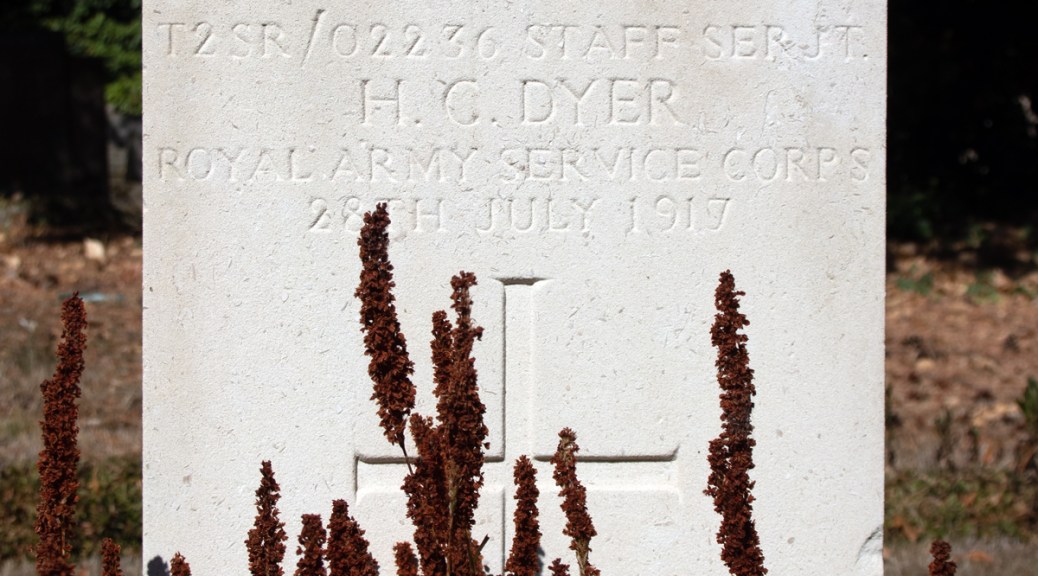
Staff Serjeant Henry Dyer

Staff Serjeant Henry Dyer

Henry Charles Dyer was born in January 1865 in the Devon town of Ivybridge. The oldest of five children, his parents were carpenter James and dressmaker Mary Dyer. When he left school, Henry found work as a cordwainer’s apprentice but, after James died in 1886, he sought out a career that would help support his mother.

Henry enlisted in the Army Service Corps on 10th July 1886 and, by the time of the next census was based at barracks in Woolwich, South London. His service records note that he was 5ft 4.5ins (1.64m) tall and weighed 124lbs (56.25kg). He had a dark hair, grey eyes and a dark complexion. He was also noted as having a tattoo of a cross on his left forearm.

Private Dyer served in the regiment on home soil for more than thirteen years, qualifying as a horse collar maker and saddler during this time and rising through the ranks. He was made a Driver in 1889, Corporal in 1895 and Staff Sergeant in October 1899.

Trouble was afoot on the other side of the world by this time and his promotion was linked to Henry being sent to South Africa. He was there for eighteen months, and was awarded the Queen’s South Africa Medal, as well as clasps for service at Tugela Heights, the Relief of Ladysmith, Laing’s Nek, Transvaal and Orange Free State.

Staff Sergeant Dyer went back to Britain in April 1901, where he remained for a further six years. On 4th July 1907, reached the end of his term of service and having completed 21 years with the Army Service Corps he returned to civilian life.

Henry moved back to Devon, moving back in with his mother and younger brother. Mary had remarried after James passed, but her second husband had also passed away, and so having two of her sons home would have been of comfort to her. The 1911 census records the family as living in three rooms of a house in Grenville Street, Plymouth. They shared the property with the Smith family, a husband, wife and two children. Henry was recorded as an army pensioner (saddler), while his brother Ernest was listed as being a watchmaker, while also in the army reserve.

War was on the horizon again, and, Henry was one of the first to step up when it was declared. He was 49 years old by this point, and so technically exempt from enlisting, but as an army life had served him well before, it must have seemed fit for him to serve King and Country once more.

Staff Sergeant Dyer’s new service records noted that he was formally employed as a saddler, and that he had put on 18lbs (8kg) since he initially signed up.

Henry was based firmly on home soil this time round, and while he was initially based in Aldershot, Hampshire, he seems to have been moved to barracks in Kent. He served for more than two and a half years, but his health seems to have been suffering by this point. At a medical on 24th July 1917, he was deemed to be no longer fit enough for war service and was discharged from the army.

It is likely that this discharge came while he was admitted to the Preston Hall Military Hospital in Aylesford. While Staff Sergeant Dyer’s earlier military service is fairly detailed, his later career is not. What is clear is that, four days after being discharged, he passed away. He was, by this time, 52 years of age.

A lack of funds may have prevented Mary from bringing her son home to Devon. Instead Henry Charles Dyer was laid to rest in the graveyard of St Peter and St Pauls Church in Aylesford, not far from the Kent hospital in which he passed.


Serjeant Albert Rumbelow

Serjeant Albert Rumbelow

Albert Edward Rumbelow was born in 1879 in Wycombe Marsh, Buckinghamshire. One of eleven children, his parents were Suffolk-born paper maker Philip Rumbelow and his wife, Jane.

Little information is available about Albert’s early life, although by the time of the 1901 census, he is recorded as being a Private in the Rifle Brigade. The family had moved to the village of Little Chart in Kent by this point, where his father was still continuing in the manufacture of paper.

Private Rumbelow’s military service is evidenced in later documents. He served with the 1st Battalion from 1895 to 1907, was awarded the South Africa medals for 1901 and 1902: he was also granted the clasp for his involvement in the defence of Ladysmith. He appears to have been wounded at this point, and was invalided out of full military service and placed on reserve.

In 1904, Albert was back in England, and living in London. That year he married Ellen Sillis, a cordwainer’s daughter from Norfolk. The couple set up home in Fulham, and went on to have five children: Abert Jr, Iris, Florence, Doris and Hilda.

By the time of the 1911 census, Albert was working at the local Public Hall, as a labourer, hall attendant and cleaner. The family were living at 9 Crabtree Lane in Fulham, sharing the property with the Fitzgerald family.

War was closing in on Europe by this point, and, once again, Albert stepped up to plat his part. He enlisted within days of conflict being declared, and within weeks had been given the rank of Corporal. His service records note that he was 5ft 10ins (1.78m) tall, weighed 156lbs (70.8kg), had brown hair and blue eyes. He was also recorded as having a tattoo of crossed rifles and a crown on his right forearm, and scared on his left calf, knee and eyebrow.

By the spring of 1915, Albert had been promoted again, to the rank of Serjeant. He was sent to France on 19th May, having been assigned to the 7th (Service) Battalion. Serjeant Rumbelow was involved at the Somme and was awarded the Distinguished Conduct Medal “for conspicuous gallantry” on 3rd June 1916. “He exposed himself to machine-gun and rifle fire when going across the open to rescue a wounded man. Later he went under fire to fetch a stretcher.”

Serjeant Rumbelow appears to have been injured in the skirmish, and was invalided to the UK later that month. When he recovered he was posted again, this time to the 18th (London) Battalion of the Rifle Brigade.

The following February he made the transfer across to the Labour Corps, and by March 1917, Serjeant Rumbelow was back in France. In August he was promoted to Company Sergeant Major, but was invalided back to England with bronchitis in February 1918.

When he recovered Albert was assigned to the 364th Area Employment Coy. in Kent, and seems to have voluntarily taken a drop in rank – back to Serjeant – in doing so. His health was dogging him by this point and in the late summer of 1918, he was admitted to Preston Hall Military Hospital in Aylesford, suffering from VDH, or heart disease.

Sadly, the strain of his military service was to be his undoing. He passed away from the heart condition on 21st September 1918, at the age of 39 years of age.

Albert Edward Rumbelow was laid to rest in the graveyard of St Peter & St Paul’s Church in Aylesford, not far from the hospital where he had breathed his last.


Now widowed, Ellen was left with the unenviable task of raising five young children on her own. She married again, to Private William Lake, on 8th June 1919, and the family moved to Essex. She lived until the age of 79, and was laid to rest in Sutton Road Cemetery in Southend.


Private Edward Savage

Private Edward Savage

In the graveyard of St Augustine of Hippo Church in Penarth, Glamorgan, lies the Commonwealth War Grave for Private Edward Savage. The headstone confirms that he had died on 25th December 1915 and that he was in the Loyal North Lancashire Regiment.

The Commonwealth War Grave Commission website suggests that he was the son of Edward and Rachel Savage and that he was born in Beccles, Suffolk. Sadly, there are no available census documents to shed any further light on that early life.

The same website suggests that he served in Burma, and in the South African campaign, which would have placed him there in the late 1890s and early 1900s.

It is also noted that Edward was the husband of Emily Savage and that they were living in Fleetwood, Lancashire. Edward’s later pension ledger suggests this was an Emily Shannon, who is, in fact, noted as the guardian of his illegitimate child. Further information, however, is not available.

From a military perspective, it is likely that Private Savage was either still service at the point that the First World War broke out, or that he was called into service – or volunteered his services – shortly after its declaration. He was assigned to No. 5 Supply Company of the 3rd/4th Loyal North Lancashire Regiment and, by the autumn of 1915, he found himself based at Penarth Head Fort near Cardiff.

Edward’s death seems to have been a less than auspicious one, as a local newspaper reported at the time.

The district coroner held an inquest at Penarth on Tuesday touching the death of Private Edward Savage, who was found dead at the billets of the A Company of the Loyal North Lancashire Regiment on Sunday morning. Surgeon-Major Charles Parsons, the local medical officer, stated that the deceased had apparently fallen down some stone steps, causing a fracture of the base of the skull. The jury returned a verdict of “Accidental Death.”

Western Mail: Wednesday 29th December 1915

Private Edward Savage had died on Christmas Day, 25th December 1915. He was 54 years of age. He was laid to rest in the graveyard of St Augustine of Hippo Church in Penarth.


Edwards shares his grave with another member of the Loyal North Lancashire Regiment, Serjeant Frank Carter. Read his story here.

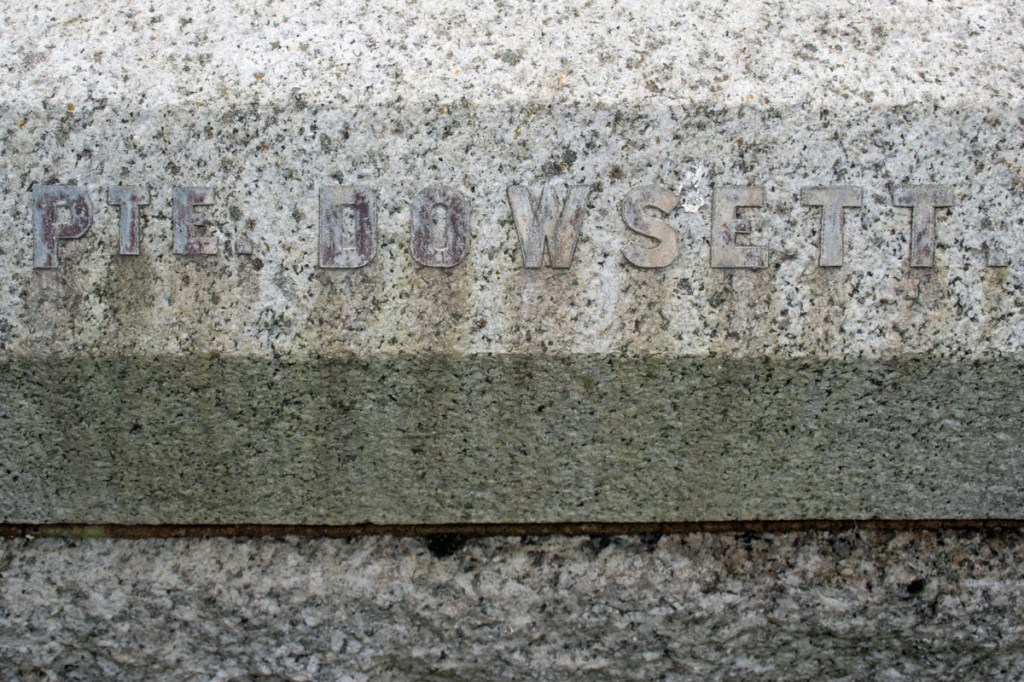
Private Albert Dowsett

Private Albert Dowsett

Albert Dowsett was born in the Essex village of Sible Hedingham in the spring of 1868. He was the fourth of six children – all of them boys – to Stephen and Susan Dowsett. Stephen was an agricultural labourer, while his wife worked as a straw plaiter to bring in a little extra money.

Albert seems to have been a bit of a tearaway. In July 1877, a local newspaper reported that:

Ezekiel Rulton and Albert Dowsett, boys each nine years of age, were indicted for breaking into the dwelling house of Matilda Jaggard, at Sible Hedingham, and stealing two books, value 1s, on the 20th June. Rulton, having once before committed burglary was sentenced to 10 days’ hard labour and five years in a Reformatory School. Dowsett was acquitted.

Essex Standard: Friday 6th July 1877

Stephen died in the autumn of 1884, while Susan died in March 1892. By this point Albert was 23 years of age, and had found solid work in the army. Full details of this early service no longer remain available, but he fought in South Africa in the 1890s.

By 1897 he returned to England and moved to Stone, near Greenhithe, in Kent. It was here that he met and married Anna Davis, the daughter of a local brewery man. The couple set up home in the village, and went on to have three children, William, Dorothy and Margaret.

The 1911 census recorded the family living in a small terraced house close to the railway station in Greenhithe. Albert was working as a labourer in the wash mill of the local cement works, and the family had a boarder, widower William Davies, who was a weighman at the same works.

Away from work, Albert had also found another calling, and was employed as a verger at St Mary’s Church, just a few minutes’ walk from home.

War was now encroaching on Europe, and, with his previous army service, Albert was perfect to resume his military role. Given the age limitations for new recruits early on in the conflict, it is likely that he volunteered for this role. He willingly took up a post with the 3rd Supply Company of the 2nd/4th Battalion of The Buffs (East Kent Regiment).

Private Dowsett was given a guard’s role, and was part of the team given the duty of patrolling two explosives factories near Faversham. He was on duty on the afternoon of Sunday 2nd April 1916 when a fire near one of the factory buildings set off a series of massive explosions. More than a hundred people were killed; sadly this included Private Dowsett. He was 48 years of age.

Albert Dowsett was laid to rest, along with the other victims of the Faversham Explosion, in a mass grave the town’s Borough Cemetery.


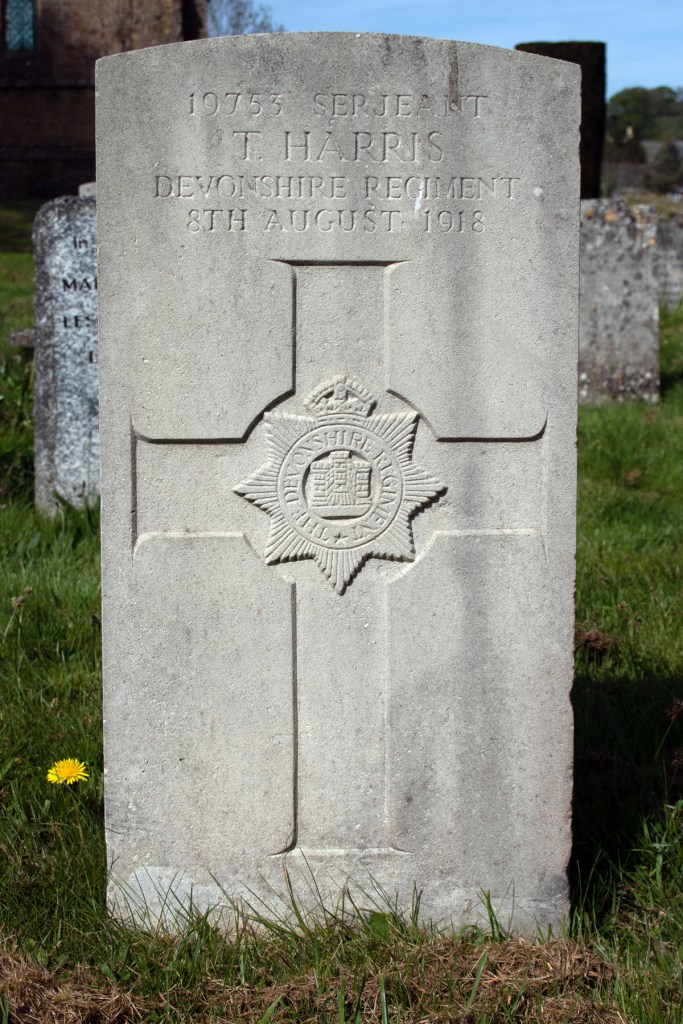
Serjeant Tom Harris

Serjeant Tom Harris

Thomas Harris – known as Tom – was born on 13th October 1876, the only son of Edmund and Mary Harris. Edmund was an agricultural labourer from the Somerset village of Seavington St Mary, and this is where Tom was born and raised.

Mary had married Edmund in the spring of 1876, but had been married before; she was widowed when her previous husband, Alfred Vickery, died ten years before. They had had seven children of their own, half-siblings to Tom.

Edmund died in the Wells Lunatic Asylum when Tom was only six years old. When he left school, he found work as a farm labourer, but sought bigger and better things, even though he was now the only one of Mary’s children still living at home.

Tom enlisted in the Somerset Light Infantry in January 1893, and soon found himself overseas. During his sixteen years’ service, he spent seven years in India and six months fighting in the Second Boer War. Corporal Harris seems to have had a sickly time of it, and while in India, was admitted to hospital a number of times for fever, ague and diarrhoea, as well as a bout of conjunctivitis.

When Tom’s contract came to an end in 1909, he returned to Britain, setting up home in Newport, South Wales, where he found work as a sheet weigher at the local steel works.

Mary died of senile decay and cardiac failure in May 1910. She was 74 years old, and sadly passed away in the Chard Workhouse, in similar circumstances to her late husband.

In October 1913, Tom married Ada Long in Chard. She was the daughter of a shopkeeper, and the couple set up home in South Wales, where Tom was still working.

War, by now, was closing in on Europe, and Tom wanted to use his previous experience to serve his country once again. He enlisted on 20th August 1914 in Newport, joining the Devonshire Regiment as a Private, although he was quickly promoted first to Corporal and then to Serjeant. His service records show that he was 5ft 8ins (1.73m) tall, had blue eyes, brown hair and a tattoo of a Spanish girl on his right forearm.

After a year on the Home Front, Serjeant Harris was sent to Egypt in September 1915. On the way out, he contracted a severe cold, which left him deaf in his left ear. He was also suffering from varicose veins, which left him in pain in his right leg. He was treated for both conditions, and put on light duties for three months.

In November 1916, Serjeant Harris was supporting a food convoy when it came under attack. Buried in sand and wounded, he was laid up in a hole for two days and nights before help came. He was initially treated for shell shock in the camp hospital, but was eventually evacuated to Britain for treatment.

The incident had put too much of a strain on Tom, and he was medically discharged from the army in April 1917. While his medical report confirmed that the general paralysis he was suffering from was a result of the attack, it also noted on six separate occasions that he had previously suffered from syphilis, suggesting this may also have been a contributing factor to his mental state.

Tom was discharged initially to an asylum in South Wales, before returning home to Ada. The couple were soon expecting a child, and a boy, Sidney, was born in February 1918. By that summer, however, Tom’s condition had worsened enough for him to be admitted back to the Whitchurch Military Hospital in Cardiff.

It was here that Tom passed away, dying from a combination of chronic phlebitis – an extension of the varicose veins he had previously complained of – and general paralysis on 8th August 1918. He was, by this point, 41 years of age.

Tom Harris was brought back to Somerset for burial. He was laid to rest – finally at peace – in Chard Cemetery.


Serjeant Tom Harris
(from ancestry.co.uk)

Lieutenant Arthur Tett

Lieutenant Arthur Tett

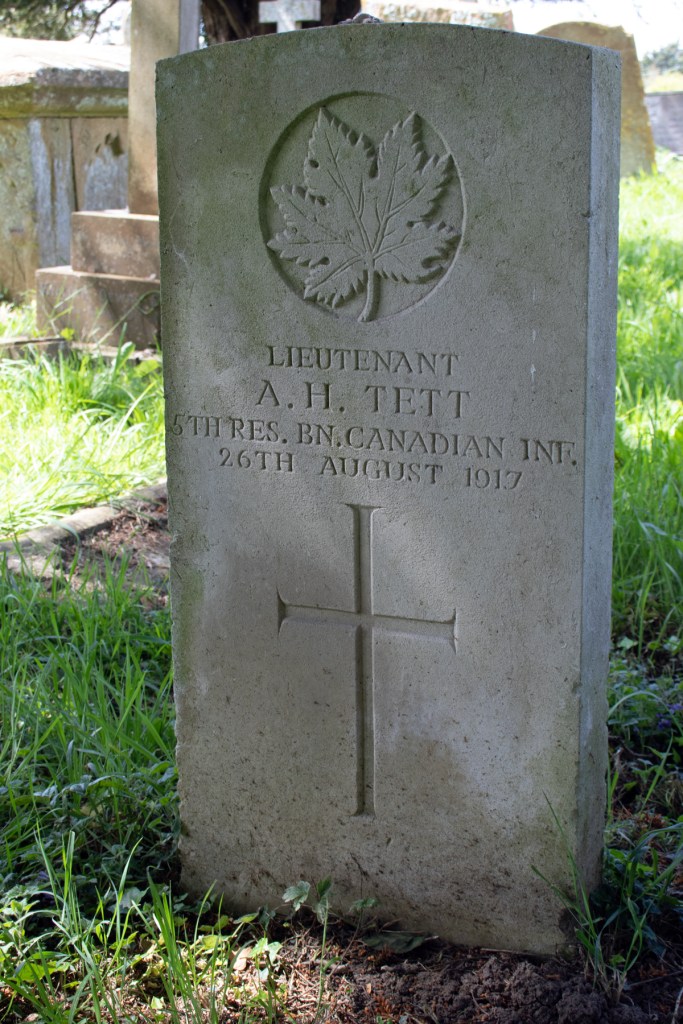
Arthur Hopkins Tett was born on 22nd August 1881 in Bedford Mills, Ontario, Canada. He was one of six children to lumberjack John Tett and his wife, Harriet. Both sets of Arthur’s grandparents had moved to Canada in the 1830s – John’s from Somerset, Harriet’s from Ireland – and his paternal grandfather had gone on to represent the county of Leeds in Ontario’s first parliament.

Arthur wanted to see the world, and viewed the army a a way to do that. After leaving school, he attended the Royal Military College, and was subsequently appointed a Signaller in the 3rd Canadian Mounted Rifles. He spent time in South Africa and, on returning to his home country, he took work as a bank clerk with the Union Bank, where he worked his way up to Head Office in Winnipeg.

He soon sought another challenge, and set up business in Outlook, Saskatchewan. In January 1913, Arthur married Bessie Kearns, an artist from back in Westport, Ontario. The couple settled in a detached property on Bagot Street, Kingston, Ontario and went on to have a son, John, who was born in 1917.

Arthur was still active in military circles at this point, playing a part in the local 14th Regiment. When war was declared, he again stepped forward to play his part, taking up a role of Lieutenant in the 253rd Battalion of the Canadian Expeditionary Force: this was a regiment made up mainly of students from the Kingston area, and it is likely that Arthur’s expertise would have been welcomed.

Having initially enlisted on 1st November 1916, Lieutenant Tett was declared fit a few months later and sent to Europe in May 1917. Based in Somerset, Arthur was not far from where his paternal grandparents had come from, nor where his cousins still lived. Sadly, however, his time in England was not to be a long one.

Lieutenant Tett was admitted to the Military Hospital attached to Taunton Barracks, suffering from pneumococcal meningitis. Sadly, this was to get the better of him, and he passed away on 26th August 1917, days after his 36th birthday.

Arthur Hopkins Tett was brought to the village of Kingstone in Somerset for burial. He was laid to rest in the graveyard of his second cousin George’s local church, St John and All Saints.


Bessie Tett did not marry again after her husband’s passing. She remained in Ontario for the rest of her life, passing away in October 1974, at the age of 89.

Arthur and Bessie’s son, John, was a babe-in-arms when his father died. He also remained in Ontario for much of his life, although he served in Europe during the Second World War. He married Sylvia Bird in September 1941; the couple went on to have two children. They returned to Canada when the war was over, and remained in Ontario until August 1974, when he passed away.


Serjeant John Ive

Serjeant John Ive

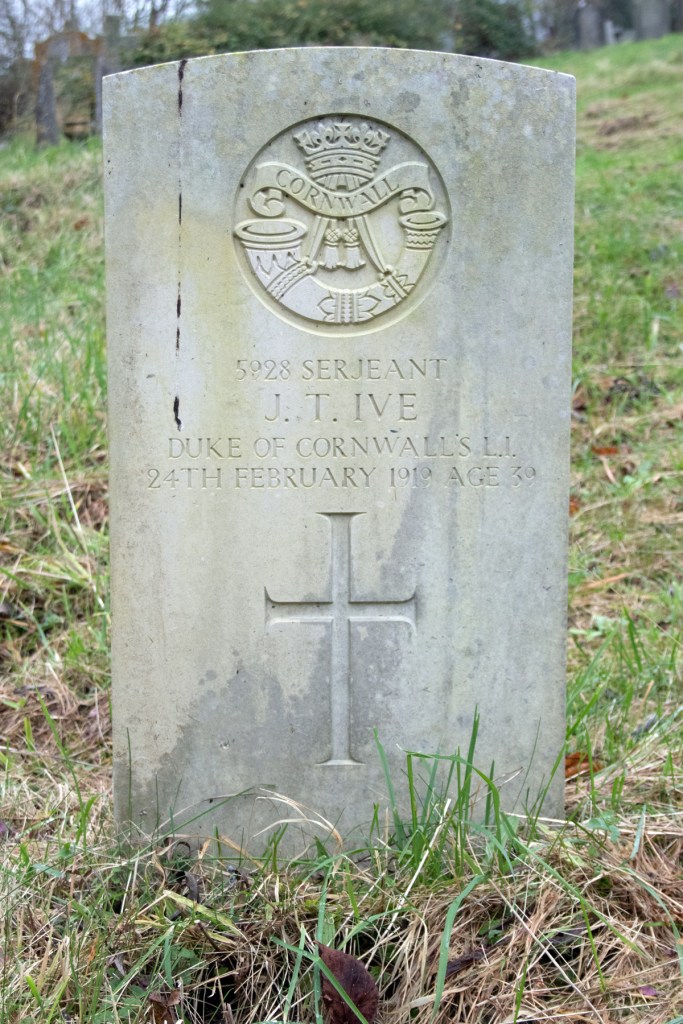
John Tucker Ive was born on 30th January 1882, one of eleven children to George and Emily Ive. George was a stone dresser from Harefield, Middlesex, and this is where the family were born and raised.

John was evidently after a life of adventure and, on leaving school, he enlisted in the Duke of Cornwall’s Light Infantry. There is little documented about his military career, but he was based in Devonport and spent a couple of years in South Africa during the Second Boer War.

When he returned to England, John met Amy Ethel Staunton, from Stonehouse in Devon. The couple married in 1905 and went on to have a son, also called John, the following year.

When his military service came to an end, John found work as a butler, and he and Amy were employed by the same household. John Jr, meanwhile, was brought up by his maternal grandmother in Plymouth.

Global conflict was on the horizon, by now, and John soon felt the need to play his part once again. He rejoined the 2nd Battalion of the Duke of Cornwall’s Light Infantry, and was given the rank of Serjeant. He was shipped to France in August 1914, where his battalion fought at Ypres and at Mons, and he was injured during both battles.

By the time the conflict ended, Serjeant Ive had transferred to the regiment’s Labour Corps; at the start of 1919, he was preparing to be discharged from the army, but contracted pneumonia. Admitted to the Alexandra Hospital in Cosham, Hampshire, the lung condition sadly got the better of him: he passed away on 24th February 1919, at the age of 37 years old.

John Tucker Ive was brought back to Devon for burial; he was laid to rest in the graveyard of St Mary’s Church in Wolborough, Newton Abbot.


Two of John’s brothers also died in the conflict.

Private George Robert Ive served with the 2nd Battalion of the Royal Fusiliers. He died at Gallipoli on 28th June 1915, at the age of 34 years old.

Gunner Edward Ive served with the Royal Garrison Artillery. He died in the Persian Gulf on 1st May 1916, aged just 30 years old.


Serjeant Frederick Flint

Serjeant Frederick Flint

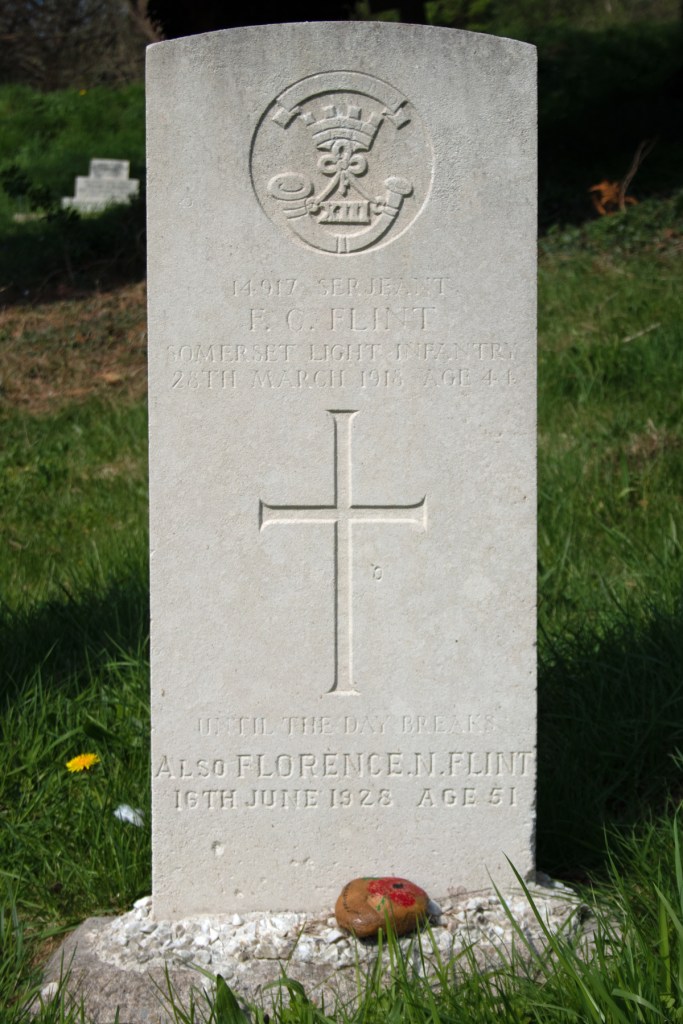
Frederick Charles Flint was born in the summer of 1872 in Bath, Somerset. He was the oldest of seven children to tailor Frederick Flint and his wife, Mary Ann.

Tailoring, however, was not a career that Frederick Jr wanted to follow and, in November 1890, he enlisted in the 7th Battalion of the Somerset Light Infantry. Over his twelve years’ service, he was posted to India and South Africa, gaining clasps for the Punjab Frontier 1897-1898, Relief of Ladysmith, Tugela Heights, Orange Free State, Cape Colony, Transvaal, South Africa 1901 and 1902 and the King’s South Africa Medal.

He returned to England in 1902, when he found employment as a postman back in Bath. He met Florence Novena Fishlock and the couple married at St Michael’s Church in Bath on 5th February 1905, before moving to nearby Radstock.

Frederick remained with the Post Office until the outbreak of war, when he again enlisted for duty, re-joining the Somerset Light Infantry. While he did not serve overseas, Serjeant Flint took on a training and mentoring role on Salisbury Plain. Suffering from tuberculosis, he was formally discharged from the army on medical ground in August 1915, and returned home.

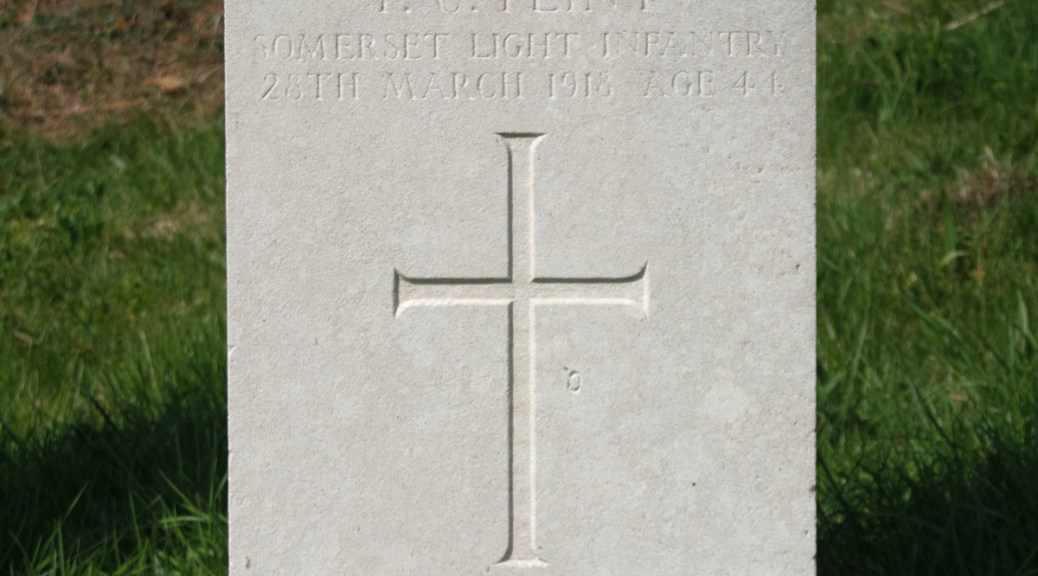
The next few years proved challenging for Frederick, as his illness left him incapacitated. He was nursed through by Florence, but eventually his body could take no more. He succumbed to the condition on 28th March 1918, at the age of 45 years old.

Frederick Charles Flint was laid to rest in the graveyard of St Nicholas’ Church in Radstock. Florence passed away ten years after her husband; she was laid to rest in the same plot in the summer of 1928.


Serjeant Frederick Flint (from findagrave.com)

Colour Serjeant Major Frederick Davis

Colour Serjeant Major Frederick Davis

Frederick Davis was born in Street, near Glastonbury, in February 1876. One of four children, his parents were Frank and Ann. Frank was an agricultural labourer, while Ann worked as a shoe binder in the local Clark’s Factory.

By the 1891 census, Frederick had left school, and had also left home, boarding with a farmer in nearby Walton, where he also worked as a labourer on the farm. Ten years later, he was living with his paternal grandmother and his older brother in the village, with both brothers working as labourers.

During this time, it seems that Frederick had his sights on bigger and better things. Full details are not available, although it appears that he enlisted in the Army and served in India and South Africa between at least 1897 and 1902. He was awarded the Distinguished Conduct Medal in 1902 for his actions, although again little information around this survives.

Confirmation of his service overseas at this time appears on Frederick’s later military service records as, in January 1909, he again enlisted in the army. Frederick’s 1909 records show that his next of kin was his wife, Mrs AL Davis, although no marriage documents are apparent. He is also recorded as living in Castle Cary, just to the south of Glastonbury.

This time he was assigned to the 4th Battalion of the Somerset Light Infantry, serving for five years on home soil. During this time, he rose through the ranks from Private to Lance Corporal to Corporal to Sergeant.

When war was declared, the 4th Battalion was sent out to India. Sergeant Davis spent the next eighteen months there, before being moved to the Persian Gulf. He was obviously well thought of as, with the move came a further promotion, this time to Company Sergeant Major.

In June 1917, Frederick returned to England from overseas, and, at the end of his term of service two months later, he was demobbed. He returned home to Somerset, but, within a couple of months, on 2nd October 1917, he passed away. The cause of his death is not recorded, but he was 42 years of age.

Frederick Davis was laid to rest in the peaceful surrounds of the Castle Cary Cemetery.


Major Stafford Douglas

Major Stafford Douglas

Stafford Edmund Douglas was born on 4th January 1863, the second of four children to Stephen and Mary Douglas. Stafford came from a military family, his father having been a Captain in the Royal Navy. This led to a lot of travelling and, having been born in Donaghadee, County Down, he then moved to South Wales.

By the 1880s, when Stephen and Mary had set up home in Portsmouth, Stafford had started to carve out a career for himself, and was a Lieutenant in the Argyll and Sutherland Highlanders, based at Edinburgh Castle.

Over the coming years, Lieutenant Douglas, who stood 5ft 8.5ins (1.74m) tall and also spoke French, travelled the world, serving in South Africa, Ceylon (Sri Lanka) and Hong Kong. By 1894 he had made Captain, and he finally retired in 1903, after nineteen years’ service.

On 29th April that year, at the age of 40, Stafford married Mary Louisa Harris. She was the daughter of an army colonel, and the couple wed in St George’s Church, Hanover Square, London. The couple set up home in Exeter, Devon, and went on to have two children – Violet and Stafford Jr.

At this point, Stafford’s trail goes cold. When war broke out in 1914, he was called back into duty, working as a Railway Transport Officer in Norwich. He continued in this role until 1919, before being stood down and returning home.

Stafford Edmund Douglas passed away on 15th February 1920, at the age of 57 years old, although no cause of death is immediately apparent. He was laid to rest in the Milton Road Cemetery in Weston-super-Mare, presumably where his family were, by this time, residing.