Category Archives: Suffolk

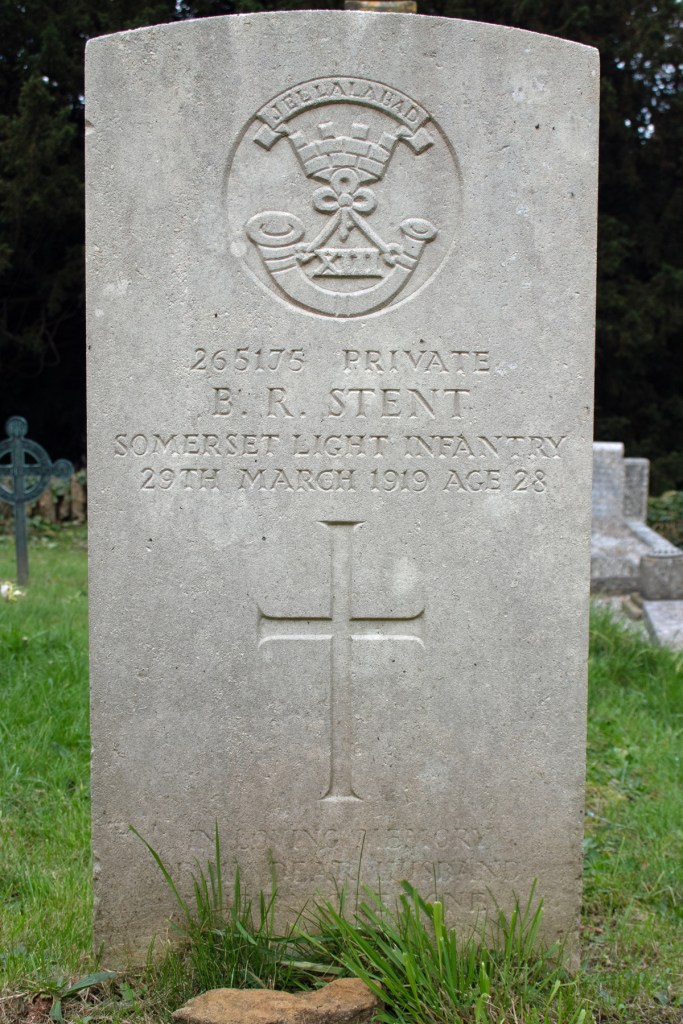
Private Bertie Stent

Private Bertie Stent

Bertie Reginald Stent was born early in 1892, one of fifteen children to Henry and Emily. Henry was a painter – initially for the railways, and then a house painter – from Frome, Somerset, and the family were raised on The Mint in town.

When he left school, Bertie also left an overcrowded home. He found work as a carter, and moved to Wellow, near Bath, where he boarded with stonemason Albert Barnes and his family. War was coming to Europe, however, and things were about to change.

Bertie enlisted in the 85th Provisional Battalion of the Territorial Force early on in the conflict. He was initially based on home soil, serving in Herne Bay in Kent and Wrentham in Suffolk. His troop became the 11th Battalion of the Somerset Light Infantry at the start of 1917 and, by the spring of the following year, he found himself in Northern France.

By this point, Bertie had met and married a woman called Ethel May. Sadly, little further information about the wedding is available, but the couple set up home in the same road as his parents and went on to have two children.

Private Stent was involved in some of the final battles of the war – the Battle of Albert and the advances in Artois and Flanders. When the Armistice was signed, he remained in France, returning home in the following spring.

Tragically, he had contracted influenza while waiting to be demobbed and, on 29th March 1919, he passed away at home from pneumonia. He was just 27 years old and had been back in Frome for just a week.

Bertie Reginald Stent was laid to rest in the churchyard of Holy Trinity Church in Frome, within sight of his family home.


While there is little information about Bertie and Ethel’s marriage, there is some detail about her life after her husband’s death. Ethel continued to live in Frome, on the same road as her marital home. The 1939 Register lists her as an unpaid domestic worker – in effect, a housewife – and she is living with Reginald, her and Bertie’s second child, who was a land worker.


Bertie’s sister, Annie, married Albert Withey, who also died after coming home from war. Read his story here.

Captain Fergusson Barclay

Captain Fergusson Barclay

Fergusson Barclay was born in Cheltenham, Gloucestershire, towards the end of 1877 and was the oldest of six children. His father, Henry, was a retired army captain, and so it is of little surprise that Fergusson and his siblings had something of a privileged upbringing.

The 1881 census recorded Henry and his wife, Agnes, bringing up the family in Tenby, South Wales. With three children under four, the Barclays employed two live-in nursemaids to support them.

Ten years later, the family had moved to Weston-super-Mare, Somerset, living in a large house to the north of the town centre. With five children now living at home, Henry and Agnes found additional help was needed: they were now employing a governess, manservant, cook and a housemaid. The family were not alone in this support: the 1891 census shows that all of the Barclays’ neighbours had at least one domestic servant.

The new century turned, and a new census followed. Captain Barclay and his family were still living in their three-storey Victorian villa in Weston-super-Mare. By this point, however, only three of the children were still living at home. Fergusson, now 23, was working as an architect, his brother Herbert was a legal professional, and his sister, Hermione, also still lived there. The house was not empty, however, as the Barclays’ retinue of staff remained. By this point, they were employing a gardener, groom, coachman, parlour maid, cook, kitchen maid and house maid. Agnes, who was around 20 years younger than her husband, also had a live-in companion, spinster Helen Empson.

Little had changed for the family when the next census was recorded in 1911. Henry was by now 84 years old, and he and Agnes had been married 34 years. Fergusson and Herbert were still living at home, fully immersed in their jobs. Helen was still providing companionship for Agnes, and the family still employed four members of staff: butler Daniel O’Brien and his wife, Jesse, who was the cook; parlour maid Rosie Davies and house maid Edith Booden.

In March 1912, Henry passed away, and it was inevitable that things would change for the Barclay household. Fergusson had been a volunteer for the Royal Engineers since the late 1890s and had steadily worked his way up through the ranks. With the outbreak of war, he found himself called into a more formal role.

Full details of his military career are not evident, but it is clear that, by the spring of 1918, Fergusson had gained the rank of Captain. He joined the Royal Air Force and was assigned to 75th Squadron.

On the afternoon of 7th December 1918, Captain Barclay took off from Elmswell Aerodrome in Suffolk, when the engine of his Avro 504K aircraft cut out. He attempted to turn the plane to land, but it nosedived into the ground and Fergusson was seriously wounded. He was taken to hospital, and died of his injuries later that day. He was 40 years old.

Captain Fergusson Barclay’s body was taken back to Somerset – he lies at rest in the Milton Road Cemetery in Weston-super-Mare, walking distance from his family home.


Captain Fergusson Barclay
(from findagrave.com)

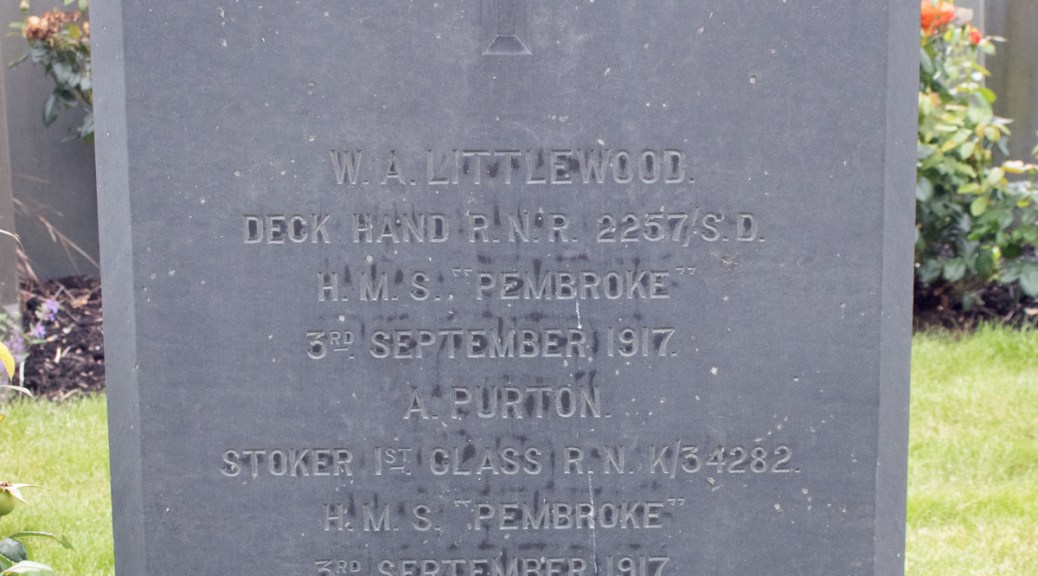
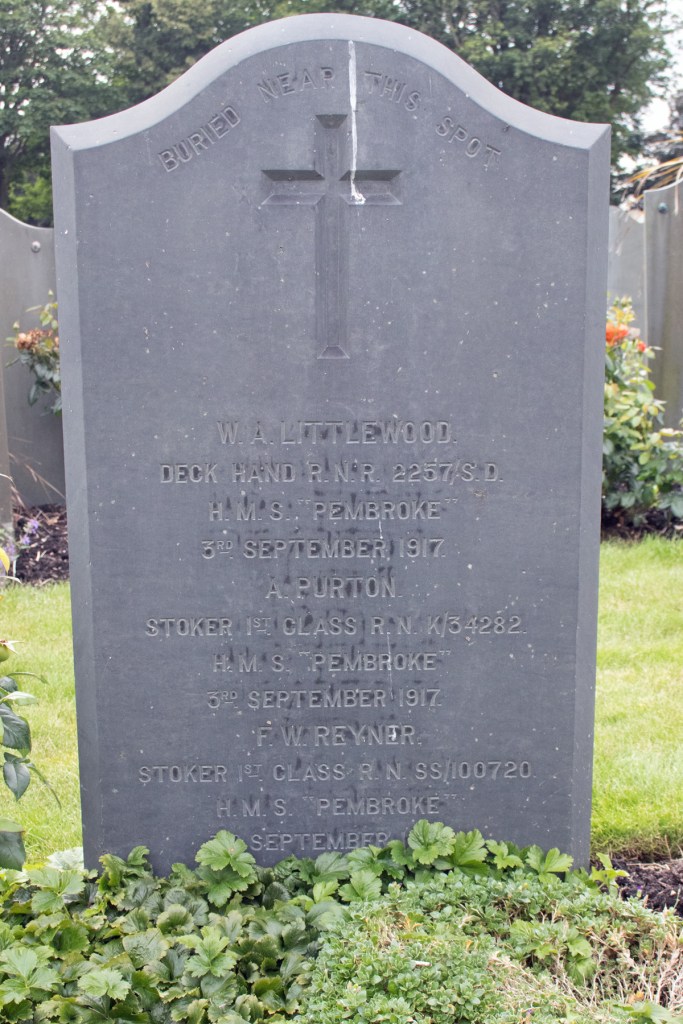
Deck Hand William Littlewood

Deck Hand William Littlewood

William Alfred Littlewood was born on 19th April 1882, the oldest of four children to Henry and Mary. Henry was a labourer for the gasworks in Great Yarmouth, Norfolk, and the couple raised their family in the town.

William also found work with the local gasworks, and this is who he was employed by when, on 19th December 1903, he married Evelyn Harriet Youman. The couple set up home near the centre of the town, and went on to have four children.

When war broke out, William was keen to play his part. On 17th August 1914, he enlisted as a Private in the Army Service Corps and, within a couple of week, was in France. He spent six months on the Western Front, before returning to home soil. The reason for this return to England was an inflammation of the middle ear, and the resulting deafness led to his discharge from the army in June 1915.

William was not to be deterred, however, and within a matter of weeks, he had enlisted again, this time volunteering for the Royal Naval Reserve as a Deck Hand. Over the next two years, he served on a number of different ships, each time returning to HMS Pembroke, the Royal Naval Dockyard in Chatham, Kent.

In August 1917, Deck Hand Littlewood disembarked HMS Acteon, and returned to his shore base. The Dockyard was particularly busy that summer, and the large number of extra servicemen meant that William was billeted in temporary accommodation in Chatham Drill Hall.

On the 3rd September 1917, the first night air raid carried out by the German Air Force bombarded the town, and scored a direct hit on the Drill Hall; Deck Hand Littlewood was among those killed instantly. He was 35 years of age.

William Alfred Littlewood was laid to rest, along with the other victims of the Chatham Air Raid, in the Woodlands Cemetery, Gillingham. Tragically, the Navy Death Records state that he was Buried as unidentified in one of the following graves: 516, 522, 642, 735, 935, 937 or 948.


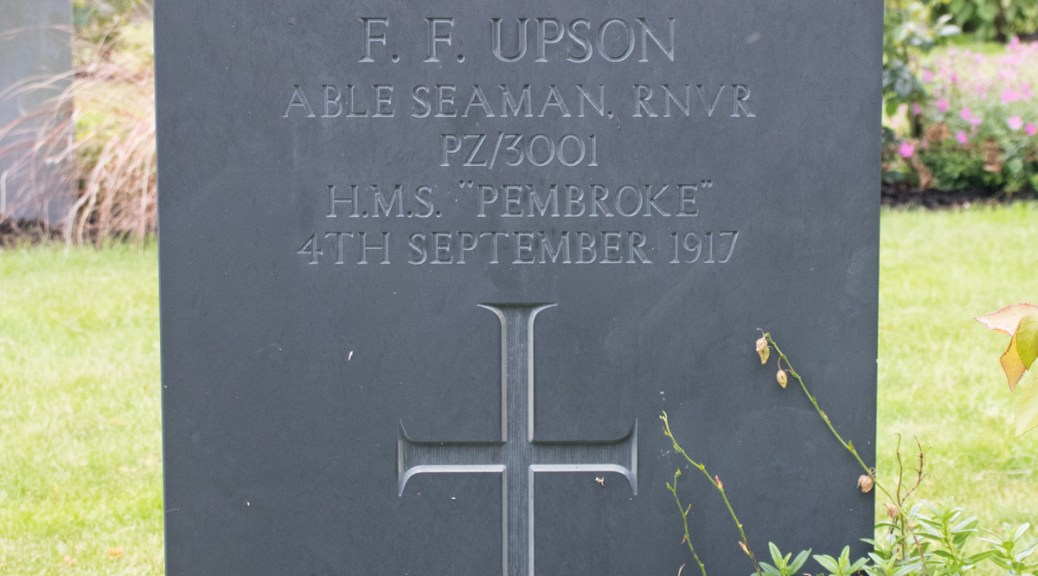
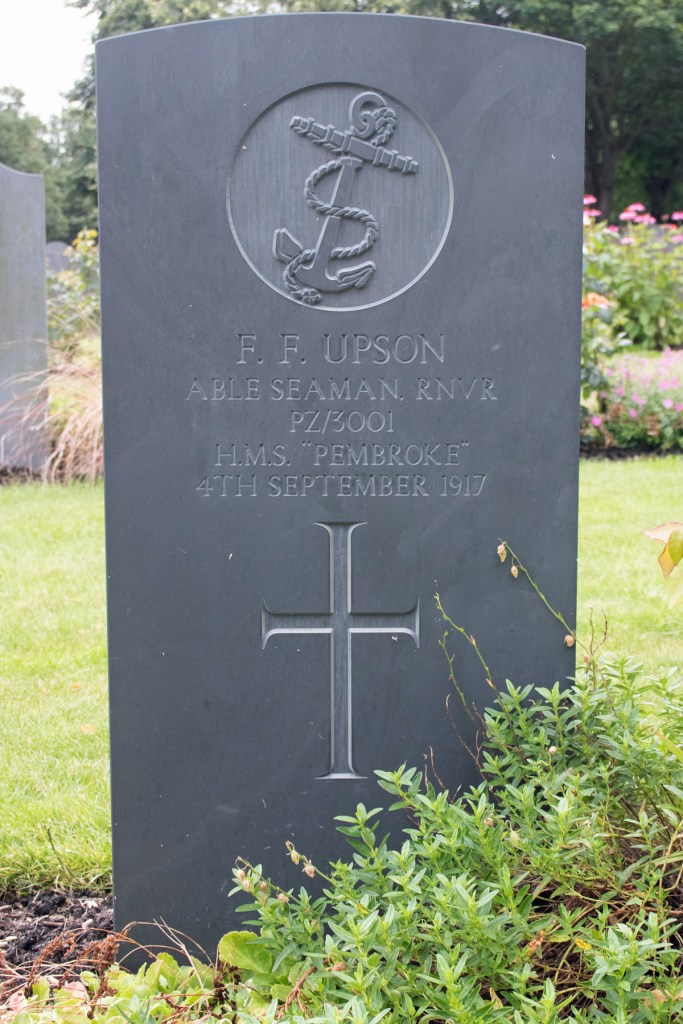
Able Seaman Frederick Upson

Able Seaman Frederick Upson

Frederick Frank Upson was born in Woodbridge, Suffolk, on 4th June 1897 and was one of eight children to Frederick and Mary Upson. Frederick Sr was an agricultural labourer and horseman, and when he left school, his soon took on a shepherding role on the same farm.

With the war raging, and the port of Ipswich not far from home, Frederick Jr seemed destined for a life at sea. In June 1915, having turned 18 years old, he enlisted in the Royal Navy as an Ordinary Seaman. His service records show that he stood 5ft 6.5ins (1.69m) tall, had brown hair, grey eyes and a fair complexion.

Frederick’s first posting was at HMS Vivid, the training base at Devonport, Devon. He spent a couple of months there, before being given his first ocean-going assignment on board the scout cruiser HMS Blonde. Ordinary Seaman Upson was on board for just over a year, and was promoted to Able Seamen during his time there.

In January 1917, he returned to shore, and was transferred to HMS Pembroke, the shore-based establishment at the Royal Naval Dockyard in Chatham, Kent. The base was particularly busy that year, and temporary accommodation was set up in the Drill Hall; Frederick found himself billeted there for the summer.

On the 3rd September 1917, the German Air Force carried out one of its first night-time air raids on England: Chatham was heavily bombed and the Drill Hall received a direct hit. Able Seaman Upson was badly injured and died of his wounds in hospital the following day. He was just 20 years of age.

Frederick Frank Upson was laid to rest, along with the other victims of the Chatham Air Raid, in the Woodlands Cemetery, Gillingham.


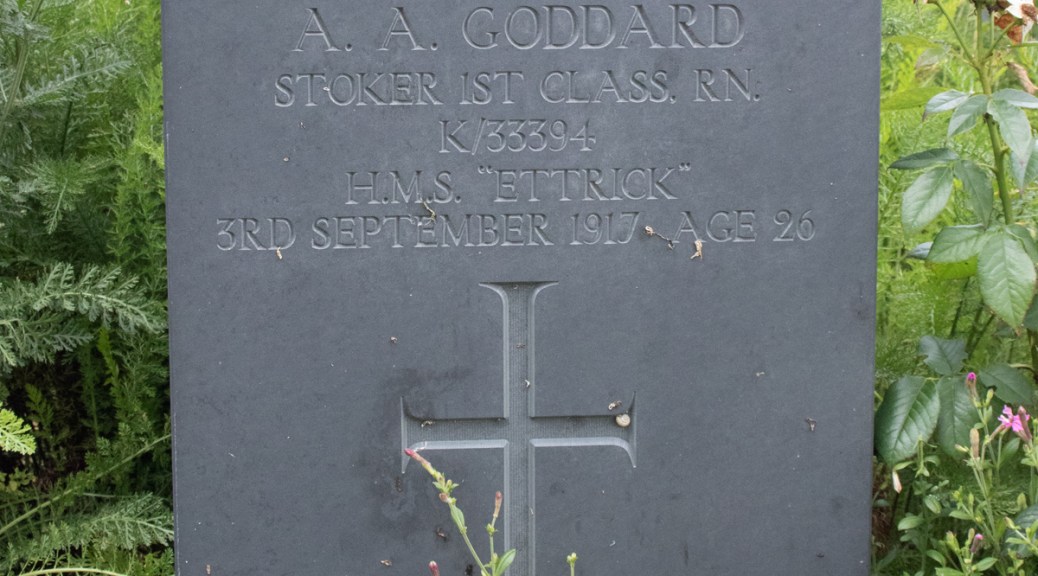
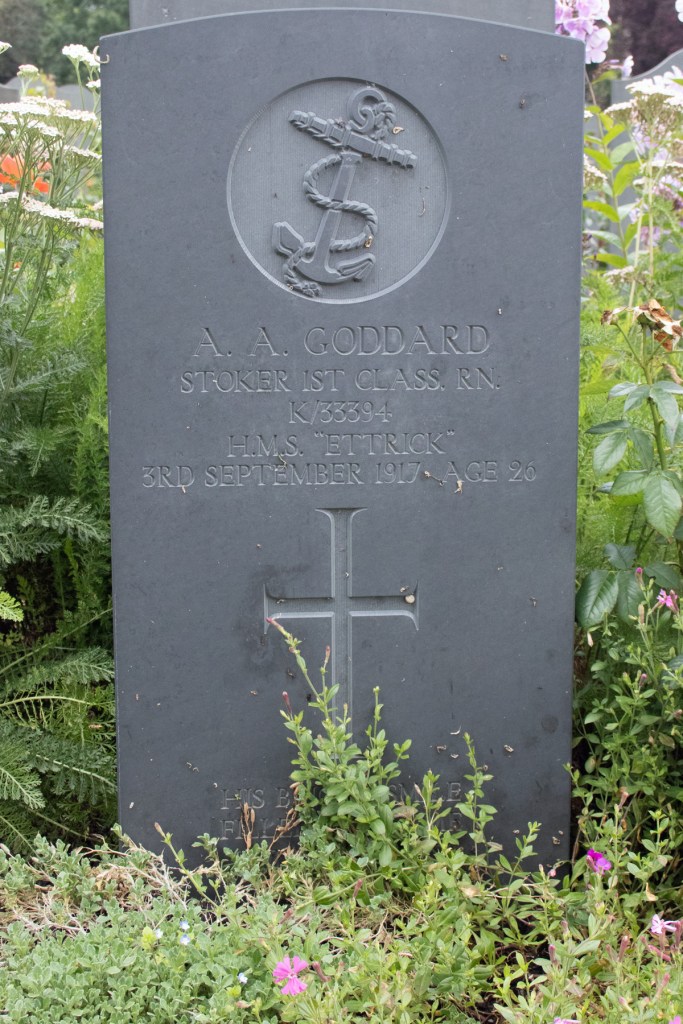
Stoker 1st Class Albert Goddard

Stoker 1st Class Albert Goddard

Albert Alfred Goddard was born on 7th April 1891, and was the oldest of seven children. His parents were Suffolk born and bred Alfred and Ellen Goddard, and it was in the village of Saxtead where Alfred – and then Albert and his brothers – worked as farm labourers.

War was coming to Europe and, when the call came, Albert took his place amongst the many. He enlisted in the Royal Navy on 24th May 1916, joining as a Stoker 2nd Class. His service records confirm that the stood 5ft 5.5ins (1.66m) tall, had brown hair, blue eyes and a fair complexion.

Stoker Goddard was initially sent to HMS Pembroke – the Royal Naval Dockyard in Chatham, Kent – for his training. After six months, he transferred to HMS Victory – the Portsmouth Naval Base – where he spent nearly a year, and gained promotion to Stoker 1st Class.

In August 1917, he was again assigned to HMS Pembroke. Chatham’s Dockyard was particularly busy that summer, and Albert was billeted in temporary accommodation in the base’s Drill Hall.

On the 3rd September 1917, the first night air raid carried out by the German Air Force scored a direct hit on the barracks and Drill Hall; Stoker 1st Class Goddard was killed instantly. He was just 26 years old.

The local newspaper reported that “the recent air raid at Chatham has brought grief to our locality. Mr and Mrs Alfred Goddard, of Saxtead, were officially notified that their sailor son was among those who were killed; they journeyed to London on Wednesday, and were present a their son’s funeral on the following day.” [Framlingham Weekly News: Saturday 8th September 1917]

Albert Alfred Goddard was laid to rest, alongside the other victims of the Chatham Air Raid, in the Woodlands Cemetery, Gillingham.


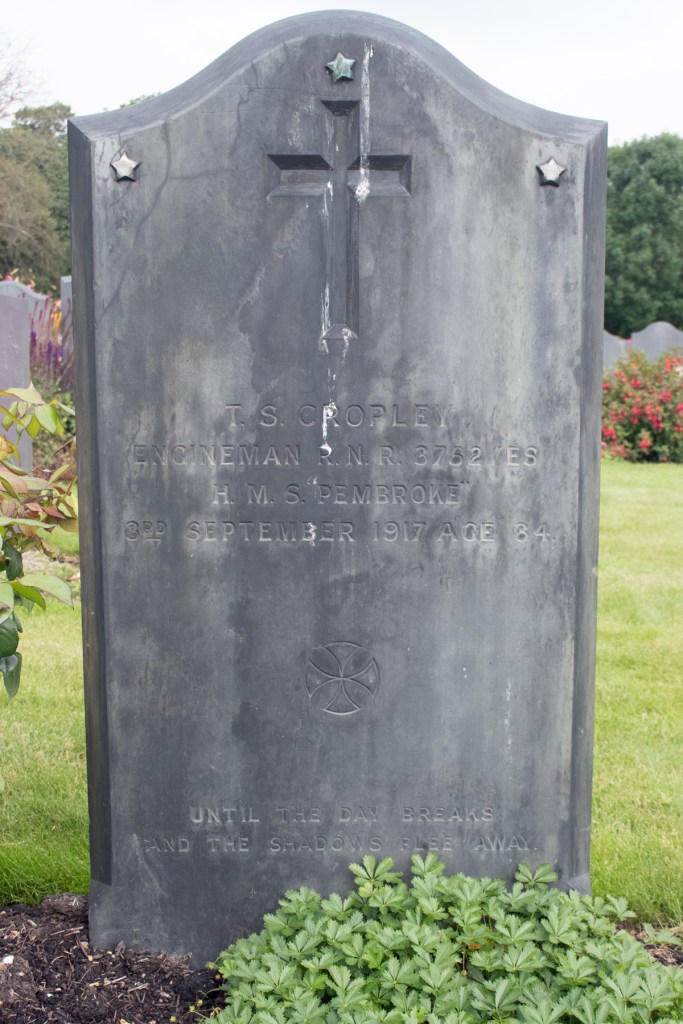
Engineman Thomas Cropley

Engineman Thomas Cropley

Thomas Samuel Cropley was born on 16th November 1882 in the Suffolk village of Mutford. The fifth of eight children, his parents were Robert and Hannah Cropley. Given Mutford’s proximity to the Hundred River Hundred and the coastal town of Lowestoft, it is little surprise that Thomas’ father was a ropemaker. Hannah was also employed, the 1901 census recording her as a monthly nurse – helping women during the month after childbirth.

Thomas’ location to the coast made fishing an ideal choice of work for him, and when he left school he followed his three older brothers into the trade. Indeed, he listed his trade as a deep sea fisherman on his marriage records.

As a young man, he had met bricklayer’s daughter Edith Tuttle, and they tied the knot on 29th May 1906. The couple set up home in Factory Street, Lowestoft, and went on to have seven children.

Sadly, little information on Thomas’ wartime service remains documented. His knowledge of boats and the sea made the navy an obvious option for him, and he enlisted in the Royal Naval Reserve.

Engineman Cropley was assigned to HMS Pembroke – this Royal Naval Dockyard at Chatham in Kent. While it is likely that he served on ships as well, this is certainly the base to which he returned.

Thomas found himself based here in the summer of 1917, which was a particularly busy place at that point in the war. Additional accommodation was desperately needed and he found himself billeted at Chatham Drill Hall, away from the main barracks.

By 1917, the German Air Force had suffered huge losses during the daylight bombing raids it had been undertaking. It was imperative for them to minimise these losses, and so a new tactic – night time raids – was employed.

The first trial of this approach was on the night of 3rd September 1917, and Chatham suddenly found itself in the firing line, startlingly unready and fundamentally unprotected. One of the German bombers landed a direct hit on the Drill Hall, and Engineman Cropley was killed. He was just 34 years old.

Ninety-eight servicemen perished during the Chatham Air Raid that night. They were buried in a mass funeral at the Woodlands Cemetery in nearby Gillingham. This, too, is where Thomas Samuel Cropley was laid to rest.


The lives of Thomas’ family outlines a lot about living conditions in the late nineteenth and early twentieth centuries, with a large number of his relatives dying young.

His father was 68 when he died in 1916; Hannah had passed away fourteen years before, when she was 56 years old. Of his siblings, two did not survive childhood, one died their 20s, one was aged 40, while three reached their late sixties.

Thomas’ widow died in 1921, at the age of 35; their two youngest children died before their first birthdays. Of the other five, one was 31 when he died, while the others lived much longer – one was in their mid-70s, two in their eighties, and the oldest reached her hundredth birthday. A varied legacy indeed.


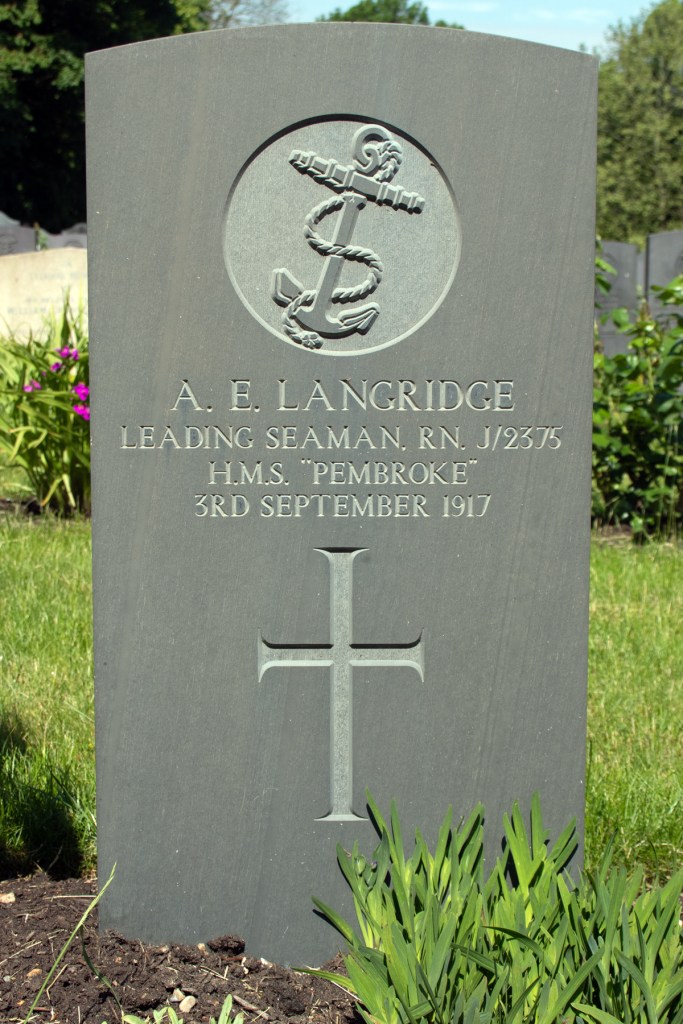
Leading Seaman Archibald Langridge

Leading Seaman Archibald Langridge

Archibald Edward Langridge was born on 9th November 1892, one of six children – and the only son – to Edward and Jane Langridge. Edward was a labourer from Sevenoaks, who raised his young family in the town. Archibald had ideas of bigger adventures, however.

In August 1908, he joined the Royal Navy. Still underage – he was only 15 years old – he was granted the rank of Boy 2nd Class and was sent off to HMS Ganges – the naval base in Suffolk – for training.

Within a year, Archibald had been promoted to Boy 1st Class, and was soon assigned to his first ship, HMS Berwick, an armoured cruiser. After three months on board, he was assigned to HMS Pembroke, the shore-based establishment at the Royal Naval Dockyard in Chatham, Kent, and it was here that he returned to in between voyages.

His next sea assignment was the battleship HMS London, which he joined on 8th February 1910, and where he spent two years. During this time Archibald turned 18, and was formally enlisted in the Royal Navy, attaining the rank of Ordinary Seaman. His service records show that he was 5ft 2ins (1.57m) tall had light hair, blue eyes and a fresh complexion. They also show that he had a scar below his right eye and another on the back of his head. He also had a number of tattoos – a woman’s head, good luck and horseshoe on his right forearm and a cross and star on his left.

Ordinary Seaman Langridge’s naval career continued and, by the time hostilities broke out in 1914, he had served on two more ships – HMS Antrim and HMS Boadicea – and had been promoted to Able Seaman.

When war was declared, Archibald was serving on Boadicea, a ship on board which he spent a total of three years. He was again promoted during this time, reaching the rank of Leading Seaman.

By the spring of 1916, he was back serving in Chatham. Archibald had met Gladys Godfrey, who came from his home town, and the couple married in Sevenoaks in May. They went on to have a son, George, who was born in March the following year.

Leading Seaman Langridge was now permanently based at HMS Pembroke, and spent spent nearly eighteen months at the dockyard. HMS Pembroke was a busy place in the summer of 1917, and its barracks reached capacity. Chatham Drill Hall was used as temporary accommodation, and this is where Archibald found himself billeted.

By this point in the war, the German Air Force was trying to minimise the losses it suffered during daytime raids, and was, instead, trialling night flights; on 3rd September 1917, Chatham found itself in their flight path. The Drill Hall received a direct hit, and Leading Seaman Langridge was killed, along with close to 100 others. He was just 24 years old.

The victims of the Chatham Air Raid were laid to rest in Woodlands Cemetery, Gillingham, walking distance from the Drill Hall where Archibald Edward Langridge and his colleagues had died.


There is a sad epilogue to this tale. Four months after Archibald’s death, Gladys gave birth to their second child, Charles. He would never know his father.


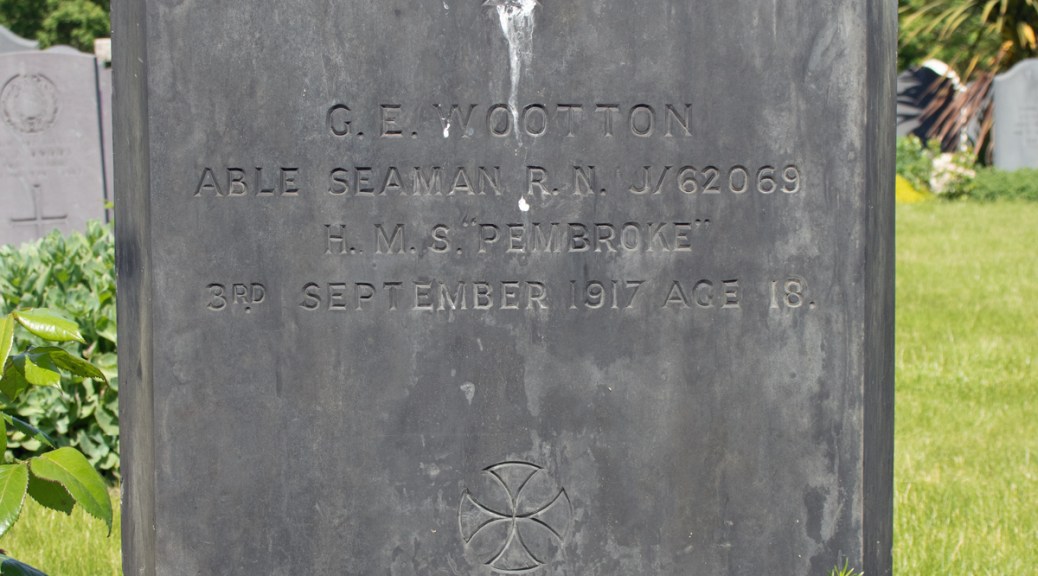
Able Seaman Gregory Wootton

Able Seaman Gregory Wootton

Gregory Ernest Wootton was born on 28th October 1898, the only child of Henry and Isabella Wootton. The family lived in East London, and the year of Gregory’s birth was a challenging one. His parents married that year, and Henry also passed away, leaving Isabella to raise her son on her own.

She was made of stern stuff, however, and moved back in with her father, Joseph, while finding employment as a florist, working with artificial flowers. By 1909, Isabella had remarried, wedding policeman Harry Mee, and moving to South London, where the couple had a child of their own, Gregory’s half-brother, Leonard.

War was edging close to Europe, although Gregory was underage when hostilities broke out. By late 1916, however, this was no longer the case, and he was drawn to the Royal Navy. On 6th November, he gave up his job as a case maker, and enlisted as an Ordinary Seaman. His sign-up papers show that he stood 5ft 4ins (1.62m) tall, had brown hair, brown eyes and a fresh complexion.

Ordinary Seaman Wootton’s first posting was at HMS Pembroke, the shore-based establishment at the Naval Dockyard in Chatham, Kent. After a couple of months, he was moved north, to HMS Ganges, which was a similar training base in Suffolk. While here, he was promoted to Able Seaman.

In June 1917, Gregory was on the move again, returning to Chatham. While here, at a particularly crowded time for the dockyard, he was billeted at the nearby Drill Hall. On the night of the 3rd September, while resting, the first German night raid dropped bombs on Chatham, directly hitting the Drill Hall. Able Seaman Wootton was killed instantly. He was just 18 years of age.

Gregory Ernest Wootton was laid to rest in the Woodlands Cemetery in nearby Gillingham. He was buried with the other 97 victims of the Chatham Air Raid.


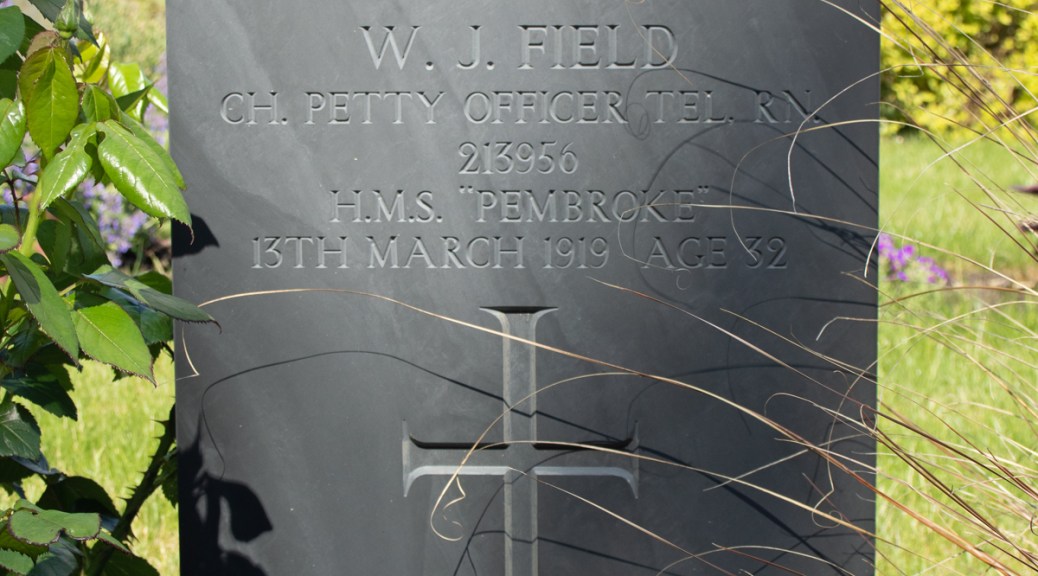
Chief Petty Officer Telegraphist William Field

Chief Petty Officer Telegraphist William Field

William John Field was born on 8th October 1885 in Boston, Lincolnshire. The eldest of four children, his parents were Charles and Ellen. Charles was a boatman for the coastguard; his job, by the time of the 1891 census, had taken the family to the village of Dawdon on the County Durham coastline.

Given his father’s job, it is not unsurprising that William was destined for a life at sea. As soon as he left school in the spring of 1901, he joined the Royal Navy and was sent to HMS Ganges, the shore-based training establishment in Suffolk. Being underage, he was initially assigned the role of Boy, moving, after a year, to HMS Pembroke, also known as the Naval Dockyard in Chatham, Kent.

By November 1902 Boy Field was moved to HMS Venerable, a ship that was to be his home for the next three years. During this time, William came of age, and was formally enrolled in the Royal Navy as a Signalman. He evidently worked hard on the Venerable, rising through the ranks to Qualified Signalman and Leading Signalman.

In June 1905, William was moved to HMS Leviathan, where he was again promoted, to Second Yeoman of Signals, before again being assigned to Chatham Naval Dockyard six months later.

While based in Kent, William met Nelly Watt, the daughter of a labourer at the dockyard. The couple married in 1906, and went on to have four children.

Over the next few years, the now Petty Officer Telegraphist Field spent an almost equal amount of time at sea and on shore. War was coming and when his initial term of service came to an end in October 1915, he immediately renewed his contract through to the end of the hostilities.

All of William’s time was now spent on land, primarily at HMS Pembroke, but also at HMS Actaeon in Portsmouth, HMS Victory VI at Crystal Palace, London and HMS Bacchante in Aberdeen.

While Chief Petty Officer Telegraphist Field’s naval service records are quite detailed, his passing is anything but. The war over, he moved back to Chatham Dockyard in January 1919. At some point he was admitted to the Royal Naval Hospital in the town, and died from ‘disease’ on 13th March that year. He was just 33 years of age.

William John Field was laid to rest in the Woodlands Cemetery in nearby Gillingham.


A sad aside to the story is that, at the time of he husband’s death, Nellie was pregnant with the couple’s fourth child. John William Field was born on 16th October 1919, destined never to know his father.


Petty Officer William Coughlan

Petty Officer William Coughlan

William Henry Coughlan was born on 16th November 1891, one of thirteen children to William and Catherine Coughlan. William Sr was a labourer, born and bred in the East End of London, who raised his family in Hackney.

William Jr seemed keen for a way to improve himself and in May 1909, enlisted in the Royal Navy. Initially given the rank of Boy, this was due to his age; on his eighteenth birthday a few months later, he was formally enrolled in the navy as an Ordinary Seaman.

To begin with, he was billeted at HMS Ganges II, the shore-based training ship in Harwich, Suffolk, but within a matter of weeks he was on board a sea-going destroyer, HMS Antrim.

Ordinary Seaman Coughlan was obviously a keen young man; by the time the Great War broke out, he had served on four further ships, as well as another shore base, HMS Pembroke I. He rose through the ranks to Able Seaman and, by 1915, had reached the role of Leading Seaman.

Most of his service was spent upon HMS Agamemnon, initially in the Channel, but was then moved to the Mediterranean. On the night of the 5th May 1916, the ship was moored in the harbour at Thessaloniki (Salonika). A Zeppelin, the LZ55, made a bombing raid, but when the searchlights caught it, the Agamemnon fired on it and hit the aircraft, breaking it in two. It crashed in the swamps around the Vardar river and its crew were captured.

Leading Seaman Coughlan remained on the Agamemnon, before returning to England in November 1917, where he received further training at the Naval Dockyard in Chatham. He was promoted to Petty Officer a couple of months later, and began three years of shore- and ship-based service.

In the summer of 1921, while again based in Chatham, he contracted pneumonia, succumbing to the lung condition in a matter of weeks. Petty Officer Coughlan died on 26th July 1921, aged just 29 years old.

William Henry Coughlan was laid to rest in the Woodlands Cemetery in Gillingham; within walking distance of the naval base that had become his home.