Category Archives: Surrey

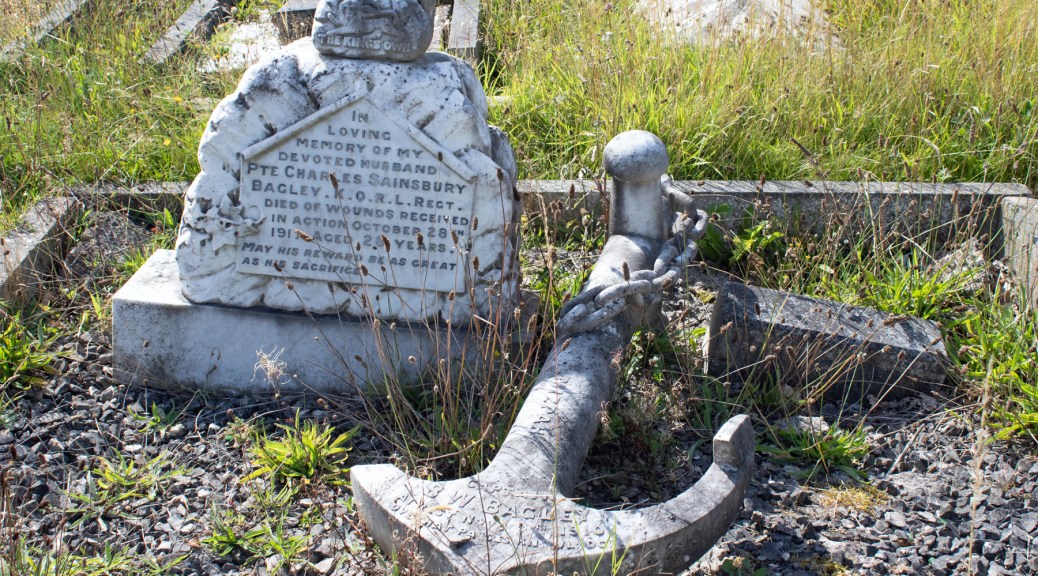
Private Charles Bagley

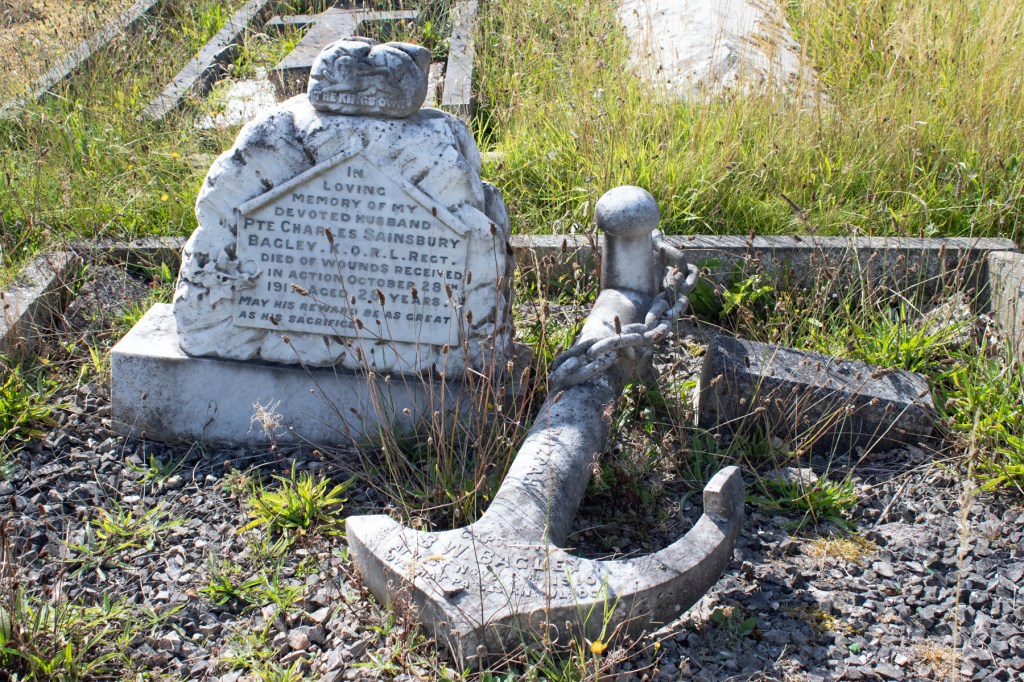
Private Charles Bagley

Charles Sainsbury Bagley was born in the autumn of 1889, one of eleven children to Benjamin and Jane Bagley. The couple’s early life was an intriguing one: they had both been born in Shoreham-by-Sea, West Sussex. The 1891 census recorded the couple living on board the barque Mizpah, with their three oldest children. Benjamin was the vessel’s master and there were ten other members of crew on board.

By the time Charles was born, the family had returned to shore and settled in Minehead, Somerset. By now Benjamin was working as a hairdresser and tobacconist on Park Street near the centre of the town.

Benjamin died in 1910, but left a thriving business to support Jane. At least three of the Bagley siblings went into hairdressing, while Charles’ older brother, Joseph, set up a bakery and confectioner’s in the town with his wife. Charles is absent from the 1911 census, although later records would suggest that he had moved to Lancashire, where he was also working as a hairdresser.

On 3rd July 1915, Charles married Celia Rogers in Lancaster. War was raging across Europe at this point and, in August 1916, he enlisted in the army. His service records confirm that he was 5ft 7.5ins (1.71m) tall and weighed 128lbs (58kg). Private Bagley joined the 5th Battalion of the King’s Own (Royal Lancaster Regiment) and by the end of the year he was on the Western Front, based around the Ypres salient.

The early part of 1917 proved relatively quiet for Private Bagley’s troop. At the end of July, however, he was caught up in the battle of Pilkem Ridge, and was shot in his left leg. Initially treated on site, the wound was severe enough for him to be medically evacuated to Britain for treatment.

Charles was admitted to the Royal Surrey County Hospital in Guildford, but his wounds were to prove to be too severe. He passed away on 28th October 1917, at the age of 27 years old.

The body of Charles Sainsbury Bagley was taken back to Somerset for burial. He was laid to rest in the family plot in Minehead Cemetery, reunited with his parents, Jane having died at the beginning of 1917. The seafaring headstone paid homage to his father’s maritime service.


Lance Corporal Henry Rowell

Henry Edward Rowell was born on 22nd May 1898 in Southwark, Surrey. One of five siblings, of whom only three survived childhood, his parents were Henry and Jane Rowell. Henry Sr was a bricklayer’s labourer from Southwark, and the family were brought up in a small terraced house on Brandon Street, Walworth.

When he finished his schooling, Henry Jr found work as a turner’s improver but, when war came to Europe, he was called upon to play his part. He enlisted on 29th May 1915, and, as a Private, was attached to the 12th (Service) Battalion (Bermondsey) of the East Surrey Regiment. His service records tell a little of the man he was, confirming that he stood 5ft 3.5ins (1.61m) tall, and suggesting that he gave his age a 19 years old (he was just 16 at the time).

Henry seemed to have made an impression on his superiors as, in early October, he was promoted to Lance Corporal. His early service was based on home soil, primarily in Witney, Surrey.

In December 1915, Henry was temporarily released from military duty for munitions work. Sent to work for the engineering company Peter Hooker Ltd, in Walthamstow, Essex, Lance Corporal Rowell was to remain here for the next four months. On 25th March 1916, however, he was called back to service, as his battalion readied itself to move from its base, by that point in Aldershot, Hampshire, to Northern France.

Lance Corporal Rowell found himself in the thick of things very quickly. From 1st July, the 12th Battalion was caught up in the Battle of the Somme, and he remained entrenched there for the next couple of months.

On 15th September 1916, the British launched an attack on the German front line at Flers-Courcelette, mid-way between Albert and Bapaume. Lance Corporal Rowell was involved in the battle, which lasted until the end of the month, and was cut down on the very first day. He was just 18 years of age.

Henry Edward Rowell was laid to rest in the Bulls Road Cemetery in Flers, Picardie.


Henry Edward Rowell was my paternal grandmother’s first cousin.


Ordinary Seaman Walter Nipper

Ordinary Seaman Walter Nipper

Walter Henry Nipper was born on 21st September 1900 in Bleadon, Somerset. The oldest of four children, his parents were Gilfred and Rose Nipper. Gilfred was an agricultural labourer turned butcher and poultry dealer, and, by the time of the 1911 census, he had set up a retail business in the middle of the village.

Walter turned to farm work when he finished his schooling, but with war raging across Europe, he seems to have been one of the young men desperate not to miss out on the action. On 16th September 1918, just five days before he turned 18, Walter enlisted in the Royal Naval Volunteer Reserve. His service records confirm that he stood just 5ft 1.5ins (1.56m) tall, had black hair, hazel eyes and a fresh complexion. The document also noted that he had a scar on the back of his right hand.

Ordinary Seaman Nipper was sent to HMS Victory VI, the shore-based training vessel in Crystal Palace, Surrey, for his induction. It is likely that, when he left Somerset for the capital, that was the last time his parents saw him. Billeted in cramp barracks, with young men from across the country, Walter fell ill: he passed away on 10th October, just 24 days after joining up. He was barely 18 years of age.

Walter Henry Nipper’s body was brought back to Somerset for burial. He was laid to rest in the tranquil graveyard of St Peter and St Paul’s Church in his home village.


Serjeant Thomas Wood

Serjeant Thomas Wood

Thomas Wood was born in Bristol, Gloucestershire, in the summer of 1862. The third of ten children, he was the oldest son to Thomas and Emma Wood. Thomas Sr was a cabinet maker, but his son was not to follow in his father’s footsteps, seeking a life of adventure instead.

Thomas enlisted in the army and, while documents relating to his early life are not readily available, the 1891 census recorded him as being billeted at the Cambridge Barracks in Portsmouth, Hampshire. A member of the Royal Artillery, he seems to have been enlisted for a while, as he had risen to the rank of Corporal.

In 1894, Thomas married Leah Barrett, who was born in Oxfordshire. The army life underscored where the family would settle. They had four children and, according to their ages, the Woods were in Liverpool by 1895, Gosport, Hampshire, in 1896 and Cork in Ireland by 1899. The 1901 census found the family living in Wicklow, with Thomas having now achieved the rank of Company Sergeant Major.

Ten years later, and Thomas had stepped away from the army life. Now 48 years of age, he and Leah had been married for 17 years. The couple had settled in the Worle, on the outskirts of Weston-super-Mare, Somerset, where Thomas had set himself up as a butcher, with Leah assisting him.

War came to Europe in 1914, and it seems that Thomas felt drawn to play his part once more. He joined the Royal Defence Corps as a Serjeant when it was formed in the spring of 1916, and was assigned to the regiment’s 263rd Company.

Little information is available about Serjeant Wood’s army service, but by the autumn he had been admitted to the Shell Shock Hospital (now the Maudsley Hospital) in Denmark Hill, London. His entry to the hospital, however, was actually due to kidney disease, and this was what would claim his life. Thomas died from a combination of nephritis and uraemia on 21st November 1916. He was 54 years of age.

Thomas Wood was brought back to Somerset for burial. He was laid to rest in the graveyard of St Martin’s Church in Worle.


Serjeant Thomas Wood
(from ancestry.co.uk)

Private Hamlyn Perham

Private Hamlyn Perham

Hamlyn Horwood Perham was born in the autumn of 1872, one of seven children to William and Margaret. William was a solicitor from Wrington in the north part of Somerset, but it was in the village of Flax Bourton that the family settled.

Expectations were high for Hamlyn, who was the Perhams’ oldest son: the 1881 census found him boarding as a student in a private school in Weston-super-Mare. Ten years later, he was back home, but listed as a law student. The 1901 census recorded him as living with his family, but a practicing solicitor, presumably alongside his father (who, the document notes, was a solicitor and a Lieutenant Colonel in the Somerset Light Infantry).

Colonel WE Perham, the commanding officer of the 3rd Volunteer Battalion Somerset Light Infantry, had just been retired, after a connection with the corps dating from the year 1861, when he joined as a private. His retirement will occasion within the regiment universal regret, for he deservedly held the esteem and respect of all ranks. That Colonel Perham was well qualified to command is shown by the high state of efficiency in which he leaves the 3rd Battalion. He had taken the higher examinations, and in tactics passed with distinction. An officer who has worked through all grades from private to commander should, indeed, be a practical administrator and leader, and Colonel Perham was essentially both, and his knowledge of military matters singled him out for the important divisional and other commands. Latterly he was foremost in organising officers’ rides through the West Country – an instruction much valued at the War Office.

Somerset Standard: Friday 15th February 1907

The next census, taken in 1911, found Hamlyn still living with his parents and older sister. The family were supported by three live-in staff: a cook, a parlour maid and a housemaid. Hamlyn’s younger brother, Herbert, had also followed their father into law and, according to the same census, had set up a practice in Nailsea, where he lived with his wife of three years.

When war came to Europe, Hamlyn quickly stepped up to play his part. He enlisted in the Royal Fusiliers as a Private, and was assigned to the 23rd Service Battalion, also known as the 1st Sportsmen’s. Based at a camp in Hornchurch, Essex, Private Perham’s service was not to be a long one. He contracted meningitis, and was admitted to the South Western Hospital in Southwark. Sadly, the condition was to get the better of him: he died in hospital on 20th February 1915, at the age of 42 years old.

Hamlyn Horwood Perham’s body was brought back to Somerset for burial. He was laid to rest in the family plot in St Michael’s Church, Flax Bourton.


Stoker Petty Officer Henry Cordas

Stoker Petty Officer Henry Cordas

Much of Henry John Cordas’ early life is destined to remain a mystery. The first record for him is the 1881 census, which gives is his address as St Mary’s Orphanage in Heston, Middlesex, where he was one of 650 children.

The 1891 census recorded Henry as living in Humber Street, Grimsby, Lincolnshire, right next to the town’s docks. He is noted as being a fisherman, and is married to a woman called Mary, who was born in Deptford, Surrey.

The next available census record for Henry adds confusion to his story. The document, dating from 1911, confirms that he and Mary are now living in Hotwell Road, Bristol, Gloucestershire, again within spitting distance of the docks. Henry was employed as a marine fisherman in the merchant service. The document suggests that the couple had been married for ten years, and give Mary’s place of birth as Swansea, Glamorganshire.

While the document matches previous information for Henry, it seems unlikely that the Marys in the 1891 and 1911 censuses are one and the same. Either way, the couple were sharing their house with Mary’s niece, Ellen.

Henry seems to have joined the merchant fleet in a more official capacity in the autumn of 1900. His records show that he was 5ft 11ins (1.8m) tall, with blue eyes and a fair complexion. He served out of Bristol and, in the years leading up to the outbreak of war, he was assigned to a number of ships, travelling the Atlantic to Montreal and Jamaica, amongst other far-flung places.

When hostilities commenced, Henry was assigned to the Royal Naval Reserve. Over the next few years, he served on a number of ships, including the armoured cruisers HMS Suffolk and HMS Doris. He worked as a Stoker, but by the end of the conflict had been promoted to Stoker Petty Officer.

In December 1918, Henry’s service came to an end. He was, by now, based at HMS Vivid, the Royal Naval Dockyard in Devonport, but his health was suffering. Medically discharged with a combination of chronic bronchitis and rheumatic pain, he seems to have returned to Bristol.

On 6th December 1920, Henry was admitted to Bath War Hospital in Somerset, as he was coughing up blood. The plan was to transfer him to Greenwich Hospital in Surrey, but he suffered an aneurysm before that move could be made. He passed away on 11th December 1920, at the age of 50 years old.

The body of Henry John Cordas did not travel far for burial. He was laid to rest in the peaceful expanse of Bath’s Locksbrook Cemetery.


Private Maurice Chapman

Private Maurice Chapman

Maurice Chapman was born in the summer of 1883 in Newington, Surrey (now in the London borough of Southwark. The younger of two children, his parents were Charles and Jessie Chapman. Charles was a horse collar maker and, by the time Jessie passed away in 1899, Maurice was following in his father’s footsteps.

Maurice sought a bigger career, however, and, on 6th April 1899, he enlisted in the Royal Artillery. His service records show that he was 5ft 6ins (1.68m) tall, and that he weighed 118lbs (53.5kg). In the section relating to any distinguishing marks, it was noted that his eyebrows met, he had a scar on his forehead and two tattoos, one on each forearm.

Maurice’s military career was not to be a lengthy one. He was recorded as being absent without leave on 18th May, and docked 6 days’ pay. Admitted to a hospital in Woolwich on 26th May, he spent a week there, suffering from scabies. On 27th July, Maurice was formally discharged from the army, when it was discovered that he had lied about his age: on his enlistment papers, he stated he was 18 years 7 months old (he was, in fact, just sixteen.

Returning to the family home, Maurice took up his father’s trade once more. Charles remarried in 1905, to a woman called Rosa. The 1911 census found the two living in two rooms in a house in Kennington Lane, but of his children, there is no sign. Maurice does not appear on any of the 1911 census records. It is also not possible to track down his older sister Charlotte either, there are a number of Charlotte Chapmans in the that year’s records, and it is also unclear whether she had married by this point.

Maurice only reappears on 1st March 1916, when he stepped up to serve his King and his Country. Initially signing up for the Labour Corps, he wasn’t formally mobilised for eighteen months. Maurice gave his profession as a barman, but also noted that he had served for two years in the 2nd Battalion of the Dragoon Guards, before being discharged in 1904, although there is no other record to corroborate this.

Private Chapman’s service records provide some, but not a lot of, information. There is no record of him spending time overseas, but he spent ten months with the Labour Corps, before transferring to the Tank Corps on 30th August 1918. Over the next year-and-a-half, he moved between a couple of the regiment’s depots and their reserve unit, and remained on active service long after the Armistice was signed.

Maurice remained on active service with the Tank Corps until November 1920, when he was medically discharged. He had been unwell for a while by this point, and a combination of diabetes and a perineal fistula meant that he was no longer physically fit enough to serve.

It is likely that Maurice was in the War Hospital in Bath, Somerset, when he was discharged, as this is where he passed away, on 22nd December 1920. He was 37 years of age.

Maurice Chapman did not travel far to his final resting place. He was buried in the grounds of the Locksbrook Cemetery in Bath, Somerset.


Private Henry Wiggs

Private Henry Wiggs

Henry Wiggs was born in Camberwell, Surrey, in the autumn of 1880. One of eleven children, his parents were dock labourer Thomas Wiggs and his wife, Sarah.

When he finished his schooling, Henry also took up labouring work and, by the time of the 1911 census, was working as a partition block maker in the building trade. The census shows him a living with his brother William and his family.

On 3rd August 1913, Henry married Blanche Hill. She was eight years older than Henry, and the daughter of a Sergeant in the Royal Horse Artillery. Blanche had been widowed ten years earlier, and had four children, who Henry took on as his own.

At this point, Henry’s trail goes cold. When war broke out, he stepped up to play his part, initially joining the Worcestershire Regiment. At some point he was transferred to the Royal Berkshire Regiment, subsequently becoming attached to the Labour Corps.

Details of Private Wiggs’ military service are lost to time, and it is unclear whether he served on the Home Front or overseas. He survived the war, and was discharged from the army on 13th March 1919. He was suffering from heart disease, directly attributable to his military service.

Again, Henry falls off the radar at this point. He and Blanche made the move to Somerset, setting up home in Weston-super-Mare. His heart problem seems to have dogged him, however, and likely caused his admission to a hospital in Bath towards the end of 1920. It was in the city that he passed away, on 28th December 1920, at the age of 40 years old.

Henry Wiggs’ body was not brought back to Weston-super-Mare for burial – the cost of doing so may have been too much for the now twice-widowed Blanche to afford. Instead, he was laid to rest in the sweeping Locksbrook Cemetery in Bath.


Private William MacPherson

Private William MacPherson

William George MacPherson was born in the township of Greenway, Huron County, Ontario, on 24th September 1893. The eighth of nine children, his parents were farmer Edmund Macpherson and his wife, Sarah, who was better known by her middle name, Keren (short for Kerenhappuch).

Edmund was the fourth generation of the family to be born in Canada, his maternal great grandfather having emigrated from Scotland to Nova Scotia in the late 1770s. Sarah was the first generation of her family to be born in North America, her parents having moved there in the 1850s.

After he finished his schooling, William followed his father into farming. When war broke out in Europe, the Empire was called upon to serve their King. On 7th January 1916, William enlisted in the Canadian Expeditionary Force. His service records show that he was 5ft 6.5ins (1.69m) tall and weighed 150lbs (68kg). He was noted a having dark hair, brown eyes and a dark complexion.

Private MacPherson set sail from Halifax on 22nd August 1916, and arrived in Liverpool eight days later. His troop was based in Witley, Surrey, and it was here, while attached to the 125 Battalion of the Canadian Infantry, that William spent the winter.

On 23rd May 1917, Private MacPherson was transferred to the 4th Battalion, and set sail for France. He was to spend the summer at Ypres, where he encountered some of the bloodiest fighting of the conflict. William was not to be unscathed, and was wounded in his shoulder and neck on 6th November 1917.

William was initially treated at the No. 2 State Hospital at Abbeville. Dangerously ill, though, he was medically evacuated to Britain, on board the Hospital Ship Essequibo, from Le Havre to Shornescliffe. Private MacPherson was quickly moved to Somerset, and was admitted to the Bath War Hospital. Tetanus set in, and he died of his wounds on 21st December 1917. He was 24 years of age.

With his family thousands of miles away, William George MacPherson was laid to rest in the Locksbrook Cemetery in Bath, not far from the hospital in which he had breathed his last.


Captain John Cooper

Captain John Cooper

John Bruce Cooper was born on 21st July 1869 in Croydon, Surrey. He was the oldest of eight children, all but one boys, to John and Maria Cooper. John Sr was a boot and shoe manufacturer whose business, by the time of the 1881 census, was employing around 600 people.

By 1901, the business was doing well. The family had moved to Northamptonshire, and were living at Delapré Abbey, on the outskirts of Northampton. They were now supported by fourteen servants living on site, while grooms, coachmen and gardeners were housed on the estate.

John Sr died in August 1906, while Maria passed away less than six months later. Their children, now aged between 25 and 37, went on to live their separate lives. Five of John Jr’s brothers remained in bootmaking, in Leicestershire, Northamptonshire and Surrey, while one of them, Philip, took holy orders. John, however, sought a different route.

In April 1907, John married Violet Mary Gordon in Kensington, London. She was the daughter of a general in the Indian Army, and had been born in Simla. The couple settled in a house in Basingstoke, Hampshire, and went on to have two children: Thomas and Richard. The 1911 census records the family residing in Daneshill Cottage, with two live-in domestics. By this point John was noted as being a dealer in motor cars.

When war broke out, John felt duty bound to serve his country. Little information about his military career remains documented, but a contemporary newspaper report of his funeral provides some indication of his service.

Captain Bruce Cooper… was formerly an officer of Territorial [Royal Army Medical Corps], being transport officer of the 2nd South-Western Mounted Brigade, and was stationed at Frome [Somerset]. Obtaining a commission in the [Army Service Corps], he was promoted captain, and was so proficient and zealous that he became Officer Commanding Vehicles at Bulford Camp, where he was held in the greatest esteem.

Bath Chronicle and Weekly Gazette: Saturday 27th November 1915

Captain Cooper fell ill in October 1915, and was suffering from phlebitis, or inflammation the veins. This was to prove fatal, and he passed away at the family home in Bath, Somerset, on 21st November 1915. He was 46 years of age.

John Bruce Cooper was laid to rest in a family plot in the cemetery of Bath Abbey. His older son, Thomas was laid to rest with him, when he passed away in 1949. Violet was reunited with her husband and son when she was buried with them in 1972.


Captain John Cooper (from ancestry.co.uk)