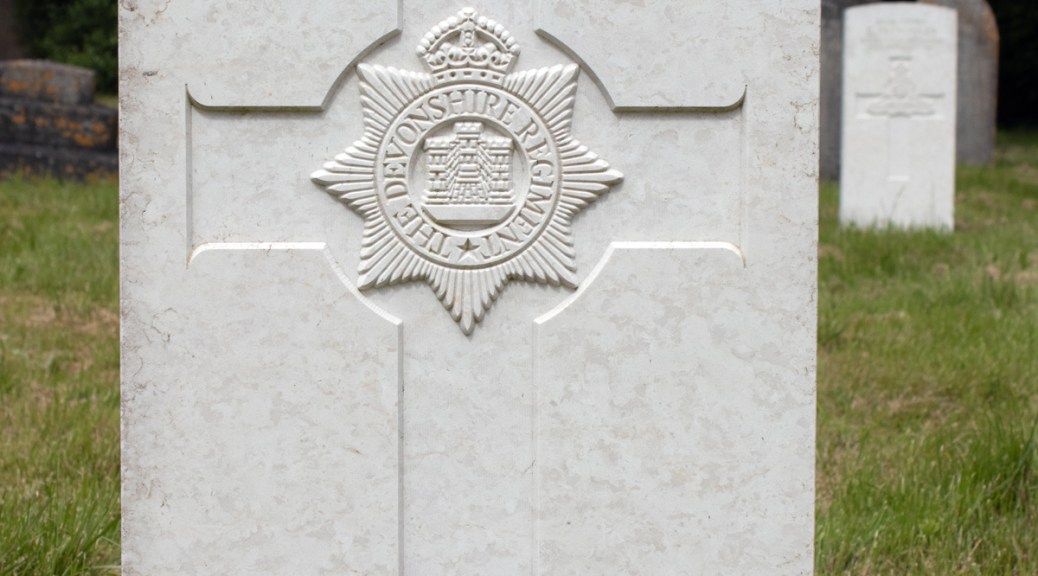
John Samuel Channing was born in Axminster, Devon, in 1884, the oldest of four children to John and Elizabeth. John Sr was a bricklayer’s labourer, and, when Elizabeth died in the late 1890s, he struggled to look after the whole family.
The 1901 census found John Sr and his two youngest children living with his widowed mother, while John Jr and his sister Sarah were sent to live with their maternal grandmother, widow Mary Telford. Both were of age to leave school, and both were employed: Sarah as a lace mender, John Jr as a nail brush finisher.
John Jr married a woman called Elizabeth in 1910. There is little additional information available about her, but by the time of the following year’s census, the young couple were boarding with an Eliza Banks in Silver Street, close to the centre of the town. John was employed as a toilet brush maker, adding that they were bone nailbrushes. Within the year, Elizabeth gave birth to their only child, son Leslie.
In addition to his brushwork, John had also enlisted in the local militia. He joined the Devonshire Regiment on 1st April 1908, although his service details are lost to time. Private Channing’s unit – the 4th Battalion – were based around Exeter, but, when war was declared, they moved to India. There is no evidence, however, that John went with them: promoted to the rank of Lance Corporal, it is likely that his experience was better used on the Home Front, training new recruits.
John’s wartime experience was not to be a lengthy one, however. By 1st April 1915, he had been medically discharged from service, having contracted tuberculosis. At this point, Lance Corporal Channing’s trail goes cold, but it is likely that he returned home to Elizabeth and Leslie.
The next record for John is that of his passing. He died from tuberculosis at home on 29th December 1918: he was 34 years of age.
John Samuel Channing was laid to rest in Axminster Cemetery, a short walk from where his widow and son still lived.
Thomas Fidler was born on 15th May 1881 in Newbury, Berkshire and was the fourth of eight children to Charles and Sarah. Charles was a groom, who travelled where the work was, and, by the time of the 1901, the family has relocated to Whitchurch in Hampshire.
When he finished his schooling, Thomas found work as a dairyman. However, he had always had his sights on bigger and better things, and, having been a volunteer for the local militia, he was keen to become a full soldier. Things did not go immediately to plan though, and he was initially turned down because he was under height – he was just 5ft 3ins (1.6m) tall when he turned 18.
But Thomas was persistent, and, on 27th June 1898, he was formally enrolled in the Hampshire Regiment. Along with his height, his service records confirm other details about the young man he had become. The document show that he weighed 124lbs (56.2kg), and that he had brown hair, brown eyes and a fresh complexion. The records advise that he was considered fit for duty, but also note that he was given special authority to enlist, presumably to bypass the concerns about his height.
Private Thomas Fidler would go on to build up quite a military career for himself. He spent nearly two years on home soil, before his unit was shipped out to South Africa. During his time in the colony, he served in a number of the campaigns, and was awarded with the Queen’s South Africa medal, including clasps for Cape Colony, Orange Free State and Transvaal, and the King’s South Africa Medal 1901-1902.
After more than two years spent overseas, Thomas’ unit returned to Britain. He would remain on home soil until 1903, extending his service beyond the five compulsory years, and choosing to remain on active duty, rather than being stepped down to reserve status. In September of that year, his unit was on the move again, and he was transferred to Malta.
It would not be until September 1905 that Private Fidler saw home soil again. He was formally stood down from duty the following June and assigned to the Army Reserve. Interestingly, his transfer papers recorded that his conduct was indifferent, disobedient… inclined to drink.
Thomas’ attitude over the years was evidenced by his entries in the Regimental Defaulter Book. He was disciplined no fewer than twelve times during his military career. His offences included being absent from parade and using insubordinate language. While stationed in Malta, he was punished for being drunk four times. Over the years, Private Fidler spent 125 days confined to barracks, and was fined a total of £1 2s 6d for his crimes.
When he was not confined to barracks, Private Fidler would likely be found in a sick bay. Between January 1901 and September 1905, he spent 342 days in hospital with conditions ranging from fevers, psoriasis, scabies and gonorrhoea.
On 22nd March 1905, while serving in Malta, Thomas was admitted to hospital having suffered a fractured jaw following a scuffle. The cause of the injury is recorded in detail in an eleven-page report, which outlined that Private Fidler had been out in Valetta, and ended up quite drunk. He was approached by a couple of military police officers, and became abusive towards them. While trying to take off his boots, a private from another regiment, who was also drunk, came along and punched him in the face, fracturing his jaw. Both men were arrested and taken back to barracks. The investigation in to the incident found that, while Private Fidler was off duty at the time, he was to blame for the altercation.
In June 1906, Thomas returned to civvy street, and to his former job as a dairyman. On 5th February 1907, he married Tryphena Snook, who was the daughter of his employer. The couple had had a son the previous year, and would go on to have three more children in the next few years.
The 1911 census found the young family living in Sparsholt, Hampshire, the household being made up of Thomas, Tryphena and their older two children, Tryphena’s parents, William and Emma, and a boarder, William Clark, who was a carter on the farm.
By the summer of 1914, Thomas had been formally stood down from the army, his contract coming to an end on 26th June. A storm was brewing over the Channel, however, and he would soon be called upon to play his part once more.
Details of Thomas’ re-enlistment into the army have been lost to time. It is likely that he was called upon quite quickly. He was assigned to the South Wales Borderers, and, with the experience he had under his belt, was given the rank of Lance Corporal.
Thomas’ unit – the 4th (Service) Battalion – was initially sent to France, and he arrived there early in July 1915. Within a matter of weeks, however, the battalion moved on to the Eastern Mediterranean, ending up at Gallipoli.
Lance Corporal Fidler’s time in on the peninsula would have been fraught with danger. In the autumn of 1915, he was badly injured and was medically evacuated to Britain for treatment. Admitted to hospital in Devon, his wounds were to prove too severe, and he passed away on 5th November, at the age of 34.
The funeral rook place at Paignton… of Lance-Corpl. Thos. Fidler, of the 4th South Wales Borderers, who died at Oldway Hospital on Friday as a result of wounds sustained at Gallipoli. The widow and other mourners followed, and the Matron of the Hospital (Miss Blackmore) was among those present. Wounded convalescents from Oldway and a Company of the 7th Devons, under Capt. Brearley, attended, and the Devons provided a firing party.
[Exeter and Plymouth Gazette – Tuesday 09 November 1915]
Thomas Fidler was laid to rest in Paignton Cemetery.
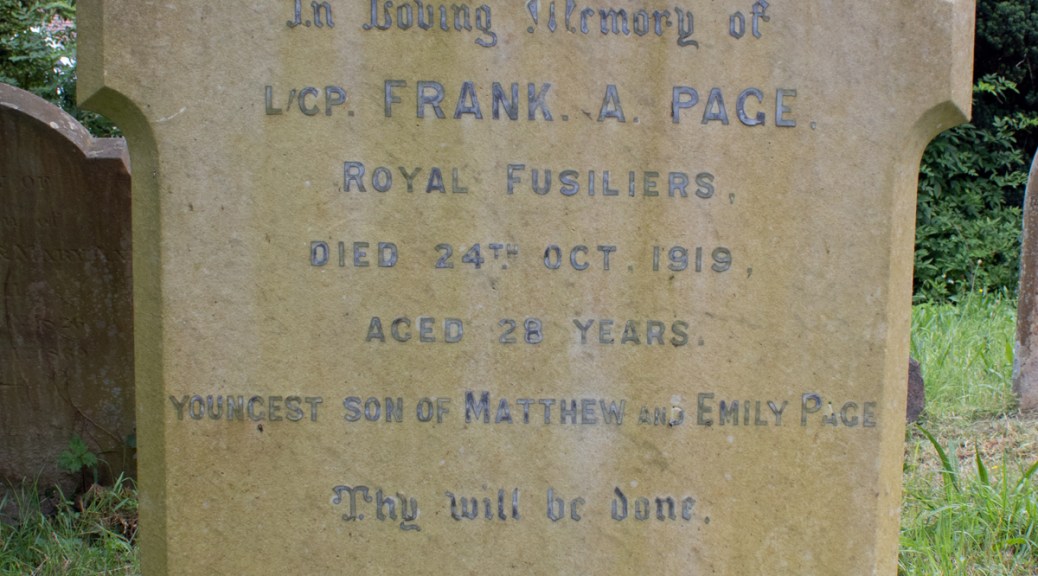
Frank Arthur Page was born early in 1891, and was one of seven children – and the youngest son – to Matthew and Emily Page. Matthew was a bricklayer’s labourer from Lancing in Sussex, while Emily had been born in Norfolk. It was in the village of Steyning, however, that the couple raised their family.
By the time of the 1901 census, Matthew had been invalided out of work. The family had moved to a small cottage in Lancing by this point, and Frank’s older brothers were working to bring in some money for the family.
The next census return, taken in 1911, found Matthew and Emily living Frank and his older brother Sydney at 2 Ivy Cottages in Lancing. Both of the Page siblings were working as market gardeners by this point, bringing in some money to help support the family.
War came to Europe in the summer of 1914, and Frank stepped up to serve his King and Country. Full details of his military service are lost in the mists of time, but it is clear that he enlisted in the Royal Fusiliers, and was attached to the 26th (Service) Battalion (Bankers).
Frank’s unit served in both France and Italy, although, without his documents, it isn’t possible to determine where, and for how long, he served. During his time in the army, however, he was promoted to the rank of Lance Corporal, underlining a level of dedication on his part.
Matthew passed away in the spring of 1917, and it appears that Frank was demobbed at some point after the Armistice. By the autumn of 1919, he was back in Sussex, living with his now widowed mother. His time in the army seems to have impacted on Frank’s health by this point, and he died ‘from disease’ on 24th October 1919. He was 28 years of age.
Frank Arthur Page was laid to rest in the graveyard of St James the Lesser Church in Lancing, not far from where his father had been buried.
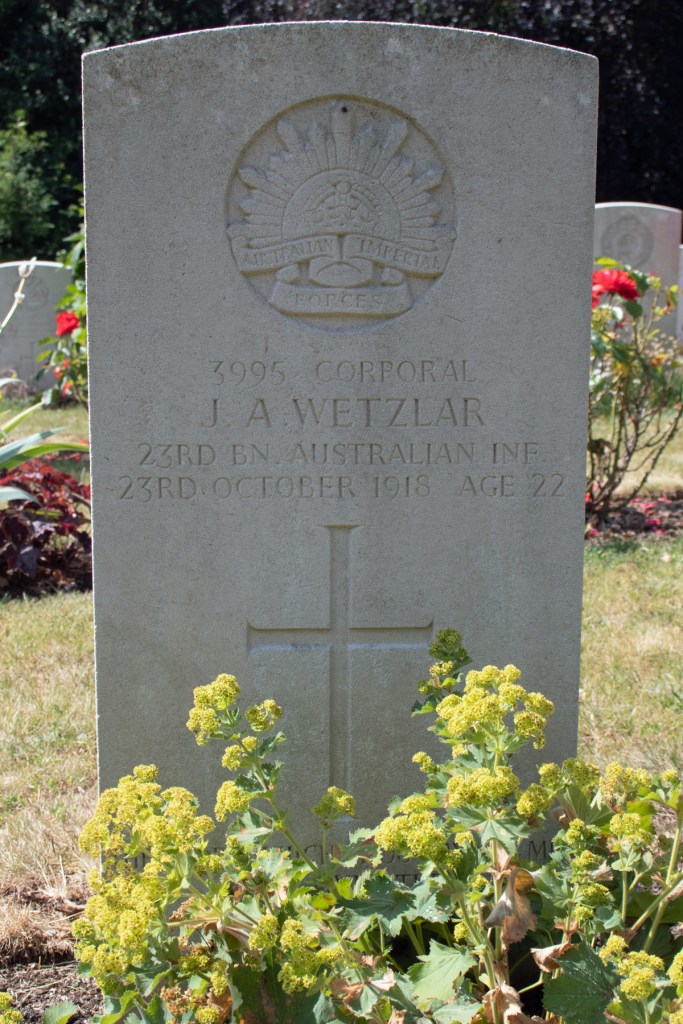
John Albert Wetzlar was born in Bendigo, Victoria, Australia, in the spring of 1895. One of four children, his parents were Ernest and Annie Wetzlar.
Little information about John’s life is available, and most of the detail that can be pieced together comes from his First World War service records. These confirm that he was working as a clerk when he enlisted on 14th July 1915. John’s medical record shows that he was 5ft 4.5ins (1.63m) and weighed 8st 5lbs (53kg). He had brown hair, blue eyes and a fresh complexion.
Private Wetzlar set sail for Europe on 8th February 1916, arriving with his unit in Alexandria, Egypt, six weeks later and landing in Marseille, France, on 31st March. Attached to the 23rd Battalion of the Australian Infantry, by the end of June, he found himself on the front line.
On 22nd August 1916, John’s unit was caught up in fighting, and he was wounded by shrapnel in his right leg. He was admitted to the 4th Australian Field Ambulance unit, before being transferred to the No 1. Canadian General Hospital in Etaples. His injuries required more care, however, and he was medically evacuated to Britain, and was sent to the 2nd General Hospital in Manchester.
Private Wetzlar spent the next six months recuperating, only re-joining his unit back in France on 10th March 1917. Back on the Western Front, he was promoted to Lance Corporal on 9th June, and to full Corporal four months later.
In January 1918, John was transferred back to Britain. Details are sketchy, but it may be that his experience was used to help train new recruits, as he was billeted at Tidworth Camp in Wiltshire. He remained on British soil until May, when he was sent to the Western Front for a third time.
Corporal Wetzlar’s time in France was to be fated. On 1st September 1918, John was wounded a second time, when he received a gun shot injury to his right leg once more. Medically evacuated back to Britain, he was admitted to Bath War Hospital in Somerset. The injury was severe enough to warrant an operation, and the damaged limb was amputated.
During his recovery, Corporal Wetzlar contracted influenza and pneumonia and, tragically, given what he had been through, these were to prove fatal. John died on 23rd October 1918: he was 22 years of age.
Thousands of miles from the home he had left nearly three years before, John Albert Wetzlar was laid to rest in the military section of Bath’s sweeping Locksbrook Cemetery, alongside other from his homeland.
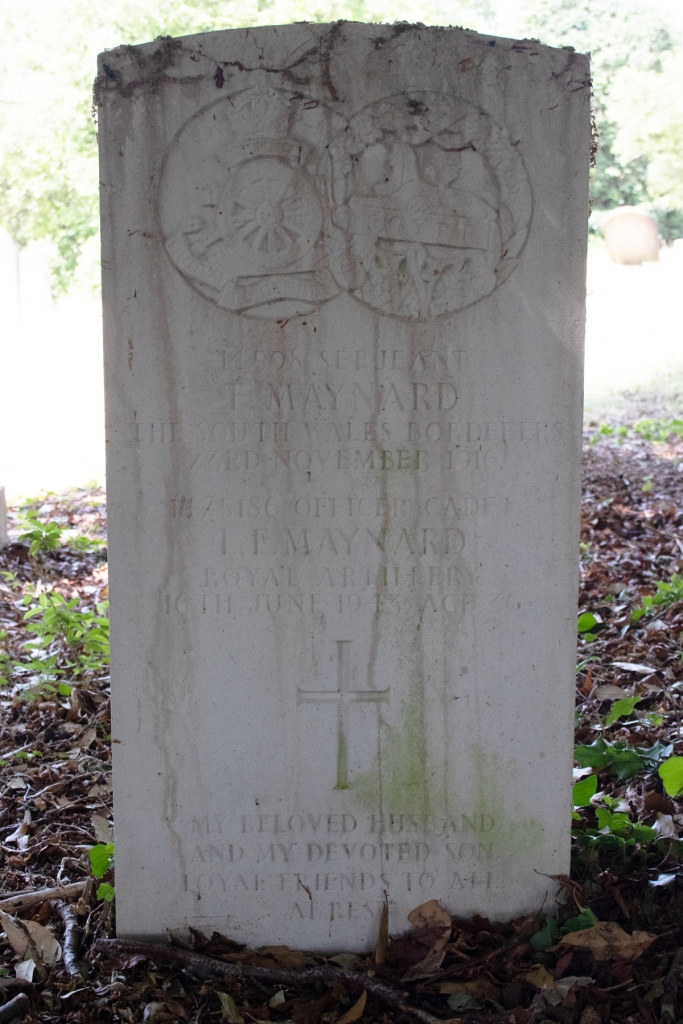
Details of Fred Maynard’s early life are a challenge to piece together. His First World War service records give his age as 44 years old when he enlisted in September 1914, and confirm his place of birth as Melksham, Wiltshire.
A newspaper report of his funeral gives the name of three brothers – Charles, Frank and Arthur – while only one census return, from 1881, provides a potential match for the family. This suggests Fred’s parents were iron fitter Alfred Maynard and his wife, Deborah, and gives the family’s address as Waterworks Road in Trowbridge.
Fred joined the army in the autumn of 1888. Initially assigned to the Gloucestershire Regiment, he had transferred to the Wiltshire Regiment by the following spring. Private Maynard showed a commitment to duty: in December 1890 he was promoted to Lance Corporal, rising to Corporal in the summer of 1893.
Fred was stood down to reserve status after his seven years’ active duty, but was recalled to the army in December 1899, when war broke out in South Africa. Promoted to Serjeant, he was sent to fight in the Boer War, and was mentioned in dispatches on 2nd April 1901 for special and meritorious service in South Africa. He was stood back down to reserve status in October 1901.
On 21st November 1895, Fred had married Louisa Card. The couple set up home in Trowbridge, but soon moved to London. They went on to have six children: Ernest, Nora and Leslie, who were all born in the London; and Arthur, Martha and Stuart, who were born in Cardiff, the family having moved to Wales by 1910.
The army was not finished with Fred, however, and, within weeks of war breaking out in the summer of 1914, he was called back into service. Given the rank of Serjeant again, he was attached to the South Wales Borderers. Fred was 44 years of age by this point, his service records confirming that he stood 5ft 8ins (1.73m) tall, weighed 164lbs (74.4kg) and had brown hair and hazel eyes.
Attached to one of the regiment’s depots, it seems unlikely that Fred saw service overseas this time around. He was discharged from the army on 1st September 1916 and this seems to have been on medical grounds. Later documents suggest that Serjeant Maynard had been diagnosed with carcinoma of the pylorus, or stomach cancer.
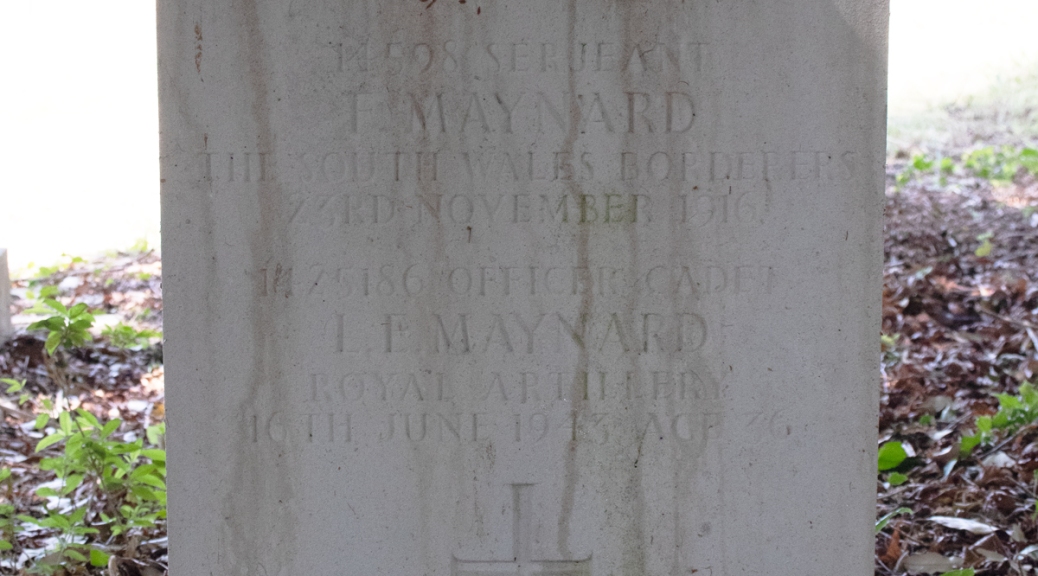
Fred returned to Cardiff, but his time back home was to be short. He was admitted to the Lansdown Road Military Hospital, and passed away on 23rd November 1916. He was 46 years of age.
It seems that Fred’s brother’s had some sway in his funeral. Instead of being laid to rest in Cardiff, where Louisa and the children were living, he was, instead, buried in the Locksbrook Cemetery, Bath, Somerset. His sibling Charles, who was a sergeant in Bath City Police, lived in the city, as did another brother, Frank.
Fred’s headstone also commemorates his and Louisa’s son, Leslie. He had joined the army in the 1920s and, in the summer of 1943, was in Yorkshire, undergoing officer training.
The death of an officer cadet through the accidental discharge of a rifle whose bolt had jammed was described at an inquest…
Captain WH Price said he was in charge of an exercise on the moors which involved the used of small arms and the firing of live ammunition. A squad of cadets lay on the ground in front of a trench firing over a range. All finished firing except Cadet Frank Holroyd, who said his bolt had hammed while firing a second round. [Price] told him to release the bolt by knocking the cocking piece up and back.
This attempt failed, and he told Holroyd to get back into the trench, turn the rifle magazine upwards, place the butt on the side of the trench, and kick the bolt down with his foot. While Holroyd was doing this he noticed Maynard standing in the trench about 4ft away from Holroyd and on his right-hand side.
Captain Price said he saw the rifle was pointing down the range when Holroyd kicked the butt. The cartridge suddenly exploded and Maynard dropped into the trench, shot in the head, and was dead when they reached him.
[Bradford Observer: Saturday 19th June 1943]
Officer Cadet Leslie Maynard was 36 years of age when he was killed. His body was taken back to Somerset for burial: he was laid to rest in the same grave as Fred, father and son reunited after 27 years.
Louisa remained somewhat elusive as time wore on. Fred’s military records confirm that she had moved from Cardiff to the Isle of Wight by 1922. By the time of her son’s death, she was living in Sidcup, Kent.
Much of George Fenn’s life is destined to be lost to time. Born in Bristol, Gloucestershire, in the summer of 1878, details of his parents are unknown. His was a common name in the late Victorian period, and census returns from the time identify at least two men born in the area around the same time.
The first document that can be directly connected to George is the 1911 census. This recorded him living at 13 Tankards Close in Clifton, where he was working as a dock labourer. His is noted as having been married to Minnie since 1902. The couple had one child, a son called William who was six years old.
When war broke out, George was quick to enlist. Full details of his service are lost, but he had certainly joined the Bedfordshire Regiment by the end of 1914. Attached to the 7th (Service) Battalion, by the start of the following year, his unit had moved to Salisbury Plain in anticipation of being sent to the Western Front.
George seems to have made his mark in the army, and he was soon promoted to the rank of Lance Corporal. In the spring of 1915, he contracted pneumonia, however, and was admitted to the military hospital in Codford, Wiltshire, close to where his unit was based.
Sadly, the condition was to prove Lance Corporal Fenn’s undoing: he passed away on 1st June 1915, at the age of 36 years of age.
George Fenn was laid to rest in the peaceful churchyard of St Mary’s, Codford, not far from where he had passed away.
George’s entry on the Army Register of Soldiers’ Effects and his Pension Ledger card shed a little more light on the family he had left behind. The first divides his belongings between his widow, Minnie, and the guardian of his child, Mrs Sarah Clarke. George’s pension ledger gives Sarah’s address as 14 Tankard’s Close, Bristol, and confirms that he was, in fact, separated from Minnie when he passed.
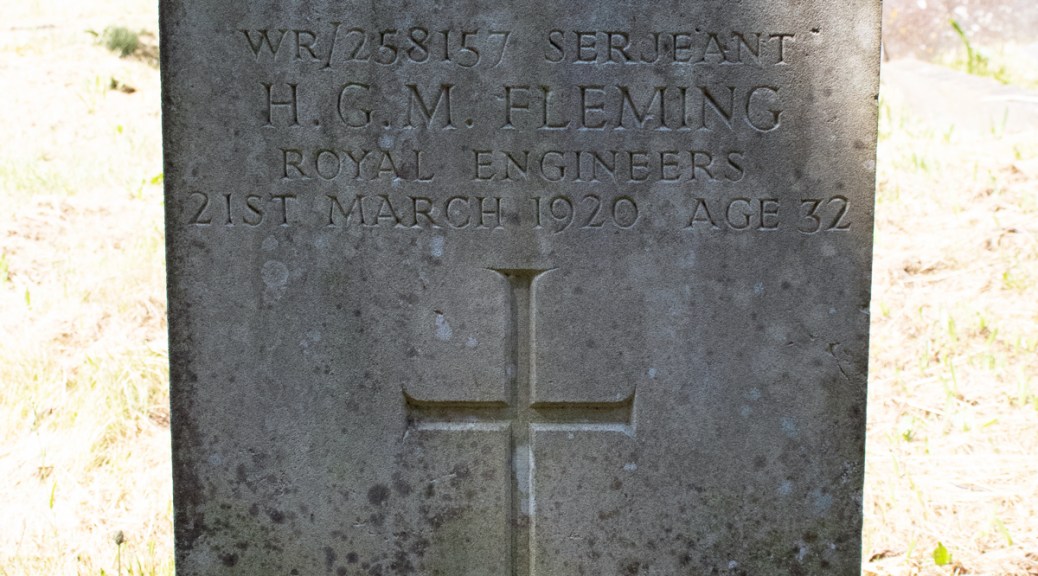
Herbert Gordon Maurice Fleming was born in Stockton, Wiltshire, on 24th March 1888. An only child, his parents were carpenter and wheelwright George Fleming and his wife, Annie.
Little further information is available about Herbert’s early life. On 25th June 1910 he married Ethel Young, a shepherd’s daughter from Wiltshire: they would go on to have four children, Herbert Jr, Ivy, George and Harold.
Herbert’s marriage certificate noted that he was employed as an engine driver. In his spare time, he also volunteered for the Wiltshire Regiment. When war broke out in the summer of 1914, he was called upon to play his part, and was formally mobilised in July 1916.
Sapper Fleming joined the Royal Engineers. His service records show that, at 28 years of age, he stood 5ft 7.5ins (1.71m) tall, and weighed 159lbs (72kg). He was of good physical development, although his medical report noted that some dental attention was required, and he had a pendulous mole on his back.
After his initial training, Herbert was sent to France. He was to remain part of the British Expeditionary Force for the next three years. While details of his service are scarce, his commitment to the army was clear: he was promoted to Lance Corporal in December 1918; full Corporal in June 1919; and Serjeant just three months later.
In October 1919, Herbert arrived back in Britain and the following month he was formally demobbed. He returned to his family, who were now living in Bath, Somerset. Back on civvy street, Herbert took up work as a motor waggon driver in the city, but his post-army life was to be short-lived.
The enquiry into the death on Saturday of Herbert John Maurice Fleming… was held at Bath Guildhall… Medical evidence proved that the cause of death was heart failure, due to an unexpected attack of pneumonia.
The widow said her husband did not complain of illness until Friday evening, when he returned from a journey to Reading. He then said he ached all over, and would go to bed at once. On Saturday evening he said he felt better, and sent her to the chemist for a tonic. He told her not to send for a doctor, as he expected to be quite well on Monday. On Sunday he still appeared fairly well, and was quite cheerful: but in the afternoon he complained of sickness, and the end came very suddenly.
[Bath Chronicle and Weekly Gazette: Saturday 27th March 1920]
Herbert John Morris Fleming was just three days short of his 32nd birthday when he died. He was laid to rest in Bath’s sweeping Locksbrook Cemetery.
The spelling of Herbert’s second middle name is variously noted as Maurice and Morris. For consistency, I have used the spelling noted on his birth certificate.
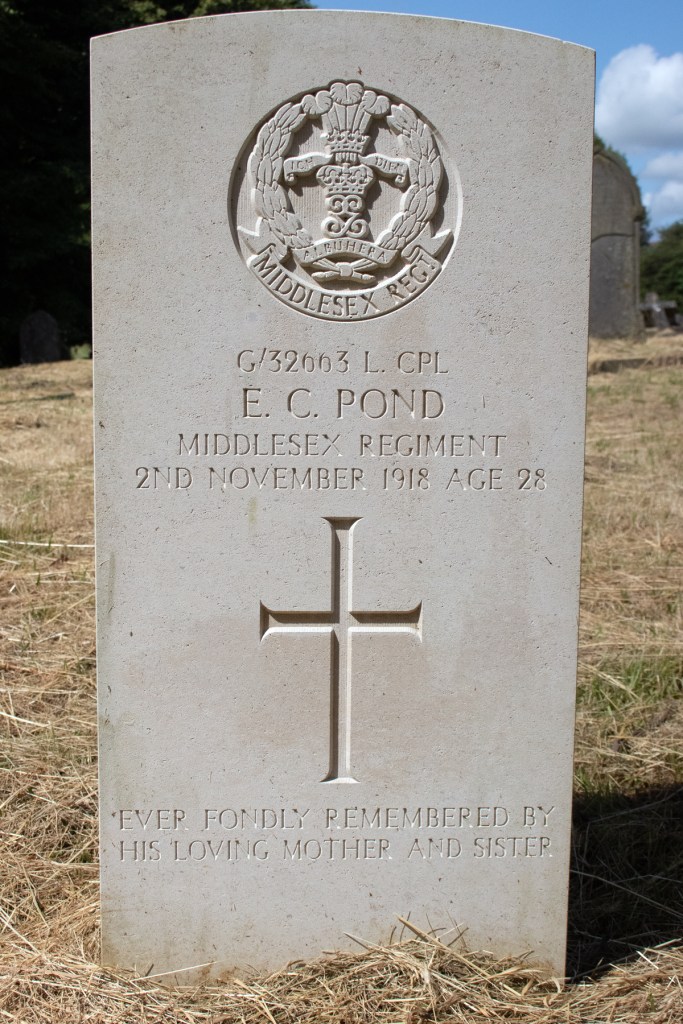
Ernest Charles Pond was born in the autumn of 1889 in Bath, Somerset, and was the younger of two children. His father, Charles, who worked as a wheelchairman, died in 1904, leaving his mother, Eliza, to raise the Ernest and his older sister, Daisy, on her own.
The 1911 census shows the determination the Pond family had in the wake of Charles’ death. Eliza had opened up a tea room in River Street Place, and was living above the business with Daisy and two servants. Daisy, meanwhile, was employed as a school teacher, something she had been doing for at least ten years. Ernest had left Bath, and headed for London: he had taken a room in a house in Tufnell Park, and was working as a furniture designer.
When war came to Europe, Ernest was called upon to play his part. Sadly, full details of his service have been lost to time, but it is clear that he had enlisted by the summer of 1918. He joined the Middlesex Regiment, and was assigned to the 6th (Reserve) Battalion. His unit formed part of the Thames and Medway Garrison, and there is no evidence that Ernest spent any time overseas.
By the autumn of 1918, Ernest had risen to the rank of Lance Corporal. With the war coming to an end, he fell ill, however, and was admitted to a military hospital in Chatham, Kent. Details of his illness are unclear, but it was severe enough that he succumbed to it: he passed away on 2nd November 1918, at the age of 28 years old.
The body of Ernest Charles Pond was taken back to Somerset for burial. He was laid to rest in Bath’s sweeping Locksbrook Cemetery, not far from where his father was buried.
Ernest Roye Hewett was born on 18th April 1898 and was the third of twelve children to Alfred and Ada. Alfred was a coachman and groom and, while both he and Ada were born in Cornwall, it was in Budleigh Salterton, Devon, that the family were born and raised.
When he finished his schooling, Ernest found work as a butcher’s boy, but when sought bigger and better things. His oldest brother, Ralph, had enlisted in the army by the time of the 1911 census and, by that October, his next oldest brother, Leslie, had enlisted in the Royal Navy. Ernest felt a career in the military was his destiny and, on 12th September 1913, he also joined the navy.
As he was under age at this point, he was given the rank of Boy 2nd Class, and sent to HMS Impregnable, the training establishment in Devonport, for his induction. His service records show that he was 5ft 2.5ins (1.59m) tall, with brown hair, hazel eyes and a fresh complexion.
Ernest spent nine months training, moving from Impregnable to HMS Powerful, and gaining a promotion to Boy 1st Class in the process. In June 1914, he was assigned to the cruiser HMS Edgar, remaining on board for six months, by which point war had broken out.
On 18th December 1914, Lance Corporal Ralph Hewett was killed in action, aged just 20 years old. Attached to the 2nd Battalion of the Devonshire Regiment, he was caught in fighting in Northern France, and is commemorated on the Le Touret Memorial.
Ernest, by this point, had been assigned to another ship, the armed merchant cruiser HMS Viknor. Patrolling the seas off Scotland, towards the end of the month, she was tasked with locating and detaining the Norwegian ship Bergensfjord, on board which was a suspected German spy.
The vessel was located and escorted to Kirkwall in the Orkneys, and the suspect and a number of other prisoners, were taken on board the Viknor to be transported to Liverpool. The ship and crew were never to reach their destination. On 13th January 1915, she sank in heavy seas off the Irish Coast: no distress signal was made and all hands were lost.
BODY WASHED ASHORE – Another body has been washed ashore at Pallntoy Port, about six miles from Ballycastle. The body was that of a man of about 5ft 10in. in height. He was dressed in a blue jacket, and wore a service blue webbed belt, on which was the name E. F. Hewett. In the pocket of the trousers was a boatswain’s whistle.
Freeman’s Journal: 24th February 1915
Already in mourning for Ralph, Alfred and Ada were unable to bring 16-year-old Ernest Roye Hewett back home. Instead, he was laid to rest in Ballintoy parish church, County Antrim.
The heartbreak was to continue for the Hewett family. Leslie’s career had gone from strength to strength and, by the time of his older brother’s death, he had been promoted to Able Seaman. In the summer of 1915, he was assigned to the cruiser HMS Europa, remaining aboard for the next year as it patrolled the Mediterranean. In July 1916 he fell ill, having contracted malaria. This was to prove his undoing: he passed away from the condition on 21st July, at 20 years old.
Able Seaman Leslie Hewett was laid to rest in the Mikra British Cemetery in Greece. His parents had now lost their three oldest sons, and had no way to reach their final resting places.
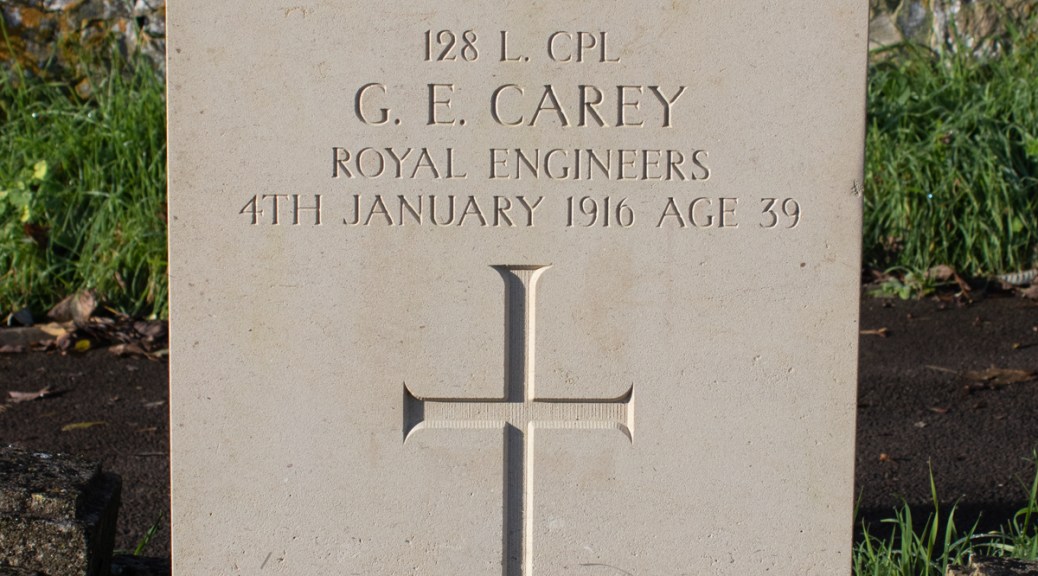
George Edward Carey was born at the start of 1877 and was the oldest of eight children to Samuel and Hester Carey. Samuel was a solicitor’s clerk from Clevedon in Somerset, and this is where the family were born and raised. Samuel was not one to sit on his laurels, however, and the 1891 census recorded his occupations as law clerk, innkeeper and insurance agent.
George followed a different path to his father, and found work as a printer’s apprentice when he finished his schooling. He worked up to being a full compositor quite quickly, and was employed as such when, on 30th January 1899, he married Lizzie Taylor. A civil engineer’s daughter, she was working as a teacher when the couple wed: they set up home in Clevedon, and went on to have four children.
By 1911, the Carey family were living in a seven-room house on Strode Road, Clevedon. George was still working as a compositor, but was employed by the local sanitary works. His widowed brother, Albert, who was lodging with his brother and sister-in-law also did the same job.
With storm clouds brewing over Europe, George stepped up to play his part. He enlisted in the Royal Engineers in the autumn of 1914 and was attached to the 503rd Field Company in Exeter. Little information is available about his time in the army, and he only comes to light again a year or so later.
Lance-Corporal Carey, 2nd Wessex RE, who has been employed at the office in Colleton-crescent, Exeter, was found dead, with his neck broken, at the bottom of a flight of stairs at the Grapes Inn, South-street, on Thursday morning. The discovery was made by Mrs Dorothy, wife of the licensee of the inn. Information was given to the police, and Dr Pereira visited the scene, and subsequently the body was removed to the mortuary by PCs Wise and Barrett. Carey was fully dressed. He was about 48 years of age, and leaves a widow and four children. For about fourteen months he had been engaged on the Wessex RE staff, and was billeted at a house in the Friars. His home is at Clevedon, Somerset, where he was engaged as a compositor before mobilisation with the Territorials. He was under orders for transfer to another station.
Taunton Courier and Western Advertiser: Wednesday 12th January 1916
George Edward Carey died on 4th January 1916: he was, in fact, not quite 39 years of age. His body was brought back to Somerset for burial and was laid to rest in the stunning graveyard of St Andrew’s Church in his home town of Clevedon.












 Death and Service