Bertie Ball was born in Westcott, Berkshire, in the spring of 1890, the oldest of ten children to John and Matilda Ball. John was from Berkshire, who raised his family in Wantage. He began life as a farm labourer, but, by the time of the 1901 census, he had found other employment, as a groom at a racing stable.
Details of Bertie’s life are scarce. When he left school, he found work as a garden labourer and, when war broke out, he enlisted in the Royal Army Service Corps. Private Ball was assigned to the Mechanical Transport Company, but whether he served overseas or on home soil is unknown.
Bertie died on 4th March 1915 from cerebrospinal meningitis. He was just 24 years old. He was laid to rest in the graveyard of St John the Baptist Church in Midsomer Norton – I can find no Somerset connection, so can only imagine that he passed away in or near the town.
Bertie’s younger brother Percival Ball also served in the First World War. He served with the 5th Battalion of the Wiltshire Regiment and fought in Mesopotamia. Sadly, he was killed there, dying on 5th April 1916. He was just 17 years of age. He is commemorated on the Basra Memorial in Iraq.
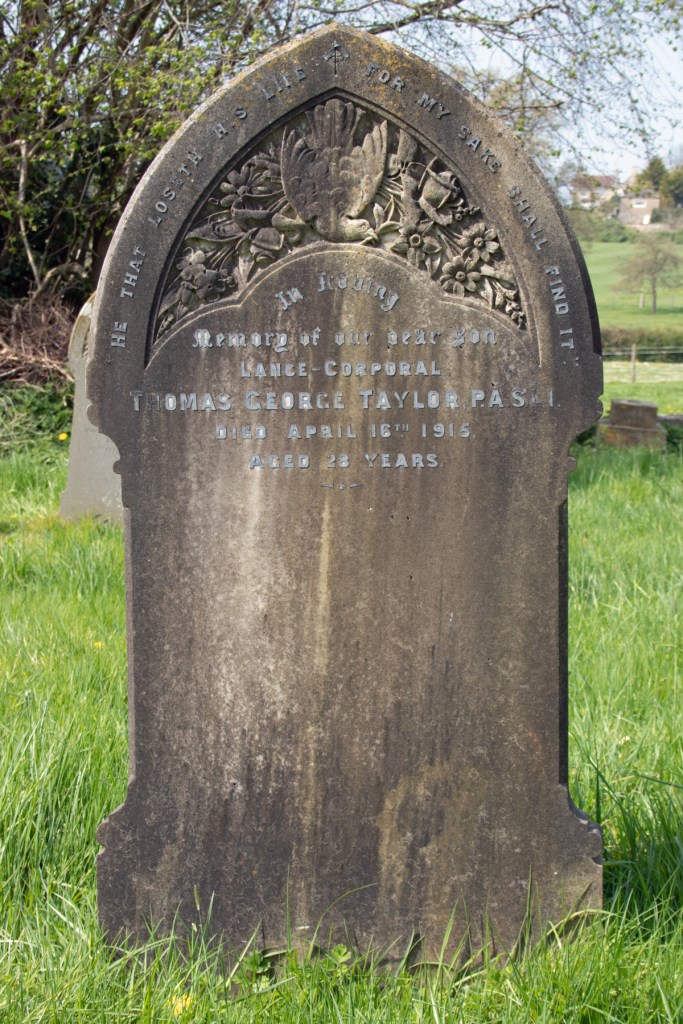
Thomas George Taylor was born in the summer of 1886, and was the youngest of five children to George and Sarah Taylor. George was a gamekeeper in Clutton, Somerset, and he and Sarah raised their family in Rudges Cottage opposite the village church.
Thomas’ older brother John found a variety of jobs, from boot finisher to coal miner, but Thomas followed in his father’s footsteps, and, by the 1911 census, was recorded as a butcher’s apprentice.
Storm clouds were brewing across Europe by this point and, when war broke out, Thomas was one of the first to enlist. Sadly, there is little information on his military service, but it is clear that he joined the 7th Battalion of the Somerset Light Infantry and was quickly promoted from Private to Lance Corporal.
The only other documentary evidence for Thomas is his entry in the Army Register of Personal Effects. This confirms that he was admitted to the Isolation Hospital in Aldershot, suffering from meningitis. Lance Corporal Taylor passed away from the condition on 16th April 1915, aged just 29 years old.
Brought back to Somerset for burial, Thomas George Taylor was laid to rest in the graveyard of St Augustine’s Church, across the road from his family home in Clutton.
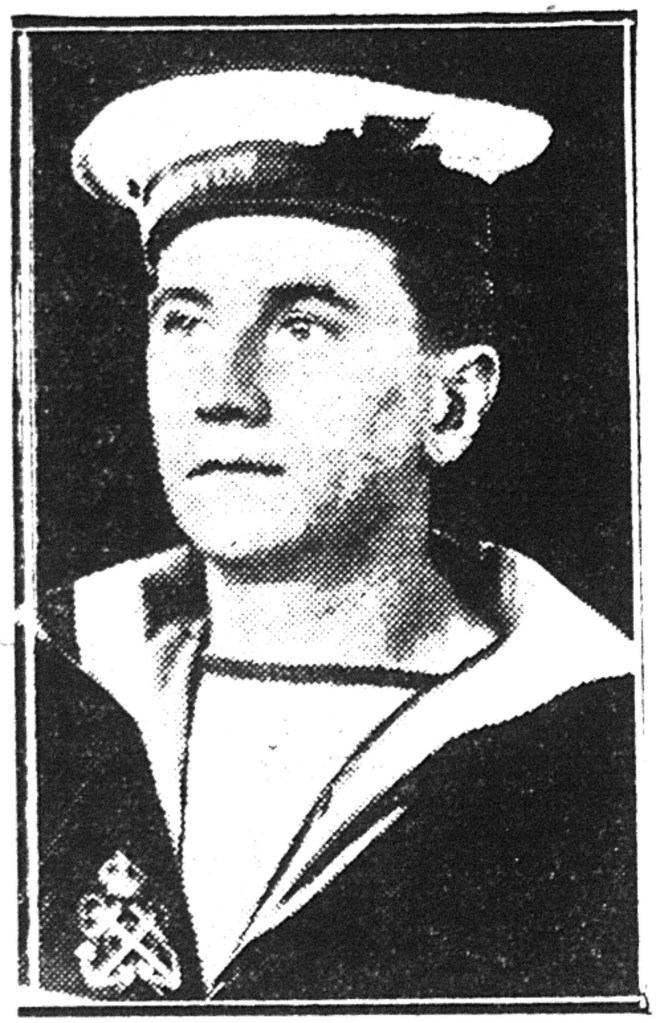
Leonard Frederick John Gigg was born in Silverton, Devon, on 9th May 1882. He was one of six children to Matthew and Sarah Gigg, both of whom were born Ottery St Mary, but who moved the young family to Chudleigh in the late 1880s.
Matthew was a domestic gardener, and his son initially joined him in this trade. However, as the third of five sons, Leonard obviously wanted to carve out a life for himself and so, on 21st August 1897, he enlisted in the Royal Navy.
Leonard’s naval records shows that he was 5ft 3ins (1.60m) tall, had light brown hair, blue-grey eyes and a fresh complexion. He also gave his year of birth as 1880 so he would be accepted in the navy.
Even with this altered date of birth, Leonard was still under age, and so was given the rank of Boy 2nd Class. He was obviously dedicated to his career, however, and, on his “eighteenth” birthday in 1898, he was officially enrolled as an Ordinary Seaman.
Over the course of his twelve years’ service, Leonard served on ten vessels; after each voyage, however, he returned to HMS Vivid – the Royal Naval Dockyard at Devonport, Portsmouth. During his time at sea, he also progressed through the ranks, becoming an Able Seaman as early as 1900.
When Leonard’s initial contract came to an end, he volunteered for a further term. Up until the outbreak of war, Able Seaman Gigg served on another six ships, but after falling ill while on board HMS Caesar in the summer of 1914, he returned again to Portsmouth.
Leonard had contracted cancer of the mouth, and, as a result of the condition, he was formally invalided out of the Royal Navy in May 1915. He returned home but, in spite of a couple of operations, he succumbed to the cancer, passing away on 9th October 1915. He was just 33 years of age (his gravestone gives a different age).
Leonard Frederick John Gigg was laid to rest in the cemetery in Chudleigh.
Able Seaman Leonard Gigg (from findagrave.com)
The local newspaper reported on Leonard’s funeral:
The death has taken place at his father’s residence of Mr Leonard FJ Gigg, third son of Mr M Gigg, after a painful illness. The deceased had served in the Royal Navy for 18 years and was only invalided out in May last, owing to cancer of the tongue. Although undergoing three operations, he was no better, and expired form the effects of that dreadful malady at the early age of 33 years. In the service he was extremely well liked and highly respected both by officers and men, and always had a pleasant word for everyone.
The deceased’s four brothers, Mr Charles Gigg (now in Canada), Chief Petty Officer H Gigg (HMAS Australia), Able Seaman Walter Gigg (HMS Carnarvon), and Private Albert Gigg (4th Devons, now in India) were prevented from attending.
John James Foxworthy was born in the South Devon village of East Allington in 1867. He was the middle of five children to carpenter Roger Foxworthy and his wife Ann.
When he left school, John found work on a local farm, but he had bigger plans and, in July 1887, he enlisted in the Royal Marine Light Infantry. His service records show that he stood 5ft 8ins (1.73m) tall, had dark brown hair, brown eyes and a fresh complexion.
John had a varied military career that lasted for more than two decades. During this time, he served on nine ships, and was based at HMS Vivid – the Royal Naval Dockyard in Plymouth – for significant periods of time. He began as a Private, but rose through the ranks to Corporal (in 1894) and Sergeant (in 1900). He was wounded in April 1899, when he was shot in the leg, but recovered from this and continued his career.
In 1895, John married Maria Woodley, the daughter of a railway labourer from Totnes. The couple went on to have four children, Minnie, Gladys, Alice and William.
In 1908, Sergeant Foxworthy left the Royal Marine Light Infantry after 21 years’ service. By now the family home was in Prospect Terrace, Newton Abbot, just a short walk from the town centre. The 1911 census records him as being a Royal Marine pensioner and caretaker of the Miniature Rifle Club.
When war broke out, John was called back into duty and, by September 1914, he found himself in a Royal Marine Depot in Belgium. His service overseas was fairly short, and he had returned to England by the spring. He was working as a recruiting sergeant in Northampton on 30th March 1915, when he suddenly collapsed and died. He was 47 years of age.
John James Foxworthy’s body was brought back to Devon; he lies at rest in the family grave in Newton Abbot Cemetery.
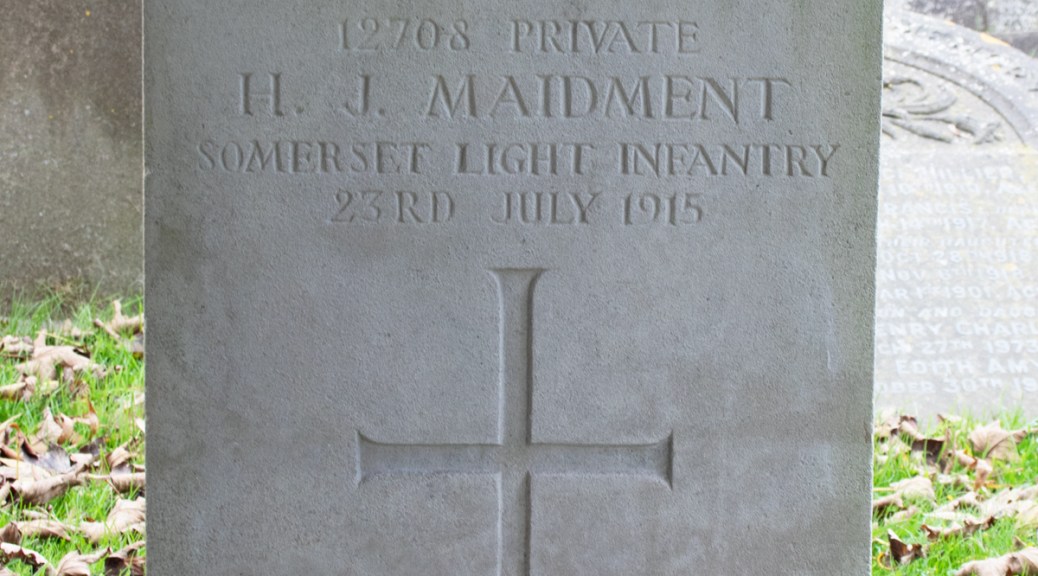
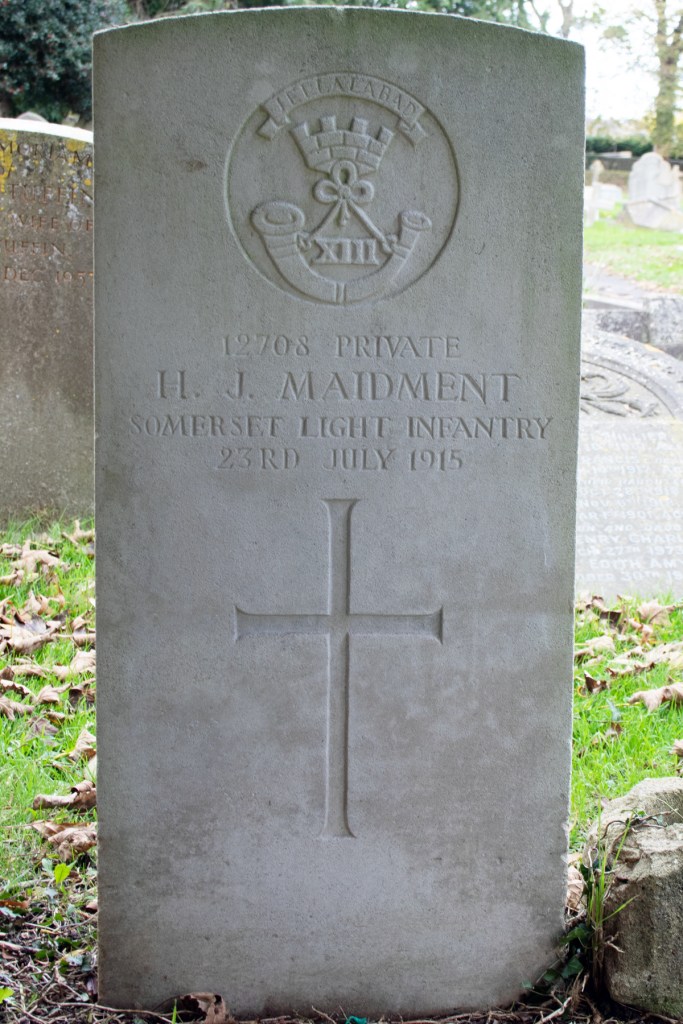
Henry James Maidment – known as Harry – was born in Penarth, South Wales, in the autumn of 1890. He was one of seven children to Somerset-born Henry and Minnie Maidment. Henry Sr was a general labourer, and, when he died in 1899, Minnie remained in Penarth, earning money to support the family as a hawker of fruit.
By the time of the 1911 census, most of Minnie’s children were still living at home, with all but one of them working. Harry was employed as a van driver for a laundry, while his siblings were working variously as labourers, sailors and a housekeeper.
In the autumn of 1911, Harry married Annie Hillier, a servant who had been born in Yeovil, but who had also moved to South Wales. The couple went on to have a son, Henry, in October 1912, but he tragically passed away when he was just a couple of months old. They were not to have any other children.
War was coming to Europe by this point, and Harry was keen to play his part. He enlisted towards the end of 1914, joining the 1st Battalion of the Somerset Light Infantry as a Private. He arrived in France at the beginning of May 1915, and would have seen fighting at Ypres that spring.
It seems that Private Maidment was wounded at Ypres; he was medically evacuated home and was admitted to the Graylingwell Hospital in Chichester, West Sussex. Details of his injuries are not available, but they must have been severe; he passed away from them on 23rd July 1915, aged just 25 years old.
Harry James Maidment’s body was brought back to Somerset; he was laid to rest in the graveyard of Christ Church, Frome, his parents’ home town, and where his widow, Annie was living.
Daniel Mcauley was born in Belfast in around 1883, one of six children to John and Margaret Mcauley. John was a farmer, and when Daniel – who was named after his uncle – left school, he found labouring work to help the family bring in an income.
In January 1909, Daniel married Annie Fittis, the daughter of a linen tenter (stretching cloth on a loom while it was drying and maintaining the machines). The couple had had a son, John, eighteen months before, and would have another child, Sarah, later that year.
The 1911 census for Northern Ireland found the young family living with Annie’s mother and two sisters in Dayton Street, near the middle of Belfast. Annie and her sisters were working as flax spinners, while Daniel was a labourer. Tellingly, the document lists inhabitants’ religion – Daniel is the sole Roman Catholic amongst a family of Presbyterians.
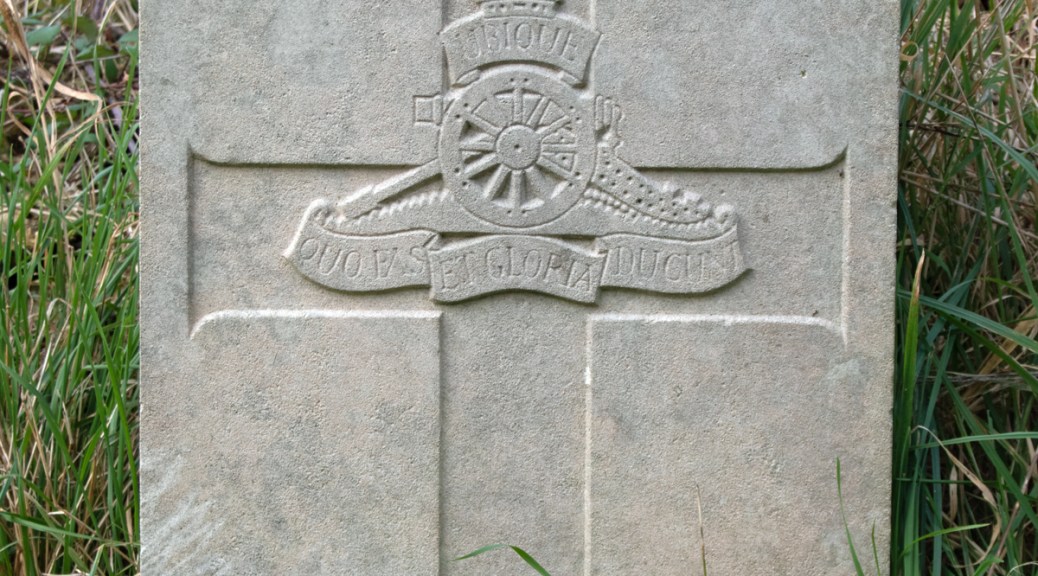
War was coming to Europe, and Daniel was called on to do his bit. Sadly, full details of his military service are not available, but what is clear is that he enlisted as a Bombardier in the Royal Field Artillery towards the end of 1914. He was shipped to England, and barracked in Somerset, near Frome.
Sadly, the next evidence of Daniel’s life comes in a wealth of newspaper articles that report on the accident that led to his death.
One soldier was killed and another seriously injured as the result of a horse attached to a Royal Field Artillery wagon bolting at Frome Saturday morning. The wagon was on its way to the stables when the horse got out of control and ran along Christ Church Street West.
One man, who was riding in the wagon, in jumping clear was seriously cut about the head and body, and was taken to the hospital. The other, Bombardier Daniel MacAulay, belonging to Glasgow [sic], remained in the wagon trying to pull up the horses, but the vehicle swerved across the road and he was thrown out, his head coming into contact with a street lamp.
He was taken to the hospital on the police ambulance, but died before admission. He was a married man, about 34 years of age, and was to have gone on leave Saturday in order to visit his sick child. In the morning he received a letter from his wife saying that the child had been seriously ill and had gone blind.
Mr Douglas Mackay, deputy coroner, held an inquest at Frome on Tuesday on the body of the deceased. The verdict was “Accidental death.”
Shepton Mallet Journal: Friday 19th March 1915
Other newspapers reported similarly, a couple stating that Daniel was father to three children. There is no evidence that this was the case and, given that all of the reports state that he came from Scotland, when he was Irish, it is likely that this too was an error. Each newspaper give variations of the spelling of his surname too, evidence that spelling was often at the mercy of the person documenting it, even in the media.
Daniel was buried in Somerset and Annie travelled to England to attend the funeral. Again, newspaper reports suggest that Daniel’s brothers also attended, although he had only one male sibling.
Bombardier Daniel Mcauley died on 13th March 1915, aged around 33 years old. He was laid to rest in the Vallis Road Burial Ground in Frome, also known as the Dissenters’ Cemetery (for those who did not follow the English Protestant faiths.
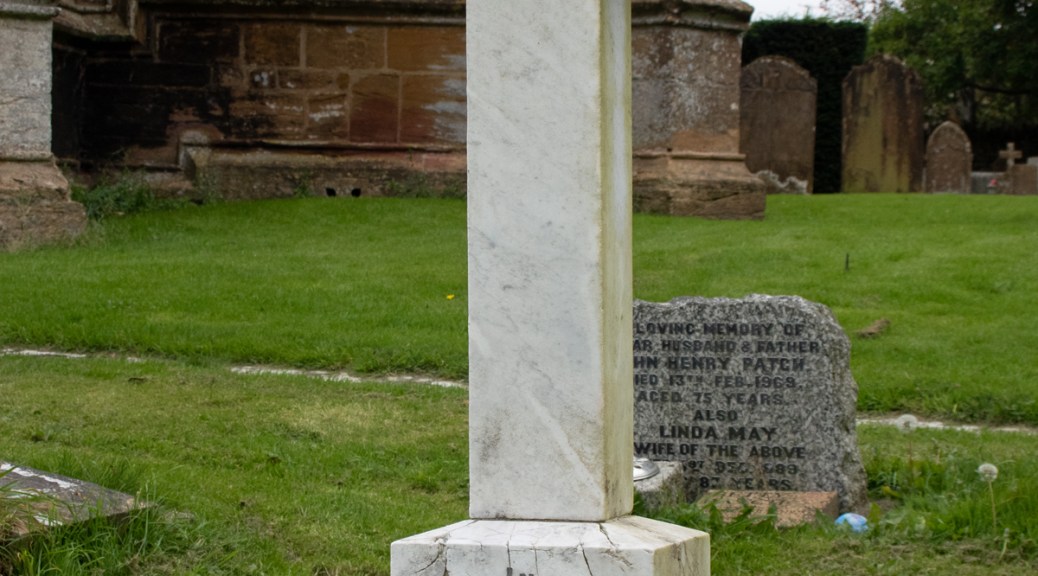
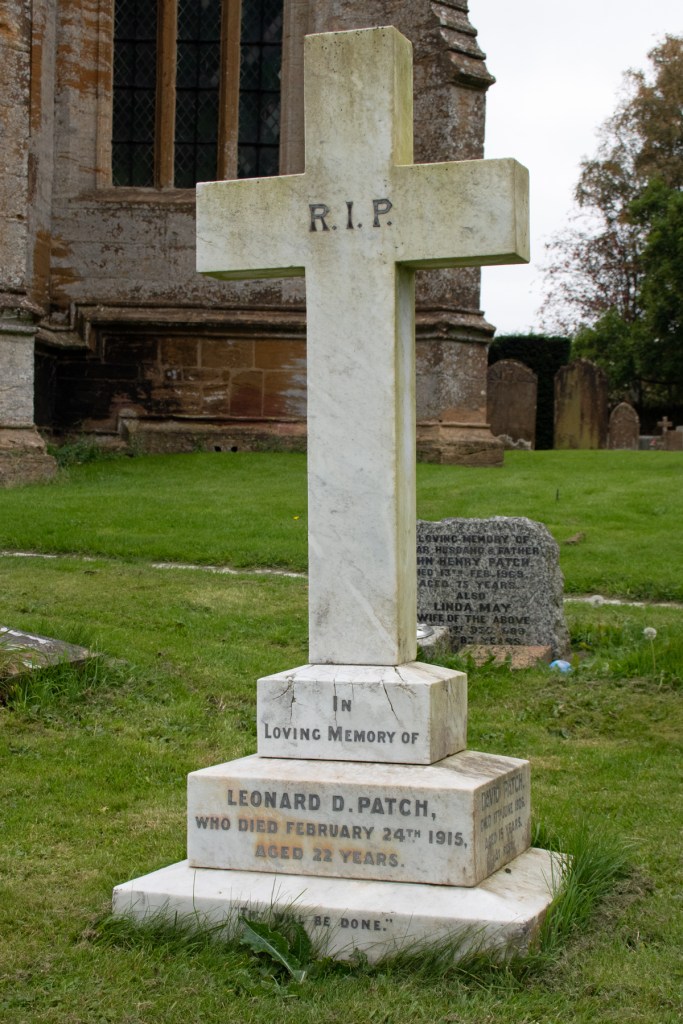
Leonard David Patch was born on 22nd October 1892, the oldest of four children to David and Fanny Patch from Norton-sub-Hamdon in Somerset. David was a stone mason, but when his eldest son left school, he found work as a carpenter.
When war came to Europe, Leonard was one of the first from the village to volunteer. Given the small size of Norton-sub-Hamdon, it seems likely that he would have done so with friends; many of the Pals Battalions were formed like this.
Leonard joined the Somerset Light Infantry as a Private, and was assigned to the 7th Battalion. He was sent to Woking, Surrey, for training and it was while he was billeted there that he contracted measles. Moved to the Military Isolation Hospital in Aldershot, he developed pneumonia, and passed away from the lung condition on 25th February 1915. He was just 22 years of age, and had seen no military action.
Private Patch’s body was brought back to his home village, where he was laid to rest in the graveyard of St Mary’s Church, where he had been baptised two decades before.
Of Leonard’s brothers, two saw active service.
John Henry Patch, the second oldest of the siblings, served in the Royal Engineers, enlisting just ten months after his brother had died. He survived the war, married Linda Turner in Yeovil and went on to have a son, Norman. John passed away in February 1969, a few days after his 75th birthday.
Edward Lionel Patch – the third brother – served with the Devonshire Regiment. He too survived the war, marrying Honor Brown in 1923; they also had a son, called David. Edward passed away in Yeovil in 1966, aged 70 years old.
The youngest of the four brothers, Clarence William Patch, was born in 1899 and was lucky enough not to have seen military service. He married Emily Brown in 1924 and the couple had a daughter, Emmie. Sadly, she passed away as a babe-in-arms, and Emily was to follow soon after. In 1931, Clarence married again, this time to Emily Dyer; they went on to have a son, Douglas Leonard. Clarence passed away in 1945 at the age of just 46 years old.
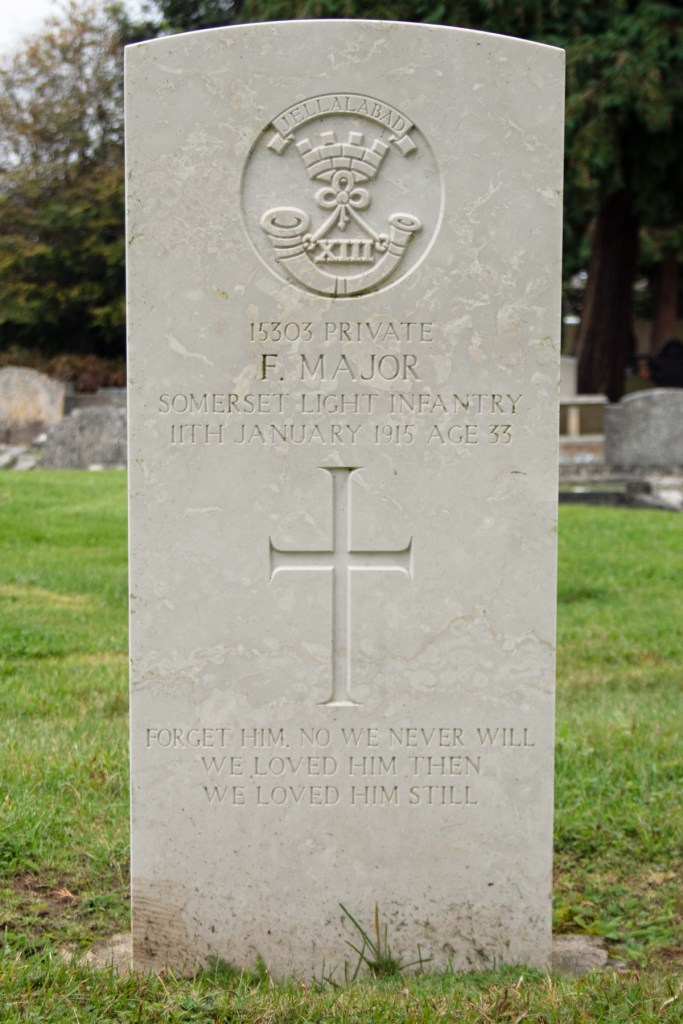
Frederick John Major was born in the spring of 1882, the oldest of seven children to John and Eliza Major. John was a farm labourer and he and Eliza – who was 20 years his junior – raised their family in the Dorset village of Batcombe.
John passed away in 1900, when Frederick was just 18 years old. He was already working as a carter, and continued to live with his mother, helping support her financially, along with his brother and sister.
With war on the horizon, Frederick was keen to do his part. He enlisted in the Somerset Light Infantry, and was assigned to the 9th Battalion as a Private. This was a service battalion based in Plymouth, and it is unlikely, therefore, that Private Major saw any active service overseas.
Sadly, Frederick’s time in the army was to be short. He passed away in Somerset on 11th January 1915, aged just 33 years old. No evidence of the cause of his death is documented.
Frederick John Major was laid to rest in Yeovil Cemetery, in the town in which he died.
Charles William Debney was born in the spring of 1887, one of eight children to George Debney and his wife Susannah. George was a cooper for a cement works, who had brought his family from Norfolk to Kent in the mid-1890s, presumably for employment.
When Charles left school, he found work as a bricklayer; war was on the horizon, though, and when the call came, he signed up quickly.
While full details of Charles’ service are not available, it is evident that he had joined the Northamptonshire Regiment by November 1914. He was assigned to the 5th Service Battalion as a Private. Formed in Northampton, the battalion moved to Kent in the early months of the war, before moving to the Western Front at the end of May 1915.
Sadly, there is limited additional information available on Private Debney. He passed away on 29th May 1915, but there is no confirmation of the cause of his death. He was just 28 years of age.
Charles William Debney was laid to rest in the Woodlands Cemetery, in his home town of Gillingham, Kent.
Raymond Champ was born on 30th March 1880, one of eight children to coachman William Champ and his wife Eliza. While Raymond was born in the West Sussex village of Cowfold, within a year, the family had moved to Worthing, settling in the Broadwater area of the town.
The 1901 census gives more of an insight into Champ family life. William by now is listed as unable to work and gives his infirmity as paralysed. There are no newspaper records evident to highlight an accident of any sort, so the cause of his paralysis, and his inability to work, are destined to remain a mystery. The document does show, however, that the other members of the family stepped up to fill in the shortfall of money; Eliza was working as a laundress, Raymond was a bricklayer’s labourer, and his younger brother Francis (or Frank) was employed as a milk boy.
Fast forward ten years, and the next census give further information. It confirms that William was paralysed when he was 45 years old (in around 1894/1895). Raymond, now aged 30, was still working as a bricklayer, Frank was an iron founder, and the youngest brother, George, was a baker.
Raymond was a keen footballer, and went on to captain the Silverdale Football Club. By the time war broke out, he had found work at Wenban Smith, a renowned timber supplier in the town. The call to arms came, however, and, in September 1914, he enlisted.
Private Champ joined the Royal Sussex Regiment, and was assigned to the 2nd Battalion. Shipped overseas in February 1915, he served on the Western Front, but his time there was not to be a lengthy one. A local newspaper report picked up Raymond’s story:
The wretched conditions which our Troops had to contend with during February and March proved too much for his constitution, and having the misfortune to contract bronchitis, he was invalided home in April, being taken to one of the Military Hospitals in Manchester.
His recovery was regarded as hopeless from the first, but the careful nursing and attention which he received there brought about a temporary improvement, and he was eventually discharged in order that he might return to his home, where his death occurred on Sunday week.
The funeral on Thursday afternoon was of a very impressive character, and despite a heavy deluge of rain, there was a large number of sympathising friends at the Cemetery to pay the last tribute of respect.
Worthing Gazette: Wednesday 14th July 1915
Private Raymond Champ passed away on 4th July 1915 and just 35 years old. His body was laid to rest in Broadwater Cemetery, Worthing, not far from where his family were living.












 Death and Service