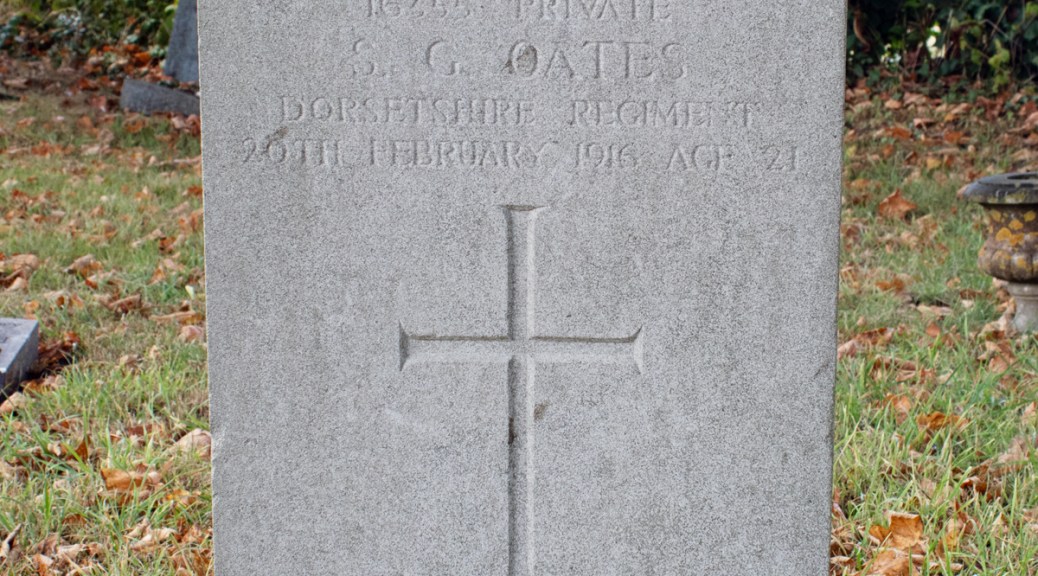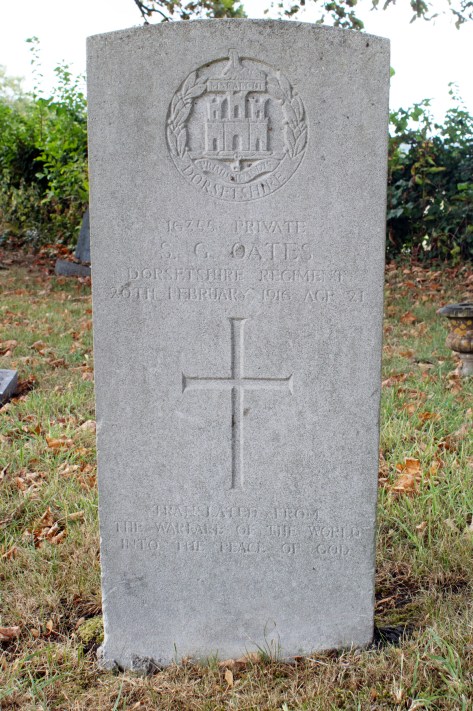
Sidney George Oates was born in the spring of 1895, and was the oldest of three children – all boys – to John and Eliza Oates. John was a general labourer from Parkstone, Dorset, but it was in the village of Odcombe in Somerset that the family were born and raised.
Eliza died in 1899, and John was left to raise three young children on his own. He re-married, to a Lucy Moores, but the a split of the family followed the wedding. Sidney’s younger brothers stayed with their father and his new wife, while Sidney himself was looked after by his maternal grandparents. Job and Elizabeth Green lived in Buckhorn Weston, a village to the west of Gillingham, Dorset.
When he finished his schooling, Sidney was apprenticed to a carpenter. War was on the horizon, however, and he soon stepped up to play his part. As with many others, his service papers have been lost to time, but it is clear that he had enlisted in the Dorsetshire Regiment no earlier than August 1915.
Private Oates was assigned to the 7th (Reserve) Battalion and sent to a training camp near Wool, Dorset. While there, however, he caught pneumonia, and was admitted to a military hospital in the village. The condition was to prove fatal: he passed away on 20th February 1916, aged just 21 years old.
The body of Sidney George Oates was taken back to Buckhorn Weston for burial. He was laid to rest in the village’s cemetery.
Sidney’s younger brother Edward also served in the First World War. A Pioneer in the Royal Engineers, he was killed in action in northern France on 12th April 1917. He was buried in Mory Abbey Military Cemetery to the north of Bapaume.
Albert Dobson was born in Bridlington, Yorkshire, on 7th April 1896. One of seven children, his parents were John and Annie Dobson. John was a bricklayer, and, when he completed his schooling, Albert was apprenticed to him. The 1911 census found the family living in a small terraced house at 55 St John’s Walk, on the outskirts of the town.
Bricklaying was not what Albert wanted from a career and, on 19th July 1913, he enlisted in the Royal Navy. Below the age to formally enlist, he was taken on with the rank of Boy 2nd Class, and sent to HMS Vivid – the Royal Naval Dockyard in Devonport, Devon, for his training.
Over the next nine months, Albert learnt the tools of his trade. Promoted to Boy 1st Class in October 1913, he spent time on board the battleship HMS Irresistible, before moving to HMS Pembroke, Chatham Dockyard in Kent. While he was there, he came of age, and was fully inducted into the Royal Navy as an Ordinary Seaman. Albert’s service papers show the man he had become: he was 5ft 7ins (1.7m) tall, with brown hair, blue eyes and a fresh complexion.
In April 1914, Ordinary Seaman Dobson was assigned to the new cruiser HMS Lowestoft. She would become his home for the next two years, and, while his annual reviews were average (character varying from good to very good and ability from moderate to satisfactory), he did gain a promotion to Able Seaman on 26th April 1915.
A singular fatality to a naval seaman names Albert Dobson, age 30 [sic], a native of Bridlington, was investigated at the Royal Naval Hospital, Chatham, on Monday. On October 20th, Dobson was one of a working party engaged on a battleship in the Dockyard, when, owing to the breaking of a plank, he and three men fell a distance of about eight feet. The knee of one of the men caught him in the stomach, with the result that he sustained a rupture of the spleen. In hospital he developed pneumonia, and died. A verdict of “Accidental Death” was returned.
[Kent Messenger & Gravesend Telegraph: Saturday 2nd December 1916]
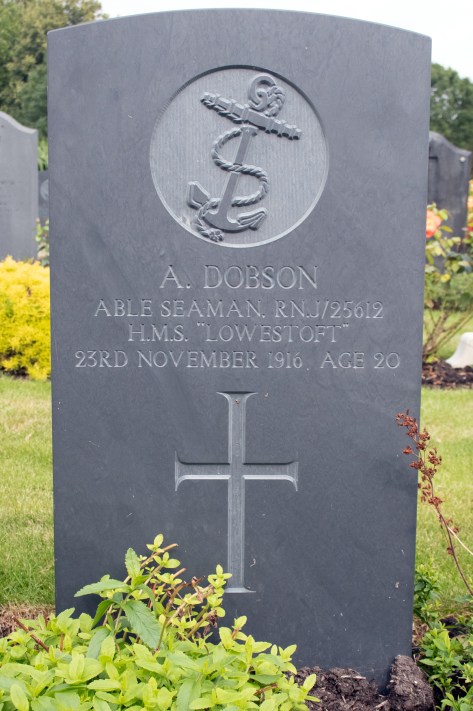
Able Seaman Dobson’s service papers confirm that the incident occurred as the men were transferring a torpedo from HMS Illustrious. He was just 20 years of age when he died on 23rd November 1916.
The body of Albert Dobson was taken to Woodlands Cemetery in Gillingham, Kent, close to the dockyard he had come to know as home. He was laid to rest in the graveyard’s naval section.
James George Mills was born on 5th August 1891 in Poplar, Middlesex. One of nine children, his parents were Robert and Emily Mills. Robert was a bricklayer, and by the time of the 1901 census, they had settled in Lochnager Street.
Robert had died by 1911, and Emily was left to raise their children alone. That year’s census return found them living in rooms at 1 Cobden Street, with three of the children – including James – old enough to be earning a wage.
James had enlisted in the Royal Navy the year before, and was employed as a Stoker 2nd Class. His service papers show that he was 5ft 5ins (1.65m) tall, with light brown hair, blue eyes and a fair complexion. He was also noted as having a small scar on his right cheek.
Stoker Mills would come to be based at HMS Pembroke, the Royal Naval Dockyard in Chatham, Kent, during his career. He served on a number of ships and, by the time he was promoted to Stoker 1st Class in October 1911, he had spent time on board the cruisers HMS Vindictive and HMS Foresight.
With his promotion came a move, and James was assigned to HMS Acteon, the navy’s new torpedo school based in Sheerness, Kent. From here on in, much of his time seems to have been spent on land, and in January 1914, he moved to HMS Dido, also in Sheerness.
This move to the navy’s land bases seems to have coincided with James’ life away from his career. On 26th December 1912, he married Classina Steenbergen, a Dutch national, whose parents had moved to Barking, Essex in the late 1890s. The couple would go on to have two children: daughters Clasina and Iris.
James’ dedication to the Royal Navy began to pay off, with his annual reviews noting a very good character and a superior ability. In May 1915 he was promoted to Acting Leading Stoker, with the position being formalised that November.
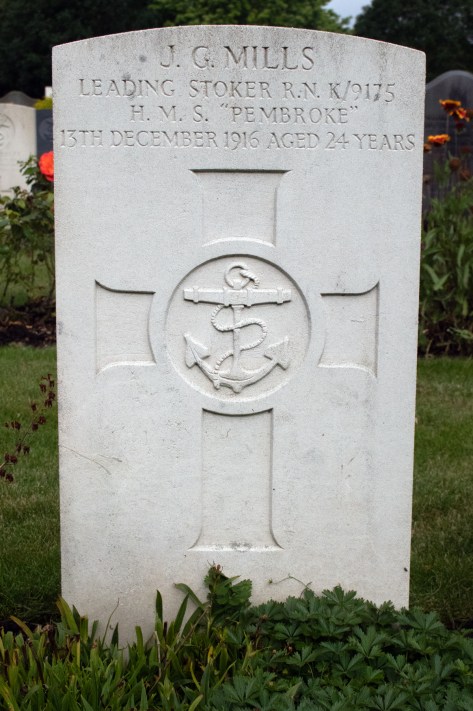
By this point, however, James’ health was becoming impacted. He was admitted to the naval hospital in Chatham in December 1916, suffering from a malignant growth on his pancreas. The condition would prove fatal: he died on 13th December, at the age of just 25 years old.
The body of James George Mills was laid to rest in Woodlands Cemetery, Gillingham, Kent, not far from the naval base he had known so well.
Classina now had two young children to support on her own. She married again in the spring of 1920, her new husband being cabinet maker William Walter Hermann. The couple went on to have three children: Walter, Pearl and James.
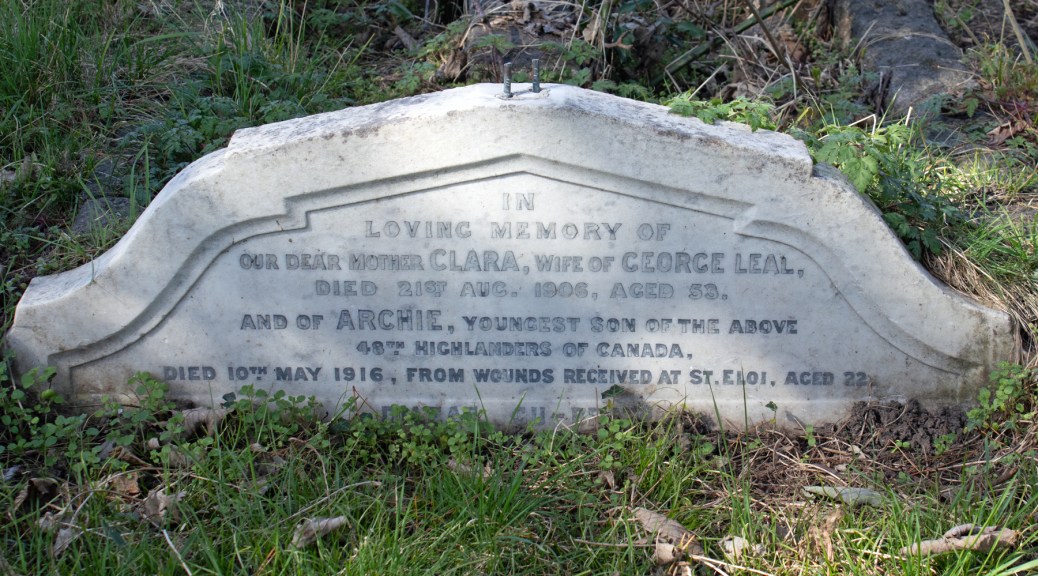
Archibald Edmund Leal was born in Tinwood, West Sussex on 13th September 1894. The youngest of six children, his parents were George and Clara Leal. George was a dairyman, and, by the time of the 1901 census, the family had moved to a terraced cottage at 66 Newland Road in Worthing.
Clara died in 1906, and Archibald – who was better known as Archie – and two of his siblings took the opportunity to seek a better life across the Atlantic. In 1910, the three of them – Archie, brother Phillip and sister Winifred – emigrated to Canada, settling in Breakeyville, to the south of Quebec.
Archie found work as a chauffeur, but when war was declared, he was quick to step up and serve his King and Empire. He enlisted on 10th September 1914, joining the Canadian Expeditionary Force as a Private. His service records show that he was 5ft 6in (1.67m) tall, with fair hair, brown eyes and a dark complexion. He was also noted as having “very many [acne] scars over [his] chest and back.”
Assigned to the 15th Battalion of the Canadian Infantry, Private Leal sailed to Britain, arriving at Tidworth Camp in Wiltshire on 12th February 1915. By April he was in France, and, on 28th July he was in a front line trench near the town of Ypres. A shell exploded nearby and, in seeking shelter, he badly twisted his ankle and back. Medically evacuated to Britain, Archie spent a month recuperating at the Royal Herbert Hospital in Woolwich, Kent, before returning to his unit in Wiltshire.
By December 1915, Private Leal was back on the Western Front and remained there for the next five months. In April his unit was on the front line, and he was injured in his right leg when a rifle grenade exploded. Archie was initially treated by a field ambulance, but his injury was such that evacuation to Britain was again necessary. He was admitted to the County of London War Hospital in Epsom, Surrey, but had contracted tetanus by this point. This was to prove fatal, and his body succumbed on 10th May 1916: he was 21 years of age.
The body of Archibald Edmund Leal was taken back to Worthing for burial. He was laid to rest with full military honours in the town’s Broadwater Cemetery. A local newspaper reported that “Private Leal, although not a Canadian, was possessed of true Colonial grit, and had had his full share of active service.” [Sussex Daily News: Wednesday 17th May 1916]
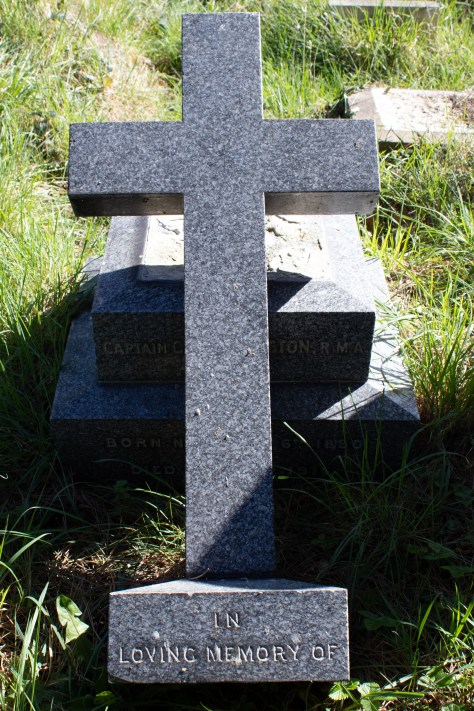
Guye Wellesley Lushington was born in India on 6th November 1880. The oldest of four children, his parents were James and Bessie Lushington. James was a worked in the Bombay Uncovenanted Civil Service and, while it’s not possible to track his location through census records, by the time of the 1891 census, Bessie had returned to Britain with the children. The document found them living at 31 Clarendon Street in Bedford, Bedfordshire.
Guye’s background stood him in good stead when it came to building a career. His chosen profession was the army and, by January 1898 he had landed a commission in the Royal Marine Artillery. Lieutenant Lushington continued to do well and, on 13th March 1908, he received a promotion to Captain.
Full details of Guye’s military service have been lost to time, but by the time war broke out, he was attached to the dreadnought battleship HMS Bellerophon. The stress of the Great War was to take its toll, however, and he was diagnosed with neurasthenia. In 1916, he was admitted to the King Edward Convalescent Home at Osborne House, on the Isle of Wight. Captain Lushington’s condition, however, was to worsen.
The Isle of Wight Coroner yesterday held an inquest respecting the death of Captain George [sic] Wellesley Lushington, 35, of the Royal Marine Artillery, sone of Mr James Law Lushington, of Briar Bank, Grove-road, Worthing [West Sussex], who was found dead… on Tuesday, having apparently thrown himself over an iron staircase fire escape into the courtyard.
Colonel Douglas Wardrop, house governor and medical superintendent, said the deceased arrived at Osborne House from Haslar on the 5th inst… He was rather depressed and worried about his loss of will power. He had been four years on the “Bellerophon” and on active service with the Grand Fleet. There was nothing in the deceased’s manner to suggest suicide. He slept on the top floor of the south wing. At two o’clock on Tuesday morning, the night nurse reported that the deceased had not slept in his room. Search was made, and the deceased was found lying in the courtyard between the kitchen and the south wing. He must have jumped from the fire escape – which was an iron staircase with platforms outside each landing – onto the flag stones below, a distance of 45 feet. His skull was smashed to pieces. There was a railing 3 feet 6 inches high round the staircase, and deceased could not have accidentally fallen over.
Two letters were found in deceased’s room, one addressed to his father and the other to his sister. His father identified the writing. The letter to the deceased’s father was as follows:
“Osborne House, Sunday.
“My dear pater, Since I broke down a month ago, I feel I shall never pick up again. I am afraid this will rather surprise you, but I cannot stand the tension any longer. I am always wondering what is going to happen to me. Give my love to Daisy. If one has to die, it is better quickly than slowly. With lots of love – GUYE”
Nursing sister Arkins, who had charge of the deceased, said he was quiet, bur showed no suicidal tendency.
Lieutenant George Stewart Manisty, of the Indian Army Reserve, attached to the 7th Bengal Lancers, said he played bridge with the deceased up till 10:30 on Monday night, and for three nights running. Deceased seemed quite friendly and in good spirits.
A verdict of “Suicide while of unsound mind” was returned.
The Coroner said that was the third suicide within a week on the Isle of Wight, either directly or indirectly due to the war.
[Sussex Daily News: Thursday 11th May 1916]
Captain Lushington’s full state of mind on the night he took his life will never be know. The family had suffered three early deaths in a matter of years: Guye’s oldest sister, Violet, had died in 1899, at the age of 18; his brother Hubert had died in 1905 at the age of 19; his mother Bessie passed away in 1911 at the age of 58. Guye had taken his life on 8th May 1916, aged 35 years old.
The body of Guy Wellesley Lushington was taken to Worthing, West Sussex, for burial. He was laid to rest in the town’s Broadwater Cemetery.
In the graveyard of St John the Baptist Church in Marldon, Devon, is a headstone commemorating Sergeant William Low of the Royal Garrison Artillery. The marker notes his parents as being Thomas and Mary Low, and that he was their eldest son.
Details of William’s early life are a challenge to piece together. Born early in 1872, he was the oldest of eight children. The 1881 census found the Low family living in the village of Compton, just to the north of Marldon. Thomas was working as a farm labourer and his children were still at school.
At this point, William falls off the radar. Thomas and Mary continued to live in Compton until their deaths in 1906 and 1907 respectively, but their eldest son is nowhere to be seen. It is possible that he had sought a better life for himself and enlisted in the army when he came of age, but there are no military records to back this up.
The only other available document relating to him is his entry on the British Army Register of Soldiers’ Effects. This confirms that Sergeant Low had passed away in Lakenham Military Hospital, Norfolk, on 21st February 1916. His next of kin was recorded as being his executor, Edward A Harper, and his effects were recorded as being £24 6s 9d (around £2700 today), with a war gratuity of £8 10s (approx. £950).
The body of William Low, who was 44 years old when he passed away, was taken back to Devon for burial. He was laid to rest in the graveyard of his childhood parish church.
The early life of Albert James Button is a challenge to piece together. Born in Melbourne, Australia, in 1892, his father was also called Albert. When he finished his schooling, he found work as a hotel clerk, settling at 58 Stirling Street, Fremantle. He married a woman called Gladys, and, in his free time, he volunteered in the local militia.
When war broke out, Albert stepped up to play his part. He enlisted in the Australian Imperial Force on 9th December 1915, his service papers confirming that he was 5ft 8ins (1.72m) tall and weighed 129lbs (58.5kg). He was noted as having fair hair, blue eyes and a fresh complexion: he also had two vaccination marks on his left arm, and a mole on the right side of his neck.
Private Button spent the first half of 1916 training. His voluntary experience put him in good stead, and, he was promoted to Sergeant on 28th March. Towards the end of July, his unit – the 44th Battalion – left Fremantle for Britain, and he arrived in Plymouth, Devon, some two months later.
Sergeant Button was billeted at the ANZAC camp in Codford, Wiltshire. For a unknown reason, when he arrived at the base on 19th September, he was demoted to the rank of Corporal – it is unclear whether or not this was his choice. At this point, he was transferred to the 51st Battalion.
While in Wiltshire, Albert’s training continued. A local newspaper described what happened next:
Mr FAP Sylvester held an inquest at Codford, on Saturday, relative to the death of Corporal Albert James Button, 23, of the Australian Imperial Forces. The deceased, with several of his comrades, was in a bay awaiting his turn to throw a hand grenade, when a private named Taylor, who was in the throwing bay with an instructor, landed his grenade in the opposite direction to that intended, with the result that it pitched into the midst of the soldiers in the waiting bay. Being warned most of the men got away, but the deceased seemed paralysed and stayed until the bomb exploded. He was struck in the head and died almost immediately. Several of his comrades were struck i the legs, but their wounds were not serious. Pte. Taylor’s explanation was that the lever of the grenade caught in his thumb and caused him to swing his arm around. A verdict of “Accidental death” was returned.
[Devizes and Wilts Advertiser: Thursday 30th November 1916]
Albert James Button died on 23rd November 1916: he was 24 years of age. He was laid to rest in the recently extended graveyard of St Mary’s Church, Codford. The epitaph on his headstone starts “In loving memory of my comrade”, but it is unclear who specifically paid for it. Was it Private Taylor? We may never know.
Gladys seems to have distanced herself from her husband’s passing. His memorial plaque and medals were returned undelivered, and his pension seems to have gone unclaimed. It was only in 1923 that the Australian Military Forces were able to confirm that she had remarried, and moved to Sydney.
Private Albert Button (from findagrave.com)
Private Button’s service papers shed more detail on the incident that took his life. Evidently a summary of notes taken during the inquest, they are light on punctuation:
Inquiry into the death of a soldier in that he on 23.11.16 at Codford whiles in the bay of a live bomb throwing pitch was killed. The bomb was known by 2264 Pte Taylor of 50th Btn now attached to the 13th Inf Btn, which struck against the top of the parapet to the head of the thrower, owing probably to the spin of the bomb came back and dropped on the inside edge of the bay. All men were warned… to reach cover with the exception of 1870 Cpl Button AJJ 51st Battn. who seemed paralysed with fear. He remained in the bay and was found after the explosion lying across the sandbags which were placed at the entrance to prevent the bombs which were thrown against the parapet from falling into the pen. Other soldiers were wounded by shrapnel effect, because instead of falling down flat when a short distance from the bay, continued to run. The bomb not being as was thought a five second bomb, exploded in three seconds (witness 2nd Liet. JW Swanse 45th Bn)… The Court declared that the occurrence was purely accidental owing to the inexperience of live bomb throwing and nervousness on the part of the thrower, also that no blame is attached to any persons concerned in the practice.
Michael Smith was born in Melbourne, Australia, in the spring of 1878. Details of his early life are scarce, but he seems to have been one of five children to Michael and Mary Smith.
Michael Jr married Lucy Mungovan, twelve years his senior, on 7th August 1915. By this point he had moved to Sydney and was working as a cook. The couple had had a son, William, in 1903, and the wedding seems to have been a way of formalising their relationship in anticipation of the coming war.
Michael Jr enlisted in the Australian Imperial Force on 13th July 1916. His service records show that, at 38 years of age, he was 5ft 3.5ins (1.61m) tall and weighed 125lbs (56.7kg). A Roman Catholic, he had brown hair, although he was balding, blue eyes and a fresh brown complexion. He was also noted as having two scars: one on the back of his right shoulder, the other on the back of his right thigh.
Assigned to the 45th Battalion of the Australian Infantry, Private Smith’s unit left Sydney on 7th October 1916 for its seven week voyage to Britain. The A40 Ceramic troop ship reached Plymouth, Devon, on 21st November, and Michael was marched to the ANZAC base in Codford, Wiltshire the same day.
The voyage took its toll on the soldiers, and Private Smith was not to be immune. Within a fortnight he had been admitted to the Military Hospital in Sutton Veny, five miles to the north west. He was suffering from pneumonia, but it was to prove too late. He passed away on 5th December 1916 – the day he arrived at the hospital – at the age of 38.
Thousands of miles from home, the body of Michael Smith was laid to rest in the extension to St Mary’s Churchyard in Codford, Wiltshire.
The shock of her husband’s death was to prove too much for Lucy. She passed away on 16th January 1918, at the age of 52.
Richard Charles Gladstone Ryan was born in Talia, South Australia, on 31st March 1895. The son of Richard and Margaret Ryan, he was the older of two chidren.
There is little information available about Richard Jr’s early life. When he finished his schooling, he found work as a farm hand, and this was the trade he was following when war broke out. In his spare time, he was a member of the Elliston Rifle Club, and, on receiving the call to serve his King and Empire, he stepped up to play his part.
Private Ryan’s service papers show that he enlisted in the Australian Imperial Force on 13th March 1916. The document shows that he was 5ft 4.75 (1.64m) tall, and weighed 143lbs (64.9kg). A Roman Catholic, Richard had auburn hair, brown eyes and a medium complexion.
Richard ‘s unit – the 50th Battalion of the Australian Infantry – left Adelaide on 21st September 1916. The ship he was on, the A73 Commonwealth, would take nearly two months to reach Britain, and he disembarked in Plymouth, Devon, on 14th November. From there, he was marched to the ANZAC base in Codford, Wiltshire.
Soon after arriving, Private Ryan became unwell. He had contracted pneumonia, and was admitted to the No. 3 New Zealand General Hospital in Codford on 13th December 1916. His condition quickly worsened, and he passed away just three days later. He was 21 years of age.
The body of Richard Charles Gladstone Ryan was laid to rest in the newly extended graveyard of St Mary’s Church in Codford.
John Stuart Butler was born on 8th May 1896 in Warminster, Wiltshire. The middle of three children, he was one of three boys to John and Harriet Butler. John Sr was a coachman, and the family lived at 3 St John’s Terrace on the eastern side of the town.
When John Jr – who was known as Jack to avoid any confusion with his father – finished his schooling, he found work as an office boy. He sought a life of adventure, however, and looked to the Royal Navy.
Jack enlisted on 3rd June 1912 and, being underage, he was given the rank of Boy 2nd Class. Initially sent to HMS Impregnable, the training base in Devonport, Devon, within three months he had been promoted to Boy 1st Class.
Over the next year-and-a-half, Jack served on three separate ships. After leaving Impregnable, he was assigned to armoured cruiser HMS Royal Arthur. From there he moved to the battlecruiser HMS New Zealand and the battleship HMS Dreadnought. In between assignments Boy Butler’s returned to what became his shore base, HMS Victory, the Royal Naval Dockyard in Portsmouth, Hampshire.
While assigned to Dreadnought, Jack came of age. He was formally enlisted in the Royal Navy, his service papers confirming that he was 5ft 6.5ins (1.69m) tall, with brown hair, grey-blue eyes and a fresh complexion. He was also noted as having a scar on his right side.
In May 1915, Jack was promoted again, this time to Able Seaman. His annual reviews noted his character was very good, but that his ability was satisfactory. He would remain on HMS Dreadnought for nearly three years, before being reassigned to HMS Mohawk, a destroyer that was attached to the Dover Patrol, protecting the English Channel against German incursions, in July 1916.
On the night of the 26th October 1916 a number of enemy torpedo boats carried out a raid into the Channel. When one of the German vessels sank HMS Flirt, Mohawk was one of six ships sent to retaliate. As she left Dover harbour, she was hit by a barrage of shells. Her steering jammed, but she remained floating. The German torpedo boats escaped, but four of the Mohawk’s crew – including Able Seaman Butler – were killed. He was just 20 years of age.
The body of John Stuart “Jack” Butler was taken back to Wiltshire for burial. He was laid to rest in the graveyard of St John’s Church, on the same road as where his grieving parents were still living.