Tag Archives: drowning

Private Alfred Reed

Private Alfred Reed

Alfred John Reed was born in St Pancras, Middlesex, on 29th September 1865. One of twelve children, his parents were Charles and Eliza Reed. Charles was a carman, possibly working out of the nearby railway stations, and the 1871 census found the family taking rooms at 70 Aldenham Street.

Details of Alfred’s life is a little sketchy. By the time of the 1881 census he had finished his schooling and was employed as a coach painter, again probably connected to the railways. At some point shortly after this, however, he enlisted as a Private in the Royal Marine Light Infantry. It is likely that he was still a teenager when he made this move, as he seems to have lied about his age to get in – later records give his date of birth as 8th June 1863.

We next pick up Private Reed in the 1901 census. By this point, he was assigned to the floating battery HMS Terror, which was based in Bermuda, under the remit of Captain Thomas McGill.

Alfred appears to have served his contract, as by 1911 he was living at 56 Northview Road, Hornsey, Middlesex. Employed as a house painter, the census records him as being having been married to Clara Emily for nine years. This may have been for the sake of appearance, as the formal record of the couple’s marriage suggests that exchanged vows in the summer of 1914. The census showed that the couple had a son – Alfred John Reed – who was two years old.

When war broke out, Alfred was 49 years old. While over the age to formally enlist, it seems that he did re-join the Royal Marines. By the spring of 1917, he was attached to HMS Spey, an old gunboat, which served in the River Medway, close to Chatham Dockyard.

On the 7th March 1917, she was accidentally rammed by a sludge vessel carrying 1000 tons of sewage. The Spey sank in the shallow water, and one of the crew – Private Alfred Reed – was drowned. He was 51 years of age.

The body of Alfred John Reed was laid to rest in the naval section of Woodlands Cemetery, Gillingham, not far from the Royal Naval Base in which he had been helping.


The 1921 census sheds more light onto the family that Alfred had left behind.

Clara had re-married, her new husband being motor fitter George Comer. The couple had a daughter, eighteen-month-old Eileen, and George was noted as being stepfather to Alfred and Clara’s children, Alfred and Ernest (who was born in 1911).

There is another mystery, however, as the census gives the name of 18 year old Louie Reed. She may also have been Alfred and Clara’s daughter, although she is not recorded as being so on the 1911 census. She may, therefore, have been Clara’s child from a former relationship, then adopted by Alfred.


Deck Hand James Lineham

Deck Hand James Lineham

A verdict of drowned was returned at the inquest at Dartmouth on Saturday evening on James Lineham (18), a seaman, whose body was recovered from the sea. Lineham was bathing in Dartmouth harbour nine days ago. He called for help, and a comrade with him caught him by the hair, but could not retain his hold. The skipper found the body drifting towards the ship on Saturday.

[Western Times: Tuesday 13th August 1918]

Beyond the newspaper report on James Lineham’s death, there is tantalisingly little information about him or his life. The Commonwealth War Graves Commission confirm he was a Deck Hand in the Mercantile Marine Reserve, and that he was assigned to the HM Drifter Niedra.

James’ pension record add a little more light and a little more confusion to the matter. This names Miss Beatrice Lineham as his dependant, and confirms she was in the care of Mrs Buchly of 22 Vera Road Fulham.

The document has another name on it, written in red, that of a Acting Corporal Thomas Lineham of the Army Service Corps, who died from disease on 7th February 1917. The word daughter is also written in red, so it would seem that Beatrice was Thomas’ child, and potentially James’ niece.

Frustratingly, Thomas’ service number is the same as Deck Hand Lineham’s so it is not possible to trace any more information about his army service.

A more general search of census records draws a blank too: there is no combination of James and Thomas Lineham, with or without Beatrice, in the Fulham area in the 1901 or 1911 records.

It would seem, therefore, that the life of Deck Hand James Lineham , who drowned in the River Dart on 2nd August 1918, is destined to remain lost to time. His secrets were buried with him in St Clements’ Churchyard, Dartmouth, Devon.


Trimmer Cook Douglas Ferguson

Trimmer Cook Douglas Ferguson

At Dartmouth on Saturday, Mr AM Dawson held an inquest on Douglass [sic] Davidson Mitchell Ferguson, cook, aged 30, of a Government trawler, whose body was recovered from the boat float the previous afternoon.

TG Elliott, of the Britannia Inn, said deceased had one drop of whiskey at his house on Thursday.

W Bursey, seaman, said he saw deceased at the King’s Arms Hotel, the same evening. He was very quiet and chatted with others.

Frank Lavers, coal lumper, said he thought he saw Ferguson at 9.50 on his way to the Embankment. Deceased asked the time and spoke quite rationally.

After evidence as to the recovery of the body, and Dr GM Soper’s evidence that the death was due to drowning, an open verdict was returned.

Lieut. PN Taylor [Royal Naval Reserve], commander of the vessel to which deceased had belonged, said Dartmouth was the most dangerous place for the embarkation at night that he had visited, owing to the restricted lighting. He thought rails should eb placed not only around the Boat Float, but along the whole of the Embankment.

Members of the jury agreed that lights in the vicinity of the Boat Float were inadequate, and the jury added a rider to their verdict urging the authorities to provide adequate lighting as advised by the Town Council, for the benefit of persons embarking in the vicinity of the Boat Float, and with a view to preventing further tragedies.

[Western Times: Tuesday 29th February 1916]

Douglas Davidson Ferguson was born in Stirling, Scotland, on 28th August 1896. One of four children, his parents were Andrew and Mary Ferguson. There is little information available about his early life, unfortunately, but it is clear that he enlisted in the Royal Naval Reserve on the 6th September 1915.

Assigned the role of Trimmer Cook, Douglas’s records show that he was 5ft 3ins (1.6m) tall, with brown eyes and a pale complexion. He was also noted as having a tattoo of a dancing girl on his left arm.

Douglas was initially assigned to the cruiser HMS Pactolus, and travelled from Scotland to Devon, where the Royal Naval Dockyard in Devonport would become his base. He remained stationed there for the next few months, working on ships’ galleys as they patrolled out the Channel coastline. It was during one of these voyages that he fell into the River Dart and drowned.

It would seem that Douglas Davidson Ferguson’s family were unable to cover the cost of taking his body back to Scotland for burial. Instead, he was laid to rest in the graveyard of Dartmouth’s St Clement’s Church.


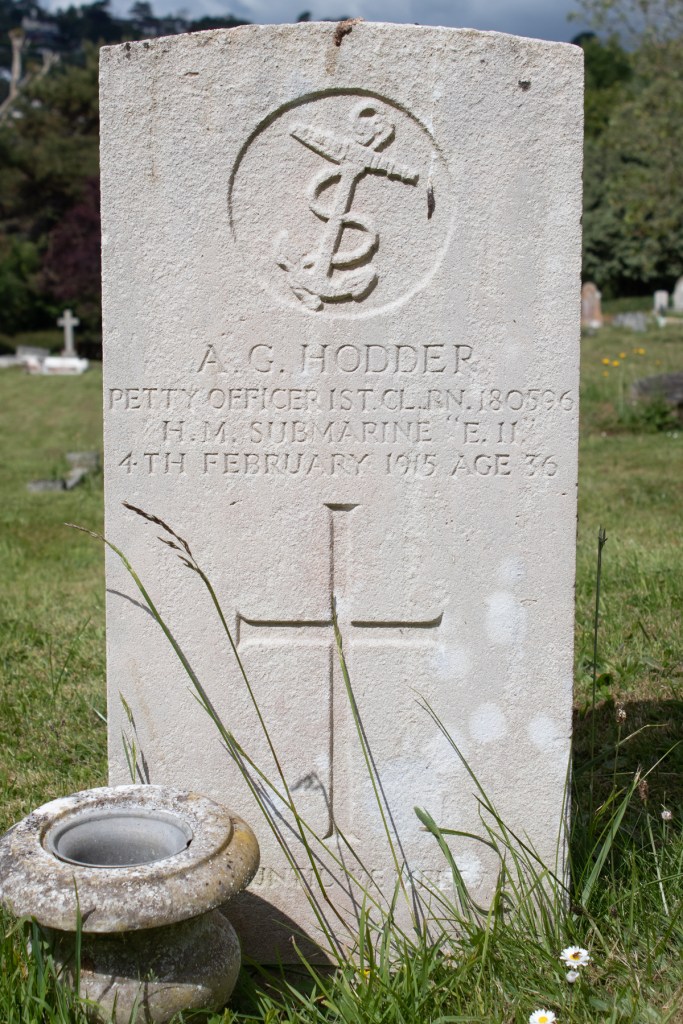
Petty Officer 1st Class Albert Hodder

Petty Officer 1st Class Albert Hodder

Albert George Hodder was born on 27th December 1878 in Lyme Regis, Dorset. The oldest of three children, his parents were Samuel and Ellen Hodder. Samuel was a general labourer who died in 1886, when he was 35 years of age. By the time of the 1891 census, Albert had given up school, and was working as a live-in cowboy in the nearby Devon village of Uplyme, bringing in what would be the only wage for him, his mother and his two younger brothers.

Working on a dairy farm would not bring in the money the his family would need. So, on 7th August 1894, Albert sought out more of a career and enlisted in the Royal Navy. His service records confirm that he was 5ft 4ins (1.62m) tall with brown hair, grey eyes and a ruddy complexion.

Albert was under the age to formally enlist, and so was given the rank of Boy 2nd Class. He was sent to the training ship HMS Boscawen, and, over the next eighteen months he received a basic education and naval induction. By the end of July 1895, he had been promoted to the rank of Boy 1st Class.

On 12th November 1895, Boy Hodder was assigned to the ironclad ship HMS Alexandra, and his naval career began. Over the next nearly two decades, he would serve on twelve separate ships, rising through the ranks as he did so.

When Albert came of age, on 27th December 1896, he was serving on board HMS Gibraltar. Formally inducted into naval service, he was given the rank of Ordinary Seaman. He spent more than three years on board Gibraltar, and rose to Able Seaman on 1st January 1899.

From here his career continued: He was promoted to Leading Seaman on 18th May 1903, Petty Officer 2nd Class on 1st April 1905 and Petty Officer 1st Class just two years later.

In the autumn of 1912, Albert’s career changed course. He was assigned to HMS Maidstone, a submarine depot ship, and a life under the ocean waves started to appeal. On 28th March 1914, Petty Officer Hodder was sent to HMS Dolphin, home of the Royal Navy Submarine Service, where he was trained up for new duties. By October that year he was to be found serving on board the newly-commissioned submarine E11.

Over the next few months he served in the North Sea, Baltic Sea, and the E11 was involved in a minor way in the defence of Scarborough in December 1914 and the Cuxhaven Raid ending on Christmas Day that year.

At this point, Petty Officer Hodder’s trail goes cold. He remained on the E11 until early February, by this time she was based off the Norfolk coast.

An inquest was held on Friday on the body of Albert George Hodder… of Lyme Regis, Dorset, a member of the crew of one of HM vessels, who died from the effect of immersion.

Evidence showed that at 9.20 on the previous Thursday night a petty officer heart the shout of “Man overboard.” He got on to a collier moored in the river and saw a black object float past. Unable to reach it, he jumped ashore and got into the ferry boat. He was then able to reach the object, which he found was the deceased. He held his head above the water while the ferryman pulled the boat to the quay. The deceased was got out in an insensible condition, a doctor sent for, and artificial respiration tired. Efforts were persisted till breathing was established, and he was then wrapped in blankets, with hot water bottle; but he succumbed to the effects of immersion and shock shortly after eleven. No one saw how the deceased fell overboard.

A verdict of “Accidental death” was returned.

[Diss Express: Friday 12th February 1915]

Petty Officer 1st Class Albert George Hodder was just 35 years of age when he died on 4th February 1915. His body was taken back to Dorset for burial, and he was laid in Lyme Regis Cemetery.


Private John Merritt

Private John Merritt

John Merritt was born on 17th August 1880 in Shoreditch, London, and was the youngest of three children to James and Emily Merritt. James was a dock labourer, who passed away when his son was just four years old. Emily remarried the following year, having a child with her new husband, George Wise, in 1888.

When he completed his schooling, John found work as a stoker. However, he sought bigger and better things and, on 21st February 1898, he enlisted in the Royal Marine Light Infantry. Not yet eighteen years old, his service records show that he was 5ft 5.5ins (1.64m) tall, with grey eyes, brown hair and a fresh complexion. His service records also record a couple of tattoos: an anchor on his left forearm, and a crossed heart on his right.

Over the next two decades, Private Merritt sailed and saw the world. Primarily based out of the Royal Naval Dockyard in Chatham, Kent, he served on ten ships in all. His superiors obviously thought highly of him, as his records note his character and ability as very good throughout his service.

On 3rd July 1909, John married Harriett Wise. She was a lighterman’s daughter from East London, who was working as a cork cutter when the couple exchanged their vows. They went on to have two children: Florence, who was born in 1910, and Reginald, who came along six years later.

By the time war was declared in the summer of 1914, John seems to have been mainly shore-based, his time being split between Chatham and Portsmouth, Hampshire.

On 7th March 1917, Private Merritt was on board the gunboat HMS Spey, which was carrying out diving operations in the Thames Estuary. At 4 o’clock in the afternoon, in “bitterly cold and boisterous conditions” [Whitstable Times and Herne Bay Herald: Saturday 24th March 1917], the ship lost an anchor, and the decision was made to return to base at Sheerness, Kent. Another vessel, the HMS Belvedere, was close by and turned towards the Spey, and, despite trying to avoid a collision, the smaller ship was struck a glancing blow.

The Spey was 40 years old, and the impact sheered numerous rivets from the side. Water gushed in, and the gunboat sunk beneath the Thames within a matter of minutes. Some of the crew had managed to escape on a life raft, but it was not fitted with lights or flags. The boat drifted and was not found until five hours later, partially submerged: all on board had died.

In total, twenty of the thirty-seven crew perished on that March afternoon, including Private Merritt. He was 36 years of age.

It would seem that Harriett was unable to cover the cost of bringing her late husband’s body back to London for burial. Instead, John Merritt was laid to rest in Woodlands Cemetery in Gillingham, Kent, not far from the naval base in Chatham which he had called home for so long.


Boy 1st Class Ernest Hewett

Boy 1st Class Ernest Hewett

Ernest Roye Hewett was born on 18th April 1898 and was the third of twelve children to Alfred and Ada. Alfred was a coachman and groom and, while both he and Ada were born in Cornwall, it was in Budleigh Salterton, Devon, that the family were born and raised.

When he finished his schooling, Ernest found work as a butcher’s boy, but when sought bigger and better things. His oldest brother, Ralph, had enlisted in the army by the time of the 1911 census and, by that October, his next oldest brother, Leslie, had enlisted in the Royal Navy. Ernest felt a career in the military was his destiny and, on 12th September 1913, he also joined the navy.

As he was under age at this point, he was given the rank of Boy 2nd Class, and sent to HMS Impregnable, the training establishment in Devonport, for his induction. His service records show that he was 5ft 2.5ins (1.59m) tall, with brown hair, hazel eyes and a fresh complexion.

Ernest spent nine months training, moving from Impregnable to HMS Powerful, and gaining a promotion to Boy 1st Class in the process. In June 1914, he was assigned to the cruiser HMS Edgar, remaining on board for six months, by which point war had broken out.

On 18th December 1914, Lance Corporal Ralph Hewett was killed in action, aged just 20 years old. Attached to the 2nd Battalion of the Devonshire Regiment, he was caught in fighting in Northern France, and is commemorated on the Le Touret Memorial.

Ernest, by this point, had been assigned to another ship, the armed merchant cruiser HMS Viknor. Patrolling the seas off Scotland, towards the end of the month, she was tasked with locating and detaining the Norwegian ship Bergensfjord, on board which was a suspected German spy.

The vessel was located and escorted to Kirkwall in the Orkneys, and the suspect and a number of other prisoners, were taken on board the Viknor to be transported to Liverpool. The ship and crew were never to reach their destination. On 13th January 1915, she sank in heavy seas off the Irish Coast: no distress signal was made and all hands were lost.

BODY WASHED ASHORE – Another body has been washed ashore at Pallntoy Port, about six miles from Ballycastle. The body was that of a man of about 5ft 10in. in height. He was dressed in a blue jacket, and wore a service blue webbed belt, on which was the name E. F. Hewett. In the pocket of the trousers was a boatswain’s whistle.

Freeman’s Journal: 24th February 1915

Already in mourning for Ralph, Alfred and Ada were unable to bring 16-year-old Ernest Roye Hewett back home. Instead, he was laid to rest in Ballintoy parish church, County Antrim.


The heartbreak was to continue for the Hewett family. Leslie’s career had gone from strength to strength and, by the time of his older brother’s death, he had been promoted to Able Seaman. In the summer of 1915, he was assigned to the cruiser HMS Europa, remaining aboard for the next year as it patrolled the Mediterranean. In July 1916 he fell ill, having contracted malaria. This was to prove his undoing: he passed away from the condition on 21st July, at 20 years old.

Able Seaman Leslie Hewett was laid to rest in the Mikra British Cemetery in Greece. His parents had now lost their three oldest sons, and had no way to reach their final resting places.


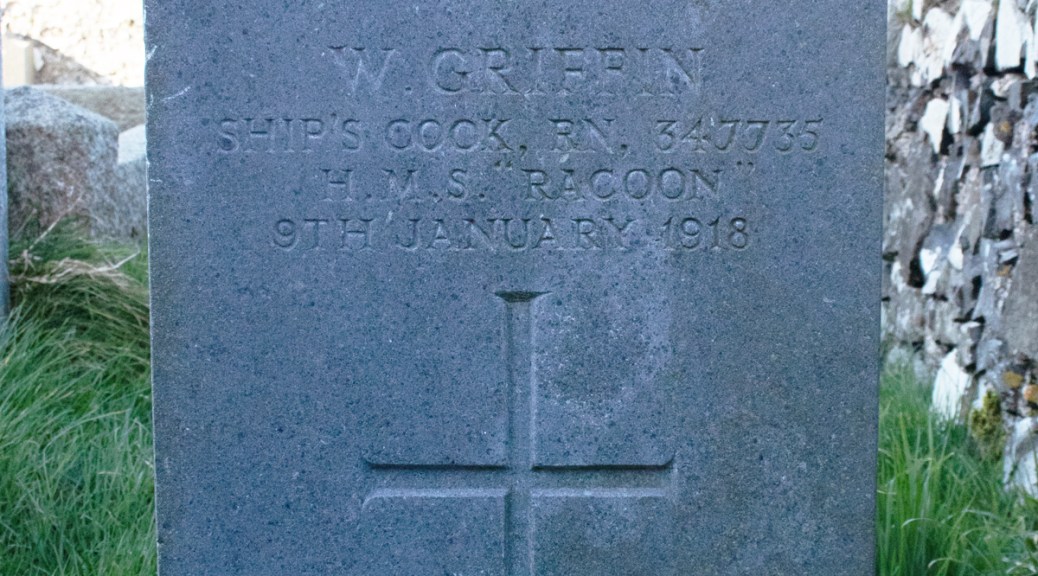
Ship’s Cook Walter Griffin

Ship’s Cook Walter Griffin

Walter Griffin was born on 15th December 1886 in Woolwich, Kent. Details of his early life are lost to time, but, by the time of the 1901 census, he was working as a cooper’s mate at a cement factory in Higham, Kent.

Walter sought bigger and better things for himself, and, on 19th June 1907, he enlisted in the Royal Navy as Cook’s Mate 2nd Class. His service records confirm that he was 5ft 4ins (1.62m) tall, with brown hair, grey eyes and a fresh complexion.

Walter was initially sent just down the coast to the Royal Naval Dockyard in Chatham, Kent, for his training. He remained there for nine months, and was promoted to Cook’s Mate 1st Class for his service.

In January 1908, he was given his first posting, on board HMS Wildfire, and, over the next nine years, he served on a further four ships, returning to Chatham in between postings. Walter was obviously dedicated to the work he was doing: in January 1910 he was promoted to Leading Cook’s Mate, and by 1917, he was promoted again, to the ran of Ship’s Cook.

This promotion coincided with a transfer to what would be his last assignment, on board HMS Racoon. This Beagle-class destroyer patrolled the waters between Scotland and Northern Ireland, and he spent the winter of 1917/18 on board.

On 9th January 1918, there were storm conditions off the Irish coast: high seas and blizzard limited limited vision. At 2am, the Racoon struck rocks, and foundered: in the treacherous conditions, all hands were lost. Shio’s Cook Griffin was 31 years of age.

Walter Griffin’s body washed ashore near the village of Ballintoy, Country Antrim, the following day. He was laid to rest in the parish church, next to two other crew members, Ordinary Seaman Frank Green and Stoker 2nd Class Frederick Sarell.

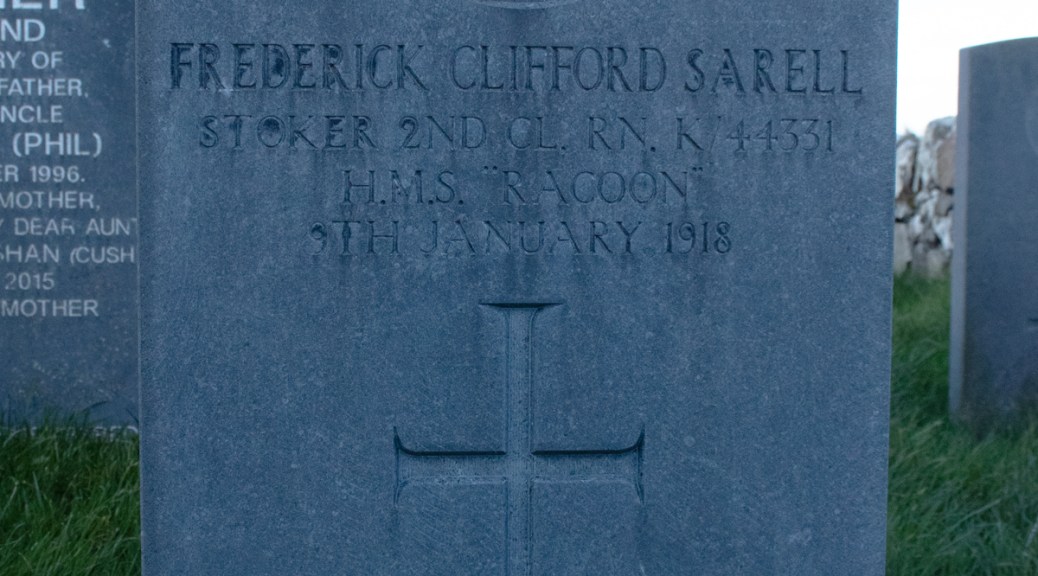
Stoker 2nd Class Frederick Sarell

CWG: Stoker 2nd Class Frederick Sarell

Frederick Clifford Sarell was born on 6th July 1899, one of six children to James and Theresa. James was a general labourer from East London, and the family were born and brought up in West Ham, Essex.

The Sarell family were beset by tragedy: Frederick’s oldest brother, James, died in 1903, at the age of 23, while James Sr passed away three years later. By the time of the 1911 census, Theresa was raising her five remaining children in a small house in Fife Road, Canning Town, with her oldest three children bringing in some money to support the family,

In 1913, another of Frederick’s brothers, George, passed away, and the following year his oldest sister, Theresa Jr, also died. By the summer of 1917, with war raging across Europe, Frederick stepped up to play his part. It is unclear whether his motives were to support his mother, or because he was conscripted, but either way he enlisted in the Royal Navy.

Frederick had been working as a dock labourer when he signed up. He Employed as a Stoker 2nd Class, his naval records show that he was 5ft 6.5ins (1.69m) tall, with brown hair, grey eyes and a fresh complexion. He was noted as having a scar on his right knee, a distinguishing mark that would tragically help to identify his body before the year was out.

Stoker Sarell was initially sent to HMS Pembroke, the Royal Naval Dockyard in Chatham, Kent, for his training. On 10th October 1917, he was given his first posting, on board the destroyer HMS Racoon, which patrolled the seas between Ireland and Scotland.

Frederick was on board when, on 9th January 1918, the Racoon struck rocks off the coast of Northern Ireland in heavy seas and blizzard conditions. All of the crew – more than 90 men – were lost. Stoker 2nd Class Sarell was just eighteen years old when he died: he had been in the Royal Navy for less than six months.

The body of Frederick Clifford Sarell washed ashore near Ballintoy, County Antrim. He was laid to rest in the graveyard of the village’s church next to two other crew members, Ordinary Seaman Frank Green and Ship’s Cook Walter Griffin.


Ordinary Seaman Frank Green

Ordinary Seaman Frank Green

Frank Ernest Green was born in Stratford, Essex on 14th November 1889. One of nine children, his parents were printer’s compositor John Green and his wife, Susan. The family were raised in Leytonstone and, by the time of the 1911 census, they were living in a house in Elsham Road.

Frank found work as a clerk for a financial company when he finished his schooling. On 31st August 1912, he married sailor’s daughter Charlotte Greenland, who was four years his senior. The couple settled in Gibbon Road, Peckham, Surrey, where Frank continued his work.

When war broke out, Frank was called upon to play his part. On 3rd January 1917, he enlisted in the Royal Navy for the duration of the war. His service records show that he was 5ft 6.5ins (1.69m) tall, with brown hair, blue eyes and a fresh complexion.

Ordinary Seaman Green was initially sent to HMS Pembroke, the Royal Naval Dockyard in Chatham, Kent, for training. He spent short periods of time on two ships before being assigned to HMS Racoon, a Beagle-class destroyer,

Initially patrolling the Mediterranean, by the time Frank joined the crew the Racoon she was part of the Second Destroyer Flotilla, based from Northern Ireland. In January 1918, she struck harsh weather:

HMS Racoon, Lieut. George LM Napier RN, in command, struck some rocks off the north coast of Ireland at about 2am on the 9th [January], and subsequently foundered with all hands.

Nine of the crew had been left behind at her last port of call, and these are the sole survivors.

Seventeen bodies have been picked up by patrol craft, and are being buried at Rath Mullan. Five more bodies have been washed ashore, and are being buried locally.

All the next of kin have been informed.

Exeter and Plymouth Gazette – Monday 14 January 1918

Ordinary Seaman Frank Ernest Green was one of those to be washed ashore. He was just 28 years of age. He was laid to rest in the peaceful and picturesque graveyard of Ballintoy Church, County Antrim, not far from where he had come to land. He was buried next to two other crew members, Ship’s Cook Walter Griffin and Stoker 2nd Class Frederick Sarell.


Sailor Angus MacIver

Sailor Angus MacIver

Angus MacIver was born in 1887 in the isolated hamlet of Geshader (Geisiadar), on the Isle of Lewis, Scotland. His parents were Murdo and Marion MacIver, and he was one of seven children.

Detail of Angus’ early life are a challenge to uncover. It would seem that he worked with boats when he completed whatever schooling he undertook. Given Geshader’s proximity to the coast, it is likely that Murdo was a fisherman, and that his three sons – Angus included – followed suit.

By the time war broke out in 1914, Angus had joined the Canadian Merchant Navy. He held the rank of Sailor: records suggest that he would have been an Able Seaman, had he been in the Royal Navy.

In the spring of 1918, Sailor MacIver was serving on board the SS Tagona, a Canadian steamer, ferrying goods across the Atlantic. The ship was en route for Glasgow, having sailed from Bilbao, Spain, and, on 16th May she was passing close to the North Cornish coast. Five miles (8km) from Trevose Head, Tagona was torpedoed by the German submarine U-55, and sank. Eight crew members, including Angus, drowned. He was 31 years of age.

The body of Sailor Angus McIver washed ashore in the Camel Estuary: the remains were identifiable, but his family were unable to bring him back to Lewis. Instead, he was laid to rest in the peaceful graveyard of St Menefreda’s Church in St Minver, Cornwall.