Tag Archives: haemorrhage

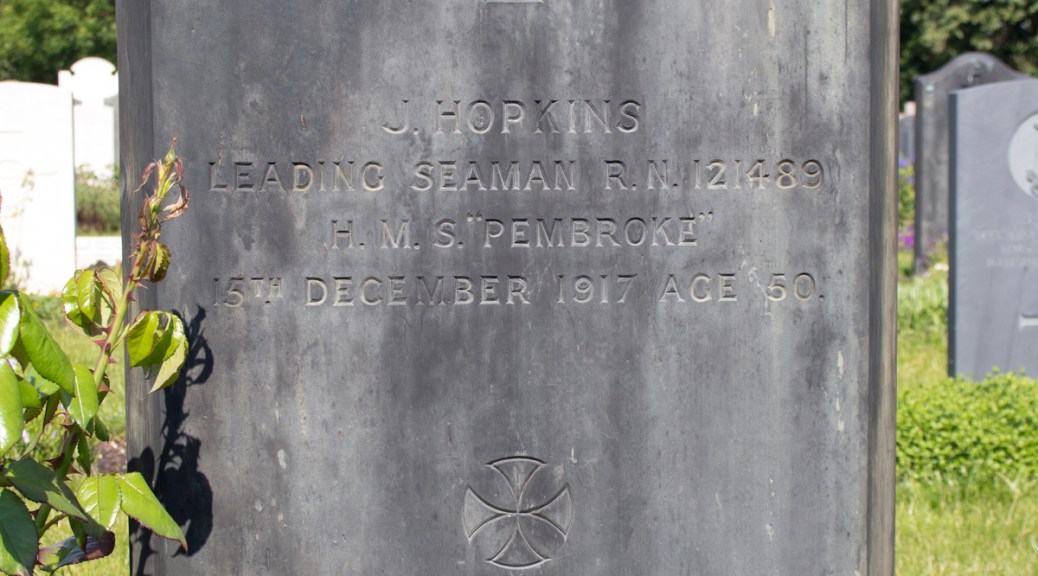
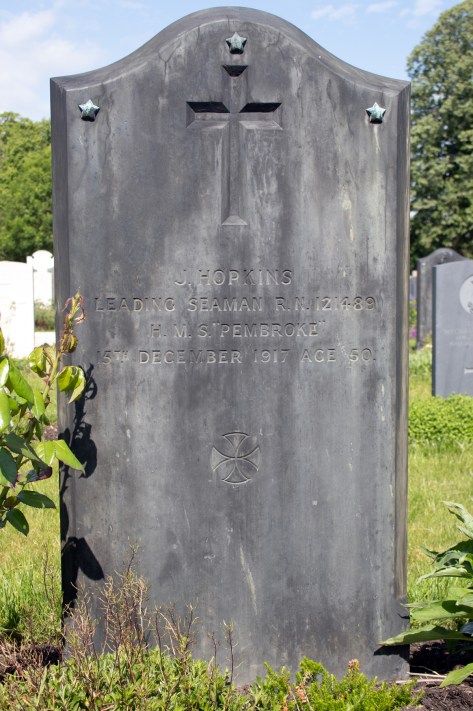
Leading Seaman Joseph Hopkins

Leading Seaman Joseph Hopkins

Joseph Hopkins was born in Ramsgate, Kent, on 27th May 1867. The third of seven children, his parents were commissioned sailor George Hopkins and his wife, Agnes.

Given his father’s job, Joseph seemed destined for a life at sea himself and, on 30th November 1882, he joined the Royal Navy as a Boy 2nd Class. Over the next couple of years, he learnt the tools of his trade, starting on the training ships HMS St Vincent and HMS Hector. During this time, he was promoted to Boy 1st Class.

On 1st January 1885, Joseph was assigned to the ironclad ship HMS Repulse. He remained on board for six months, during which time he came of age. Now an Ordinary Seaman, his service papers show that he was just 5ft 1in (1.55m) tall, with black hair, grey eyes and a pale complexion. He was also noted as having a scar on the left of his forehead.

Ordinary Seaman Hopkins’ contract was for ten years and over that decade he sailed the world, serving on eight ships. Less than a year after formally enlisting, he was promoted to Able Seaman, but his time in the navy was not without its problems.

Able Seaman Hopkins spent four separate periods of time – totalling 49 days – in the brig between 1886 and 1895. Details of his most of his offences have been lost to time. Given the last instance was an expired shore leave which also landed him with a find of £3 10s (around £580 today), it seems likely that he was a repeat offender.

When Able Seaman Hopkins’ contract expired, he immediately re-enlisted. He served for another ten year and, apart from one further bout in the cells in 1898, his record was incident free. In the summer of 1905, after more than two decades in the Royal Navy, he was formally stood down to reserve status.

Joseph’s trail goes cold for a while and it is only in the 1911 census that we pick him up again. At this point he was living with his younger brother in Kilburn, Middlesex, where he was employed as a warehouseman.

When war broke out, Joseph was called upon to play his part once more. He took up the rank of Able Seaman once again, but remained shore-based, serving at HMS Pembroke, the Royal Naval Dockyard in Chatham, Kent. He would spend the next three years at the dockyard, rising to Leading Seaman in March 1917.

By this point, however, Joseph’s health was beginning to decline. In December 1917 he was admitted to Chatham’s Royal Naval Hospital following a cerebral haemorrhage, but the condition would prove fatal. He passed away on 15th December, at the age of 50 years old.

The body of Joseph Hopkins was taken to Woodlands Cemetery in Gillingham, Kent, and he was laid to rest, not far from the base he had called home for so long.


Private John Thompson

Private John Thompson

The death occurred at the Voluntary Aid Detachment Red Cross Hospital last week of Private John Thompson, aged 38 years, of the 10th Battalion Gloucester Regiment. The deceased was admitted to the Hospital about two months since with injuries which developed into hemorrhage [sic] of the brain.

[Salisbury and Winchester Journal: Saturday 19th December 1914]

The life of John Thompson is a challenge to unpick. Full service details are lost to time, but his Pension Ledger Card confirms that he was married to a Mary Ellen, who lived in Ladywood, Birmingham, and that the couple had a daughter, Florence May, who was born on 4th October 1903.

The family do not appear on the 1911 census return, and there are no marriage records for John and Mary. It is uncertain whether the couple had wed before the time of the 1901 census, and without a definite place of birth, John’s name is too common to provide an accurate search before then.

The British Army Register of Soldiers’ Effects suggests that he had served with the Gloucestershire Regiment for less than six months, and, given the date of his death, it is probable that he enlisted shortly after war was declared, falling ill soon after that.

The 10th (Service) Battalion was based on Salisbury Plain when Private Thompson first became unwell, and it seems likely that he was camped near Mere, Wiltshire, as this is where the VAD hospital was situated.

John Thompson died on 9th December 1914, at the age of 38 years old. He was laid to rest in Mere cemetery on the outskirts of the town.


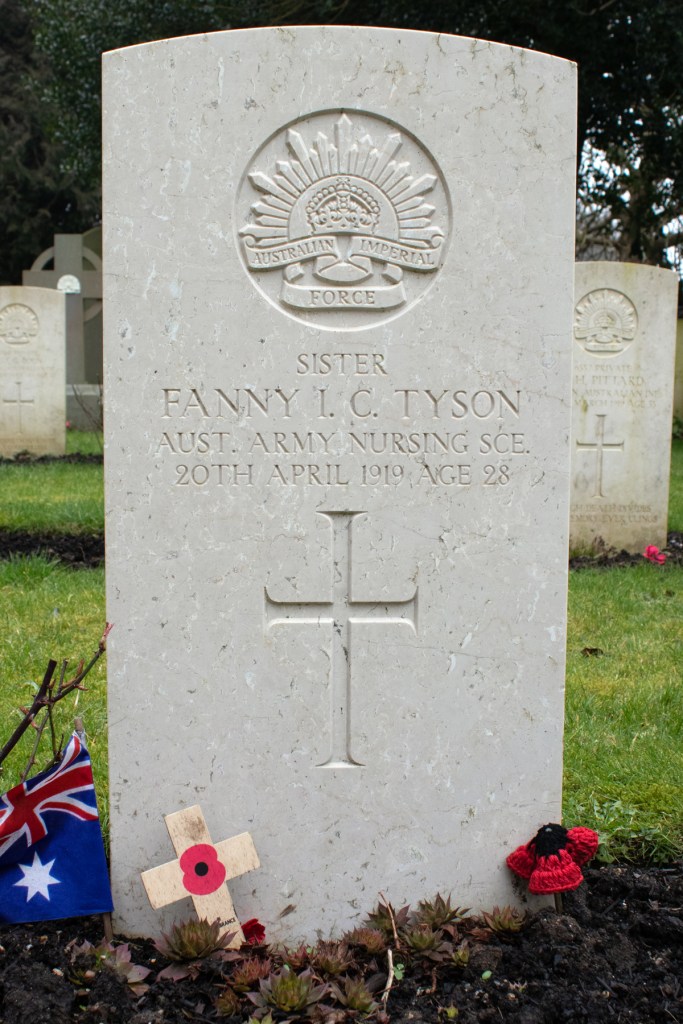
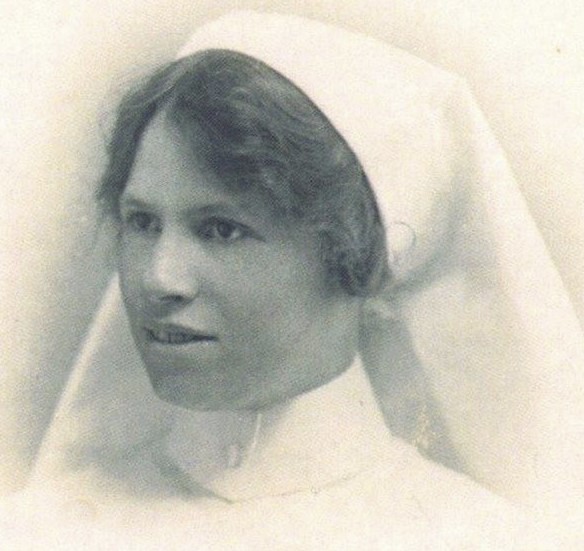
Sister Fanny Tyson

Sister Fanny Tyson

Fanny Isobel Catherine Tyson was born in Balranald, New South Wales, Australia, in 1890, and was the fourth of ten children to John and Teresa Tyson.

There is little information about Fanny’s early life, but when she finished her schooling, she went into the medical profession, and, by October 1911 she was working as a nurse at Bendijo Public Hospital. She became a staff sister and, when war broke out, she stepped up to support the troops being sent to Europe.

On 20th May 1915, Fanny enrolled in the Australian Army Nursing Service and by the following spring, she was on her way across the world. Arriving in France on 6th April 1916, she soon made her way to Rouen. For the next fourteen months Staff Nurse Tyson was attached to the No. 1 Australian General Hospital, but in the summer of 1917, she transferred to the No. 10 Stationary Hospital in Saint-Omer.

Fanny was committed to her job, which would have been traumatic at the best of times. She moved to Dieppe in February 1918, and in the closing weeks of the war, she transferred to Britain, working at the 2nd Australian General Hospital in Southall, Middlesex. On 1st October 1918 she was promoted to the rank of Sister.

Fanny would remain in Britain through the Armistice and beyond. On 20th April 1919, she was admitted to the No. 1 Australian General Hospital in Sutton Veny. Her service records do not confirm what had taken her to Wiltshire, but it seems likely that she was either accompanying wounded soldiers being transferred to Southall, or was training or supporting nurses there.

Sister Tyson had suffered a cerebral haemorrhage. She passed away that evening, as the age of 28 years old.

Fanny Isobel Catherine Tyson was laid to rest in the grounds of St John’s Church, Sutton Veny. She was buried alongside the soldiers her unit had made comfortable in their last days.


Sister Fanny Tyson
(from findagrave.com)

Sapper Charles Salisbury

Sapper Charles Salisbury

Charles Salisbury was born in Helensville, New Zealand, on 23rd June 1885. The fifth of six children, his parents were James and Sarah Salisbury.

Little information is available about Charles’ early life, but by his 20s he had found work as a linesman, working his way up to foreman. In April 1914 he married Nora Fiori: the couple settled in Onehunga, and had two children: Pauline had been born in 1907, and sister Catherine followed in 1911.

When war broke out in Europe, the British Empire called upon its own to step up and serve. Charles enlisted on 9th April 1916, joining the 15th Division of New Zealand Signallers, itself part of the New Zealand Engineers. His service records show that he was 31 years of age, 5ft 9ins (1.65m) tall and weighed 154lbs (69.9kg). He was noted as having dark hair, blue eyes and a dark complexion.

Sapper Salisbury’s unit left Wellington for Britain on 28th July 1916. The voyage on board the ship Waitemata took ten weeks, Charles setting foot on solid ground again in Devonport, Devon, in October. From there the battalion moved to its base near Codford, in Wiltshire.

Charles would spend the next six months in camp, presumably in preparation for a move to the continent. Sadly for Charles, however, he was not to see any action away from Britain. On 27th May 1917 he was admitted to the camp hospital, suffering from a cerebral haemorrhage: he died the following day. Sapper Salisbury was 31 years of age.

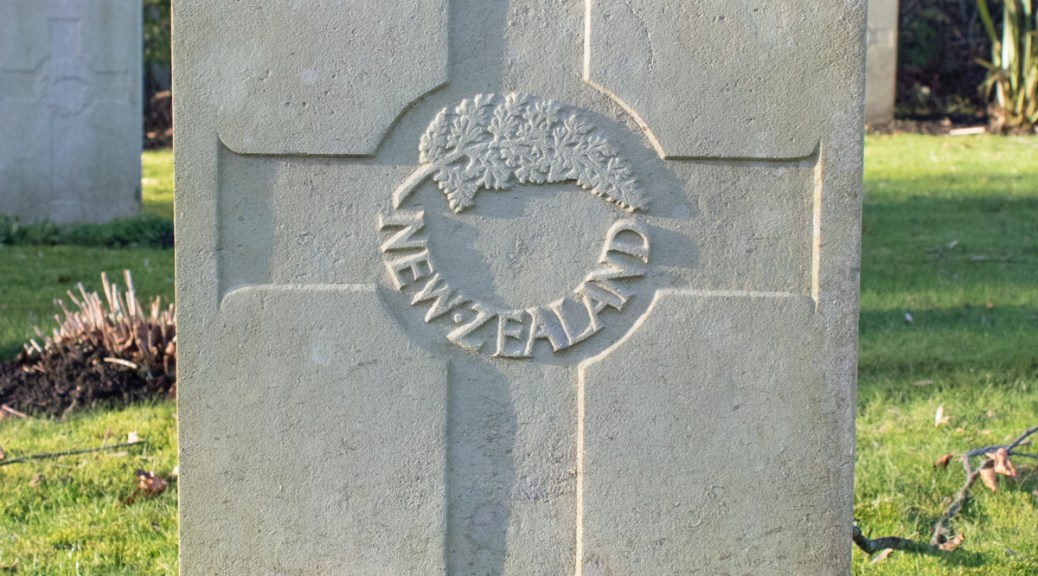
Charles Salisbury was laid to rest in the newly consecrated ANZAC extension to St Mary’s Churchyard in Codford, not far from the troops encampment.


Sapper Charles Salisbury
(from findagrave.com)

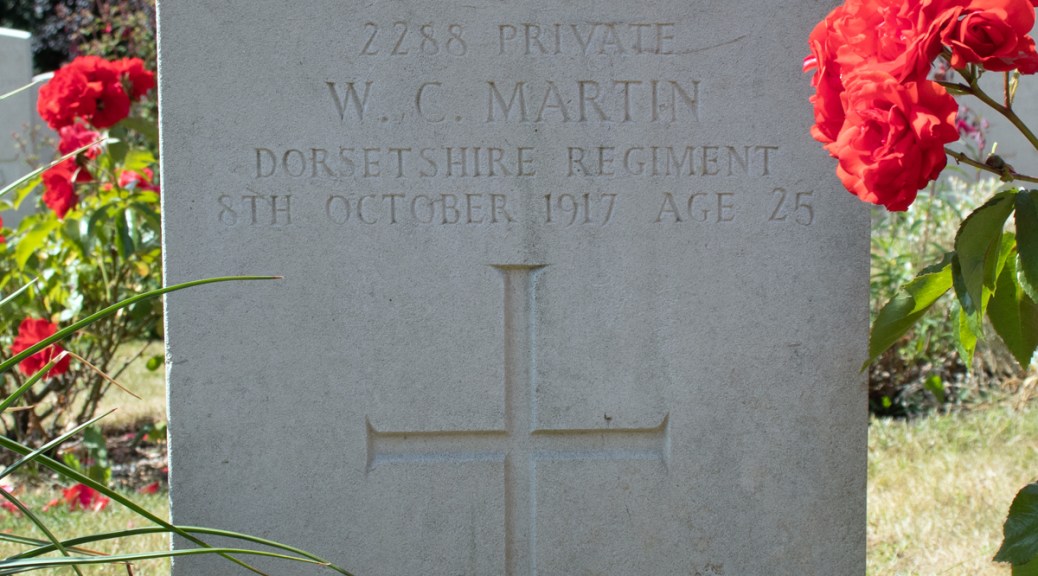
Private Willie Martin

Private Willie Martin

Willie Cyril Martin was born in December 1891 in the Dorset village of Almer. The son of Elizabeth Martin, his mother would go on to marry Edward Holloway nine years later, although it is unclear whether he was Willie’s father.

When he finished his schooling, Willie found work as a kitchen porter, and this led him to the Dorset coast. The 1911 census found him boarding with 35 others at Pryory Mansions in Bournemouth.

When war broke out, Willie stepped up to play his part. He enlisted on 9th October 1914, joining the Dorsetshire Regiment. Assigned to the 4th Battalion, his unit was soon sent to India, moving to the Middle East over the following years.

By the autumn of 1916, Private Martin was back in Dorset. On 7th November he married Edith Williams at St Clement’s Church in Bournemouth. She was the 26-year old daughter of a gas fitter, and the couple’s marriage certificate sheds some light on Willie’s background as well. It gave his father’s name as Richard Martin (deceased), who was a butler, although there is no other information to substantiate this, and Elizabeth had passed away some years before, so could not back up or refute the suggestion.

Private Martin returned to duty after his wedding. At some point he transferred to the Labour Corps, and was attached to 644 Company. His re-assignment may have been down to medical issues – he had contracted malaria while serving overseas – and by the autumn of 1917, he was sent to hospital because of his deteriorating health.

Willie was admitted to Bath War Hospital in Somerset, suffering from a bout of malaria. The condition was to get the better of him, and he passed away on 8th October 1917, from a haemorrhage on his lungs. He was 25 years of age.

Willie Cyril Martin was laid to rest in the military section of Bath’s sweeping Locksbrook Cemetery, not far from the hospital in which he passed away.


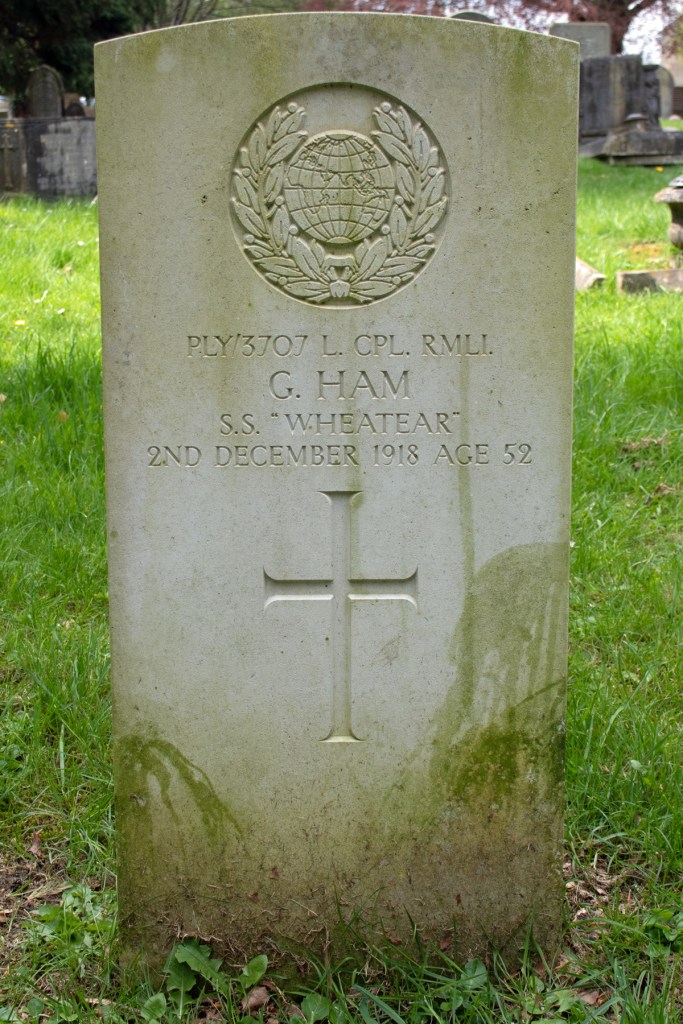
Lance Corporal George Ham

Lance Corporal George Ham

George Ham was born on 19th December 1867 in Twerton, Somerset. His parents were George and Emily Ham, and he was the oldest of their nine children. George Sr was a mason, and initially his first born followed suit, but he was pulled towards something bigger and better and, on 19th January 1886, he enlisted in the Royal Marine Light Infantry.

George’s service records note that he was 5ft 6ins (1.68m) tall, with brown hair, grey eyes and a fresh complexion. He was initially sent to the barracks at Walmer in Kent, and it was from here that Private Ham began a 21 year career in the Royal Marines. Over that time, he served on seven separate ships, and, between voyages, he was based in barracks in Plymouth, Devon. Both his character and ability were consistently noted as being very good.

Private Ham’s career took him around the world and, in 1887, he found himself on the gunboat HMS Banterer, on which he served for three years. His tour of duty included a period of time in Galway, Ireland, and it was here that he met Mary Ann Goode. On 5th July 1889, the couple married in city’s St Nicholas’ Church. The church’s records suggest that the couple went on to have four children – Frederick George; Emily, who died just after her first birthday; Albert; and Katherine.

George’s records from this point become a little disjointed. In October 1890, he returned to his Plymouth base, and the following year’s census recorded him as living in the East Stonehouse Barracks, although his marital status was noted as single.

The next census, in 1901, presents a different picture. George and Mary were, by this time, living in family barracks in East Stonehouse, with two children, (Frederick) George and Albert. Katherine, the couple’s youngest child, was born the following year.

In January 1907, after more than two decades’ service, George was stood down from active service in the Royal Marines. He was placed on reserve status, and took up work as a mason once more. At this point, however, the family seemed to have hit more troubled times, underlined by four separate 1911 census documents.

George, who was 44 by this point, was recorded as being an inmate in the Bath Union Workhouse and Infirmary in Lyncombe, Somerset. Mary and Katherine, meanwhile, were in two rooms in a house in Stonehouse, Devon. Frederick, who was now better known as George, had followed his father into military service, and was a Private in the Royal Marine Light Infantry, serving on HMS Colossus. Albert, who was 13 years old, was one of 946 students boarding at the Royal Hospital School for Sons of Seamen in Greenwich, London.

George spent nine years in the reserves, and, in 1914, was called up again for war service, this time as a Lance Corporal. According to a contemporary newspaper:

[He was] engaged on naval patrol work against submarines off the Canadian coast and elsewhere, and was in charge of a gun on an armed merchant ship. Once the boat he was on was torpedoed, and on another occasion he had a long running fight with a submarine in the Irish Channel. The ship, however, reached Portrush (Ireland), and the inhabitants gave Lance-Corporal Ham a testimonial, and he was also rewarded in other ways, the Cardiff owners of the vessel recognising his skill and gallantry.

Bath Chronicle and Weekly Gazette: Saturday 7th December 1918

Tragedy was to strike in the end, however, and George was to meet a sad end to a distinguished career.

While at Cork [George] fell, either from a boat or the dock, and sustained an injury to the side of his head. It did not appear very serious, and it is understood that he made a trip to Cardiff and back to Londonderry, [where] he became so seriously ill as to necessitate his going to a military hospital in Londonderry. Hemorrhage [sic] of the brain set in, and he died on Monday [2nd December 1918] before his brother, Mr Albert Ham, who had been telegraphed for, could reach him.

Bath Chronicle and Weekly Gazette: Saturday 7th December 1918

Lance Corporal George Ham was days short of his 51st birthday when he died. His body was brought back to Somerset for burial, and he was laid to rest in Twerton Cemetery. The newspaper report give no indication as to whether Mary or their children were in attendance and, in fact, does not mention his wife and family at all.


Serjeant George Collins

Serjeant George Collins

Details of the lives of those who fell during the Great War can be limited by the documentation that is available more than a century later. Based on what remains, the life of George Collins would have been technical and sparse.

From the formal documents that remain, it is possible to determine that he was born in Bath, Somerset, in 1870 or 1871, and his father was farmer Oliver Collins.

George married Florence Lydyard on 25th January 1896 at the parish church in Bathampton. George was listed as a cellarman, while Florence was noted as being the daughter of George Lydyard, an agent.

The 1901 census found the couple living at the Liberal Club in Bath, which they were both managing. The couple had had a son, George Jr, who was born in 1898, and were employing a servant to help with the daily chores.

The 1911 census shows that George had left the club behind, and was employed as a gymnastic instructor. He and Florence now had four children: Mona, who was 14 (and who didn’t appear on the previous census); George; and twins Marjorie and Dorothy, who were born on 5th July 1904.

The limited military documentation confirms that George enlisted in the North Somerset Yeomanry by October 1917. He was assigned to the 2nd/1st Battalion, which was a mounted division that became a cyclist unit. The troop was based on home soil throughout the war and, depending on when he joined, George could have served anywhere from Northumberland to East Anglia or Southern Ireland.

These details, while uncovering something of George’s life, remain as clinical as the engraving on his headstone. With Serjeant Collins, it is a newspaper article on his passing that adds humanity to his life:

Many friends in Bath will regret to hear that Sergeant George Collins died on Saturday at the Bath War Hospital, where he had been an inmate for seven weeks, suffering acutely from gastritis. Deceased, who was a Bathonian by birth, when a youth joined the Welsh Regiment, and served for seven years in the 1st Battalion… He returned to Bath 21 years ago, and became a drill and physical instructor to several schools… whilst he also instructed evening classes at Guinea Lane and St Mary’s Church House. Being a Reservist he was called upon for the South African War, and Sergeant Collins rejoined his old regiment in 1899. He was wounded and invalided home… When he recovered from his wounds, Sergeant Collins resumed his work as an instructor at schools, and continued to act in that capacity until 1915. Though 44 years of age and not liable for military service, he very patriotically rejoined; he entered the North Somerset Yeomanry and became a drill instructor. He had not been abroad in this war, but had served in several places with the 2/1st NSY. The fatal illness became very pronounced in January when on leave, and he was not able to rejoin his unit. Sergeant Collins was a fine boxer, and became middle-weight champion of the Army when serving with the 1st Welsh. His experience as a trainer was often in request locally, and he had acted in that capacity to the most successful Avon Rowing Club crews. Deceased leaves a widow, one son, and three daughters. His only boy, Sapper George Collins, Wessex [Royal Engineers], has been serving at Salonika since 1915.

Bath Chronicle and Weekly Gazette: Saturday 13 April 1918

Beyond the staid, formal documents is a life well lived. Serjeant George Collins was 47 or 48 years old when he passed on 5th April 1918; the army record noted the cause of his death as a cerebral haemorrhage. His body was laid to rest in the graveyard of St Mary the Virgin Church, Bathwick, overlooking the city he loved.


Private Harry Ashford

Private Harry Ashford

Harry Ashford was born in Sidford, Devon, on 2nd June 1880, the oldest of seven children to Samuel and Fanny Ashford. Samuel was a mason and Fanny worked as a lace worker managing this at the same time as raising her children. The family left Devon in the late 1880s, settling instead in Chard, Somerset.

After initially working as an errand boy, when Harry finished school he found employment as a house painter. He had met lace worker Ada Hancock by this point, and the couple married in Chard’s Methodist Church on 4th May 1901. The couple set up home in the same road as Harry’s parents, and went on to have a daughter, Nora, the following year.

By this point, storm clouds were brewing over Europe, however, and Harry felt the need to play his part. On 22nd September 1915, at the age of 35, he enlisted in the Royal Army Medical Corps. His service record shows that he stood 5ft 6ins (1.68m) tall and was of good physical development.

Private Ashford served on the Home Front, and was based at the Tweseldown Camp near Farnham, Surrey. He served there for a little over a year before he contracted nephritis – inflamed kidneys – and was admitted to hospital. Sadly, the condition proved too severe, and he died on 31st October 1916 from a cerebral haemorrhage. He was 37 years of age.

Harry Ashford’s body was brought back to Somerset for burial. He was laid to rest in the cemetery of his adopted home town, Chard.


Both of Harry’s parents passed away not long after he died – Samuel in 1919 and Fanny in 1920. Ada never remarried, and lived a reasonable life, passing away in Nottinghamshire in the autumn of 1932, at the age of 53 years old.


Lance Corporal Edmund Durnford

Lance Corporal Edmund Durnford

Edmund George Durnford was born in the spring of 1881 in the Somerset village of Pitcombe. The second oldest of twelve children, he was the oldest son to Edmund and Eliza Durnford. Edmund Sr was an agricultural labourer who travelled with the work – the 1891 census recorded the family living in Mells, near Frome.

When Edmund Jr left school, he found work at an ironmonger’s. He moved to Midsomer Norton and, in 1907, he married local carter’s daughter Bessie Welch. The young couple set up home in a terraced house on the road to nearby Radstock, and went on to have two children: Ian, who was born in 1908, and Ronald, born the following year.

War came to Europe, and Edmund was keen to play his part. He enlisted in the Royal Army Service Corps as a Driver, and was assigned to the 827th Company. Full details of his service are not available, but he remained a part of the territorial force and was promoted to Lance Corporal.

The local newspaper of the time reported on what became of Edmund:

Lance Corporal Edward [sic] G Durnford, Army Service Corps… son of Mr and Mrs EG Durnford… died suddenly on April 18 at Duston Hospital, Northampton, from shell shock and hemorrhage [sic] of the brain, was 38 years of age. The body was brought back from Northampton, and the deceased accorded a military funeral at Midsomer Norton last week.

Somerset Guardian and Radstock Observer: Friday 3rd May 1918

There are a couple of inconsistencies with the report. The newspaper has Edmund’s name wrong, while his pension record does not mention shell shock as the cause of death (it confirms the cerebral haemorrhage, but also cites a granular kidney). Given that Lance Corporal Durnford did not serve abroad, it seems unlikely that shell shock was a contributing factor.

The same article also places three of Edmund’s brothers in the war, and gives an insight into what had become of them before the conflict. Gunner Percy Durnford was with the Canadian Field Artillery, training in the South of England; Sergeant Major Arthur Durnford, of the Australian Light Horse, was based in Sydney; Bombardier Horace Durnford, of the Royal Garrison Artillery, had served in France, where he had been gassed, but was, at the time of his oldest brother’s death, based in Egypt.

Edmund George Durnford died in Northampton on 18th April 1918. He was 38 years of age. His body was brought back to Somerset, and he was laid to rest in the graveyard of St John the Baptist Church in Midsomer Norton.


Edmund’s younger son, Ronald, served in the Second World War. He joined the Royal Artillery, reaching the rank of Lance Bombardier. Ronald was serving in the Far East early in 1942, and for the next year, no news was heard of him.

However, contact was made in March 1943, confirming that Ronald had been captured by the Japanese, and was a prisoner of war in Borneo. Three months later, his wife, Kathleen, received a postcard from him, confirming he was a prisoner of war, well and unwounded.

Tragic news was quick to follow, however:

In last week’s issue it was stated that Mrs [Bessie] Durnford… had received through her daughter-in-law news that her son, Lance Bombardier Ronald Durnford, was a prisoner of war in Jap hands and was unwounded.

On Saturday she received the sorrowful news that he was dead in the following messages, which her daughter-in-law had sent on:

“I deeply regret to inform you a report has been received from the War Office, that [Ronald], who was reported a prisoner of war in Borneo Camp, had died from dysentery. The date of his death is not yet known, but you may rest assured as soon as any further information is received, I will immediately let you know.”

Somerset Guardian and Radstock Observer: Friday 30th July 1943

Lance Bombardier Durnford was laid to rest in the Labuan War Cemetery in Malaysia.


Further family tragedy, albeit with a life well-lived, was to follow as, on 6th September 1943, Bessie too died at the age of 86. She was laid to rest alongside Edmund in the family plot. Her obituary confirmed that “She leave a husband, seven daughters, and four sons to mourn her loss. One son and one daughter are in Canada, and one son in Australia, and one daughter and son in London.” [Somerset Guardian and Radstock Observer, Friday 17th September 1943]

Bessie had not, in fact, remarried: the husband was, in fact, the one who had died some 25 years before.


Private Frederick Willmer

Private Frederick Wilmer

Frederick Ernest Potter Willmer was born in Worthing in 1878 and was the oldest of five children to Eliza Emma Willmer. She married Charles William Sparks Green in December 1880, and the couple went on to have four children – Frederick’s half-siblings.

Frederick falls off the radar for a number of years, only reappearing in 1898 when, on 26th October, he married Gertrude Boote. The couple would go on to have two children, Maude and Leslie.

By 1901, the young family were living near Tunbridge Wells in Kent, where Frederick was working as a coachman and groom. Sussex was calling, however, and, by the time of the census ten years later, the family had returned to Worthing. Frederick was now working as a gardener, and the family were living in two rooms in a house near the centre of the town.

With war calling, Frederick signed up to do his bit. His full service records no longer exist, but it is clear that he joined the Royal Sussex Regiment, and, as a Private, was assigned to the 72nd Provisional Battalion.

It seems that Private Willmer was part of the territorial force, serving instead on home soil, rather than overseas. The next record available for him – his pension record – confirms that he died on 12th December 1915 as a result of a cerebral haemorrhage following an illness. He was just 37 years old.

Brought home to Worthing, Frederick Ernest Potter Willmer was laid to rest in the Broadwater Cemetery in the town.