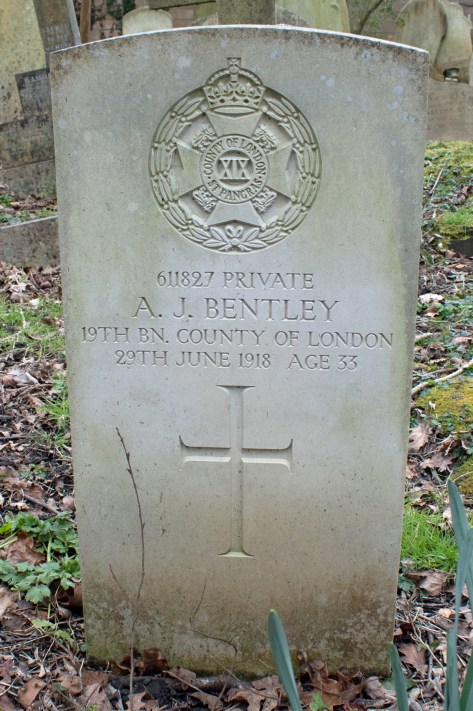
Albert John Bentley was born in St Pancras, Middlesex, in the spring of 1885. The second of six children, his parents were John and Eleanor (also known as Elizabeth) Bentley. John was a piano maker, and the family lived at 27 Hampshire Street in St Pancras.
When his father died in 1910, Albert had already started to follow in his footsteps. The following year’s census recorded him living with his mother and three younger siblings. Employed as an organ builder, his was one of three wages being brought into the household.
Albert stepped up to play his part when war broke out. Full details of his military service have been lost to time, but it is clear that he enlisted in the London Regiment, and was assigned to the 1st/19th (County of London) Battalion (St Pancras).
It is unclear whether or not Private Bentley spent any time overseas. By the summer of 1918, however, he had fallen ill, and was admitted to a military hospital in Shoreham-by-Sea, Sussex. He succumbed to a combination of influenza and pneumonia on 28th June 1918: he was 33 years of age.
The body of Albert John Bentley was taken back to Middlesex for burial. He was laid to rest in the sweeping grounds of Highgate Cemetery.
Richard Oscar Ford was born in Williamstown, Australia, in July 1891. The oldest of four children – and the only son – his parents were Anthony and Mary Ford. Anthony was a soldier, but Richard chose a different route and took work as a labourer when he completed his schooling.
There is little information available about Richard’s early life, but when war broke out, he stepped up to play his part. He enlisted in the Australian Imperial Force on 9th November 1914.
By this point he was working as a bushman, and his service papers reveal something of the man he had become. Standing 5ft 7ins (1.7m) tall, he weighed 140lbs (63.5kg), Private Ford had auburn hair, blue eyes and a fair complexion.
Assigned to the Light Horse Regiment, Richard left Australia for Europe on in March 1915. His unit arrived on the Gallipoli Peninsula on 15th July, and he would remain there for the next five months.
In December 1915, Richard came down with a bout of influenza, and was medically evacuated to the island of Mudros, then on to Alexandria, Egypt. In January 1916, he was admitted to hospital again, this time suffering from gonorrhoea and, after treatment, he re-joined his unit on 2nd February.
Private Ford’s unit spent that spring training in Egypt, but on 29th May, they set sail for the Western Front. Within a week they had disembarked in the French port of Marseilles and headed north to Etaples.
The next couple of years would prove a little disjointed. Richard switched units in August 1916, and given the rank of Gunner, but within two months his role had changed to Driver. His service records suggest that he managed to avoid injury during the fighting he was involved in, but that did not mean that he avoided hospital completely.
In January 1917 Driver Ford was admitted to the 51st General Hospital with a heart murmur, returning to his unit on 16th March. He had a second spell in hospital in February 1918, having come down with laryngitis.
In July 1918, having spent some time at the 4th Army Corporal School, Richard was reassigned to the 3rd Australian Field Artillery. This move seemed to have been the focus he needed. Initially promoted to Bombardier, within a month he rose to Lance Corporal, and by December 1918 he was a full Sergeant.
After the Armistice was signed, Richard was given three weeks’ leave, which he spent in Britain. By January 1919, however, his health was becoming an issue again, and he was admitted to the military hospital in Fovant, Wiltshire, suffering from influenza. The condition worsened, and Sergeant Ford passed away from bronchopneumonia on 4th February 1919. He was 27 years of age.
Richard Oscar Ford was laid to rest in Highgate Cemetery, Middlesex. While there seems to be no direct connection between the location and the man, his father, Anthony, had been born in Hackney, so it can be assumed that there was a family link to the area.
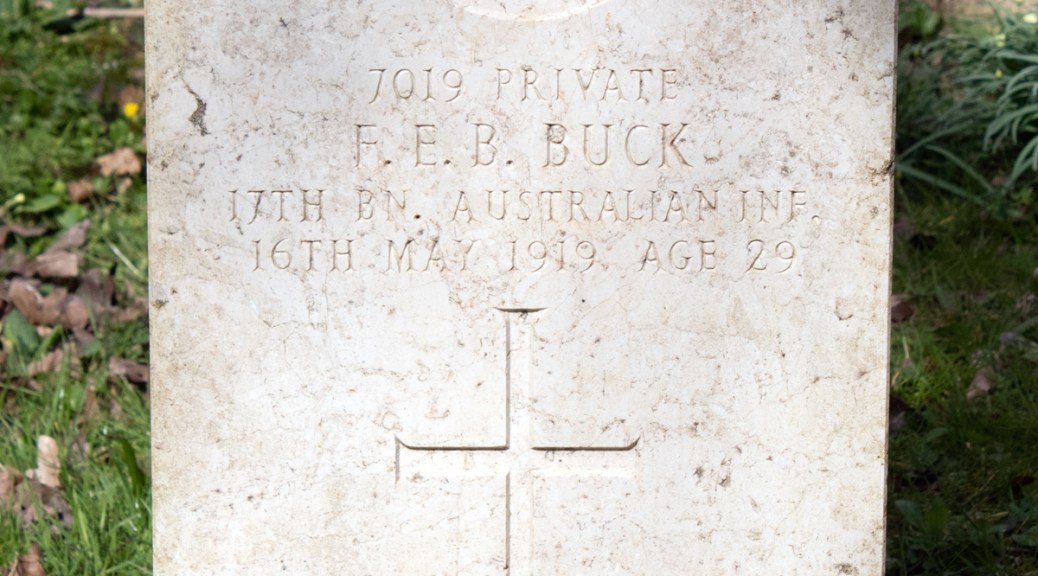
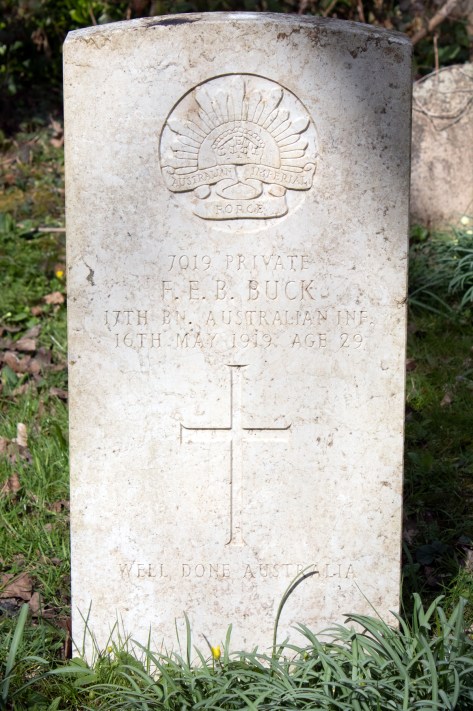
Frank Ernest Brydgnes Buck was born in Islington, Middlesex, early in 1889, his mother’s name was Rosina, but his father’s details have been lost to time, the 1901 census confirming that she was a widow. The document notes that Frank was the youngest of four children, and the family had taken rooms in a three-storey house on Yerbury Road.
By the summer of 1917, Frank had emigrated to Australia. Settling in the town of Inverell, New South Wales, he took employment as a clerk. However, when war came to Europe, he was called on to play his part, and enlisted in the Australian Imperial Force on 16th July 1917.
Private Buck’s service records confirm that he was 5ft 11.5ins (1.82m) tall and weighed 11st 4lbs (71.7kg). He was recorded as having dark hair, blue eyes and a dark complexion. He had a burn scar on his right forearm, and a third nipple on the right side of his chest.
Frank’s unit departed from Sydney on 31st October 1917, and he spent the next two months on board the SS Euripides. During that time he was promoted to Acting Corporal and, when he disembarked in Devonport, Devon, on 26th December, he marched to the ANZAC camp in Fovant, Wiltshire.
Assigned to the 5th Training Battalion, Frank seems to have taken this unexpected return to Britain as a free ticket home: on 6th February 1918 he went AWOL, and only surrendered back to his unit on 9th April. Help in detention for a day, he forfeited 63 days’ pay, and was demoted to the rank of Private for his actions.
On 13th May, Private Buck was dispatched to France. He was assigned to the 17th Battalion of the Australian Infantry, but his time overseas was not to be a lengthy one. In July he was admitted to the 5th Australian Field Ambulance with gastritis: he was then transferred to the 5th Casualty Clearing Station, then the 3rd General Hospital in Le Treport. Medically evacuated to Britain for treatment, he ended up in Reading War Hospital for ongoing treatment.
Placed on furlough on 16th September, Private Buck went AWOL again on just two weeks later. Arrested on 26th November 1918, he was hauled before a judge at Highgate Police Court: his crimes amounted to being absent without leave, but also stealing three blank cheques and forgery. Pleading guilty, he was sent to Wormwood Scrubs for nine months.
Frank would not end up serving his time, however. He was admitted to the infirmary with a perforated duodenal ulcer, and died from exhaustion on 16th May 1919. He was 29 years of age.
Frank Ernest Brydgnes Buck was laid to rest in Highgate Cemetery.
Dudley Harry Weedon was born in Islington, Middlesex in the spring of 1891. The second of two children, his parents were solicitor’s clerk Thomas Weedon and his wife, Frances.
When Dudley finished his schooling, he also found work as a clerk. The 1911 census recorded the Weedon family living at a prestigious address – an eight roomed Victorian villa at 59 Canonbury Park North, Islington. Thomas was still employed as a solicitor’s clerk, Dudley as a clerk for a corn merchant, and his older brother, Horace, as a clerk for a mining company.
War came to Europe in the summer of 1914, and Dudley was keen to step up and play his part. He enlisted early on, joining the 1st/2nd County of London Yeomanry, also known as the Westminster Dragoons. The regiment spent most of the war in the Middle East, and by November 1914, Private Weedon found himself in Egypt.
Dudley would spend the next year or so overseas, and was sent to, and evacuated from, Gallipoli. In February 1916, he received a promotion – to the rank of Second Lieutenant – this increase in rank coming with a transfer to the Northumberland Fusiliers. His new unit – the 8th (Service) Battalion – had also served in the Dardanelles, but by that summer they had moved to France.
Second Lieutenant Weedon spent the next eighteen months on the Western Front, fighting at Messines and at Ypres. It was here, possibly at the Battle of Polygon Wood, that Dudley was injured. Details are unclear, but his wounds were sever enough for him to be medically evacuated to Britain for treatment.
Dudley was admitted to a hospital in Roehampton, Surrey, but his injuries were to prove too severe. He passed away on 20th November 1917, at the age of 26 years old.
Dudley Harry Weedon was laid to rest in Highgate Cemetery, not far from his grieving family’s home.
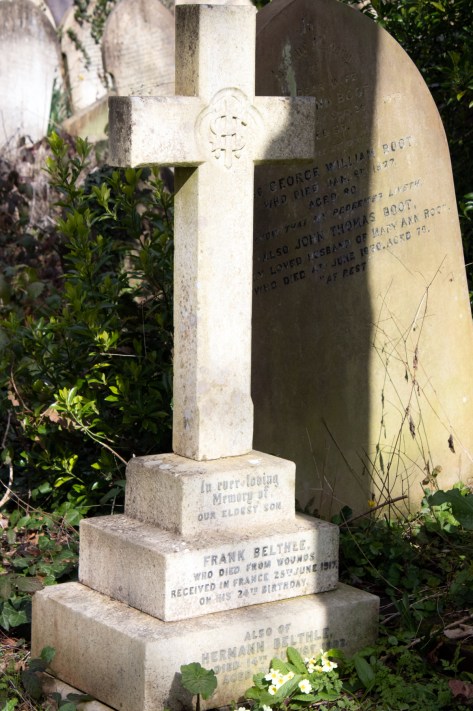
Frank Hermann Belthle was born in Dartford, Kent, on 25th June 1893. The oldest of four children, his parents were German-born Frederick Emil Hermann Belthle and his wife Elizabeth, who came from Surrey.
Frederick – who was better known as Hermann – was a manufacturer compressed tablets and pills. By the time of the 1901 census, he had moved his family to Aldrington, Sussex, were the set up home at 58 Westbourne Street. They had the house to themselves, unlike their neighbours, with two or three families sharing each property.
Hermann took the family to where work required him, and between 1903 – when Frank’s youngest sibling was born – and 1911, they relocated to London. Now seventeen years old, Frank was assisting his father in the business, and that business was obviously paying dividend: the Belthles’ new home was the 8-roomed house at 106 Barnsbury Road, Islington. Again, they occupied the whole building, while others in the street renting just a couple of rooms.
The outbreak of war must have had an impact on German national Hermann and his family. Frank looks to have stepped up to play his part, however, joining the Royal Army Medical Corps, possibly because of the medical training he had picked up through the family business.
There is little documentation about Private Belthle service, although he was awarded the Military Medal. By the summer of 1917, his unit – the 14th Field Ambulance – was supporting troops at Arras. While here, on 9th May, he was badly wounded, and medically evacuated to Britain for treatment. His injuries were to prove too severe, however, and, on 25th June 1917, he passed away: it was his 24th birthday.
Frank Belthle was laid to rest in the majestic Highgate Cemetery.
After the war, Hermann continued with his business. Things were more difficult for the family, however and, while they had moved to the prestigious Lonsdale Square, Islington, they were one of six families taking rooms in the large Georgian terrace.
Hermann passed away in the autumn of 1932, at the age of 70: he was laid to rest alongside his son in Highgate Cemetery.
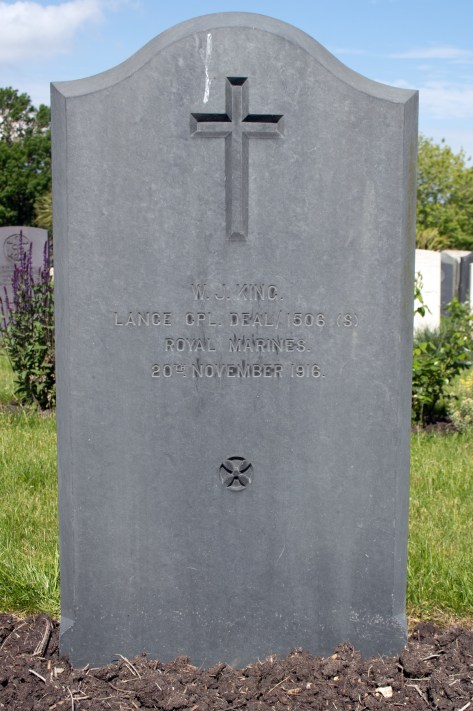
William James King was born on 7th March 1883 in Kensington, Middlesex. He was the fourth of eight children to bricklayer and builder’s labourer John King and his wife, Hannah.
There is little specific information available about William’s early life. The 1891 census found the family living at 16 Burlington Mews in Paddington, but he does not appear on any census returns after this date.
On 4th August 1906, William married Marion Oliver. Born in Chelsea, she was the daughter of a house painter, and the couple exchanged vows in St Luke’s Church, Paddington. The marriage certificate noted William’s trade as a bricklayer, and the couple went on to have two children: daughter Gwendoline, born in 1911, and son Henry, born two years later.
When war came to Europe, William was quick to step up and play his part. He enlisted on 5th October 1914, joining the Royal Marines. His service records show that he was 5ft 4ins (1,62m) tall, with brown hair, grey eyes and a fresh complexion.
Sent to Deal, Kent for training, Private King was initially assigned to the 2nd Field Company of the Mediterranean Expeditionary Force. Appointed to the rank of Lance Corporal he soon found himself ensconced at Gallipoli. On 15th May he was medically evacuated to Britain with an injury to his spinal cord. Admitted to Charing Cross Hospital, London, he was discharged from the army on 27th March 1916.
William’s treatment was ongoing, and by the autumn of 1916, he had been admitted to Gillingham Hospital in Kent. It was here that he would died, passing away on 20th November: he was 33 years of age.
William John King was laid to rest in Woodlands Cemetery, Gillingham, Kent.
Alfred John Reed was born in St Pancras, Middlesex, on 29th September 1865. One of twelve children, his parents were Charles and Eliza Reed. Charles was a carman, possibly working out of the nearby railway stations, and the 1871 census found the family taking rooms at 70 Aldenham Street.
Details of Alfred’s life is a little sketchy. By the time of the 1881 census he had finished his schooling and was employed as a coach painter, again probably connected to the railways. At some point shortly after this, however, he enlisted as a Private in the Royal Marine Light Infantry. It is likely that he was still a teenager when he made this move, as he seems to have lied about his age to get in – later records give his date of birth as 8th June 1863.
We next pick up Private Reed in the 1901 census. By this point, he was assigned to the floating battery HMS Terror, which was based in Bermuda, under the remit of Captain Thomas McGill.
Alfred appears to have served his contract, as by 1911 he was living at 56 Northview Road, Hornsey, Middlesex. Employed as a house painter, the census records him as being having been married to Clara Emily for nine years. This may have been for the sake of appearance, as the formal record of the couple’s marriage suggests that exchanged vows in the summer of 1914. The census showed that the couple had a son – Alfred John Reed – who was two years old.
When war broke out, Alfred was 49 years old. While over the age to formally enlist, it seems that he did re-join the Royal Marines. By the spring of 1917, he was attached to HMS Spey, an old gunboat, which served in the River Medway, close to Chatham Dockyard.
On the 7th March 1917, she was accidentally rammed by a sludge vessel carrying 1000 tons of sewage. The Spey sank in the shallow water, and one of the crew – Private Alfred Reed – was drowned. He was 51 years of age.
The body of Alfred John Reed was laid to rest in the naval section of Woodlands Cemetery, Gillingham, not far from the Royal Naval Base in which he had been helping.
The 1921 census sheds more light onto the family that Alfred had left behind.
Clara had re-married, her new husband being motor fitter George Comer. The couple had a daughter, eighteen-month-old Eileen, and George was noted as being stepfather to Alfred and Clara’s children, Alfred and Ernest (who was born in 1911).
There is another mystery, however, as the census gives the name of 18 year old Louie Reed. She may also have been Alfred and Clara’s daughter, although she is not recorded as being so on the 1911 census. She may, therefore, have been Clara’s child from a former relationship, then adopted by Alfred.
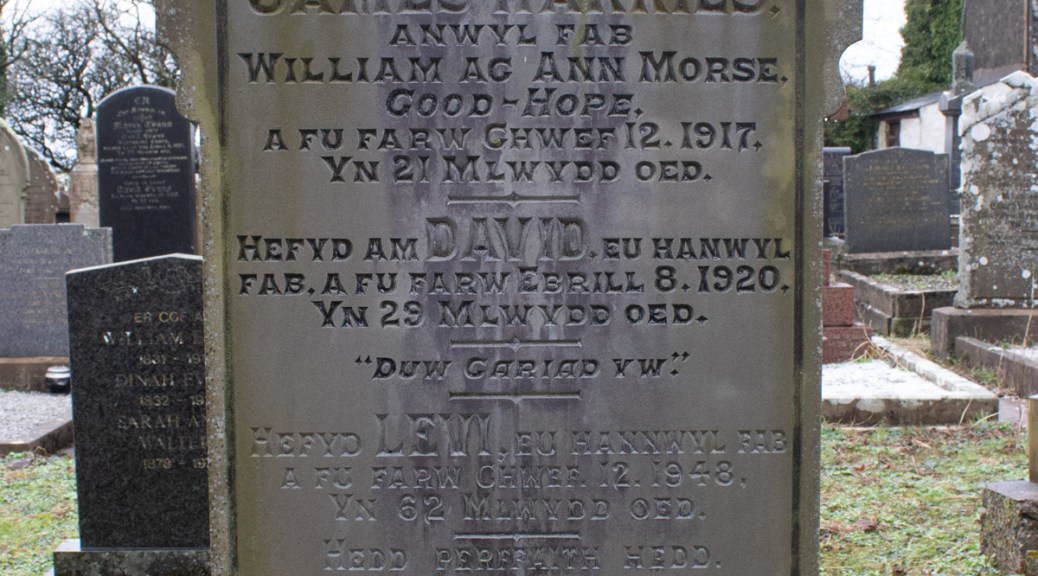
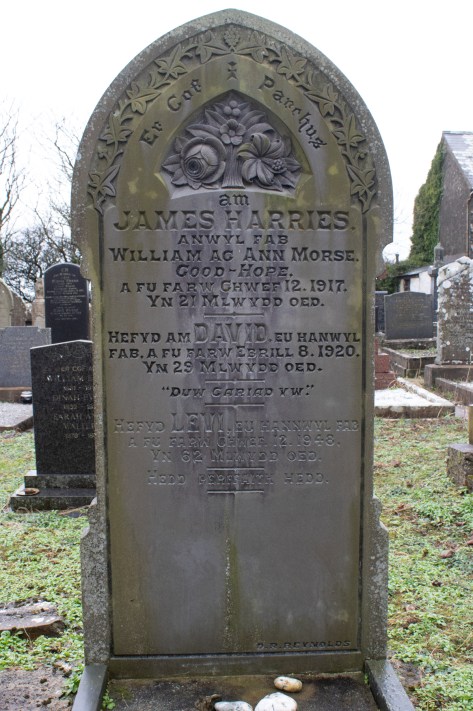
James Harries Morse was born in the autumn of 1895 in Llanwnda, Pembrokeshire. One of eleven children, his parents were agricultural labourer William Morse and his wife, Ann.
James’ schooling was completed early, and he was soon found work to keep him occupied. The 1911 census recorded him as being a cattle boy for the James family, living in on a farm not far from his family home.
When war broke out, James was keen to play his part. Details of his military service have been lost to time, but it is clear that he enlisted as a Private in the Welch Regiment, and was assigned to the 3rd (Reserve) Battalion. It’s not possible to identify where or for how long he served, and the only other documents available relate to his passing.
James Harries Morse died of disease on 12th February 1917: he was just 21 years of age. His body was taken back to Pembrokeshire for burial, and he was laid to rest in the family plot in Pencaer (Harmony) Baptist Burial Ground, not far from his parents’ home.
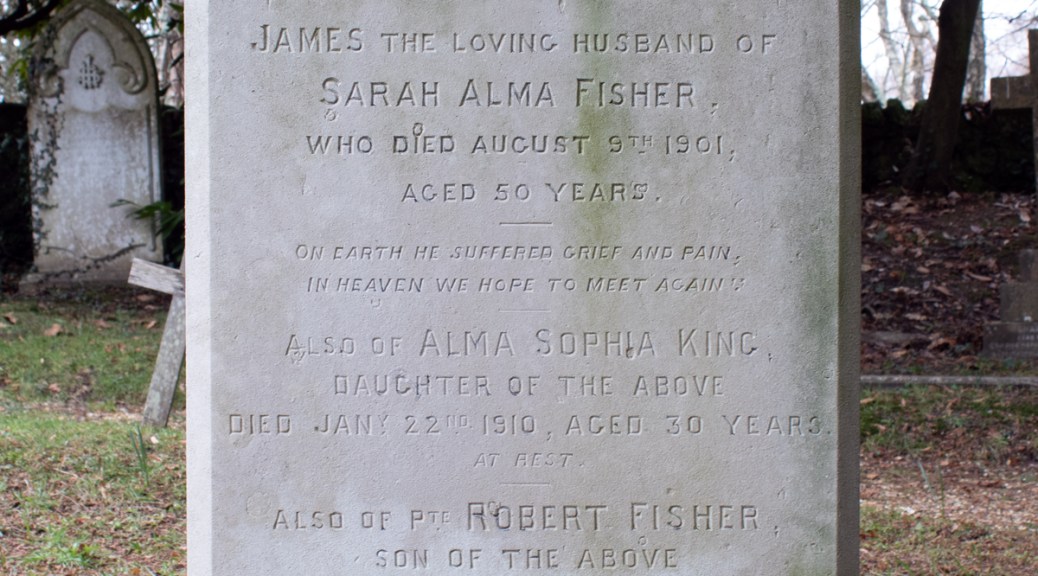
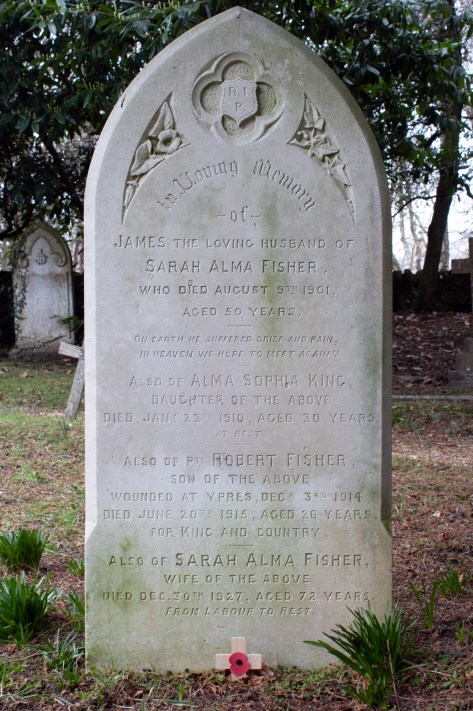
Robert Fisher was born on 12th September 1888 in Lyndhurst, Hampshire. He was the sixth of eight children to James and Sarah Fisher. James was a coachman, and the family lived on Pike’s Hill, to the north of the town centre.
James died in 1901, and Robert remained at home to support his mother and two younger sisters. The 1911 census found the family living in the same four-roomed cottage on Pike’s Hill: Robert was employed as a mail driver, while his sister Kathleen worked as a domestic servant. The family also had a lodger, William Penny, to help bring in some extra money.
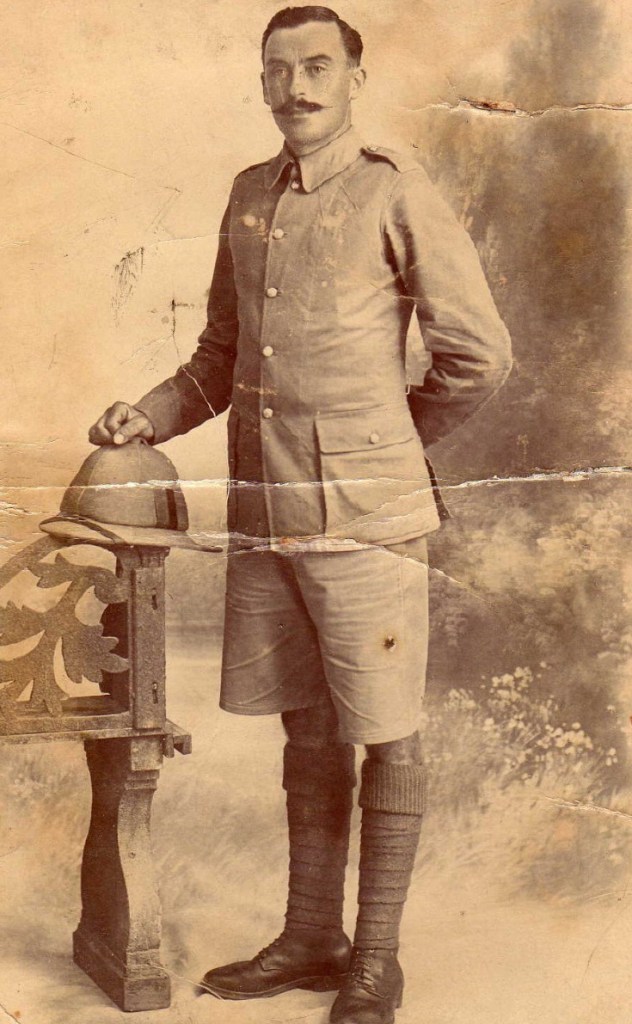
When war broke out, Robert stepped up to play his part. His service documentation has been lost, but it is clear that he enlisted in the opening weeks of the conflict, and was assigned to the 1st Battalion of the Hampshire Regiment. As proof of a quick turnaround for these new recruits, Private Fisher found himself in France by mid-November 1914.
Fighting on the Western Front near Armentières, Private Fisher was wounded on 3rd December 1914. He was medically evacuated to Britain for treatment, and admitted to Netley Hospital near Southampton, Hampshire. He had been “struck in no less than seven places by shrapnel.” [Hampshire Independent: Saturday 3rd July 1915]
Eventually well enough to return home, by June 1915, Robert’s health had deteriorated. He contracted meningitis, and was admitted to the Isolation Hospital back in Southampton. The condition would ultimately prove fatal and Private Fisher passed away on 20th June 1915: he was 26 years of age.
Robert Fisher was laid to rest in the family plot in Lyndhurst Cemetery, alongside his father, and not far from where his grieving mother still lived.
Joseph Walls was born in Tortington, near Arundel, in West Sussex, on 13th November 1880. The youngest of four children, his parents were gamekeeper James Walls and his wife Annie. James moved the family to where his work took him and, by the time of the 1891 census, they had settled in the New Forest village of Sway, Hampshire.
When Joseph finished his schooling, he found work as a horseman and groom. The 1901 census found him living with his parents and older sister in a house in Brockenhurst. He seems to have taken his work seriously, and soon found himself a position as a chauffeur. The next census, taken in 1911, recorded him as working for Ann Libbey and her family in the village of Boldre.
On 18th February 1914, Joseph married Edith Perry. A carpenter’s daughter, she was working as a domestic servant when the couple exchanged vows. Their wedding certificate confirms that Joseph was ten years his new wife’s senior, and that they ceremony was witnessed by his older brother Frederick and her younger sister, Esther.
Joseph and Edith would go on to have two children: Vera was born in 1915, while Daphne came along three years later. During this time, however, war was raging across Europe, and Joseph had stepped up to play his part.
Private Walls enlisted within weeks of war being declared, on 10th December 1914. His service papers show that he was living at Hospital Cottage in Lyndhurst when he joined up. He was 5ft 8ins (1.72m) tall, with black hair, grey eyes and a dark complexion. He was also noted as being asthmatic since he was a child.
Assigned to the 1st/4th Battalion of the Hampshire Regiment, over the next few years, Private Wallis would see the world. Within days of enlisting, he was shipped out to India, where he would spend nearly three years (apart from the in the summer of 1917, when he served as part of the Mediterranean Expeditionary Force). During this time, Joseph was promoted to Lance Corporal, although by the time he left the army, he had returned to the tank of Private.
By the beginning of September 1917, Joseph was back on home soil. A spell of malaria that spring had impacted his asthma, and at the end of November, he was deemed no longer fit for war service. Private Walls was medically discharged from the army on 29th November 1917.
At this point, Joseph’s trail goes cold. He definitely returned home – Daphne was born just a few days after the Armistice – but it is unclear whether he was it enough to work.
Joseph Walls died on 14th February 1919: he was 38 years of age. He was laid to rest in Lyndhurst Cemetery, not far from where Edith and their children lived.