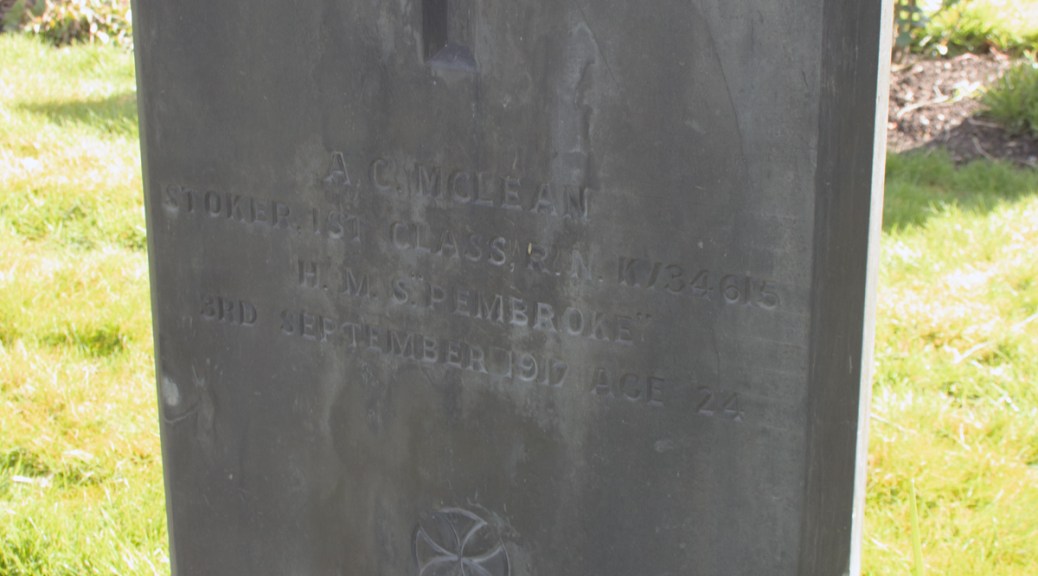
Alexander McLean was born in the village of Bowling, on the River Clyde near Glasgow, on 7th February 1893. There is little documented on his life, other than that his parents were Duncan and Margaret (Maggie) McLean.
When he left school, he fond work as a caulker at the local docks; war came to Europe, however, and he wanted to play his part. on 11th November 1914, he enlisted in the Cameron Highlanders as a Private. His service records show that he was 5ft 4ins (1.63m) tall, weighed 118lbs (53.5kg), had dark brown eyes, grey eyes and a fresh complexion.
Private McLean’s time in the army was a brief one, however, as his entry exam identified him as medically unfit, and that he would not be an effective soldier.
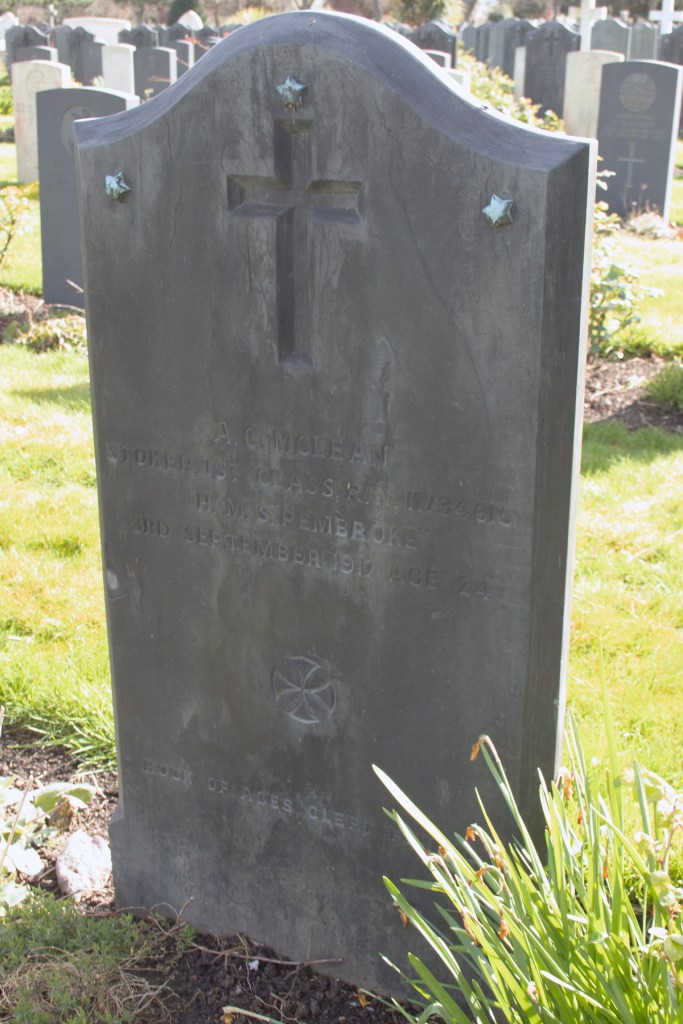
Alexander was not to be deterred, however, and he soon enlisted in the Royal Navy as a Stoker 2nd Class. There is little information about his life at sea. At some point he was promoted to Stoker 1st Class, and he was certainly based at HMS Pembroke, the Royal Naval Dockyard in Chatham, Kent, by the summer of 1917.
That was particularly busy time for the base, and temporary accommodation had been put in place at the barrack’s Drill Hall: this is where Alexander found himself billeted.
On the night of the 3rd September 1917, Chatham was bombarded by a German air raid, and the Drill Hall received a direct hit. Tragically, Stoker 1st Class McLean was amongst those killed. He was just 24 years old.
Alexander McLean’s body was laid to rest in the Woodlands Cemetery in Gillingham, alongside the other victims of the Chatham Air Raid.
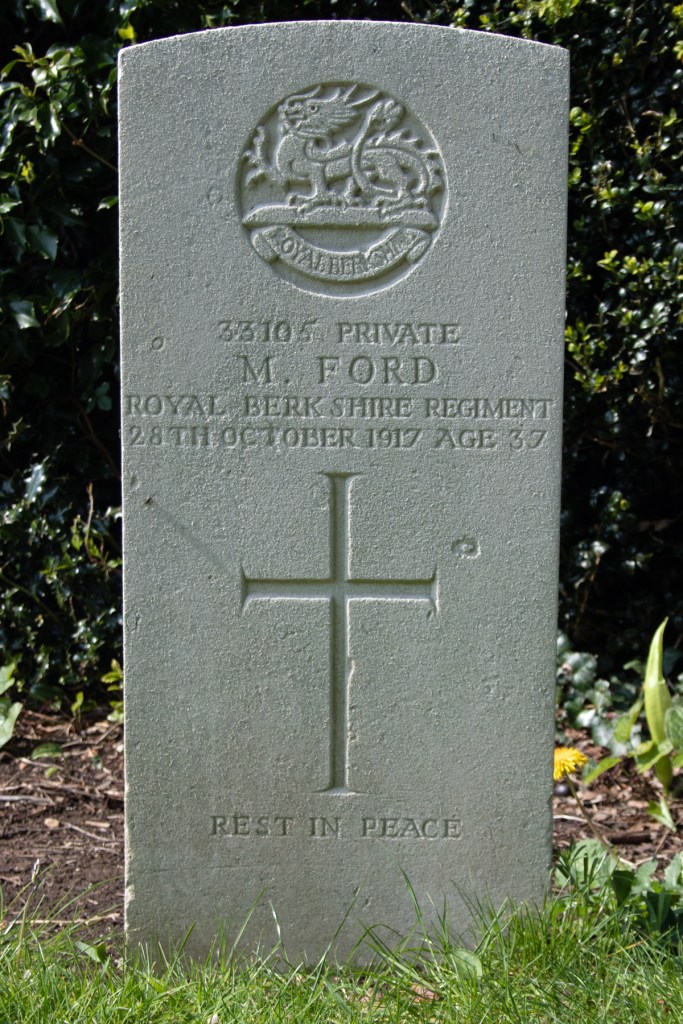
Mark Ford was born early in 1881 in Wellow, near Peasedown St John in Somerset. He was the youngest of eleven children, and the son of Thomas and Ellen Ford. Thomas was a coal miner, and this was a trade that his seven sons, including Mark, went into.
The 1901 census recorded Mark as boarding in a house in Abertillery, Monmouthshire, learning his trade. Within a few years, however, he was back in Peasedown St John. In the summer of 1910, he married local woman Emily Tucker and the couple set up home in Wellow, where they went on to have four children: George, Phyllis, Hubert and Ethel.
War was coming to Europe and, while records are scarce, it’s possible to build up a picture of the service Mark undertook. He initially enlisted as a Private in the Royal Berkshire Regiment, and was assigned to the 10th (Labour) Battalion. They were sent to France in June 1916, although it is not possible to confirm if Mark went at the same time.
His battalion became the 158th and 159th Labour Companies in April 1917, and it seems that Private Ford transferred to the former and, at this point, was definitely serving in France. That summer, he was wounded in the hip and head by an exploding shell and was medically evacuated to England for treatment.
Private Ford was admitted to the Military Hospital in York, where he lay injured for some time; long enough, thankfully, for Emily to make the journey to be with him. Sadly, his wounds were to prove too much: he passed away at the hospital on 28th October 1917, at the age of 36 years old.
Mark Ford’s body was brought back to Somerset for burial He was laid to rest in the churchyard of St John the Baptist, in Peasedown St John.
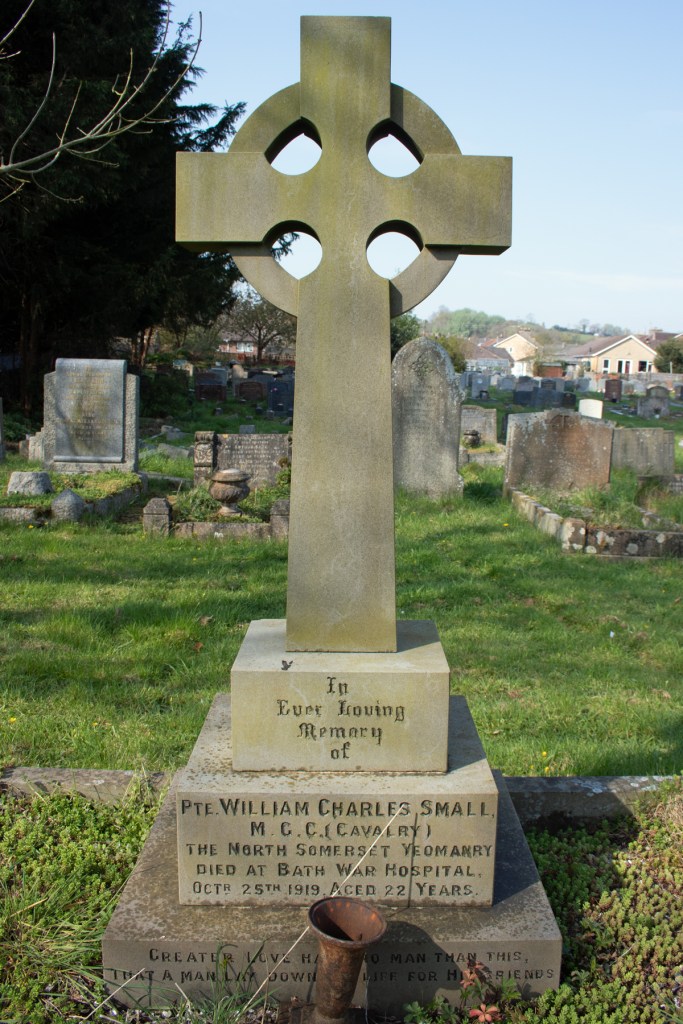
William Charles Small was born towards the end of 1896 in the Somerset town of Midsomer Norton. He was one of six children to coal hewer William George Small and his wife Margaret.
When he left school, William worked for the Co-op store in nearby Radstock, but when war came, he was keen to play his part. His service records are lost to time, but the local newspaper’s report on his funeral in 1919 sheds light on Private Small’s army career:
…he joined the army in May 1915, then being only 18 years of age. He joined the North Somerset Yeomanry and went to France on active service in September the same year, being sent straight to Belgium. There being a shortage of machine gunners, he was transferred to the [Machine Gun Corps], in the 3rd Cavalry Division.
He fought at Peronne, at Cambrai, Arras and Verdun, and other places. His regiment were commended by its General for their bravery in holding back the Germans. He first had leave after one year and eight months’ service in France, and another in August 1918.
He was in the Third Army which stemmed the German attack when they attempted to break through, and fought night and day till they succeeded in holding the enemy back. He had many narrow escapes while in battle, but came through without a scratch.
He was demobilised in January 1919, and was discharged A1, but the strain of 3 years and 6 months of active service proved too much and his health entirely broke down, and he was not able to follow his employment at all. His case was taken up by the military two months ago, and he was sent to Bath War Hospital, where he never recovered from the severe strain…
Somerset Guardian and Radstock Observer: Friday 7th November 1919
Private William Small died in the hospital on 25th October 1919, at the age of just 22 years of age. His body was brought back to Midsomer Norton for burial and he was laid to rest in the family plot in the graveyard of St John the Baptist Church there.
Private William Small (from britishnewspaperarchive.co.uk)
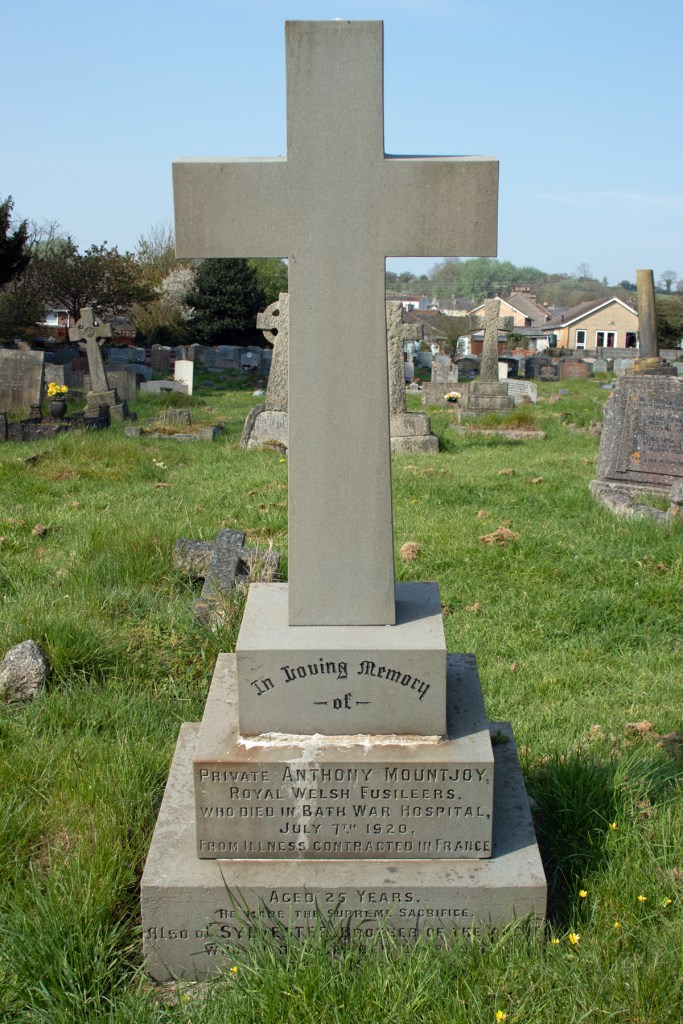
Anthony Mountjoy was born in the Somerset village of Clutton in the spring of 1895. One of eleven children, his parents were William and Sarah. William worked as a hewer in a local coal mine, and this is a job into which Anthony and at least two of his brothers went.
War was coming to Europe and, while there is limited documentation relating to his military service, a newspaper report on his funeral sheds some light into his life.
The funeral took place at Midsomer Norton on Monday afternoon of Private Anthony Mountjoy, 2nd Royal Welch Fusiliers, who died at the Bath Pensions Hospital… at the age of 25 years. Private Mountjoy… enlisted in the army on January 22, 1916, and went to France in July 1917. He was gassed and wounded at Passchendaele in March 1918, and arriving in England was take to the Tusehill Military Hospital, Carlisle in June. He was transferred to Bristol in April, 1919, and from there to Bath Pensions Hospital in November of the same year. He never recovered from the effects of active service.
Somerset Guardian and Radstock Observer: Friday 16th July 1920
Private Anthony Mountjoy died on 7th July 1920. He was laid to rest in the family plot in the graveyard of St John the Baptist Church in Midsomer Norton.
Bertie Ball was born in Westcott, Berkshire, in the spring of 1890, the oldest of ten children to John and Matilda Ball. John was from Berkshire, who raised his family in Wantage. He began life as a farm labourer, but, by the time of the 1901 census, he had found other employment, as a groom at a racing stable.
Details of Bertie’s life are scarce. When he left school, he found work as a garden labourer and, when war broke out, he enlisted in the Royal Army Service Corps. Private Ball was assigned to the Mechanical Transport Company, but whether he served overseas or on home soil is unknown.
Bertie died on 4th March 1915 from cerebrospinal meningitis. He was just 24 years old. He was laid to rest in the graveyard of St John the Baptist Church in Midsomer Norton – I can find no Somerset connection, so can only imagine that he passed away in or near the town.
Bertie’s younger brother Percival Ball also served in the First World War. He served with the 5th Battalion of the Wiltshire Regiment and fought in Mesopotamia. Sadly, he was killed there, dying on 5th April 1916. He was just 17 years of age. He is commemorated on the Basra Memorial in Iraq.
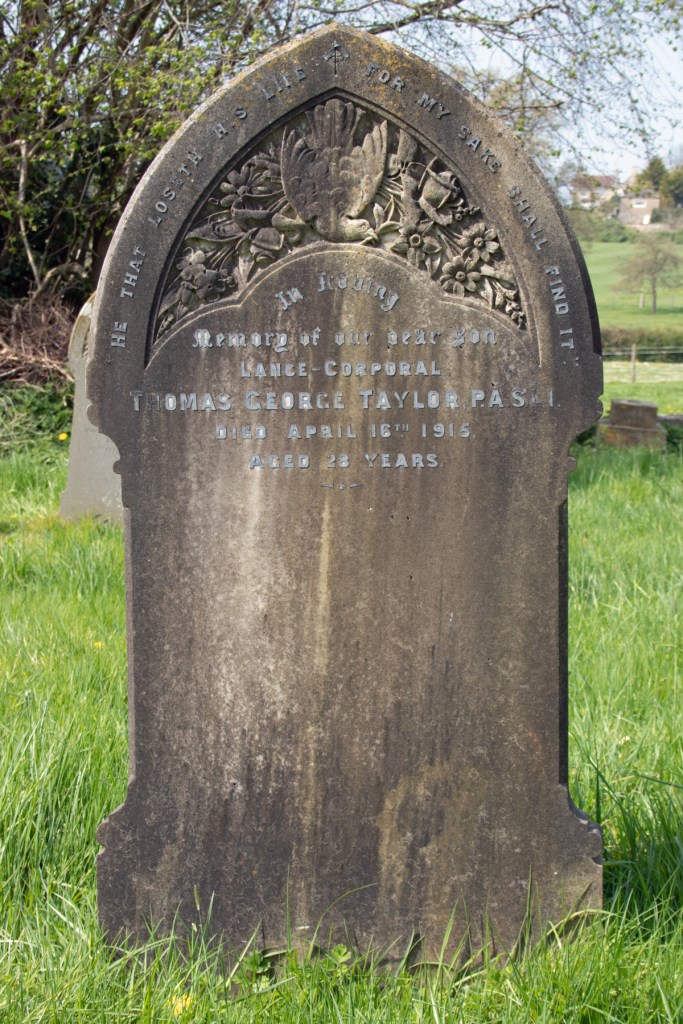
Thomas George Taylor was born in the summer of 1886, and was the youngest of five children to George and Sarah Taylor. George was a gamekeeper in Clutton, Somerset, and he and Sarah raised their family in Rudges Cottage opposite the village church.
Thomas’ older brother John found a variety of jobs, from boot finisher to coal miner, but Thomas followed in his father’s footsteps, and, by the 1911 census, was recorded as a butcher’s apprentice.
Storm clouds were brewing across Europe by this point and, when war broke out, Thomas was one of the first to enlist. Sadly, there is little information on his military service, but it is clear that he joined the 7th Battalion of the Somerset Light Infantry and was quickly promoted from Private to Lance Corporal.
The only other documentary evidence for Thomas is his entry in the Army Register of Personal Effects. This confirms that he was admitted to the Isolation Hospital in Aldershot, suffering from meningitis. Lance Corporal Taylor passed away from the condition on 16th April 1915, aged just 29 years old.
Brought back to Somerset for burial, Thomas George Taylor was laid to rest in the graveyard of St Augustine’s Church, across the road from his family home in Clutton.
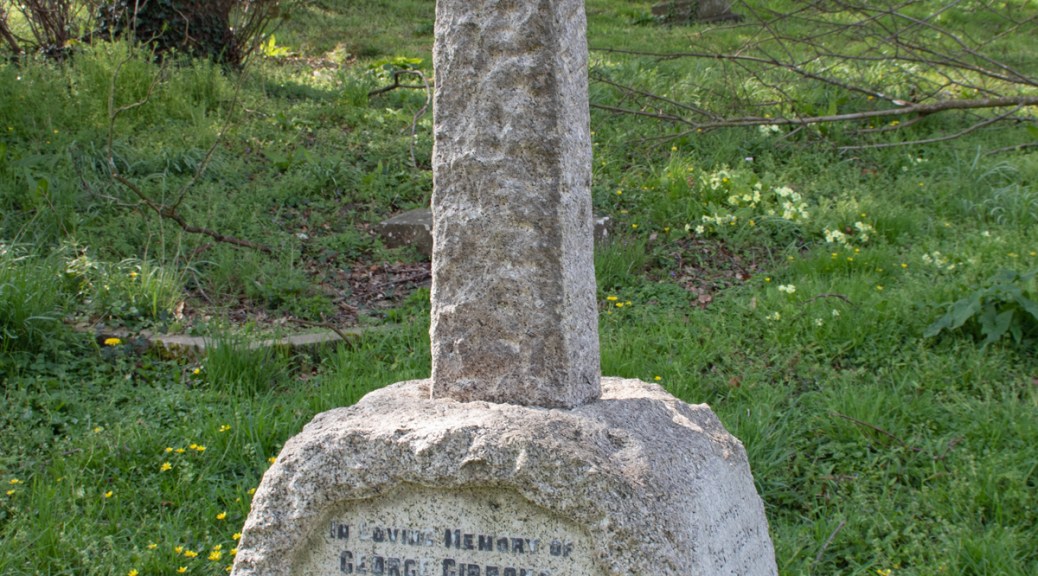
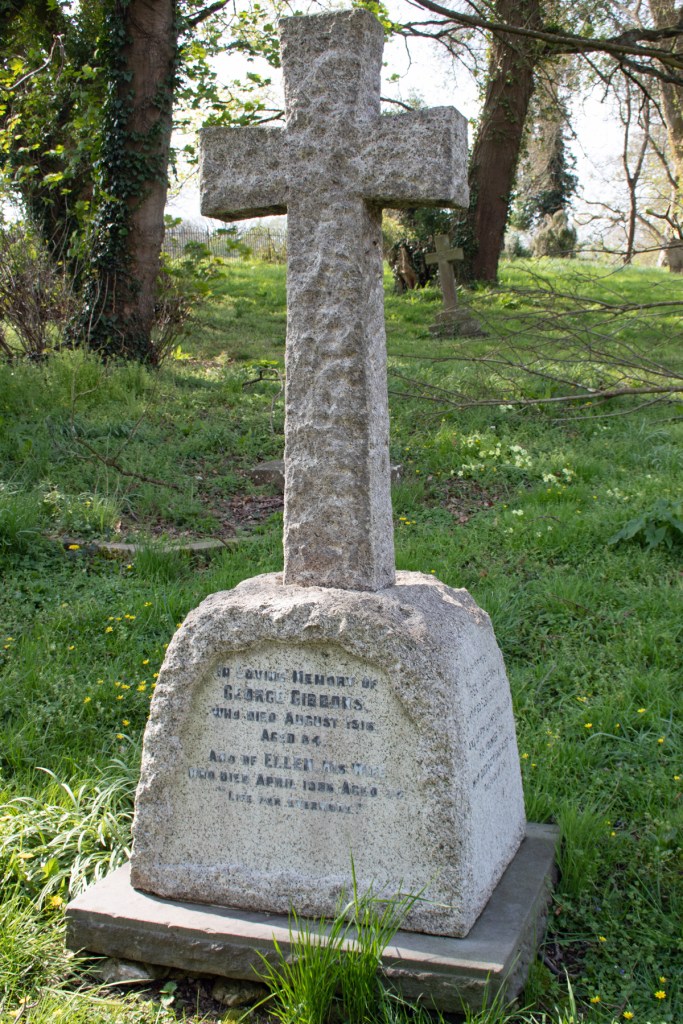
Lionel Millard Gibbons was born in the spring of 1898 and was one of four children. His father, Benjamin, was a seed merchant from Camerton, Somerset, while his mother, Mary, had been born in Taunton. The family lived at Sheep House Farm in Camerton, where Benjamin employed a couple of servants to help manage things.
When war broke, out, Lionel was keen to play his part. He enlisted in the 4th Battalion of the Gloucestershire Regiment as a Private. While there are no dates to confirm when and where Lionel served, the regiment itself was involved at the Somme in 1916 and Ypres the following year.
Private Gibbons was badly wounded by shrapnel in the autumn of 1917, and returned to England to recover. Once he had, he was transferred to the 449th Agricultural Company of the Labour Corps and employed on farm work in Egford, near Frome.
It was while he was there that Private Gibbons contracted influenza and pneumonia; he passed at the farm on 28th October 1918, at the age of just 20 years old.
Lionel Millard Gibbons’ body was brought back to Camerton for burial. He lies at rest in the family grave in the ground of St Peter’s Church there.
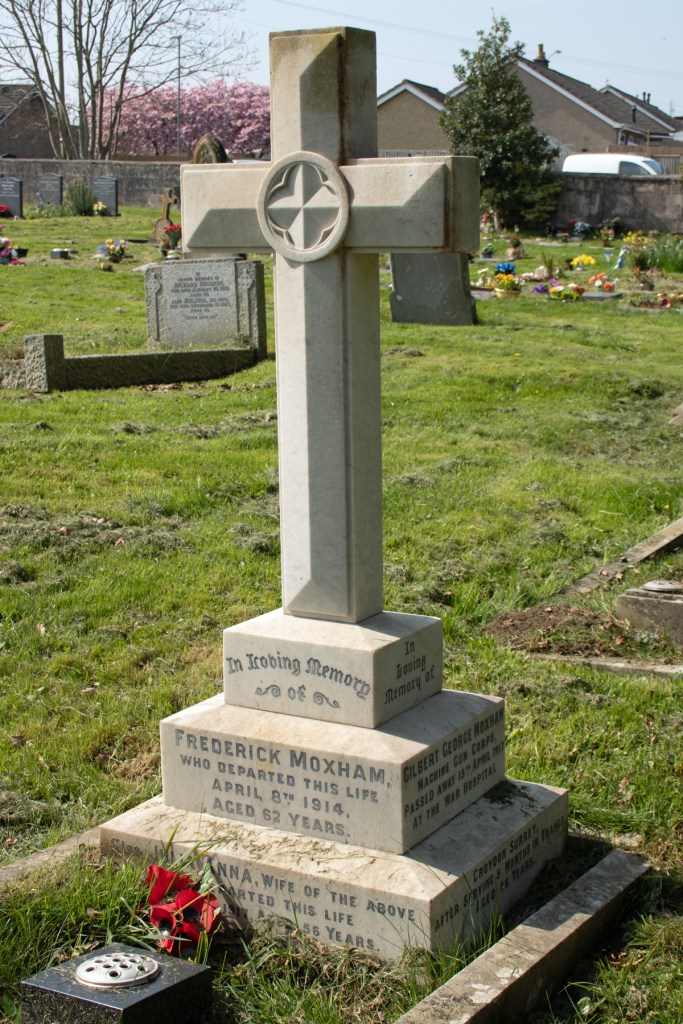
Gilbert George Moxham was born in the spring of 1891 in the Somerset village of Timsbury. His father, Frederick, was the local blacksmith and both he and Gilbert’s mother, Julia, had been born and raised in the village.
When he left school, Gilbert helped his father and older brother, Albert (known as Ernest), in the blacksmith’s. War was coming to Europe, and things were going to change for the Moxham family.
In April 1914, Frederick died after a short illness. The Somerset Guardian and Radstock Observer reported that he had “been engaged in the business as a blacksmith for a considerable number of years” and was “well-known and highly respected“. [Friday 17th April 1917] Ernest now took over the family business and provided support for Julia, who was not in good health herself.
Gilbert, meanwhile, enlisted in the Machine Gun Corps. While full details of his service are not available, he joined up before October 1916. Private Moxham spent five months in France and was awarded the Victory and British Medals.
Ernest was still back in Somerset working. He had been exempt from enlisting, as the work he was doing was needed for the war effort. In February 1917, he applied for a further exemption. The local newspaper reported that:
He had one brother serving, and himself managed the blacksmith’s business for his mother. Much of his work was done for agriculturists. His mother was practically an invalid and had a trained nurse to look after her by day. He had a contract to make shoes for the Army, but there was no time specified as to the termination of the contract. In addition, he looked after between 60 and 70 horses for shoeing.
Somerset Guardian and Radstock Observer: Friday 2nd February 1917
Just over a month later, Julia passed away, after a long illness. She was 55 years of age.
Meanwhile, Gilbert was also suffering with his health. He was admitted to the Croydon War Hospital in April 1917, having contracted pneumonia. Tragically, he was to succumb to the lung condition, passing away on 13th April 1917, aged just 26 years old.
Gilbert George Moxham was brought back to Somerset for burial. He was laid to rest with his parents in the family grave in the church cemetery of St Mary’s in his home village.
Private Gilbert Moxham
Ernest lived on for another three decades. He married a woman called Ada, and they had three children. The local newspaper – a constant for the Moxham family through the years, reported on his passing:
The death of Mr Albert Ernest Moxham, at the age of 67, has removed from Timsbury a very highly respected resident. In business as a blacksmith he had traded in this capacity all his working life.
Following the family trade, he was the fourth generation of blacksmiths, and will be missed by many farmers and other tradesmen for many miles around for his work and advice.
In addition to this, the family, for two generations, were recognised as the village dentists, and the late Mr Moxham could remember helping his father in this capacity in his early days…
Apart from his business, he was particularly interested in bell-ringing, and for many years rung in St Mary’s Church belfry, where, for a period of time, he was captain.
Somerset Guardian and Radstock Observer: Friday 23rd January 1953
Ernest, too, was laid to rest in the family plot. The church in which he rang was next door to the Forge, his home and business for many years.
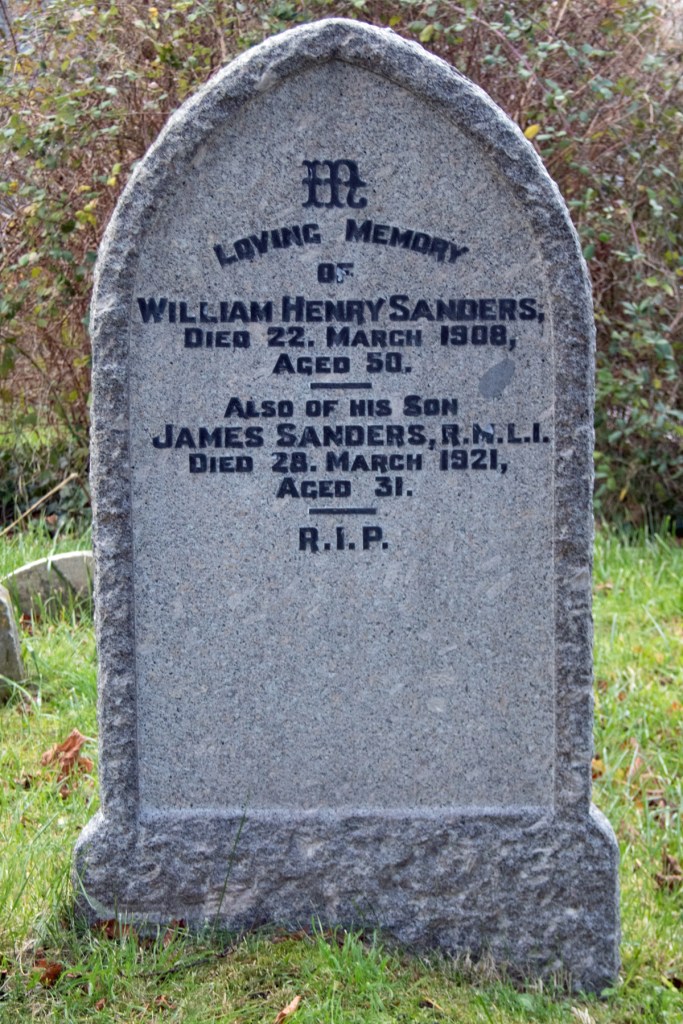
James Sanders was born on 17th April 1889. One of nine children, his parents were William and Emily Sanders. William worked for a clay company in his home town of Kingsteignton, Devon. He had various roles, including caretaker, inspector and messenger.
William’s son, however, was after bigger things in life and, on 17th July 1907, he enlisted in the Royal Marine Light Infantry. James’ service records show that he was 5ft 6ins (1.67m) tall, had light brown hair, grey eyes and a fresh complexion.
Based out of Plymouth, Private Sanders signed up for an initial period of twelve years. During this time, and throughout the war, he served on six vessels, including 30 months on HMS Argyll (where he was based for the 1911 census) and more than five years on HMS Colossus.
In April 1919, Private Saunders returned to land. When his initial contract was up, he re-enlisted, this time remaining at the Naval Dockyard in Plymouth.
James’ trail goes a little cold for the next couple of years, although he continued in his role with the Royal Marine Light Infantry. On the night of the 28th March 1921, however, he encountered some trouble. The local newspaper reported on the subsequent inquest.
Kingsteignton Man’s Mysterious Death
At an enquiry held at Teignmouth on Saturday afternoon into the circumstances attending the death of Private James Sanders, RMLI… who was found drowned in the river Teign on Friday, it was stated that deceased and seven other Kingsteignton men on Monday visited Teignmouth to attend a football match, at which Sanders acted as touch-judge.
After the match they went to a public house, where deceased had three or four pints of beer and some spirits, which made him unsteady.
They left to catch a bus, but at Station Road deceased turned back. One of his companions followed him, but could not persuade him to return, so he left deceased on his own to travel back home.
The man considered Sanders was in a condition to look after himself. An open verdict was returned.
Wester Times: Friday 8th April 1921
Private James Sanders died on 28th March 1921, aged 31 years old. He was laid to rest with his father, William, who had died in 1908, in the graveyard of St Michael’s Church in Kingsteignton.
Lawrence Arthur Scott was born in the spring of 1889 in the Devon town of Kingsteignton. He was one of nine children to George and Louisa Scott. George was a lighterman – transporting clay and other goods on a barge. When his father passed away in 1905, Lawrence found work as a clay cutter, bringing in money to help support his mother. By the time of the 1911 census, he was on the only one of Louisa’s children to still be living at home, and was the main breadwinner.
In the spring of 1915, Lawrence married Elizabeth Webber in Newton Abbot. The young couple settled in Kingsteignton, and went on to have a son, Frederick, who was born the following year.
By now war had descended upon Europe. Lawrence enlisted, joining the Royal Berkshire Regiment in the summer of 1916. His service records confirm that he was 5ft 7in (1.7m) tall, had dark hair, blue eyes and a fair complexion.
Private Scott arrived in France on 20th August 1916 and, over the next couple of years he served on the Western Front. In September 1917, he was transferred to the Labour Corps, but by now his health was suffering. On 22nd March 1918 he was admitted to a hospital in Rouen with bronchitis. He was transferred to a hospital back in England and, on 17th June 1918 he was formally discharged from the army, with arteriosclerosis.
Lawrence returned home, but his health was to get the better of him. He passed away from heart failure on 30th March 1919, aged just 30 years old.
Lawrence Arthur Scott was laid to rest in a family plot in the graveyard of St Michael’s Church, Kingsteignton. Elizabeth was finally reunited with her husband 67 years later and was buried with him.










 Death and Service