Tag Archives: Scotland

Able Seaman William Green

Able Seaman William Green

William Charles Green was born on 27th December 1897, one of five children – and the only son – to William and Mary Green. The family’s backstory is a bit hard to decipher.

William Sr was born in the Bath Union Workhouse in 1869 and the only details of his parentage comes in his marriage certificate, which suggests that his father was also called William Green, who was deceased. The same document records the groom as being a miner, and that he and Mary were living in Widcombe, Bath.

The Greens do not appear on the 1901 census – or at least that census record for them is lost to time. The next census return, in 1911, does have the family recorded as living in three room in St George’s Place, Widcombe. This particular census was the first to put the onus on the resident to complete the form, and, in William Green Sr’s case, this has led to a handful of anomalies in the record.

William Sr notes his trade as “going out with commercial travellers and hotel work also”. He confirms that he was “Somerset-born”, but suggests that Mary was born in “South Wells” (a spelling error, which should be South Wales), even though her birth and marriage certificate confirm she came from Bath.

The Greens certainly spent some time in Wales – their eldest daughter was born in Merthyr Tydfil, while William Sr was working as a miner there. By the time of William Jr’s birth, however, the family seem to have returned to England – he is recorded as coming from Bath.

William was 13 years old at the time of the 1911 census, and still at school. When he left education, he found work at a fishmonger, but with war closing in on Europe by this point, he was keen to serve his King and Country.

On 7th May 1915, William enlisted in the Royal Navy and, as he was just under age, he was given the rank of Boy 2nd Class. His service records note that he was 5ft 1in (1.55m) tall, with brown hair, blue eyes and a fresh complexion. Intriguingly the records give the place of his birth as Aberdare, Glamorganshire, but whether it is this document or the 1911 census that is incorrect is impossible to confirm.

Boy Green was initially sent to HMS Impregnable, the training establishment based in Devonport, Devon. He spent four months there and, on the day he was promoted to Boy 1st Class, he was assigned to HMS Defiance, the navy’s Torpedo School, off the Plymouth coast. In October 1915 he was assigned to HMS Fox, and remained on board for the next three years.

Fox was a cruiser that patrolled the seas from the East Indies to Egypt and the Red Sea. While on board, William came of age, and was formally enrolled in the Royal Navy as an Ordinary Seaman. With a character that was classed very good, even if his ability was noted as satisfactory, within eighteen months he was promoted again, to Able Seaman.

In August 1918, William was assigned to HMS Mantis, a river gunboat that patrolled the Tigris around Baghdad. He remained on board until the end of the year, when he was assigned to HMS Vivid, the Royal Naval Dockyard in Plymouth.

Over the next fifteen months, Able Seaman Green’s time was split between Plymouth and HMS Columbine, the naval base at Port Edgar on the Firth of Forth. It was when he was back in Devon, early in 1920, however, that he fell ill.

Able Seaman Green had contracted influenza, which had developed into pneumonia, and it was the combination of lung conditions that was to ultimately take his life. He passed away at the naval base on 5th March 1920, at the age of just 22 years old.

William Charles Green’s body was brought back to Somerset for burial. He was laid to rest in St James Cemetery, Bath, to be reunited with his parents when William Sr died in 1938 and Mary passed away in 1959.


Private Robert Templeton

Private Robert Templeton

Robert Muckart Templeton was born in Glasgow, Scotland, in 1894. He was the fourth of five children to shipyard labourer William Templeton and his wife, Agnes.

There is little information on Robert’s early life: the family’s 1911 census records are lost, so it is not possible to identify what work he took on when he left school. It is, however, reasonable to assume that he joined his father in the shipyards.

When war broke out, Robert was one of the first to enlist. He joined the Royal Scots Fusiliers, and, as a Private, was assigned to the 8th (Service) Battalion. His troop was sent to Salisbury Plain, Wiltshire, for training, and he was camped at Codford St Mary.

Towards the end of October, the 8th Battalion was moving to Bristol, and it was at this point that the fates intervened for Private Templeton. Suffering from an acute bout of appendicitis, he was admitted to the Abbas and Templecombe hospital. The condition was to prove his undoing and, on 1st November 1914, he passed away. He was just 20 years of age.

A shipyard labourer’s wages were not going to be enough to transport a body halfway across the country, so the Templetons were left with little choice but to have their son buried close to where he died. Robert Muckart Templeton was laid to rest in the quiet graveyard of St Mary’s Church, in Templecombe, Somerset.


Editor’s note: My gratitude goes to Christine Scott, who was able to furnish me with details of Robert’s death.

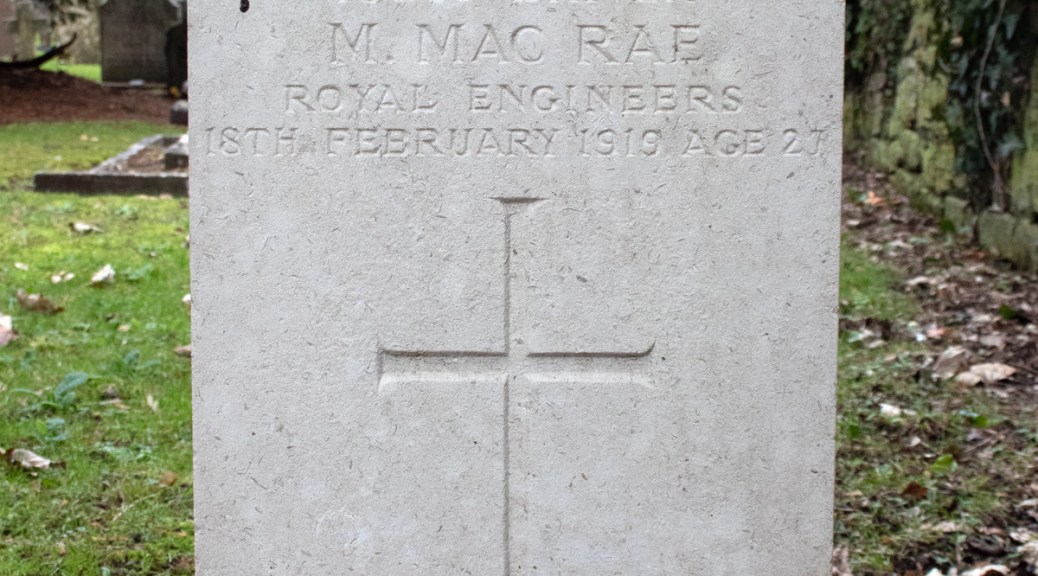
Driver Matthew MacRae

Driver Matthew MacRae

Much of Matthew Alexander MacRae’s life is destined to remain a mystery. He was born in Scotland in 1892, and was the second of three children to Thomas and Christiana MacRae. The family had moved to Birmingham – where Thomas had found work as a garment dyer – by the time of the 1901 census.

When war came to Europe, Matthew enlisted in the Royal Engineers. Nothing of his service records survives, but it is clear that he had joined as a Driver by the summer of 1918.

The next evidence for Driver MacRae is that of his passing, on 18th February 1919, at the age of 27 years. No cause of death is evident, although there is nothing in contemporary newspapers to suggest anything other than natural causes.

Two documents add a little more mystery to Matthew’s legacy. The Army Register of Soldiers’ Effects notes his father, Thomas, as the beneficiary of his estate. The Dependents’ Pension, however, suggests that an Emily MacRae, was to be provided with support. This was not Matthew’s sister, and Emily’s address – Cross Street in Bath, not far from where Driver MacRae was buried – would suggest that she was his widow, although there are no marriage records to corroborate this.

Matthew Alexander MacRae was laid to rest in the Roman Catholic Cemetery in Bath, Somerset.


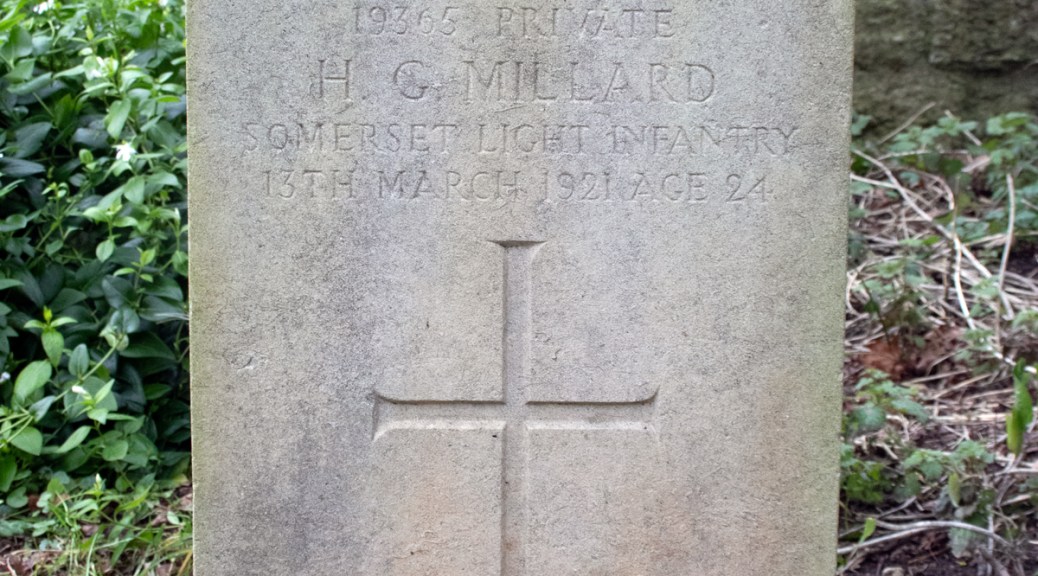
Private Herbert Millard

Private Herbert Millard

Herbert George Millard was born on 8th February 1897 in Wells, Somerset, and was the second of six children to John and Alice Millard. John was a cowman, and, as Herbert grew, the family moved with his father’s work.

By the time of the 1911 census, the family had set up home at the Castle of Comfort Public House in East Harptree, to the south of Bristol. John, by now, was recorded as being a farmer and inn keeper, while his three oldest sons, Herbert included, were all employed as farm hands.

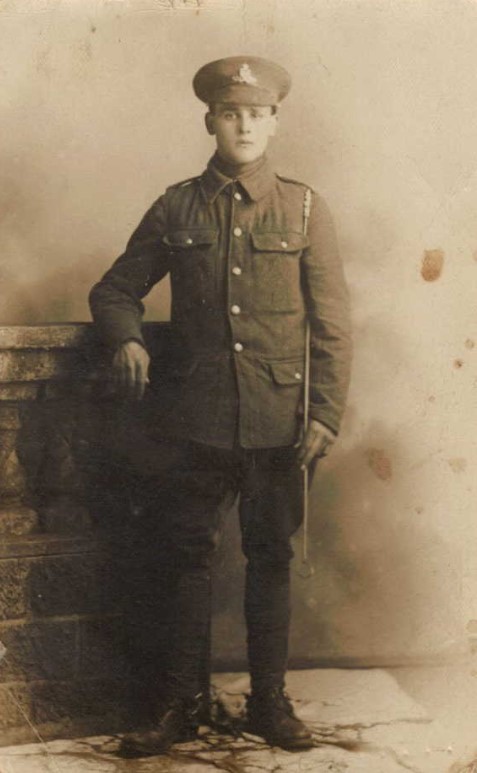
When the war broke out, Herbert was keen to play his part. He enlisted on 8th February 1915, his eighteenth birthday, and was assigned to the Royal Field Artillery. Initially posted for training in Glasgow, within a couple of months, Gunner Millard had been transferred to the Somerset Light Infantry.

The now Private Millard was sent to France in July 1915, and ended up serving three separate periods on the Front Line: July 1915 to October 1916, May 1917 to August 1917 and March 1918 to June 1918.

At some point during his service, he received gunshot wounds to his chest and ‘upper extremities’. It is unclear when this happened, but it may have been what led to Private Millard’s ultimate discharge from service in August 1918.

At this point Herbert’s trail goes cold. He appears to have returned to Somerset, and was living with his family, who had now moved to Baltonsborough, to the south of Glastonbury. The next record for him is that of his passing: he died on 13th March 1921, aged just 24 years old.

Herbert George Millard was laid to rest in the quiet St Dunstan’s Churchyard in Baltonsborough.


Private Herbert Millard (from ancestry.co.uk)

Seaman James McNichol

Seaman James McNichol

James McNichol was born on 21st December 1884, in Greenock, Renfrewshire. His parents were James and Elizabeth McNichol, but there is little additional information about his early life.

On 22nd May 1908, James enlisted as a Seaman in the Royal Naval Reserve. Again, little information is available, although he appears to have spent most of his career based out of his home town or on the ship Spindrift, based out of Glasgow.

James’ service records do shed some light on him. His height was recorded as 5ft 4ins (1.63m), he had a fair complexion and blue eyes. He also had a tattoo of a tombstone on his right arm and the words True Love on his right.

James had married a woman called Elizabeth at some point, and, while the marriage documents are lost to time, she is noted as his next of kin on his naval death records.

By the summer of 1912, Seaman McNichol was assigned to the battleship HMS Bulwark. The ship patrolled the English Channel at the outbreak of war, but by that autumn of 1914, she had moved to North Kent, guarding the waters around the Isle of Sheppey against potential German invasion.

James was on board Bulwark on the morning of 26th November 1914, when an explosion ripped through the ship and sinking it. More than 740 lives were lost, Seaman McNichol among them. He was just 29 years of age.

James McNichol was laid to rest in a marked grave in Woodlands Cemetery, Gillingham, not far from a mass grave where scores of his colleagues had been buried.


Seaman James McNichol
(from findagrave.com)

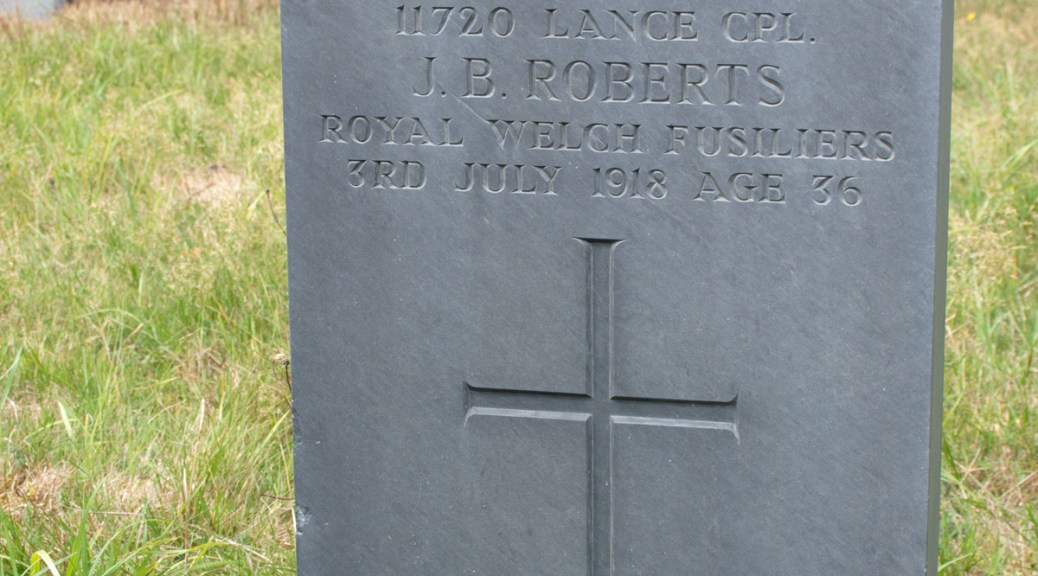
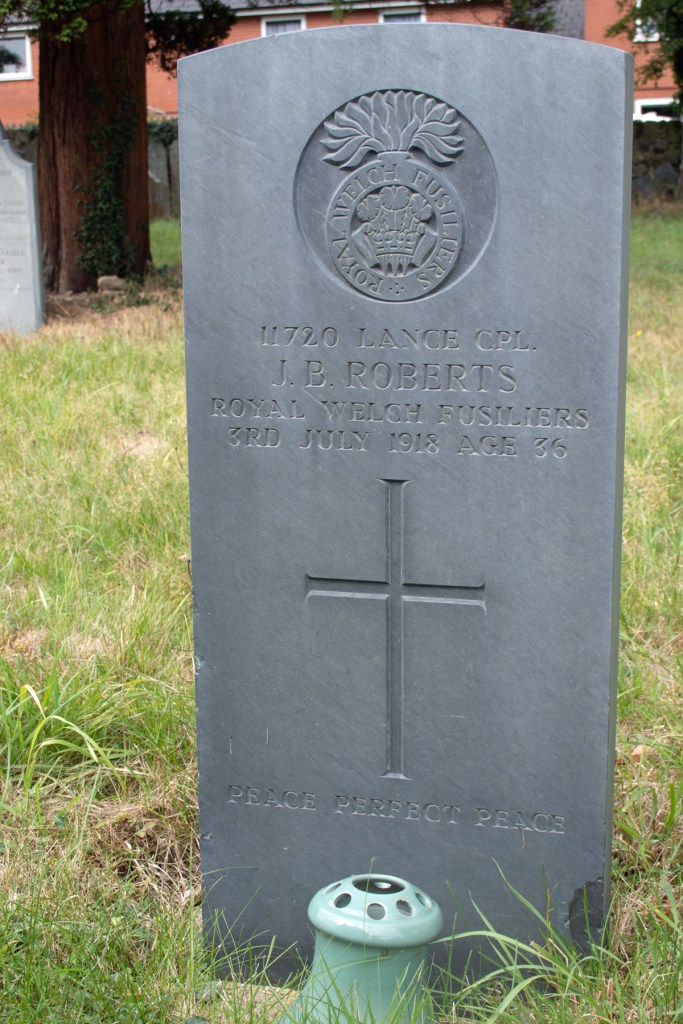
Lance Corporal John Roberts

Lance Corporal John Roberts

John Briscoe Roberts was born in 1882 in the Welsh village of Llanaelhaiarn. He was the oldest of ten children to the village’s sub-postmaster Samuel Roberts and his wife Elizabeth.

When he left school, John found employment with a local estate agent and, by the time of war was declared, he was working as a clerk for a timber mill in Llangollen, Denbighshire.

John was quick to enlist – he joined up on 15th August 1914 and, as a Private, was assigned to the Royal Welch Fusiliers. His service records show he was 5ft 7ins (1.70m) tall, and weighed 142lbs (64.4kg). They also note that he had black hair, brown eyes and a dark complexion.

Private Roberts’ initial service was carried out on home soil. He worked diligently and was rewarded for it, being promoted to Lance Corporal in December 1914. By the following June, his troop, the 8th Battalion, was sent overseas, first to Mudros in Greece, and then on to Gallipoli. In September 1915, Lance Corporal Roberts contracted dysentery and tuberculosis. He was medically evacuated back to Britain and admitted to the 1st Scottish General Hospital in Aberdeen to recover.

On 26th January 1917, John married Gladys Emily Edwards in Wrexham Parish Church. The couple settled down in Llangollen, where Gladys was from, and where John had been working before the war. His lung condition continued to dog him, however and, after another couple of months, he was deemed no longer fit for active service, and medically discharged from the army.

John took up his role in the timber yard again, remaining there for the next year or so. Tuberculosis was ultimately to get the better of him, however, and he passed away on 3rd July 1918, at the age of 36 years old.

John Briscoe Roberts was laid to rest in the graveyard of St John’s Church in Llangollen, Denbighshire.


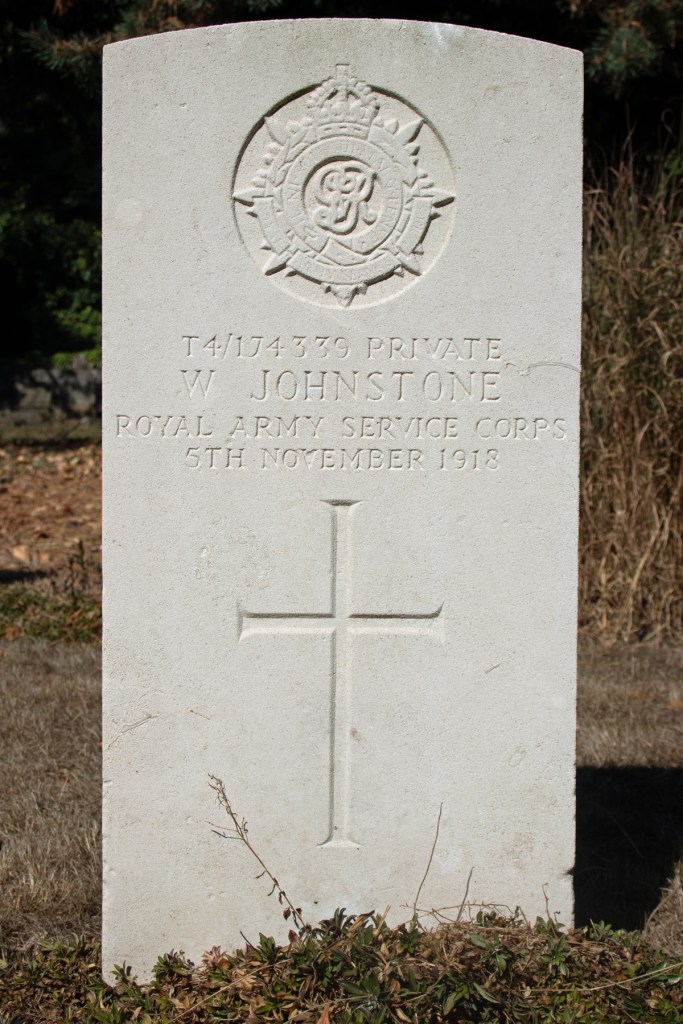
Private William Johnstone

Private William Johnstone

In the First World War section of St Peter and St Paul’s Churchyard in Aylesford, Kent, is a headstone dedicated to T4/174339 Private W Johnstone of the Royal Army Service Corps. Little other immediate information is apparent, and there are no military records available based on his service number.

The Commonwealth War Graves Commission website confirms that Private Johnstone transferred across to the 697th Agricultural Coy of the Labour Corps. He was given another service number – 440640 – and this allows access to a few more strands of his life.

Private Johnstone’s first name was William, and he had a dependent, Mrs CM Gunn, who lived at Moss Fall in Linwood, Paisley. The records, however, add a little more confusion to the story – Mrs Gunn is recorded as U/Wife and a guardian is also noted: Mrs Catherine McDree.

The waters are muddied further by the Army Register of Soldiers’ Effects. While this confirms that William had enlisted by the spring of 1918, it also highlights that his effects and war gratuity were not actually claimed.

With no date of birth for William, it is impossible to narrow down any further details of his early life: there are too many combinations of William and Catherine in the Paisley area to be able to identify them with any confidence.

The only thing that can be confirmed is that Private William Johnstone died from a combination of influenza and pneumonia on 5th November 1918, at the Preston Hall Military Hospital in Aylesford, Kent. He was buried in the nearby churchyard.


Lieutenant Thomas Denny

Lieutenant Thomas Denny

Thomas David William Denny was born on 26th December 1890 in Glasgow, Lanarkshire. There is little information on his early life, other than that his parents were Thomas and Annie Denny.

By the time of the 1911 census, Thomas Jr was serving as a Lance Corporal in the 2nd Battalion of the Gloucestershire Regiment, and was based at the Verdola Barracks in Malta.

When war broke out, the battalion was called back to mainland Europe. By 19th December 1914, Thomas found himself in France; two years later, he was in Salonika, Greece.

Thomas’ bravery was not in doubt. While serving in France, he received the Military Medal for conspicuous gallantry. This went hand in hand with a promotion to Sergeant. In 1917, he received a commission as Second Lieutenant and was moved to the regiment’s 3rd Battalion.

In the spring of 1918, Second Lieutenant Denny married Elsie, a woman from Bearsted, near Maidstone in Kent. Sadly, little else is known of her, and even a later newspaper report only referred to her as “a Bearsted lady” [East Kent Gazette: Saturday 15th March 1919].

By early 1919, Thomas was back in Britain. Whether he had been demobbed is unclear, but is seems more likely that he had returned home for medical treatment. On 6th March, he passed away in Maidstone. He was just 28 years of age.

Thomas David William Denny was laid to rest in the graveyard of Holy Cross Church in Bearsted close to where the now-widowed Elsie must have lived.


Petty Officer Albert Smith

Petty Officer Albert Smith

Albert Septamus Smith was born in Maidstone, Kent, on 12th January 1881. The oldest of three children to George and Frances Ditcher, he may has been born before the couple married, and seems to have retained his mother’s maiden name throughout his life.

When he left school, Albert sought a life at sea, joining the Royal Navy as a Boy 2nd Class on 12th January 1898, when he was just fifteen. Albert’s naval career was a long and varied one which began on board HMS Impregnable, a training ship. After a month’s training, he was assigned to HMS Lion, where he spent more than a year, gaining a promotion to Boy 1st Class in the process.

In October 1897, Albert transferred to HMS Pembroke, the Royal Naval Dockyard in Chatham, Kent. In the four months that he spent on shore, he turned seventeen and, as a result, came of legal age to formally be enlisted in the navy. Ordinary Seaman Smith signed up for a period of twelve years, and his service records showed that he was 5ft 8ins (1.73m) tall, had brown hair, brown eyes and a dark complexion. He was also noted to have a scar on his right wrist, and a tattoo of a flower and bracelet on the same wrist.

Ordinary Seaman Smith was dedicated to his career. Over the next twelve years he served on board nine different vessels, and rose through the ranks, gaining promotion to Able Seaman (in May 1899), Leading Seaman (January 1903), and Petty Officer 2nd Class (September 1903). He returned to the rank of Leading Seaman, doing so in August 1906, but this seems to have been a deliberate choice, as his service record appears unblemished.

In 1910, Albert’s initial period of service came to an end and he chose not to renew his contract. He had married Ellen Miles on 6th October 1900, and, with four young children, it appears that family had become more important to him. Returning to Maidstone, he found work on the railways, joining the South East and Chatham company as a platelayer. The family home was in Bearsted, a village to the east of Maidstone, now part of its suburbs, and they shared is with Ellen’s sister, Dorothy.

Life was going well for the Smith family, but war was coming to Europe and, with his previous naval experience, Albert was to be called upon again. He was called out of reserve on 2nd August 1914 and, after an initial couple of weeks at HMS Pembroke, Leading Seaman Smith was soon back at sea.

After a couple of years on board the seaplane tenders HMS Engadine and Campania, Albert was promoted to Petty Officer again, and assigned to HMS Sandhurst, a fleet repair ship based at Scapa Flow. He was on board when an explosion in the boiler room killed seventeen seamen on 27th February 1917, although he was not hurt.

It was while Petty Officer Smith was on board HMS Sandhurst that he contracted tuberculosis. He returned to Chatham Dockyard, but the condition was severe enough for him to be medically discharged from active service in February 1918.

Albert returned to civilian life again, and his trail goes cold for a couple of years. His lung complaint continued to haunt him, however, and he passed away from tuberculosis on 4th March 1921. He was 40 years of age.

Albert Septamus Smith was laid to rest in the graveyard of Holy Cross Church in Bearsted, not far from his family home.


Petty Officer Albert Smith
(from ancestry.co.uk)

Stoker 1st Class William Banfield

Stoker 1st Class William Banfield

William Banfield was born on 7th November 1890, in Henfield, near Horsham, West Sussex. He was the second youngest of seven children to George and Ellen Benfield. George was a carpenter, and this was a trade his two sons – William and his older brother, George – were initially both to follow as well.

William had a longing for the sea, however, and, on 11th June 1909, he enlisted in the Royal Navy as a Stoker 2nd Class. His service records show that he was 5ft 7.5ins (1.71m) tall, had brown hair, blue eyes and a fair complexion.

Stoker Banfield was based out of HMS Victory, the Royal Naval Dockyard in Portsmouth, Hampshire, but, over the eventual decade of his service, he spent no more than seven months ashore. Instead, he served on a total of nine ships. This included the battleship HMS Exmouth where, during the eighteen months he spent on board, he was promoted to Stoker 1st Class, and also spent 14 days in the brig, for reasons undisclosed.

On 27th September 1915, William was assigned to HMS Princess Royal. He served aboard for nearly three and a half years, patrolling the North Sea, coming under fire during the Battle of Jutland, and providing support during the Second Battle of Heligoland Bight.

Towards the end of January, Stoker 1st Class Benfield fell ill, and was admitted to the Edinburgh City Hospital. Suffering from encephalitis, sadly the condition proved too much for his system to bear and he passed away at the hospital on 31st January 1919. He was 28 years of age.

William Banfield was brought back to Sussex for burial. He was laid to rest in the cemetery of his home town, Henfield.


William’s older brother, George, was also to fall victim to the First World War. He had enlisted in the Royal Navy three years before his younger sibling, and also served as a Stoker 2nd Class (subsequently being promoted to Stoker 1st Class in 1907).

George was also based out of HMS Victory, and, in April 1911, was stood down to the Royal Naval Reserve, having completed an initial five years’ service.

When war broke out, George was called back into service, and was assigned to HMS Good Hope, travelling from English shores to Nova Scotia, before heading to South America and into the Pacific.

Caught up in the Battle of Coronel on 1st November 1914, the Good Hope was sunk by the German cruiser SMS Scharnhost. All souls on board – all 926 of them – were lost; this included Stoker 1st Class George Banfield. He was only 27 years of age.