William Michael Shanly was born in Hampstead, Middlesex, in the summer of 1892. The fourth of eight children, of whom three died in infancy, he was the eldest son to Michael and Mathilde Shanly. Michael was the owner of a coffee and refreshment company.
The Shanly family lived at 78 Sumatra Road, Hampstead, but by the time he was nine years old, William had been sent to Sussex, and was boarding at the Xavarians Brothers School in Uckfield.
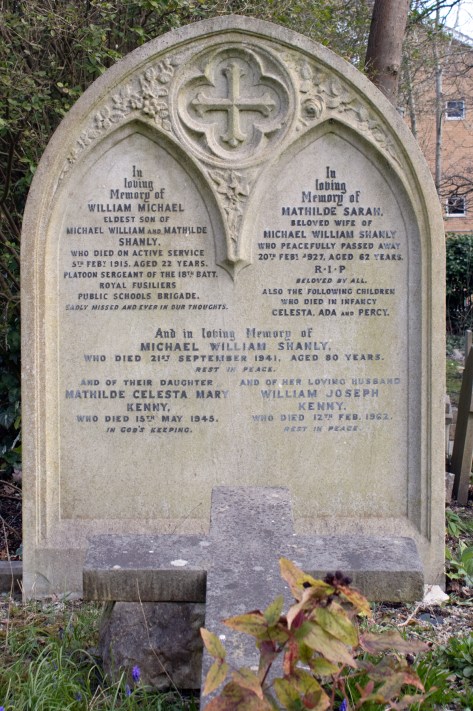
There is little further information available about William’s life. His epitaph on the family headstone suggests that he died on active service and was a Platoon Sergeant of the 18th Battalion of the Royal Fusiliers. His unit was also known as the 1st Public Schools, although exactly what role he held is unclear. His entry on the Commonwealth War Graves Commission Grave Index suggests that he was attached to the 15th (Reserve) Battalion, but his military records no longer exists, so it isn’t possible to confirm either way.
Serjeant Shanly died on 5th February 1915, aged 22 years of age. He had had an operation for appendicitis five days earlier, but had succumbed to peritonitis.
William Michael Shanly was laid to rest in the family plot in Highgate Cemetery, not far from where his grieving family were living.
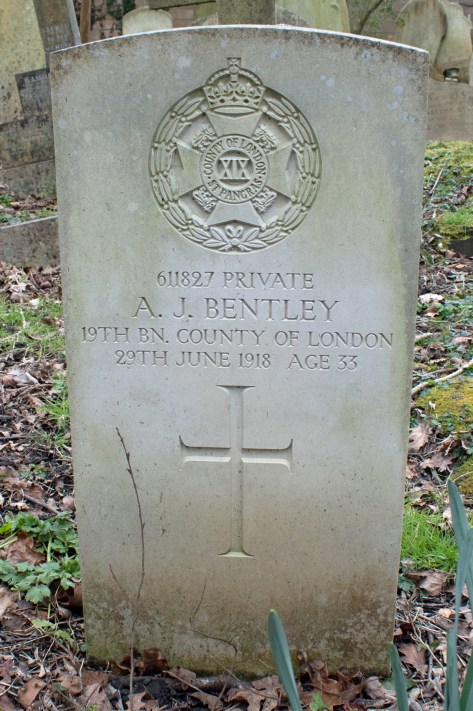
Albert John Bentley was born in St Pancras, Middlesex, in the spring of 1885. The second of six children, his parents were John and Eleanor (also known as Elizabeth) Bentley. John was a piano maker, and the family lived at 27 Hampshire Street in St Pancras.
When his father died in 1910, Albert had already started to follow in his footsteps. The following year’s census recorded him living with his mother and three younger siblings. Employed as an organ builder, his was one of three wages being brought into the household.
Albert stepped up to play his part when war broke out. Full details of his military service have been lost to time, but it is clear that he enlisted in the London Regiment, and was assigned to the 1st/19th (County of London) Battalion (St Pancras).
It is unclear whether or not Private Bentley spent any time overseas. By the summer of 1918, however, he had fallen ill, and was admitted to a military hospital in Shoreham-by-Sea, Sussex. He succumbed to a combination of influenza and pneumonia on 28th June 1918: he was 33 years of age.
The body of Albert John Bentley was taken back to Middlesex for burial. He was laid to rest in the sweeping grounds of Highgate Cemetery.
Frank Hermann Belthle was born in Dartford, Kent, on 25th June 1893. The oldest of four children, his parents were German-born Frederick Emil Hermann Belthle and his wife Elizabeth, who came from Surrey.
Frederick – who was better known as Hermann – was a manufacturer compressed tablets and pills. By the time of the 1901 census, he had moved his family to Aldrington, Sussex, were the set up home at 58 Westbourne Street. They had the house to themselves, unlike their neighbours, with two or three families sharing each property.
Hermann took the family to where work required him, and between 1903 – when Frank’s youngest sibling was born – and 1911, they relocated to London. Now seventeen years old, Frank was assisting his father in the business, and that business was obviously paying dividend: the Belthles’ new home was the 8-roomed house at 106 Barnsbury Road, Islington. Again, they occupied the whole building, while others in the street renting just a couple of rooms.
The outbreak of war must have had an impact on German national Hermann and his family. Frank looks to have stepped up to play his part, however, joining the Royal Army Medical Corps, possibly because of the medical training he had picked up through the family business.
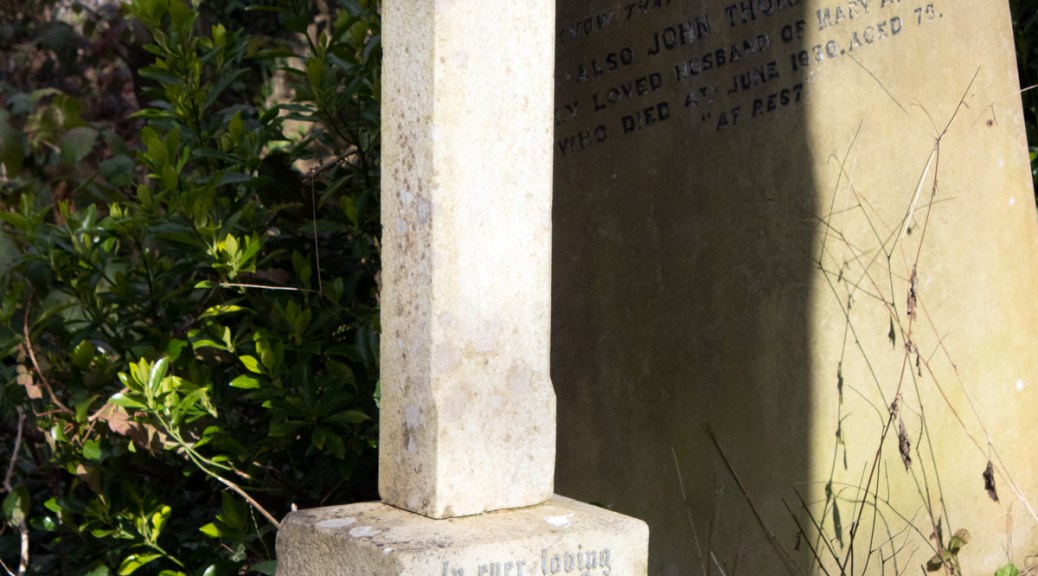
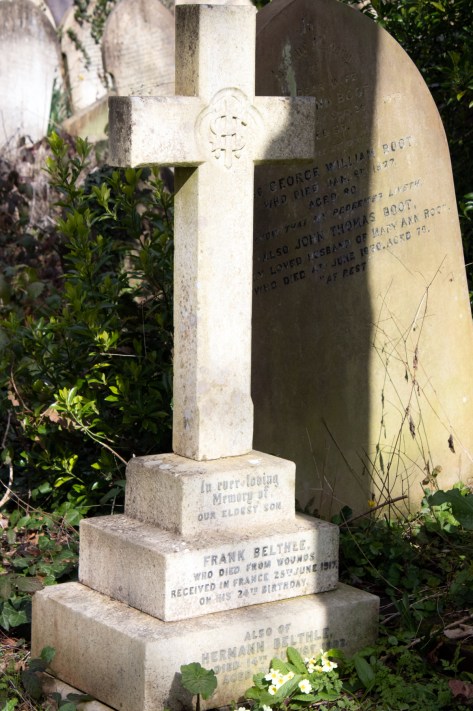
There is little documentation about Private Belthle service, although he was awarded the Military Medal. By the summer of 1917, his unit – the 14th Field Ambulance – was supporting troops at Arras. While here, on 9th May, he was badly wounded, and medically evacuated to Britain for treatment. His injuries were to prove too severe, however, and, on 25th June 1917, he passed away: it was his 24th birthday.
Frank Belthle was laid to rest in the majestic Highgate Cemetery.
After the war, Hermann continued with his business. Things were more difficult for the family, however and, while they had moved to the prestigious Lonsdale Square, Islington, they were one of six families taking rooms in the large Georgian terrace.
Hermann passed away in the autumn of 1932, at the age of 70: he was laid to rest alongside his son in Highgate Cemetery.
In Highgate Cemetery, Middlesex is a headstone dedicated to Able Seaman F Hall, who served in the Mercantile Marine during the First World War.
Able Seaman Hall served on board the cargo ship SS Cairndhu, which transported coal from Northumberland to Gibraltar. At 9pm on 15th April 1917, while 25 miles west of Beachy Head, Sussex, she was torpedoed by the German submarine U-40.
Cairndhu immediately began to list, and her captain, Robert Purvis, ordered all 38 of his crew into the lifeboats. He took charge of one of the boats, while the Third Mate, Thomas Healy, was given responsibility for the second.
The German submarine, captained by Oberleutnant Karl Dobberstein, had moved away, but returned a few minutes later. In a seemingly deliberate act, it rammed into Healy’s boat, cutting it in half and throwing most of those on board into the water.
A passing ship reached the site and rescued what remained of the Cairndhu’s crew. Eleven men had been lost.
What role Able Seaman Hall had in the incident is unclear. The survivors were taken to safety in the Sussex port of Newhaven, and it is evident that he was one of those who had perished.
Able Seaman Hall’s name does appear on the Register of Deaths of Passengers and Seaman at Sea. This confirms his connection with the Cairndhu, and give his age as 20 years old. His birthplace is noted as Hertfordshire, and records his last address as 7 Clarendon Road, Leeds, Yorkshire. However, even with this additional information it has not been possible to pinpoint any exact details about his life, or his connection to the North London cemetery in which he was buried.
Joseph Walls was born in Tortington, near Arundel, in West Sussex, on 13th November 1880. The youngest of four children, his parents were gamekeeper James Walls and his wife Annie. James moved the family to where his work took him and, by the time of the 1891 census, they had settled in the New Forest village of Sway, Hampshire.
When Joseph finished his schooling, he found work as a horseman and groom. The 1901 census found him living with his parents and older sister in a house in Brockenhurst. He seems to have taken his work seriously, and soon found himself a position as a chauffeur. The next census, taken in 1911, recorded him as working for Ann Libbey and her family in the village of Boldre.
On 18th February 1914, Joseph married Edith Perry. A carpenter’s daughter, she was working as a domestic servant when the couple exchanged vows. Their wedding certificate confirms that Joseph was ten years his new wife’s senior, and that they ceremony was witnessed by his older brother Frederick and her younger sister, Esther.
Joseph and Edith would go on to have two children: Vera was born in 1915, while Daphne came along three years later. During this time, however, war was raging across Europe, and Joseph had stepped up to play his part.
Private Walls enlisted within weeks of war being declared, on 10th December 1914. His service papers show that he was living at Hospital Cottage in Lyndhurst when he joined up. He was 5ft 8ins (1.72m) tall, with black hair, grey eyes and a dark complexion. He was also noted as being asthmatic since he was a child.
Assigned to the 1st/4th Battalion of the Hampshire Regiment, over the next few years, Private Wallis would see the world. Within days of enlisting, he was shipped out to India, where he would spend nearly three years (apart from the in the summer of 1917, when he served as part of the Mediterranean Expeditionary Force). During this time, Joseph was promoted to Lance Corporal, although by the time he left the army, he had returned to the tank of Private.
By the beginning of September 1917, Joseph was back on home soil. A spell of malaria that spring had impacted his asthma, and at the end of November, he was deemed no longer fit for war service. Private Walls was medically discharged from the army on 29th November 1917.
At this point, Joseph’s trail goes cold. He definitely returned home – Daphne was born just a few days after the Armistice – but it is unclear whether he was it enough to work.
Joseph Walls died on 14th February 1919: he was 38 years of age. He was laid to rest in Lyndhurst Cemetery, not far from where Edith and their children lived.
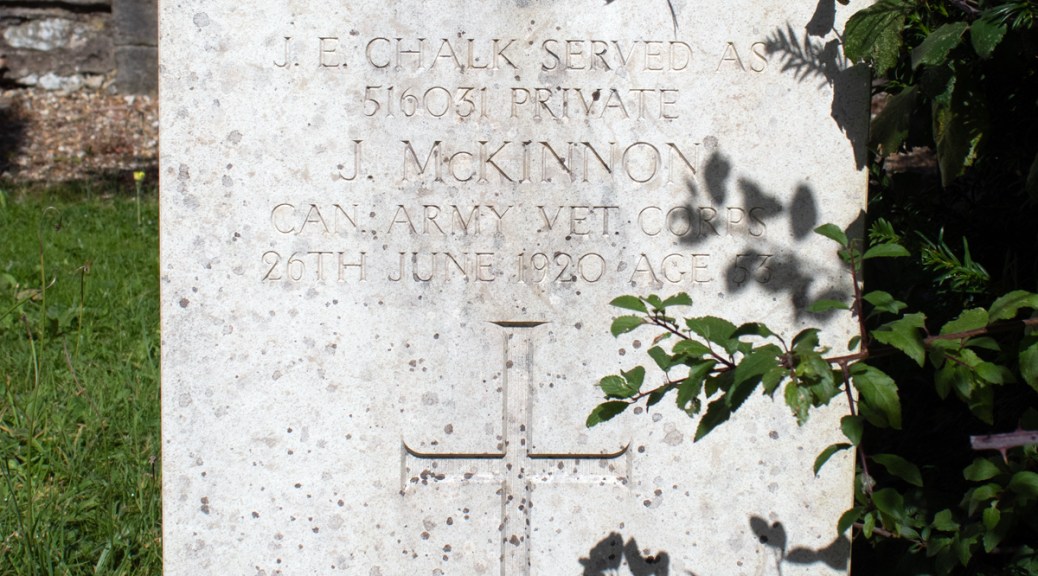
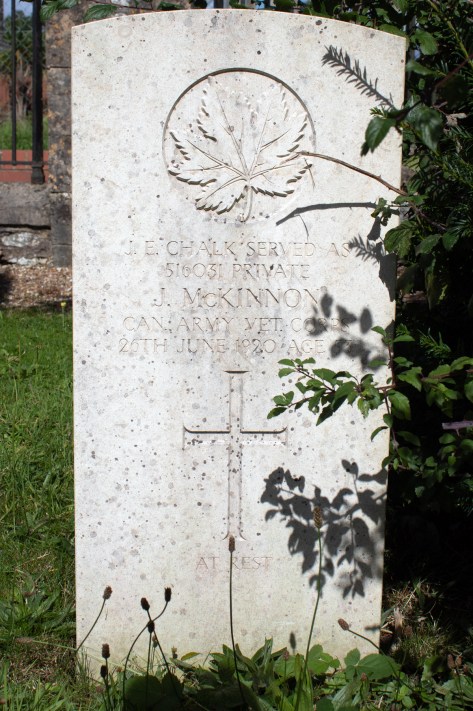
In Mere Cemetery, Wiltshire, is a headstone dedicated to JE Chalk, who served as Private J McKinnon in the Canadian Army Veterinary Corps. He died on 25th June 1920, and gives his age as 53 years old.
Private McKinnon’s service records suggest, however, that he was born on 14th October 1874 in Inverness, Scotland, and give his army name as John. The Commonwealth War Graves Commission give his other name as James Edward Chalk. James seems to have been keen to disguise his background, and it is only with some digging that the real story comes out.
James was the youngest of five children to Edward and Mary Chalk. Edward was a carpenter from Mere, and this is where the family were born and raised.
When he finished his schooling, James found work as a booking clerk. Edward died in the 1880s, and the 1891 census found James living at home with his mother, who had taken on laundry work to help with their finances.
By 1901, Mary and James were living on Water Street, to the south of the town centre. There’s was now an extended household, and included James’ sister Olive. James is noted as being married, and while no marriage records exist, it would seem that his wife, Mary, and their daughter, Ivy, were also living there.
The next census, taken in 1911, suggests James’ life had taken a different turn. Employed as a railway foreman, he was now living with his older sister, Olive, in her home. He is noted as being married with a child, but neither Mary nor Ivy appear in the same census.
At some point in the next five years, James took the decision to move overseas, and create himself a new identity.
John McKinnon was living in Montreal when the call came to join up. He enlisted on 29th April 1916, by which point he was 41 years of age. Assigned to the Canadian Army Veterinary Corps, his service records confirm that he was 5ft 9ins (1.75m) tall, with greying brown hair, grey eyes and a sallow complexion. He was noted as having scars on both legs, and another on the second toe of his right foot.
Private McKinnon’s unit were quick to be dispatched to Britain, and he arrived in Shornecliffe, Kent, on 29th June. He spent the next five months at the army base, and had two spells of a month each in hospital during that time: the first for asthma, the second for bronchitis.
In November 1916, John moved along the coast to Shoreham, West Sussex. His health was badly impacted, though, the medical report stating that ‘his chest is of the emphysematous type but at present free from bronchitis. He will not do well in England.’ John was formally discharged from the army on 15th November 1916.
At this point, John’s already sparse trail goes cold once more. It is possible that he moved to Wiltshire to be nearer to family, although nothing can be confirmed.
James Edward Chalk, who serves as Private John McKinnon, died on 26th June 1920: His service records suggest that he was 45, but he was, in fact, 53 years of age. He was laid to rest in Mere Cemetery, on the outskirts of the town he had called home for so long.
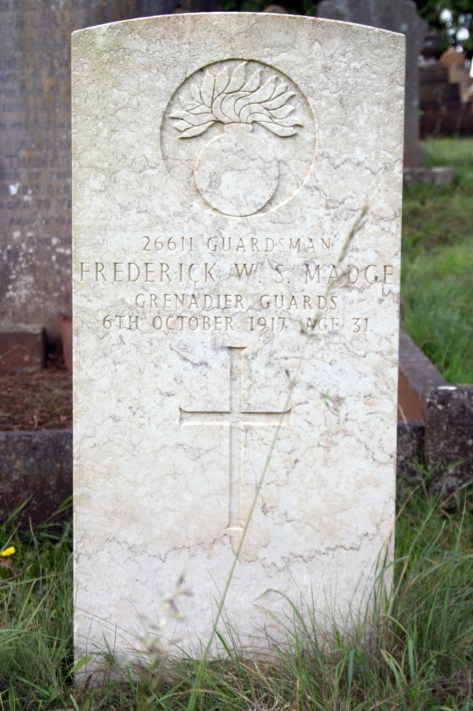
Frederick Walter Smith Madge was born on 29th April 1886 and was the youngest of three children to Walter and Elizabeth. Walter was a painter from Paignton, and it was in the Devon town that the family was raised.
When Frederick finished his schooling, he found employment as a errand boy. By the 1901 census, the family were living on Princes Street, and his older sisters were both working as domestic servants. The next census found Frederick as the only one of the Madge siblings still living at home: he was also now working a a painter, presumably assisting his father.
Early in 1913, Frederick married Sarah Bishop. Sadly, there is little information about her, but her father’s name was Nicholas, and she was living in Newton Abbot, Devon, at the time of the wedding, which took place in nearby Wolborough.
When war broke out, Frederick stepped up to play his part. His service records are long gone, but it is clear that he had enlisted before March 1917, and had joined the prestigious Grenadier Guards. Guardsman Madge definitely saw service overseas, and his unit was heavily involved in some of the key battles on the Western Front.
It was during this fighting, possibly at the Battle of Polygon Wood, that Frederick was injured. He was medically evacuated to Britain for treatment, and admitted to the Kitchener Military Hospital in Brighton, Sussex.
The funeral took place, at Paignton, on Wednesday, Rev. AR Fuller officiating, of [Guardsman] FWS Madge, 31, Grenadier Guards, who died on October 6th in hospital at Brighton, following an amputation of the leg. Deceased, who was well known in Paignton, was a member of the town Fire Brigade, and highly respected.
[Western Times: Tuesday 16th October 1917]
Frederick Walter Smith Madge was laid to rest in Paignton’s sweeping cemetery.
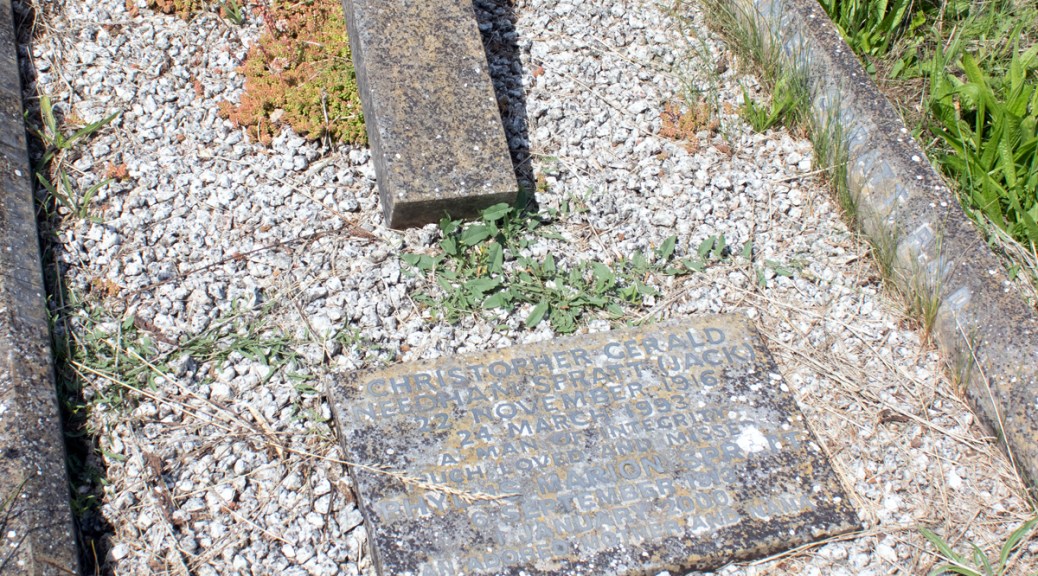
Christopher Templar Spratt was born on 23rd August 1889 in Streatham, Surrey. The youngest of three children, his parents were James and Elizabeth. James was an electrician by trade, and the 1891 census recorded the family as living at 58 Limes Road, between Selhurst and West Croydon.
The Spratts seem to have been a divided family. By the time of the 1901 census, James appears to have emigrated to Australia, presumably to earn money in the burgeoning country. Elizabeth and their younger two children were visiting Worthing, West Sussex.
At this point, and the decision seems to have been made for them to move to Sussex permanently, as the 1911 census found her and Christopher living at 87 Westcourt Road, Worthing. Elizabeth was noted as living on her own means; Christopher was working as a solicitor’s clerk, and they had a boarder, governess Nettie Buckler, to help bring in some additional money.
In January 1912, Christopher married Edith Green, a dressmaker from just along the coast in Goring-by-Sea. The couple moved in with Elizabeth, and went on to have two children: Florence, who was born that June; and Christopher Jr, who was born in November 1916.
By this point, war was raging across Europe, and Christopher stepped up to serve his King and Country. He had enlisted the Royal Naval Volunteer Reserve on 9th December 1915, but was not formally mobilised until the following June. Given the rank of Ordinary Seaman, Christopher’s service records note that he was 5ft 9ins (1.75m) tall, with dark brown hair, grey eyes and a fair complexion. He was also noted as having a mole on his left thigh.
Christopher was assigned to the Nelson Battalion of the Royal Naval Division, and sent to Dorset for training. While details of his service as more haphazard than usual, it seems that he served time overseas, and was promoted to Able Seaman on 1st October 1916. He became unwell in February 1917, as was admitted to the 18th General Hospital in Dannes-Camiers, on the French coast.
Suffering from cellulitis, Able Seaman Spratt was medically evacuated to Britain for treatment, and ended up as a patient in the 2nd Western General Hospital in Manchester. The condition was to prove fatal: he passed away on 12th February 1917, at the age of 27 years old.
The body of Christopher Templar Spratt was brought back to Sussex for burial. He was laid to rest in the churchyard of St Mary’s in Goring-by-Sea.
Elizabeth went on to re-marry and, by the time of the 1921 census, was living in East Preston, Sussex, with her new husband, Edward Neal, Christopher Jr and her new daughter, Enid. There is no evidence of Elizabeth’s older daughter, Christopher, although there is a Florence Spratt recorded as a patient in White Oak Schools (Homes for Ophthalmic Children) in Swanley, Kent.
Christopher Jr went on to marry Phyllis Bennett in the autumn of 1946. They remained in the Worthing area until his death in March 1993: he was laid to rest alongside the father he would not have remembered, in St Mary’s Churchyard. When Phyllis died seven years later, she was buried alongside her husband and father-in-law.
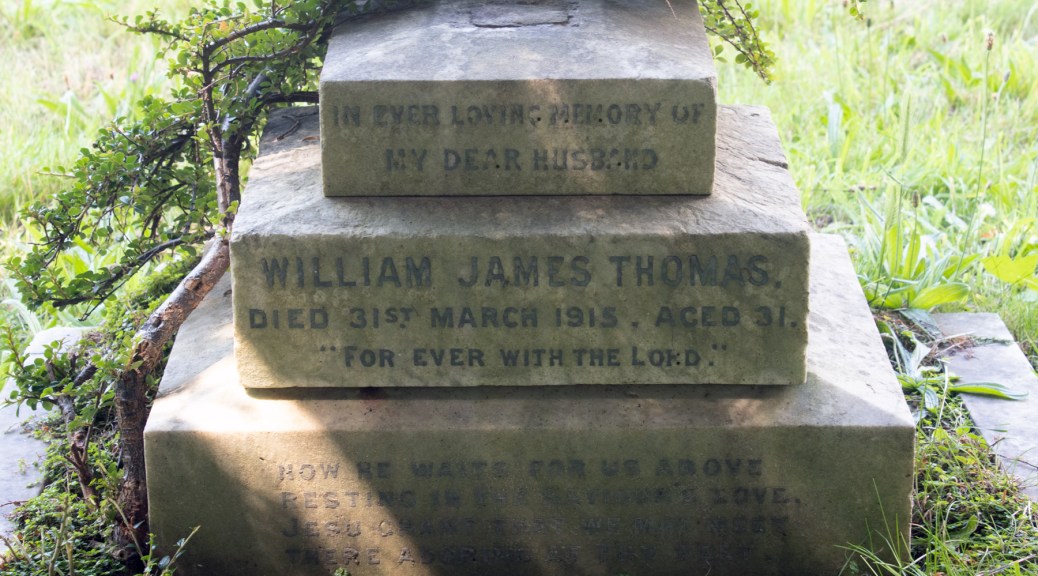
William James Thomas was born in Manordeifi, Pembrokeshire, in 1894. The older to two children his parents were Benjamin and Ellen Thomas. Benjamin was a groom, and, at the time of the 1891 census, the family were living at Cilwendeg Lodge at the entrance to the Welsh estate.
The family moved to Aberporth on the Cardigan coast by the 1901 census. Benjamin had become a farmer, and William, now 17 years of age, was helping out.
Something changed dramatically for William, however, and by 1914, he was living in the West Sussex village of Ferring, some 200 miles (320km) from his birthplace. By this point he was working as a motor driver and, on 25h March, he married Winifred May Knight at St Mary’s Church in Goring-by-Sea.
William stepped up to serve his country when war broke out, enlisting on 18th February 1915. His service records show that he was 5ft 4ins (1.63m) tall, and weighed 138lbs (62.6kg). He was noted as having a mole on his right cheek, and that several teeth were missing. The document confirms his marriage to Winifred, but also gives details of a child, Evelyne Winifred, who had been born in 1905: there is nothing to confirm whether she was his, or was born to Winifred before the couple met.
Private Thomas was assigned to the Army Service Corps Mechanical Transport Division, and sent to nearby Worthing for his training. His time in the army was to be tragically brief, as within a fortnight he had been admitted to the town’s Red Cross Hospital, suffering from cerebrospinal fever.
On 23rd March, William was transferred to Worthing Civil Infections Hospital, but any treatment he was receiving was to prove ineffective. He passed away on 31st March 1915, at the age of 31 years old.
The body of William James Thomas was laid to rest in the graveyard of St Mary’s Church, Goring, where just over a year before he and Winifred had been married.
Ernest Arthur Pointing was born on 21st March 1896 in Goring-by-Sea, Sussex. The second-to-last of thirteen children, his parents were William and Kate. William was a baker from Brighton, but by the time of the 1901 census, the family were living at The Cottage, next to Goring Hall.
When Ernest left school, he found work as a stable boy. The next census, taken in 1911, found him and his parents – William now having retired – living at 1 Elm Tree Cottages in the centre of Goring itself. The three of them shared the house with Ernest’s older sister, Louisa, and his nephew, seven-year-old Herbert.
Alongside his paid work, Ernest also volunteered for the Royal Sussex Regiment and, within a week of turning eighteen, he stepped up to enlist with them. His medical report, undertaken on 18th March 1914, show that he was 5ft 4.5ins (1.64m) tall, and weighed 112lbs (50.8kg). He had dark brown hair, brown eyes and a fresh complexion. He as noted as having two scars on his left thumb, and two more on his right knee.
Assigned to the 2nd Battalion of the Royal Sussex Regiment, Private Pointing would spend the next nine months training on home soil. By the middle of January 1915, however, he was sent to France. Intriguingly, he was to spend only two months overseas, before returning to home soil. There is no evidence of him being injured, but it would not be until September 1915 that he returned to the fray.
In January 1916, Private Pointing transferred to the Machine Gun Corps. He remained overseas until March 1916, at which point his health seemed to have become affected. Ernest returned to Britain, and was ultimately discharged from military on 28th March 1917. He was suffering from pulmonary tuberculosis, the condition that would ultimately take his life less than six months later.
Ernest Arthur Pointing died on 5th October 1917. He was just 21 years of age. He was back in Sussex by this point, and he was laid to rest in the family plot in the graveyard of St Mary’s Church in Goring. He was buried alongside his father, William, who had died two years earlier.










 Death and Service