Category Archives: Hampshire

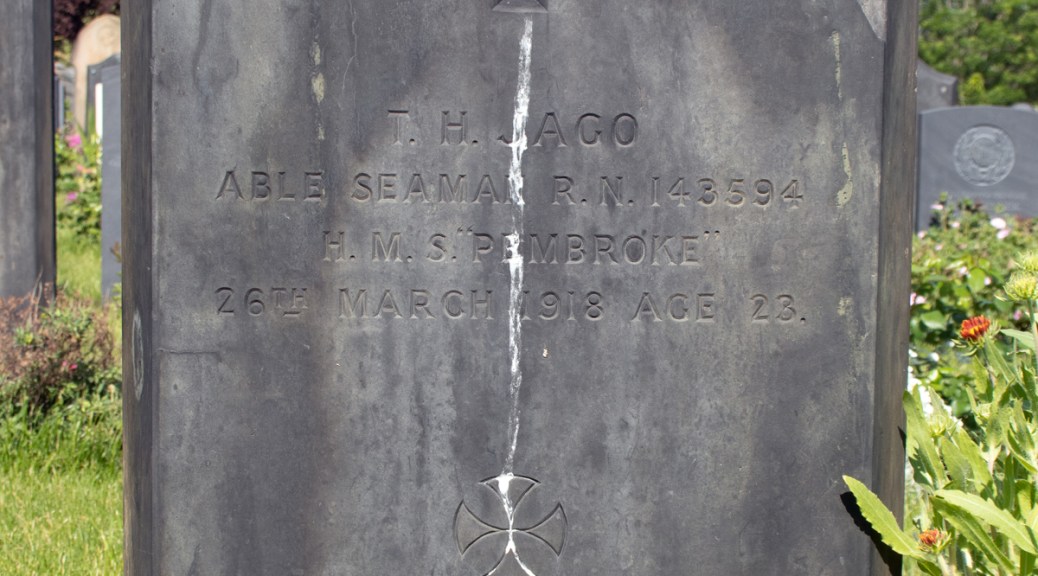
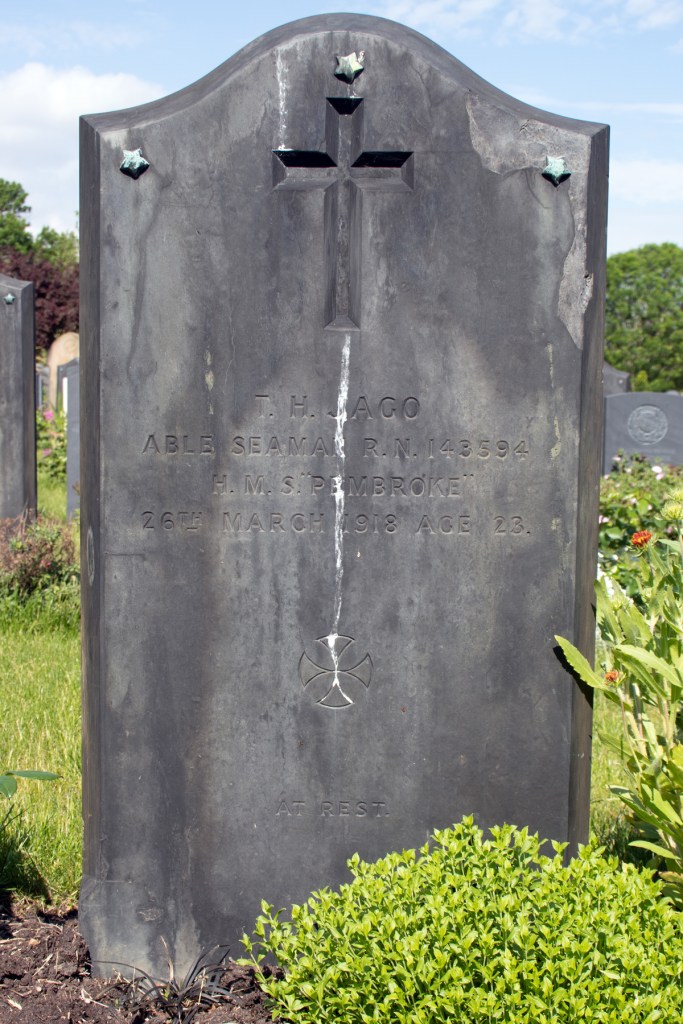
Able Seaman Thomas Jago

Able Seaman Thomas Jago

Thomas Henry Jago was born on 3rd June 1872 in Romney Marsh, Kent. The second of ten children, his parents were James and Elizabeth. James was a coastguardman, and his son was destined to be connected to the sea.

Thomas joined the Royal Navy on 19th December 1887. Given the rank of Boy 2nd Class, his records show that he was just 5ft (1.52m) tall, with dark brown hair, grey eyes and a fresh complexion. He was sent to HMS St Vincent, the training ship based in Haslar, Hampshire, and would remain there until June 1889. During this time, he was promoted and given the new rank of Boy 1st Class.

Thomas’ first ocean assignment was on board the corvette HMS Active. She would be his home for the next three years. In June 1890 he came of age, and was formally inducted into the Royal Navy as an Ordinary Seaman. By November 1890, he had proved his worth again, and was promoted to Able Seaman.

Over the next seventeen years, Thomas would serve on 21 ships. Frustratingly, the dates on his service records become a little muddled as time goes on, but it was while he was on board the RMS Empress of India in the late 1890s that he was promoted to Leading Seaman, then Petty Officer 2nd Class and Petty Officer 1st Class, all within a matter of three years.

In March 1903 he was demoted to Petty Officer 2nd Class, but the higher rank was reinstated eighteen months later. In September 1907, while serving on HMS Magnificent, Thomas seems to have been in some sort of trouble. This resulted in the removal of his ranking, and he was downgraded to Able Seaman once more, a rank that he would then hold until the end of his naval career.

In between voyages, Able Seaman Jago would have a shore base to return back to. His most common port seems to have been Chatham, and HMS Pembroke, the town’s Royal Naval Dockyard, features on his records more and more as time goes by.

In June 1912, after 22 years of service, Thomas was stood down to reserve status. Over the next few years his trail goes cold, although a later document suggests that he had moved to Sandgate, Kent, where he was renting rooms at 18 High Street.

War was soon raging across the world, and Able Seaman Jago was called upon to serve again. Assigned to London’s HMS President in December 1915, he quickly returned to Chatham Dockyard again. Over the next couple of years, Thomas serves on two further ships – HMS Diligence and HMS Mars – but HMS Pembroke definitely became a home from home.

In February 1918, Able Seaman Jago returned to the Royal Naval Dockyard in Chatham one last time. He was unwell by this point, and was admitted to the the town’s Royal Naval Hospital for an operation on his mouth. Thomas was suffering from carcinoma of the tongue, and the condition was to prove fatal. He passed away on 26th March 1918, at the age of 45 years old.

Thomas Henry Jago was laid to rest in the naval section of Woodlands Cemetery in Gillingham, Kent, not far from the base he had called home for so many years.

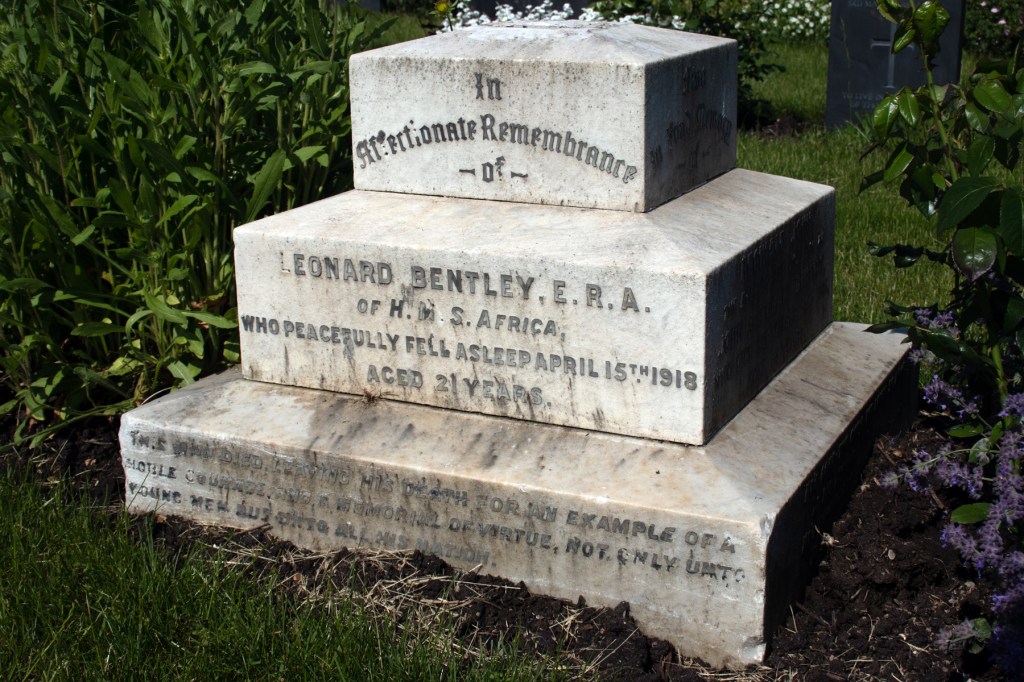
Engine Room Artificer 4th Class Leonard Bentley

Engine Room Artificer 4th Class Leonard Bentley

Leonard Bentley was born in Strood, Kent, on 6th December 1896. One of six children, his parents were John and Emma Bentley. John was a barge captain, transporting ship-loads of cement from the local works to where it was needed.

The 1911 census found an extended Bentley family living at 85 Cliffe Road in Strood. John and Emma shared their home with Leonard, his older brother Arthur, and Arthur’s wife and son. Eleven years younger than Arthur, who was his next oldest sibling, Leonard was still at school by this point.

Education was obviously important to Leonard, and by the end of the year, he had enrolled in the Royal Navy as a Boy Artificer. He would spend the next few years at HMS Fisgard, the training establishment in Woolwich, Kent, learning his trade.

When he came of age in December 1914, Leonard was officially inducted into the Royal Navy, taking on the rank of Engine Room Artificer 5th Class. He remained at Fisgard until January 1916, when he transferred to HMS Victory, the Royal Naval Dockyard in Portsmouth.

This was a temporary move, however, and on 11th April Leonard was assigned to HMS Africa, and a few weeks later, he was promoted to Engine Room Artificer 4th Class. A battleship, the Africa would become his home for the next eighteen months and he would travel with to the Mediterranean and Adriatic Seas.

In January 1918, Engine Room Artificer Bentley would return to solid ground. He transferred to HMS Pembroke, the Royal Navy’s base in Chatham, Kent. The reason for his move appears to have been health related, and he was soon moved the the town’s Naval Hospital, suffering from pulmonary tuberculosis. The condition was to prove fatal. Leonard died on 15th April 1918: he was 21 years of age.

Leonard Bentley was laid to rest in the naval section of Woodlands Cemetery, Gillingham, Kent, not far from his family home, or his final naval base.


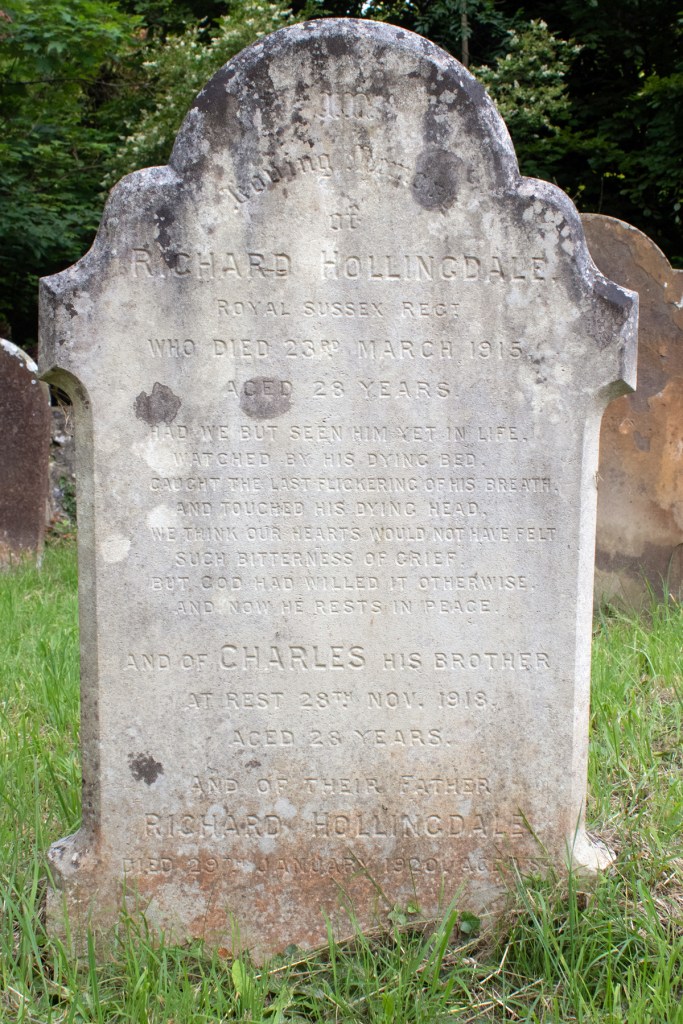
Private Richard Hollingdale

Private Richard Hollingdale

Richard Hollingdale was born at the start of 1887, and was one of nine children to Richard and Elizabeth. Richard Sr was a farm labourer from Lancing, but his namesake son was born in the Sussex village of Washington.

By the time of the 1901 census, the family had moved to Findon, a village to the north of Worthing. Attached to Muntham Farm, they lived in New Barn, a workers’ cottage on the estate. Richard Jr and his brothers all helped out on the farm and, according to the next census return, Richard Sr, now 75 years of age, was a labourer, while the three sons still living at home – William, Richard Jr and Charles – were all waggoners.

When war consumed Europe in the summer of 1914, Richard Jr stepped up to serve his country. Sadly, full details of his service have been lost to time, but it is clear from what remains that he joined up early in the conflict, and certainly no later than October 1914.

Private Hollingdale was attached to the 7th (Service) Battalion of the Royal Sussex Regiment and in the spring of 1915 his unit moved to the Ramillies Barracks in Aldershot, Hampshire. Richard had only been there for a couple of weeks, when he fell ill. He was admitted to the local Isolation Hospital with scarlet fever, and the condition was to prove fatal. He passed away on 23rd March 1915, at the age of 28 years old.

The body of Richard Hollingdale was taken back to Sussex for burial. He was laid to rest in the family plot in St John the Baptist Churchyard, Findon.


Private John Boura

Private John Boura

John Adams Boura was born in the spring of 1868 in Kensington, Middlesex. The middle of three children, his parents were Julien and Esther Boura. Julien was the son of a French immigrant, who had built up two businesses as a dyer and cleaner (the first business having failed).

John followed in his father’s line of employment, and, by the time of the 1891 census, he was living with business partner Isabel Knight, at 3 St Mark’s Place in Wimbledon, Surrey. Work and pleasure were obviously mixing, though, and, on 3rd October that year, the couple married in the nearby Queen’s Road Chapel.

The newlyweds would go on to have a son, also called John, in March 1895. By the start of the new century, the family has moved out of the capital, relocating to Aldershot, Hampshire, where they set up a new business at 111 Victoria Road, in the town centre.

Within the next decade, however, the Bouras had moved back to the London suburbs, setting up home and business in Merton, Surrey. A new alliance was forged at 106 Kingston Road, with the three sharing their home with Henry and Adelaide Shelley. All four adults were involved in the business, while the now 16-year-old John Jr was employed as a dentistry improver.

Julien – who was also known by his middle name, Aimé – and Esther had moved to Maidenhead in Berkshire by this point, and in September 1910, it seems that their son visited them. An argument seems to have erupted, and John was arrested. Taken before the Maidenhead Petty Sessions, he was tried for unlawfully and maliciously damaging the glass of certain windows, exceeding he amount of £5 to wit £8 6s., the property of Aimé Boura. John was find a total of £10 for the damage.

When war broke out, John stepped up to serve his country. While his service documents are long since lost, other records suggest that he had enlisted by the summer of 1916, and likely volunteered, give he was in mid-40s by this point. Private Boura was assigned to the Royal Army Service Corps, and was to be based at the Supply Depot in Bath, Somerset.

It is probable that John’s dying and cleaning background meant that he was involved in uniforms in some way, although nothing concrete remains to document his time in the army. During the early part of 1917, he fell ill, coming down with bronchitis. He was admitted to Bath War Hospital, but the condition was to get the better of him. Private Boura passed away on 9th February 1917, at the age of 48.

The body of John Adams Boura was laid to rest in Bath’s majestic Locksbrook Cemetery, not far from the hospital in which he had passed.


Lance Corporal Thomas Fidler

Lance Corporal Thomas Fidler

Thomas Fidler was born on 15th May 1881 in Newbury, Berkshire and was the fourth of eight children to Charles and Sarah. Charles was a groom, who travelled where the work was, and, by the time of the 1901, the family has relocated to Whitchurch in Hampshire.

When he finished his schooling, Thomas found work as a dairyman. However, he had always had his sights on bigger and better things, and, having been a volunteer for the local militia, he was keen to become a full soldier. Things did not go immediately to plan though, and he was initially turned down because he was under height – he was just 5ft 3ins (1.6m) tall when he turned 18.

But Thomas was persistent, and, on 27th June 1898, he was formally enrolled in the Hampshire Regiment. Along with his height, his service records confirm other details about the young man he had become. The document show that he weighed 124lbs (56.2kg), and that he had brown hair, brown eyes and a fresh complexion. The records advise that he was considered fit for duty, but also note that he was given special authority to enlist, presumably to bypass the concerns about his height.

Private Thomas Fidler would go on to build up quite a military career for himself. He spent nearly two years on home soil, before his unit was shipped out to South Africa. During his time in the colony, he served in a number of the campaigns, and was awarded with the Queen’s South Africa medal, including clasps for Cape Colony, Orange Free State and Transvaal, and the King’s South Africa Medal 1901-1902.

After more than two years spent overseas, Thomas’ unit returned to Britain. He would remain on home soil until 1903, extending his service beyond the five compulsory years, and choosing to remain on active duty, rather than being stepped down to reserve status. In September of that year, his unit was on the move again, and he was transferred to Malta.

It would not be until September 1905 that Private Fidler saw home soil again. He was formally stood down from duty the following June and assigned to the Army Reserve. Interestingly, his transfer papers recorded that his conduct was indifferent, disobedient… inclined to drink.

Thomas’ attitude over the years was evidenced by his entries in the Regimental Defaulter Book. He was disciplined no fewer than twelve times during his military career. His offences included being absent from parade and using insubordinate language. While stationed in Malta, he was punished for being drunk four times. Over the years, Private Fidler spent 125 days confined to barracks, and was fined a total of £1 2s 6d for his crimes.

When he was not confined to barracks, Private Fidler would likely be found in a sick bay. Between January 1901 and September 1905, he spent 342 days in hospital with conditions ranging from fevers, psoriasis, scabies and gonorrhoea.

On 22nd March 1905, while serving in Malta, Thomas was admitted to hospital having suffered a fractured jaw following a scuffle. The cause of the injury is recorded in detail in an eleven-page report, which outlined that Private Fidler had been out in Valetta, and ended up quite drunk. He was approached by a couple of military police officers, and became abusive towards them. While trying to take off his boots, a private from another regiment, who was also drunk, came along and punched him in the face, fracturing his jaw. Both men were arrested and taken back to barracks. The investigation in to the incident found that, while Private Fidler was off duty at the time, he was to blame for the altercation.

In June 1906, Thomas returned to civvy street, and to his former job as a dairyman. On 5th February 1907, he married Tryphena Snook, who was the daughter of his employer. The couple had had a son the previous year, and would go on to have three more children in the next few years.

The 1911 census found the young family living in Sparsholt, Hampshire, the household being made up of Thomas, Tryphena and their older two children, Tryphena’s parents, William and Emma, and a boarder, William Clark, who was a carter on the farm.

By the summer of 1914, Thomas had been formally stood down from the army, his contract coming to an end on 26th June. A storm was brewing over the Channel, however, and he would soon be called upon to play his part once more.

Details of Thomas’ re-enlistment into the army have been lost to time. It is likely that he was called upon quite quickly. He was assigned to the South Wales Borderers, and, with the experience he had under his belt, was given the rank of Lance Corporal.

Thomas’ unit – the 4th (Service) Battalion – was initially sent to France, and he arrived there early in July 1915. Within a matter of weeks, however, the battalion moved on to the Eastern Mediterranean, ending up at Gallipoli.

Lance Corporal Fidler’s time in on the peninsula would have been fraught with danger. In the autumn of 1915, he was badly injured and was medically evacuated to Britain for treatment. Admitted to hospital in Devon, his wounds were to prove too severe, and he passed away on 5th November, at the age of 34.

The funeral rook place at Paignton… of Lance-Corpl. Thos. Fidler, of the 4th South Wales Borderers, who died at Oldway Hospital on Friday as a result of wounds sustained at Gallipoli. The widow and other mourners followed, and the Matron of the Hospital (Miss Blackmore) was among those present. Wounded convalescents from Oldway and a Company of the 7th Devons, under Capt. Brearley, attended, and the Devons provided a firing party.

[Exeter and Plymouth Gazette – Tuesday 09 November 1915]

Thomas Fidler was laid to rest in Paignton Cemetery.


Ordinary Signalman Frederick Timms

Ordinary Signalman Frederick Timms

Frederick James Timms was born on 21st January 1897 in Watford, Hertfordshire. One of ten children – and the oldest surviving boy – his parents were Frederick and Rosina Timms. Frederick Sr was a farm labourer, but when his son completed his schooling, he found work with a blacksmith.

Frederick Jr wanted bigger and better things, however, and, on 18th April 1913, he enlisted in the Royal Navy, set on a life at sea. As he was below the age to be a full recruit, he was given the rank of Boy 2nd Class, and was sent to HMS Ganges, the navy’s training base on the outskirts of Ipswich, Suffolk, for his induction.

During his initial training, Boy Timms seems to have had some educational affinity. Seven months after enlisting, he was moved to the signal corps, and ranked as Signal Boy accordingly. In April 1914, a year after enlisting, he was transferred to HMS Victory, the Royal Naval Dockyard in Portsmouth, Hampshire, for posting. He was assigned to the battleship HMS Duncan, his first formal service at sea.

Over the next year, Frederick served on three further ships, coming of age on board the cruiser HMS Latona. Now formally inducted into to the Royal Navy, he was assigned the rank of Ordinary Signalman.

In March 1915, Frederick was transferred again, to HMS Princess Irene, an ocean liner built in 1914 for the Canadian Pacific Railway. With the outbreak of the war, she was requisitioned by the Royal Navy, and converted to a minelayer. In the spring of 1915, she was involved in laying a minefield to the north west of Heligoland, but spent much of her time in and around the Thames Estuary.

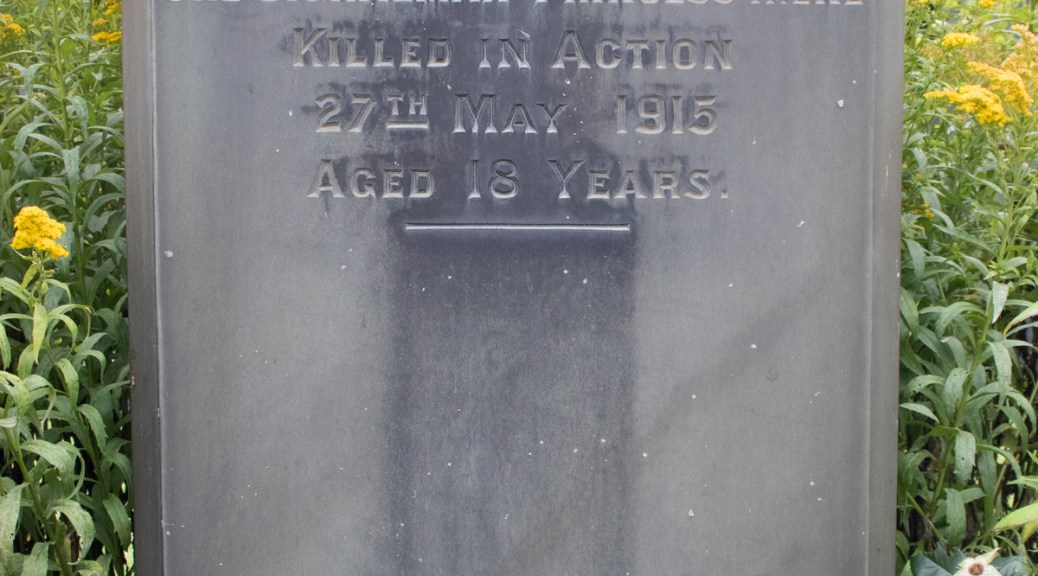
On the morning of 27th May 1915, Princess Irene was moored in the Medway Estuary and was being loaded with mines in preparation for a mission. At 11:14am, she exploded and disintegrated, taking two neighbouring barges with her. More than 250 crew – including Ordinary Signalman Timms – were killed. He was just 18 years of age.

Frederick James Timms body was laid to rest in the Woodlands Cemetery in Gillingham, Kent, alongside some of the other crew whose bodies had been rescued and identified.


Frederick’s death was the second tragedy to strike the Timms family in less than a fortnight. Back in Hertfordshire, Rosina had been pregnant with her eleventh child. On 16th May, she had had an internal haemorrhage, which resulted in the loss of both mother and child.


Leading Signalman Alexander Daisley

Leading Seaman Alexander Daisley

Alexander William Arthur Daisley was born on 13th November 1886, and was the second of four children to William and Judith Daisley. William was a Private in the Royal Marines and, as the time his son was born, the family were based in Dartmouth, Devon. By the time of the 1891 census, however, they had moved to Kent, and were billeted in family accommodation in the Milton Barracks, near Gravesend.

Ten years on, and the 1901 census confirms that the Daisleys had relocated again. William had left his military service behind him, and had taken up work as a publican at the Seven Stars Inn in Litlington, Cambridgeshire. Alexander is noticeable in his absence from the record, however. The following year, he surfaces again, however, and seems that he was destined to follow his father’s naval career.

On 10th April 1902, Alexander enlisted in the Royal Navy. At just 15 years of age, he was assigned the rank of Boy 2nd Class, and was sent to HMS St Vincent, a training ship based in Haslar, Hampshire, for his induction. He remained there for the next fifteen months, gaining promotion to Boy 1st Class in February 1903.

Alexander spent the second half of that year at HMS Victory, the Royal Naval Dockyard in Portsmouth, Hampshire, before being given his first posting in November. His assignment was on board the armoured cruiser HMS Good Hope: she was to become his home for the next year and a half, during which he came of age, and was formally inducted into the Royal Navy.

At this point, Alexander’s service records give an insight into the man he was becoming. He was noted as being just 5ft 1in (1.55m) tall, with hazel eyes and light brown hair. He had a fair complexion and three scars on the back of his head. It seems that he had some aptitude, as he was given the rank of Signalman, rather than being directed to the role of seaman.

Over the next twelve years – the term of his contract – Signalman Daisley would serve on eight ships: in between assignments he would return to his Portsmouth base. His time in the Royal Navy was not without incident, and he spent three separate periods in the cells – 14 days in 1907, 17 days in 1908 and 10 days in 1909. Despite this, he was promoted to the rank of Leading Seaman in January 1913, while serving on board HMS Egmont, an armoured frigate.

On 9th March 1915, Leading Signalman Daisley was assigned to HMS Princess Irene, an ocean liner that had been converted to a minelayer at the start of the war.

On 27th May 1915, while Irene was moored off Sheerness, Kent, a series of explosions ripped through the ship, killing more than 350 crew. Leading Signalman Daisley was among those who perished: he was 29 years of age.

The body of Alexander William Arthur Daisley was buried in Woodlands Cemetery, Gillingham, Kent, alongside the other victims of the disaster.


Writer 1st Class Harry Goodger

Writer 1st Class Harry Goodger

Harry Goodger was born on 15th April 1885, the fourth of five children – and the only boy – to George and Emma Goodger. George was a canal labourer from Aylesbury in Buckinghamshire, but by the time of his son’s birth, the family had settled in Tipton, Staffordshire.

Harry was initially committed to education and, by the time of the 1901 census, he was working as a school teacher. His heart seemed set on a career with more prospects, however, and so, on 2nd November 1904, he enlisted in the Royal Navy.

Harry’s service records show that he was 5ft 2ins (1.57m) tall and that he had bark brown hair, dark brown eyes and a fresh complexion. He was also noted as having a mole on his wight upper arm and another on his left breast.

Harry’s rank was Writer 3rd Class, which was the naval equivalent of a clerk. After an initial training period, he was assigned to the cruiser HMS Terrible. Over the next decade, he served on ten further ships, and was based at HMS Victory, the Royal Naval Dockyard in Portsmouth, in between voyages.

Writer Goodger slowly progressed through the ranks during his naval service. On 1st November 1908 he was promoted to Writer 2nd Class, and on 31st October 1912 was raised to Writer 1st Class. Harry seems to have needed extra support, however, and he was knocked back to Writer 2nd Class on 25th April 1913, and sent back to Portsmouth for further training. By 23rd October 1914, however, while serving on HMS Bulwark, he again received a promotion to Writer 1st Class.

By the spring of 1915, Harry had been assigned to HMS Princess Irene. She an ocean liner that has been converted to a minelayer at the start of the war.

On 27th May 1915, while Irene was moored off Sheerness, Kent, a series of explosions ripped through the ship, killing more than 350 crew. Writer Goodger was among those who perished: he was 30 years of age.

The body of Harry Goodger was buried in Woodlands Cemetery, Gillingham, Kent alongside the other victims of the disaster.


Writer 1st Class Harry Goodger
(from findagrave.com)

Harry’s surname is variously spelt Goodger and Goodyer across the documents that trace his life. While his headstone has the latter spelling, I have used Goodger, as this is what is recorded on his naval service records.


Private William Preston

Private William Preston

William Robert Preston was born on 2nd January 1888, and was the oldest of six children to William and Alice Preston. William Sr was a blacksmith from Norwich, Norfolk, and this is where the family were initially raised.

The 1901 census saw a move to Northamptonshire, however, the document confirming that the family were living at Tanner Cottages in the village of Walton.

When he finished his schooling, William Jr found work as a painter’s labourer. However, he sought bigger and better things and, on 5th June 1905, he enlisted in the Royal Marine Light Infantry. His service records show that he was 5ft 6ins (1.67m) tall, with dark brown hair, blue eyes and a fresh complexion. He was also noted as having a number of tattoos on his arms.

Private Preston was sent to barracks in Deal, Kent, for his initial training. He spent the best part of a year there, before being transferred to the Royal Naval Dockyard in Portsmouth, Hampshire, in April 1906. He was given his first ocean-going posting in January 1907, when he joined the crew of the cruiser HMS Terrible.

Over the next eight years, Private Preston served on three further ships, returning to HMS Victory, Portsmouth, in between trips. In March 1915, he was assigned to HMS Princess Irene, an ocean liner converted to a minelayer at the start of the war.

On 27th May 1915, while Irene was moored off Sheerness, Kent, a series of explosions ripped through the ship, killing more than 350 crew. Private Preston was among those who perished, but whose body was identified: he was 27 years of age.

The body of William Robert Preston was buried in Woodlands Cemetery, Gillingham, Kent alongside the other victims of the disaster.


Signalman Philip Files

Signalman Philip Files

Phillip William Turner Files was born on 13th April 1894 in Walmer, Kent. One of eight children, his parents were George and Annie Files. George was a carpenter at a local colliery, but living so close to the sea, his son was inevitably drawn there. On 25th January 1910, Phillip gave up his life as an errand boy and joined the Royal Navy.

Phillip’s service records show that he was 5ft 4ins (1.62m) tall, with dark brown hair, blue eyes and a fresh complexion. He was just 15 years old when he enlisted, and, as he wasn’t of full age, he was given the rank of Boy 2nd Class. He was initially sent to HMS Ganges, the shore-based establishment in Suffolk for his initial training.

Phillip remained at HMS Ganges for the next year, and was promoted to Boy 1st Class on 5th September 1910. The following January he was moved to the Royal Naval Dockyard in Portsmouth, Hampshire, also known as HMS Victory.

Over the next year, with Victory as his base, Boy Files was sent to serve on three ships – the dreadnought battleship HMS Albermarle, and the cruisers HMS Sappho and HMS Philomel. While on board Philomel, Phillip came of age and, because of his technical abilities, was given the rank of Ordinary Signaller – changing to Signalman when the ranks were updated later in 1912.

Phillip remained on Philomel until October 1913 and, after a brief spell back in Portsmouth, he was transferred to the armoured cruiser, the converted RMS Laconia. She was to be Signalman Files’ base for the next year, when, on 9th March 1915, he was transferred again, this time to HMS Princess Irene.

Princess Irene was a converted liner, requisitioned as a minelayer when war broke out. On 27th May 1915, an explosion ripped through the ship, while moored off Sheerness, Kent. Signalman Files was one of the 352 souls killed. He was just 21 years of age.

Phillip William Turner Files was laid to rest in the Woodlands Cemetery in Gillingham, Kent. His body having been identified, he was given his own grave, unlike those who were buried in a mass grave nearby.


Signalman Files’ headstone spells his first name with one L. However, all the other documents relating to Phillip spell it with two.