Category Archives: Surrey

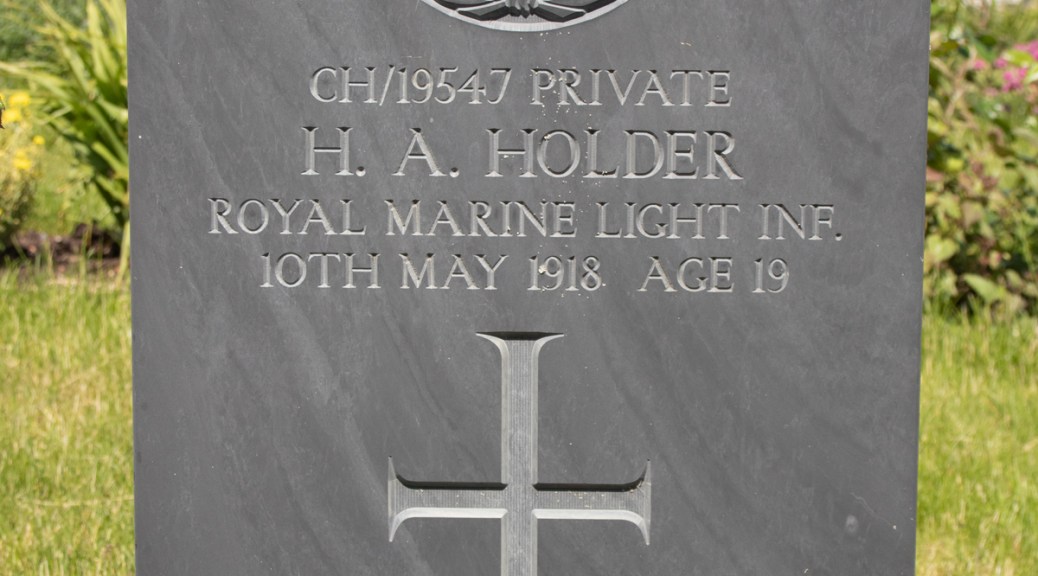
Private Harry Holder

Private Harry Holder

Harry Alfred Holder was born in the summer of 1899, and was the older of two children – both boys – to Harry and Kate. Harry Sr had been widowed a couple of years before, and the extended family included four half-siblings for his new family.

The family had rooms at 16 Warner Street in Southwark, Surrey. By the time of the 1911 census, gad fitter Harry Sr had been widowed a second time, and he and three of his sons were sharing the house with William and Hannah Gayzer and widower Edward Maude.

Harry Jr would have been 15 years old when war broke out, and so too young to serve. He would eventually enlist, however, and had joined the Royal Marine Light Infantry by the spring of 1918. The only documentation relating to his service is his entry on the Commonwealth War Graves Commission Register: Took part in the operations against Zeebrugge on board HMS “Iris II” on 23rd April, 1918.

One of two Mersey ferries to take part in the Zeebrugge raid – the other being called Daffodil – Iris attempted to come alongside the port’s mole, or breakwater, to offload the troops she had on board. An initial attempt to boor failed, and when she came alongside again, a shell burst through the deck where nearly 60 marines were preparing to land. Forty-nine were killed and the rest, including Private Holder, were badly injured.

Iris managed to make her way back to Chatham, Kent, where the Royal Navy had a major dockyard. Most of the survivors were moved to a Royal Naval Hospital in London, but Harry’s injuries were to prove too severe: He succumbed to them on 10th May 1918: he was just 19 years of age.

The body of Harry Alfred Holder was laid to rest in the Naval section of Woodlands Cemetery, Gillingham, Kent, not far from the port in which he had come ashore.


Captain Robert Graves

Captain Robert Graves

Robert Kennedy Grogan Graves was born on 1st January 1878. An announcement in the local newspaper confirmed that “at Baronne Court, County Tipperary, the wife of Lieutenant-Colonel W. Grogan Graves, 82nd Regiment, of a son (prematurely).” Robert was the older of two children, while his parents were William Graves, a Justice of the Peace in Ireland, and his wife, Georgianna Graves.

William died in 1890, and Georgianna moved the family to London. The 1891 census found her residing at the Golden Hotel in St Martin in the Fields, while her two boys, Robert and his younger brother, Geoffrey, were boarding students at Francis Napier’s classics school on Shooter’s Hill Road in Kidbrooke, Kent.

Robert found his calling through education. He studied medicine, and by January 1896 he was a student at St George’s Hospital in Tooting, Surrey.

By 1906 Robert had set himself up in an infirmary on Southgate Street in Gloucester, Gloucestershire. That same year, he married Kathleen Schofield: the couple went on to have two children, Robert Jr in 1912, and Bernard the following year.

Graves, Robt. Kennedy Grogan, Scison Lodge, Clevedon, Somerset (Tel. 11 Y Clevedon) – MRCS, LRCP London 1904; (St Geo.); Hon, Med, Off. Clevedon Cott. Hosp.; Med. Off Mutual Insur. N.Y. & Clevedon Hydro. Estab.; late Sen. Ho. Surg. & Asst. Ho. Surg., & Surg. Gloucester Co. Infirm., & Asst. Med. Regist. & Obst. Clerk St Geo. Hosp.

[The Medical Directory, 1910]

Robert had set himself up well during his life. The 1911 census found him and Kathleen – who was better known by her middle name, Gladys – living in their 17-room house on Linden Road in Clevedon. They afforded themselves three servants, including a housemaid, a cook and a motor driver. By the outbreak of war, Robert has an entry in the town’s Kelly’s Directory, and seemed to be a focal member of the community, joining the local Grand Lodge in September 1908.

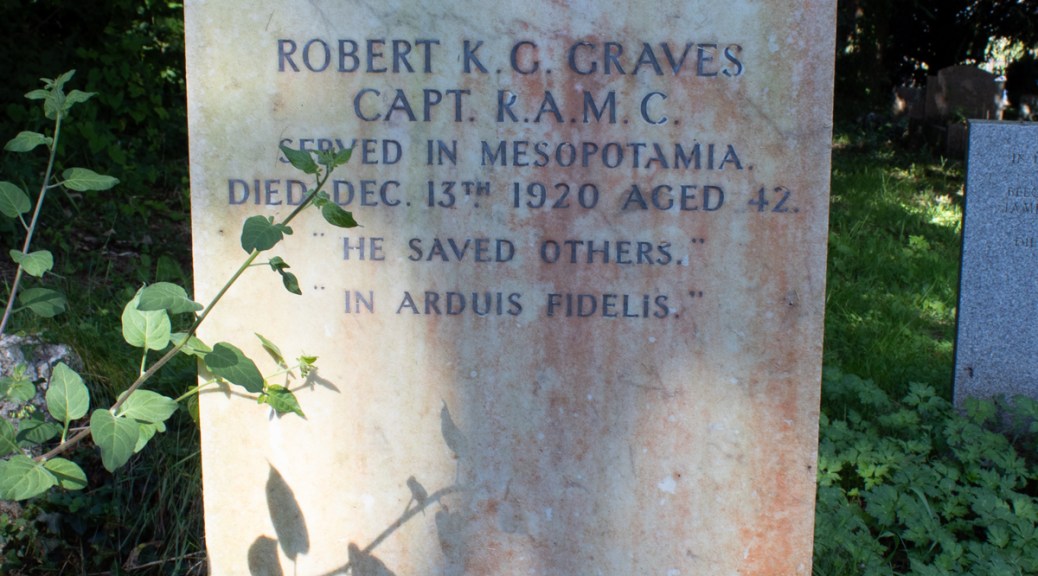
Robert’s time in the army, is hard to piece together. He joined the Royal Army Medical Corps as a Captain, and appears to have been connected to the air force. His headstone suggests that he served in Mesopotamia, but when and exactly where, however, is lost to time.

After the war, Robert returned to Britain. Leaving the Somerset coast, however, he and Kathleen appear to have set themselves up in Dorset. He died, through causes not detailed, on 12th December 1920, at 42 years of age. His entry on the probate register states:

GRAVES Robert Kennedy Grogan of 1 Charnwood Chambers Seabourne-road West Southbourne Hampshire died 12 December 1920 at The Grange Buckfastleigh Devonshire…

It is unclear whether Charnwood Chambers was his working address, with The Grange being the family’s official home, or if Buckfastleigh served as a place of convalescence.

Robert Kennedy Grogan Graves left an estate totalling £370 14s 7d (approximately £21,100 today) to Kathleen. He was buried in the graveyard of Holy Trinity church, Buckfastleigh.


Sergeant James Gard

Sergeant James Gard

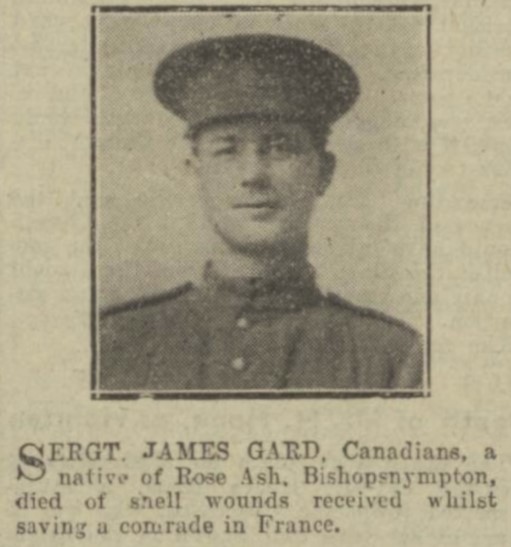
James Gard was born on 8th March 1889 in the Devon village of Rose Ash. One of fourteen children, he was the fourth of six sons to George and Mary Gard. George was a poultry dealer, but when both he and Mary died within two months of each other in 1897, their children were suddenly left as orphans.

The 1901 census found 12-year-old James visiting the Cole family, farmers who lived a few miles away in Bishops Nympton. James’ older brother Philip had plans, however, and in 1907, the two of them set out for a new life in Canada.

Boarding the SS Saxonia in Liverpool, they arrived in Boston with 50s (approx. £390 in today’s money) between them. Their final destination was to be Winnipeg in Manitoba, but the soon moved further north, setting up neighbouring homes in the town of Fisher Branch.

Both siblings found farming work, but when war broke out in Europe, James stepped up to play his part. On 24th February 1916 he enlisted in the Canadian Expeditionary Force, and was assigned to the Canadian Infantry. His service records show that he was 6ft (1.83m) tall and weighed 155lbs (70.3kg). He had dark brown hair, blue eyes and a ruddy complexion.

Private Gard set sail for Britain within a matter of weeks, arriving in Shorncliffe, Kent, on 12th May 1916. His unit – the 44th Battalion – moved to their base in Bramshott, Hampshire, and this is where he would receive his training.

James’ unit was involved in the fighting at the Somme and Ancre, and his commitment was rewarded when, on 20th January 1917, he was promoted to the rank of Sergeant. Just days later, however, he was badly injured.

A high explosive shell exploded near Sergeant Gard that day, bursting both of his eardrums. Initially treated on site, he was medically evacuated to Britain for treatment, and was admitted to the Military Hospital in Tooting, Surrey. He developed mastoiditis in both ears, and this, combined with septicaemia, lead to his ultimate death. He passed away on 1st April 1917, at the age of 28 years of age.

The body of James Gard was taken back to Devon for burial. He was laid to rest in the graveyard of St Peter’s Church in his home village, Rose Ash.


Sergeant James Gard
(from findagrave.com)

Able Seaman Christopher Spratt

Able Seaman Christopher Spratt

Christopher Templar Spratt was born on 23rd August 1889 in Streatham, Surrey. The youngest of three children, his parents were James and Elizabeth. James was an electrician by trade, and the 1891 census recorded the family as living at 58 Limes Road, between Selhurst and West Croydon.

The Spratts seem to have been a divided family. By the time of the 1901 census, James appears to have emigrated to Australia, presumably to earn money in the burgeoning country. Elizabeth and their younger two children were visiting Worthing, West Sussex.

At this point, and the decision seems to have been made for them to move to Sussex permanently, as the 1911 census found her and Christopher living at 87 Westcourt Road, Worthing. Elizabeth was noted as living on her own means; Christopher was working as a solicitor’s clerk, and they had a boarder, governess Nettie Buckler, to help bring in some additional money.

In January 1912, Christopher married Edith Green, a dressmaker from just along the coast in Goring-by-Sea. The couple moved in with Elizabeth, and went on to have two children: Florence, who was born that June; and Christopher Jr, who was born in November 1916.

By this point, war was raging across Europe, and Christopher stepped up to serve his King and Country. He had enlisted the Royal Naval Volunteer Reserve on 9th December 1915, but was not formally mobilised until the following June. Given the rank of Ordinary Seaman, Christopher’s service records note that he was 5ft 9ins (1.75m) tall, with dark brown hair, grey eyes and a fair complexion. He was also noted as having a mole on his left thigh.

Christopher was assigned to the Nelson Battalion of the Royal Naval Division, and sent to Dorset for training. While details of his service as more haphazard than usual, it seems that he served time overseas, and was promoted to Able Seaman on 1st October 1916. He became unwell in February 1917, as was admitted to the 18th General Hospital in Dannes-Camiers, on the French coast.

Suffering from cellulitis, Able Seaman Spratt was medically evacuated to Britain for treatment, and ended up as a patient in the 2nd Western General Hospital in Manchester. The condition was to prove fatal: he passed away on 12th February 1917, at the age of 27 years old.

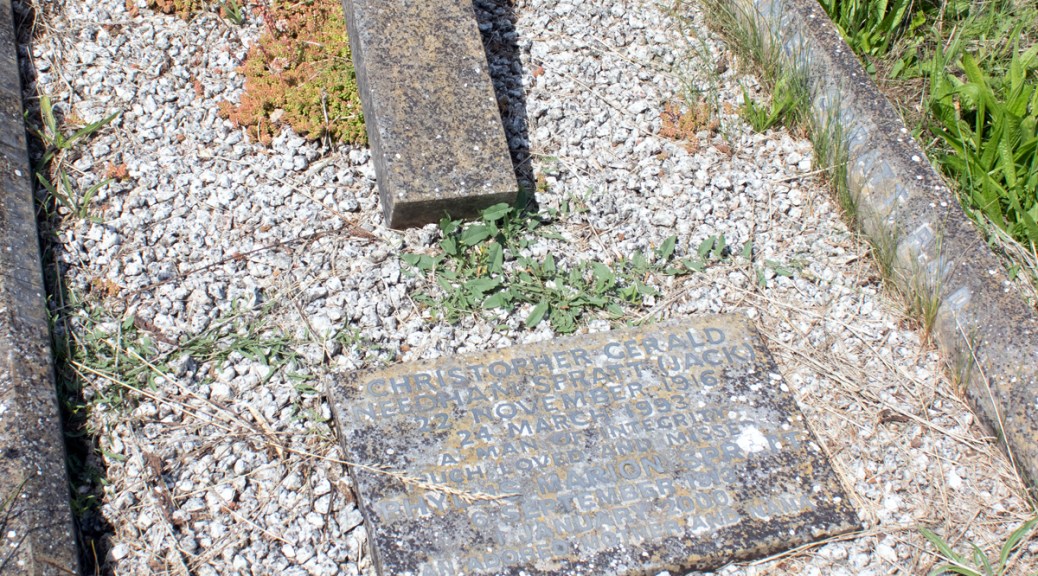
The body of Christopher Templar Spratt was brought back to Sussex for burial. He was laid to rest in the churchyard of St Mary’s in Goring-by-Sea.


Elizabeth went on to re-marry and, by the time of the 1921 census, was living in East Preston, Sussex, with her new husband, Edward Neal, Christopher Jr and her new daughter, Enid. There is no evidence of Elizabeth’s older daughter, Christopher, although there is a Florence Spratt recorded as a patient in White Oak Schools (Homes for Ophthalmic Children) in Swanley, Kent.

Christopher Jr went on to marry Phyllis Bennett in the autumn of 1946. They remained in the Worthing area until his death in March 1993: he was laid to rest alongside the father he would not have remembered, in St Mary’s Churchyard. When Phyllis died seven years later, she was buried alongside her husband and father-in-law.


Private Thomas Reed

Private Thomas Reed

Thomas William Reed was born in 1883 and was one of nine children to George and Catherine. George was a general labour and he and his wife were born in Alton, Hampshire. It was in South London, however, that they raised their family.

Thomas found work as a house painter when he completed his schooling. The 1911 census recorded him as being the only one of his siblings still living in the family home, 16 Valentine Row in Blackfriars.

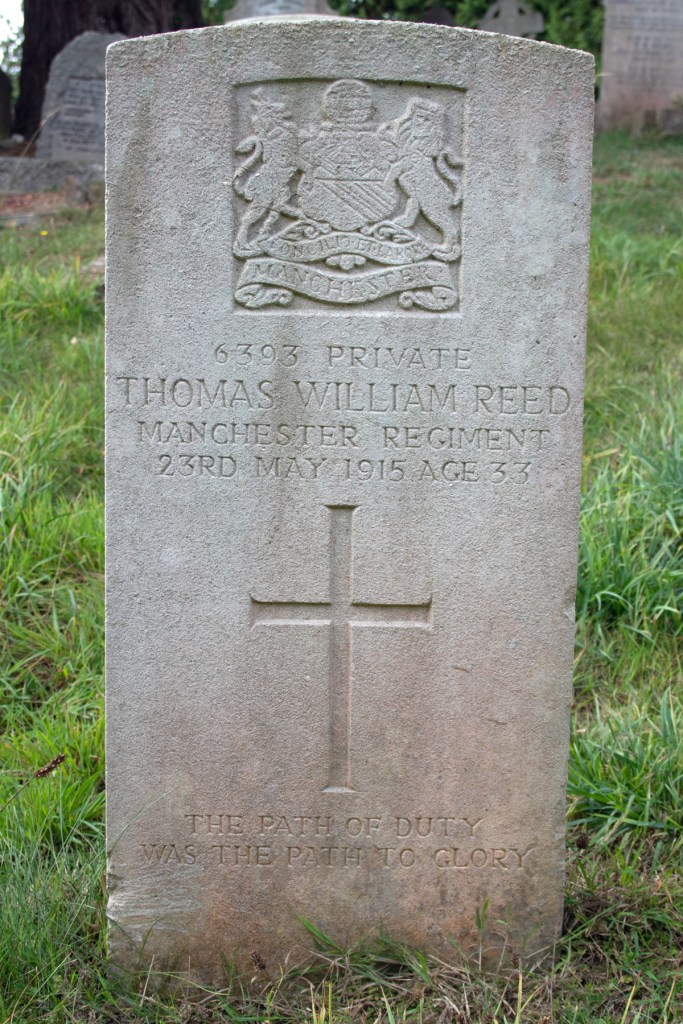
When war came to Europe, Thomas stepped up to play his part. Full service records have been lost to time, but from what remains it is clear that he had enlisted in the army in the opening months of the conflict. Private Reed was assigned to the Manchester Regiment and, as part of the 2nd Battalion, would have quickly found himself on the Western Front.

Thomas’ time in the army was to be tragically brief. By the spring of 1915 he was back in Britain, hospitalised in Devon with nephritis, or inflamed kidneys. His condition worsened, and he passed away on 23rd May: he was 32 years of age.

Thomas William Reed was laid to rest in Paignton Cemetery, not far from the Devon hospital in which he had breathed his last.


Captain William Mence

Captain William Mence

William Charles Mence was born in Blackheath, Kent in the spring of 1877. He was the oldest of five children to William Cookes Mence and his wife, Susanna.

William Sr was a chemist-turned-dentist, and by the time of the 1881 census, the family had moved to prestigious lodgings on the corner of Claremont and Victoria Roads in Kingston-upon-Thames, Surrey. William had set up practice in the building, and employed two servants to assist him with the practice, and two more to help Susanna with the family.

Dentistry would keep William Sr occupied for at least the next thirty years, a move to nearby Surbiton in the late 1890s being the only change tot he business.

William Jr, meanwhile, was making his own way in the medical world. The 1901 census recorded the 24-year-old Mr Mence visiting a possible mentor, physician and surgeon Charles Gallie, in Camberwell. William was also noted as being a physician and surgeon, and this was to become the career in which he forged his way.

On 9th August 1906, William married Dorothy Mytton in the Saint Aelhaiarn’s Church in Guilsfield, Powys, Wales. Dorothy was the daughter of a retired army captain, Devereaux Mytton. She had been born in Guilsfield and, at the time of the 1901 census, was living with her family and ten servants at Garth Hall, close to the village.

The young couple’s marriage certificate also sheds some light on William’s career. It confirms that he was working as a medical practitioner, and was living in the village of Perranzabuloe in Cornwall.

William and Dorothy went on to have five children, and named them to reflect their combined family histories. Daughter Evaline Dorothy Cookes Mytton Mence was born first, in 1907, followed by sons John Herbert Myttone Cookes Mence, Devereaux Mervyn Mytton Cookes Mence and Godfrey Powis Mytton Cookes Mence. Their fifth child, daughter Myfanwy Susan Mence, was born in 1914.

When war broke out in Europe, William was drawn to play his part. While full details about his service are not available, his public standing meant that he took a commission as Captain in the Royal Army Medical Corps. His Medal Roll Index Card confirms that he was awarded the 1914-1915 star, so he joined early in the conflict. It also outlines that he served in Mesopotamia from 4th February 1916, in France in 1917 and in Salonika from 1917 to 1919.

Ill health seemed to have dogged him in later years, and by the summer of 1919, Captain Mence had returned to British shores, and to Devon, where his practice had moved to shortly before the conflict.

Dr William Charles Mence, of Axminster, who died in Axminster Cottage Hospital on Friday night, recently returned from active service… He was a medical officer under Axminster Board of Guardians…

Western Morning News: Monday 28th July 1919

William Charles Mence died on 25th July 1919 as a result of an ongoing illness: he was 42 years of age. He was laid to rest in Axminster Cemetery, not far from the family home.


Private John Richards

Private John Richards

John Henry Richards was born in Sutton, Surrey, on 3rd June 1896. The third of four children, his parents were John and Harriet Richards. John Sr was an engine driver and stoker, while his son found employment as a greengrocer’s assistant when he finished his schooling.

When war came to Europe, John Jr stepped up to serve his King. Full details of his military service have been lost to the annals of time, but he had certainly enlisted by the end of 1917. Initially joining the Devonshire Regiment, he subsequently transferred to the Labour Corps, and was assigned to the 385th Coy.

Private Richards seems to have been based in Kennington near Lambeth, Surrey. He married Dorothy Ford on 23rd December 1917, at which point, both bride and groom were living at 47 Hartington Road.

The family’s geographical locations become a bit confused at this point: Dorothy had been born in Bristol, Gloucestershire, but the 1911 census found her living in Ottery St Mary, Devon, with her paternal grandparents. John seems to have served some time in Devon as well, but it is unclear whether the couple met in the South West or London.

By the autumn of 1918, Private Richards’ unit was certainly in Devon: it was here that he contracted pneumonia, and he was admitted to the No. 1 Section Hospital in Devonport for treatment. This was to prove ineffectual, however, and he passed away on 2nd November 1918. He was 22 years of age.

Dorothy’s family appears to have been living in Axminster by this point, and it is certainly somewhere he would return to in later years. The town’s cemetery is where she would bury her late husband: John Henry Richards at peace again.


Private John Boura

Private John Boura

John Adams Boura was born in the spring of 1868 in Kensington, Middlesex. The middle of three children, his parents were Julien and Esther Boura. Julien was the son of a French immigrant, who had built up two businesses as a dyer and cleaner (the first business having failed).

John followed in his father’s line of employment, and, by the time of the 1891 census, he was living with business partner Isabel Knight, at 3 St Mark’s Place in Wimbledon, Surrey. Work and pleasure were obviously mixing, though, and, on 3rd October that year, the couple married in the nearby Queen’s Road Chapel.

The newlyweds would go on to have a son, also called John, in March 1895. By the start of the new century, the family has moved out of the capital, relocating to Aldershot, Hampshire, where they set up a new business at 111 Victoria Road, in the town centre.

Within the next decade, however, the Bouras had moved back to the London suburbs, setting up home and business in Merton, Surrey. A new alliance was forged at 106 Kingston Road, with the three sharing their home with Henry and Adelaide Shelley. All four adults were involved in the business, while the now 16-year-old John Jr was employed as a dentistry improver.

Julien – who was also known by his middle name, Aimé – and Esther had moved to Maidenhead in Berkshire by this point, and in September 1910, it seems that their son visited them. An argument seems to have erupted, and John was arrested. Taken before the Maidenhead Petty Sessions, he was tried for unlawfully and maliciously damaging the glass of certain windows, exceeding he amount of £5 to wit £8 6s., the property of Aimé Boura. John was find a total of £10 for the damage.

When war broke out, John stepped up to serve his country. While his service documents are long since lost, other records suggest that he had enlisted by the summer of 1916, and likely volunteered, give he was in mid-40s by this point. Private Boura was assigned to the Royal Army Service Corps, and was to be based at the Supply Depot in Bath, Somerset.

It is probable that John’s dying and cleaning background meant that he was involved in uniforms in some way, although nothing concrete remains to document his time in the army. During the early part of 1917, he fell ill, coming down with bronchitis. He was admitted to Bath War Hospital, but the condition was to get the better of him. Private Boura passed away on 9th February 1917, at the age of 48.

The body of John Adams Boura was laid to rest in Bath’s majestic Locksbrook Cemetery, not far from the hospital in which he had passed.


Private Robert Kelway

Private Robert Kelway

Robert Jenkins Kelway was born in the autumn of 1897 in the Devon town of Torquay. The oldest of four children, his parents were Robert and Rosina Kelway. Robert Sr had been born in Paignton and, when a job working as a carter for Hollicombe Gas Works came up in around 1900, he moved the family back down the coast.

By the time of the 1911 census, the Kelways were living at 3 Hollicombe Terrace, on Torquay Road: their home was one of a row of terraced houses build specifically for the gas works employees, and all of their neighbours were employed there in one form or another.

Robert Jr was 13 years old at this point, and seemed to have completed his schooling: his entry on the census confirms he was employed as a telegraph messenger for the Post Office.

Everything was to change when war was declared and, on 22nd April 1915, Robert Jr voluntarily stepped up to play his part. Lying about his age – he said he was 19, when he was, in fact, two years younger – he was nonetheless taken on his word. His service records show that he was 5ft 5ins (1.65m) tall and weighed 141lbs (64kg). He was noted as having brown hair, blue eyes and a fresh complexion.

Assigned to the Devonshire Regiment, Private Kelway was initially attached to the 3rd Battalion. At the end of October 1915, however, he was transferred to the 8th (Service) Battalion, and dispatched to France. His unit was caught up in the Battle of Loos, but it was at the Somme the following year that Robert would really have cut his teeth in fighting.

Private Kelway saw out the Somme relatively unscathed, but, on 27th December 1916 his luck was to run out. He was shot in the back, damaging one of his lower vertebra, and was medically evacuated to Britain for treatment.

Robert was admitted to King George’s Hospital in South London, and it was quickly ascertained that the damage to his spine was permanent. Paralysed from the waist down, he was, not surprisingly, no longer able to continue in the army in any capacity. His discharge papers noted that he was a ‘steady, sober and honest’ person.

From this point, details of Robert’s life are sketchy. It is unclear whether he was able to return home, although he was definitely back in Devon by the spring of 1919, as this is where he died. Admitted to the Royal Devon & Exeter Hospital, he passed away from pneumonia on 18th April, aged just 21 years old.

Robert Jenkins Kelway was laid to rest in Paignton Cemetery, a short distance from where his family lived, in the Preston area of the town.


Petty Officer William Feldon

Petty Officer William Feldon

William Feldon was born on 16th October 1878, the middle of three children – and the only son – to William and Jessie Feldon. William Sr was a carpenter from Highgate, Middlesex, but it was south of the Thames, in Lambeth, Surrey, that the family were raised.

When he finished his schooling, William Jr found work as a general labourer. He was drawn to bigger and better things, however, and a life at sea was to catch his eye. In June 1894, he enlisted in the Royal Navy as a Boy 2nd Class. His service records noted that he was 5ft 2ins (1.57m) tall, with brown hair, brown eyes and a fresh complexion.

By the time William had completed his initial training, he had been promoted to Boy 1st Class. He was then moved to HMS Pembroke, the Royal Naval Dockyard in Chatham, Kent.

By October 1895, he was given his first posting, on board the torpedo cruiser HMS Archer, and he would remain assigned to her for the next two years. During this time, William came of age and was formally inducted into the Royal Navy, and was given the rank of Ordinary Seaman. His commitment to the service was pretty clear, and, within seven months he had been promoted again, to Able Seaman.

After a short spell back at Pembroke, William was assigned to HMS Wildfire, another shore establishment just along the coast in Sheerness. He remained there for nine months, during which time he was promoted again, to the rank of Leading Seaman.

In May 1899, William was moved to another posting, on board the gunboat HMS Partridge. This assignment provide him with the route to further promotion: he remained on board until July 1901, having risen to Petty Office 2nd Class on 1st July 1899 and Petty Officer 1st Class on 23rd September 1900.

Over the remainder of his initial term of service, William served on six further vessels. The sea was in his blood by this point, and when his contracted ended on 15th October 1908, he re-enlisted without any hesitation.

Away from the Navy, William fell in love. On 23rd October 1909, he married Ada Plumpton, who was 25 years old, and who lived in Battersea, Surrey. The couple exchanged vows at St Faith’s Church in Southwark, but settled down in the village of Dovercourt, Essex. They went on to have two children, Doris, who was born in 1910, and Elsie, who came along the following year.

Back at sea, Petty Officer Feldon was assigned to the cruiser HMS Boadicea. He spent two years on board, before moving to another cruiser, HMS Blonde, for another two years. In between voyages, William returned to the Royal Naval Dockyard in Chatham.

On 13th January 1914, Petty Officer Feldon was posted to the battleship HMS Formidable, part of the Channel Fleet patrolling the seas of the southern coast of Britain.

Early on the morning of 1st January 1915, while off the Dorset coast, she was torpedoed by the German submarine U-24. Other ships in her convoy came to help, but after a couple of hours – and another torpedo strike – the damage was too great and she sank. 120 members of the crew were saved, but more than 540 officer and crew – including Petty Officer Feldon – were lost. He was 36 years of age.

William Feldon’s body was one of those recovered and identified. He was laid to rest in a communal grave in Lyme Regis Cemetery, in the hills above the Dorset town where he had been brought ashore.