Category Archives: Wales

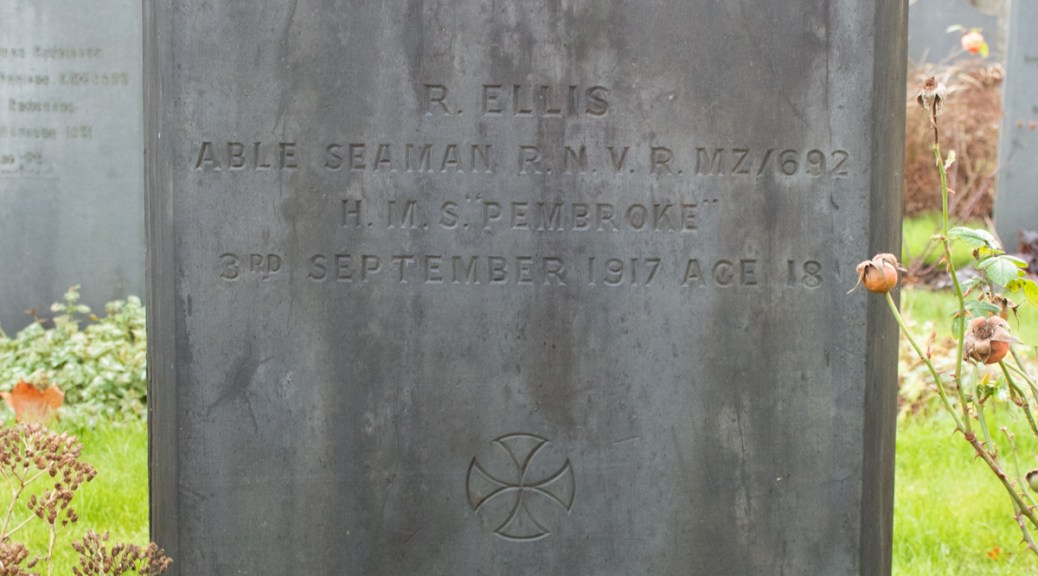
Able Seaman Raymond Ellis

Able Seaman Raymond Ellis

Raymond Ellis was born on 10th August 1898, the youngest of eleven children to Thomas and Elizabeth. Thomas was a former army officer from North Wales. He had met and married Elizabeth Moseley while living in Worcestershire in the 1870s, before moving the family to Oxfordshire ten years later. By the time Raymond was born, the family had moved back to Wales again, and were living in Llandygai, not far from Bangor in Caernarvonshire, where Thomas was working as slate quarry inspector.

By the time of the 1911 census, Thomas had found other employment, and was working as the caretaker for a telephone exchange. This is where one of his daughters was employed, and was also where Raymond himself found work when he left school.

War was coming to Europe by this point, however, and, on 23rd September 1915, Raymond enlisted in the Royal Navy Volunteer Reserve for a period of three years. His service records show that he was 5ft 4.5ins (1.64) tall, had red hair, blue eyes and a fresh complexion. He was given the rank of Able Seaman and, after a month at HMS Victory – the Naval Dockyard in Portsmouth, Hampshire – was given his first posting, on board HMS Wallington.

Able Seaman Ellis came on shore at HMS Pembroke, the Royal Naval Dockyard in Chatham, Kent, on 17th July 1917. The base was a particularly busy place at that point in the war and additional accommodation was desperately needed. Raymond found himself billeted at Chatham Drill Hall, away from the main barracks.

On the night of 3rd September 1917, Chatham suddenly found itself in the firing line, as the German Air Force launched a bombing raid. One of the bombs landed squarely on the Drill Hall, and Able Seaman Ellis was killed. He was just 18 years old.

Ninety-eight servicemen perished during the Chatham Air Raid that night. They were buried in a mass funeral at the Woodlands Cemetery in nearby Gillingham. This, too, is where Raymond Ellis was laid to rest.


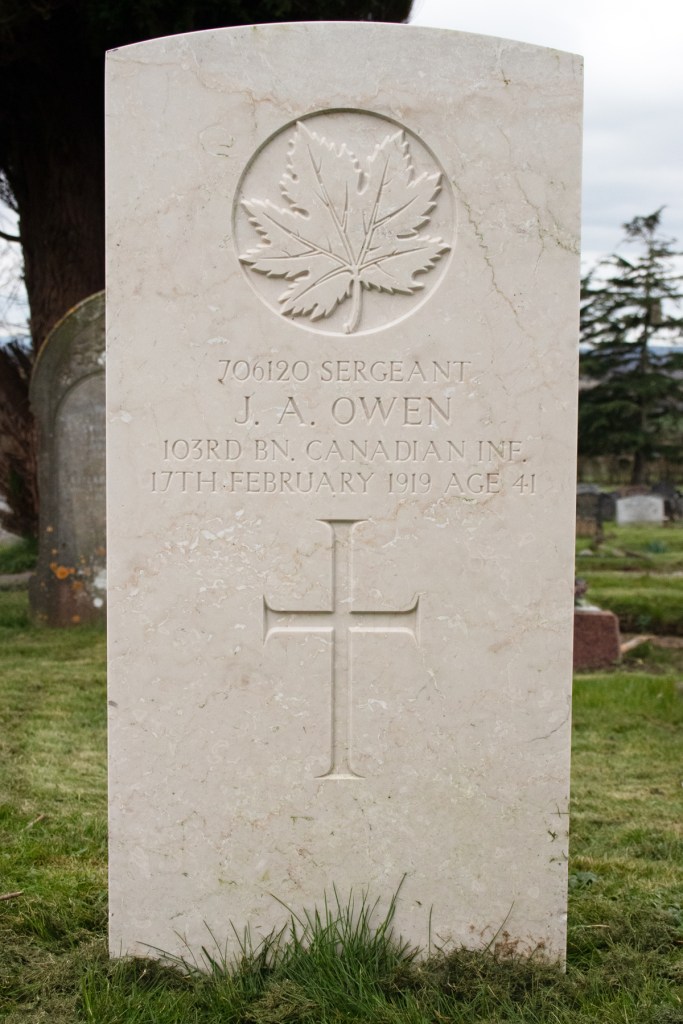
Sergeant James Owen

Sergeant James Owen

James Alfred Owen was born on 4th August 1877 and was the middle of three children to James and Sarah Owen. James Sr was a woodman from Herefordshire, who had moved the family to Radnor in mid-Wales.

James Jr’s early life has been lost to time, but by the time he turned 30, he had emigrated to Canada. He settled in the west coast town of Prince Rupert and found work as a salesman. On 28th January 1910 he married Hattie Whidden: the couple went on to have three children – Annie, Louisa and Dorothy.

War was coming to Europe, and James wanted to play his part for King and Country. He enlisted on 4th December 1915, joining the 103rd Battalion of the Canadian Infantry. His service records show that he stood 5ft 9ins (1.75m) tall and weighed 156lbs (70.8kg). His physical development was recorded as ‘average’, he had a ruddy complexion, brown hair and brown eyes. It was also noted that he had a birthmark in his left groin and his teeth were poor and required attention.

Private Owen departed for England in July 1916 and was assigned to the Oxney Camp in Hampshire. He was promoted to Corporal and then to Sergeant and, over the next few years, he remained in England. He was primarily based in barracks at Bramshott – also in Hampshire – though did spend time in Seaford in Sussex.

Sergeant Owen survived the war, but was admitted to the Ripon Military Hospital on 8th February 1919, having contracted bronchitis and malaria. The hospital didn’t have any specific expertise in contagious diseases, so it is likely that his move to Ripon was one stage of his move back to Canada.

Sadly, the conditions proved too much for James. He passed away on 17th February 1919, at the age of 41 years of age.

James Alfred Owen’s body was brought to Castle Cary in Somerset, where his sister Eleanor lived with her family. He was laid to rest in the town’s cemetery.


Private Roderick Smith

Private Roderick Smith

Roderick Morgan Smith was born on 14th April 1896 in Upton Park, Essex. One of twin sons to Francis and Frances Smith, he had three siblings altogether. Francis is absent from the two census returns on which Roderick features, but the documents confirm that Frances – who was a certified teacher – was married, so he may have been elsewhere at the time.

By the time of the 1901 census, the family had moved from East London to Monmouthshire, where Roderick’s mother was teaching at the school in the village of Wonastow. Ten years later, they had moved across the River Severn to Withycombe in Somerset, not far from where Frances had been born. Other records show that they subsequently moved to Bath, then to Weston-super-Mare.

When war broke out, Roderick was keen to join up. He enlisted as a Private in the Durham Light Infantry, and was assigned to the 7th Battalion. He was sent to France in the spring of 1915, and would have been involved with his regiment at Ypres and the Somme.

It was at the Somme that Private Smith was gassed and wounded. Full details are not recorded, but they were enough for him to be medically evacuated to England. He was admitted to the military hospital in Taunton, but passed away on 7th May 1916. He was just 20 years of age.

Roderick Morgan Smith was brought to Weston-super-Mare and laid to rest in the town’s Milton Road Cemetery.


Roderick’s twin, Frank Morgan Smith, also played his part in the First World War. He enlisted in the Bedfordshire Regiment as a Private, and was assigned to the 7th Battalion. He also found himself embroiled at the Somme, and he too was wounded.

Sadly, Frank’s wounds were too severe for him to be repatriated to England; he died in a French hospital on 3rd December 1916, also aged 20 years old. He was laid to rest at the Wimeraux Cemetery.


Major Stafford Douglas

Major Stafford Douglas

Stafford Edmund Douglas was born on 4th January 1863, the second of four children to Stephen and Mary Douglas. Stafford came from a military family, his father having been a Captain in the Royal Navy. This led to a lot of travelling and, having been born in Donaghadee, County Down, he then moved to South Wales.

By the 1880s, when Stephen and Mary had set up home in Portsmouth, Stafford had started to carve out a career for himself, and was a Lieutenant in the Argyll and Sutherland Highlanders, based at Edinburgh Castle.

Over the coming years, Lieutenant Douglas, who stood 5ft 8.5ins (1.74m) tall and also spoke French, travelled the world, serving in South Africa, Ceylon (Sri Lanka) and Hong Kong. By 1894 he had made Captain, and he finally retired in 1903, after nineteen years’ service.

On 29th April that year, at the age of 40, Stafford married Mary Louisa Harris. She was the daughter of an army colonel, and the couple wed in St George’s Church, Hanover Square, London. The couple set up home in Exeter, Devon, and went on to have two children – Violet and Stafford Jr.

At this point, Stafford’s trail goes cold. When war broke out in 1914, he was called back into duty, working as a Railway Transport Officer in Norwich. He continued in this role until 1919, before being stood down and returning home.

Stafford Edmund Douglas passed away on 15th February 1920, at the age of 57 years old, although no cause of death is immediately apparent. He was laid to rest in the Milton Road Cemetery in Weston-super-Mare, presumably where his family were, by this time, residing.


Private John Payne

Private John Payne

John Spencer Payne’s life is a bit of a challenge to piece together, as there is little documentation available. He was born in 1894 in the village of Overton-on-Dee, near Wrexham and was one of two children to Charles and Elizabeth Payne. John was christened in Tenby, Pembrokeshire, at which point, his father’s trade was ‘gentleman’.

The next available document for John is the 1911 census. This records him as living in Weston-super-Mare, Somerset, where he was working as a bank clerk. He was living in Severn Road, to the south of the town centre, with his now-widowed mother, his older sister and his maternal aunt.

War came to Europe in 1914, and, while there is limited information about John’s service, it is clear that he had enlisted by September 1915. He joined the Royal Gloucestershire Hussars as a Private and was assigned to the 2nd/1st Battalion.

The battalion was a second-line unit, that remained in England until late in the war, when it transferred to Ireland. By the spring of 1916, it had become a cyclist unit although, with no other documentation for Private Payne, it is impossible to determine how or when he served.

Sadly, too, the only other document about Private Payne’s life is the confirmation of his death. He passed away at home on 10th February 1916, although the cause of his death is not recorded. He was just 22 years old.

John Spencer Payne was laid to rest in the Milton Road Cemetery in Weston-super-Mare.


Private John Payne
(from findagrave.com)

Private Albert Sparrow

Private Albert Sparrow

Albert Edward Sparrow was born in Frome, Somerset, in March 1880. One of four children, his parents were Albert and Louisa Sparrow. Albert Sr was a labourer at an iron foundry, and the family were raised close to the centre of the town.

When he left school, Albert Jr found work as a labourer. However, after his father passed away in 1895, he sought longer term prospects. On 11th November 1898 he enlisted in the Royal Fusiliers as a Private for a period of twelve years. His service records show that he stood 5ft 6in (1.67m) tall, weighed 115lbs (52.2kg), had brown eyes, curly brown hair and a sallow complexion.

During his time in the army, Private Sparrow served in Gibraltar, South Africa and Burma. He returned home in March 1903, was placed on reserve in November 1906, and then ended his contract four years later.

At this point, Albert’s trail goes cold. However, when war was declared, he was keen to play his part. He re-enlisted on 27th August 1914, and was assigned to the Somerset Light Infantry. Assigned to the 6th (Service) Battalion, he was sent to France in December that year.

In July 1916, while fighting at the Somme, he was hurt when he received a gunshot wound to his right buttock. The injury proved enough for him to be medically evacuated back to England, and he spent the next five months recovering, and then working, on home soil.

In December 1916, Private Sparrow was sent back out to France. Six months later, he contracted bronchitis and was again evacuated back to England. He was admitted to the Royal Infirmary in Liverpool and, after a month there, he was moved to the Plas Tudno Nursing Home in Llandudno to recover.

Albert’s condition meant that he could not continue in military service, and he was discharged from the army on 18th December 1917. He returned home to Somerset, but his lung condition proved too much; he passed away on 19th January 1918, at the age of 37 years old.

Albert Edward Sparrow was laid to rest in the graveyard of Holy Trinity Church in his home town of Frome.


Captain Fergusson Barclay

Captain Fergusson Barclay

Fergusson Barclay was born in Cheltenham, Gloucestershire, towards the end of 1877 and was the oldest of six children. His father, Henry, was a retired army captain, and so it is of little surprise that Fergusson and his siblings had something of a privileged upbringing.

The 1881 census recorded Henry and his wife, Agnes, bringing up the family in Tenby, South Wales. With three children under four, the Barclays employed two live-in nursemaids to support them.

Ten years later, the family had moved to Weston-super-Mare, Somerset, living in a large house to the north of the town centre. With five children now living at home, Henry and Agnes found additional help was needed: they were now employing a governess, manservant, cook and a housemaid. The family were not alone in this support: the 1891 census shows that all of the Barclays’ neighbours had at least one domestic servant.

The new century turned, and a new census followed. Captain Barclay and his family were still living in their three-storey Victorian villa in Weston-super-Mare. By this point, however, only three of the children were still living at home. Fergusson, now 23, was working as an architect, his brother Herbert was a legal professional, and his sister, Hermione, also still lived there. The house was not empty, however, as the Barclays’ retinue of staff remained. By this point, they were employing a gardener, groom, coachman, parlour maid, cook, kitchen maid and house maid. Agnes, who was around 20 years younger than her husband, also had a live-in companion, spinster Helen Empson.

Little had changed for the family when the next census was recorded in 1911. Henry was by now 84 years old, and he and Agnes had been married 34 years. Fergusson and Herbert were still living at home, fully immersed in their jobs. Helen was still providing companionship for Agnes, and the family still employed four members of staff: butler Daniel O’Brien and his wife, Jesse, who was the cook; parlour maid Rosie Davies and house maid Edith Booden.

In March 1912, Henry passed away, and it was inevitable that things would change for the Barclay household. Fergusson had been a volunteer for the Royal Engineers since the late 1890s and had steadily worked his way up through the ranks. With the outbreak of war, he found himself called into a more formal role.

Full details of his military career are not evident, but it is clear that, by the spring of 1918, Fergusson had gained the rank of Captain. He joined the Royal Air Force and was assigned to 75th Squadron.

On the afternoon of 7th December 1918, Captain Barclay took off from Elmswell Aerodrome in Suffolk, when the engine of his Avro 504K aircraft cut out. He attempted to turn the plane to land, but it nosedived into the ground and Fergusson was seriously wounded. He was taken to hospital, and died of his injuries later that day. He was 40 years old.

Captain Fergusson Barclay’s body was taken back to Somerset – he lies at rest in the Milton Road Cemetery in Weston-super-Mare, walking distance from his family home.


Captain Fergusson Barclay
(from findagrave.com)

Private William Lamacraft

Private William Lamacraft

William Morrish Lamacraft was born in Guernsey in 1888, the only son of John and Annie Lamacraft. Annie passed away when William was just 4 years old, and John brought his son back to England, returning to Devon, where he himself had been born. John found employment as a porter at St Thomas’ Union Workhouse in Exeter and lived in here, while William was taken in by his paternal grandmother, Mary, who was also in Exeter.

In 1909, John also passed away. William, by this time, had left school and found work as a bootman at the Queen’s Hotel in Newport, Gwent. War was on its way to Europe by this point and, when it broke out, William enlisted as a Private in the Labour Corps.

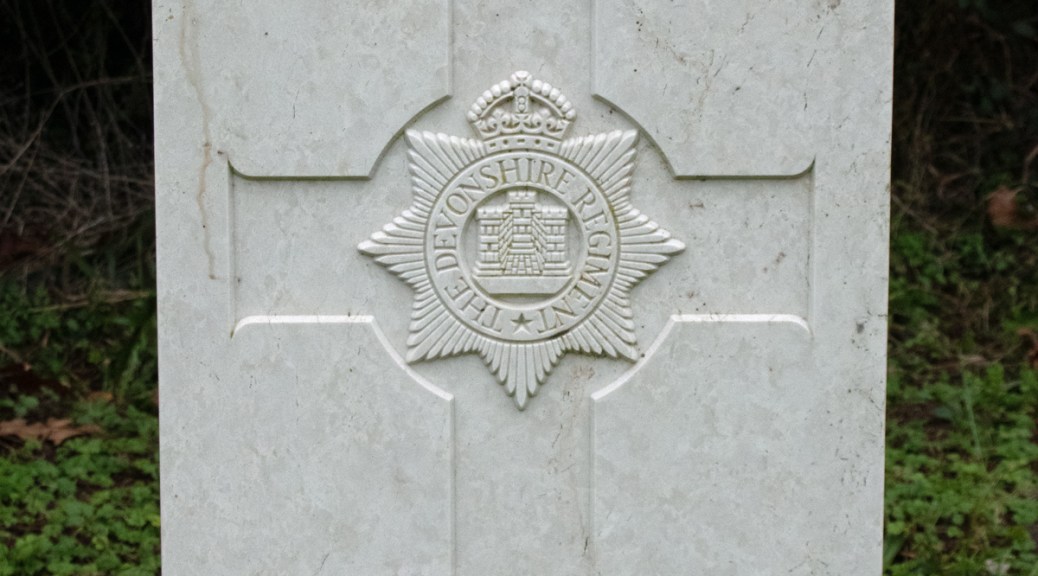
At some point William transferred across to the Devonshire Regiment, but there is little tangible evidence to document when and where he served. What is clear is that Private Lamacraft survived the war, and had returned to Newton Abbot when he was demobbed.

Sadly, William Morrish Lamacraft was not to live a long life after the Armistice was declared. He passed away on 6th June 1919, aged just 31 years old; the cause of death lost to time. He was laid to rest in Newton Abbot Cemetery.


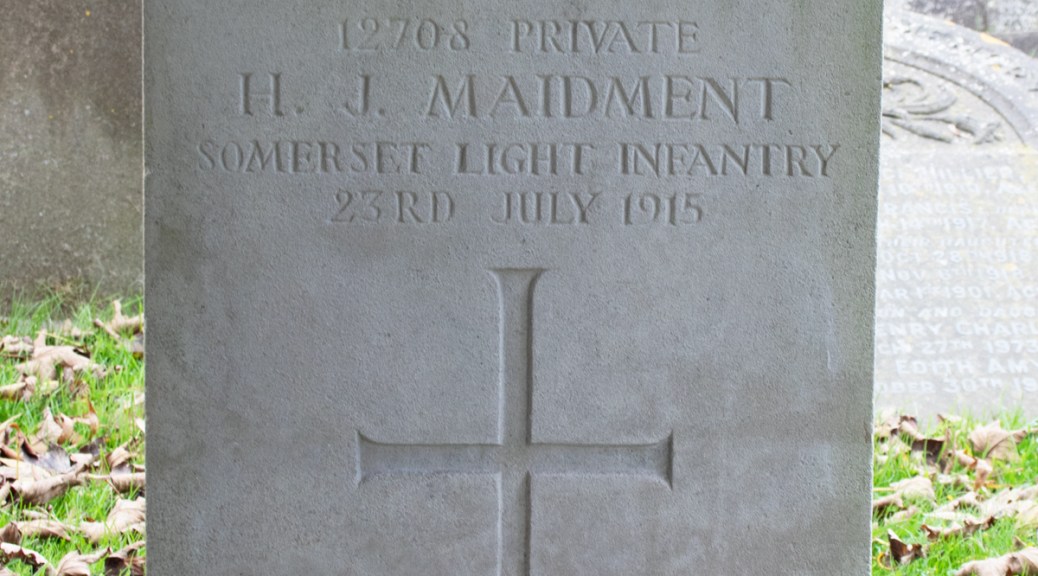
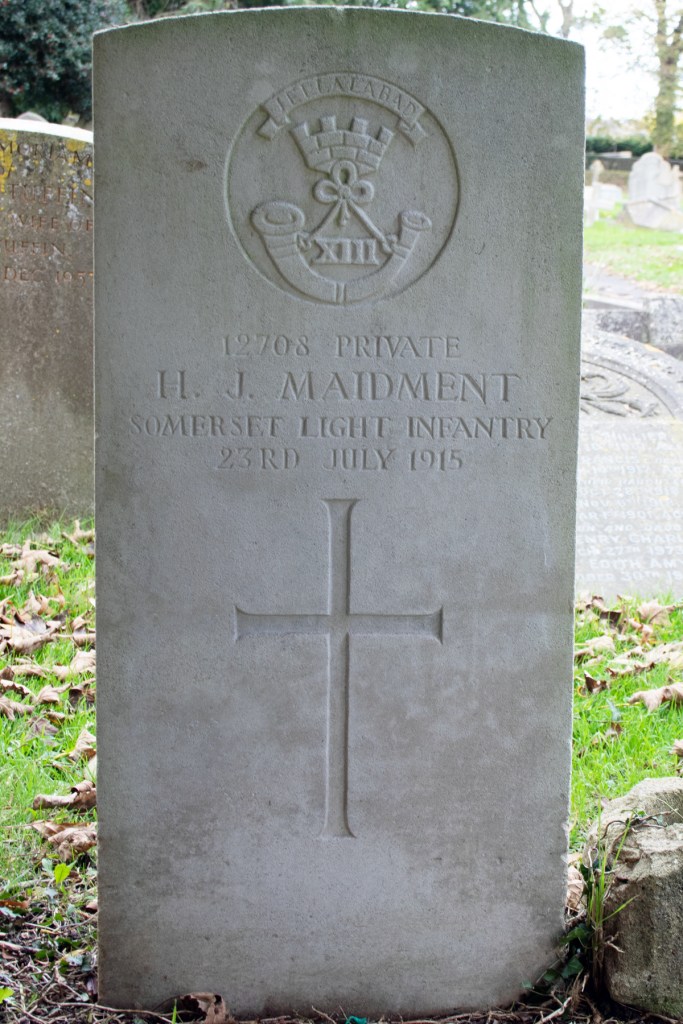
Private Harry Maidment

Private Harry Maidment

Henry James Maidment – known as Harry – was born in Penarth, South Wales, in the autumn of 1890. He was one of seven children to Somerset-born Henry and Minnie Maidment. Henry Sr was a general labourer, and, when he died in 1899, Minnie remained in Penarth, earning money to support the family as a hawker of fruit.

By the time of the 1911 census, most of Minnie’s children were still living at home, with all but one of them working. Harry was employed as a van driver for a laundry, while his siblings were working variously as labourers, sailors and a housekeeper.

In the autumn of 1911, Harry married Annie Hillier, a servant who had been born in Yeovil, but who had also moved to South Wales. The couple went on to have a son, Henry, in October 1912, but he tragically passed away when he was just a couple of months old. They were not to have any other children.

War was coming to Europe by this point, and Harry was keen to play his part. He enlisted towards the end of 1914, joining the 1st Battalion of the Somerset Light Infantry as a Private. He arrived in France at the beginning of May 1915, and would have seen fighting at Ypres that spring.

It seems that Private Maidment was wounded at Ypres; he was medically evacuated home and was admitted to the Graylingwell Hospital in Chichester, West Sussex. Details of his injuries are not available, but they must have been severe; he passed away from them on 23rd July 1915, aged just 25 years old.

Harry James Maidment’s body was brought back to Somerset; he was laid to rest in the graveyard of Christ Church, Frome, his parents’ home town, and where his widow, Annie was living.


Ordinary Seaman William Godwin

Ordinary Seaman William Godwin

William John Godwin – known as Willie – was born on 13th March 1897, the oldest of six children. His parents were railway signalman George Godwin, and his wife Emily. George was born in Monmouthshire, Emily was from Bristol; the couple raised their family in South Wales.

When Willie left school, he found work at a local tinplate manufacturer, and was employed as a cold roll greaser – helping maintain the equipment. War was knocking on Europe’s doors, however, and, in September 1916, he was called upon to do his duty.

Willie joined the Royal Naval Volunteer Reserve; his enlistment papers show that he stood 5ft 6ins tall, had dark brown hair, brown eyes and a fair complexion. It was noted, however, that he had an abscess scar on his right cheek.

Ordinary Seaman Godwin’s first posting was at HMS Victory, the Royal Naval Dockyard in Portsmouth, Hampshire. Here he undertook his initial training, but in May 1917, he was sent to another shore-based establishment, HMS Pembroke – Chatham Dockyard.

The base was particularly busy when Willie arrived. Temporary accommodation at Chatham Drill Hall had to be set up, and this is where he found himself billeted.

On the 3rd September 1917, the German Air Force carried out one of the first night-time air raids on England: an unprepared Chatham was heavily bombed and the Drill Hall received a direct hit. Ordinary Seaman Godwin was amongst those killed instantly. He was just 20 years of age.

William John Godwin was laid to rest, along with the other victims of the Chatham Air Raid, in the Woodlands Cemetery, Gillingham.