Frederick John James was born in Willesden, Middlesex, in the spring of 1890. The oldest of six children, his parents were William and Louisa James. Louisa was William’s second wife, his first, Emily, having died in 1887. Frederick had ten half-siblings from this first marriage.
William was a fishmonger: the 1891 census recorded the family at 159 York Road, Battersea, Surrey. Ten years later, they had moved over the river, and were living to 46 Artizans Dwellings, Hammersmith, Middlesex.
Frederick’s father had passed away by the time of the 1911 census. The document recorded his mother residing at 18 Western Terrace, Notting Hill, Middlesex. She lived with three of her children – Ben, Alice and Grace – and was doing char work to bring in a little money.
Frederick, however, was already carving out a career in the army for himself. The same census recorded him as one of 250 troops billeted in Fyzabad, India, where he was a Private in the 2nf Battalion of the East Yorkshire Regiment.
Private James’ military career lacks some detail, and can only be picked up around the time of his passing. By this point, he had switched regiments, and was a Corporal in the 8th (Service) Battalion of the Somerset Light Infantry. He is also noted as being married to a woman called Frances Esther New: the couple had married in 1913, although there is no other information about her.
In the summer of 1917, Corporal James’ unit was caught up in the fighting at Passchendaele. Frederick was initially reported missing, but was later declared as being killed in action on 4th October 1917. He was 27 years of age.
The body of Frederick John James was laid to rest in the Zandvoorde British Cemetery, Ypres.
Frederick Short was born in Sturminster Newton, Dorset, in the spring of 1894. The oldest of five children, he was one of three sons to John and Martha Short. John was the caretaker of the village’s cemetery, and the family lived in a cottage on site.
When Frederick completed his schooling, he found work as a groom and, by the time of the 1911 census, he was boarding with John and Clara Binning in the village of Weare, Somerset.
War came to Europe in the summer of 1914, and Frederick was called upon to play his part. Full details of his military service have been lost to time, but it is clear that he enlisted in the Queen’s Own Dorset Yeomanry. By the end of the conflict, he had risen to the rank of Corporal.
Frederick survived the conflict, and returned home. At the start of 1919, he married Mabel Heritage, a soldier’s daughter from Somerton, Somerset. Her father, George, had died by the time of the 1901 census, and Mabel moved with her mother to Milborne Port, on the Somerset-Dorset border. The 1911 census found her working as a leather glove machinist, in a four-roomed cottage on Paddock Walk, to the north of the town centre.
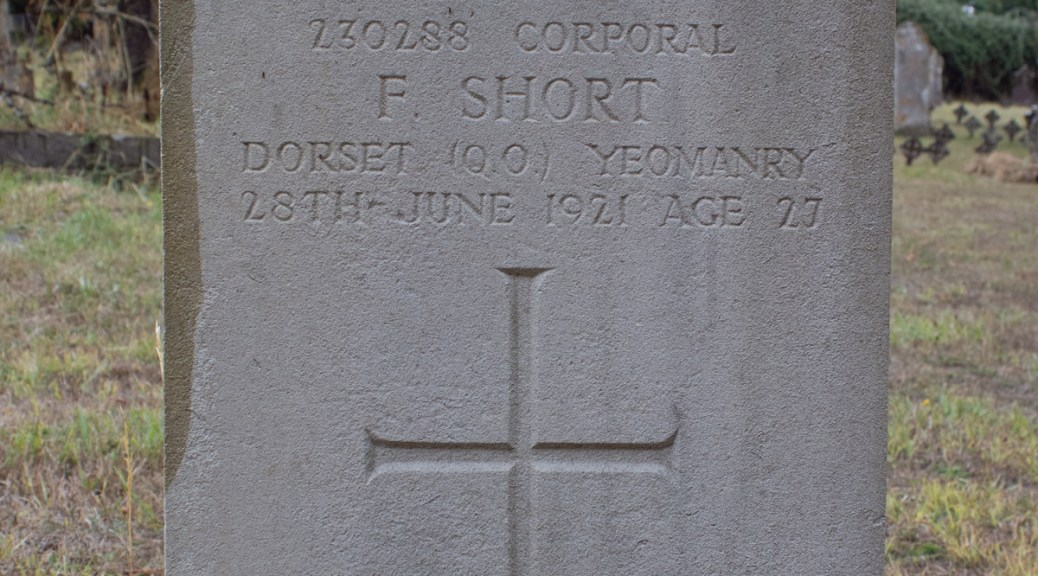
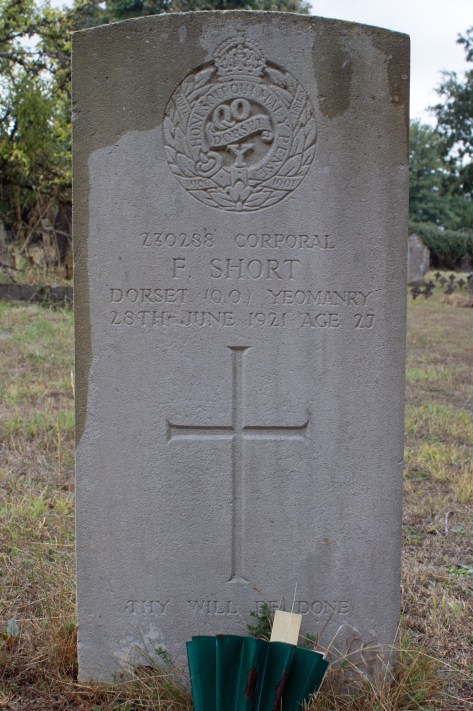
The war had had a negative impact on Frederick’s health. The 1921 census shows him and Mabel visiting his parents in Sturminster: his occupation was given as unfit (formerly a groom). It was only a matter of weeks later that his condition worsened. Frederick passed away from a combination of malaria and heart disease on 28th June 1921: he was 27 years of age.
The body of Frederick Short was laid to rest in Sturminster Newton Cemetery, close to, and under the watchful eye of, his caretaker father, John.
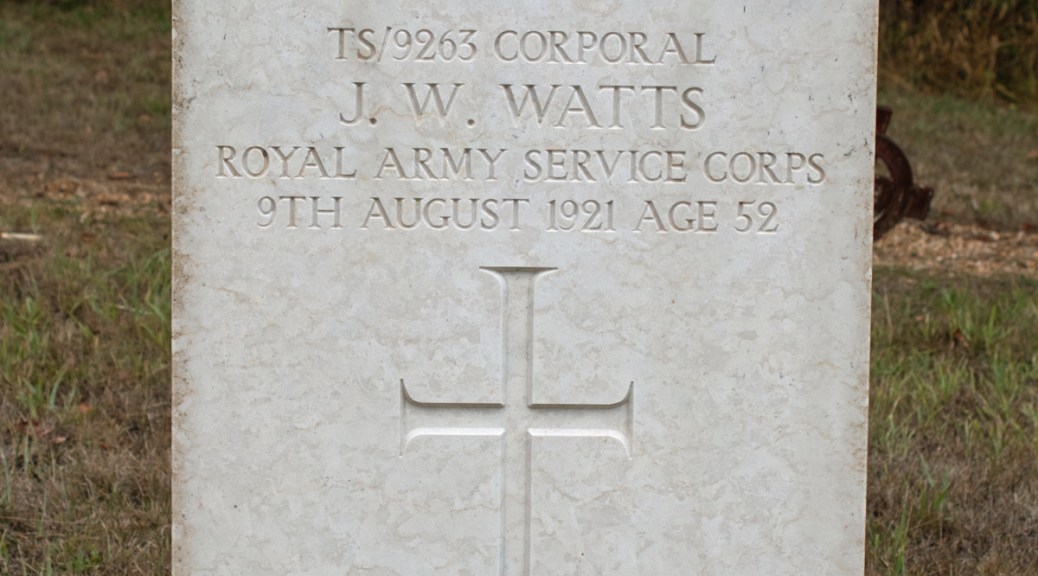
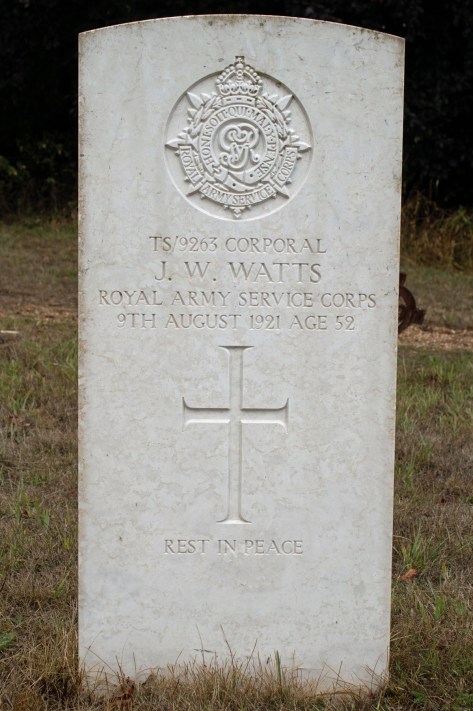
John William Watts was born in the summer of 1869, the youngest of six children to Reuben and Maria Watts. Reuben was a sawyer from Haselbury Brian, Dorset, and it was her that the Watts family were born and raised.
John seemed keen to progress himself, and found employment as a police constable. The 1891 census recorded him as living at the station in Blandford Forum. Three years later, he married Elizabeth Hallett, a shoemaker’s daughter from Lyme Regis. The couple would go on to have eight children before Elizabeth’s untimely death in 1912.
By this point, John’s career had taken a sharp turn: in 1901, when the family were living in Sturminster Newton, he was working as a blacksmith. The next return, taken in 1911, found them at 19 Church Street in the village, where John was employed as a journeyman shoeing smith.
With young children to raise, John took a new wife, marrying widow Rose Yeatman on 3rd August 1914. His oldest daughter, Elsie, and her father, Tom Bleathman, acted as witnesses. John and Rose would go on to have a daughter of their own, Muriel, the following year.
When war broke out, John stepped up to play his part. His service papers have been lost to time, but it is clear that he enlisted in the Royal Army Service Corps, and, presumably because of his age and experience, was assigned the rank of Farrier Corporal There is no indication that he served time outside of Britain, and it seems likely that he would have overseen the preparation of horses and training of blacksmiths for the Western Front.
Farrier Corporal Watts survived the conflict, but was medically discharged with malaria on 16th May 1919. The 1921 census found him living with Rose and five of his children and step-children in their Church Street home. He was employed as a bricklayer’s labourer, and was working for builder and contractor Mr J Silverthorne.
John’s health was suffering now, though, and he would only last until the summer. He passed away at home on 9th August 1921: he was 52 years of age.
The body of John William Watts was laid to rest in Sturminster Newton Cemetery, a short distance from his grieving family’s home.
Charles Albert Frost was born in Daventry, Northamptonshire, at during the winter of 1882/3. The third of eight children, his parents were William and Louisa Frost. William was a foreman at a shoe factory in Northampton and, at the time of the 1891 census, the family were living at what looks to be 47 Ardington Road or Abington Road (the return is not clearly legible).
Charles also found work in the shoe trade when he completed his schooling, but his is not a career he wanted to make for himself. Instead he was drawn to the army and, on 26th January 1900, he joined up. The now Driver Frost’s service records show that, at 18 years of age, he was 5ft 4.5ins (1.63m) tall and weighed 127lbs (57.6kg). He had brown hair, blue eyes and a fresh complexion.
Assigned to the Army Service Corps, Charles spent the next few years on home soil. Attached to the 17th Company, he would work hard and that dedication would pay off. He was promoted to Lance Corporal in April 1902, and 2nd Corporal just six months later. By January 1903 he had risen to Corporal, extending his term of service the same month.
Interestingly, in March 1904, Charles reverted to the role of Driver at his own request. He would remain at that rank until for the next four years, when he was stood down to reserve status.
The 1911 census found Charles living back home with his parents and siblings. By this point there were six adults and three children living at 74 Hood Street, Northampton, a seven-roomed terraced house on the east of the town centre. Charles had found work as a blouse cutter in a local factory, and with his father and older siblings all involved in factory work in some way.
Life on civvy street seemed not to appeal, however, and in November 1911 Charles was re-engaged with the Army Service Corps. This was initially planned to be for four years, but he would remain in the army for nearly twice that long.
In August 1914, Driver Frost was shipped out to France. and, barring leave, he would remain there for the next three years. In the summer of 1915, he returned home briefly, marrying Daisy Harris at St Edmund’s Church in Hardingstone, Northamptonshire, when he did so. He was soon sent back out to France, however, and remained on the other side of the Channel until April 1917.
Back on home soil, Charles’ career had taken a surprising turn. In January 1915 he was promoted to Acting Corporal, rising to Acting Sergeant just four months later. By November 1916 he had been promoted to Acting Quartermaster Sergeant, a role that was formalised just four months later.
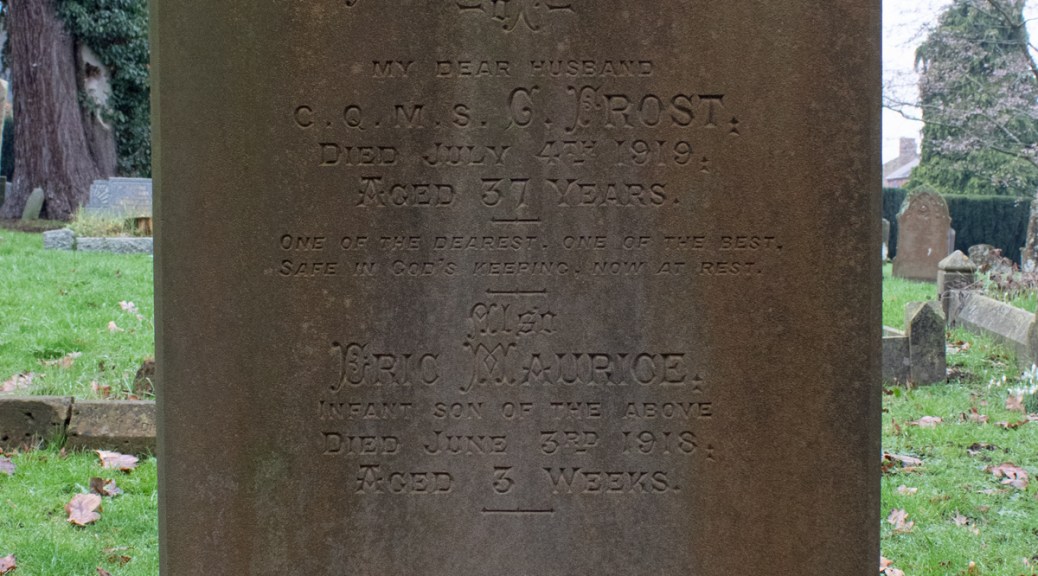
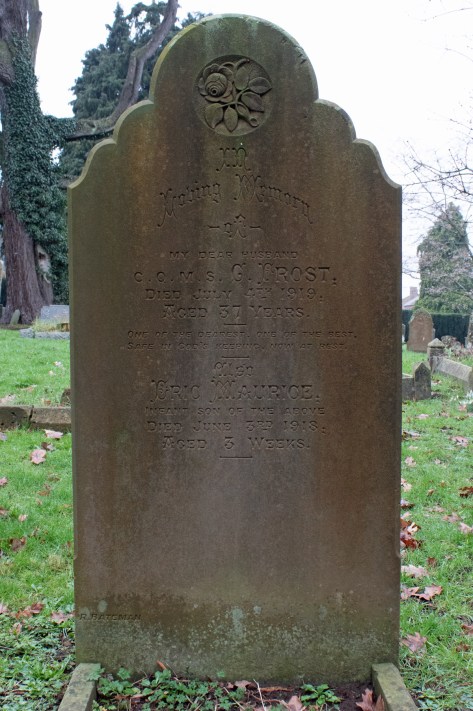
In May 1918, Daisy gave birth to their first – and only – child, a boy they called Eric. Tragically, he passed away just three weeks later, from a combination of pemphigus and asthma: with Charles away, Daisy had to register the death.
Quartermaster Sergeant Frost survived the war, but was admitted to the Mill Road Hospital in Liverpool, Lancashire, on 28th June 1919. He was suffering from a cerebral tumour, but his treatment would prove ineffectual. He died at 3:20am on 4th July 1919: he was 37 years of age.
The body of Charles Albert Frost was taken back to Northamptonshire for burial. He was laid to rest in the graveyard of St Edmund’s Church, Hardingstone, alongside Eric: a father and son reunited.
Daisy had not lost her son and husband in just over a year. The 1921 census found her back living with her father and sister, carrying out home duties while they worked.
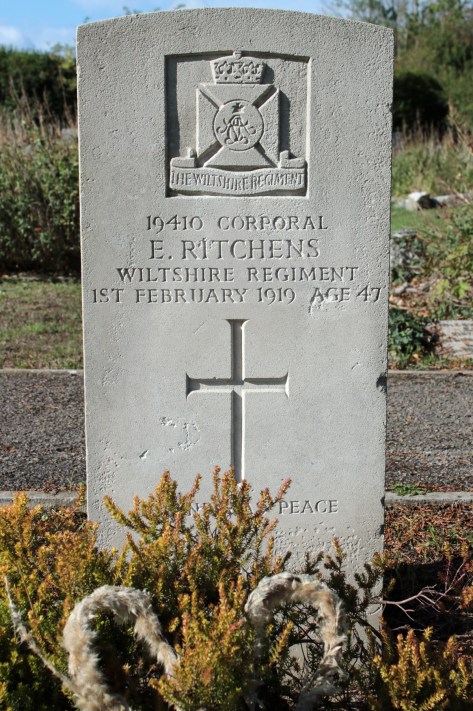
Ernest Ritchens was born in the summer of 1872 in the Wiltshire village of Semington. The youngest of nine children, he was one of seven boys to Isaac and Sarah Ritchens. Isaac was a farm labourer, and this is a job into which Ernest also followed when he completed his schooling.
Farming was not something Ernest wanted to be in for the long term, however, and, after the death of his parents – Isaac in 1895, and Sarah four years later – he joined the army. Details of his military career have been lost to time, but it seems that he joined the Wiltshire Regiment and, as a Private, spent time in South Africa. By the time he was stood down, he had risen to the rank of Lance Corporal.
Back home and, in the summer of 1907, Ernest married Sarah York, a wheelwright’s daughter from Hilperton near Trowbridge, Wiltshire. The newlyweds would set up home in the village, and go on to have four children. The 1911 census found the young family living on Devizes Road, Ernest back working as a farm labourer.
When war broke out, Ernest was again called upon to play his part . He was given the rank of Corporal, and attached to the Wiltshire Regiment (although other records he was assigned to the Hampshire Regiment). He did not appear to have spent any time overseas and, was soon transferred over to the 160th Company of the Labour Corps.
DEATHS
RITCHENS – On February 1st, at No. 1, Australian Hospital, Sutton Veny, Corporal Ernest Ritchens, of the Labour Corps, and formally of the Wilts Regiment, resident of Hilperton…
[Wiltshire News: Friday 7th February 1919]
Ernest Ritchens was 46 years of age when he passed away in 1919. While the cause us not reported, it is likely to have been an illness of some sort. His body was taken back to Hilperton, and he was laid to rest in the village cemetery.
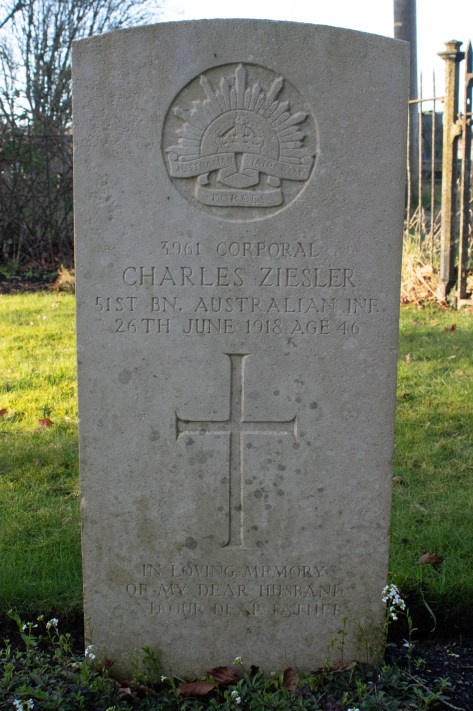
Charles Frederick Wilhelm Ziesler was born on 12th February 1877 in Timaru on New Zealand’s South Island. The oldest of nine children, his parents were Norwegian-born Johan Ziesler, and his New Zealand wife, Lucy.
Little information is available about Charles’ early life, but it is clear that he found work as a clerk when he finished his schooling. By the time of the 1899 electoral role, he had set up home at 258 Hereford Street in the Canterbury area of Christchurch.
Things were to change, however, and Charles emigrated to Australia. Taking up a job as a fire adjuster for an insurance company, he settled in the Subiaco suburb of Perth. In 1909 he married Martha Grimwood: the couple went on to have three children, and lived in a house at 97 Park Street.
When war broke out, despite his age, Charles stepped up to serve the Empire. He enlisted in the Australian Imperial Force on 12th November 1915, and was initially attached to the 35th Depot. His service papers show that he was 5ft 11ins (1.8m) tall and weighed 182lbs (82.6kg). He was recorded as having brown hair, blue eyes and a fair complexion.
After several weeks’ training, Private Ziesler’s unit left Australia for the battlefields of Europe. Arriving in Suez, Egypt, on 11th March 1916, he would receive further instruction there over the next couple of months. While many of the ANZAC battalions then set sail for the Dardanelles, the 35th Training Battalion, of which Charles was now a part, headed for Britain.
Private Ziesler arrived in Plymouth, Devon, on 16th June, and was marched into Rollestone Camp in Wiltshire. His preparation continued, and, in August, he was promoted to the rank of Corporal. Charles’ service records suggest that he did not serve on the Western Front, instead remaining attached to the Training Battalions based around Salisbury Plain, in Tidworth and Codford.
By the summer of 1918, Corporal Ziesler had been in Britain for two years and had been promoted to the rank of Acting Sergeant in the 51st Battalion of the Australian Infantry. In June he fell ill, and was admitted to the No 3 New Zealand General Hospital in Codford, suffering from bronchopneumonia. The condition was to prove his undoing: he passed away on 26th June 1918, at the age of 41 years old.
Thousands of miles from home, the body of Charles Frederick Wilhelm Ziesler was laid to rest in the ANZAC extension to the graveyard of St Mary’s Church, Codford, Wiltshire.
Charles’ belongings were returned to his widow: these included his clothing (a leather vest, fur vest, boots, puttees, cap, breeches, underpants and singlets) and more personal items (pipes, coins, photo albums, letters).
Martha may have taken comfort from a detailed letter she received about her late husband’s funeral. “The late Sergeant Ziesler was held in a very high esteem by all ranks in the Unit, and always proved himself a keen soldier, a true and sympathetic comrade and a friend in need and deed. His loss to the Unit is very keenly felt.”
(The CWGC records record the last full rank Charles held: as he held the role of Acting Sergeant, he is noted at the level below, Corporal.)
Herbert Ernest Marriott was born on 15th November 1881 in the Hampshire village of Alverstoke (now part of Gosport). The younger of two children, his parents were George and Sarah Marriott. George was a navy pensioner, who died a matter of months after his youngest son was born, leaving Sarah to raise their two children alone.
The 1891 census found Sarah living at Prince Alfred Cottage in Alverstoke, with her two sons – Herbert, aged 9, and Joseph, aged 22 – and grandson, one-year-old Charles. She was employed as a launderess, while Joseph was employed as a bricklayer’s labourer.
Herbert was keen to build a career for himself and, on 20th July 1897, he enlisted in the Royal Marine Light Infantry. His service record shows that he was 5ft 7.5ins (1.71m) tall, with dark brown hair, brown eyes and a fresh complexion. He was also recorded as having a small scar on his left shoulder.
Private Marriott was sent just along the coast to Portsmouth for his training: this would become his land base in between voyages. He evidently showed some musical talent as, just two months after enlisting, he was given the rank of Bugler. Over the years the career he had sought grew, and his abilities grew with it.
Between 1897 and 1914, Herbert would serve on nine vessels in total. In February 1900 he became a Private once more, but by the end of the following year he had been promoted to Corporal. He continued to rise through the ranks, becoming Lance Sergeant in January 1905 and full Sergeant in the summer of 1907.
In the spring of 1901, Herbert married navy pensioner’s daughter Annie Hill. The newlyweds would set up home at 140 Queen’s Road, Gosport, and have six children between 1904 and 1914.
Back at sea and, by the time war was declared, Sergeant Marriott had been assigned to the battleship HMS Bulwark for two years. Part of the Channel Fleet, she was charged with patrolling and protecting the water off the south coast of England.
On 16th November, Bulwark was moored in the River Medway, near Sheerness, Kent, and being restocked with ammunition. A number of cordite charges had been stored incorrectly and overheated. These detonated the nearby shells and the resulting chain reaction of explosions ripped apart the battleship, sinking it and killing more than 740 crewmen, including Sergeant Marriott. He had turned 33 years of age just the day before.
The bodies recovered were laid to rest in the naval section of Woodlands Cemetery, Gillingham, Kent. As his had been identified, Herbert Ernest Marriott was buried in a marked grave.
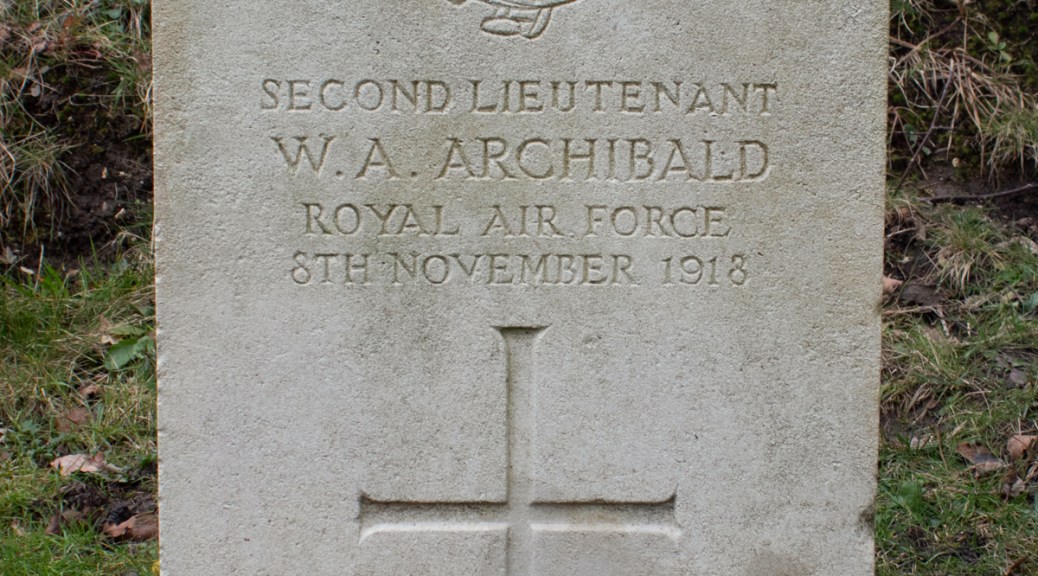
Wesley Alexander Archibald was born in Flatlands, New Brunswick, Canada, on 19th October 1894. The oldest of ten children, his parents were Scottish-born couple James and Jane Archibald. It is unclear what employment James was in, but when he completed his schooling, Wesley found work as a telegraph operator.
When not working, Wesley was an active member of the Irish Fusiliers of Canada, and, by the time was broke out, he had been with the 11th Regiment for a year.
Wesley enlisted in the Canadian Expeditionary Force on 29th November 1915. His service records show that he was 5ft 6.5ins (1.69m) tall, with black hair, brown eyes and a fresh complexion. He was also noted as having a large scar on the outer side of his right thigh.
Private Archibald’s initial training was completed on home soil. His unit – the 121st Battalion – left Halifax on 14th August 1916, and arrived in Liverpool, Lancashire, ten days later. His dedication to the role was clear: his unit moved to Bramshott, Surrey, and he had been promoted to Corporal by the time he arrived there, and Sergeant just two months later.
In January 1917, Wesley was assigned to the 7th Battalion of the Canadian Expeditionary Force and sent to the Front Line. Over the next few months, his unit saw some fierce fighting at Arras, Vimy and Hill 70. On 9th July Sergeant Archibald was awarded the Military Medal for his actions.
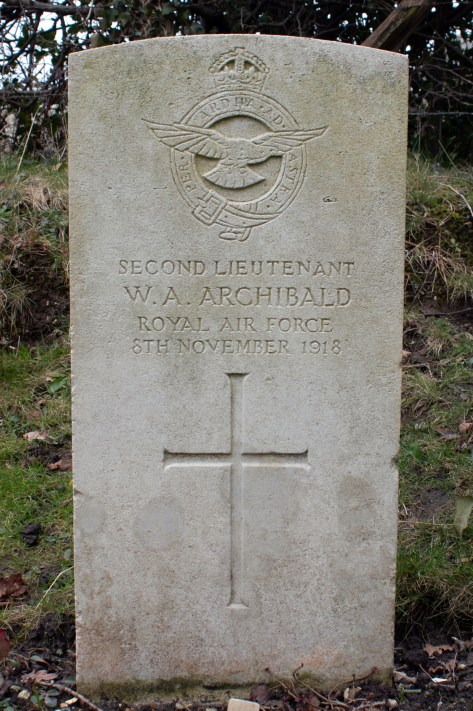
By the end of 1917, Wesley was seeking more adventure, and, on 10th December, he transferred to the Royal Flying Corps. Attached to the 29th Training Depot Station, he was based near Beaulieu in Hampshire when the Royal Air Force was created. Over the next year he learnt his new trade and, on 7th November 1918, he was appointed Second Lieutenant.
The following day, Wesley was preparing for a flight in his Sopwith Dolphin. The aircraft took off, but the engine stalled, and the plane crashed. Second Lieutenant Archibald was killed instantly. He was 24 years of age.
The body of William Alexander Archibald was laid to rest in the graveyard of St Paul’s Church in East Boldre, not far for the airfield he had called home.
The early life of Henry Watkin Lewis is a challenge to piece together, and a lot of the detail comes from his later service records.
The document confirms that Henry was born in Pontypool, Monmouthshire, in December 1885. It gives his next of kin as his aunt, Ann Dunning, and there are no details about his parents.
Henry joined up in the days after war was declared. He was working as a plumber by this point, and enlisted in Preston, Lancashire, although it is not clear whether he was living in the area at this point. His records showing that he was 5ft (1.52m) tall and weighed 116lbs (52.6kg). With brown hair, blue eyes and a fresh complexion, he had a scar across the bridge of his nose and another on his lower lip.
Henry’s military career is an intriguing one. Assigned to the Loyal North Lancashire Regiment, he was initially given the rank of Private. He was promoted to Lance Corporal on 5th September 1914, just two weeks after enlisting. Four days later his rank was increased to Corporal, and by 14th October he had been promoted again, this time to Lance Sergeant. There is no evidence of any previous military background for him, and the cause of this rapid rise is unclear.
With any rapid rise, a rapid fall is often likely to follow, and Henry’s case was to be no different. He service records note that he was discharged from the army on 16th January 1915, as he was ‘not likely to become an efficient soldier’. Again, there is no further record as to why, although his papers do not suggest the cause was anything medical.
Lance Sergeant Lewis’ unit was based in Tidworth, Wiltshire, by this point, but he must have moved to Warminster following his discharge. It was here that he died on 23rd April 1915, the cause of his passing unknown. He was 29 years of age.
Henry Watkin Lewis was laid to rest in the graveyard of St Denys’ Church, Warminster.
The early life of Albert James Button is a challenge to piece together. Born in Melbourne, Australia, in 1892, his father was also called Albert. When he finished his schooling, he found work as a hotel clerk, settling at 58 Stirling Street, Fremantle. He married a woman called Gladys, and, in his free time, he volunteered in the local militia.
When war broke out, Albert stepped up to play his part. He enlisted in the Australian Imperial Force on 9th December 1915, his service papers confirming that he was 5ft 8ins (1.72m) tall and weighed 129lbs (58.5kg). He was noted as having fair hair, blue eyes and a fresh complexion: he also had two vaccination marks on his left arm, and a mole on the right side of his neck.
Private Button spent the first half of 1916 training. His voluntary experience put him in good stead, and, he was promoted to Sergeant on 28th March. Towards the end of July, his unit – the 44th Battalion – left Fremantle for Britain, and he arrived in Plymouth, Devon, some two months later.
Sergeant Button was billeted at the ANZAC camp in Codford, Wiltshire. For a unknown reason, when he arrived at the base on 19th September, he was demoted to the rank of Corporal – it is unclear whether or not this was his choice. At this point, he was transferred to the 51st Battalion.
While in Wiltshire, Albert’s training continued. A local newspaper described what happened next:
Mr FAP Sylvester held an inquest at Codford, on Saturday, relative to the death of Corporal Albert James Button, 23, of the Australian Imperial Forces. The deceased, with several of his comrades, was in a bay awaiting his turn to throw a hand grenade, when a private named Taylor, who was in the throwing bay with an instructor, landed his grenade in the opposite direction to that intended, with the result that it pitched into the midst of the soldiers in the waiting bay. Being warned most of the men got away, but the deceased seemed paralysed and stayed until the bomb exploded. He was struck in the head and died almost immediately. Several of his comrades were struck i the legs, but their wounds were not serious. Pte. Taylor’s explanation was that the lever of the grenade caught in his thumb and caused him to swing his arm around. A verdict of “Accidental death” was returned.
[Devizes and Wilts Advertiser: Thursday 30th November 1916]
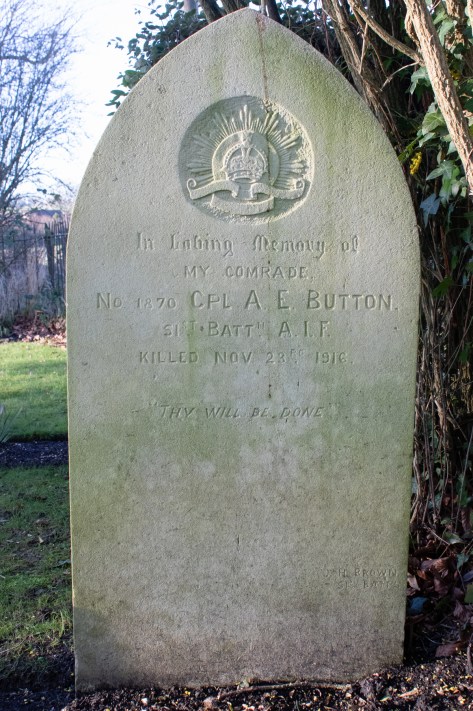
Albert James Button died on 23rd November 1916: he was 24 years of age. He was laid to rest in the recently extended graveyard of St Mary’s Church, Codford. The epitaph on his headstone starts “In loving memory of my comrade”, but it is unclear who specifically paid for it. Was it Private Taylor? We may never know.
Gladys seems to have distanced herself from her husband’s passing. His memorial plaque and medals were returned undelivered, and his pension seems to have gone unclaimed. It was only in 1923 that the Australian Military Forces were able to confirm that she had remarried, and moved to Sydney.
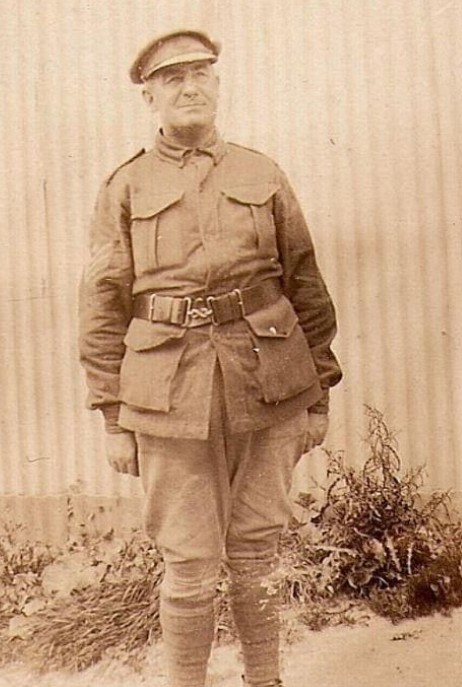
Private Albert Button (from findagrave.com)
Private Button’s service papers shed more detail on the incident that took his life. Evidently a summary of notes taken during the inquest, they are light on punctuation:
Inquiry into the death of a soldier in that he on 23.11.16 at Codford whiles in the bay of a live bomb throwing pitch was killed. The bomb was known by 2264 Pte Taylor of 50th Btn now attached to the 13th Inf Btn, which struck against the top of the parapet to the head of the thrower, owing probably to the spin of the bomb came back and dropped on the inside edge of the bay. All men were warned… to reach cover with the exception of 1870 Cpl Button AJJ 51st Battn. who seemed paralysed with fear. He remained in the bay and was found after the explosion lying across the sandbags which were placed at the entrance to prevent the bombs which were thrown against the parapet from falling into the pen. Other soldiers were wounded by shrapnel effect, because instead of falling down flat when a short distance from the bay, continued to run. The bomb not being as was thought a five second bomb, exploded in three seconds (witness 2nd Liet. JW Swanse 45th Bn)… The Court declared that the occurrence was purely accidental owing to the inexperience of live bomb throwing and nervousness on the part of the thrower, also that no blame is attached to any persons concerned in the practice.








 Death and Service