Tag Archives: Cambridgeshire

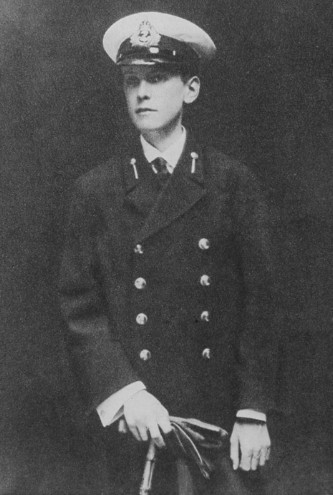
Second Lieutenant Edward Topley

Second Lieutenant Edward Topley

Edward Percival Augustus Topley was born on 6th November 1899 in Woolwich, Kent. He was the third of seven children to Percival and Sarah Topley. Percival was a grocer, and the 1901 census found the family living at 64 Eglinton Road, Plumstead.

Details about Edward’s early life are sketchy. There is a record of him learning to fly at the Cambridge School of Flying, and gaining his wings on 4th November 1917. “…he went through a course at the Royal Naval College, Greenwich. From there he was sent to Beaulieu Aerodrome, Hants…” [Kentish Independent: Friday 15th November 1918]

Edward rose to the rank of Second Lieutenant when the Royal Flying Corps and Royal Naval Air Service merged to become the Royal Air Force on 1st April 1918. Attached to the 29th Depot Training Station, he seems to have built up a fair amount of flying experience.

On 30th October 1918, Second Lieutenant Topley was flying his Sopwith Camel, when the engine stalled, and the aircraft crashed to the ground. Edward was killed instantly. He was a week shy of his nineteenth birthday.

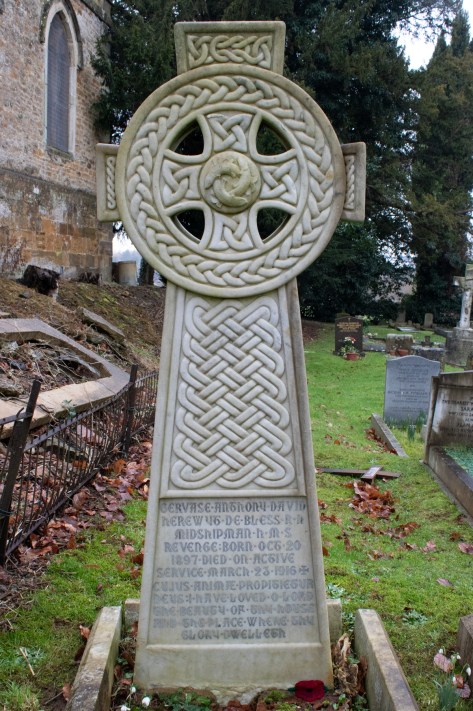
The body of Edward Percival Augustus Topley – “a very promising young officer, and loved by all who knew him” [Kentish Independent: Friday 15th November 1918] – was taken to St Paul’s Church, East Boldre, not far from the base he had begun to call home, and laid to rest.


Second Lieutenant Edward Topley
(from britishnewspaperarchive.co.uk)

Reverend Joseph Dathan

Reverend Joseph Dathan

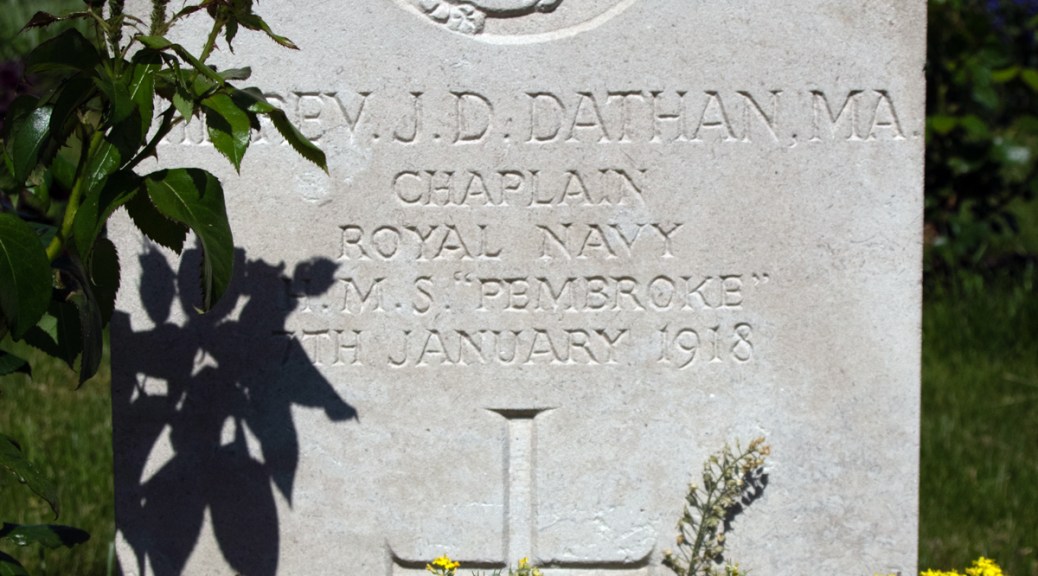
Much regret has been felt… at the death of Rev. JD Dathan MA, chaplain to the Royal Marines, at the age of 50 years. His death was due to pneumonia, caused by catching a chill while doing temporary duty… at the [Royal Naval Hospital, Chatham, Kent]. The eldest son of Captain JC Dathan RN, the deceased gentleman was educated at Christ’s Hospital and Cambridge, where he obtained the degree of MA. He entered the Royal Navy as a chaplain in 1896, and served on the China Station during the Boxer riots. For five years he was chaplain of Bermuda Dockyard and Hospital. He also served commissions in HMS Monmouth, Goliath and Russell. He was posted to the Royal Marine Barracks in July 1914, but on the outbreak of war he was appointed to HMS Formidable, and was transferred from the ship a week before she was lost. He was subsequently sent tot he Dardanelles for service in the Implacable at the first landing in April 1915. Later he joined the Italian Fleet, and was subsequently recalled to the Royal Marine Barracks. Three of the deceased officer’s brothers – Paymr.-in-Chief Ellis Dathan, Com. Hartley Dathan, and Eng.-Com. William Dathan – are serving in the Royal Navy.

[Naval & Military Record and Royal Dockyards Gazette: Wednesday 16th January 1918]

Joseph Duncan Dathan was born in 1866 in Halifax, Nova Scotia. The second of seven children, his parents were Joseph and Emma Dathan.

By the time of the 1891 census, the Dathan family had moved back to Britain. Joseph Sr and Emma were living in Portsea, Hampshire, while the younger Joseph was studying at Christ’s Hospital. The next return, taken in 1901, found him having taken up a role as curate at St John’s Church in Ipswich, Suffolk. He was, by this point, living on Foxhall Road on the western edge of the town.

On 25th February 1904, Joseph married Alicia Cane. The daughter of a vicar, she lived in Ipswich, and the couple married in the local parish church. By this point, Joseph was based in Portsmouth, Hampshire, and this is where the young couple set up home. Alicia gave birth to their first child, John, that November. The couple’s second son, Joseph, was born in 1906 and their third, daughter Alicia, was born in Bermuda while the family were stationed out there with Reverend Dathan’s work.

Joseph’s connection to the navy continued much as the newspaper reported. He died from pneumonia on 7th January 1918: he was 51 years of age.

Reverend Joseph Duncan Dathan was laid to rest in the naval section of Woodlands Cemetery in Gillingham, Kent, a place he would have known well, given its proximity to the Royal Naval Dockyard in Chatham, Kent, where he had been based.


Private Edward Vale

Private Edward Vale

Edward Charles Vale was born in the spring of 1890, one of ten children to William and Ellen. Born in Cambridgeshire, William was employed by the local railways, becoming a signalman by the time of the 1901 census. The family were raised in Great Shelford, before moving to the Ely area in the early 1900s.

By the time of the 1911 census, Edward was the oldest of three of his siblings to still be living at home. The Vales were living at 12 Granta Terrace, Stapleford, and Edward was employed as a domestic gardener.

When war broke out, Edward volunteered to serve his country. Full service details are lost to time, but he had enlisted in the Royal Fusiliers by the spring of 1915. By June of that year, Private Vale was fighting in the Balkans.

At some point during the conflict, Edward transferred to the Oxfordshire & Buckinghamshire Light Infantry. He remained in the Easter Mediterranean, but was badly wounded in the summer of 1917.

Medically evacuated to Britain, Private Vale was admitted to the Voluntary Aid Detachment hospital that had been set up at Knightshayes Court, Devon. While details are unclear, Edward’s injuries were to prove too severe. He passed away on 9th October 1917, at the age of 27 years old.

Edward Charles Vale was laid to rest in the peaceful graveyard of St Thomas’ Church in Chevithorne, not far from the hospital in which he had passed.


Driver Albert Stokes

Driver Albert Stokes

Albert John Stokes was born in the autumn of 1878, the fourth of seven children to John and Mary Ann Stokes. John was a cord winder from Puriton in Somerset, and it was in the village, in the house next to his parents, that he and Mary Ann raised their young family.

By the 1890s, John had turned his hand to boot making. When he finished his schooling, however, Albert found more manual work, and by the time he got married in 1903, he was working as a quarry labourer.

Albert’s wife was Minnie Nichols, a cooper’s daughter, who lived just up the road from the Stokes family. They married in Bridgwater Registry Office on Christmas Eve 1903. The newlyweds set up home in a small cottage in Puriton, and went on to have six children, although only four survived childhood.

When war came to Europe, Albert was one of the first to join up. He enlisted on 7th December 1914, and was assigned to the Royal Field Artillery as a Driver. His service records give an insight into the man he had become: he was 5ft 7ins (1.7m) tall, weighed in at 136lbs (61.7kg) and was of good physical development.

Driver Stokes spent the next eight months on home soil. He was sent to France on 21st July 1915, and was involved in the fighting at Loos. It was here, that he developed a persistent cough and, by October, he was back on home soil. That winter Albert contracted influenza, which then developed into haemoptysis.

While Driver Stokes did recover, he was admitted to the Voluntary Aid Detachment Hospital in Bishops Stortford in May 1916, having come down with influenza once more. He was transferred to the 1st Eastern General Hospital in Cambridge for a medical assessment, and this led to an eventual discharge from the army in August.

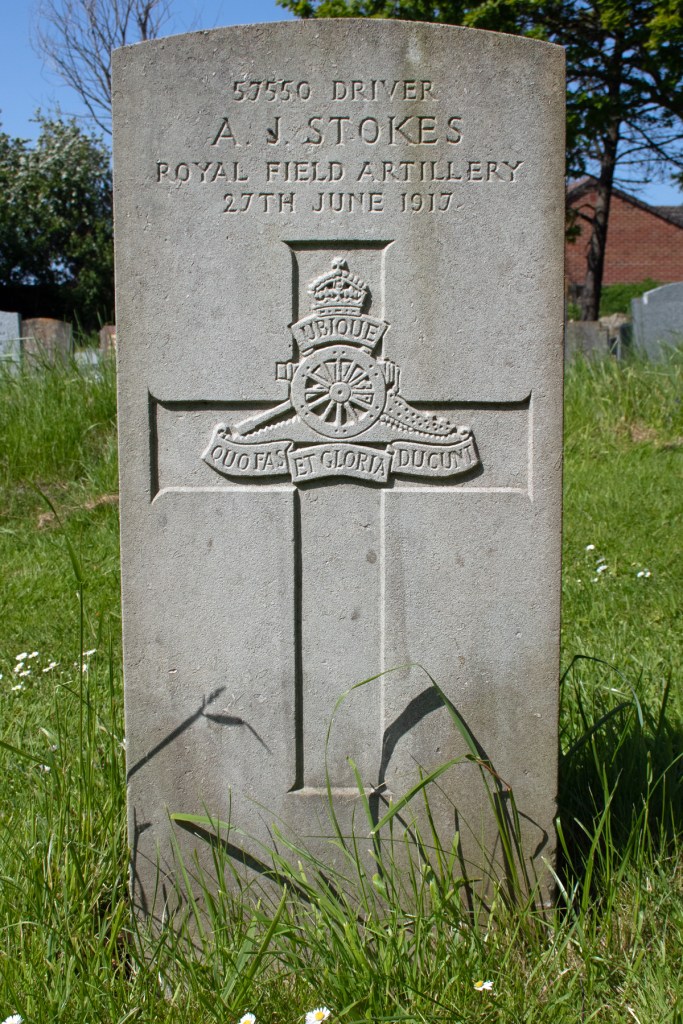
Albert returned to Somerset after leaving the Royal Field Artillery, although his trail does go cold. He was at home when he passed away on 27th June 1917, at the age of 39 years old. The cause of his passing is not recorded, but it is likely to have been as a result of a repeat of the conditions that had led to him leaving the military.

Albert John Stokes was laid to rest in the peaceful graveyard of St Michael’s Church in his home village of Puriton.


Stoker 1st Class Charles Lemmon

Stoker 1st Class Charles Lemmon

Charles Lemmon was born in Norwich, Norfolk on 12th July 1892. He was one of ten children and the son of bricklayer Henry Lemmon and his wife Sophia.

When Charles left school, he found work as an errand boy; by the time of the 1911 census, he had moved to Cambridge. He was living with John Buol, a Swiss confectioner and pastry chef who had set up a restaurant in the centre of the city, opposite King’s College.

The move from Norfolk to Cambridgeshire must has ignited a yearning for travel, however. Within a year, Charles had enlisted in the Royal Navy, and was taken on as a Stoker 2nd Class. His naval records show that he stood at 5ft 2ins (1.57m) tall, had brown hair, grey eyes and a fair complexion. It was also noted that he had a scar on his left leg.

Stoker Lemmon was set to see the world. After his initial training at HMS Pembroke – the Royal Naval Dockyard in Chatham, Kent – he was assigned to HMS Berwick, an armoured cruiser that sailed between England and the Americas.

The following year, Charles was reassigned to HMS Swiftsure, and received a promotion to Stoker 1st Class. He returned to HMS Pembroke in May 1916, and, after a couple of months on land, boarded HMS Titania, a submarine depot ship that had recently seen action in the Battle of Jutland.

Stoker Lemmon spent just under a year on the Titania, before again returning to Chatham in the spring of 1917. HMS Pembroke was a crowded place that summer, Charles was billeted in temporary accommodation in the dockyard’s Drill Hall.

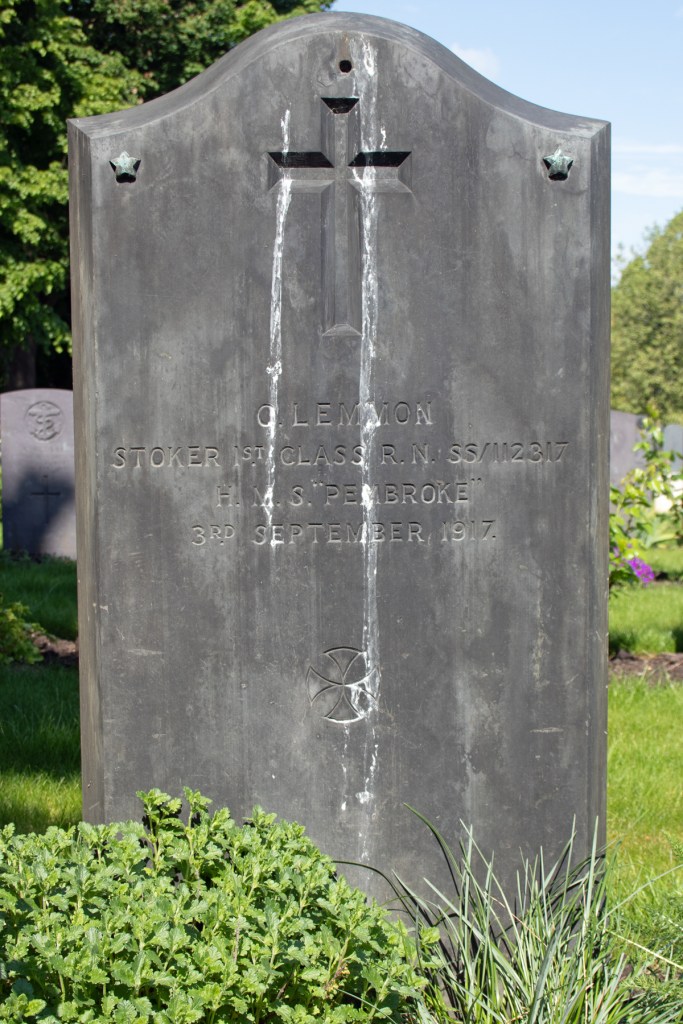
On 3rd September, the German Air Force was trialling night raids on English locations; Chatham found itself in the line of fire. The Drill Hall received a direct hit, and Stoker 1st Class Lemmon was killed, along with close to 100 other servicemen resting there. He was just 25 years of age.

The servicemen who lost their lives in the Chatham Air Raid, including Charles Lemmon, were laid to rest in the Woodlands Cemetery in nearby Gillingham.


Lieutenant Basil Scott-Holmes

Lieutenant Basil Scott-Holmes

Basil Scott-Holmes was born on 2nd February 1884 in the Somerset village of Wookey. The oldest of two children, his father was Liverpool-born Thomas Scott-Holmes and his wife, Katherine. When Basil was born, Thomas was the vicar of St Matthew’s Church, Wookey, but by 1901, he had risen to the role of clergyman – and subsequently Chancellor – at Wells Cathedral.

Basil’s pedigree stood him in good stead. Initially educated in Llandaff, South Wales, he subsequently attended Sherborne School in Dorset. Sent up to Cambridge, he studied history at Sidney Sussex College.

After leaving university, Basil spent time in Europe learning German and French. He was then assigned the role of Assistant Commissioner in North Nigeria but, after a year there he was invalided home taking up a teaching role at the Bristol Grammar School in 1912.

In July 1913, Basil married Barbara Willey, a surgeon’s daughter from Reigate, Surrey. The marriage record shows that Basil was registrar for an architectural association by this point; the couple went on to have two children, daughters Annette and Prudence.

When the war broke out, he was obviously keen to do his bit. In September 1914 he enlisted in the Royal Army Service Corps, before gaining a commission in the King’s Royal Rifle Corps a couple of months later. In the spring of 1916, Lieutenant Scott-Holmes had been seconded to the Machine Gun Corps, although it is unclear whether he served abroad during any of his time in the army.

On the evening of 24th October 1916, Lieutenant Scott-Holmes was riding in a motorcycle sidecar through central London, on the way back to camp. A local newspaper picked up the story:

…they stopped when going through Wandsworth to re-light the near light, and in the dark a motor omnibus ran into them, and Lieutenant [Scott-Holmes], who was strapped in the side-car, was, with the car, flung across the road. He died as he was being taken to Wandsworth Hospital. At the subsequent inquest, a verdict of “accidental death” was returned.

Central Somerset Gazette: Friday 3rd November 1916

Basil Scott-Holmes was just 32 years old. His body was brought back to Somerset; he was laid to rest in the cemetery at Wells Cathedral.


Larger memorial image loading...
Basil Scott-Holmes
(from ancestry.co.uk)

Captain Arthur Poole

Captain Arthur Poole

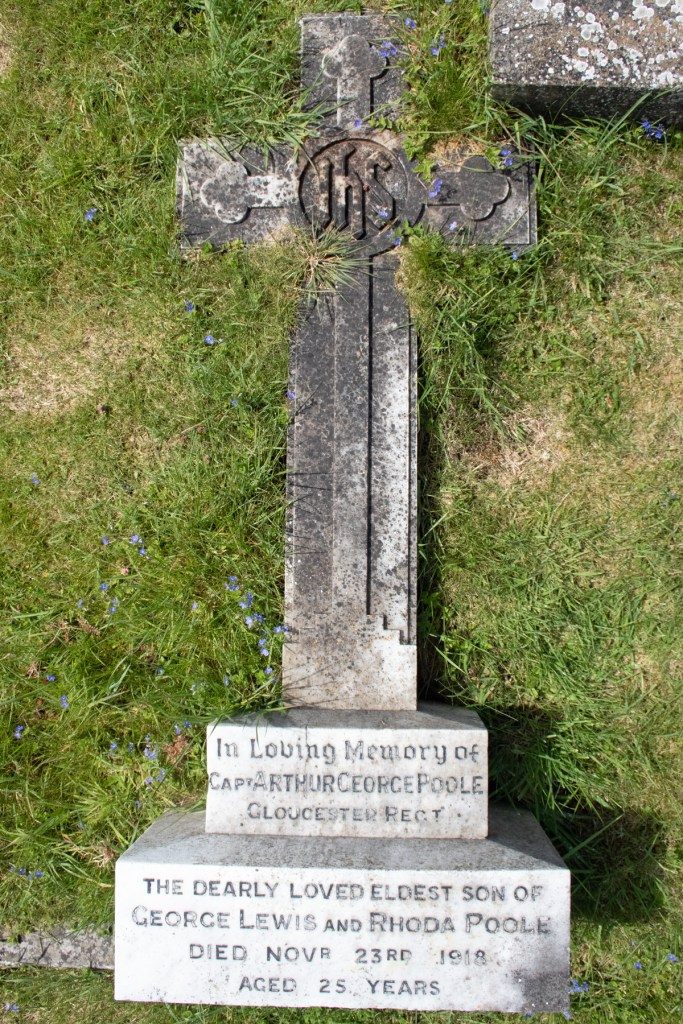
Arthur George Poole was born in Brislington, Somerset, in April 1893. His father, George, was a master builder, and with his mother, Rhoda, the family raise their five children in the Bristol suburb.

Arthur was obvious a bright lad; he attended the Bristol Grammar School, excelling at football, hockey and cricket. After finishing school, he joined a firm of Bristol solicitors and was also appointed secretary of the Bristol Law Society. He went on to continue his studies, when he was accepted to read law at Emmanuel College, Cambridge.

The war was on the horizon, however, and he was called upon to do his duty.

He joined Bristol’s Own (12th Gloucester Regiment) in 1914, and was musketry officer at Chiseldon for some months before going to France in 1915, where he was attached to the 6th Gloucester Regiment.

Within three months he had a severe attack of trench fever, and was home on sick leave for a few weeks. He was severely wounded in October 1917, and came back to England for good. Some months later he was mentioned in despatches. He spent a year in hospital, and although not discharged, was allowed to resume his law studies.

Gloucestershire Echo: Saturday 14th December 1918

While in hospital, Captain Poole contracted influenza, which then became pneumonia. Although recovering from his injuries, it was these conditions that were to get the better of him, and he passed away on 23rd November 1918, at the age of 25 years old.

Arthur George Poole was laid to rest in the pretty graveyard of St Andrew’s Church in Clevedon, Somerset, where his parents now lived.


Petty Officer 1st Class Albert Brooks

Petty Officer Albert Brooks

Albert Brooks was born in February 1877 in Cambridge. Sadly, a lot of the documentation for his early life is lost to time, but he enlisted in the Royal Navy in July 1893, at the rank of Boy 2nd Class.

He formally enrolled in naval service in February 1895, initially for a period of twelve years. Beginning as an Ordinary Seaman aboard HMS Thunderer, during his initial time in the navy, he was promoted to Able Seaman and then Petty Officer 2nd Class, while serving on vessels including Hawke, Wildfire, Eclipse and Vernon.

In 1904, Albert married Rosina Wise. A couple of years younger than her new husband, she had been born in Camberwell, South London. The couple had a daughter, Gwendoline, and they set up home in Gillingham, Kent, where Albert was based when not at sea.

War was on the horizon, however, and Petty Officer Brooks’ naval service was extended until the end of the conflict.

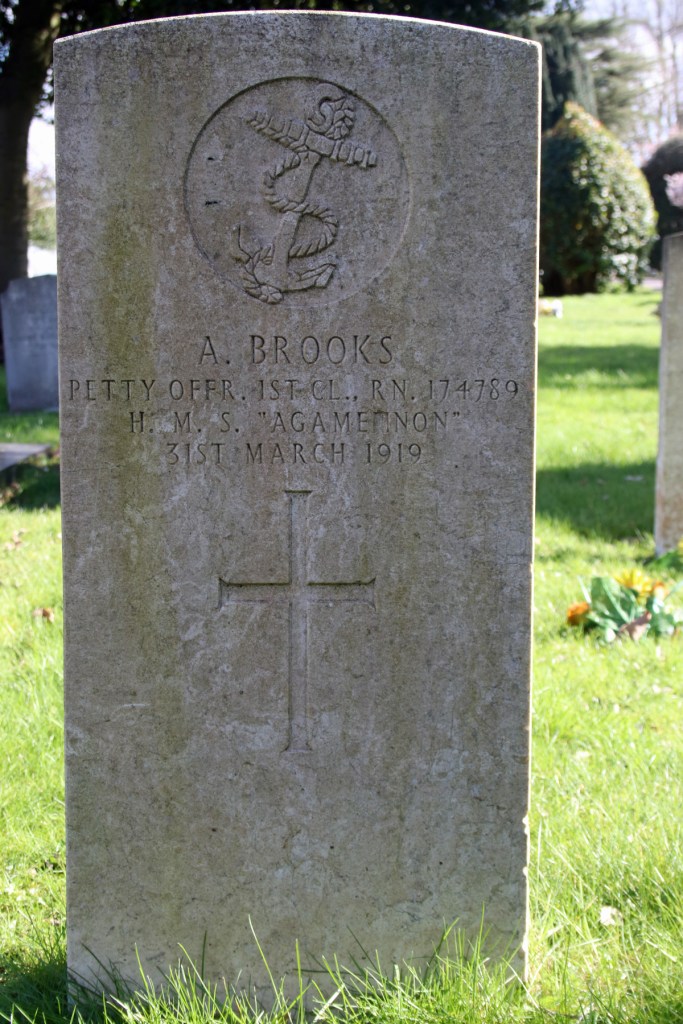
Albert was promoted to Petty Officer 1st Class, and continued his service on vessels that included Andromache, London and Hibernia. He transferred to what would be his final ship, HMS Agamemnon, in November 1917.

Petty Officer Brooks served aboard Agamemnon for eighteen months, but it was while stationed at the Naval Dockyard in Chatham that he fell ill. He passed away from aortic disease of the heart – more than likely a heart attack or cardiac arrest – on 31st March 1919. He had just turned 42 years of age.

Albert Brooks lies at rest in the Woodlands Cemetery in Gillingham, Kent.