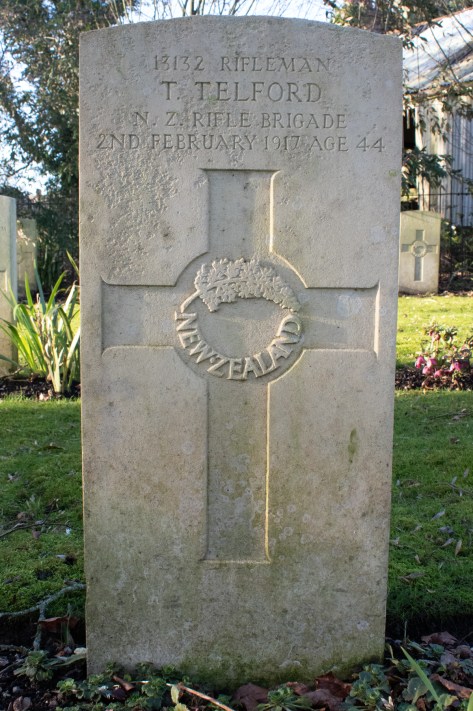
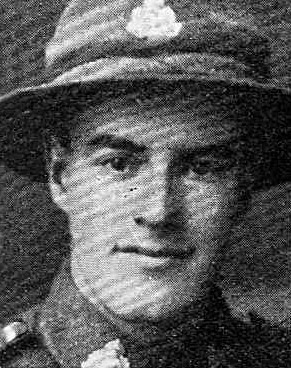
Thomas Telford was born in Bacchus Marsh, Victoria, Australia, on 31st July 1873. The fifth of eleven children, his parents were James and Mary Telford.
There is little additional information about Thomas’ early life. By the time war broke out, he had moved to New Zealand, and was working as a bushman, based out of Whanganui on the south coast of North Island.
Thomas enlisted on 18th January 1916, and would be assigned to the New Zealand Rifle Brigade. His service records show that, at 42 years of age, he was 5ft 5ins (1.65m) tall, and weighed 149lbs (67.6kg). A Roman Catholic, he had iron grey hair, blue eyes and fair hair.
Rifleman Telford’s unit left New Zealand in the spring of 1916. After five weeks in Egypt, he arrived on British soil on 7th August, marching from Southampton, Hampshire, to the Sling Camp in Wiltshire.
By 20th August, Thomas was in France, fighting on the front line. He was injured less than three weeks later and, after initial treatment in France, he was medically evacuated to Britain at the end of September.
Rifleman Telford spent time convalescing in a military home in Hornchurch, Essex, before being transferred to the ANZAC base in Codford, Wiltshire. That winter he contracted pneumonia, and he was admitted to the No. 3 New Zealand General Hospital on the outskirts of the village.
Sadly, the lung condition was to prove the better of Thomas. He passed away on 2nd February 1917, at the age of 43 years old.
Thousands of miles from home, Thomas Telford was laid to rest in the graveyard extension to St Mary’s Church in Codford, not far from where he had breathed his last.
James McLeod was born on 15th April 1893 in Dunedin, New Zealand. There is little further information about his early life, although the Commonwealth War Graves Commission give his father’s name as Samuel, and his service records note his next-of-kin as his brother, George McLeod.
James was employed by A&T Watt as a French polisher. However, he gave that up on 25th January 1915, when he enlisted in the New Zealand Expeditionary Force. His service records show that he was 5ft 8.5ins (1.74m) tall, and weighed 166lbs (75.3kg). He was recorded a having fair hair, blue eyes and a fair complexion.
Private McLeod was assigned to the New Zealand Otago Regiment, and undertook his initial training on home soil. He evidently showed some promise as, on 1st May, he was promoted to Lance Corporal. Six weeks later his unit was heading for Europe, and by the summer James was in Egypt.
On 20th August 1915, Private McLeod was admitted to the New Zealand and Australian Convalescent Hospital in Mena with a gun shot wound to his finger. He remained there for three weeks, returning to his unit in time for them to leave for the Dardanelles on 7th November 1915.
What happened to James over the next couple of months is uncertain. Certainly he was on the Greek island of Moudros by 18th November and in the Dardanelles on 7th December 1915. Just 20 days later he was back in Alexandria, and he would remain there for the next few months. There is, however, nothing in his medical record to suggest that his return to Egypt was on health reasons.
On 6th April 1916, Private McLeod was on the move again, this time to France. He was wounded again on 14th July 1916, and medically evacuated to Britain for treatment. Details of this injury are not clear, but he was admitted to the 2nd London General Hospital in Chelsea, Middlesex. After a month recuperating, James was released from hospital and sent to camp in Hornchurch, Essex. At this point he was also demoted to Private, although, again, the reason is unclear: it may have been a personal choice, or the reversion may have been connected to his injuries.
In September 1916, Private McLeod was transferred to the ANZAC Camp on the outskirts of Codford, Wiltshire. That winter he contracted pleurisy, and he was admitted to the No. 3 New Zealand Hospital, which was connected to the camp, on Christmas Day. His condition worsened, and James passed away from pneumonia on 28th December 1916. He was just 23 years of age.
Thousands of miles from home, James McLeod was laid to rest alongside his fellow soldiers in the extension to the graveyard of St Mary’s Church, Codford.
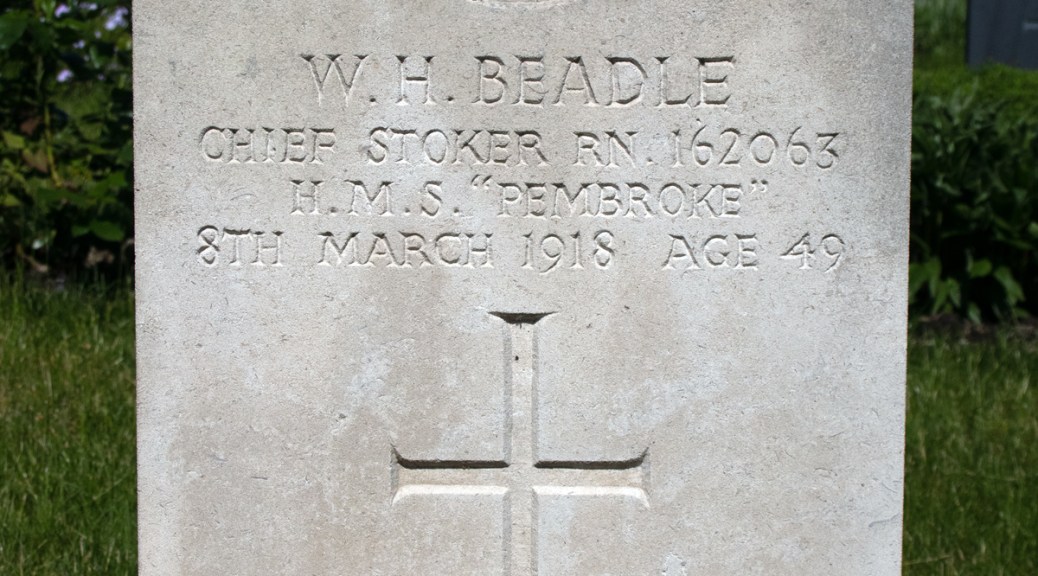
William Henry Beadle was born in Heybridge, Essex, on 23rd April 1870. The youngest of three children his parents were William and Sophia Beadle. William Sr was a waterman-turned-labourer, and the young family lived with Sophia’s parents.
When Sophia died in 1875, her widow and their children remained with his in-laws. William Sr died in 1887, and by the time of the 1891 census, his son was living with his now widowed grandmother. The document notes that she was a pauper, but he was a moulder in the local iron works.
William sought bigger and better things and, on 13th August 1891, he enlisted in the Royal Navy as a Stoker 2nd Class. His service records show that, as 21 years of age, he was 5ft 8ins (1.72m) tall, with brown hair, grey eyes and a fresh complexion.
Stoker Beadle was initially sent to HMS Pembroke, the Royal Naval Dockyard in Chatham, Kent, for his training. He would spend the next six months split between there and HMS Wildfire, a shore establishment downriver at Sheerness.
In 1892, William spent six months on board the troop ship HMS Tyne. He returned to Chatham in July of that year, and was promoted to Stoker 1st Class. Over the course of the next eleven years, he would go on to serve on four ships, each time returning to his base port, HMS Pembroke.
William’s service record is pretty much mark free. He was confined to cells for seven days in October 1895, although his offence s unclear. In April 1896 he was promoted to Leading Stoker 2nd Class, and made Leading Stoker 1st Class three years later. In December 1902, while on board the cruiser HMS Diana, William was promoted again, to Acting Chief Stoker, and the following August, his initial contract of service came to an end.
By this point William was a married man. He married Clara Walford in Rochford, Essex, and, while the couple did not go on to have children, there is little additional information about her.
William re-enlisted as soon as his initial twelve-year contract came to an end. In December 1903 he was promoted to Chief Stoker, and he remained at this rank until he war formally retired on 16th August 1913. He had spent more than two decades in the Royal Navy ,and travelled the world: the 1911 census recorded him as one of the crew of HMS Lancaster, moored in Malta.
Chief Stoker Beadle’s time away from the Royal Navy was not to be lengthy and, when war broke out less than a year later, he was called upon once more. He spent nine months back at HMS Pembroke, before being assigned to the new cruiser HMS Calliope. She would be William’s home for the nearly three years, and it was not until March 1918 that he came back to shore.
William’s return to Chatham seemed to coincide with a downturn in his health. He was admitted to the town’s Royal Naval Hospital with nephritis, and this is what would take his life. He died on 8th March 1918: he was 47 years of age.
William Henry Beadle was laid to rest in the military section of Woodlands Cemetery, Gillingham, not far from the naval base he had called home for so long.
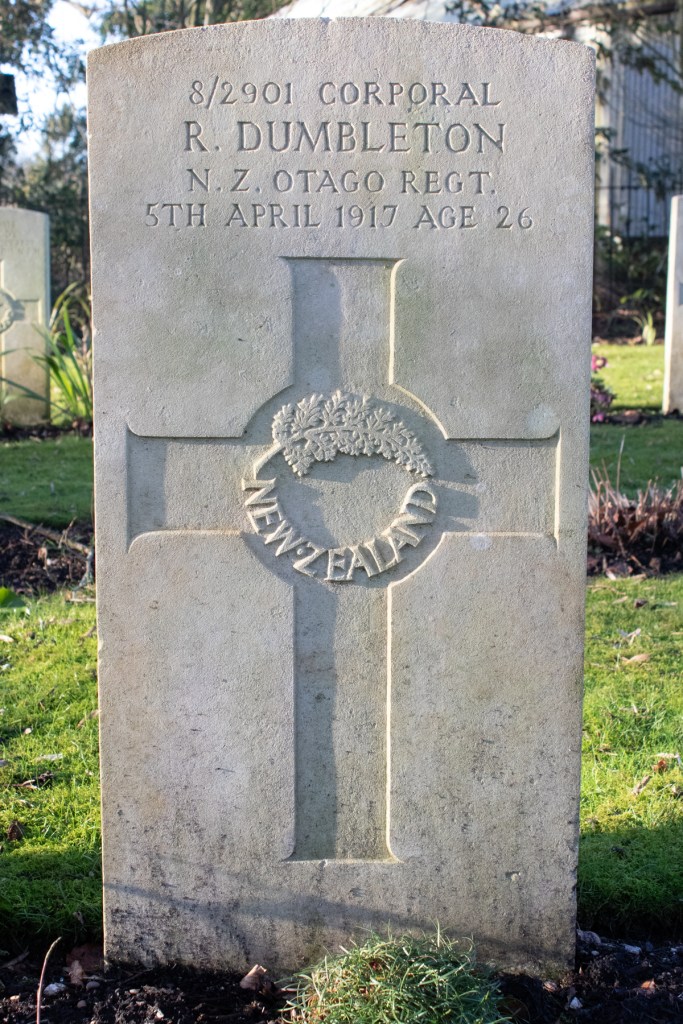
Ronald Dumbleton was born in Pukeuri Junction, New Zealand, at the end of 1890. His parents were William and Lucy, but about his early life, there is very little information.
When he finished his schooling, found work as a telegraphist and, by the time war broke out, he was employed at the Oamaru Post Office. This employment fitted in perfectly with his hobby as a volunteer in the Signal Company.
Ronald enlisted in the Otago Regiment of the New Zealand Infantry on 13th June 1915. His service records show that he was 5ft 8ins (1.73m) tall and weighed 140lbs (63.5kg). An Anglican by faith, he had black hair, dark eye and a dark complexion.
Assigned to the 7th Battalion, Private Dumbleton’s unit set sail for Europe towards the end of the year and, after a few weeks in Egypt, Ronald arrived in Britain in March 1916. His previous military service stood him in good stead. On 8th July 1915 he was promoted to Lance Corporal, and just six weeks later he had made full Corporal.
In April 1916, Ronald arrived in France. Transferred to the 1st Battalion, he would remain overseas for six months. Caught up in the fighting at the Somme, he was injured in his left arm and shoulder and medically evacuated to Britain for treatment. Corporal Dumbleton was admitted to the 1st Southern General Hospital in Birmingham, and remained there for a month.
In November, Corporal Dumbleton transferred to a hospital in Hornchurch, Essex. He then seems to have been moved to the ANZAC base near Codford, Wiltshire, for his ongoing recuperation. He was given two weeks’ leave in January 1917, returning to the base towards the end of the month.
At this point, Ronald’s trail goes cold. He remained based in Codford, possibly as he was not yet fit enough to re-join his unit on the Western Front. While in camp, however, he fell ill, passing away on 5th April 1917. He was 26 years of age.
Thousands of miles from home, Ronald Dumbleton’s body was laid to rest in the extended graveyard of St Mary’s Church in Codford, not far form the base which he had called home.
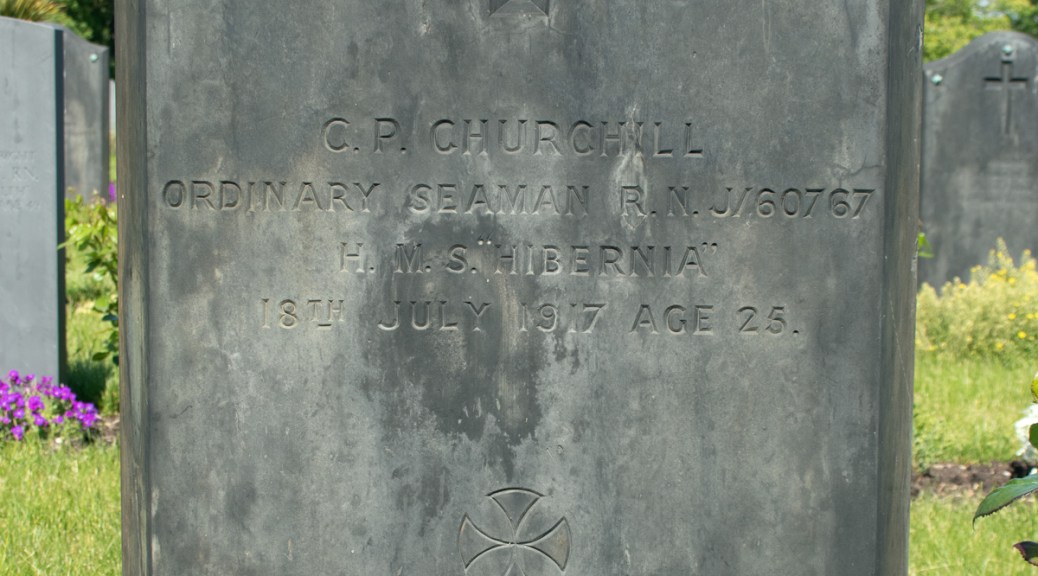
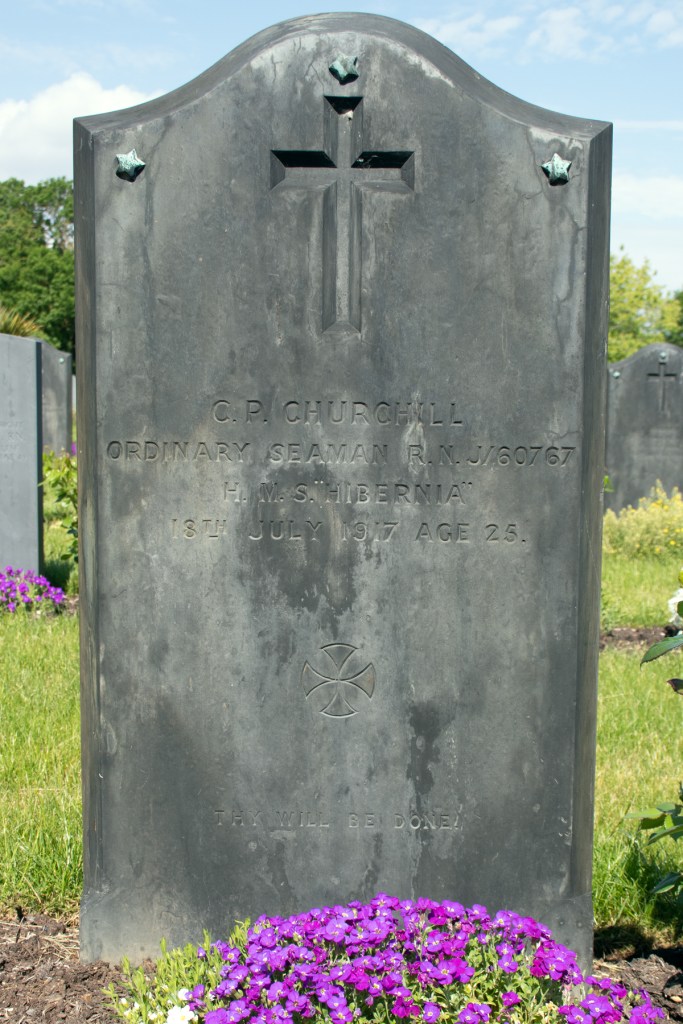
Charles Percival Churchill was born on 31st January 1892 in Marylebone, London. The oldest of three children, his parents were Charles and Annie Churchill.
Charles Sr was a farrier, and was 18 years his wife’s senior. When he died in 1904, at the age of 54, Annie got married again. At this point, Charles Jr found work as a houseboy to John and Florence Cassley-Whitaker, a couple living on their own means in Frinton-on-Sea, Essex.
When war came to Europe, Charles would be called upon to play his part. Conscripted in the autumn of 1916, he enlisted in the Royal Navy, and was given the rank of Ordinary Seaman. His service records show that he was 5ft 6.5ins (1.69m) tall, with brown hair, blue eyes and a dark complexion.
Ordinary Seaman Churchill was initially sent to HMS Pembroke, the Royal Naval Dockyard in Chatham, Kent, for training. He remained there until March 1917, when he was assigned to the battleship HMS Hibernia. Part of the Nore Command she helped patrol the Thames Estuary and protect the north Kent coast.
Charles’ time at sea was not to be a lengthy one. In July 1917 he was admitted to the Royal Naval Hospital in Chatham, Kent, having contracted anthrax. The condition was to ravage his body, and he died on 18th July: he was 25 years of age.
The body of Charles Percival Churchill was laid to rest in Woodlands Cemetery, Gillingham, Kent, not far from the naval base he had so briefly called home.
It was reported to the Chatham Town Council on Wednesday that a fatal case of anthrax had occurred at the Royal Naval Hospital. The deceased bought and used a cheap shaving brush from a shop in the borough, and a similar brush purchased at the same shop for experimental purposes was found at the Royal Naval Laboratory to contain a bacillus similar to the anthrax bacillus. The Medical Officer took possession of the whole of the stock of brushes and sent some to the County Council Laboratory and others to the Local Government Board for examination. Some of the brushes had been found to contain anthrax spores, and further tests were being made.
South Eastern Gazette: Tuesday 18th September 1917
While Ordinary Seaman Churchill’s name is not mentioned in the article, the severity of the condition, and the timing of the report would suggest that this was how Charles had met his fate.
Charles John Crane was born in Canning Town, Essex, on 14th April 1879. One of at least five children, his parents were Charles and Sarah Crane. Charles Sr had been born in Bath, Somerset, but was working in London as a hairdresser when he met his wife, and settled in West Ham. The family lived in rooms at 52 Burnham Street, sharing the house with Sarah’s parents, Daniel and Rebecca King, and siblings.
By the time of the 1891 census, the family set-up had changed. Charles Jr was now living with Daniel and Rebecca at 56 Burnham Street, but his parents and siblings are nowhere to be found. Daniel was a dock labourer, and his job seems to have ignited a passion for the sea that was to direct his grandson’s life.
Charles took to a life at sea, working his way up to the rank of Master, and settling in the Montrose area of Scotland. He married Margaret McIntosh, and they went on to have six children.
When war broke out, Charles was assigned to the SS Innescroone, and served his time on board during the conflict.
FATAL BLOW WHILE WORKING AN ANCHOR.
An inquest was held at the Royal Naval Hospital, Gillingham, into the circumstances attending the death of Charles John Crane, aged thirty-nine, master of the s.s. Innescroone. The deceased met with an accident on the 8th inst. while working the anchor of his vessel, and was removed to the hospital, where he died from the injuries he sustained on 12th inst.
The Coroner (Mr. C. B. Harris) remarked that the deceased’s vessel was at sea, so that it would not be possible to conclude the inquiry that day, as witnesses from the ship would have to be called. Only necessary evidence would be taken, and the inquest would be adjourned. Evidence of identification was given by Mrs Crane, who stated that her husband was conscious when she saw him at the hospital, but he was in too bad a condition to tell her anything about the accident.
Surgeon Percy Gibson, R.N. stated that the deceased was admitted to the hospital from Sheerness, suffering from a blow in the stomach, which he received owing to the winch handle flying back. He was suffering from severe shock. He was operated on the same morning. He had ruptured a small intestine. Peritonitis set in, and he died on Sunday (12th inst.) from rupture of the intestine and general peritonitis. There was a bruise on the abdominal wall just over where the rupture was found, which showed that it was due to the accident.
At the adjourned inquest, the mate (Boynton) gave evidence as to the cause of the mishap. It appeared that the Inniscroone was lying at anchor near the Edinboro’ Channel on the morning of May 8. There was a strong wind blowing either from the north-east or the south-east. It was desired to heave the anchor, but owing to the strong wind the motor failed. In consequence it was intended to use hand power for the purpose. The winch handle was fitted to the winch, but the actual heaving process by hand had not commenced. Owing to a lurch of the ship the grip holding the anchor chain came open, and this sudden strain broke the pivot and part of the frame of the winch’s pawl. As a result the chain started, and many fathoms ran out. In revolving at high speed the winch handle flew off and struck deceased a blow in the stomach, knocking him down. He was attended to by the ship’s doctors, who were called, and admitted to the Sheerness Sickquarters in the afternoon of that day, and removed the next day to the Royal Naval Hospital, Chatham.
The jury found death to be due to peritonitis caused by the accidental blow from the flying winch handle.
The deceased, who belonged to London, had been resident in Montrose for the past sixteen years, and leaves to mourn his loss his widow and a family of six, who reside at 12 Gibson Place. For seven years he sailed on the local ketch Spartan. Full naval honours were given to his burial, which took place on 16th inst. to Gillingham Cemetery, Kent.
[Montrose Standard: Friday 31st May 1918]
Charles John Crane was 39 years of age when he passed away. He was laid to rest in the naval section of Woodlands Cemetery in Gillingham, Kent.
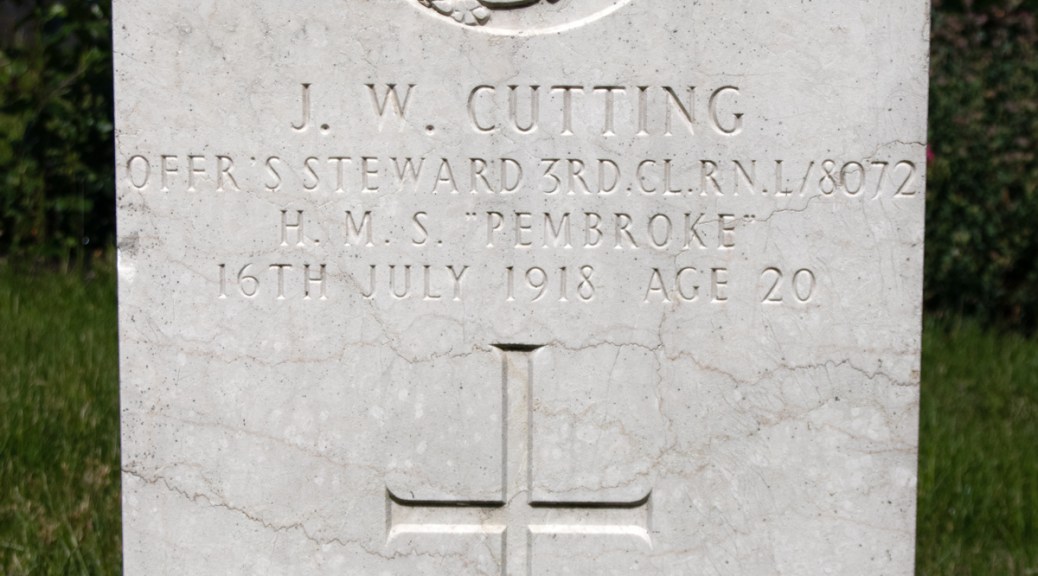
Joseph William Cutting was born on 10th September 1897 in Stratford, Essex. The middle of three children, his parents were Alfred and Clara. Alfred was a stoker in a carpenter’s workshop, but when he completed his schooling, his son found work as a clerk.
When war broke out, Joseph stepped up to play his part. He enlisted in the Royal Navy on 22nd September 1915, joining as an Officer’s Steward 3rd Class. His service records show that he was 5ft 8ins (1.72m) tall, with dark brown hair, blue eyes and a fresh complexion. He was also noted as having a scar in the middle of his forehead.
Officer’s Steward Cutting was based at HMS Pembroke, the Royal Naval Dockyard in Chatham, Kent, and would continue in his role for the next two and a half years. His annual review recorded a very good character, and moderate to satisfactory ability, which may be why he did not rise above his junior rank.
In the summer of 1918, Joseph was admitted to the Royal Naval Hospital in Chatham, suffering from tuberculosis. The lung condition was to prove his undoing, and he succumbed to it on 16th July 1918. He was just 20 years of age.
Joseph William Cutting was laid to rest in the naval section of Woodlands Cemetery in Gillingham, Kent, not far from the base he had called home for so long.
William Feldon was born on 16th October 1878, the middle of three children – and the only son – to William and Jessie Feldon. William Sr was a carpenter from Highgate, Middlesex, but it was south of the Thames, in Lambeth, Surrey, that the family were raised.
When he finished his schooling, William Jr found work as a general labourer. He was drawn to bigger and better things, however, and a life at sea was to catch his eye. In June 1894, he enlisted in the Royal Navy as a Boy 2nd Class. His service records noted that he was 5ft 2ins (1.57m) tall, with brown hair, brown eyes and a fresh complexion.
By the time William had completed his initial training, he had been promoted to Boy 1st Class. He was then moved to HMS Pembroke, the Royal Naval Dockyard in Chatham, Kent.
By October 1895, he was given his first posting, on board the torpedo cruiser HMS Archer, and he would remain assigned to her for the next two years. During this time, William came of age and was formally inducted into the Royal Navy, and was given the rank of Ordinary Seaman. His commitment to the service was pretty clear, and, within seven months he had been promoted again, to Able Seaman.
After a short spell back at Pembroke, William was assigned to HMS Wildfire, another shore establishment just along the coast in Sheerness. He remained there for nine months, during which time he was promoted again, to the rank of Leading Seaman.
In May 1899, William was moved to another posting, on board the gunboat HMS Partridge. This assignment provide him with the route to further promotion: he remained on board until July 1901, having risen to Petty Office 2nd Class on 1st July 1899 and Petty Officer 1st Class on 23rd September 1900.
Over the remainder of his initial term of service, William served on six further vessels. The sea was in his blood by this point, and when his contracted ended on 15th October 1908, he re-enlisted without any hesitation.
Away from the Navy, William fell in love. On 23rd October 1909, he married Ada Plumpton, who was 25 years old, and who lived in Battersea, Surrey. The couple exchanged vows at St Faith’s Church in Southwark, but settled down in the village of Dovercourt, Essex. They went on to have two children, Doris, who was born in 1910, and Elsie, who came along the following year.
Back at sea, Petty Officer Feldon was assigned to the cruiser HMS Boadicea. He spent two years on board, before moving to another cruiser, HMS Blonde, for another two years. In between voyages, William returned to the Royal Naval Dockyard in Chatham.
On 13th January 1914, Petty Officer Feldon was posted to the battleship HMS Formidable, part of the Channel Fleet patrolling the seas of the southern coast of Britain.
Early on the morning of 1st January 1915, while off the Dorset coast, she was torpedoed by the German submarine U-24. Other ships in her convoy came to help, but after a couple of hours – and another torpedo strike – the damage was too great and she sank. 120 members of the crew were saved, but more than 540 officer and crew – including Petty Officer Feldon – were lost. He was 36 years of age.
William Feldon’s body was one of those recovered and identified. He was laid to rest in a communal grave in Lyme Regis Cemetery, in the hills above the Dorset town where he had been brought ashore.
Horace Frank Bernthall was born in Clapton, Middlesex, on 19th February 1893. One of twelve children, his parents were Henry and Ellen. Henry was a general labourer, and this is work into which his sons followed.
By the time of the 1911 census, the Bernthall family were living on Folly Lane in Walthamstow, Essex. Henry and Ellen were sharing three rooms with six of their children – of which Horace was the eldest. The census return confirms that, of their twelve children, four had died by this point. Three of the family were working – Henry, Horace and another sibling, 16 year old Arthur.
Horace set his sights on bigger and better things, and on 30th August 1912, he enlisted in the Royal Navy. He took up the role of Stoker 2nd Class, his records confirming that he was 5ft 5ins (1.65m) tall, with brown hair, grey eyes and a fresh complexion.
Stoker Bernthall was initially sent to HMS Pembroke, the Royal Naval Dockyard in Chatham, Kent, for his training. He remained there for the next five months, before being assigned to the pre-dreadnought battleship HMS Formidable. She was to remain his home for the nest two years, and was where he gained promotion to Stoker 1st Class in August 1913.
HMS Formidable was attached to the Channel Fleet, primarily guarding the waters separating Britain from France. Early on the morning of 1st January 1915, while off the Dorset coast, she was torpedoed by the German submarine U-24. Other ships in her convoy came to help, but after a couple of hours – and another torpedo strike – the damage was too great and she sank. 120 members of the crew were saved, but more than 540 officer and crew – including Stoker 1st Class Bernthall – were lost. He was just 21 years of age.
Horace Frank Bernthall’s body was one of those recovered and identified. He was laid to rest in a communal grave in Lyme Regis Cemetery, in the hills above the Dorset town where he had been brought ashore.
The spelling of the family surname varies across the documents that cover Horace’s life – Bernthal, and Burnthall being two other suggestions – but I have gone with Bernthall, as that is what is recorded on his baptism record.
Harold Stanley Randall was born in Taunton, Somerset, in the autumn of 1898. One of twins, his parents were Joseph and Elizabeth Randall. Joseph was a carpenter, and when Elizabeth died in 1900, he was left with nine children to raise on his own. This led to Harold being raised Joseph’s brother and sister-in-law, George and Caroline, and he is noted as living with them in Bath, Somerset, in the 1901 and 1911 censuses.
There is little direct evidence of Harold’s life: at the time of the 1911 census he was still at school, so it is not clear what employment he took up once his education came to an end. When war broke out, he played his part, and had enlisted in the Gloucestershire Regiment by the summer of 1918.
Private Randall was attached to the 17th Battalion, a territorial force based in Essex. By the end of the war, Harold was billeted in St Osyth, and it was here that he fell ill. Details of his condition are lost to time, but his health was impacted enough for him to be admitted to the general hospital in Colchester.
Harold Stanley Randall’s illness was to get the better of him. He passed away on 7th December 1918, aged just 20 years old. His body was brought back to Somerset for burial, and he was laid to rest in Bath’s sweeping Locksbrook Cemetery. His next of kin was noted as his aunt Caroline, who had raised him from a toddler.