Robert Carroll was born on 15th October 1874 in Ballymena, Co. Antrim. He was one of three children to Henry and Mary Ann Carroll.
There is little additional information about his early life, but, on 6th April 1896, he married a woman called Martha Keenan. Robert was a plasterer at the time of his wedding, and the couple went on to have four children. Tragically, the youngest, Robert Jr, was just five months old when he passed: even worse, Martha was to die just weeks later, in June 1908.
With three children to raise, the grieving Robert married again, wedding Sarah O’Hara in October 1909. They were to have a son together, another boy they called Robert, the following year.
When war came to European shores, Robert stepped up to play his part. He enlisted in the Royal Irish Regiment and was assigned to the 1st Battalion. By September 1915, Private Carroll was sailing for the Eastern Mediterranean, where he was to remain for more than a year.
Little further information is available for Robert’s life. He was discharged from the army on 27th April 1917. As his service records no longer remain, it is not possible to determine why he left the army, but is likely to be as a result of illness or injury.
Robert returned to Northern Ireland, and his trail goes cold. All that can be confirmed is that he passed away at home on 7th August 1919, at the age of 44 years of age.
Robert Carroll was laid to rest in Crebilly Cemetery, on the hills outside Ballymena.
Edward John Browning was born in the autumn of 1897 in the Somerset village of Over Stowey. The youngest of five children, his parents were blacksmith-turned-farmer John Browning and his wife, Alice.
By the time of the 1911 census, the family had moved to nearby Colepool Farm in Stogursey. Edward’s older brothers were all supporting their father on the farm, while, at 13 years of age, he was still to complete his schooling.
Details of Edward’s military life are scarce. When war broke out he enlisted, and joined the 3rd (Reserve) Battalion of the Somerset Light Infantry. His troop served on home soil, moving to Derry/Londonderry, Northern Ireland, by November 1917, and Belfast by the following spring.
Private Browning survived the conflict but had fallen ill by the summer of 1919. He was admitted to the Purdysburn Military Hospital in Belfast. He was suffering from cerebrospinal meningitis, and this was to claim his young life. He passed away there on 9th July 1919, at the age of just 21 years old.
The body of Edward John Browning was brought back to Somerset for burial. He was laid to rest in the peaceful graveyard of St Andrew’s Church in Stogursey.
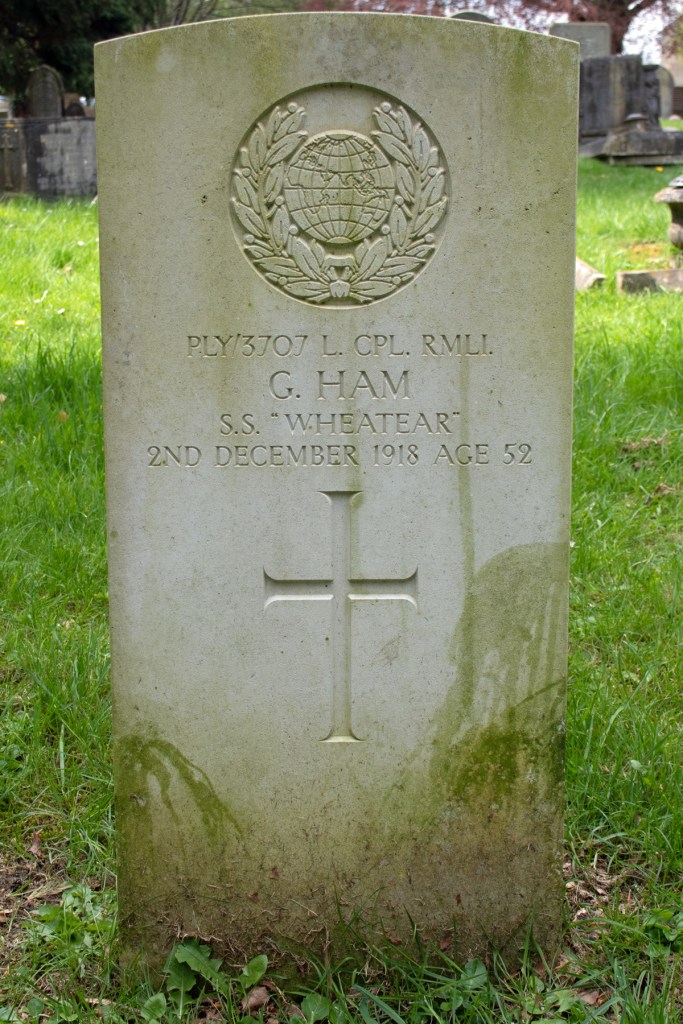
George Ham was born on 19th December 1867 in Twerton, Somerset. His parents were George and Emily Ham, and he was the oldest of their nine children. George Sr was a mason, and initially his first born followed suit, but he was pulled towards something bigger and better and, on 19th January 1886, he enlisted in the Royal Marine Light Infantry.
George’s service records note that he was 5ft 6ins (1.68m) tall, with brown hair, grey eyes and a fresh complexion. He was initially sent to the barracks at Walmer in Kent, and it was from here that Private Ham began a 21 year career in the Royal Marines. Over that time, he served on seven separate ships, and, between voyages, he was based in barracks in Plymouth, Devon. Both his character and ability were consistently noted as being very good.
Private Ham’s career took him around the world and, in 1887, he found himself on the gunboat HMS Banterer, on which he served for three years. His tour of duty included a period of time in Galway, Ireland, and it was here that he met Mary Ann Goode. On 5th July 1889, the couple married in city’s St Nicholas’ Church. The church’s records suggest that the couple went on to have four children – Frederick George; Emily, who died just after her first birthday; Albert; and Katherine.
George’s records from this point become a little disjointed. In October 1890, he returned to his Plymouth base, and the following year’s census recorded him as living in the East Stonehouse Barracks, although his marital status was noted as single.
The next census, in 1901, presents a different picture. George and Mary were, by this time, living in family barracks in East Stonehouse, with two children, (Frederick) George and Albert. Katherine, the couple’s youngest child, was born the following year.
In January 1907, after more than two decades’ service, George was stood down from active service in the Royal Marines. He was placed on reserve status, and took up work as a mason once more. At this point, however, the family seemed to have hit more troubled times, underlined by four separate 1911 census documents.
George, who was 44 by this point, was recorded as being an inmate in the Bath Union Workhouse and Infirmary in Lyncombe, Somerset. Mary and Katherine, meanwhile, were in two rooms in a house in Stonehouse, Devon. Frederick, who was now better known as George, had followed his father into military service, and was a Private in the Royal Marine Light Infantry, serving on HMS Colossus. Albert, who was 13 years old, was one of 946 students boarding at the Royal Hospital School for Sons of Seamen in Greenwich, London.
George spent nine years in the reserves, and, in 1914, was called up again for war service, this time as a Lance Corporal. According to a contemporary newspaper:
[He was] engaged on naval patrol work against submarines off the Canadian coast and elsewhere, and was in charge of a gun on an armed merchant ship. Once the boat he was on was torpedoed, and on another occasion he had a long running fight with a submarine in the Irish Channel. The ship, however, reached Portrush (Ireland), and the inhabitants gave Lance-Corporal Ham a testimonial, and he was also rewarded in other ways, the Cardiff owners of the vessel recognising his skill and gallantry.
Bath Chronicle and Weekly Gazette: Saturday 7th December 1918
Tragedy was to strike in the end, however, and George was to meet a sad end to a distinguished career.
While at Cork [George] fell, either from a boat or the dock, and sustained an injury to the side of his head. It did not appear very serious, and it is understood that he made a trip to Cardiff and back to Londonderry, [where] he became so seriously ill as to necessitate his going to a military hospital in Londonderry. Hemorrhage [sic] of the brain set in, and he died on Monday [2nd December 1918] before his brother, Mr Albert Ham, who had been telegraphed for, could reach him.
Bath Chronicle and Weekly Gazette: Saturday 7th December 1918
Lance Corporal George Ham was days short of his 51st birthday when he died. His body was brought back to Somerset for burial, and he was laid to rest in Twerton Cemetery. The newspaper report give no indication as to whether Mary or their children were in attendance and, in fact, does not mention his wife and family at all.
Alexander Maguire was born on 28th March 1880 in Glenarm, County Antrim, Northern Ireland. Little is known about his early life, apart from his parents’ names – James and Ellen.
Glenarm is a coastal village, and it is likely that Alexander would have had experience of seafaring from an early age. This seems to have spurred him into building a career and, on 16th December 1903, he enlisted in the Royal Naval Reserve as a Stoker.
With war getting closer, Stoker Maguire was called into formal service, and was assigned to the steamer SS Rathlin Head. He sailed the Atlantic in March 1914, and disembarked an New Orleans. It seems, however, that he missed his passage back home, although at this point, his whereabouts become a bit hazy.
Alexander was back in Britain by 13th January 1915, as his service papers record him in Liverpool. He then travelled to HMS Pembroke, the Royal Naval Dockyard in Chatham, Kent. This looks to have been his last move, however, as he passed away just two days later. The cause of death is simply recorded as ‘disease’: he was 34 years of age.
Alexander Maguire was laid to rest in the Roman Catholic section of Woodlands Cemetery in Gillingham, Kent, not far from the dockyard to which he had been assigned.
Much of Joseph Collins’ life is destined to remain a mystery. He was born in Northern Ireland on 8th November 1897, and was the son of William and Minnie Collins, who lived near Lurgan, in Armargh.
When war broke out, Joseph enlisted, joining the 16th (Service) Battalion – the 2nd County Down Pioneers – of the Royal Irish Rifles. Formed in Lurgan, the regiment moved from Northern Ireland to Seaford in East Sussex in July 1915. By that October, Rifleman Collins found himself on the Front Line in Northern France.
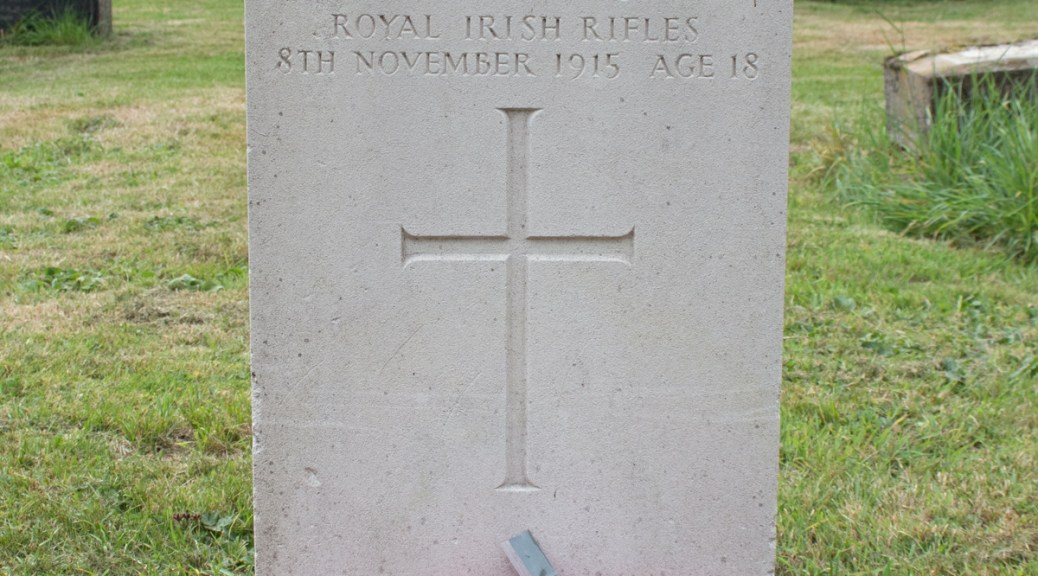
Joseph was invalided on 26th October, and medically evacuated to Britain for treatment. Admitted to the Brynkinalt Hospital in Chirk, Denbighshire, he was operated on, but this was to prove insufficient, and he passed away from his injuries on 8th November 1915 – his eighteenth birthday.
Rifleman Collins was well thought of in his regiment, as the comments in the Lurgan Mail [Saturday 20th November 1915] confirmed. Captain HF Sheppard, who commanded Joseph’s Company, noted “I need hardly say I was shocked, as I thought when he left us that the operation necessary for his complaint was certain to prove successful. I had always been attracted by his cheerful temperament, and I was always keenly interested in him as he was one of the first to join my Company.“
Lieutenant E Somerfield noted that Joseph “was a great favourite with the rest of his platoon, and a boy I had great regard for. I can assure you we all feel his loss very keenly.“
The most touching comments, however, come from one of Joseph’s colleagues, Rifleman R McKeown: “I am sending you these few lines to let you know I got a letter today which Joe wrote before he died. The nurse found it in his locker and sent it on to me I am sending you a copy of it and the nurse’s letter. I was never so badly struck in my life as when I heard of his death, for his could not have grieved me more has it been my own brother. The day he went away I never got bidding him good-bye, for the morning he went on the sick list I was on parade, and when I came in he was away. The boys in the platoon and company he was in were all greatly grieved at hearing about his death. You have my sincerest sympathy in your trouble. I don’t know how I am ever going to go home – if I ever do – without him. He was like a brother to me.“
Unable to bring their son back to Ireland, William and Minnie had to be content with the fact that their son was given a military funeral in the town where he died. Joseph Collins was laid to rest in the graveyard of St Mary’s Church in Chirk.
George Boyd was born in Belfast, Northern Ireland on 1st May 1890, although further information about his early life is not available.
What can be confirmed is that George enlisted in the Royal Navy on 8th September 1908 as a Stoker 2nd Class. He had been working as a labourer for shipbuilder Workman Clark, when the opportunity to better himself was presented. His service records show that he was 5ft 3ins (1.60m) tall, had light brown hair, grey eyes and a fresh complexion. He was also noted as having a tattoo of a compass and square on the back of his left hand.
Over the five years of his service, Stoker Boyd served on five different ships, returning each time to what would become his base, HMS Pembroke, also known as the Royal Naval Dockyard in Chatham, Kent. During his time, he was also promoted to Stoker 1st Class.
When his five years’ service was up, George was transferred to the reserve ranks, only to be called up again less than a year later, when war broke out. Stoker Boyd’s enthusiasm for the job may have been waning by this point: his previous Very Good character was noted only as Fair when he was re-engaged, and, in July 1915, while based in Chatham, he went absent without leave, a crime than resulted in six weeks’ detention.
Stoker 1st Class Boyd served on a number of ships during his renewed period of service, although he returned to HMS Pembroke between voyages. He returned there for good on 7th August 1917.
That summer was a particularly busy time for the Royal Naval Dockyard: temporary overflow accommodation was put in place at the barracks’ Drill Hall, and this is where George found himself billeted.
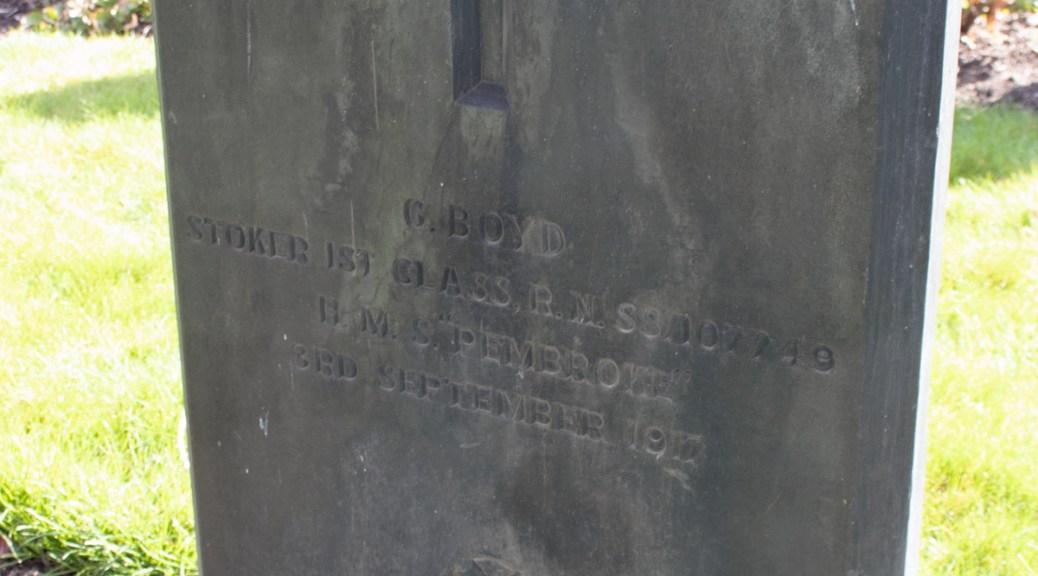
On the night of 3rd September, Chatham came under attack from a German air raid, and the Drill Hall received a direct hit. Stoker 1st Class Boyd was among those to be killed that night. He was 27 years of age.
George Boyd was laid to rest in the Woodlands Cemetery in Gillingham, Kent, alongside the other victims of the Chatham Air Raid. His pension was transferred to his widow, Adelaide Boyd (née Kerr).
Adelaide Kerr was an interesting character in her own right. Born in Belfast on 9th June 1893, she was one of three children to labourer Joseph Kerr and his wife Elizabeth (or Lizzie).
Adelaide married James Stephenson when she was just 17 years old, and five months before the birth of their first child, James Jr. The couple went on to have a second child, Joseph, although he tragically passed away when just a year old.
James also passed away, 27th February 1916, aged just 23 years old. Intriguingly, his place of death is Crumlin Road Gaol in Belfast, but there is no record of why he was imprisoned, nor the cause of his death.
It seems that Adelaide needed support and, within a few months of James’ death, she had married George. After he too died during the air raid, she went on to marry a third time, to Samuel Buller. The couple tied the knot in March 1918, and went on to have a son, William, that September. Tragedy was to strike again, however, when he passed away in December 1923, having just turned five.
There is no further information about Samuel, and time passed for Adelaide as well. She outlived her remaining son, James, who died in Belfast in 1979. At some point Adelaide emigrated – records do not confirm when, nor whether Samuel left Northern Ireland as well – and she passed away, at the age of 90, in the Australian hamlet of Paschendale, some 219 miles (352km) from Melbourne.
Albert Cairns was born on 22nd October 1894, one of ten children to Wilson and Maria Cairns. Both of his parents were born in Northern Ireland, and flax dresser Wilson raised his family in the capital, Belfast.
When he left school, Albert began shop work, but he wanted bigger and better things. On 2nd March 1912, having already been a volunteer in the Royal Inniskilling Fusiliers, he enlisted in the regiment full time. His service records show that he was 5ft 4.5ins (1.64m) tall, weighed 125lbs (56.7kg) and had blue eyes, brown hair and a fresh complexion.
Private Cairns’ army service was brief, however, as, on 23rd March he was discharged for “having made a mis-statement as to [his] age on enlistment.”
Undeterred, six months later, Albert tried again, this time enlisting in the Royal Navy as a Stoker 2nd Class. His determination was clear, as he lied about his age again, giving his year of birth as 1893. This was overlooked (or at the very least not checked), and he was sent to HMS Pembroke, the Royal Naval Dockyard in Chatham, Kent, for his training.
In February 1913, Stoker Cairns was assigned to the cruiser HMS Blonde. He spent the next two years on board, and was promoted to Stoker 1st Class.
For all his desire to serve, Albert’s military career was a chequered one. Over the period of five years, he served on four ships, returning to Chatham after each voyage. His character began as Very Good, but as time went on this slipped to Good and then to Indifferent. On four separate occasions he was detained for going AWOL, and he spent a total of 159 days in the brig.
In May 1917 he returned to HMS Pembroke; that summer was a busy time for the base, and Stoker 1st Class Cairns found himself billeted in overflow accommodation set up in the barracks’ Drill Hall.
On the night of 3rd September, Chatham came under attack from a German air raid, and the Drill Hall received a direct hit. Stoker Cairns was among those to be killed that night. He was 22 years of age.
Albert Cairns was laid to rest in the Woodlands Cemetery in Gillingham, Kent, alongside the other victims of the Chatham Air Raid.
Tragically, Albert was not the first boy of that name to be born to the family. Albert Wilson Cairns was born in 1888, but died when only a toddler.
Wilson and Maria also had three sons called Wilson: the first, born in 1889, died at the age of two. The second was born in 1892, but passed away at the age of seven months.
The third Wilson Cairns was born in 1896. He went on to become a mill labourer, before joining the Royal Inniskilling Fusiliers in February 1913. Just like his older brother had done before him, however, he had lied about his age, and was soon discharged. Two years later he tried again, and this time succeeded in joining up.
Private Cairns was assigned to the 2nd Battalion, and soon found himself in France and in the thick of it. Fighting in the Battle of Ancre, he was killed on 23rd November 1916. He was just 20 years of age, and was laid to rest in the Waggon Road Cemetery near Beaumont-Hamel.
Private Wilson Cairns (from findagrave.com)
The Belfast Telegraph reported on Albert’s death, and noted Wilson’s death ten months previously. It also confirmed that Wilson and Maria’s oldest son, George, had also been wounded, and was recovering in a convalescent camp.
The same newspaper ran a number of messages of condolence for Albert, including one from his loving sweetheart, Katie Rollins.
Stafford Edmund Douglas was born on 4th January 1863, the second of four children to Stephen and Mary Douglas. Stafford came from a military family, his father having been a Captain in the Royal Navy. This led to a lot of travelling and, having been born in Donaghadee, County Down, he then moved to South Wales.
By the 1880s, when Stephen and Mary had set up home in Portsmouth, Stafford had started to carve out a career for himself, and was a Lieutenant in the Argyll and Sutherland Highlanders, based at Edinburgh Castle.
Over the coming years, Lieutenant Douglas, who stood 5ft 8.5ins (1.74m) tall and also spoke French, travelled the world, serving in South Africa, Ceylon (Sri Lanka) and Hong Kong. By 1894 he had made Captain, and he finally retired in 1903, after nineteen years’ service.
On 29th April that year, at the age of 40, Stafford married Mary Louisa Harris. She was the daughter of an army colonel, and the couple wed in St George’s Church, Hanover Square, London. The couple set up home in Exeter, Devon, and went on to have two children – Violet and Stafford Jr.
At this point, Stafford’s trail goes cold. When war broke out in 1914, he was called back into duty, working as a Railway Transport Officer in Norwich. He continued in this role until 1919, before being stood down and returning home.
Stafford Edmund Douglas passed away on 15th February 1920, at the age of 57 years old, although no cause of death is immediately apparent. He was laid to rest in the Milton Road Cemetery in Weston-super-Mare, presumably where his family were, by this time, residing.
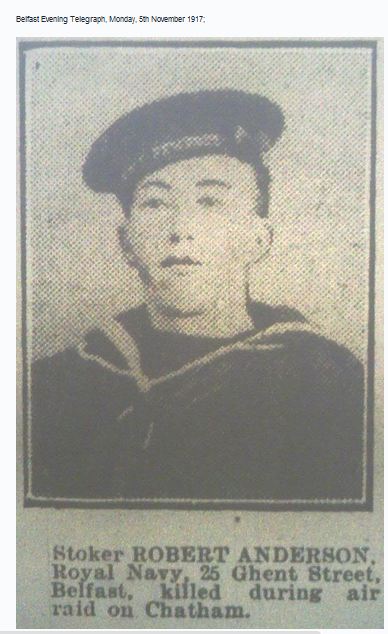
Robert Anderson was born on 4th September 1889, one of ten children – of whom tragically only three survived – to James and Emily Anderson. James was a storekeeper from Belfast, who had moved his family to Preston, Lancashire, but who had subsequently moved them back to Northern Ireland after Robert had been born.
In 1911, while working as a town labourer, Robert had met and married Rebecca Barkley; the couple went on to have to children, Mary and Agnes.
War was coming to Europe, however, and Robert was keen to play his part. He enlisted in the 3rd Battalion of the Royal Irish Rifles and, according to a subsequent newspaper report, saw action at Mons and the Marne early in the conflict.
The Belfast Evening Telegraph reported that “He completed his time, and instead of re-enlisting in the Army, he joined the Navy.” [Thursday 4th October 1917] Given that Robert enlisted in the Royal Navy in the autumn of 1915, this raises the question of how he left the army at the height of the conflict, particularly given that the same report suggests that he had come through the major battles “unscathed“.
Either way, Private Anderson made the move to Stoker 2nd Class on 10th November 1915. He record show that he stood 5ft 5.5ins (1.66m) tall, had fair hair, brown eyes and a fresh complexion. On his arms he sported a number of tattoos; a lady, crossed flags and a ship on his right, and his initials on the left.
Robert’s first posting was HMS Pembroke, the Royal Naval Dockyard at Chatham, Kent, where he received a couple of months’ training. He was then assigned to HMS Egremont, also known as Fort St Angelo in Birgu, Malta, where he spent a couple of months. Stoker Anderson then returned to England, serving at HMS Victory, the Royal Naval Dockyard in Portsmouth, and gaining a promotion to Stoker 1st Class in the process.
By August 1917, he had returned to HMS Pembroke. The Dockyard was particularly busy that summer, and the large number of extra servicemen meant that Robert was billeted in temporary accommodation in Chatham Drill Hall.
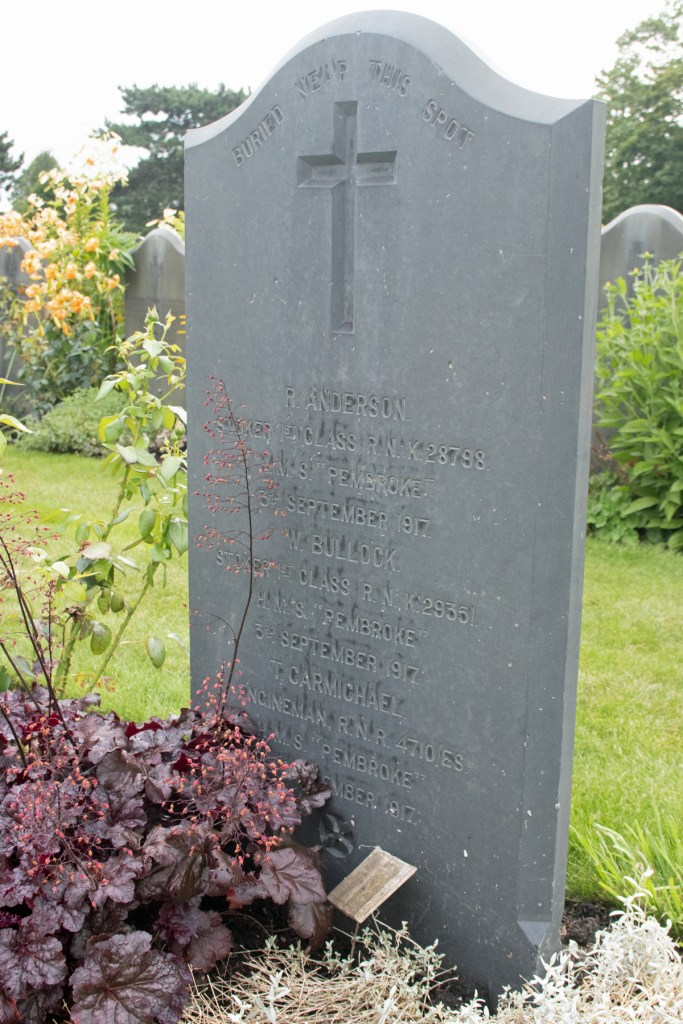
On the 3rd September 1917, the first night air raid carried out by the German Air Force bombarded the town, and scored a direct hit on the Drill Hall; Stoker 1st Class Anderson was among those killed instantly. He was a day short of his 28th birthday.
Robert Anderson was laid to rest, along with the other victims of the Chatham Air Raid, in the Woodlands Cemetery, Gillingham.
Stoker 1st Class Robert Anderson (from findagrave.com)








 Death and Service