Category Archives: Somerset

Gunner Daniel Davies

Gunner Daniel Davies

Daniel Rees Davies was born on 10th August 1887, one of eight children to Daniel and Katherine Rees. Daniel Sr was a coal miner, born in Brecon, South Wales, and it was in Aberdare that the family were born and raised.

By the time of the 1901 census, five of the Davies family were working as coal miners. However, something changed dramatically over the following decade. The next census return, taken in 1911, found Daniel Sr working as a butcher, with Daniel Jr employed as his assistant. The two Daniels and Katherine were living in a six-roomed house with Daniel’s younger brother, Moses, his older sister, Margaret, and her husband, another Daniel.

In the autumn of 1913, Daniel Jr married Daisy Loud. She was a milliner from Bath, and it was in the Somerset city that the couple exchanged their vows. The couple set up home in Bath, and went on to have two children, Maurice and Norman. He continued working as a butcher and, by the time war was declared, he was employed by Larkhall.

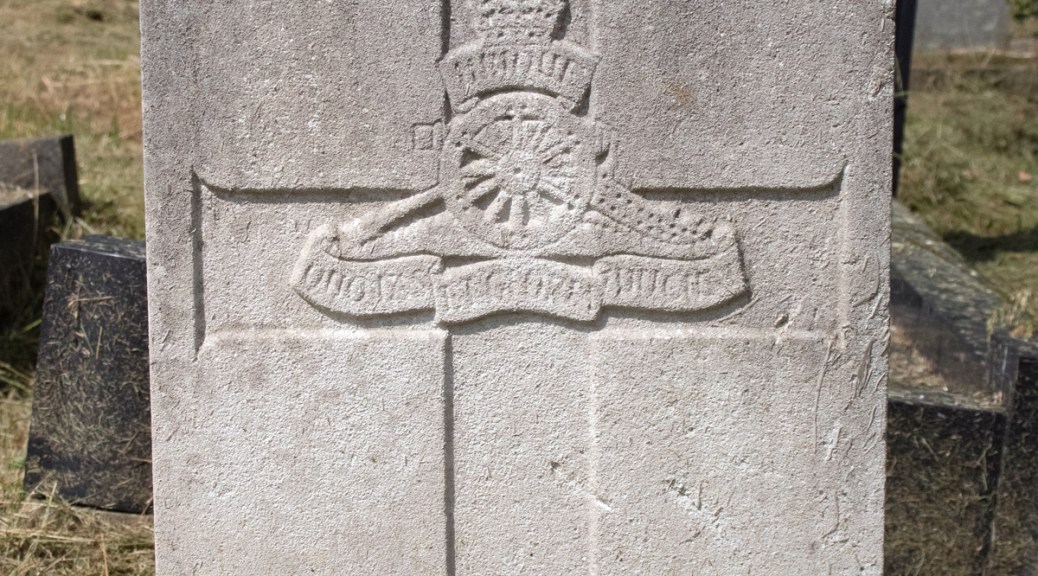
When war came to Europe, Daniel stepped up to play his part. Sadly, full details of his service have been lost to time, but it is clear that he enlisted in the Royal Field Artillery in the spring of 1917 and he was attached to the 88th (Howitzer) Brigade.

Gunner Davies served in Northern France and was badly injured on 3rd June 1918. He was initially hospitalised in Rouen, but then medically evacuated to Britain for treatment. Admitted to Netley Hospital in Hampshire, the wounds he had received to his arm and shoulder were to prove too severe. A telegram was sent to Daisy for her to come to the hospital, but her train was delayed, and she arrived too late to see her husband before he passed away. He died on 17th June 1918, at the age of 30 years old.

The body of Daniel Rees Davies was taken back to Somerset for burial. He was laid to rest in Bath’s majestic Locksbrook Cemetery.


Gunner Daniel Davies
(from ancestry.co.uk)

Ordinary Telegraphist Thomas Morris

Ordinary Telegraphist Thomas Morris

Thomas Henry Morris was born in Bridgwater, Somerset, on 7th September 1898. The oldest of five children, his parents were Christopher and Jemima Morris. Initially a viceman for a carriage works, by the time of the 1911 census, Christopher had moved the family to the Weston area of Bath, where he was employed as an engineer’s fitter for a printing firm.

When Thomas – who was better knows as Harry – finished his schooling, he found work at a printer’s – Messrs. Goodalls in Westgate Buildings, Bath. In the summer of 1915, he enlisted in the Royal Navy as an Signaller.

He was then appointed to HMS Valiant, and was serving in this ship at the Battle of Jutland. As a result he was the victim of shell-shock, and totally unfitted for further active service. By this time he had passed his exams and had qualified as a telegraphist. After recovering he was put on the staff of the Admiral commanding the Orkney Island base, but nominally attached to HMS Cyclops…

[Bath Chronicle and Weekly Gazette: Saturday 1st March 1919]

It was while Ordinary Telegraphist Morris was serving on board Cyclops, he fell ill, contracting a combination of influenza and pneumonia. He was transferred to the Hospital Ship Agadir, but succumbed to the conditions on 21st February 1919. He was just 20 years of age.

Thomas Henry – Harry – Morris, was brought back to Somerset for burial. He was laid to rest in the sweeping grounds of Bath’s Locksbrook Cemetery.


Ordinary Telegraphist Harry Morris
(from britishnewspaperarchive.co.uk)

Gunner William Woodward

Gunner William Woodward

William Percy Walker Woodward was born on 18th November 1879, and was the third of six children to James and Mary Woodward. James was a manufacturer of sanitaryware and had been born in Derbyshire, but it was in Ashby-de-la-Zouch, Leicestershire that he and Mary raised their family.

James passed away in the spring of 1886, leaving Mary to raise the family on her own. His obituary in the local media underlined the business that he had built up: “Mr Woodward succeeded his father and eldest brother to the fire brick business, established by the late Mr John Hunt of Swadlincote, of 1790.In 1856 Mr Woodward added to the above trade that of glazed sewerage pipe and terra cotta earthenware, and in 1873 that of general sanitary appliances, and by industry, perseverance, and foresight developed the same into one of the largest manufactories of the kind in the Midland counties, and became well known throughout the greater part of the kingdom as a leading manufacturer of these goods. He was a large employer of labour, kind and considerate, always manifesting great interest in the welfare of his employees.” [Hinckley News – Saturday 15 May 1886]

Mary was left to raise six children, but, thanks to the business, did not do so without support. The 1891 census found the family living at High Fields in Ashby, with a cook, housemaid, children’s maid and a coachman and his family living next door. William and his siblings were all taught at home by their governess.

By the time of the next census, William seemed to have taken on the running of his late father’s business, along with two of his brothers, James and Harold. Things were to change for the Woodward family, however, as they began to go their separate ways.

The 1911 censes shows a divide: James was living on his own means in Snarestone, Leicestershire, with his young family and household retinue. Harold, meanwhile, had emigrated to Canada with another sibling, younger brother Ernest, where they had both set up as farmers.

Mary had also moved, setting up home in Weston-super-Mare, Somerset. She lived on Clarence Road South with William and her daughter, Lilian. The house – Glencathara – was twelve-roomed property, and they had a live0in cook, Emily Young, supporting them. Notably, William’s employment was listed as ‘none, on account of health’, so the move to the coast may have been brought about for medical reasons.

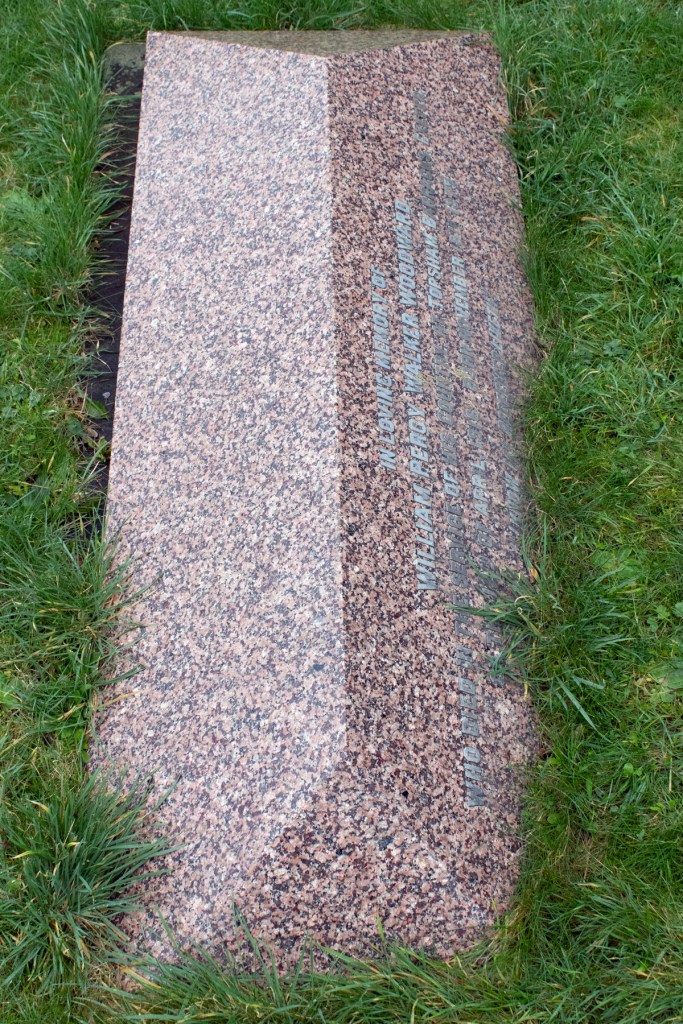
When war came to Europe in summer of 1914, William stepped up to play his part. His service records have been lost, but he had enlisted in the Royal Field Artillery no earlier than the autumn of 1915. He was attached to the 18th Reserve Battery, and came to be based in Topsham Barracks in Exeter.

Little is known of Gunner Woodward’s time in the army, but it was to be brief. He passed away, through causes unknown, on 13th April 1916, at the age of 36.

It is unclear where Mary was living at this point. The body of William Percy Walker Woodward was taken to Dorset for burial, and he was laid to rest in the peaceful graveyard of St Hippolyte’s Church, in Ryme Intrinseca. Interestingly, the parish records note that William was ‘a personal friend of [the] rector’.


Private Henry Weakley

Private Harry Weakley

Henry Weakley was born in 1885 in Bath, Somerset. The second of six children, he was the eldest son to James and Fanny. James was a cab driver, and Henry – who was better known as Harry – followed suit, becoming a coachman by the time of the 1901 census.

In 1910, Harry married a woman called Jennie. There is little information available about her, but the following year’s census return found the couple living with his family at 1 Cork Street, Bath, not far from the city’s Royal Crescent. The census had two records for that address, which confirmed the family’s living arrangements. Harry and Jennie had one room, while the rest of the Weakleys – James, Fanny, four of their children and a grandson – took up four rooms.

Harry was still employed as a coachman as this point, but, with war on the horizon, things were to change. Full details of his military service are lost in the mists of time, but it is clear that he enlisted in the Somerset Light Infantry, and that he was assigned to the 3rd (Reserve) Battalion.

Private Weakley’s unit was a territorial battalion and it remained on UK soil throughout the war. Initially based in Devonport, Devon, the 3rd moved to Londonderry, Northern Ireland, in November 1917, and Belfast the following April. Sadly, the little that remain of Harry’s records do not confirm where he served.

Harry was demobbed on 13th May 1919: his pension ledger notes that he had received gun shot wounds to his neck and back, although no further records identify when or how these injuries occurred. He returned home – 5 St George’s Buildings, Upper Bristol Road, Bath – and seems to have settled back into his pre-war life, although his health was still impacted.

Harry passed away at home on 27th March 1921. He was 36 years of age, and had died of heart failure. Despite his wartime injuries, the war office determined that his condition had been contracted after his army service: Jennie was denied a war pension.

Henry “Harry” Weakley was laid to rest in Bath’s sweeping Locksbrook Cemetery, not far from where his widow still lived.


Private William Pollard

Private William Pollard

William Pollard was born at the end of 1887, the youngest of seven children to John and Alice Pollard. Agricultural labourer John hailed from Hinton Charterhouse in Somerset, while his wife was from Southampton, Hampshire. The family were living in the village of Buckler’s Hard when William was born, but moved back to Somerset when he was just a toddler.

As with most of his siblings, William followed in his father’s footsteps when he completed his schooling. By the time of the 1911 census, only he and his older brother Thomas we still living in the family home: the two siblings were working as carters, while their father, now 61 years of age, was a general labourer.

Alice died in the summer of 1911, and would net get to see her youngest boy wed. On 11th April 1914, William married Augusta Loveless, a carpenter’s daughter from Bath. The couple were living in 2 Rossini Cottages, on Hedgemead Road, to the north of the city centre, and would go on to have two children, William Jr and Geoffrey.

When war was declared, William was called upon to play his part. He enlisted in the Somerset Light Infantry on 30th November 1915, but soon transferred over to the 5th (Service) Battalion of the Dorsetshire Regiment. Attached to the 673th Labour Company, while his unit served at Gallipoli and in France, there is no evidence that Private Pollard spent any time overseas.

William’s brother Thomas had also been called up. He joined the Somerset Light Infantry, and, as a Private, was attached to the 1st Battalion. His unit fought at the Somme, and Thomas was badly injured. He died of his wounds, and was laid to rest in the Puchevillers British Cemetery. He was 31 years of age.

In fact, William seems to have been dogged by ill health. Full service records have been lost to time, but he was medically discharged from the army on 12th September 1917.

John had died that February, at the age of 68 years old, and was laid to rest next to his wife in St John the Baptist Church, Hinton Charterhouse.

At this point, William’s trail goes cold. He returned to Bath, and spent at least some time in the city’s War Pensions Hospital. His condition warranted an operation, but he died of heart failure following the procedure on 12th December 1920. He was 33 years of age.

William Pollard was laid to rest in Bath’s sweeping Locksbrook Cemetery.


Serjeant Herbert Fleming

Serjeant Herbert Fleming

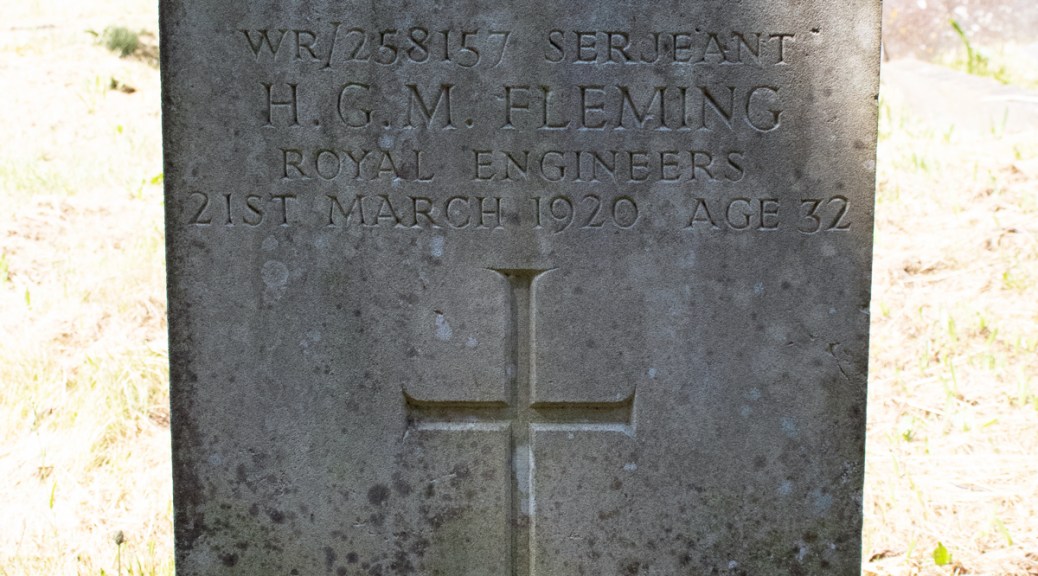
Herbert Gordon Maurice Fleming was born in Stockton, Wiltshire, on 24th March 1888. An only child, his parents were carpenter and wheelwright George Fleming and his wife, Annie.

Little further information is available about Herbert’s early life. On 25th June 1910 he married Ethel Young, a shepherd’s daughter from Wiltshire: they would go on to have four children, Herbert Jr, Ivy, George and Harold.

Herbert’s marriage certificate noted that he was employed as an engine driver. In his spare time, he also volunteered for the Wiltshire Regiment. When war broke out in the summer of 1914, he was called upon to play his part, and was formally mobilised in July 1916.

Sapper Fleming joined the Royal Engineers. His service records show that, at 28 years of age, he stood 5ft 7.5ins (1.71m) tall, and weighed 159lbs (72kg). He was of good physical development, although his medical report noted that some dental attention was required, and he had a pendulous mole on his back.

After his initial training, Herbert was sent to France. He was to remain part of the British Expeditionary Force for the next three years. While details of his service are scarce, his commitment to the army was clear: he was promoted to Lance Corporal in December 1918; full Corporal in June 1919; and Serjeant just three months later.

In October 1919, Herbert arrived back in Britain and the following month he was formally demobbed. He returned to his family, who were now living in Bath, Somerset. Back on civvy street, Herbert took up work as a motor waggon driver in the city, but his post-army life was to be short-lived.

The enquiry into the death on Saturday of Herbert John Maurice Fleming… was held at Bath Guildhall… Medical evidence proved that the cause of death was heart failure, due to an unexpected attack of pneumonia.

The widow said her husband did not complain of illness until Friday evening, when he returned from a journey to Reading. He then said he ached all over, and would go to bed at once. On Saturday evening he said he felt better, and sent her to the chemist for a tonic. He told her not to send for a doctor, as he expected to be quite well on Monday. On Sunday he still appeared fairly well, and was quite cheerful: but in the afternoon he complained of sickness, and the end came very suddenly.

[Bath Chronicle and Weekly Gazette: Saturday 27th March 1920]

Herbert John Morris Fleming was just three days short of his 32nd birthday when he died. He was laid to rest in Bath’s sweeping Locksbrook Cemetery.


The spelling of Herbert’s second middle name is variously noted as Maurice and Morris. For consistency, I have used the spelling noted on his birth certificate.


Able Seaman Walter Brett

Able Seaman Walter Brett

Walter Brett was born in Batheaston, Somerset, on 12th July 1896. The fourth of seven children, he was the second son of George and Louisa Brett. George was a groom and coachman from Norfolk, and his work took the family around the country. Louisa had been born in Staffordshire, their oldest child, daughter Florence, had been born in South Wales. By 1893, the family had settled in Somerset, but the next census, taken in 1901, found them in Branksome, Dorset.

When Walter finished his schooling, he found work as an errand boy for a hairdresser. By now the Bretts had moved back to Somerset, where George – and his widowed father, John – were working as coachmen for a Mr Page. There were seven in the household – George, Louisa, Walter and three of his siblings, and George Sr – and the family were living at 1 Nelson Terrace, on Walcot Street, Bath, in a six-roomed cottage.

Walter sought bigger and better things for himself. His older brother, Frederick, had left home, and was working as a grocer’s assistant in Brislington – now a suburb of Bristol – and he too wanted a career. On 23rd January 1912, he enlisted in the Royal Navy. As he was only 15 year of age, he was given the rank of Boy 2nd Class, and was sent to HMS Impregnable, a training ship based in Devonport, Devon, for his induction.

Obviously showing signs of ability and commitment to the role, Walter was promoted to Boy 1st Class just seven months later. His first assignment was on board the battleship HMS Cornwallis, and he spent the remainder of 1912 serving with her.

After a brief period back in Devonport – this time at HMS Vivid – and six weeks aboard HMS Lancaster, Boy 1st Class Brett was assigned to the ship that would become his home for the next three years. HMS Lion was a battlecruiser, and she was to serve as the flagship of her class of ships during the First World War.

Walter came of age while serving on Lion, and was given the rank of Ordinary Seaman on his eighteenth birthday. His service records show that he was 5ft 6ins (1.68m) tall, with brown hair, blue eyes and a fresh complexion. He was also noted as having a mole on his stomach.

Walter was promoted to Able Seaman in the summer of 1915, and remained on board HMS Lion until the end of April the following year. His ship had been involved in a number of skirmishes by this point, including the Battle of Heligoland Bight, the defence of the raid on Scarborough and the Battle of Dogger Bank. In June 1916, she would be caught up in the Battle of Jutland, but Able Seaman Brett was back on terra firma by this point, and was billeted in Devonport.

On 1st August 1916, Walter was given a new posting, when he was assigned to the dreadnought battleship HMS Ajax. Acting as support to the Norwegian convoys in the North Sea, he was to remain on board until the closing weeks of the war.

Walter’s brother Frederick, meanwhile, was also caught up in the conflict. He had enlisted in the Gloucestershire Regiment, and was assigned to the 12th Battalion. By the spring of 1917, his unit was based in Arras, and was Private Brett was heavily involved. Following an attack on 8th May, he was declared missing, presumed dead. He was 24 years of age, and is commemorated on the Arras memorial.

Back at sea, in October 1918, Able Seaman Walter Brett became unwell, contracting a combination of influenza and pneumonia. He was transferred to the Hospital Ship Garth Castle, but the conditions were to get the better of him. He passed away on 27th October, at the age of 22 years old.

Walter Brett was brought back to Somerset for burial. His parents had lost both of their sons, but were able to lay their youngest to rest in Locksbrook Cemetery, Bath.


Lance Corporal Ernest Pond

Lance Corporal Ernest Pond

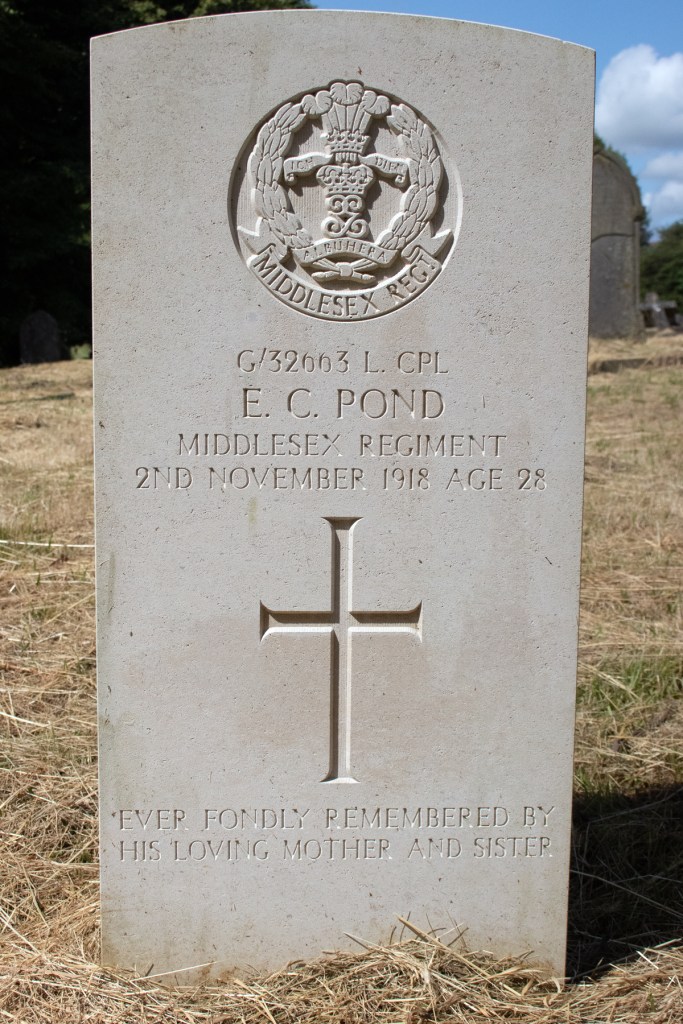
Ernest Charles Pond was born in the autumn of 1889 in Bath, Somerset, and was the younger of two children. His father, Charles, who worked as a wheelchairman, died in 1904, leaving his mother, Eliza, to raise the Ernest and his older sister, Daisy, on her own.

The 1911 census shows the determination the Pond family had in the wake of Charles’ death. Eliza had opened up a tea room in River Street Place, and was living above the business with Daisy and two servants. Daisy, meanwhile, was employed as a school teacher, something she had been doing for at least ten years. Ernest had left Bath, and headed for London: he had taken a room in a house in Tufnell Park, and was working as a furniture designer.

When war came to Europe, Ernest was called upon to play his part. Sadly, full details of his service have been lost to time, but it is clear that he had enlisted by the summer of 1918. He joined the Middlesex Regiment, and was assigned to the 6th (Reserve) Battalion. His unit formed part of the Thames and Medway Garrison, and there is no evidence that Ernest spent any time overseas.

By the autumn of 1918, Ernest had risen to the rank of Lance Corporal. With the war coming to an end, he fell ill, however, and was admitted to a military hospital in Chatham, Kent. Details of his illness are unclear, but it was severe enough that he succumbed to it: he passed away on 2nd November 1918, at the age of 28 years old.

The body of Ernest Charles Pond was taken back to Somerset for burial. He was laid to rest in Bath’s sweeping Locksbrook Cemetery, not far from where his father was buried.


Private Frederick China

Private Frederick China

Frederick George China was born in Bath, Somerset, in the summer of 1885. He was the second of children to tailor George China and his wife, Gloucestershire-born Frances.

Frederick was working as a grocer’s assistant when his father died in 1906, at the age of 52. Determined to earn money for Frances and his three sisters, he left Somerset for work. The 1911 census recorded him as living in Worthing, West Sussex, boarding with the Vitler family. Percy was a baker’s assistant, and lived at 4, Tarring Road with his wife and two daughters. The census noted two visitors to the property, railway contractor Robert Puttock and his wife, Annie.

On 26th December 1912, Frederick married Lucy Hellier. Born in Midhurst, West Sussex, she was working as a confectioner’s shop assistant in Worthing’s Montague Street, boarding with the manager, Catherine Castle, her mother and her niece. The couple wed in Stanmer Parish Church, to the north of Brighton, which is where Lucy’s family were then living.

The newlyweds moved back to Bath, and Frederick took up a job as manager of the Widcombe branch of the Twerton Co-operative Society. Their only child, son Douglas, was born in February 1915.

By this point, war was raging across Europe, and Frederick stepped up to play his part. His full service details are no longer available, but he joined the Somerset Light Infantry in June 1916, and was assigned to the 7th Battalion.

He was in a battalion of the Somersets, who were heavily engaged at Langemarck, but he and his chum came safely through the severe fighting at that place. While returning, some time after, to the front trenches, he was knocked out by a shell, and received severe injuries. The spine was so badly hurt that, if he had survived, he would never have walked again.

[Bath Chronicle and Weekly Gazette – Saturday 29 September 1917]

Private China was medically evacuated to Britain for treatment, and he was admitted to King George’s Military Hospital in South London. Lucy and Frances travelled to Surrey to see him, and were with him when he passed, his wounds being too severe for him to survive. He passed away on 21st September 1917, at the age of 32 years of age.

The body of Frederick George China was aid to rest in Bath’s sweeping Locksbrook Cemetery, not far from where his father, George, was buried.


Private Frederick China
(from britishnewspaperarchive.co.uk)

Captain Lewis White

Captain Lewis White

Lewis Scott White was born at the start of 1896 in Bath, Somerset. The youngest of four children, his parents were surgeon Edward White and his wife, Fanny. The 1911 census recorded the family living in a substantial property in Green Park: the now medical practitioner Edward, Fanny and Lewis sharing the 12-room house with a servant, Ellen Fry.

As befitting of his station in life, Lewis’ education was a well rounded one: “[he] was educated at Bath College and Kelly College, Tavistock, and was coached for his matriculation examination by Mr Samuel Edwards, of Grosvenor College. He exhibited a fondness for aeronautics when quite a lad. While at Victoria College he evinced much enthusiasm for the art of flying, and made models of flying machines. One of these miniature planes he flew successfully on Lansdown, and we believe showed at an exhibition in London. He was one of the leading spirits in the Bath Aerial Club, which used to meet at the Church Institute.” [Bath Chronicle and Weekly Gazette – Saturday 06 October 1917]

Lewis’s mechanical mind was put to good use in his working life as well. He found employment as a motor fitter, and this is what he was doing when war broke out in the summer of 1914. He felt duty bound to service his King and his Country, and, on 20th October, he enlisted in the Royal Flying Corps as an Air Mechanic. His service records confirm the man he had become: at 18 years of age, he was 5ft 4ins (1.63m) tall and weighed 117lbs (53kg). He had dark brown hair, brown eyes and a fresh complexion.

His skill and daring earned promotion, and he was given a commission… He accomplished many fine feats in actual aerial warfare on the Western Front, and for one of these some months ago he was awarded the Military Cross. He was acting as an observer when the flight occurred; the pilot in the same machine was given the DSO.

While wearing only one wing he came home to England to train as a pilot. He rapidly passed all the tests for this, and obtained the two wings, and was gazetted Captain of the RFC on May 5th last. It was only on Wednesday last week that Captain White attended an investiture at Buckingham Palace and was decorated by the King with the MC. So complete was his mastery of flying machines and so great his initiative that Captain White was appointed Flight Instructor, and for the last two months he had been Flight Commander quartered in Wiltshire.

[Bath Chronicle and Weekly Gazette – Saturday 06 October 1917]

On 29th September 1917, Captain White was piloting a Sopwith Camel from RAF Yatesbury, Wiltshire, when the aircraft failed to pull up from a dive. It crashed into the ground and Lewis was killed instantly. He was just 21 years of age.

It is no secret that the aeronaut whose intrepid feats in the air above Bath of late had caused much notice was Captain White. He would loop the loop with the greatest ease, and his nose-diving was most daring. When questioned why he performed these dangerous acts in the air Captain White would declare that there was no risk from engine trouble unless a man ‘lost his head,’ and apparently he had no idea that is was possible for him to get into difficulties from that cause. It is to be surmised therefore that in the accident which had cost his life, so especially valuable to the country now, something beyond engine trouble must have happened.

To stay-at-home and peacefully minded citizens some of the manoeuvring by aeroplanes in flight savours too much of the sensational, and they are apt to think that it is unnecessarily throwing away chances. But such an impression is as unjust as it is unkind. The strange evolutions described by machines in mid-air are just the kind that have to be executed in actual aerial warfare when seeking to gain an advantage over the foe, and unless this preliminary training were carefully and systematically gone through it would be hopeless to seek to acquire the necessary skill in the moment of crisis. Captain White was absolutely fearless, and his death will be deeply deplored by by many comrades who knew his worth.

[Bath Chronicle and Weekly Gazette – Saturday 06 October 1917]

A subsequent inquest found no immediate cause for the crash, but suggested that Captain White may have misjudged the distance whilst diving and flew into ground.

The body of Lewis Scott White was brought back to Somerset for burial He was laid to rest in the majestic Locksbook Cemetery in Bath, his funeral attracting a full page report in the city’s Chronicle and Weekly Gazette.


Captain Lewis White
(from findagrave.com)