John Edward Major was born on 1st April 1881 in Gorleston, Suffolk. One of seven children, his parents were William and Elizabeth Major. William was a fisherman and the family lived on the town’s High Street.
Things changed for the Major family, however, and the 1891 census found them living in Barking, Essex. William was now employed as a general labourer, and the family had set up home at 16 Rosa Terrace.
John was drawn to his coastal past and, according to the next census, he was a ship’s mate on the fishing boat Cygnet. Based out of London, the return was taken in Lowestoft, so it is safe to assume that she plied the Essex and Suffolk coasts.
Love was blossoming for John at this point and, on 9th September 1906, he married Ann Davy. She was a coal porter’s daughter from Barking, and the couple married in the town’s St Margaret’s Church. They would go on to set up home in Cleethorpes, Lincolnshire, and have five children: Blanche, Amelia, Annie, Elizabeth and John Jr.
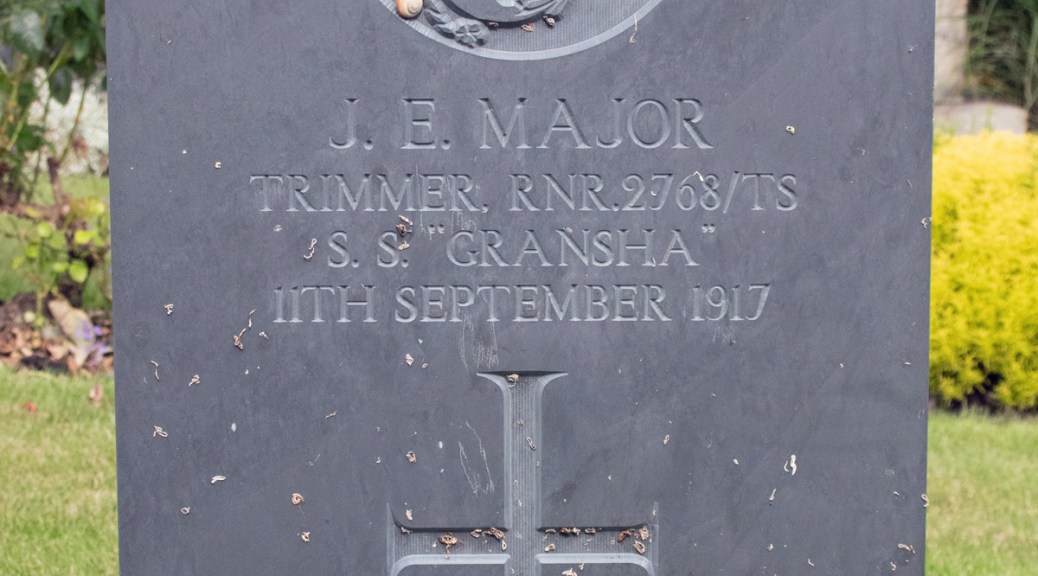
Over the next few years John’s trail goes cold. When war broke out, he was called upon to play his part, and joined the Royal Naval Reserve as a Trimmer. By the summer of 1917 he was attached to the SS Gransha, based out of the Royal Naval Dockyard in Chatham, Kent.
The next record for Trimmer Major relates to his passing. His pension ledger notes that, on 11th September 1917, he fell overboard from Gransha and was drowned. Sadly, there is no other information available about the incident, but John was 37 years of age.
The body of John Edward Major was laid to rest in the naval section of Woodlands Cemetery, Gillingham, Kent, not far form the naval base that he had come to call home.
Tragically, John’s entry on the Pension Ledger confirms that his and Ann’s youngest child – John Jr – died on Christmas Eve 1917, three months after his father.
Alexander Augustus Maurice Leslie was born in France in 1852. One of five children, his parents were Government Secretary of State Francis Leslie and his French wife, Josephine.
Alexander’s mother died when he was 8 years old, by which point the family had moved back to Britain. Francis had set up home in Ealing, Middlesex, and they were living at 15 Castlebar Road, a Victorian villa.
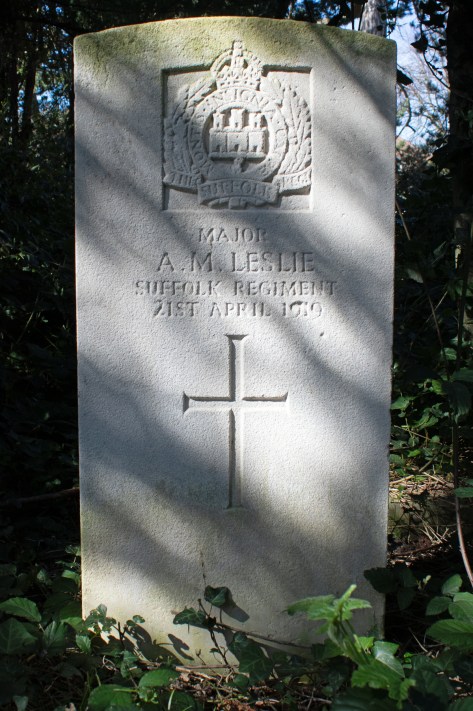
When he completed his schooling, Alexander sought out a military life. The 1881 census recorded him as a Lieutenant in the Suffolk Regiment, living in St Helier, Jersey. He had married the year before, to Louisa Cumming, a surgeon’s daughter from Devon. They had a son, Maurice, by this point, and a daughter, Ida, was born the following year.
Lieutenant Leslie’s service records are sparse, but a later newspaper report fills in some of the gaps: “Leslie’s military experience, which extended… over a period of about 25 years, included participation in the Egyptian campaign in 1884, and service on the West Coast of Africa, in Jamaica, and in India.” [Worthing Gazette: Wednesday 30th April 1919]
During her husband’s time overseas, Louisa raised the children back home in Devon. She passed away in 1901, but which point, Alexander had retired with the rank of Captain. That year’s census found him living with Maurice and Ida at 14 Spencer Hill in Wimbledon, Surrey, a large detached villa. Maurice, now 20 years of age, was working as an accountant’s clerk, and the family had a live-in servant called Rose.
The next census record, from 1911, recorded Alexander living in rooms at 46 Leinster Gardens, Paddington. A substantial Georgian property, his landlady was Eveline Giradet, whose other residents included a barrister and a banker. Alexander’s occupation was now noted as Retired Major in the British Army.
From this point, Alexander’s trail grows cold. It is likely that he was called upon to play a part in the global conflict that broke out in 1914, though exactly when and how he did so is unclear. Records suggest he was admitted to Queen Alexandra’s Military Hospital on Millbank, Middlesex on 28th September 1916, suffering from syphilis. He only remained there for a couple of days, and his increasing age and health may have led to his retirement from duty.
For the past four years Major Alexander Maurice Leslie, who was for a period of a quarter of a century connected with the Royal Sussex Regiment, had been a resident of Worthing, and a brief intimation was given in the last issue… that he had died suddenly.
The circumstances were duly investigated by… the Deputy Coroner for West Sussex, on Wednesday afternoon, the inquiry taking place at the Central Fire Station, in High-street.
Evidence of identification was given by Colonel Francis Seymour Leslie… late of the Royal Engineers, who stated that the deceased, who was his brother, had lived at Worthing for the past four years, more or less all the time, though he had no permanent address…
Mrs Ethel William, a widow, at whose house… Major Leslie had lodged, stated that he had complained of indigestion and ate light food. On Monday evening he had his supper at half-past seven o’clock, going upstairs about half an hour later. About nine o’clock witness went to his room and found him lying in bed in great agony, and he exclaimed: “Oh, my poor heart!” Witness gave him some hot water to drink and sent for a doctor.
Dr Bernard Lees stated that he was sent for, but he found Major Leslie was dead when he got to the house. He had since made a post-mortem examination, which showed that the stomach and intestines were much distended, and there were signs of chronic gastric catarrh. The heart was fatty, but the valves were healthy. Death was due to syncope, the result of acute indigestion and the fatty condition of the heart.
A verdict of “Death from natural causes” was recorded.
[Worthing Gazette: Wednesday 30th April 1919]
[It should be noted that Alexander had been attached to the Suffolk Regiment throughout his military career. The error in the newspaper report is likely because of the Sussex town he had moved to in the mid-1910s.]
Alexander Augustus Maurice Leslie was 67 years of age when he passed away on 21st April 1919. His body was laid to rest in Broadwater Cemetery, to the north of the town he had called his home for more than four years.
George Wilson was born on 1st February 1879 in the village of Worfield, Shoprshire. Details of his early life are unclear, although his father’s name was John.
When he completed his schooling, George found work as a porter. However, he was keen on adventure and a decent career, and so, on 31st May 1898, he enlisted in the Royal Marine Light Infantry. His service papers show that he was 5ft 7.5ins (1.71m) tall, with brown hair, blue eyes and a dark complexion. He was also noted as having a birth mark above his navel.
Private Wilson signed up for a period of twelve years and, during that time, he would serve around the world. Initially sent to barracks in Walmer, Kent, he would become based at Plymouth, Devon, in between assignments. Time overseas would include two years attached to HMS Magnificent (the 1901 census recording the battleship being moored in Gibraltar), two years on board HMS Spartan and three aboard HMS Encounter.
Away from the military, love blossomed and, in January 1909, George married Annie Curtis. She had a daughter, Gladys, who was either George’s, or was adopted by him. The couple set up home in Plymouth, and went on to have a son, Leslie, in 1911.
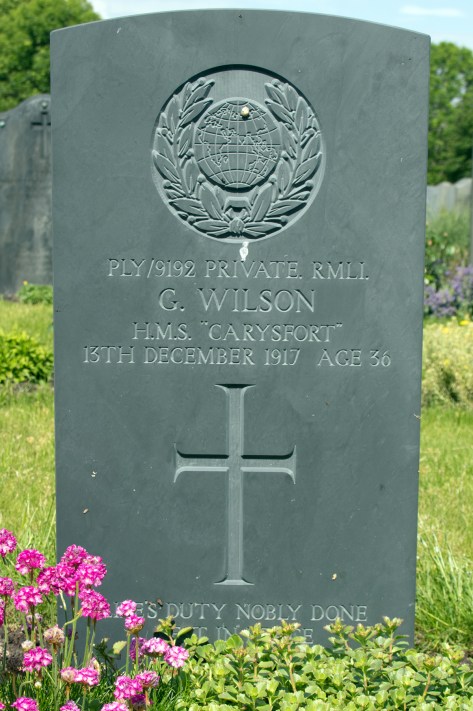
By this point, Private Wilson had renewed his military contract, and would go on to serve for a further seven years in the Royal Marines. In June 1915, he was assigned to the light cruiser HMS Carysfort. Part of the Harwich Force, her role was to patrol the waters off the east coast of England. During his time on board, George would have been involved in a number of sorties, including an attempt to intercept an enemy raid on Sunderland in August 1916, and another attempt to make contact with German ships off Zeebrugge, Belgium, that October.
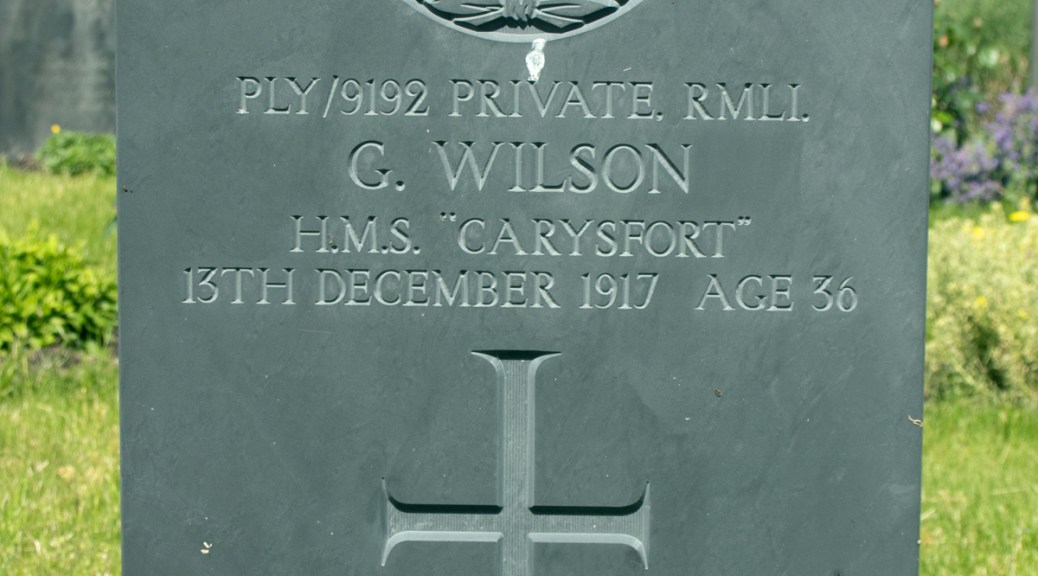
In December 1917, while patrolling off Orford Ness, Suffolk. the Carysfort collided with the SS Glentaise, a collier ship. Two crew were killed in the incident, including Private Wilson: he was 37 years of age.
Carysfort sailed to HMS Pembroke, the Royal Navy Dockyard in Chatham, Kent. From here the body of George Wilson was taken to Woodlands Cemetery in nearby Gillingham, and he was laid to rest in the naval section there.
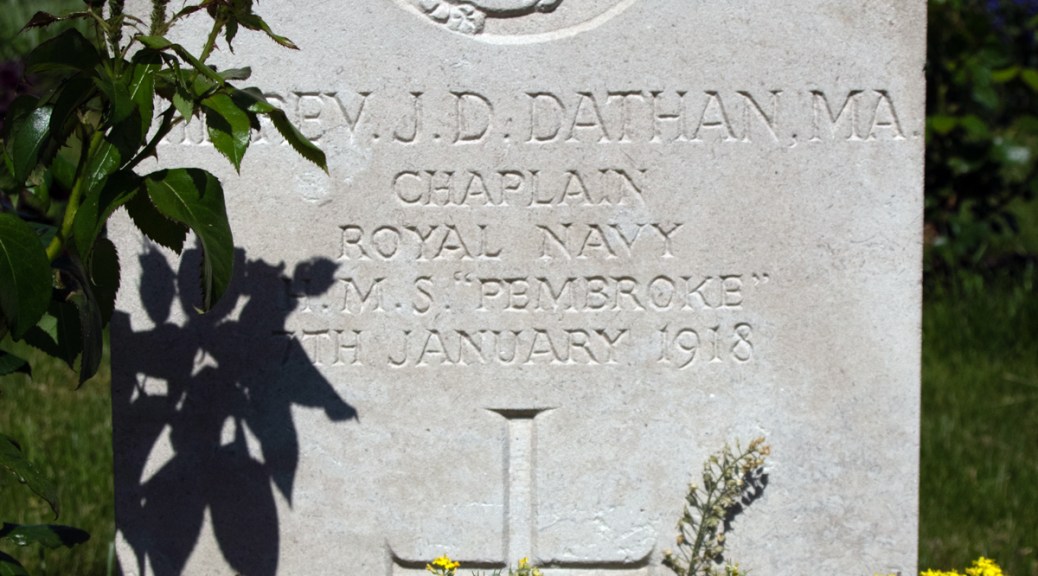
Much regret has been felt… at the death of Rev. JD Dathan MA, chaplain to the Royal Marines, at the age of 50 years. His death was due to pneumonia, caused by catching a chill while doing temporary duty… at the [Royal Naval Hospital, Chatham, Kent]. The eldest son of Captain JC Dathan RN, the deceased gentleman was educated at Christ’s Hospital and Cambridge, where he obtained the degree of MA. He entered the Royal Navy as a chaplain in 1896, and served on the China Station during the Boxer riots. For five years he was chaplain of Bermuda Dockyard and Hospital. He also served commissions in HMS Monmouth, Goliath and Russell. He was posted to the Royal Marine Barracks in July 1914, but on the outbreak of war he was appointed to HMS Formidable, and was transferred from the ship a week before she was lost. He was subsequently sent tot he Dardanelles for service in the Implacable at the first landing in April 1915. Later he joined the Italian Fleet, and was subsequently recalled to the Royal Marine Barracks. Three of the deceased officer’s brothers – Paymr.-in-Chief Ellis Dathan, Com. Hartley Dathan, and Eng.-Com. William Dathan – are serving in the Royal Navy.
[Naval & Military Record and Royal Dockyards Gazette: Wednesday 16th January 1918]
Joseph Duncan Dathan was born in 1866 in Halifax, Nova Scotia. The second of seven children, his parents were Joseph and Emma Dathan.
By the time of the 1891 census, the Dathan family had moved back to Britain. Joseph Sr and Emma were living in Portsea, Hampshire, while the younger Joseph was studying at Christ’s Hospital. The next return, taken in 1901, found him having taken up a role as curate at St John’s Church in Ipswich, Suffolk. He was, by this point, living on Foxhall Road on the western edge of the town.
On 25th February 1904, Joseph married Alicia Cane. The daughter of a vicar, she lived in Ipswich, and the couple married in the local parish church. By this point, Joseph was based in Portsmouth, Hampshire, and this is where the young couple set up home. Alicia gave birth to their first child, John, that November. The couple’s second son, Joseph, was born in 1906 and their third, daughter Alicia, was born in Bermuda while the family were stationed out there with Reverend Dathan’s work.
Joseph’s connection to the navy continued much as the newspaper reported. He died from pneumonia on 7th January 1918: he was 51 years of age.
Reverend Joseph Duncan Dathan was laid to rest in the naval section of Woodlands Cemetery in Gillingham, Kent, a place he would have known well, given its proximity to the Royal Naval Dockyard in Chatham, Kent, where he had been based.
Alfred Henry John Best was born on 17th November 1883. The second of ten children, his parents were William and Alice Best. William was an engine driver and both he and Alice were from Ipswich, Suffolk. Alfred was born in Dovercourt Essex, but by the time of the 1901 census the family had settled in the village of Ramsey, near Harwich.
When he finished his schooling, Alfred was set on a life of adventure. Living so close to the sea, a life on the ocean drew him in, and he found employment on the steamships as a steward. Absent from the 1901 census, the following return, taken in 1911, found him back at home with the family, and employed as a ship’s steward.
When war broke out, Alfred stepped up to serve his country. He enlisted in the Royal Navy as an Officer’s Steward 3rd Class, and was sent to HMS Pembroke, the Royal Naval Dockyard in Chatham, Kent. His service records give his year of birth as 1884, but show that he was 5ft 4.5ins (1.64m) tall, with light brown hair, blue eyes and a fresh complexion. He was also noted as having a mole under his right eye.
Within a matter of days, Alfred’s previous experience gained him a promotion to Officer’s Steward 2nd Class. He would spend the next couple of years on shore, his time being split between Pembroke and HMS Wildfire, a similar establishment just along the coast in Sheerness.
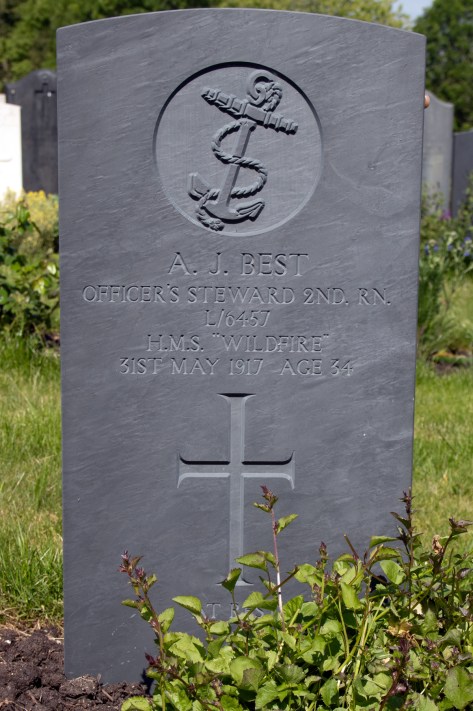
By the spring of 1917, Officer’s Steward Best was back in Chatham, and had been admitted to the town’s Royal Naval Hospital with tuberculosis. The condition would prove fatal, and he breathed his last on 31st May 1917: he was 33 years of age.
The body of Alfred Henry John Best was buried in the naval section of Woodlands Cemetery, Gillingham, Kent, not far from the base he had called home for some time.
Officer’s Steward 2nd Class Alfred Best (from ancestry.co.uk)
Henry John Gerrard Hudson was born in Whitechapel, Middlesex, on 11th November 1873. The fourth of seven children – and one of five boys – his parents were John and Emma Hudson. John was a paper stainer, and the family were raised in rooms at 62 Fern Street, Tower Hamlets.
Money was seemingly tight, and Henry sought an escape. On 5th January 1889 he enlisted in the Royal Navy, and was sent to the Devon school ship, HMS Impregnable, for his training. As he was below the age to full enrol, he was given the rank of Boy 2nd Class.
Over the next couple of years, Henry learnt the tools of his trade. He spent a year training at HMS Ganges, the shore establishment near Ipswich, Suffolk, and rose to the rank of Boy 1st Class. On 20th November 1890, he was given his first sea-faring assignment, aboard HMS Ruby, and she would remain his home for the next eighteen months.
During his time with Ruby, Henry came of age. His service records show that he was 5ft 5ins (1.65m) tall with light brown hair, brown eyes and a fair complexion. He was also noted as having a number of abscess scars under his left arm.
The now Ordinary Seaman Hudson definitely showed signs of promise as, after just three months, he was promoted to Able Seaman, a rank he would hold for the next five years. During that time, he served on four further ships, including the torpedo boat depot ship HMS Vulcan.
On 1st June 1897, Henry was promoted to Leading Seaman, although he reverted to his previous role just nine months later, at his own request. In October 1898 he transferred to HMS Caesar and, presumably with further support, he was promoted to Leading Seaman again in August 1899.
By May 1902, Henry’s initial term of service came to an end, and he was stood down to reserve status.
In January 1907 Henry married Alice Martin. She was a carpenter’s daughter, and the couple were living on Grosvenor Terrace in Newington, Middlesex, when the exchanged vows. They would go on to have three children.
The 1911 census found the Hudsons living in Weymouth, Dorset. Henry, by this point, was working as a motor boat driver, and the family had a small cottage on South View Road, not far from the town centre. The document shows how they had travelled to where Henry’s work took them: their first child, Nancy, had been born in Walworth, Surrey, in 1908, while her sister, Gladys, was born in nearby Camberwell the following year.
The next couple of years provided a big upheaval for the Hudsons and, by the spring of 1914 the family had moved to Rugby, Warwickshire. There seems to be no family connection to the area on either Henry or Alice’s side. It can only be assumed, therefore, that an opportunity of work arose.
In June 1914, Alice gave birth to the couple’s third son, John. Just two months later, war was declared, and Henry was called back into service. Taking up his previous role, Leading Seaman was to spend the next few years on land. Initially sent to HMS Victory, the Royal Naval Dockyard in Portsmouth, Hampshire. From there he moved to a base in Gorleston, Norfolk, and would remain there until the autumn of 1916.
Leading Seaman Hudson spent six month at HMS President in London, before moving to the Royal Naval Dockyard in Chatham, Kent, also known as HMS Pembroke. By this point – the spring of 1917 – his health was suffering and, that May, he was admitted to the town’s Royal Naval Hospital, suffering from tuberculosis.
The condition was to prove too severe for Henry: he passed away from a combination of the lung condition and a gastric ulcer on 20th May 1917. Henry was 43 years of age.
Alice was still living in Warwickshire at this point. Her husband, Henry John Gerrard Hudson, was therefore laid to rest in the naval section of Woodlands Cemetery, Gillingham, Kent.
Frederick Dennington was born in Wrentham, Suffolk, on 18th February 1877. The youngest of eleven children, his parents were William and Eliza Dennington. William was a house painter, and the family lived in a cottage on Southwold Road on the outskirts of the village.
Frederick was not to follow his father’s trade, and when he completed his schooling he found employment as a groom. Working with horses was one thing, but he wanted to make a bigger splash in the world, and so, on 28th April 1892, he joined the Royal Navy.
Too young to formally enlist, Frederick was given the rank of Boy 2nd Class, and was sent to HMS Impregnable, the training ship moored at Queensferry on the Firth of Forth, for his induction. Over the next three years, Boy Dennington would learn the tools of his trade, and spent time on another training vessel – HMS Lion – and at HMS Pembroke, the Royal Naval Dockyard in Chatham, Kent.
In June 1893, Frederick was promoted to Boy 1st Class, and the following January he was assigned to HMS Satellite. She was a composite screw corvette, and would remain his home for the next three years. During this time, he proved he came of age, and was formally inducted into the Royal Navy.
Give the rank of Ordinary Seaman, Frederick’s service papers give an insight into the man he was becoming. Short of stature – he was noted as being 5ft 1.5ins (1.56m) tall – he had dark brown hair, grey eyes and a fair complexion. He was also noted as having tattoos on both of his forearms, and rings tattooed on the fingers of his his right hand.
Ordinary Seaman Dennington seemed to impress his superiors and on 5th December 1895 – just ten months after coming of age – he was promoted to the rank of Able Seaman. His contract had tied him to the navy for twelve years, and during that time, Frederick would serve on five further ships. In between each of his assignments, he returned to Chatham, and this would become his longer-term base.
Frederick’s term of service came up for renewal in February 1907, and he immediately re-enlisted. His papers show that he was now 5ft 8ins (1.72m) tall, and his eyes were more grey-blue than grey. While he remained at the rank of Able Seaman, his character was always noted as being very good, and his ability as superior.
Able Seaman Dennington went on to serve on five ships over the next nine years, including three years of HMS Blenheim, and the same length of time on board HMS Duncan. By the autumn of 1916, with war raging across Europe, Frederick had clocked up 24 years in naval service.
By this point, Frederick was unwell. He was admitted to the Royal Naval Hospital in Chatham, Kent, with a stricture of the urethra. This was to be a condition that that he would succumb to, and he passed away on 9th December 1916, at the age of 39 years old.
The body of Frederick Dennington was laid to rest in Woodlands Cemetery in Gillingham, Kent, not far from the naval base that has become his second home.
Frederick never married. His probate record confirms that his effects – totalling £147 2s (worth £16,350 in today’s money) – was left to his father, William.
Archibald Thomas Victor Wright was born on 3rd August 1883 in Portsmouth, Hampshire. The second of six children – all boys – his parents were George and Alice Wright. George was a gunner and lieutenant in the Royal Navy, and the seafaring life was an obvious choice for his son to follow as well.
Archibald joined the Royal Navy as a Ship’s Steward Boy on 14th September 1898. Just fifteen years old, he was too young for formally enlist but was sent to HMS Pembroke, the Royal Naval Dockyard in Chatham, Kent, for his training.
Over the next three years, Archibald learnt the tools of his trade. He moved between establishments, from HMS Boscawen in Portland, Dorset, to HMS Excellent back in in Portsmouth. It was while on board the battleship HMS Glory, however, that he came of age, and was formally enlisted in the Royal Navy as a Ship’s Steward Assistant. His service records note that, on turning eighteen, he was 5ft 2in (1.58m) tall, with brown hair, dark brown eyes and a fresh complexion.
Ship’s Steward Assistant Wright’s contract was for twelve years, and during this time he would travel the world. By the summer of 1908 he had served on nine ships, returning to naval bases in Kent and Hampshire between voyages. On 15th June 1908 he was promoted to Acting Ship’s Steward, and just a few weeks later, he got married.
Ellen Osborne was born in Southampton just a month or so after her new husband. The daughter of a house furnisher’s clerk, by the time of the 1901 census she was employed as a boarding school teacher. After the couple married, she moved to Kent to be close to the Royal Naval Dockyard in Chatham (also known as HMS Pembroke), where Archibald would more frequently be based. The 1911 census return found her lodging with Lillie Calcutt at 112 Shakespeare Road in Gillingham, Kent.
Archibald’s career, meanwhile, was continuing apace. On 24th September 1909 he was promoted to Ship’s Steward proper, and in August 1913, when his original term of service came to an end, he quickly renewed it. By now, his service records show that he had had a few tattoos added to his arms: a girl on his right arm, a dragon on his upper left, and two cockerels on his lower left arm. Now 30 years of age, he stood 6ft tall (1.83m) tall, and, intriguingly, his eyes were now recorded as being blue.
Ship’s Steward Wright’s career trajectory does not seem to have been without its hiccups, however. Where his annual review up until 1909 have consistently given his character as very good, from hereon in, it dipped to just good. His ability also began to vary, from very good in 1909, to superior for the following couple of years, to just satisfactory in 1913 and 1915.
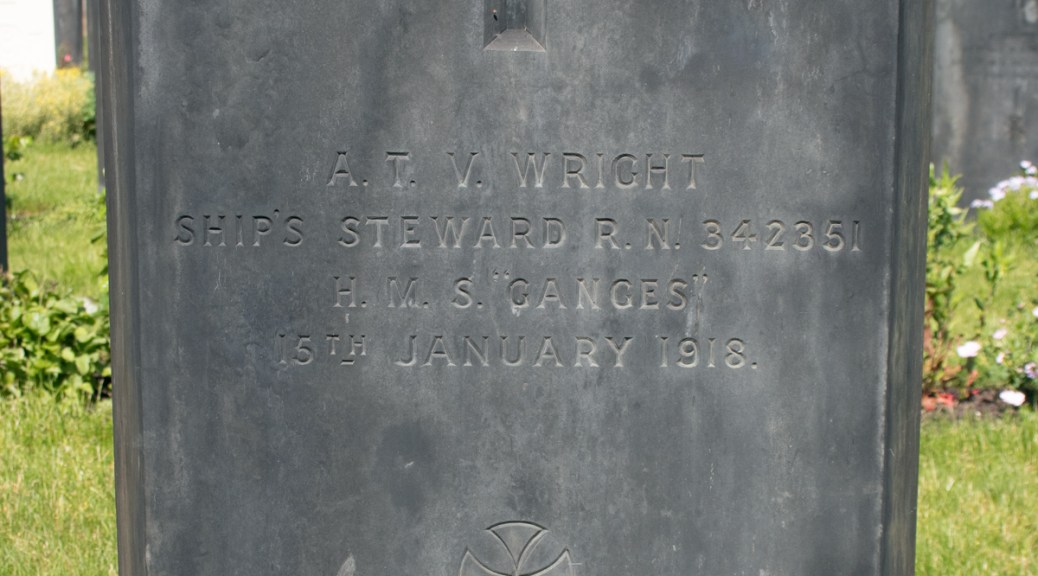
Archibald spent the last few years of the war split between HMS Pembroke and HMS Ganges – the training base just outside Ipswich, Suffolk. In January 1918, he was admitted to the Royal Naval Hospital in Chatham, following an epileptic fit. This was to prove fatal, and he passed away on 15th January. He was 34 years of age.
Interestingly, Ship’s Steward Wright’s pension ledger gives a damning insight into his health and mental well-being at the time of his passing. It noted the cause of his death as epilepsy aggravated by alcoholism, adding that the disease was neither contracted on nor aggravated by [active service], but due to his own serious negligence or misconduct.
Archibald Thomas Victor Wright was laid to rest in the military section of Woodlands Cemetery in Gillingham, Kent, not far from the dockyard he had called home.
Stanley William Vinton was born on 30th April 1898 in Dartmouth, Devon. The second of eight children, his parents were William and Kate. William was an outfitter’s assistant, and by the time of the 1911 census, the family of ten were living in a four-roomed cottage on South Ford Road.
When he finished his schooling, Stanley was apprenticed to a shipwright. Away from work, he volunteered with the Dartmouth Cadet Company, and was drawn towards an army career. On 25th May 1914, he enlisted, joining the 7th (Cyclist) Battalion of the Devonshire Regiment. His service records show that he gave his age as 17 years and four months old. He was 5ft 6.5ins (1.69m) tall, and weighed 154lbs (69.9kg). Private Vinton was of good physical development and had good eyesight.
Stanley was formally mobilised on 5th August 1914. He remained on home soil for the next three years, primarily because soldiers were unable to fight on the Western Front until they turned 19 years of age. During this time, he appears to have impressed his superiors: in July 1916 he was promoted to Lance Corporal, and just four months later he rose to full Corporal.
In July 1917, Stanley’s chance to see some action arrived, when he was posted to the 2nd Battalion, and sent overseas. This move came with a caveat, however, and he reverted to the rank of Private. It was a challenging time for the regiment, and Stanley quickly found himself in the thick of it at Passchendaele.
On 30th November 1917, after four months on the Western Front, Private Vinton’s luck came to end. Caught up in the fighting, he was wounded in his left thigh by shrapnel and the fingers of his left hand by a gun shot wound. He was medically evacuated to Britain for treatment, and admitted to the Edinburgh War Hospital in Bangour.
Thankfully, the injury to Stanley’s hand was minimal, but his leg took longer to heal, and he remained in hospital for more than two months. When he was discharged, Private Vinton was transferred to the regiment’s command depot in Sutton Coldfield. In March 1918, he was promoted to Corporal, but his injured leg was still causing him discomfort. In the end, he was reassigned to a munitions works in Lowestoft, Suffolk, and this is where he would spend the remainder of the year.
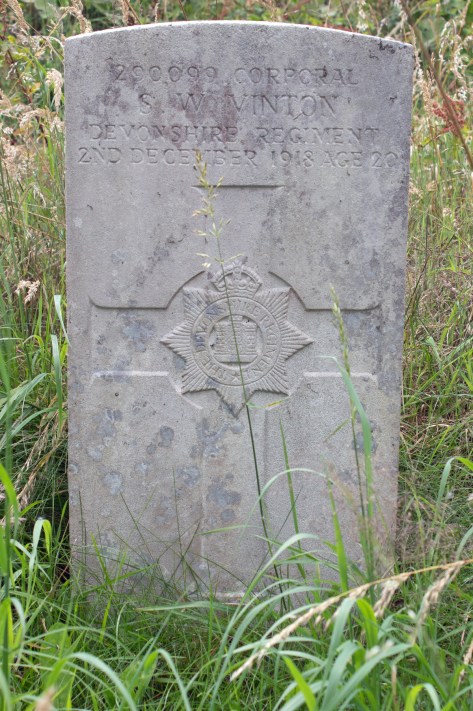
Stanley’s constitution was weakened by this point, and that winter, he contracted influenza. The condition was to prove fatal, and he passed away on 2nd December 1918. He was just 20 years of age.
The body of Stanley William Vinton was taken back to Devon for burial. He was laid to rest in the graveyard of St Clement’s Church, Dartmouth, high above the town’s centre, but within walking distance of his grieving family’s home.
Alfred Frederick King was born at the start of 1897, and was the oldest of two children to Alfred and Mary. Alfred Sr was an army pensioner-turned-carman, and both he and his wife were born in Bath, Somerset. By the time of the 1911 census, the family of four were living at 31 Avondale Road, in the Walcot area of the city.
Alfred Jr had completed his schooling by this point, and was working as an errand boy. War was not far off, however, and it would result in the ultimate sacrifice for the King family.
Alfred Sr enlisted in the Somerset Light Infantry in September 1914, but was deemed not fit for service, as he was suffering from chronic stomach issues. This may have prompted his son to join up, and he did so in October 1915.
Sadly, Alfred Jr’s full service details no longer remain, but from what is left, it is clear that he joined the Somerset Light Infantry, and was assigned to the 8th (Service) Battalion. His unit was sent to France, and he would spend the rest of the year on the Western Front.
Private King was involved in a number of skirmishes in the coming months, and soon gained a promotion to the rank of Lance Corporal. In late January or early February 1916, he was wounded, and medically evacuated to Britain. He was admitted to the East Suffolk Hospital in Ipswich, but his injuries would prove too great: he passed away on 22nd February 1916, at the age of just 19 years old.
Alfred Frederick King’s body was taken back to Somerset for burial. He was laid to rest in the sweeping grounds of Bath’s Locksbrook Cemetery.
Alfred Sr would be buried alongside his son. You can read more about his life here.











 Death and Service