Tag Archives: brothers

Stoker 1st Class Frederick Cable

Stoker 1st Class Frederick Cable

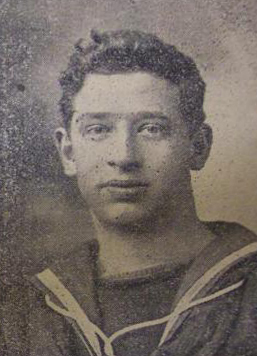
Frederick Charles Cable was born on 22nd November 1890 in Eastbourne, West Sussex. He was the younger of three children to John and Louisa Cable, and the family lived on one floor of a three-storey house in the middle of the town.

When Frederick was born, John was working as a billiard marker, but it seems that this was a poor way to scratch together a living for a young father. The 1901 census found the family in London, where John had been born, and where he was not employed as a hotel waiter.

Sadly, the new set-up was not to last long: John died in 1905, leaving Louisa to raise her boys on her own. The next census record, in 1911, records the two of them living a five-room terraced house in East Finchley. They were not alone, however, as they were sharing it with a widow – Elizbeth Hickinbottom – and her 34-year old son, George.

A year later, George and Louisa married, and went on to have a daughter, also called Louisa. Frederick, meanwhile, was to find love of his own, and, in the spring of 1914, while working as a milkman, he married Dorothy Ada Laurence. They would go on to have a son, who they named after his father, a year later.

By this point, war was raging in Europe, and Frederick was called to do his duty in May 1915. His records show that he was 5ft 7ins (1.70m) tall, had dark brown hair, brown eyes and a dark complexion and was given the rank of Stoker 2nd Class.

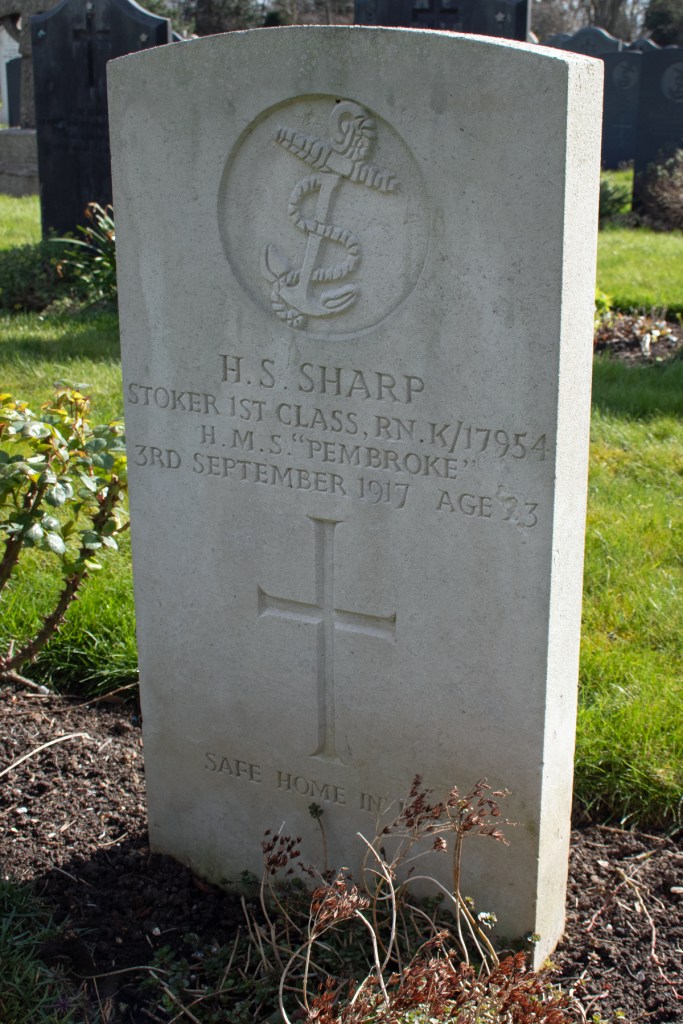
Over the next couple of years, Frederick served on two ships – HMS Actaeon and HMS Weymouth – and it was on board the latter that he was promoted to Stoker 1st Class in April 1916. The majority of his time, however, was spent on shore-based establishments: HMS Victory in Hampshire and HMS Pembroke in Kent.

The Royal Naval Dockyard in Chatham (HMS Pembroke) was where he spent most of his time, and was where he returned to in the summer of 1917. It was a particularly busy place at that point in the war and temporary accommodation was set up. Frederick found himself billeted at The Drill Hall, away from the main barracks.

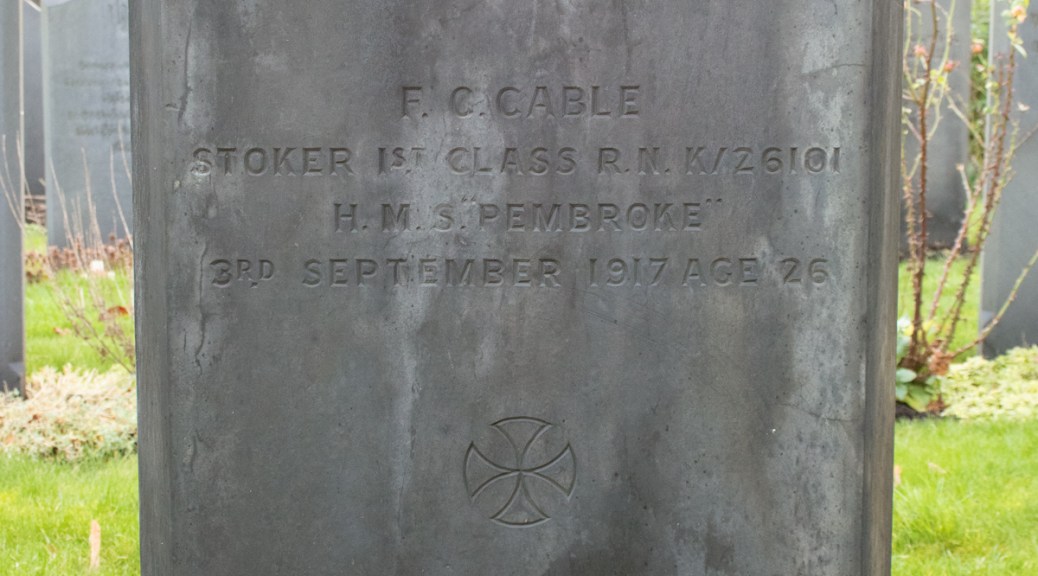
On the night of 3rd September 1917, Chatham suddenly found itself in the firing line, as the German Air Force launched a bombing raid. One of the bombs landed squarely on the Drill Hall, and Stoker Cable was killed instantly. He was just 26 years old.

Ninety-eight servicemen perished during the Chatham Air Raid that night. They were buried in a mass funeral at the Woodlands Cemetery in nearby Gillingham. This, too, is where Frederick Charles Cable was laid to rest.


Frederick’s brother John Cable also fought in the First World War. He served as a Sergeant in the 21st Battalion Middlesex Regiment and was killed at the Battle of St Quentin on 25th March 1918. He was 28 years old and left a widow and three children. #

Serjeant John Cable is commemorated on the Arras Memorial in Northern France.


Private Graham Grant

Private Graham Grant

Graham Grant was born in early 1891, one of ten children to Charles and Emma Grant. Charles was a sign painter and both he and his wife were from Wiltshire, but it was in Frome, Somerset, that they chose to settle and raise their family.

When he left school Graham found work as an assistant in a jeweller’s shop, but when war came to England’s shores, he was keen to do all that he could for King and Country.

While full details of his military service are not available, it is noticeable that the local newspaper – the Somerset Standard – dedicated a full column to news of his death in 1916, and then a further full column to his funeral a week later. The newspaper reported that:

Private Graham Grant, who was just 25 years of age, was living in Bristol when the war broke out, and in September 1914, he joined the 4th Gloucesters along with his eldest brother, Private Charles Grant, and being in the same platoon they were inseparable companions both in training and in the trenches… They went out to the Front just over 12 months ago – January 1915 – and for practically a year they escaped injury…

Private Grant had not been home since he landed in France, but he and his brother were expecting to have leave at Christmas to visit their family and friends at Frome. On the 23rd December… [he] was with his platoon in a trench, the top of which was some three feet above the heads of the men. At 8:30 in the evening they were about to be relieved… when a German machine-gun opened fire on the trench.

Somerset Standard: Friday 11th February 1916

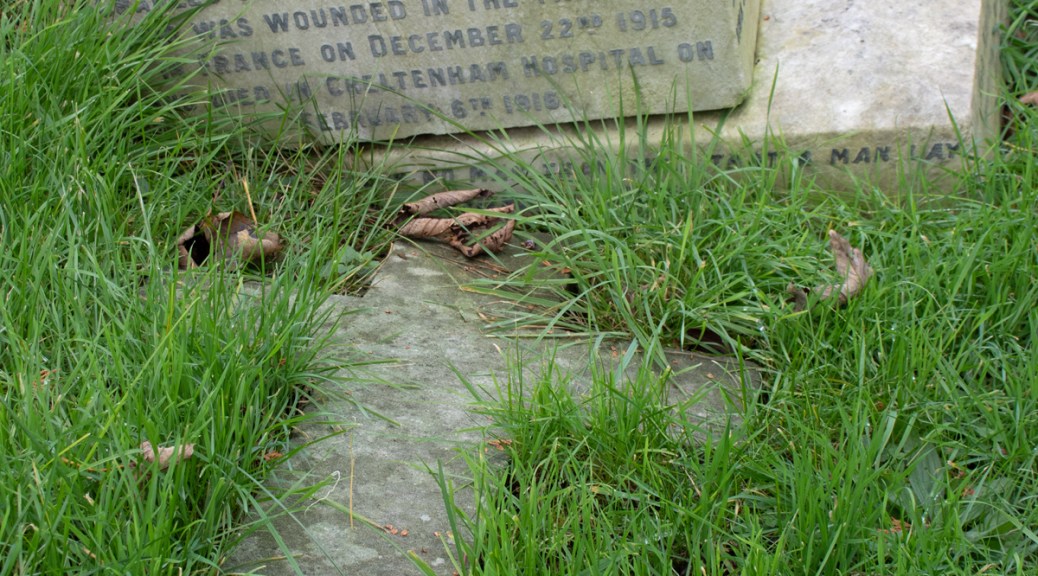
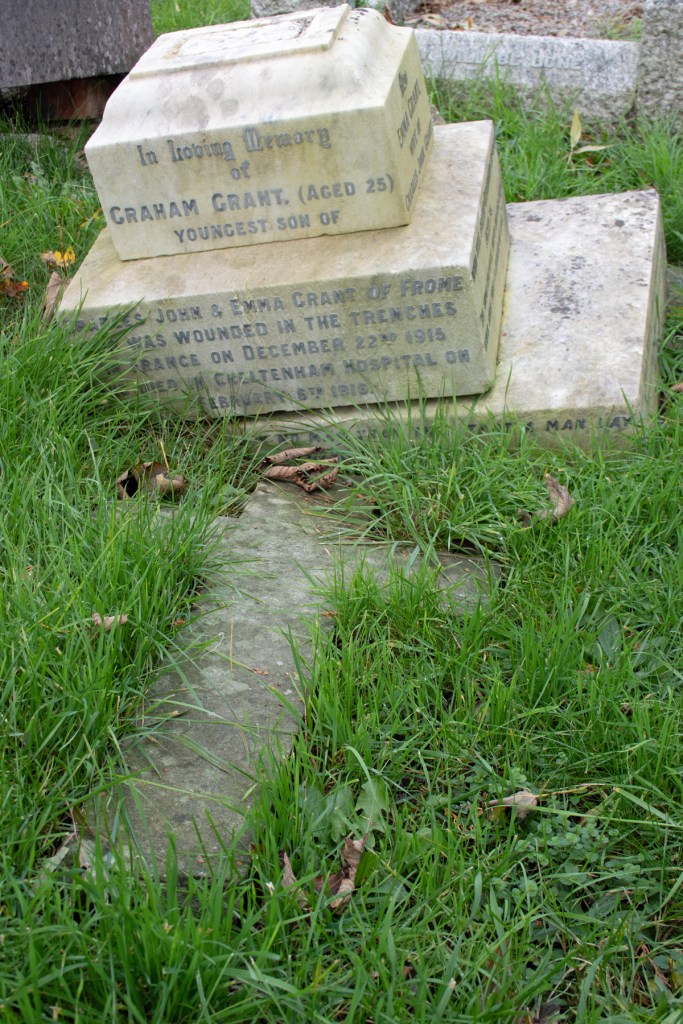
A bullet hit Graham in the back and he was taken first to a hospital in Rouen, then medically evacuated back to England. Admitted to the Racecourse Hospital in Cheltenham, x-rays showed that his spine had been shattered by the bullet, and he was paralysed from the waist down. “[His] case was regarded as hopeless from the first” and as many friends and family went to see him as possible. Private Grant passed away on 6th February 1916, Emma and his three sisters at his bedside. He was just 25 years of age.

Graham Grant’s body was brought back to Frome, and laid to rest in the graveyard of Christ Church in the town. The funeral, at the family’s request, was devoid of any military fanfare or involvement.


While there was a lot of reporting on both the death and funeral, the vicar of St John’s Church in the town noted in his sermon that Graham had been a member of the choir there, both as a boy and a man. He was also the first chorister of the church to give his life for his country. Reverend Randolph went on to say that:

…there were things connected with Graham Grant’s death for which [he was] thankful… he did not die on the battlefield, maybe after hours of suffering unattended and without succour… he did not die in the hands of the enemy or in the enemy’ country… he died surrounded by his relatives and friends, those who were near and dear to him, and that he had the most skilful medical treatment and tender nursing.

Somerset Standard: Friday 11th February 1916

Corporal Cyril Allen

Corporal Cyril Allen

Cyril Starr Allen was born on 15th June 1891 in the village of Baughurst, near Tadley in Hampshire. He was the second youngest of five children to Charles and Martha Allen. Charles was a rate collector, and the family moved around the county during Cyril’s early years.

By the time Cyril left school, Charles had become an assistant bursar in Wootton, near Basingstoke. Cyril, meanwhile, had found similar administrative employment and was working as a clerk for a local land agent.

At the start of 1911, Cyril enlisted in the British Army. He joined the 4th Battalion of the Wiltshire Regiment as a Private and was soon based on Salisbury Plain. His service records confirm that he was 19 years and 7 months old, and stood at 5ft 5ins (1.65m) tall. Private Allen served for his initial term of four years, before being remobilised.

In November 1915, Cyril married Mabel Young. She was a printer’s daughter from Wiltshire, and the couple married in Salisbury, before settling down in Frome, Somerset. They went on to have a child, a daughter they called Kathleen.

Remobilised in the autumn of 1915 Private Allen received a series of promotions – to Lance Corporal, Corporal, Lance Sergeant and Sergeant, and, by June 1917, he found himself at the Front.

On 22nd April 1918, Cyril was injured, sustaining gunshot wounds to his shoulder and left arm. He was invalided back to England for treatment, and was hospitalised in the north of the country. He was then transferred to the Royal Welch Fusiliers with the rank of Corporal and sent to Ireland to continue his recovery and work light duties.

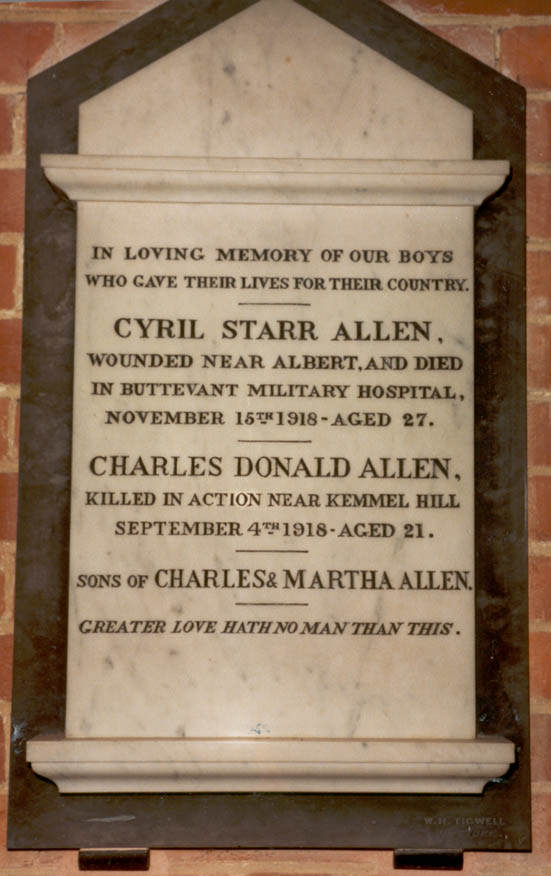
While in Ireland, Corporal Allen contracted influenza and was admitted to the Buttevant Hospital in County Cork. Sadly, in his weakened state, it was something he was to succumb to, and he passed away, with Mabel at his bedside, on 15th November 1918. He was just 27 years of age.

Cyril Starr Allen’s body was brought back to England; he was laid to rest in the graveyard of Christ Church in Frome, Somerset.


Corporal Cyril Allen (from ancestry.co.uk)

After the loss of her husband, Mabel went on to live her life. In 1923, she married James Burr, a draughtsman from Frome; they went on to have a child – a brother for Kathleen – called James.


Cyril’s two brothers, Winthrop and Charles, also fought in the First World War.

(from ancestry.co.uk)

Winthrop had emigrated to North America in 1911, but returned to Europe as part of the Canadian Expeditionary Force when war broke out.

Lance Corporal Charles Allen served with the 15th Battalion of the Hampshire Regiment. He fought on the Western Front and was killed near Kemmel Hill in Belgium on 4th September 1918. He was just 21 years old. Charles is commemorated at the Tyne Cot Memorial in Zonnebeke, Belgium.


Gunner George Hewlett

Gunner George Hewlett

George Henry Hewlett was born on 11th July 1892, the oldest of four children to Henry and Louisa Hewlett. Henry was a painter from Hampshire, who travelled for work. George and his youngest sibling were born in Romsey, while his two brothers were born in Swindon, Wiltshire. By the time of the 1901 census, when George was eight years old, the family had settled in Hammersmith, London.

The next census, in 1911, recorded the family as living in Caterham, Surrey. By this time, George and his father were working as gardeners, while his brothers were working as grocers. Louisa, meanwhile, was employed as a live-in housekeeper for a spinster and her mother just around the corner.

War was coming and George was determined to do his bit. Full details are not available, but he enlisted in the Royal Marine Light Infantry, taking on the role of Gunner. In May 1918 he was on board HMS Iris, a Mersey ferry requisitioned by the Royal Navy for support in the planned raid on Zeebrugge.

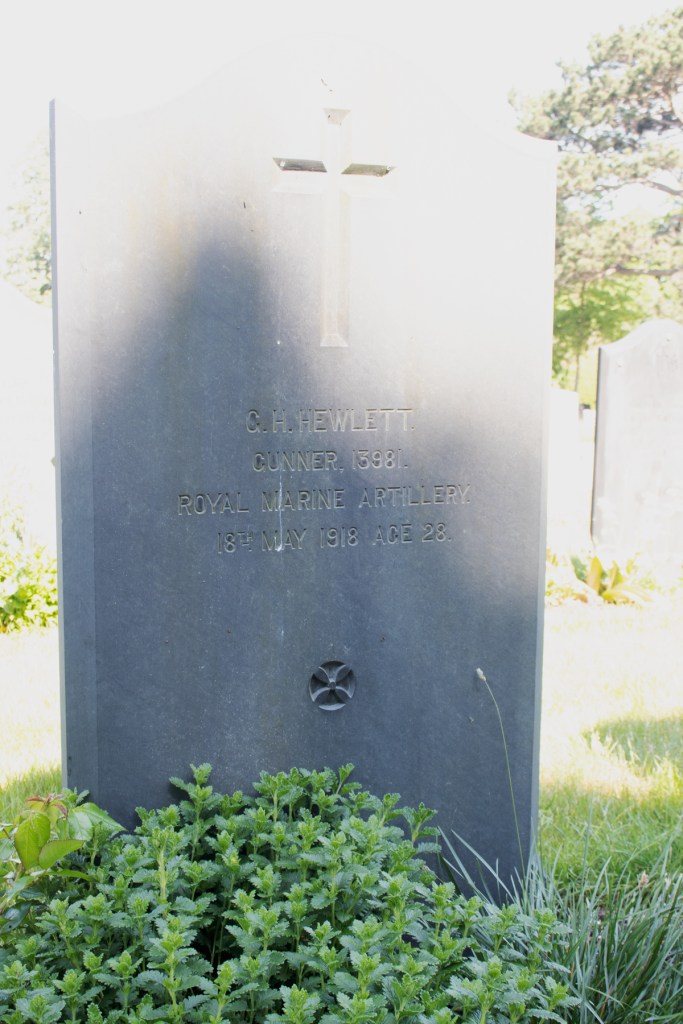
On 23 April 1918, HMS Iris was towed across the English Channel to Zeebrugge by HMS Vindictive; she was carrying a couple of platoons of the 4th Battalion of the Royal Marines as a raiding party. When the Vindictive neared the Zeebrugge she cast the ferry aside. Iris tried to pull up to the breakwater under heavy fire in order to off-load the raiding parties which were on board. She sustained heavy fire and a shell burst through the deck into an area where the marines were preparing to land. Forty-nine men were killed, including Gunner Hewlett. George was 28 years of age.

George Henry Hewett’s body was brought back to England. He was laid to rest in the Woodlands Cemetery in Gillingham, Kent, not far from the dockyard at which he was based.


George’s two brothers also fought in the First World War.

John William Hewlett, who was two years younger than George, joined the 1st Royal Marine Battalion of the Royal Naval Division as a Private. He fought on the Western Front, and was killed in fighting on 22nd October 1916. He was 21 years of age. John was laid to rest at the Mesnil-Matinsart Cemetery near the town of Albert in Northern France.

Joseph Herbert Hewlett was born three years after George. When war was declared, he enlisted in the Buffs (East Kent Regiment), joining the 4th Battalion as a Private. Dispatched to India, he was initially based in Bombay, but was injured in fighting. He was sent back to England, and treated at the Military Hospital at Netley, near Southampton. Sadly, his wounds proved too severe – he passed away on 4th April 1915, aged just 20 years old.

In the space of three years, Henry and Louisa Hewlett had lost all three of their sons to the war. After George’s death, a local newspaper reported this was their “sad and proud record”. [Dover Express: Friday 31st May 1918]


Private Joseph Dodge

Private Joseph Dodge

Joseph Dodge was born in the summer of 1883, and was one of twelve children, including eleven boys. His parents were David and Eliza Dodge, who raised their growing family in Stoke-sub-Hamdon, a few miles to the east of Yeovil, Somerset.

David was a mason and stone sawyer, but his children went into other roles when they left school; Joseph found work as an agricultural labourer.

In October 1903, Joseph married Elizabeth Ann Case – better known as Annie – who came from just over the Dorset border in the village of Corscombe. Setting up home in Yeovil itself, the couple went on to have two children – both boys – Walter and Norman.

War was coming to Europe, and Joseph was intent on doing his bit. Full service details are not available, but the documents that exist confirm that he enlisted as a Private in the Wiltshire Regiment. Initially assigned to the 1/4th Battalion (which served in Egypt), he transferred to the 2/4th Battalion (which served in India).

Sadly, there is no documentation to give service dates, it is impossible to establish when or if Joseph actually served in these locations. India seems likely, however, as he later transferred to the 1st Garrison Battalion of the East Yorkshire Regiment, which was based in Lucknow.

Private Dodge survived the war and came back to England, but seems to have contracted pneumonia on the journey home. Admitted to hospital in Liverpool, the condition sadly got the better of him. He passed away on 16th February 1919, at the age of 35 years old.

Joseph’s body was brought back to the county of his birth; he was laid to rest in Yeovil Cemetery.


Joseph came from a very patriotic family, and local newspapers early in the war highlighted that many of the Stoke-sub-Hamdon brothers had enlisted to serve King and Country.

At the time of the article, six had enlisted – Thomas, Arthur and Percy (all in the Somerset Light Infantry), Albert (West Somerset Yeomanry), Evan (Royal Navy) and David (Canadian Infantry).

Corporal David Dodge seems definitely to have distinguished himself. Having emigrated to Canada before the war, he returned to Europe when conflict broke out. An article in the Western Chronicle reported that he had “been awarded the Military Medal for conspicuous bravery on the field under heavy fire.[Western Chronicle: Friday 15th November 1918]

Amazingly, of the seven brothers who fought in the conflict, only Joseph perished.


An earlier series of articles tells the tragic story of another of Joseph’s siblings. Henry Dodge (known as William) had moved to Senghenydd, to the north of Cardiff, in 1910; mining work was plentiful there and he and a number of his fellow villagers had sought money from the black gold.

On the 14th October 1913, and explosion happened in the mine and together with the resulting fire and subsequent poisonous gas outpouring killed more than 430 miners. Initially reported missing, William was later confirmed dead; he was just twenty years old and left a widow and child.


Private Sidney Ford

Private Sidney Ford

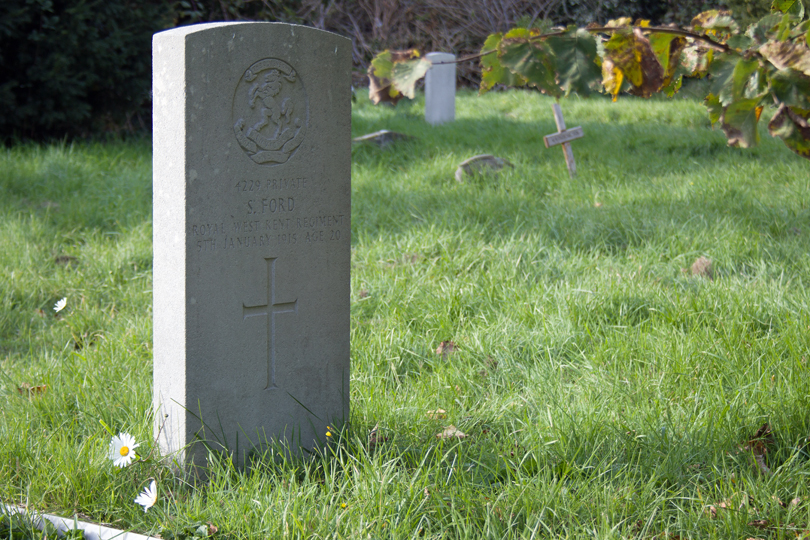
Sidney Ford was born in Kent in 1896, the son of Stephen John Ford and his second wife, Elizabeth Ann (née Underdown). The couple had four children – Frederick, Sidney, Ethel and Alice – although it seems that Elizabeth brought them up almost singlehandedly. Sidney’s military records gives his father’s name, although simply notes that he was an imbecile, in the stark way that only Edwardian officials could.

Sadly, little of Sidney’s early life remains documented. By the time war broke out, he was working as a farm labourer in Yalding, close to where he was born. He enlisted at the end of October 1914, joining the Queen’s Own (Royal West Kent Regiment), and was assigned to the 8th (Service) Battalion as a Private.

Joining up in Maidstone, by the end of the year, Private Ford’s battalion was soon billeted in Worthing, West Sussex. Tragically, his service was destined to be a short one, and he passed away after only a month in the town.

The first death from the Red Cross Hospital, Cecil’s, at West Worthing, had to be recorded. Since it has been opened there have been a large number of cases, and many of them have been of a serious nature, but happily all except the one under notice have made progress, thanks to the skill of the Medical Officers and Nursing Staff of the institution.

The deceased in this instance was a Private of the Eighth Battalion of the West Kent Regiment, now stationed locally. His name was Sidney Ford, and he was twenty-five years of age. He died on Friday, and at the funeral, which took place on Monday, full Military honours were accorded him.

Colonel Vansittart (who commands the Eighth Battalion) and Major Bock-Hollinshead attended, as also did other members of the Staff of the Hospital. A large number of the public were also at the Cemetery to witness the last rites, the progress of so long and so imposing a procession through the streets attracting considerable attention.

Worthing Gazette: Wednesday 20th January 1915

Private Ford has died on 15th January 1915, and was actually just 20 years of age, not 25, as had been reported. The Worthing Gazette does not give no mention to Sidney’s family, so it can only be assumed that they were unable to make the journey from Kent to the funeral. I have been unable to uncover details of the cause of his death, but, given that there is no mention of the cause in the newspaper, it is likely to have been following an illness than anything more sensational or unusual.

Sidney Ford lies at rest in the Broadwater Cemetery in Worthing, one of the first in the town to have passed because of the Great War.


Sidney’s older brother, Frederick, was also involved in the Great War. While there is little specific information about his service, it is evident that he was a Private in the Duke of Wellington’s (West Riding Regiment).

Unlike his younger brother, Frederick did see military action, but list his life on the Western Front on 4th November 1915, ten months after Sidney had passed in Worthing.

Frederick lies at rest in the Royal Irish Rifles Graveyard in Laventie, in Northern France.


Lance Corporal Ernest Hawkins

Lance Corporal Ernest Hawkins

Ernest Frederick Hawkins was born in Street, Somerset, in 1884. He was the youngest of six children to Charles Hawkins and his wife Elizabeth. Both of Ernest’s parents were shoemakers in the Clark’s Factory in the town, and this was the trade Elizabeth continued in after her husband’s death in 1887.

Ernest’s life has some mysteries about it and there is a sense that he spent time trying to escape from something. In August 1904, he enlisted in the army, joining the Scottish Rifles (also known as the Cameronians). He did this under an assumed name, preferring to be called James Fisher.

“James” gave his next of kin as his parents, listing them as George and Annie in South Acton (even though these were not his actual parents’ names, and that his father had passed away 17 years previously).

His enlistment papers give an interesting insight into the young man. He was listed as 22 years old, 5ft 4ins (1.62m) tall, with brown eyes, black hair and a sallow complexion. His arms were adorned with a number of tattoos, including Buffalo Bill on his upper right arm and a ship surrounded by flags on his upper left.

Private Fisher served for a year on home soil, before being shipped out to India. He returned to the UK in October 1907, and transferred to the Army Reserve.

Ernest returned to Somerset, and it was here that he met Sarah Jane Manning. The couple married in a registry office in Bristol, and went on to have two children, Hubert and Iris.

War broke out, and Private Fisher was remobilised. By August 1914 he was promoted to Lance Corporal, and sent to France as part of the British Expeditionary Force. Here he became caught up in a number of the key battles of the conflict.

On 24th July 1916, during the British attacks on High Wood at the Somme, he was wounded in the right arm, and invalided back to England for treatment. Admitted to the War Hospital in Guildford, Surrey, it was confirmed that he had received a gun-shot wound to his right arm, which had resulted in a compound fracture of the humerus, radius and ulna. Sadly for Ernest, the only option was a full amputation of his right arm.

After some time to recover, Ernest was transferred to the Pavilion Military Hospital in Brighton where he was fitted for an artificial limb. He spent three months in the Brighton facility, before being moved to the Queen Mary’s Convalescent Home in Roehampton to recuperate. He was eventually discharged – from the hospital and the army – on 10th March 1917, and returned to his wife and family in Somerset.

There is little further documented information about Ernest. He and Sarah went on to have a further child – Leslie – in 1917. Sadly, where Ernest had been a toddler when his father had died, Leslie was consigned to be a babe-in-arms when Ernest passed away.

Ernest Frederick Hawkins – also known as James Fisher – died in Swindon on 2nd July 1918, at the age of 34. He lies at rest in St Mary’s Cemetery in his adopted home town of Taunton, Somerset.


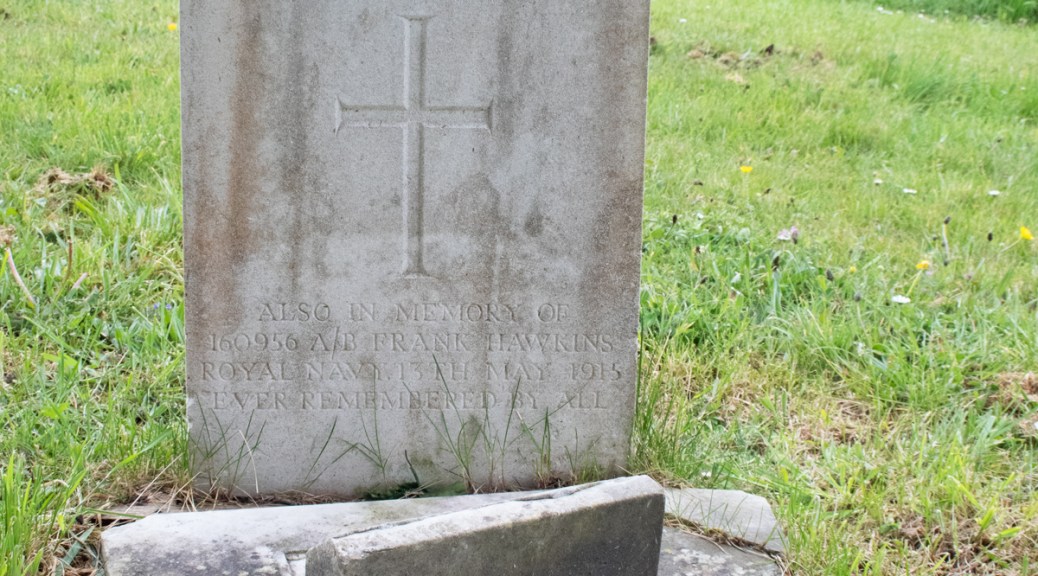
Ernest’s gravestone also commemorates his brother Frank Hawkins. Frank was nine years older than Ernest, and, like his younger brother, had decided that the military life was for him.

Frank enlisted in the Royal Navy in November 1894 and was assigned a Boy 2nd Class on HMS Impregnable – the training ship based in Chatham, Kent. Over the period of his twelve years’ service, Frank rose through the ranks to Able Seaman. When his term was up, he joined the Royal Fleet Reserve for a further five years.

When war came, Able Seaman Hawkins was immediately called back into action. He was assigned to HMS Goliath, serving off German East Africa and the Dardanelles. On the night of the 12th May 1915, the ship was guarding the water off Gallipoli, when it was struck by three Ottoman torpedoes. The resulting explosions caused the ship to sink quickly, and 570 souls – out of a total complement of 750 crew – were lost.

Able Seaman Hawkins was one of those lost, and was subsequently commemorated on his brother’s gravestone.


Able Seaman Gerald Brine

Able Seaman Brine

Gerald Montague Brine war born in October 1897, the youngest of seven children to John and Annie Brine. John was a potter, and, while the children were born in Dorset, the family soon moved to the Somerset village of Binegar.

Gerald’s three older brothers all went to work in a local stone quarry, as an engineer, breaker and foreman respectively. When Gerald left school, he found work with the local blacksmith as a striker. It was while employed there, in 1912, that his mother Annie passed away, aged just 50 years old.

War was on its way however, and where his brothers enlisted in the army, Gerald was bound for the sea. He enlisted in the Royal Navy on 3rd November 1915 and, as an Ordinary Seaman, was assigned to HMS Iron Duke. He was aboard the vessel when it became embroiled in the Battle of Jutland in May 1916, and was subsequently transferred to HMS Discoverer.

Promoted to Able Seaman in April 1918, the Discoverer headed back to Chatham a couple of months later. A Somerset newspaper picks up on Gerald’s sad tale from there.

When one of His Majesty’s ships was returning to port, and her crew were looking forward to “leave”, an unfortunate tragedy occurred by which Gerald Montague Brine, a young Able Seaman [and] a native of Binegar, lost his life. It appears that in the course of storing gear, a loaded revolver was removed by mistake to the armourer’s room, instead of to the officer’s cabin, and was placed on a table.

Curiosity led Peter Macfarlane, another able seaman, to handle it, and as he was bringing it to his side from an upward position, he, to use his own words, unconsciously pulled the trigger. It fired, and the bullet entered Brine’s body just under his left shoulder, fracturing his spine and producing paralysis of his lower limbs.

Wells Journal: Friday 12th July 1918

Gerald’s parents had a telegram to say that he was seriously wounded and in the Royal Naval Hospital, Chatham. They travelled at once to Chatham and found him very ill, but conscious. They remained with him until he died a week later, on 1st July 1918. He was just 20 years of age.

At the inquest, Macfarlane described Brine as his best chum, and all witnesses agreed that “the best possible relations existed between the members of the crew.” According to the doctor’s evidence at the inquest, Gerald was unable to be saved. The jury reached a verdict of Accidental Death.

Able Seaman was brought home to Binegar, and lies at rest in the graveyard of Holy Trinity Church.


Gerald’s grave also acts as a memorial to two of his older brothers.


Arthur Brine, who had been the stone breaker in the quarry, emigrated to Canada after his mother had died, finding work there as a fireman. The Great War brought him back to European shores, however, and he enlisted in the Canadian Expeditionary Force, joining the 188th Battalion.

Private Brine arrived in England in October 1916; he transferred to the 28th Canadians, and set off for France the following January. He was caught up in the Battle of Arras and was hit and killed by a piece of shrapnel on 15th April 1917. He was just 29 years old.

Arthur Brine lies at peace in the Ecoivres Cemetery to the north west of Arras in Northern France.


Herbert Brine had been the foreman at the stone quarry He married Sarah Lucy James shortly before his mother’s death in 1912; the couple went on to have two children, Arthur and Kenneth.

Herbert was mobilised in July 1917, initially joining the 3rd Reserve Battalion. He was drafted, as an Able Seaman, to the Hood Battalion, Royal Naval Division (RND) in November 1917, before re-joining his RND Battalion at Flesquières, near Cambrai, two months later.

In early March 1918, the Germans started bombardments in preparation for a major offensive. For ten days from 12th March, the Flesquières salient was drenched with nearly a quarter of a million (mostly mustard) gas shells, There were over 2,000 resultant casualties in the RND. After this preparatory shelling, the Germans attacked in enormous numbers.

By the end of the day, the situation was precarious and the Division was forced to retreat in steps, through Bertincourt, Ytres and the Metz lines, through the old Somme battlefields.

Able Seaman Brine was first reported missing on 24th March, but was only accepted as having been killed in action on that date nine months later.  As such, Herbert is commemorated by name on the Arras Memorial; his name also resides on Gerald’s gravestone back home in Binegar.


The Great War took its toll on the Brine family. Three of the four brothers died during those tumultuous years, leaving only John’s oldest son, Wallace, to carry on the family name. John himself died in 1942, aged 84, and lies with his wife and youngest boy in the small Binegar churchyard.


Serjeant Frederick Wickens

Serjeant Frederick Wickens

Frederick Albert John Wickens was born in Newbury, Berkshire, in the summer of 1889. The oldest of four children to Alfred and Emily Wickens, his father was a brewer’s labourer.

The military life proved more of a draw to Frederick, however. While his full records no longer exist, by the time of the 1911 census, he was recorded as being a Sapper with the 2nd Field Troop of the Royal Engineers. He was based at Potchefstroom, around 75 miles (120km) south east of Johannesburg in South Africa, and his trade was listed as a tailor.

Sadly, it is at this point that Frederick’s trail goes tepid, if not cold.

From a personal perspective, he married a woman called Rose, who was a year younger then him. Her details are scarce, and there is nothing to confirm when or where they married (other than the 1911 census, when Frederick was listed as ‘single’).

The couple must have had some connection to Gillingham, as this is where they lived; given the proximity of the Royal Engineers Barracks in neighbouring Chatham.

Sapper Wickens’ military service continued into the Great War. He was awarded the medaille militaire by Belgium, and achieved the rank of Serjeant during his career. Unfortunately, there are no details of the actions around either the award or his promotion.

Serjeant Wickens passed away on 27th February 1921; he died in Chatham, although the cause was not recorded. He was 31 years old.

Frederick Albert John Wickens lies at rest in the Woodlands Cemetery in Gillingham, Kent.


Frederick’s younger brother Thomas, also served in the Great War. He enlisted in the Princess Charlotte of Wales’s (Royal Berkshire) Regiment, and was involved in the battles on the Western Front. Sadly he was killed in the fighting on 24th May 1916, at the age of 19 years old.


Corporal Albert Shrubsall

Corporal Albert Shrubsall

Albert Arthur Shrubsall was born in Deptford, South London, in April 1896. He was the youngest of three children – all boys – to ironmonger George Shrubsall and his wife Jessie.

While his brothers continued to live at home after they had left school and got jobs, Albert found live-in work as a pageboy, or servant, for Wilfred Lineham, who was a professor of engineering for a London college. It was while he was working here that his mother, Jessie, passed away. She died in 1913, aged just 43.

Details of Albert’s military service are a bit scant. He enlisted in the Royal Marine Light Infantry, although I have been unable to confirm when he joined up. He was assigned to the Chatham Division, and was based at the Naval Dockyard in Kent, ultimately being promoted to Corporal.

Albert married Gertrude Spoore – affectionately known a ‘Ginty’ – in Deptford in October 1917. Sadly, the marriage was to las less than six months, as, on 9th April 1918, Albert passed away, having contracted pneumonia and septicaemia. He was just 22 years old.

Albert lies at rest in the Woodlands Cemetery in his adopted home town of Gillingham in Kent.


Albert’s two brothers George and Alfred were also involved in the First World War.


George, had gone on to become a tailor’s assistant when he left school. He married Emily Hawkes in 1911, and the couple went on to have a son, also called George, the following year.

When war broke out, he enlisted in the Machine Gun Corps, and served on the Western Front. Sadly, he was caught up in the fighting, and was killed in action on 22nd August 1917. He was buried at the Tyne Cot Memorial in Flanders.


When he left school, Alfred went on to become a butcher’s assistant. War came along, and he enlisted straight away.

Enrolling in the Royal Field Artillery, Gunner Shrubsall was assigned to the 95th Brigade. Sadly, he had recorded less than six months’ service, as he passed away on 8th January 1915, aged just 21 years old. His brigade did not go to France until the following year, so, while no cause of death is recorded, it is likely that he died from a communicable disease like influenza or pneumonia.

Alfred is buried in the family grave in Deptford, South London.


Within a period of just three years, George had lost all three of his sons to the Great War. Given the previous death of his wife, you can only imagine the heartbreak he was going through.