Tag Archives: Essex

Private Arthur French

Private Arthur French

Arthur John French was born on 3rd September 1889 in the Somerset village of Merriott. He was the youngest of three children to John and Annie French. John was a miller and baker in the village, and Arthur’s older brother Edward helped his father with the business. Arthur, however, followed a different path and, with Annie passing away in 1903, he had moved to London for work.

The 1911 census recorded Arthur boarding with his maternal aunt and uncle, who were both schoolteachers. He had found employment as a clerk in the head office of the National Telephone Company and shared the large terraced house with the couple, their son Alfred and their servant, Esther.

When war was declared, Arthur was in the first wave of those enlisting. He joined the Oxford & Bucks Light Infantry and, as a Private, was assigned to the 2nd/4th Battalion. Initially sent to Northampton for training, his troop soon came south again and, by April 1915, was based just outside Chelmsford, Essex.

Tightly-packed barracks, housing men from across the country soon became hotbeds for illness and disease, and Private French was not to be immune. He contracted meningitis, and was admitted to the 3rd London General Hospital in Wandsworth for treatment. Sadly he was to succumb to the condition, and he breathed his last on 16th April 1915, at the age of just 25 years old.

Arthur John French’s body was brought back to Somerset for burial. He was laid to rest in the graveyard of All Saints’ Church in his home village, Merriott.


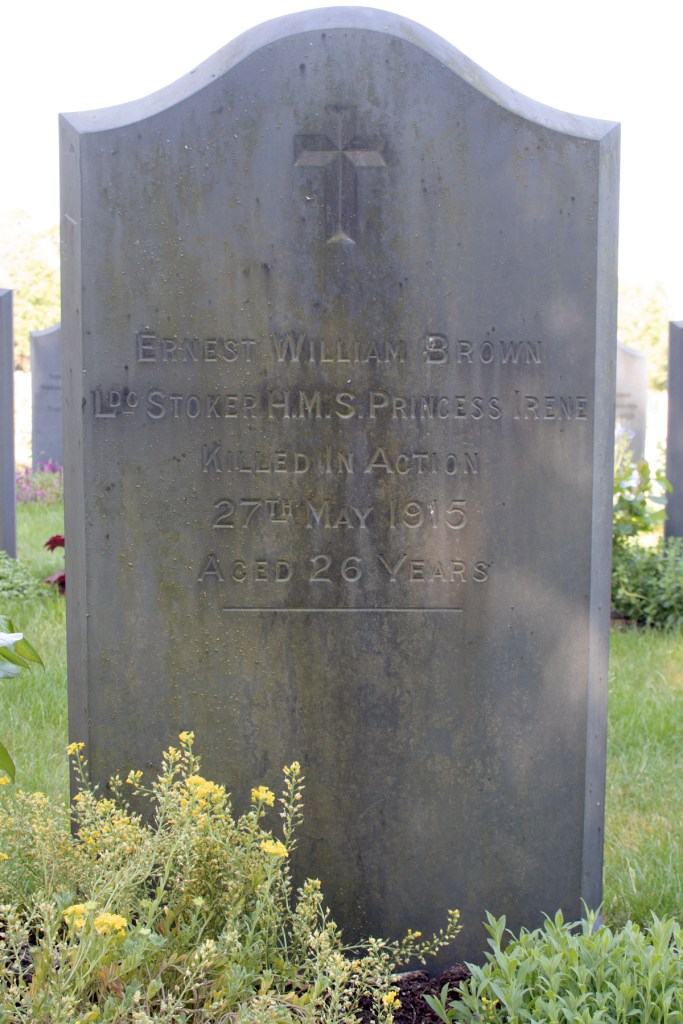
Leading Stoker Ernest Brown

Leading Stoker Ernest Brown

Ernest William Brown was born on 5th April 1889 in Halstead, Essex. One of twelve children, his parents were carpenter Edward and silk weaver Elizabeth Brown.

Ernest initially found work as an errand boy, then as a house painter. He wanted bigger and better things, however, and the Royal Navy offered him that opportunity. He enlisted as a Stoker 2nd Class on 12th March 1908 for a period of twelve years’ service.

Ernest’s early service records are lost to time, but he received a promotion to Stoker 1st Class on 12th March 1909, exactly a year after a joined up. At this point he was assigned to the dreadnought battleship HMS Russell, on board which he served until August 1912.

After a short period at HMS Pembroke, the Royal Naval Dockyard in Chatham, Kent, Stoker 1st Class Brown was transferred to the Apollo-class cruiser HMS Iphigenia. She was to be his home for the next two-and-a-half years, during which time he was promoted again, this time to Leading Stoker.

Returning to HMS Pembroke in March 1915, this was to be his shore base for the next couple of months. On 27th May, Leading Stoker Brown was helping out on the steamer Princess Irene. Tragically, while on board an explosion ripped through the ship, while moored off Sheerness, Kent and he was one of the 352 souls killed. He was just 26 years of age.

Ernest William Brown was laid to rest in the Woodlands Cemetery in Gillingham, Kent. His body having been identified, he was given his own grave, unlike those who were buried in a mass grave nearby.


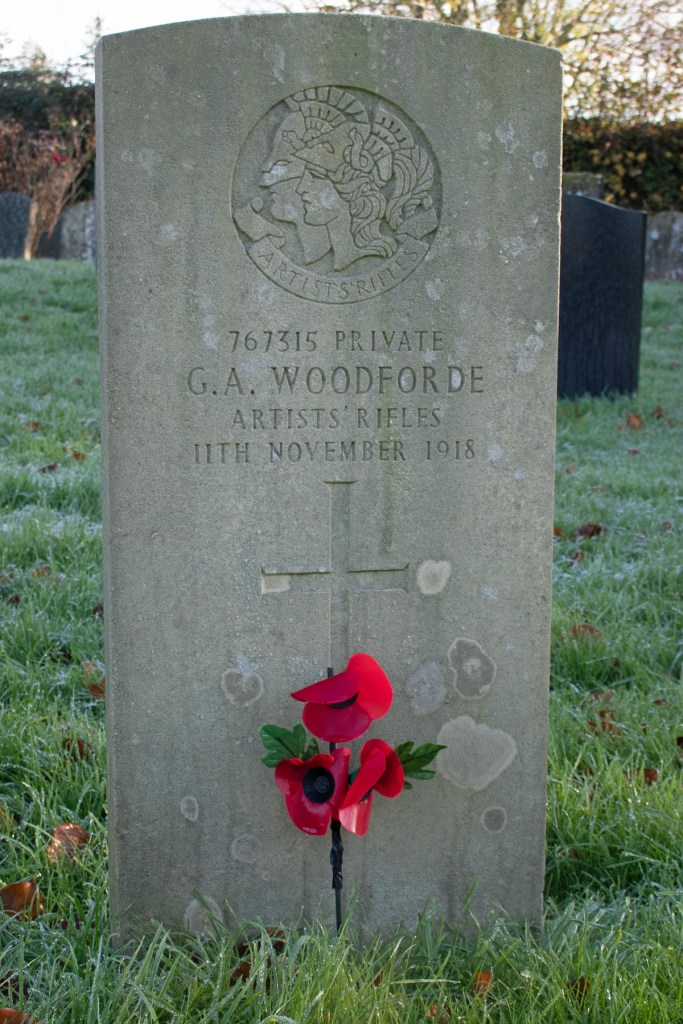
Private George Woodforde

Private George Woodforde

George Augustus Woodforde was born on 21st April 1892 in Leyton, Essex. He was one of six children to George and Harriet Woodforde, although, tragically, George had died shortly before his son was born.

George Sr had been born in Ansford, Castle Cary, Somerset and this is where he was laid to rest. He was a theological student in his twenties and, according to the 1891 census, he was living on his own means. This is something that Harriet was fortunate enough to be able to do once she was widowed.

George Jr studied into his late teens and, by the time war was declared in 1914, he was employed as a schoolmaster. He enlisted in April 1916, but was not mobilised until 17th November 1917. He served as part of the 28th Battalion (Artists’ Rifles) of the London Regiment and his records show that he was 5ft 8ins (1.73m) tall and was of a slight build, weighing in at only 110lbs (50kg).

Private Woodforde soon found himself in France, and fought on the front line for a while. He was caught up in the Battle of the Canal du Nord in late September 1918, and was badly wounded. He was medically evacuated to England, and admitted to the East Leeds War Hospital. He had received gunshot wounds to both thighs and feet, and had fractured the tarsal and metatarsals of his right foot.

Private Woodforde’s left leg became infected, and he then developed double pneumonia. It was this lung condition that he was to succumb to: he passed away at the hospital on 11th November 1918 – Armistice Day. He was just 26 years of age.

George Augustus Woodforde was laid to rest in the graveyard of St Andrew’s Church in Ansford, Somerset, close to where his father had been buried all those years before.


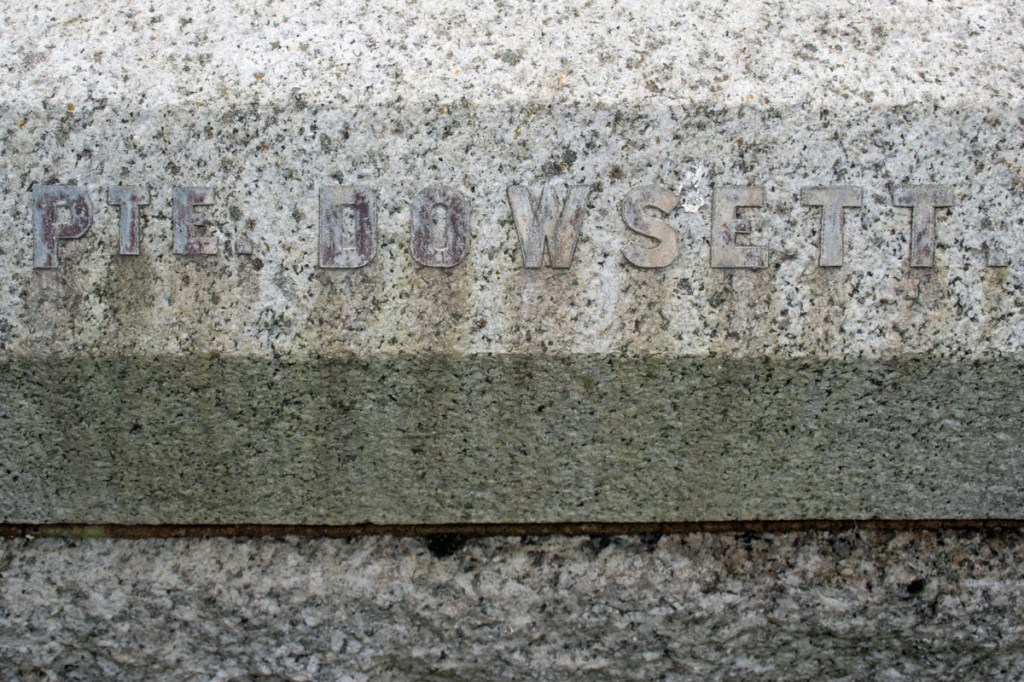
Private Albert Dowsett

Private Albert Dowsett

Albert Dowsett was born in the Essex village of Sible Hedingham in the spring of 1868. He was the fourth of six children – all of them boys – to Stephen and Susan Dowsett. Stephen was an agricultural labourer, while his wife worked as a straw plaiter to bring in a little extra money.

Albert seems to have been a bit of a tearaway. In July 1877, a local newspaper reported that:

Ezekiel Rulton and Albert Dowsett, boys each nine years of age, were indicted for breaking into the dwelling house of Matilda Jaggard, at Sible Hedingham, and stealing two books, value 1s, on the 20th June. Rulton, having once before committed burglary was sentenced to 10 days’ hard labour and five years in a Reformatory School. Dowsett was acquitted.

Essex Standard: Friday 6th July 1877

Stephen died in the autumn of 1884, while Susan died in March 1892. By this point Albert was 23 years of age, and had found solid work in the army. Full details of this early service no longer remain available, but he fought in South Africa in the 1890s.

By 1897 he returned to England and moved to Stone, near Greenhithe, in Kent. It was here that he met and married Anna Davis, the daughter of a local brewery man. The couple set up home in the village, and went on to have three children, William, Dorothy and Margaret.

The 1911 census recorded the family living in a small terraced house close to the railway station in Greenhithe. Albert was working as a labourer in the wash mill of the local cement works, and the family had a boarder, widower William Davies, who was a weighman at the same works.

Away from work, Albert had also found another calling, and was employed as a verger at St Mary’s Church, just a few minutes’ walk from home.

War was now encroaching on Europe, and, with his previous army service, Albert was perfect to resume his military role. Given the age limitations for new recruits early on in the conflict, it is likely that he volunteered for this role. He willingly took up a post with the 3rd Supply Company of the 2nd/4th Battalion of The Buffs (East Kent Regiment).

Private Dowsett was given a guard’s role, and was part of the team given the duty of patrolling two explosives factories near Faversham. He was on duty on the afternoon of Sunday 2nd April 1916 when a fire near one of the factory buildings set off a series of massive explosions. More than a hundred people were killed; sadly this included Private Dowsett. He was 48 years of age.

Albert Dowsett was laid to rest, along with the other victims of the Faversham Explosion, in a mass grave the town’s Borough Cemetery.


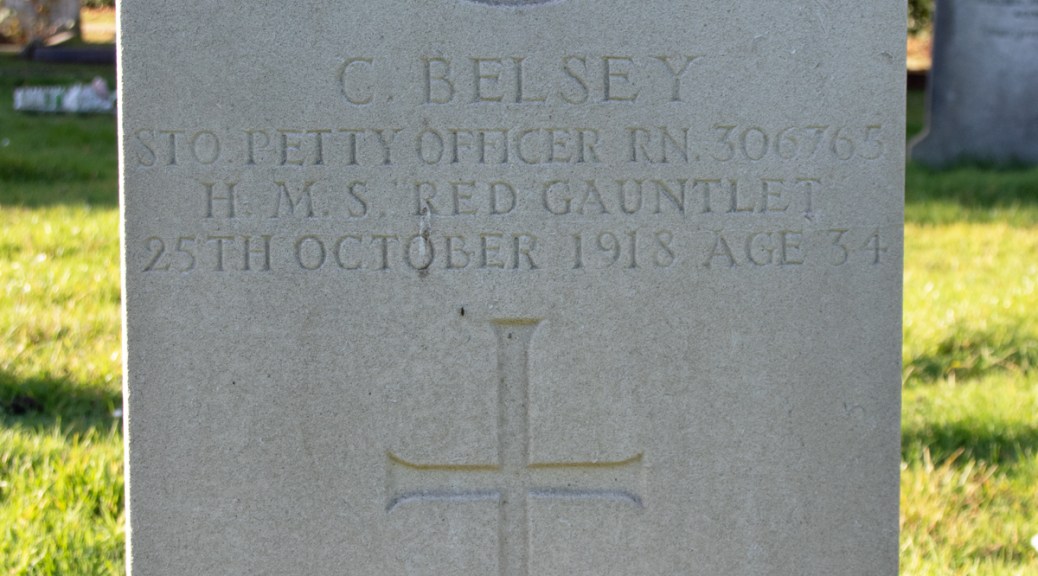
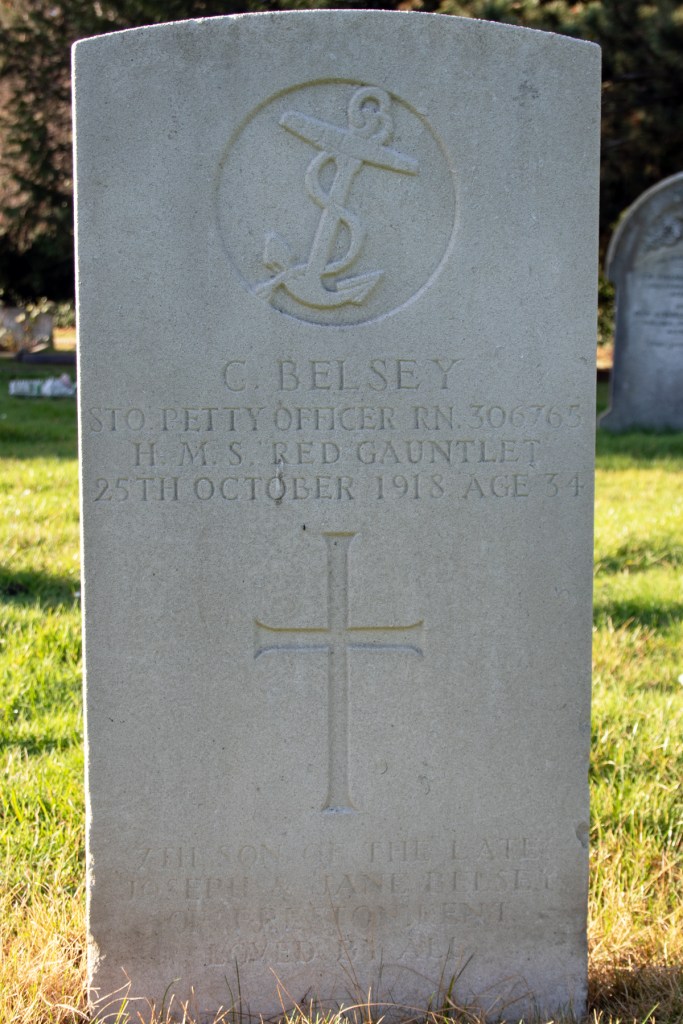
Stoker Petty Officer Christian Belsey

Stoker Petty Officer Christian Belsey

Christian Belsey was born on 12th February 1884 in the village of Preston, Kent. He was one of fourteen children to Joseph and Jane Belsey. Joseph was a farm labourer, and Christian followed suit on leaving school.

He wanted bigger and better things, however, and after his older brother Charles had sought out a life in the Royal Navy, he followed suit. Christian enlisted on 28th June 1904; his service records show that he was 6ft (1.83m) tall, had brown hair, brown eyes and a fresh complexion.

Stoker 2nd Class Belsey was based out of HMS Pembroke, the Royal aval Dockyard in Chatham, Kent, and this is where he returned to in between voyages. His first posting was on board the destroyer HMS Acheron, on board which he spent six months.

Over the twelve years of his initial service he was assigned to six different ships, rising through the ranks to Stoker 1st Class (in 1906), Leading Stoker (1911) and Stoker Petty Officer (1912).

When war broke out in August 1914, Christian was back in Chatham; he was soon assigned to HMS Laertes, a destroyer based out of Harwich, which patrolled the North Sea. She was involved in the attempt to head off the German attack on Yarmouth and Lowestoft in April 1916, during which, two of Christian’s colleagues, Stoker Ernest Clarke and Stoker Petty Officer Stephen Pritchard, were awarded the Distinguished Service Medal for their bravery under fire.

After three years on board Laertes, Christian was transferred to HMS Redgauntlet. He served on board for eighteen months until, in October 1918, he fell ill.

Admitted to a hospital in Samford, near Ipswich, Suffolk, Stoker Petty Officer Belsey was suffering from pneumonia. Sadly, the lung condition was to get the better of him, and he passed away on 25th October 1918, at the age of 34 years old,

Christian Belsey was brought back to Kent for burial. He was laid to rest in Faversham Borough Cemetery.


Stoker 1st Class Michael Brown

Stoker 1st Class Michael Brown

Michael Brown was born on 25th October 1891 in Kirkdale, Lancashire, one of four children to James and Julia Brown. James was a sailor who died when Michael was just a boy. While Julia tried to make ends meet by taking in washing, it must have worried her when her son then fell into a sea-going life when he left school.

Michael enlisted in the Royal Navy on 19th February 1910, by which time he was already a seaman in the merchant fleet. His service records show that he was 5ft 4.5ins (1.64m) tall, had bark brown hair, brown eyes and a dark complexion. He also had a number of tattoos on his forearms, including a shamrock and a cross.

Recruited as a Stoker 2nd Class, Michael served on a number of vessels in the lead up to the outbreak of war, including the scout ship HMS Patrol, which served from Harwich Harbour, Essex. It was here that he gained promotion to Stoker 1st Class in February 1911.

When not at sea, Stoker Brown was based at HMS Pembroke, the Royal Naval Dockyard in Chatham, Kent. When war broke out in 1914, however, he was in the middle of a three-year stint on board HMS St George, a cruiser that went on to guard the Humber Estuary on the east coast of Yorkshire and Lincolnshire.

By the spring of 1916, he was back in Chatham and from this point on, remained firmly on dry land, with assignments in Kent and at HMS Victory, the Royal Naval Dockyard in Portsmouth, Hampshire. By the summer of 1917, though, Stoker Brown returned to HMS Pembroke once again.

The naval base was particularly busy and cramped at that point in the war, and temporary overflow accommodation was set up in the barracks’ Drill Hall. This is where Michael came to be billeted.

On the night of the 3rd September, the German Air Force conducted the first night time raid on England. Chatham came in the firing line, and the Drill Hall received a direct hit. Stoker 1st Class Brown was among those to be killed. He was just 24 years of age.

Michael Brown was laid to rest in the Woodlands Cemetery in nearby Gillingham, along with the other victims of the Chatham Air Raid.


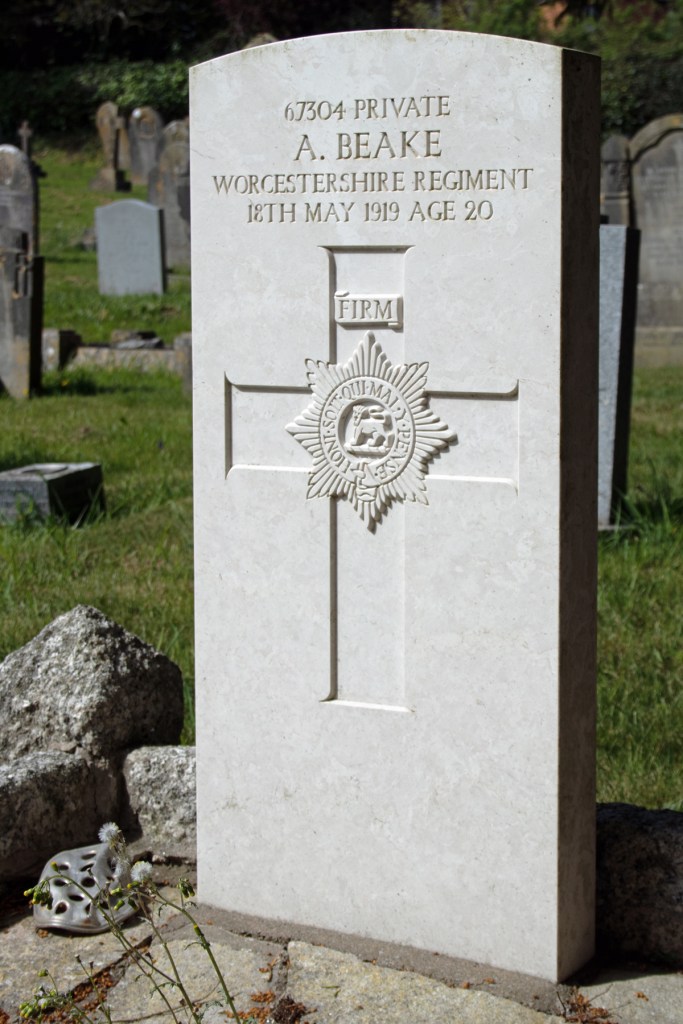
Private Alfred Beake

Private Alfred Beake

Alfred Beake was born in December 1898 and was one of nine children to Alfred and Charlotte Beake. Alfred Sr was a baker from Westonzoyland in Somerset, but it was in Chard that he and Charlotte had set up home and raised their family.

There is little documented about Alfred’s life. He played his part in the First World War, and had joined the Worcestershire Regiment by November 1918. His troop – the 5th (Reserve) Battalion – was a territorial force, and he would have split his time between Harwich, Essex, and Plymouth, Devon.

Private Beake survived the war and, by the spring of 1919 had been moved to Dublin. It was here on 18th May that he met with colleagues Private Simpson and Swindlehurst in the centre of the city. The trio caught a tram to the coastal town of Howth for a day out, where tragedy struck.

The Dublin Evening Telegraph reported on what happened next:

Private Sydney Simpson, Royal Engineers, stated… when they got to Howth, they walked along the Cliff Walk for about a mile, when they saw some seagulls down the cliff. [Beake and Swindlehurst] went out of witness’s sight for a while, when he heard a shout from Swindlehurst for help. On hurrying back, he saw Swindlehurst looking towards the sea, and he said the deceased had slipped down. The cliff was so steep that, although they tried to get down, they could not do so. Witness sent for help. None of the party had taken any drink.

Private Swindlehurst… said that he and deceased climbed down the grassy slope to get some seagulls’ eggs, but that the deceased suddenly slipped down. There was no horseplay going on at the time when the accident took place.

Captain Wynne, Royal Army Medical Corps, who made a post mortem examination, described the terrible injuries which the deceased had sustained. Death must have been instantaneous.

Dublin Evening Telegraph: Wednesday 21st May 1919

Private Beake had suffered a fractured skull from the fall. He was just 20 years of age.

Alfred Beake’s body was brought back to Somerset for burial. He was laid to rest in the family plot in Chard Cemetery.


Alfred’s oldest brother, Walter George Beake, had also served in the First World War.

Private Beake fought with the 7th Battalion of the Somerset Light Infantry, and was involved in some of the key skirmishes of the Somme. But it was at Ypres that he was buried alive during an attack, and the resulting shell shock left him totally incapacitated.

Walter was discharged from the army on medical grounds in September 1916. He returned home to try and piece his life together again. He never married, and passed away in December 1978, at the age of 87 years old.


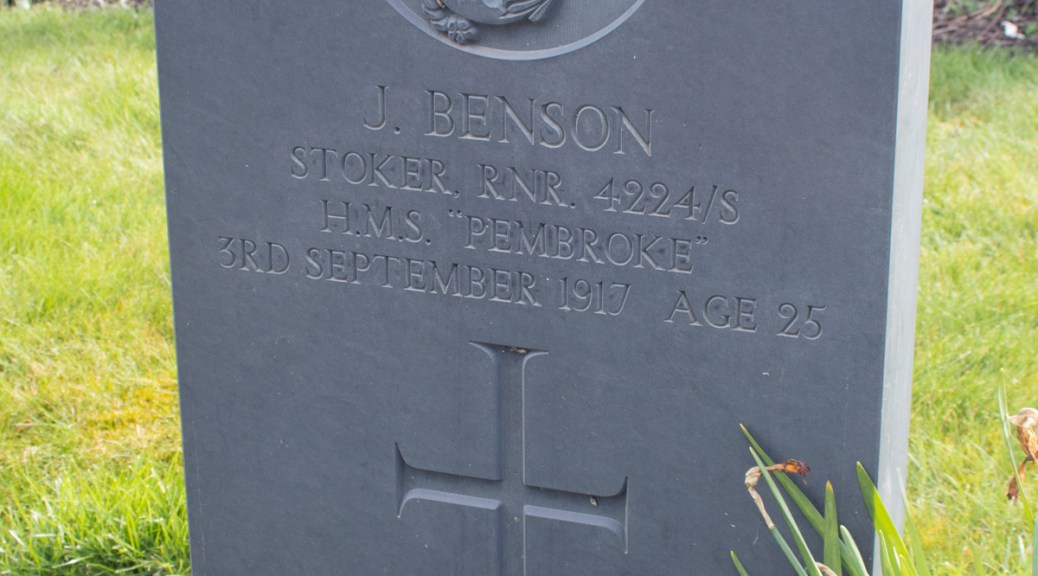
Stoker John Benson

Stoker John Benson

John Benson was born on 29th April 1892, the second of eleven children to Thomas and Annie Benson. Thomas was from Grays, Essex, and this is where the barge captain raised his growing family. While it is likely that John would have also experienced life on the water, by the time of the 1911 census, he was recorded as being a labourer at the town’s brewery.

When war broke out, it’s evident that John wanted to play his part. On 18th November 1914 he enlisted as a Stoker in the Royal Naval Reserve, and was based at HMS Pembroke, the Royal Naval Dockyard in Chatham, Kent.

Stoker Benson’s service records show that he was 5ft 3.5ins (1.61m) tall, had blue eyes and a fair complexion. He was also noted as having a number of tattoos on his forearms, including clasped hands, a bird and a lady’s head.

While John was primarily based at HMS Pembroke, he also served at sea; this included two years on board the cruiser HMS Grafton. In July 1917, however, he returned to Chatham again.

The Royal Naval Dockyard was a busy base that summer, so much so that temporary accommodation was set up in the barracks’ Drill Hall: this is where Stoker Benson found himself billeted.

On the night of the 3rd September, the German Air Force conducted the first night time raid on England. Chatham came in the firing line, and the Drill Hall received a direct hit. Stoker Benson was among those to be killed. He was just 25 years of age.

John Benson was laid to rest in the Woodlands Cemetery in nearby Gillingham, along with the other victims of the Chatham Air Raid.


Private Roderick Smith

Private Roderick Smith

Roderick Morgan Smith was born on 14th April 1896 in Upton Park, Essex. One of twin sons to Francis and Frances Smith, he had three siblings altogether. Francis is absent from the two census returns on which Roderick features, but the documents confirm that Frances – who was a certified teacher – was married, so he may have been elsewhere at the time.

By the time of the 1901 census, the family had moved from East London to Monmouthshire, where Roderick’s mother was teaching at the school in the village of Wonastow. Ten years later, they had moved across the River Severn to Withycombe in Somerset, not far from where Frances had been born. Other records show that they subsequently moved to Bath, then to Weston-super-Mare.

When war broke out, Roderick was keen to join up. He enlisted as a Private in the Durham Light Infantry, and was assigned to the 7th Battalion. He was sent to France in the spring of 1915, and would have been involved with his regiment at Ypres and the Somme.

It was at the Somme that Private Smith was gassed and wounded. Full details are not recorded, but they were enough for him to be medically evacuated to England. He was admitted to the military hospital in Taunton, but passed away on 7th May 1916. He was just 20 years of age.

Roderick Morgan Smith was brought to Weston-super-Mare and laid to rest in the town’s Milton Road Cemetery.


Roderick’s twin, Frank Morgan Smith, also played his part in the First World War. He enlisted in the Bedfordshire Regiment as a Private, and was assigned to the 7th Battalion. He also found himself embroiled at the Somme, and he too was wounded.

Sadly, Frank’s wounds were too severe for him to be repatriated to England; he died in a French hospital on 3rd December 1916, also aged 20 years old. He was laid to rest at the Wimeraux Cemetery.


Stoker 1st Class Frederick Reyner

Stoker 1st Class Frederick Reyner

Frederick Walter Reyner was born in Braintree, Essex, on 18th May 1884. The youngest of five children, his parents were Stephen and Martha Reyner. Stephen was a carpenter, who raised his family alone, when Martha passed away in 1889.

When Frederick left school, he found work as an iron worker. When Stephen also died in 1902, Frederick moved in with his older brother, Henry.

His father’s death seemed to have been the spur he needed to move on to bigger and better things: on 21st April 1904, Frederick enlisted in the Royal Navy as a Stoker 2nd Class for an initial period of five years. His service records show that he stood 5ft 4ins (1.63m) tall, had brown hair, brown eyes and a fresh complexion, with a small scar on his left thumb as an identifying mark.

Over the course of his term of service, Stoker Reyner served on three ships – HMS Acheron, Berwick and Irresistible – and was promoted to Stoker 1st Class. After each voyage, he returned to HMS Pembroke, the Royal Naval Dockyard in Chatham, Kent.

When his initial term ended in 1909, Frederick was placed on reserve, and moved back in with Henry and his family. He worked to pay his way, finding employment as a postman around Brixton, where his brother lived. He met local woman Charlotte Rebecca Scott, and the couple married in St Andrew’s Church, Peckham, on 31st May 1914.

War, by this time, was imminent, and Frederick soon found himself called back in to action. After spending a year on shore, at HMS Pembroke and HMS Victory – the Naval Dockyard in Portsmouth – Stoker Reyner was assigned to HMS Europa, a cruiser that patrolled the Eastern Mediterranean. He spent two years on board, before returning to HMS Pembroke in July 1917.

The base was particularly busy that summer, and the large number of extra servicemen meant that Frederick was billeted in temporary accommodation in Chatham Drill Hall.

On the 3rd September 1917, the first night air raid carried out by the German Air Force bombarded the town, and scored a direct hit on the Drill Hall; Stoker 1st Class Reyner was among those killed instantly. He was 33 years old.

Frederick Walter Reyner was laid to rest, along with the other victims of the Chatham Air Raid, in the Woodlands Cemetery, Gillingham. Tragically, the Navy Death Records state that he was Buried as unidentified in one of the following graves: 516, 522, 642, 735, 935, 937 or 948.


To add to the sadness of Frederick’s story, Charlotte was pregnant when he died. She gave birth on 31st May 1918, to a son who she named in memory of her late husband.