Frederick William Collier was born in the autumn of 1891. The oldest of four children, his parents were weavers Frederick and Annie Collier. Annie died in 1899, and her widow re-married. The 1911 census found the extended family – Frederick Sr, new wife Rose, Frederick Jr, two of his siblings and his three half-siblings – living at 30 New Prospect Buildings, Westbury, Wiltshire, their home town.
When Frederick Jr completed his schooling, he found work as a grocer’s labourer. War broke out in 1914, however, and he felt drawn to play his part. Full details of his military service have been lost to time, but it is clear that he had enlisted early in the conflict, and certainly by the start of 1915.
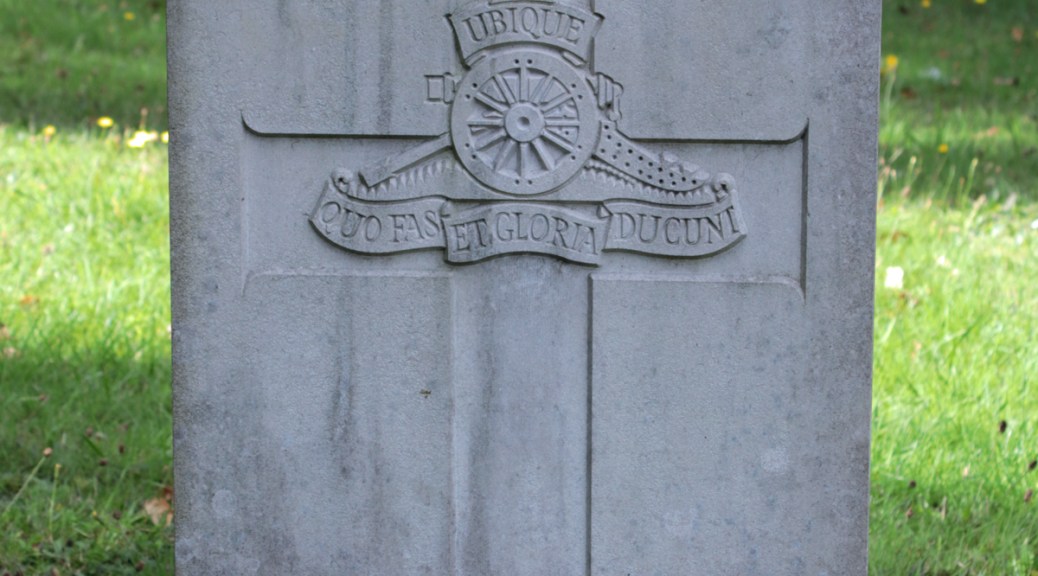
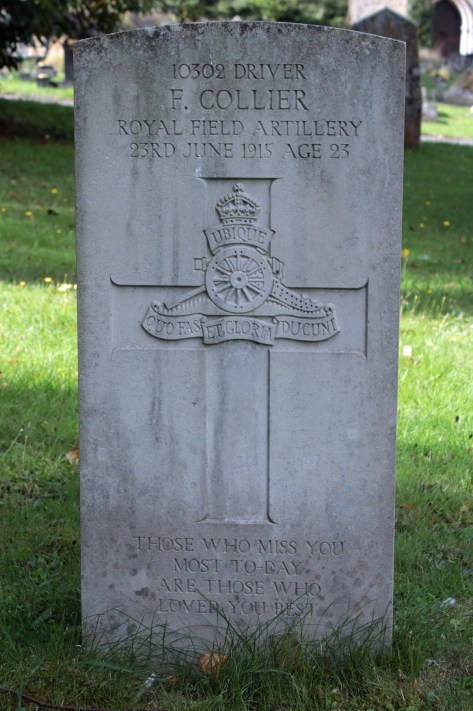
Driver Collier was assigned to the Royal Field Artillery, and was attached to the 59th Brigade Ammunition Column. He was sent to Surrey for training, unbeknownst to his unit, in preparation for the Gallipoli campaign. Frederick, however, was not to get his chance to be involved.
Frederick William Collier… died on Wednesday last week from injuries received while attempting to stop horses which were stampeding in his camp, the Ammunition Column, 59th Brigade, at Milford (Surrey)… Collier… was well known in Westbury, and was popular amongst his comrades, and the greatest sympathy is extended to his parents in their bereavement. The young fellow died the same day the accident happened in the hospital at Aldershot.
[Wiltshire News: Friday 2nd July 1915]
Driver Frederick William Collier succumbed to his injuries on 23rd June 1915. He was 23 years of age. His body was taken back to Wiltshire for burial, and he was laid to rest in Westbury Cemetery, not far from where his grieving parents still lived.
Frederick Dennington was born in Wrentham, Suffolk, on 18th February 1877. The youngest of eleven children, his parents were William and Eliza Dennington. William was a house painter, and the family lived in a cottage on Southwold Road on the outskirts of the village.
Frederick was not to follow his father’s trade, and when he completed his schooling he found employment as a groom. Working with horses was one thing, but he wanted to make a bigger splash in the world, and so, on 28th April 1892, he joined the Royal Navy.
Too young to formally enlist, Frederick was given the rank of Boy 2nd Class, and was sent to HMS Impregnable, the training ship moored at Queensferry on the Firth of Forth, for his induction. Over the next three years, Boy Dennington would learn the tools of his trade, and spent time on another training vessel – HMS Lion – and at HMS Pembroke, the Royal Naval Dockyard in Chatham, Kent.
In June 1893, Frederick was promoted to Boy 1st Class, and the following January he was assigned to HMS Satellite. She was a composite screw corvette, and would remain his home for the next three years. During this time, he proved he came of age, and was formally inducted into the Royal Navy.
Give the rank of Ordinary Seaman, Frederick’s service papers give an insight into the man he was becoming. Short of stature – he was noted as being 5ft 1.5ins (1.56m) tall – he had dark brown hair, grey eyes and a fair complexion. He was also noted as having tattoos on both of his forearms, and rings tattooed on the fingers of his his right hand.
Ordinary Seaman Dennington seemed to impress his superiors and on 5th December 1895 – just ten months after coming of age – he was promoted to the rank of Able Seaman. His contract had tied him to the navy for twelve years, and during that time, Frederick would serve on five further ships. In between each of his assignments, he returned to Chatham, and this would become his longer-term base.
Frederick’s term of service came up for renewal in February 1907, and he immediately re-enlisted. His papers show that he was now 5ft 8ins (1.72m) tall, and his eyes were more grey-blue than grey. While he remained at the rank of Able Seaman, his character was always noted as being very good, and his ability as superior.
Able Seaman Dennington went on to serve on five ships over the next nine years, including three years of HMS Blenheim, and the same length of time on board HMS Duncan. By the autumn of 1916, with war raging across Europe, Frederick had clocked up 24 years in naval service.
By this point, Frederick was unwell. He was admitted to the Royal Naval Hospital in Chatham, Kent, with a stricture of the urethra. This was to be a condition that that he would succumb to, and he passed away on 9th December 1916, at the age of 39 years old.
The body of Frederick Dennington was laid to rest in Woodlands Cemetery in Gillingham, Kent, not far from the naval base that has become his second home.
Frederick never married. His probate record confirms that his effects – totalling £147 2s (worth £16,350 in today’s money) – was left to his father, William.
Charles John Crane was born in Canning Town, Essex, on 14th April 1879. One of at least five children, his parents were Charles and Sarah Crane. Charles Sr had been born in Bath, Somerset, but was working in London as a hairdresser when he met his wife, and settled in West Ham. The family lived in rooms at 52 Burnham Street, sharing the house with Sarah’s parents, Daniel and Rebecca King, and siblings.
By the time of the 1891 census, the family set-up had changed. Charles Jr was now living with Daniel and Rebecca at 56 Burnham Street, but his parents and siblings are nowhere to be found. Daniel was a dock labourer, and his job seems to have ignited a passion for the sea that was to direct his grandson’s life.
Charles took to a life at sea, working his way up to the rank of Master, and settling in the Montrose area of Scotland. He married Margaret McIntosh, and they went on to have six children.
When war broke out, Charles was assigned to the SS Innescroone, and served his time on board during the conflict.
FATAL BLOW WHILE WORKING AN ANCHOR.
An inquest was held at the Royal Naval Hospital, Gillingham, into the circumstances attending the death of Charles John Crane, aged thirty-nine, master of the s.s. Innescroone. The deceased met with an accident on the 8th inst. while working the anchor of his vessel, and was removed to the hospital, where he died from the injuries he sustained on 12th inst.
The Coroner (Mr. C. B. Harris) remarked that the deceased’s vessel was at sea, so that it would not be possible to conclude the inquiry that day, as witnesses from the ship would have to be called. Only necessary evidence would be taken, and the inquest would be adjourned. Evidence of identification was given by Mrs Crane, who stated that her husband was conscious when she saw him at the hospital, but he was in too bad a condition to tell her anything about the accident.
Surgeon Percy Gibson, R.N. stated that the deceased was admitted to the hospital from Sheerness, suffering from a blow in the stomach, which he received owing to the winch handle flying back. He was suffering from severe shock. He was operated on the same morning. He had ruptured a small intestine. Peritonitis set in, and he died on Sunday (12th inst.) from rupture of the intestine and general peritonitis. There was a bruise on the abdominal wall just over where the rupture was found, which showed that it was due to the accident.
At the adjourned inquest, the mate (Boynton) gave evidence as to the cause of the mishap. It appeared that the Inniscroone was lying at anchor near the Edinboro’ Channel on the morning of May 8. There was a strong wind blowing either from the north-east or the south-east. It was desired to heave the anchor, but owing to the strong wind the motor failed. In consequence it was intended to use hand power for the purpose. The winch handle was fitted to the winch, but the actual heaving process by hand had not commenced. Owing to a lurch of the ship the grip holding the anchor chain came open, and this sudden strain broke the pivot and part of the frame of the winch’s pawl. As a result the chain started, and many fathoms ran out. In revolving at high speed the winch handle flew off and struck deceased a blow in the stomach, knocking him down. He was attended to by the ship’s doctors, who were called, and admitted to the Sheerness Sickquarters in the afternoon of that day, and removed the next day to the Royal Naval Hospital, Chatham.
The jury found death to be due to peritonitis caused by the accidental blow from the flying winch handle.
The deceased, who belonged to London, had been resident in Montrose for the past sixteen years, and leaves to mourn his loss his widow and a family of six, who reside at 12 Gibson Place. For seven years he sailed on the local ketch Spartan. Full naval honours were given to his burial, which took place on 16th inst. to Gillingham Cemetery, Kent.
[Montrose Standard: Friday 31st May 1918]
Charles John Crane was 39 years of age when he passed away. He was laid to rest in the naval section of Woodlands Cemetery in Gillingham, Kent.
Percy Reginald Coplestone was born in Torquay, Devon, on 17th August 1890. The oldest of four children, his parents were bakers William and Louisa Coplestone. The family moved to Kinkerswell in 1895, and, by the time of the 1911 census, they had moved to Paignton.
The Copplestones had set up business in Church Street and Louisa’s widowed mother, Louisa Smallbone, had moved in with them. Percy, now 20 years of age, was helping in the business, while his younger sister, Gladys, was employed as a draper’s assistant.
When war came to Europe, Percy was called upon to play his part. Details of his service are tantalisingly scarce, but they suggest that he had enlisted no earlier than April 1915. He joined the Royal Devon Yeomanry, and was assigned to the 3rd/1st Battalion, although his time in the military was to be brief.
The funeral took place Friday of Pte. Percy Coplestone, eldest sone of Mr and Mrs Coplestone, Church-street, Paignton, who joined 1st Devon Yeomanry, sustained an injury while undergoing gymnastic training, was operated upon on Monday, and died in the evening.
[Western Times: Tuesday 23rd November 1915]
Percy Reginald Copplestone died on 15th November 1915: he was 25 years of age. He was laid to rest in Paignton Cemetery, a short walk from where his family still lived.
While researching Percy’s life, I came across a couple of articles relating to a legal action taken against his father, William, by Edward Elkington, for damaged caused in a car accident. Edward was suing for £15 damaged, while William counter-sued for £65.
The case was initially heard in November 1915 – sadly, a week after Percy’s passing – before being adjourned until the following January. In amongst a number of witness statements, a local newspaper reported William’s evidence:
William Joseph Coplestone… baker and confectioner, said he left the Gerston [Hotel] between 11.5 and 11.10 in his single motor, with Mr Tolcher and Mr Hicks. It was a rather heavy car for his size, very reliable and very slow. They went on second speed, about six or seven miles an hour, and at the corner of Hyde-road witness [William] sounded the hooter, nothing then being visible. Taking a wide turn following the Torquay lines leading to Torquay, witness got on the left side, the proper side. He saw the lights of a car approaching, also a tram-car, the car being 140 yards away and 50 yards ahead of the tram. The car was approaching on the wrong side, and there was practically an end-on collision. Witness expected every moment the other car would have gone over to its proper side. Witness had driven about 100 feet when the collision took place and his car was stationery at the time. Witness and his friends were thrown out. The car cost him about £80 and the estimate of repairs was £63 5s. Mr Elkington said, “It is a bad job.” Witness replies, “It is your fault absolutely; you are on the wrong side of the road.” Plaintiff said, “You were crossing the road fast,” and witness replied that he was bound to cross the road. Elkington remarked, £I did my best to avoid the accident. Immediately I saw you I applied my brakes, but the roads were greasy, and the wheels would not grip.” PC Clarke was not there when the collision took place. Later he suggested to the constable that measurements should be taken, and went back to look after Mr Hicks. Before he got back they had moved his car. Coplestone said he had often driven two people in the car. When his son left for the Dardanelles, witness drove his wife and son to Southampton in comfort.
[Western Times: Tuesday 25th January 1916]
The case was adjourned once again, to 11th February. Frustratingly, there seems not to have been any follow-up newspaper report, so there is no confirmation of the outcome of William’s case.
Robert Oborne and his twin, William, were born in the summer of 1880, two of ten children to John and Elizabeth Oborne. John was an agricultural labourer, and the family were raised in Bishop’s Lydeard, Somerset.
Death was to surround Elizabeth Oborne: William died when he was only three years old and John also passed away in 1886. This was around the time that she gave birth to their last child, who she also named William. The 1891 census recorded Elizabeth as living in the centre of Bishops Lydeard with four of her children: John, who was a farm labourer, Elizabeth, an errand girl, and Robert and William, both of whom were still at school.
When he completed his schooling, Robert found work as a coal hewer. He moved to South Wales, and boarded with the Hampshire family, in Ystradyfodwg, Glamorganshire. Further details of his life before the outbreak of war are scarce, although it seems that he changed career, taking up work as a groom. Known as Bobbie, later reports suggest that he was a genial young man, and had a large number of friends.
1915 proved a pivotal year for Robert: that summer he married Amy Lyons in Taunton. Elizabeth died in October, and his next oldest sibling, a sister also called Elizabeth, passed away just weeks later.
“Just before the war he joined the Somerset Light Infantry [Territorial] and went through the Gallipoli campaign, and then went to Egypt… he acted [in the capacity of a groom] to his officer commanding, and whilst in Egypt had the misfortune to get thrown from his horse, which caused internal trouble.” [Taunton Courier and Western Advertiser: Wednesday 14th April 1920]
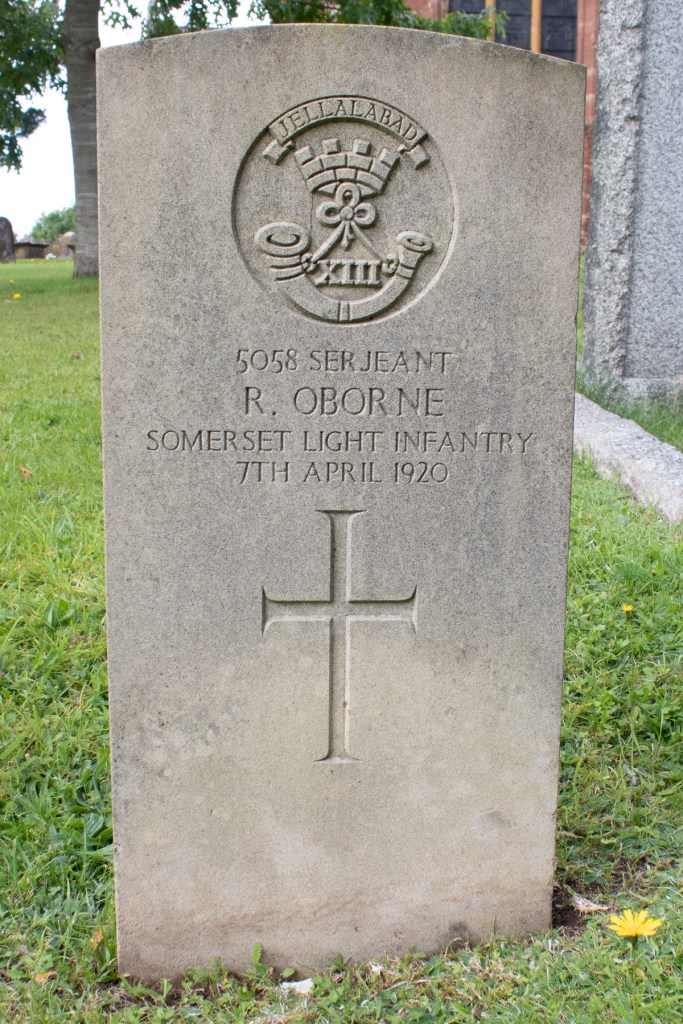
The now-Serjeant Oborne was medically discharged from 3rd/4th Battalion on 21st August 1916, and returned to Somerset. He took up employment with Colonel Dennis Boles MP, acting as his groom from him from Watts House, on the outskirts of Bishops Lydeard.
Robert appears to have continued with this life for the next few years, but his wartime injuries continued to dog him.
…on Tuesday, March 2nd [1920], he gave up work and went to the doctor, who advised his removal to the hospital, where he was taken the following Friday, and underwent an operation the same evening. Hopes were held out for his recover, and he lingered until 1:30 on Wednesday morning [7th April], when he passed away.
Taunton Courier and Western Advertiser: Wednesday 14th April 1920
Robert Oborne was 39 years old when he died. He was laid to rest in the grounds of St Mary’s Church in his home village, Bishops Lydeard.
George Ham was born on 19th December 1867 in Twerton, Somerset. His parents were George and Emily Ham, and he was the oldest of their nine children. George Sr was a mason, and initially his first born followed suit, but he was pulled towards something bigger and better and, on 19th January 1886, he enlisted in the Royal Marine Light Infantry.
George’s service records note that he was 5ft 6ins (1.68m) tall, with brown hair, grey eyes and a fresh complexion. He was initially sent to the barracks at Walmer in Kent, and it was from here that Private Ham began a 21 year career in the Royal Marines. Over that time, he served on seven separate ships, and, between voyages, he was based in barracks in Plymouth, Devon. Both his character and ability were consistently noted as being very good.
Private Ham’s career took him around the world and, in 1887, he found himself on the gunboat HMS Banterer, on which he served for three years. His tour of duty included a period of time in Galway, Ireland, and it was here that he met Mary Ann Goode. On 5th July 1889, the couple married in city’s St Nicholas’ Church. The church’s records suggest that the couple went on to have four children – Frederick George; Emily, who died just after her first birthday; Albert; and Katherine.
George’s records from this point become a little disjointed. In October 1890, he returned to his Plymouth base, and the following year’s census recorded him as living in the East Stonehouse Barracks, although his marital status was noted as single.
The next census, in 1901, presents a different picture. George and Mary were, by this time, living in family barracks in East Stonehouse, with two children, (Frederick) George and Albert. Katherine, the couple’s youngest child, was born the following year.
In January 1907, after more than two decades’ service, George was stood down from active service in the Royal Marines. He was placed on reserve status, and took up work as a mason once more. At this point, however, the family seemed to have hit more troubled times, underlined by four separate 1911 census documents.
George, who was 44 by this point, was recorded as being an inmate in the Bath Union Workhouse and Infirmary in Lyncombe, Somerset. Mary and Katherine, meanwhile, were in two rooms in a house in Stonehouse, Devon. Frederick, who was now better known as George, had followed his father into military service, and was a Private in the Royal Marine Light Infantry, serving on HMS Colossus. Albert, who was 13 years old, was one of 946 students boarding at the Royal Hospital School for Sons of Seamen in Greenwich, London.
George spent nine years in the reserves, and, in 1914, was called up again for war service, this time as a Lance Corporal. According to a contemporary newspaper:
[He was] engaged on naval patrol work against submarines off the Canadian coast and elsewhere, and was in charge of a gun on an armed merchant ship. Once the boat he was on was torpedoed, and on another occasion he had a long running fight with a submarine in the Irish Channel. The ship, however, reached Portrush (Ireland), and the inhabitants gave Lance-Corporal Ham a testimonial, and he was also rewarded in other ways, the Cardiff owners of the vessel recognising his skill and gallantry.
Bath Chronicle and Weekly Gazette: Saturday 7th December 1918
Tragedy was to strike in the end, however, and George was to meet a sad end to a distinguished career.
While at Cork [George] fell, either from a boat or the dock, and sustained an injury to the side of his head. It did not appear very serious, and it is understood that he made a trip to Cardiff and back to Londonderry, [where] he became so seriously ill as to necessitate his going to a military hospital in Londonderry. Hemorrhage [sic] of the brain set in, and he died on Monday [2nd December 1918] before his brother, Mr Albert Ham, who had been telegraphed for, could reach him.
Bath Chronicle and Weekly Gazette: Saturday 7th December 1918
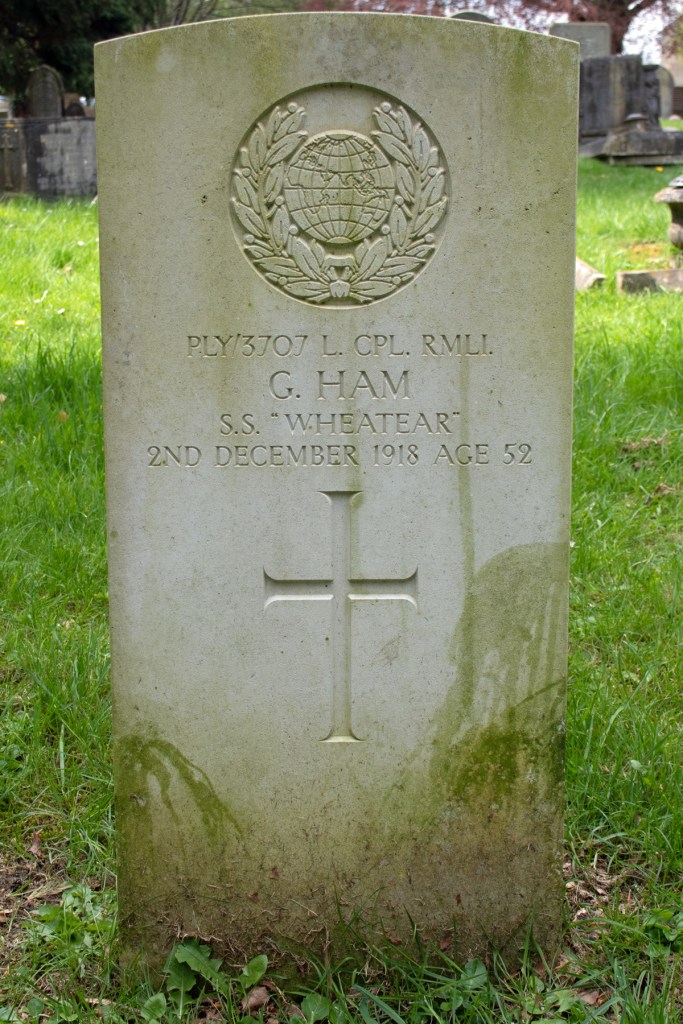
Lance Corporal George Ham was days short of his 51st birthday when he died. His body was brought back to Somerset for burial, and he was laid to rest in Twerton Cemetery. The newspaper report give no indication as to whether Mary or their children were in attendance and, in fact, does not mention his wife and family at all.
Ernest Simmons was born in Priddy, Somerset, in 1869, the oldest child to Henry and Ellen Simmons. Henry was a mason who, by the time of the 1881 census, was employing ten men and a boy. Three doors down lived another Simmons family, Daniel and Elizabeth, and it is likely that Ernest’s father was somehow related to them.
Ernest sought a bigger and better life away from the Somerset countryside, and enlisted in the army, joining the Army Veterinary Corps. “[He] served for 28 years… 10 of which were spent in India and 5 in South Africa.” [Wells Journal: Friday 23rd August 1918]
His service did him well, and he progressed through the ranks. The 1911 census recorded him back in the UK, renting a room in a terraced house in Preston, near Brighton. He was still serving in the army, however, and was listed as being a Farrier Sergeant Major in the 4th Battalion of the Dragoon Guards.
When war was declared, Ernest was quick to return to the fray, arriving in France on 16th August 1914. He served his battalion well, and was mentioned in dispatches for his action in the retreat from Mons the following month.
Farrier Sergeant Major Simmons returned to Britain, and transferred across to the 6th Reserve Regiment of Cavalry. This new regiment, formed in 1917, trained men for a number of regiments, including the 3rd, 4th, 6th and 7th Battalions of the Dragoon Guards. Ernest’s previous experience with horses, including his time in the Army Veterinary Corps, likely stood him in good stead for the role.
It was while he was at the camp in Tidworth, on Salisbury Plain, Wiltshire, that Ernest met with an accident. “[He] was thrown through his horse tripping over some wire. He was found in an unconscious state and died the same day.” [Wells Journal:Friday 23rd August 1918] Farrier Sergeant Major Simmons died on 26th July 1918: he was 49 years of age.
Ernest Simmons’ body was brought back to Somerset for burial. He was laid to rest in the peaceful graveyard of St Lawrence’s Church in his home village of Priddy.
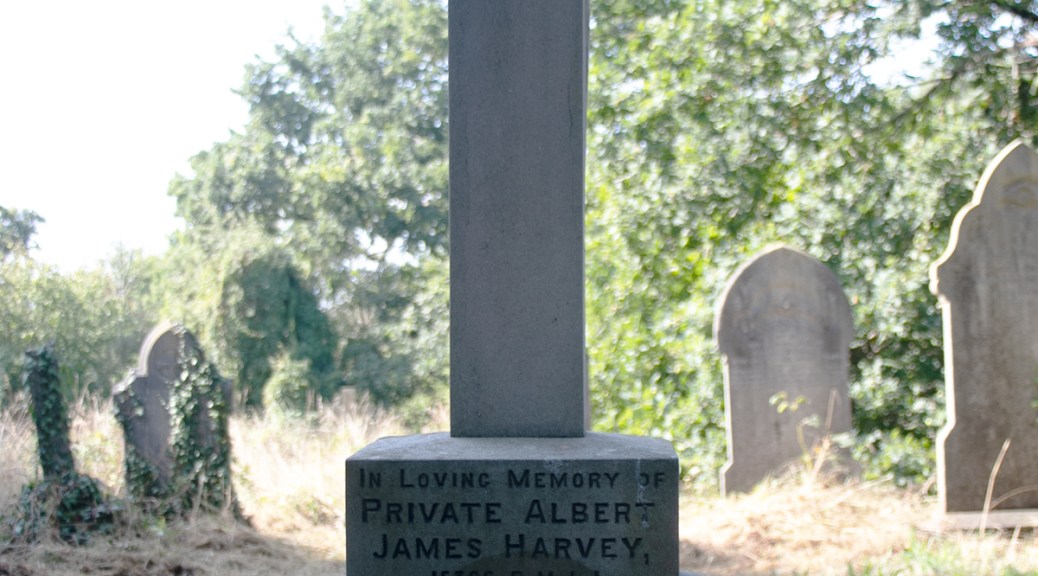
Albert James Harvey was born on 23rd May 1894 in the Gloucestershire village of Warmley. One of eleven children, his parents were James and Alice Harvey. James was a bootmaker, and most of Albert’s siblings followed him into shoemaking, but Albert bucked the trend, and found work with a baker when he left school.
He wanted bigger and better things, however, and so, on 26th April 1911, he enlisted in the Royal Marine Light Infantry. His service records record that Private Harvey was 5ft 5.5ins (1.66m) tall, with blue eyes, auburn hair and a fresh complexion. It also suggests that he added a year to his age, to ensure that he was accepted for duty.
After initially enlisting in Deal, Kent, Albert was sent to Plymouth, Devon, where he served for most of 1912. On 18th November that year, he was assigned to the dreadnought battleship HMS Conqueror, on which he was to serve for the nearly five years.
It was during his time on board Conqueror that Albert married Ethel Brewer. The daughter of a pressman, the couple exchanged vows at St Barnabas Church in their shared home village, Warmley.
Private Harvey remained serving throughout the war and, in April 1918, he was involved in the Zeebrugge Raid. This was an attempt by the Royal Navy to block the Belgian port by sinking obsolete ships in the canal entrance. During the operation, more than 200 men were killed and over 300 – including Albert – were wounded.
Private Harvey was medically evacuated to England for treatment, but his injuries were to prove too severe. He passed away in a hospital in Plymouth on 28th June 1918. He was just 24 years old.
Albert James Harvey was brought back to Gloucestershire for burial. He was laid to rest in the graveyard of St Barnabas’ Church, where he has been both baptised and married.
Robert Cantle’s life is one of hope and of tragedy. There is very little documentation on him, but what there is gives a hint to his life.
The 1911 census recorded him a living on Temple Street in Keynsham, Somerset. The head of the household was 86 year old John Cantle, a retired platelayer for Great Western Railway. His wife, Mary, was 22 years his junior, and they shared the house with their son, stationary cutter Ernest, his wife, Elsie, and their daughter, Madge. Robert was noted as being John and Mary’s adopted son. His age was given as 13, but his place of birth is ‘unknown’.
When war broke out, Robert joined the Wiltshire Regiment. Private Cantle set off for camp in Wiltshire in August 1917, and had been there for just two days when tragedy struck.
There were heavy thunderstorms in the Warminster district on Thursday, and while men of a unit of the Wiltshire Regiment were on the parade ground, three of them were struck by lightning. Pte. Robert Cantle, aged 19 years, whose home is at Keynsham, was killed on the spot, and the other two, Pte. Rowe and Pts Murgatroyd, were severely injured…
Sergeant Major HJ Bennett, of the Wilts Regiment, stated [at the inquest] the deceased lad had only just joined them. About 3pm on Thursday a squad was on the parade ground, when the signal was given to dismiss, as a storm was approaching. Immediately after there was a flash and a crash and it seemed to stagger everybody on the parade ground. Witness was brought to his knees, and when he recovered himself he saw three men, who of whom were struggling, on the ground. Private Cantle was found to be dead, and the other men recovered after being attended by a doctor. The squad consisted of recruits, and none of them were carrying arms.
Major Stocker, medical officer, said the crown of deceased’s cap was ripped off, and the body was burned from head to foot.
The jury returned a verdict of “Death from the effects of lightning.”
Somerset Standard: Friday 17th August 1917
Robert Cantle’s body was brought back to Keynsham for burial: he was laid to rest in the town’s cemetery.
John Connolly was born on 7th April 1887 in Liverpool, Lancashire. There is little information available about his early life, although his parents were Thomas and Marianne Connolly. A Roman Catholic, he was baptised at St James Church and went on to marry a woman called Bridget, although details for the wedding are lost to time.
John must have had a level of proficiency when it came to ships and sea-faring as, when war had broke out, he was call up for service with the Royal Naval Reserve (RNR). He enlisted as a Stoker on 1st October 1915, using the surname Campbell. His records show that he was 5ft 6ins (1.68m) tall, had blue eyes and a fair complexion.
Stoker Campbell was based at HMS Pembroke, the Royal Naval Dockyard in Chatham, Kent. His time in service, however, does not seem to have been a happy one. In fact, within a few months of being conscripted, John had absconded and made his way back to Liverpool.
John was caught and was being brought back to Kent under escort, when the unimaginable happened.
John Connolly, a stoker of the RNR, attached to the Royal Naval Barracks, Chatham, was found dead on the railway near Warren House Crossing, between Sole Street and Cuxton, on Wednesday, with terrible injuries to his head.
Connolly, who is known also as Campbell, had been arrested as a deserter at Liverpool, and was returning to Chatham under escort on Tuesday… The train was very full, and deceased, with his escort, stood in the corridor, where several soldiers were also standing.
Some time after the train had left Herne Hill the escort, Leading Stoker John Edward Craig, left his prisoner to proceed to the lavatory, and when he returned one of the soldiers shouted “Jack, your prisoner had gone out the window.” The train was stopped, but the guard suggested that Craig had better proceed to Rochester instead of searching for the deceased, as the night was very dark. At Rochester Bridge the matter was reported to the military authorities, and a search along the line, then ordered, resulted in the discovery of the body of deceased…
A Lance Corporal of the 2/5th King’s Liverpool Regiment, one of the soldiers in the corridor, gave evidence at the inquest… He said he was standing close by deceased, but did not see him go out of the window, which was open at the time.
It was stated that is was usual in the Navy for one man only to act as escort, as all expenses connected with desertions had to be paid by the prisoners.
The jury found the death resulted from injuries received by deceased in a fall from the train, but that there was not sufficient evidence to prove whether the fall was intentional or otherwise.
South Eastern Gazette: Tuesday 8th February 1916
Whether John had intended to throw himself from the train will never be known. All that can be confirmed is that he died of his injuries on 1st February 1916, aged just 28 years old.
John Connolly was laid to rest in Woodlands Cemetery, Gillingham, not far from the dockyard at which he had been based. His epitaph mentioned both of the names he chose to go by, and the inscription: “Beloved husband of Brigid, her one and only love. Re-united RIP. Jesus mercy Mary help.“








 Death and Service