Tag Archives: tuberculosis

Private William Hasley

Private William Hasley

William George Hasley was born on 14th June 1897. He was the oldest of three children to William and Sarah Hasley. William Sr, a former soldier, worked as a commissionaire, and the family lived at 11 Coach & Horses Yard, St James, Westminster.

Things had changed by 1900, and William Sr was employed as an engineer’s labourer. The family had moved to Dorset, setting up home in the village of Bourton, and their daughter, Susan, was born there at the turn of the century. Susan Sr came from just up the road in Zeals, Wiltshire, and it is likely that she was staying there when her youngest child, Sidney, was born in 1902.

By the time of the 1911 census, the family of five were living at Beach Cottage, Bourton. William Sr was drawing his army pension, but still employed at the engineering foundry; his eldest son, while still at school, was also listed as a news boy, possibly selling the periodicals to villagers.

War came to Europe in the summer of 1914, and William Jr was quick to step up and play his part. Giving up his job as an engineer’s fitter, enlisted on 1st September 1914, and joined the Somerset Light Infantry. His service records show that he stood 5ft 8.5ins (1.74m) tall, and weighed 124lbs (56.3kg). Private Hasley was noted as having brown hair, brown eyes and a sallow complexion. He also had a scar on the tip of the middle finger of his left hand.

Assigned to the 3rd (Reserve) Battalion, Private Hasley’s unit moved to Devonport, Devon, at the start of 1915. It was here that he contracted tuberculosis, which would ultimately lead to his medical discharge from the army in July. He served just 308 days.

At this point, William’s trail goes cold. It is likely that he returned to Bourton, although he had regular check-ups by the army inspection board. He was deemed totally incapacitated by the illness on 3rd January 1917.

William George Hasley’s lung condition would seal his fate. He passed away on 23rd March 1917: he was just 19 years of age. He was laid to rest in Bourton Cemetery.


Private Samuel Harris

Private Samuel Harris

Samuel John Harris was born in the spring of 1895, and was the oldest of three children to Samuel and Annie Harris. Samuel Sr was a cabinet maker from South Molton, Devon, and this was the village in which he and Annie raised their family.

The 1901 census found the Harrises taking rooms at 24 North Street, a house they shared with two other families. Move forward, and they were living four doors down the road at No. 28, a smaller cottage, but one they had to themselves.

Samuel Jr, at this point, was sixteen years old, but had completed his schooling and was working as a hotel waiter. His younger brother, Albert, had also started work, and was employed as an apprentice coach builder. Samuel Sr, meanwhile, was continuing with his cabinet making.

When war broke out, Samuel Jr was one of the first to enlist. While full details of his time in the army have been lost, it is clear that he joined the Devonshire Regiment, and he was initially attached to the 1st/6th Battalion.

Pte. SJ Harris proceeded to India and Mesopotamia with the Territorials. The hardships of campaigning and the trying climate in Mesopotamia proved too much for his constitution.

[Western Times: Friday 9th November 1917]

Samuel returned to Britain, and was admitted to the military hospital in Sutton Veny, Wiltshire. He passed away on 29th October 1917, from a combination of tuberculosis and a cyst in his back. He was 22 years of age.

Despite the apparent weakness in his constitution, the Western Times reported on his youth in South Molton:

The young man was very popular among his comrades in arms, and at Sutton Veny a general favourite. Prior to th war he was a familiar figure at football matches, having played for various teams at [South Molton] and in the district.

[Western Times: Friday 9th November 1917]

The body of Samuel John Harris was brought back to Devon for burial. He was laid to rest in the South Molton Cemetery, just a sort walk from his grieving family’s home.


Private George Whiteway

Private George Whiteway

George William John Whiteway was born in Paignton, Devon, on 4th February 1893. The youngest of three children, and the only son, his parents were William and Sarah Whiteway.

William was a journeyman painter, and from at least when his son was born, the family lived in a small terraced house, 9 Tower Road, on the outskirts of the town centre.

By the time of the 1911 census, George had completed his schooling, and was working as an apprentice painter. It is unclear whether this was under his father’s tutelage, as he gave his employment as verger and caretaker of the local parish church.

When war broke out, George stepped up to play his part. He enlisted in Torquay on 1st December 1915, and his service records note that he was of good physical development, stood 5ft 6.25ins (1.68m), and weighed 126lbs (57.2kg). He was also recorded as having light brown hair, brown eyes and a fair complexion.

Initially assigned to the Duke of Cornwall’s Light Infantry, Private Whiteway was transferred to the London Regiment and attached to the 3rd/21st Battalion. By the summer of 1916 George had transferred to the 1st/21st (County of London) Battalion, also known as the First Surrey Rifles. On 15th June his unit was sent to France, and he soon found himself in fighting on the Somme.

Private Whiteway’s time in France was to be a brief one. Caught up in the Battle of Flers-Courcelette, he was wounded in the back and neck, and, after initial treatment on site, he was medically evacuated to Britain.

It is unclear where George was first admitted, but by February 1917, he was being tended to in the Voluntary Aid Detachment Hospital in his home town, Paignton. He remained there for a couple of month, before being released back to duty.

Private Whiteway’s time fighting was over. He was transferred to the 619th Home Service Employment Company of the Labour Corps, and would spend the next year in and around Winchester, Hampshire. It is evident, however, that George’s health had been impacted. By March 1918 he was in hospital again, this time close to his army base. Suffering from a combination of peritonitis and tuberculosis, the contagious nature of the latter condition would lead to his dismissal from military service, and he was formally stood down on 29th April 1918.

At this point, George’s trail goes cold. It seems likely that he returned home, as his death was recorded in Totnes, Devon. He breathed his last on 25th August 1918: he was 25 years of age.

George William John Whiteway was laid to rest in Paignton Cemetery, a short walk from his family home.


Private Alfred Ribbans

Private Alfred Ribbans

Alfred Ribbans was born in Belvedere, Kent, in the summer of 1889. The sixth of nine children, his parents were Arthur and Sarah Ribbans. William was an iron turner from Ipswich, Suffolk, while his wife had been born in Jersey, Channel Islands. It is unclear how the couple met, but by the 1891 census the family were at No. 8 Coastguard Cottages in Erith.

When he finished his schooling, Alfred followed in his father’s stead, finding employment as a fitter and turner. By the autumn of 1908, he found an opportunity to turn this work into a career, and enlisted in the Royal Army Ordnance Corps. His service records show that, at 19 years of age, he was 5ft 7ins (1.71m) tall, and weighed 132lbs (59.9kg). He had a fair complexion with brown hair and brown eyes. He was also noted as having a scar on his left eyebrow, another on the right side of his upper lip, and two noticeable moles: one on the left side of his navel and the other on the right side of his neck.

Private Ribbans’ initial term of service was for three years. He served on home soil, and when his contract came to an end on 27th October 1911, he was stood down to reserve status. When war broke out he was mobilised again, and by 14th August 1914, he found himself in France. It is unclear exactly where he served, but his time overseas was not to be a lengthy one.

By April 1915 Alfred was back on home soil, suffering from tuberculosis. The contagious nature of the condition meant he was no longer suited to the crowded barracks and billets of the Western Front, and so Private Ribbans was medically discharged from the army.

Alfred returned home to Kent, and, when he recovered, to his job as a fitter. On 3rd July 1916 he married dressmaker Armenia Tuckerman in the parish church in Erith. At the time, the couple were living at 9 Stanmore Road, but soon moved to Totnes in Devon, presumably to help with Alfred’s now-failing health.

The following January, Armenia gave birth to a daughter, Armenia Joy, but the young family’s happiness was to be short-lived: Alfred succumbed to his lung condition on 20th March 1917. He was 27 years of age.

Alfred Ribbans was laid to rest in Paignton Cemetery, Devon.


Private Alfred Ribbans
(from ancestry.co.uk)

Leading Stoker Charles Ching

Leading Stoker Charles Ching

Charles Ching was born in Torquay, Devon, on 22nd March 1885. The oldest of three children, his parent were Joseph and Sarah Ching. Joseph died by the time Charles was just four years old. The 1891 census found Sarah living with their three sons – plus her other son from a previous marriage – on Pannier Street in Paignton. There is no evidence of work for any of the family, but it is likely that Charles’ half-brother, George, would have been bringing some money in, as he was 14.

Moving forward ten years, and Sarah was employed as a charwoman. Her three boys with Joseph were still at home, and Charles and his younger brother Henry were both working as errand boys.

Charles had his sights on bigger and better things, however, and on 21st March 1903, he enlisted in the Royal Navy. His service records show that he had given up a job as a gardener, and he would continue with manual labour, taking on the rank of Stoker 2nd Class. The document also confirms that he was 5ft 8ins (1.73m) tall, with brown hair, hazel eyes and a fresh complexion.

Throughout his naval career, Stoker Ching would be based out of HMS Vivid, the Royal Naval Dockyard in Devonport. Over the twelve years of his service, he was assigned to six ships, and rose through the ranks. In June 1904, he was given the rank of Stoker, and two years later was promoted to Stoker 1st Class.

On 1st July 1907, Charles was given a posting on board the cruiser HMS Forth. She would remain his home for five-and-a-half years, during which time, a number of things changed. A previously unblemished record was tainted by seven days in cells in November that year, although his misdemeanour is not noted.

In December 1908, Charles married Florence Tucker. The daughter of a carter from Totnes, her mother’s maiden name was Ching, although whether there was any connection to Charles’ late father is unknown.

On 1st September 1911, Charles was promoted again, taking on the rank of Leading Stoker. When his initial term of service came to an end in March 1915, war was raging around the world. He re-enlisted, and his records not that he had grown an inch (2.5cm) over the previous decade, but had also gained a number of tattoos. These included a woman’s head, a rose pierced by a sword and a Japanese woman on his right arm; there was also a peacock, clasped hand, heart and butterfly on his left.

Leading Stoker Ching’s health was beginning to suffer at this point, and by September 1915, he had returned to his short base, HMS Vivid. Suffering from pulmonary tuberculosis, he was invalided out the Royal Navy just a month later.

At this point, Charles’ trail goes cold. He seems to have settled in Totnes with Florence, her father having passed away there in 1915. His health was to get the better of him, however. He passed away on 9th January 1917 at the age of 31 years old.

Charles Ching was taken to Paignton for burial. He was laid to rest in the town’s cemetery.


Florence remained in Totnes after her husband’s passing. Her life there would not be a lengthy one: she passed away in March 1919, aged 29.


Boy 1st Class Robert Atkins

Boy 1st Class Robert Atkins

Robert Reginald Atkins was born in the Kent village of Sarre, on 8th January 1900. The younger of two children, his parents were carter Reginald Atkins and his wife, Alice. Alice died in 1908, aged just 30, and her widower moved the family to the village of Martin, near Dover, where he took up work as a miller.

Robert found work as a grocer’s assistant when he completed his schooling. Being so close to the English Channel, the conflict in Europe must have seemed unavoidable. On 7th August 1917, he stepped up to play his part, and enlisted in the Royal Navy.

Boy 2nd Class Atkins was sent to HMS Powerful, the training ship in Devonport, Devon, for his initial instruction. After just two months he was promoted to the rank of Boy 1st Class, and given a posting to the battleship HMS Dominion.

Robert’s time on board was to be brief. By 3rd November he stepped ashore at HMS Pembroke, the Royal Naval Dockyard in Chatham, Kent. He would remain there for the next few months, during which time he came of age. His service records show that Robert was 5ft 7ins (1.71m) tall, with brown hair, blue eyes and a fresh complexion.

While stationed at Pembroke, Boy 1st Class Atkins fell ill. He was admitted to the Royal Naval Hospital in Chatham, but his condition, pulmonary tuberculosis, was to prove fatal. He died on 21st April 1918, at just 18 years of age.

Robert Reginald Atkins was laid to rest in the Naval section of the Woodlands Cemetery in Gillingham, Kent, not far from the dockyard he had briefly called home.


Following Alice’s death, Reginald re-married. By the time of the 1921 census, he was living in Ashford, Kent, with his new wife, Rosa, and their two children, William and Frank. He was still employed as a miller, but this time was working for Mersham Mills.

According to the same census, Robert’s older sister, Monica, was employed in domestic service. She was working for stockbroker Frank Newton-Smith and his family, in their Dover home.


Private Ernest Pointing

Private Ernest Pointing

Ernest Arthur Pointing was born on 21st March 1896 in Goring-by-Sea, Sussex. The second-to-last of thirteen children, his parents were William and Kate. William was a baker from Brighton, but by the time of the 1901 census, the family were living at The Cottage, next to Goring Hall.

When Ernest left school, he found work as a stable boy. The next census, taken in 1911, found him and his parents – William now having retired – living at 1 Elm Tree Cottages in the centre of Goring itself. The three of them shared the house with Ernest’s older sister, Louisa, and his nephew, seven-year-old Herbert.

Alongside his paid work, Ernest also volunteered for the Royal Sussex Regiment and, within a week of turning eighteen, he stepped up to enlist with them. His medical report, undertaken on 18th March 1914, show that he was 5ft 4.5ins (1.64m) tall, and weighed 112lbs (50.8kg). He had dark brown hair, brown eyes and a fresh complexion. He as noted as having two scars on his left thumb, and two more on his right knee.

Assigned to the 2nd Battalion of the Royal Sussex Regiment, Private Pointing would spend the next nine months training on home soil. By the middle of January 1915, however, he was sent to France. Intriguingly, he was to spend only two months overseas, before returning to home soil. There is no evidence of him being injured, but it would not be until September 1915 that he returned to the fray.

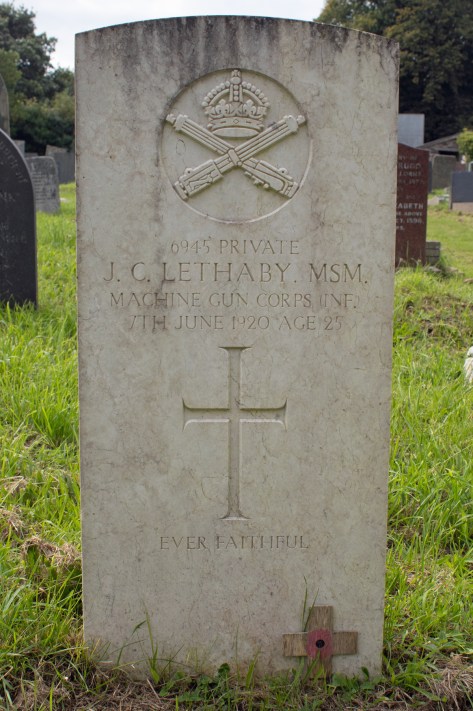
In January 1916, Private Pointing transferred to the Machine Gun Corps. He remained overseas until March 1916, at which point his health seemed to have become affected. Ernest returned to Britain, and was ultimately discharged from military on 28th March 1917. He was suffering from pulmonary tuberculosis, the condition that would ultimately take his life less than six months later.

Ernest Arthur Pointing died on 5th October 1917. He was just 21 years of age. He was back in Sussex by this point, and he was laid to rest in the family plot in the graveyard of St Mary’s Church in Goring. He was buried alongside his father, William, who had died two years earlier.


Engine Room Artificer 4th Class Leonard Bentley

Engine Room Artificer 4th Class Leonard Bentley

Leonard Bentley was born in Strood, Kent, on 6th December 1896. One of six children, his parents were John and Emma Bentley. John was a barge captain, transporting ship-loads of cement from the local works to where it was needed.

The 1911 census found an extended Bentley family living at 85 Cliffe Road in Strood. John and Emma shared their home with Leonard, his older brother Arthur, and Arthur’s wife and son. Eleven years younger than Arthur, who was his next oldest sibling, Leonard was still at school by this point.

Education was obviously important to Leonard, and by the end of the year, he had enrolled in the Royal Navy as a Boy Artificer. He would spend the next few years at HMS Fisgard, the training establishment in Woolwich, Kent, learning his trade.

When he came of age in December 1914, Leonard was officially inducted into the Royal Navy, taking on the rank of Engine Room Artificer 5th Class. He remained at Fisgard until January 1916, when he transferred to HMS Victory, the Royal Naval Dockyard in Portsmouth.

This was a temporary move, however, and on 11th April Leonard was assigned to HMS Africa, and a few weeks later, he was promoted to Engine Room Artificer 4th Class. A battleship, the Africa would become his home for the next eighteen months and he would travel with to the Mediterranean and Adriatic Seas.

In January 1918, Engine Room Artificer Bentley would return to solid ground. He transferred to HMS Pembroke, the Royal Navy’s base in Chatham, Kent. The reason for his move appears to have been health related, and he was soon moved the the town’s Naval Hospital, suffering from pulmonary tuberculosis. The condition was to prove fatal. Leonard died on 15th April 1918: he was 21 years of age.

Leonard Bentley was laid to rest in the naval section of Woodlands Cemetery, Gillingham, Kent, not far from his family home, or his final naval base.


Private Wilfred Bridger

Private Wilfred Bridger

Wilfred Percival Bridger was born on 20th January 1885, the middle of three children to William and Emma. William was a groom from Albourne in Sussex, but, after a spell in Newmarket, the family had settled in Findon near Worthing.

William passed away just two years after Wilfred’s birth, and Emma remarried. The 1891 census found her and her new husband, George Lish, living with William and his siblings in a house on Findon Street.

When he completed his schooling, William found work as a shepherd: the next census return, taken in 1901, found the extended family living at 1 Brazil Cottages, next to the Black Horse Inn in Findon Village. George and Emma now had three children of their own, and Emma’s widowed mother, Martha, completed the household.

Shepherding was not a permanent career option for Wilfred and, on 28th April 1902, he enlisted in the army. He gave his occupation as groom, and his medical report confirmed he was 5ft 7ins (1.7m) tall and 120lbs (54.4kg) in weight. He was noted as having brown hair, grey eyes and a fresh complexion.

The Royal Sussex Regiment would definitely provide Private Bridger with the globe-trotting adventures that he may have wished for. After two years on home soil, his unit – the 2nd Battalion – moved to Malta, where he would spend close to twelve months. In May 1905 he moved to Crete, and from there to India in January 1907.

By the start of 1910 Wilfred had returned to Britain, and he was stood down to reserve status when his contract came to an end that April. He returned to Sussex, and the family home. 1 Brazil Cottages was crowded by this point, with Wilfred sharing the five-roomed house with his mother, stepfather, half-brother, niece. There were also two lodgers, widowed farm labourer Alfred Newman and his son, William.

Things were to change for Wilfred, however. In September 1911 he married Florence Herrington, a carter’s daughter from Henfield, Sussex. When the couple wed, she was working as a servant in a boarding house in Ambrose Place, Worthing. The young couple set up home in Nepcote, near Findon, and went on to have four children – William, Albert, Henry and Lilian.

When war broke out, Wilfred was called upon to play his part again. He re-joined the Royal Sussex Regiment on 31st August 1914, but when his medical was carried out the following March, he was found to have tuberculosis, and deemed not fit for service. After further tests, Private Bridger was medically discharged on 28th May 1915.

At this point, Wilfred’s trail goes cold. He returned to Findon and, it seems this is where he passed away on 13th September 1918. He was 33 years of age.

Wilfred Percival Bridger was laid to rest in the quiet surroundings of Findon’s St John the Baptist Churchyard.


Private Wilfred Bridger
(from ancestry.co.uk)

Officer’s Steward 3rd Class Joseph Cutting

Officer’s Steward 3rd Class Joseph Cutting

Joseph William Cutting was born on 10th September 1897 in Stratford, Essex. The middle of three children, his parents were Alfred and Clara. Alfred was a stoker in a carpenter’s workshop, but when he completed his schooling, his son found work as a clerk.

When war broke out, Joseph stepped up to play his part. He enlisted in the Royal Navy on 22nd September 1915, joining as an Officer’s Steward 3rd Class. His service records show that he was 5ft 8ins (1.72m) tall, with dark brown hair, blue eyes and a fresh complexion. He was also noted as having a scar in the middle of his forehead.

Officer’s Steward Cutting was based at HMS Pembroke, the Royal Naval Dockyard in Chatham, Kent, and would continue in his role for the next two and a half years. His annual review recorded a very good character, and moderate to satisfactory ability, which may be why he did not rise above his junior rank.

In the summer of 1918, Joseph was admitted to the Royal Naval Hospital in Chatham, suffering from tuberculosis. The lung condition was to prove his undoing, and he succumbed to it on 16th July 1918. He was just 20 years of age.

Joseph William Cutting was laid to rest in the naval section of Woodlands Cemetery in Gillingham, Kent, not far from the base he had called home for so long.