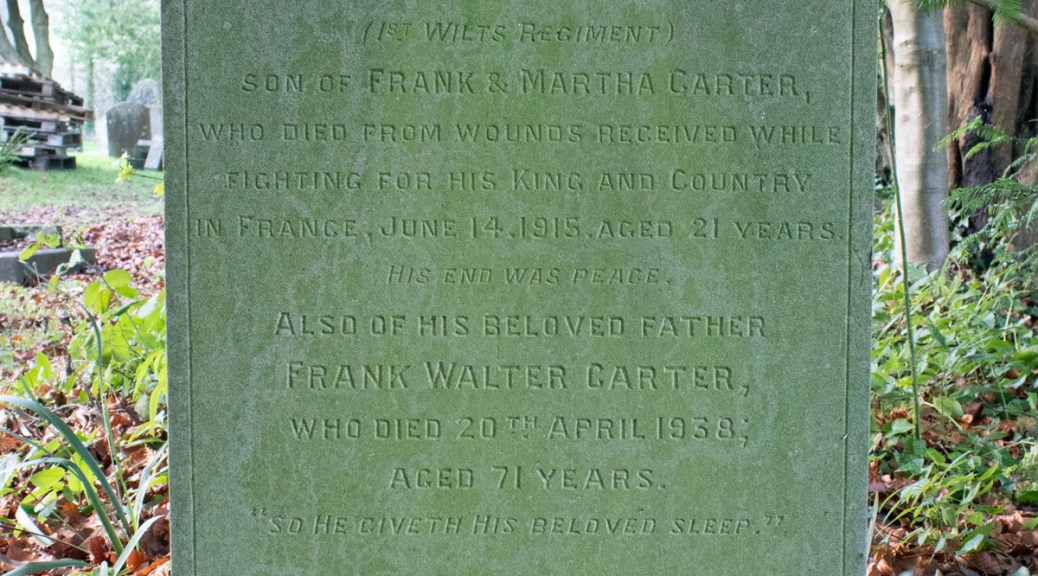
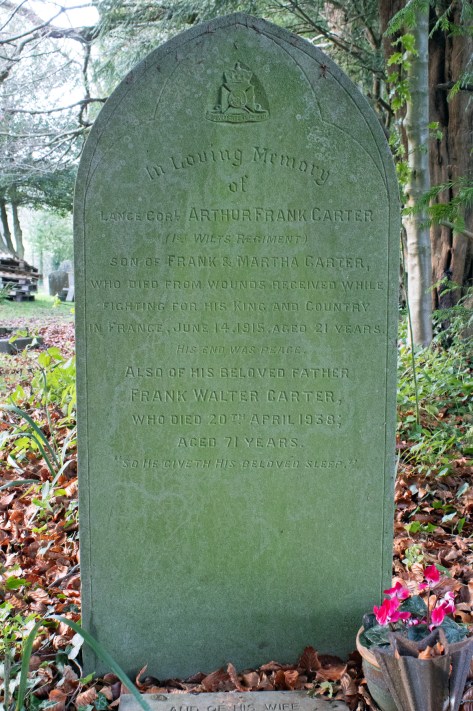
Arthur Frank Carter was born in the 10th July 1893 in Bratton, Wiltshire. The third of seven children, he was the oldest of four sons to Frank and Martha Carter. Frank was a farm labourer, and the family lived on Lower Street, to the north of the village centre.
When Arthur finished his schooling, he found work as a carter, probably unintentionally living up to his family’s name. When war broke out, however, he stepped up to play his part. Serving in the Wiltshire Regiment as a Private, he was attached to the 1st Battalion and, by the 19th January 1915, he found himself in France.
Full details of Private Carter’s service have been lost to time, but during his time overseas, he received a promotion to Lance Corporal. In June 1915 he was wounded, and was sent back to Britain for treatment. Admitted to hospital in London, Arthur’s injuries would prove to be too severe. He passed away on 12th June 1915, at the age of just 21 years old.
The body of Arthur Frank Carter was taken back to Wiltshire for burial. He was laid to rest in the family plot in St James’ Churchyard, Bratton.
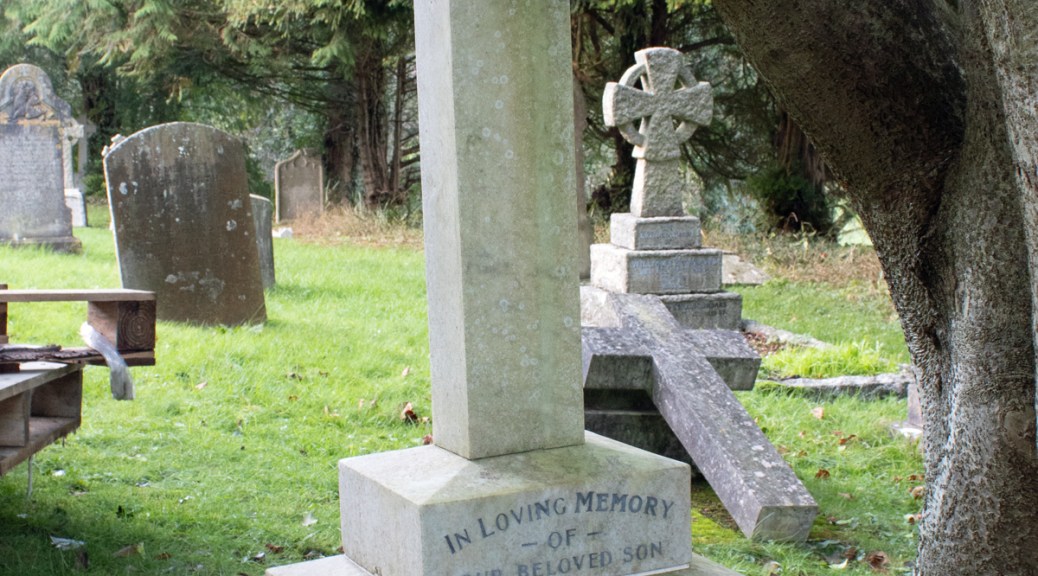
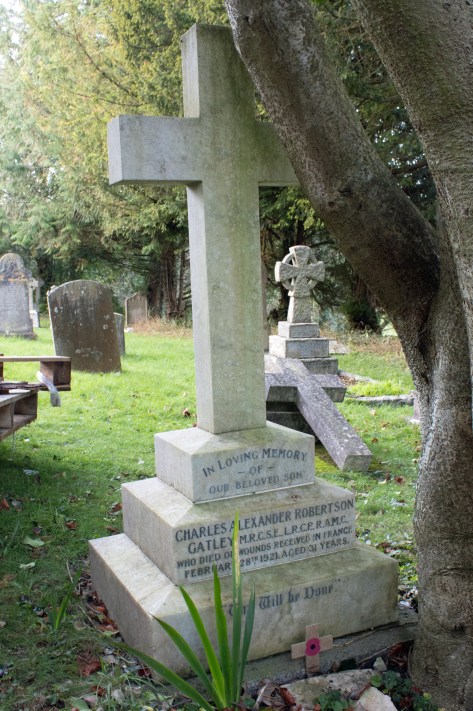
A gloom was cast over Bratton and the neighbouring villages when it became known on February 28th, that Dr Gatley had passed away, after an illness of about a fortnight. Although he had only lived at Bratton since 1919, he had endeared himself to everyone with whom he came into contact.
Dr Gatley had become partner with Dr Trevor Shorland, of Westbury, in September 1919, and after working for six months with him in Westbury, went to live at Mill Vale House, Bratton. He was the only son of Dr HR Gatley and Mrs Gatley, of Kingston-on-Thames, and received his education at Marlborough College and Guy’s Hospital, London, where he was house surgeon for some time. On the outbreak of war he went as house surgeon to Mrs Hal Walker’s (not Lady Wavertree) hospital, in Regent’s Park, and a year later went to France, and was attached to the East Kents.
It was while at Cherisy in 1917, that he was very severely wounded, and the effects of the wound he received brought about his death at the early age of 31.
Dr Gatley was medical officer for the Bratton district and the Westbury Board of Guardians, and he was also a member of the Pensions Board for Wiltshire.
[Wiltshire News: Friday 11th March 1921]
Charles Alexander Robertson Gatley was born in the spring of 1889 in Norbiton, Surrey. The youngest of three children, his parents were general practitioner Henry Gatley, and his wife, Isabella.
The family moved around the area with Henry’s work and status: in 1891 they were recorded as living in a villa on Kingston Hill; by 1901 they had moved to Adelaide Road, Surbiton; and the 1911 census recorded the family residing at 12 Surbiton Road, Kingston. Interestingly, Henry is not recorded as being at home for the latter two documents and, in fact, does not appear on the census records again until 1921, when he is the Assistant Medical Officer for the Warneforld Mental Hospital in Oxfordshire.
Charles, meanwhile, was continuing his education and, according to the 1911 census, was a medical student. He and Isabella were sharing their Kingston home with his older newlywed sister and brother-in-law, Marion (or May) and Russell Fawcus. The family were supported by two servants, Edith and Sarah.
The Wiltshire News outlined Charles’ studies and career: wounded in France, he was invalided out of the Royal Army Medical Corps, and moved to the county to set up his practice. He died on 28th February 1921, at the age of 31, and was laid to rest in the village’s St James’ Churchyard.
Tragically by this point, Henry and Isabella had outlived all three of their children. Their eldest, daughter Jane, had died in 1900, aged just 16 years old. Marion – May – passed away in 1918, at the age of 30.
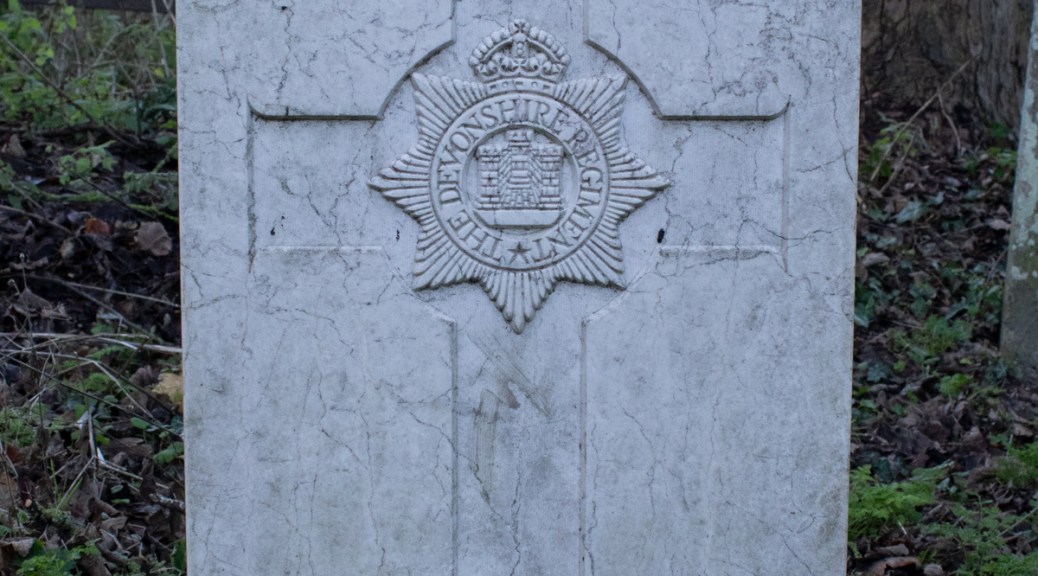
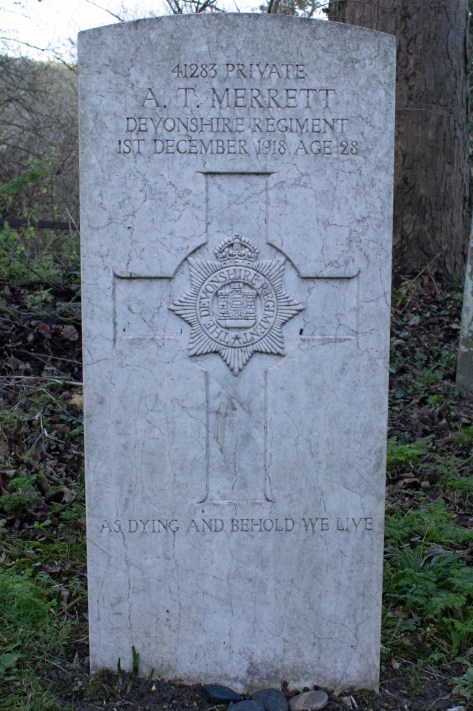
Albert Tom Merritt was born in the spring of 1890, the youngest of six children to John and Mary. John was a bricklayer from the village of Bratton in Wiltshire, and this is where the family were born and raised.
When he completed his schooling, Albert took up employment as a carpenter. His mother passed away in 1905, and on 15th September 1915, he married Elsie House. A labourer’s daughter from Aller Hilton, Dorset, the couple exchanged vows in her parish church, and went on to have three children: Frederick and Edward.
Albert was called up in October 1916, and was assigned to the 13th Battalion of the Devonshire Regiment. His service papers show that he was 5ft 6ins (1.67m) tall and weighed 119lbs (54kg). He was noted as having poor hearing, but declared fit for service in the regiment’s Labour Corps.
Assigned to the 447th Agricultural Company, Private Merritt remained on home soil during the conflict. He survived the war, but contracted influenza in the autumn of 1918. Sent home to recuperate, he passed away on 1st December, at the age of 28 years old.
The body of Albert Tom Merritt was laid to rest in the graveyard of St James’ Church, in his home village of Bratton.
Tragically, Elsie was pregnant when her husband died. She gave birth to a third son, Leonard, in May 1919.
The Commonwealth War Graves Commission’s records give Albert’s surname as Merrett. However, all other documents confirm the spelling as Merritt.
Geoffrey Hugh Willoughby St Quintin was born in Cromarty, Ross-shire, on 17th November 1899. The second of two children (although his older sister Doris had died two years before he was born), his parents were Geoffrey and Muriel St Quintin.
Geoffrey Sr was an estate manager and the 1901 census showed the family having eight live-in servants. Geoffrey Jr was then sent off to a private prep school in Wokingham, Berkshire.
The next census return, taken in 1911, found Geoffrey Sr was visiting his brother at Scampston Hall in North Yorkshire. Muriel, meanwhile, was staying with her cousin Eliza Willoughby, the wife of Baron Middleton. Between the two residences, there was a retinue of some 23 servants.
Geoffrey Sr died in 1913, and his son went on to attend Eton College. When war broke out he stepped up to serve his country, joining the Royal Fusiliers.
Ross-shire friends, especially in the Cromarty and Fortrose districts, will regret the death from heart failure, following pneumonia and influenza, of Geoffrey Hugh Willoughby St Quintin, son of the late Mr Geoffrey St Quintin, and of Mrs Geoffrey St Quintin, Flowerburn, Fortrose. He died in London just prior to an intended visit to Scampston, Yorks., to the home of his uncle, Mr WH St Quintin. Born at Cromarty House nineteen years ago, growing up into a young manhood of great strength and stature, he was well known and very popular in Ross-shire, where he passed the greater part of his young life. On leaving Eton College he was appointed to a cadetship in the Household Brigade, Officers’ Cadet Battalion, with the intention of joining the Guards, and was qualifying for his commission at Bushey, Herts., where he contracted his illness. He was a right gallant young gentleman, and everywhere a favourite…
A sad circumstance was the death on the day of the funeral of his devoted old nurse, Miss Johan Fraser, who was with him during his illness and contracted the influenza which carried her away.
[North Star and Farmer’s Chronicle: Saturday 21st December 1918]
Geoffrey Hugh Willoughby St Quintin was just 19 years of age when he passed away. His body was taken to Eton for burial, and he was laid to rest in the village’s St John’s Churchyard.
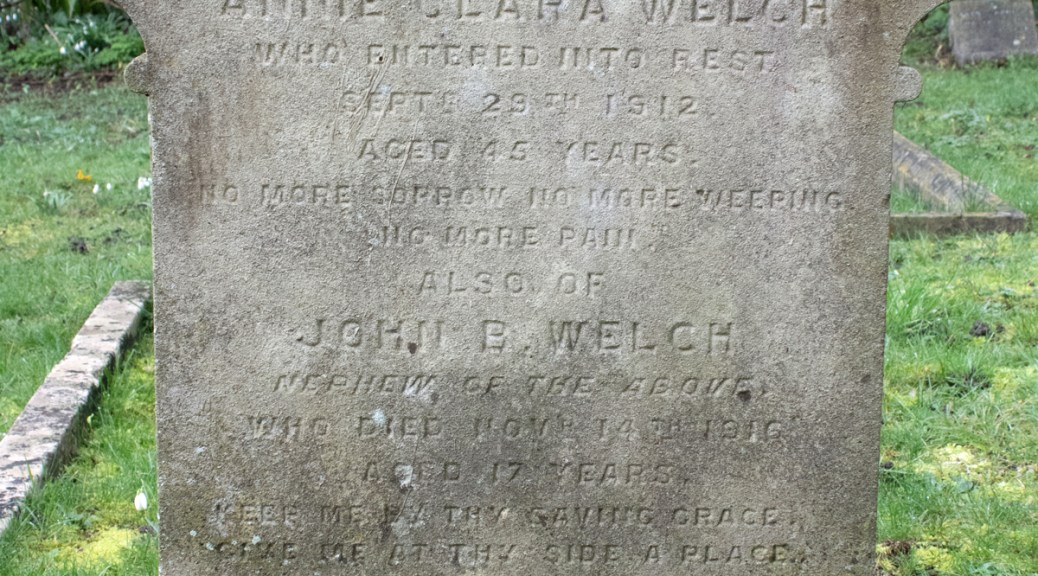
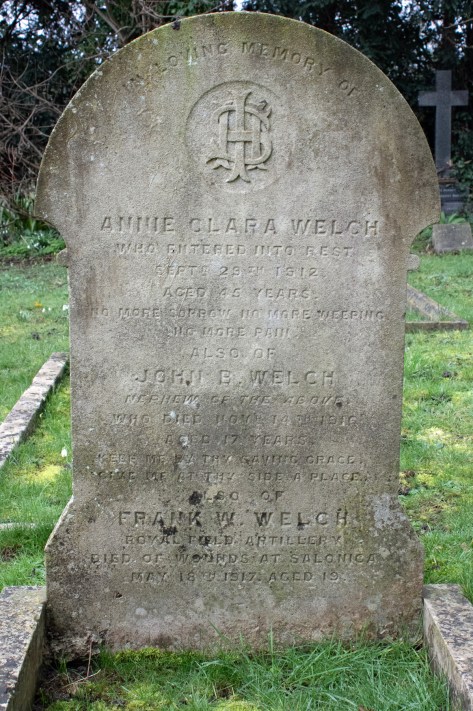
John Benjamin Welch was born in Eton, Berkshire, on 16th October 1899. The second of five children, his parents were Frank and Annie Welch. Frank was a house porter at Eton College, and the family lived at 4 Willow Place in the village, before moving to 8 Eton Square by the time of the 1911 census.
When he completed his schooling, John (who was known as Jack) found work in a local foundry. He sought a life of adventure, however, and, on 25th July 1916, he joined the Royal Navy. His service records show that he was just 5ft 3.5ins (1.6m) tall, with brown hair , blue eyes and a fresh complexion.
Being below the age to formally enlist, John was given the rank of Boy 2nd Class, and sent to the cruiser HMS Powerful to be trained on the job. Tragically for John, however, he contracted pneumonia, and the condition would take his life. He passed away on 14th November 1916: he was just 17 years of age.
The body of John Benjamin Welch was taken back to Berkshire for burial. He was laid to rest in the peaceful graveyard of St John’s Church, Eton.
John’s older brother, Frank, had also spent time serving his country. Enlisting in the Royal Field Artillery, and was attached to the 145th Brigade.
Gunner Welch served at Ypres and at Loos, and, by the spring of 1917, his unit was fighting in Salonika. He was wounded, and died of his injuries on 8th May that year: he was eighteen years of age.
By this point, through war and illness, Annie had lost a daughter, and three of her sons. The impact must have been unbearable: she died in the autumn of 1919, aged 43 years old.
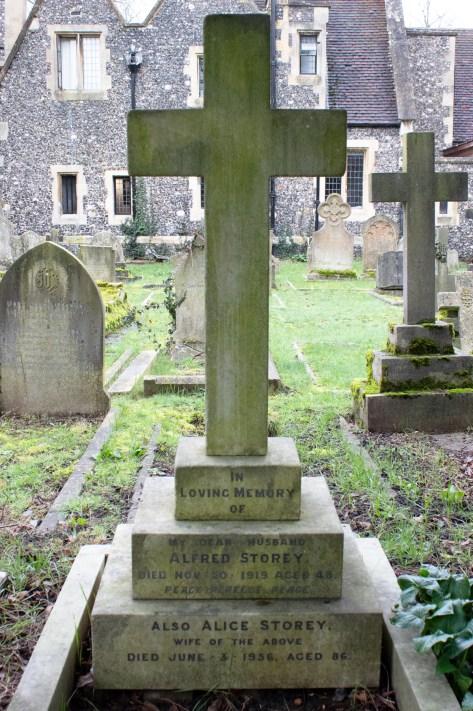
Alfred Story was born in the summer of 1876 in Poplar, Middlesex. The youngest of three children, his parents were Benjamin and Margaret. Benjamin was an engine fitter from North Shields, Tyne and Wear, but he and Margaret had moved to London by the time their eldest was born in 1863.
Margaret died in the 1880s, and, when Alfred left school, he found work as a draper’s assistant. He did not carry out this trade for long, however, and took up a career in the Royal Army Medical Corps. His First World War service papers suggest that he remained in the army for twelve years, gaining the Kedive’s Star for service in the Sudan in 1898, and the Queen’s Medal with five clasps and the King’s Medal with two clasps for his time in South Africa.
By the time of the 1911 census Alfred was living at 1 Belle Vue, Eton, Berkshire, and that he was a house porter at Eton College. He was recorded as having married Alice in 1905 (although a later document suggests they did not exchange vows until 26th October 1916), and the couple were living there with their daughter, May, who was three years old. While no formal marriage certificate is available, it would seem that Alice was a widow when they got together: also living at 1 Belle Vue were her children, William Mallaband (who was 15) and Violet Mallaband (13).
The next record for Alfred is his service papers for the First World War. He enlisted on 26th February 1917, and was assigned back to his former regiment as a Private. His medical confirms that he was 5ft 8ins (1.72m), and that he weighed 160lbs (72.6kg). He was recorded as having brown hair, blue eyes and a fresh complexion.
Private Storey carried out his duties on home soil, and was attached to 18th Company. He survived the conflict, and rose to the rank of Corporal, then Acting Sergeant. When he was stood down on 16th February 1919, we readily volunteered to extend his service for a further twelve months. On 20th November that year, he collapsed and died from a cerebral haemorrhage. He was 39 years of age.
The body of Alfred Storey was taken back to Berkshire for burial. He was laid to rest in the peaceful graveyard of St John’s Church, Eton. He was reunited with Alice when she died in 1956: husband and wife buried together after 37 years.
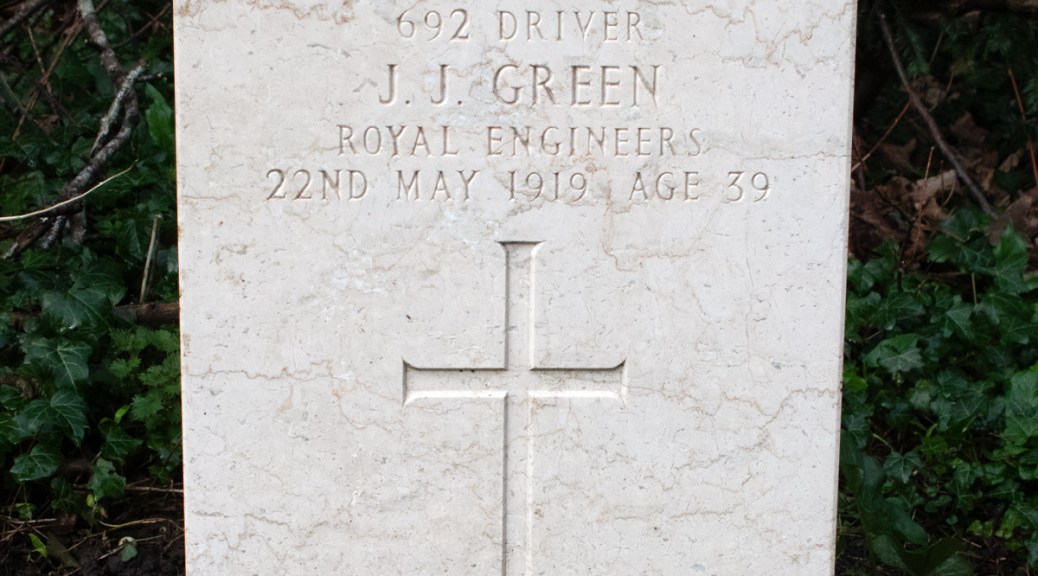
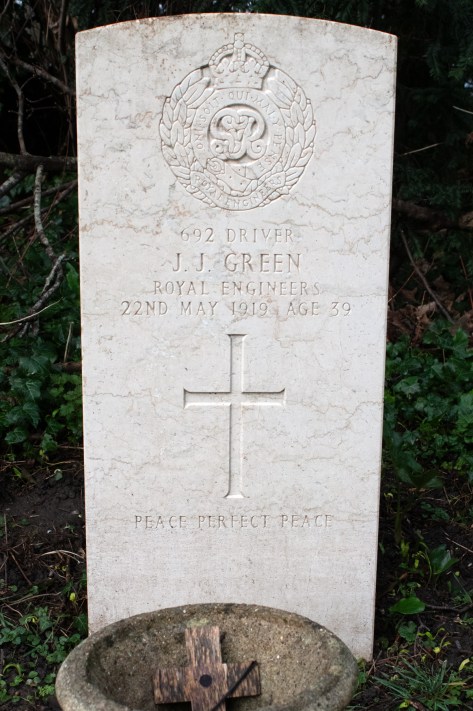
The life of John James Green is a challenge to piece together. Born in Chatham, Kent, in the spring of 1880, he was the older of two children to David and Frances Green. David was a Sapper in the Royal Engineers, but when he died in 1883, his widow was left with two young children to raise.
Frances moved the family back to Eton, Berkshire, where she had been born. She married again, to groom Robert Edwards, and the couple went on to have a child of their own, John’s half-brother, Robert.
When John completed his schooling, he followed in his father’s footsteps. He joined the Royal Engineers, and went on to be a Driver for the regiment.
The 1901 census recorded him as being a patient in the Connaught Hospital, attached the North Camp in Aldershot, Hampshire. While not confirming John’s condition, it does note that he was married, although there does not appear to be any other record confirming this.
On 29th October 1903, however, John did get married. His new bride was Alice Morton, and the couple exchanged vows in St Mary Magdalene Church in Southwark, London.
Sadly, Alice seems to have died young, and in December 1905, John wed for a second time, to grocer’s daughter Ellen Mansey. Now based back in Aldershot, the two married in Holy Trinity Church, and went on to have five children: John, Ernest, May, Charles and Alice.
The 1911 census found the Green family in rooms at 25 Lyson’s Road. A small terraced cottage, they shared it with the Scotts – married couple John and Edith, and their baby, William.
At this point, John’s trail goes cold. War broke out, and it is certain that he served in some capacity, but how and where is unclear. Driver Green survived the conflict, but passed away in Aldershot on 22nd May 1919: he was 39 years of age.
The body of John James Green was taken back to Berkshire for burial. He was laid to rest in the graveyard of St John’s Church in Eton, where his mother was still living.
It appears that Ellen may also have passed away by this point, as John’s pension was split equally between their five children. Tragically, his pension card notes Ernest and Charles’ guardian as the Sister in charge of St Augustine’s Home for Boys in Clewes, Berkshire. May and Alice were being looked after by Miss J Angerous of Pembroke Gardens, Windsor; while oldest son John Jr was in the care of Mrs B Evans Baldwin’s End, Eton College.
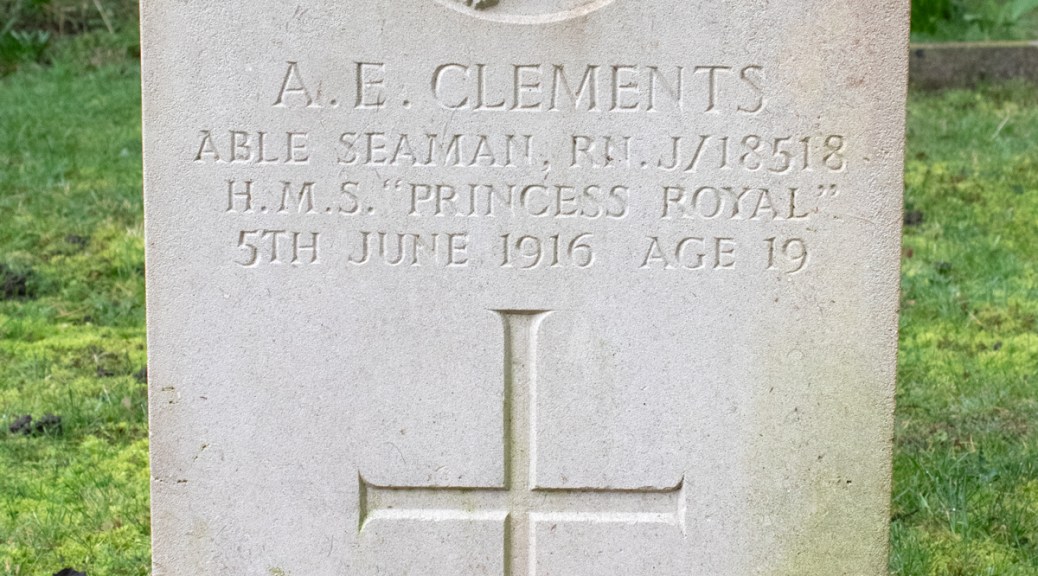
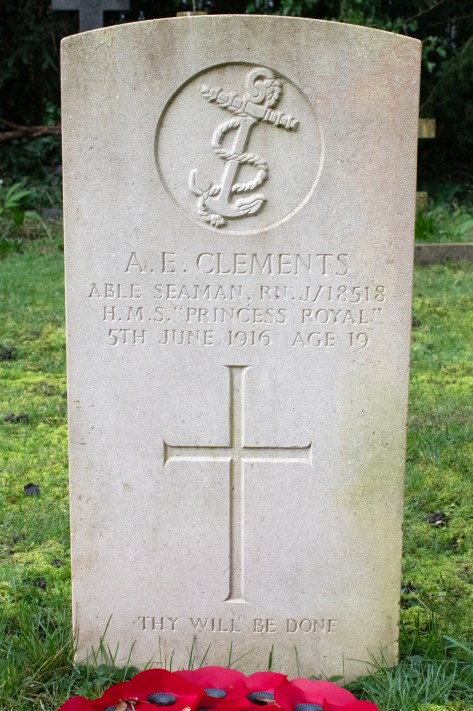
In spite of unpropitious weather, an exceedingly large number of people of all classes paid a last tribute to Able-Seaman Albert Edward Clements, at Eton, on Saturday last. The deceased, whose home was at 3, Tangier-lane, Eton, was on HMS Princess Royal, which took part in the naval fight in the North Sea, and he as severely injured by burns. He was taken on board HM Hospital Ship Plassy, but died on 31st May, and his remains were brought home on Thursday evening last week from Scotland. Clements as a boy showed an affection for the sea, and when old enough joined the merchant service and made several voyages. Five years ago from the day he was laid to rest he joined the Navy, and was at first on HMS Warspite and afterwards on the ship on which he received his mortal wounds. He was a loyal and devoted son, and after the death of his father three years ago was of great assistance to his mother. His father was for 29 years in the Royal service at Frogmore and consequently served under three Sovereigns – Queen Victoria, King Edward and King George. His elder brother, Charles George, was in the Oxford and Bucks LI, and was killed at Loos a year ago. The Admiralty, through pressure, was not able to send a representative, but his mother had received from that department a letter expressing its sympathy and appreciation of his services. A letter of sympathy has also been received from the King.
[Windsor and Eton Express: Saturday 17th June 1916]
The early life of Albert Edward Clements is a challenge to piece together. Born in 30th October 1896 in Marylebone, details of his parents are unclear and, by the time of the 1901 census, he seems to have been adopted by his paternal grandparents, George and Louisa. By this point the family were living at 4 Sunbury Road, Eton, the household being made up of Albert, his grandparents, and his four uncles and aunts.
At 45 years of age, George was a gardener’s labourer, but, as the newspaper report suggests, Albert had a hankering for the sea. He served on merchant vessels, but enlisted in the Royal Navy on 12th June 1912. Sent to HMS Ganges – the training base near Ipswich, Suffolk – he was given the Rank of Boy 2nd Class, as he was too young to formally join up.
By January 1913, Albert was assigned to the dreadnought battleship HMS St Vincent. Within four months he had moved to the heavy cruiser-turned-aircraft carrier HMS Vindictive. By the end of the year, however, Boy Clements received his main move, to HMS Princess Royal.
Albert was formally inducted in the Royal Navy on 28th May 1914, and was given the rank of Ordinary Seaman. His service records notes that he was 5ft 5ins (1.65m) tall, with dark brown hair, blue eyes and a fresh complexion. He was also recorded as having a birth mark on the back of his left arm.
Princess Royal would remain Albert’s home for more than three years and, on 1st April 1915, he received a promotion to Able Seaman. His ship would be involved in some of the Royal Navy’s fiercest skirmishes, including Heligoland Bight and Dogger Bank, but it was during the Battle of Jutland, on the night of the 31st May 1916, that Albert was injured and died of his wounds. He was just 19 years of age.
The hospital ship Plessy brought the body of Albert Edward Clements back to shore, and he was taken home to Berkshire for burial. He was laid to rest in the cemetery of St John’s Church in Eton.
William James Maslin was born in the autumn of 1898, and was the second of four children to Mark and Emma. Mark was a hay cutter from Liddington, Wiltshire, but the family were born and raised in Edington, near Westbury.
There is little specific information about William’s life, but it is clear that when war broke out, he was keen to play his part. He enlisted in the Training Reserve Battalion, and was assigned to the 25th Battalion. Sent to Wool, near Bovington, Dorset, it wasn’t long before Private Maslin fell ill. He passed away from bronchial pneumonia on 4th April 1917: he was just 18 years of age,
The body of William James Maslin was taken back to Wiltshire for burial. He was laid to rest in the graveyard of Ss. Mary and Katherine and All Saints’ Church in his home village, Edington.
William’s older brother, Walter Frank Maslin, also served in the First World War. Born in 1891, he followed in his father’s footsteps, working as a farm labourer.
On 24th September 1911, Walter married Rose Long. The couple set up home just along the road from Mark and Emma, and wend on to have three children: Florence, Herbert and Dorothy.
Walter enlisted in the Worcestershire Regiment, and was attached to the 2nd/8th Battalion. His unit fought at Fromelles, the Ancre and Langemarck, although, as his service papers no longer exist, it isn’t clear where or how Private Maslin served.
What is clear, however, is that he was captured, and taken as a prisoner of war. Imprisoned at Hamelin Camp, not far from the German town of the same name, he was certainly there by the spring of 1918. Conditions would have been harsh, and Private Maslin succumbed to pneumonia on 6th May 1918: he was 26 years of age. His widow and family would not find out about his passing for some weeks, and a death notice was only reported in the Devizes and Wiltshire Advertiser on the 18th July.
The body of Walter Frank Maslin was laid to rest in Friedhof Ohlsdorf, Hamburg, Germany.
Leonard Stephen Lovelock was born early in 1887 in the Wiltshire village of Edington. The son of Ellen Lovelock, there is no confirmation of who his father was. Ellen married Stephen Drewett in 1889, and from this point on Leonard took that surname. Stephen was a sawyer, and he and Ellen set up home in Kington Langley, near Chippenham.
Leonard, however, was destined for a different upbringing. The 1891 census return found him living with Jesse and Ann Coldrake, who were recorded as his grandparents: also in the household were Betsy Drewett (Jesse’s mother-in-law) and Emily Drewett (his daughter-in-law). The relationships are a little confusing, but Leonard remained with Jesse and Ann for the1901 and 1911 census records.
When he completed his schooling, Leonard followed Jesse into farm labouring. The later census return recorded the family living in a three-roomed cottage on Tinhead, the road leading north from Edington village centre.
Farm work was only the first step for Leonard and, by the time war broke out, he was employed as an attendant at the Wiltshire County Asylum in Devizes. He enlisted on 12th January 1916, his medical records showing that he was a little under 5ft 6ins (1.67m) tall, and weighed 170lbs (77.1kg).
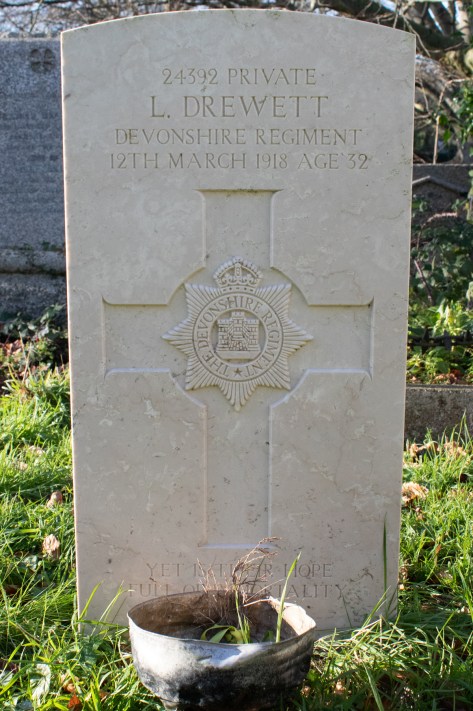
Private Drewett was initially assigned to the 12th Battalion of the Devonshire Regiment and, on 14th June 1916, his unit crossed the channel for France. While there, he was transferred to the Labour Corps, and was attached to the 152nd Labour Company. In the summer of 1917, Leonard joined the 5th Army School of Cookery, but after just six weeks he was admitted to a camp hospital suffering from epileptic seizures.
Moved from the camp hospital to the 2nd Australian General Hospital in Wimereux, by the end of the year, Private Drewett had been medically evacuated to Britain for treatment. He was sent to the General Military Hospital in Colchester, Essex, but his condition would ultimately prove fatal. Leonard died on 12th March 1918: he was 32 years of age.
The body of Leonard Stephen Lovelock Drewett was taken back to Wiltshire for burial. He was laid to rest in the graveyard of Ss Mary and Katherine and All Saints in his home village of Edington.
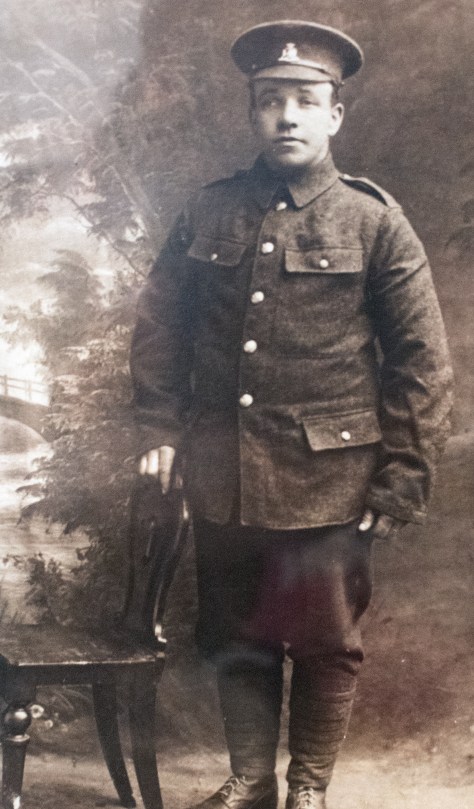
Private Leonard Drewett (from Edington Church memorial)