
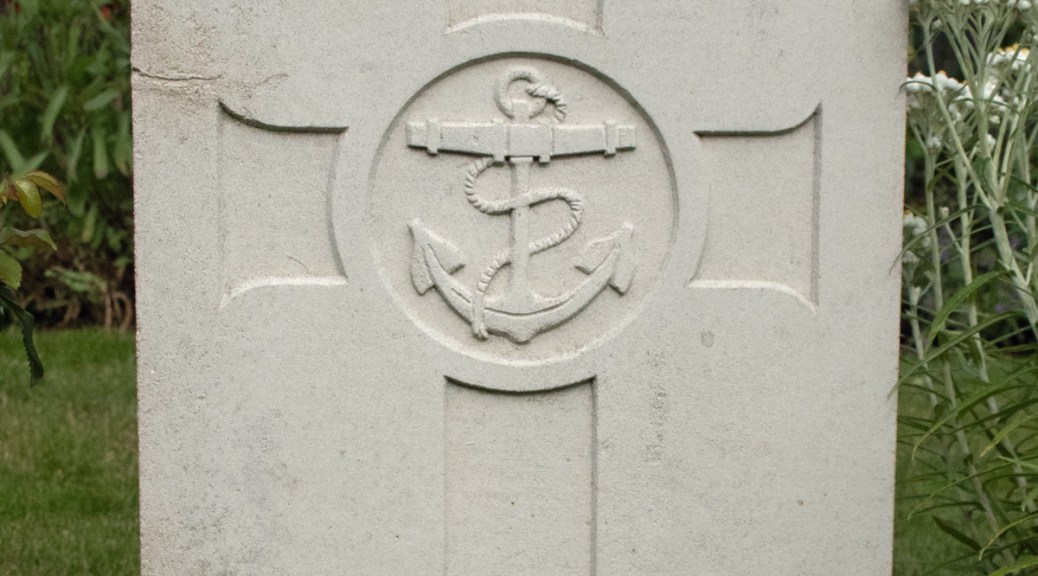

The details of Thomas Davis’ early life are a challenge to piece together.
His navy service papers confirm that he was born in Stockton, County Durham, on 25th January 1867, and was the son of John and Ann Davis. The 1881 census found the family living at 66 Argyle Street, Linthorpe, Yorkshire. John was a puddler, working iron in a local foundry, while Thomas, now 15 years of age, was a labourer in the same ironworks.
Thomas falls off the radar for a few years, and it is only his service papers that brings things together again. He enlisted in the Royal Naval Reserve in June 1915, joining up as a Trimmer. The document confirms that he was 5ft 6ins (1.77m) tall with blue eyes and a fair complexion.
Over the next eighteen months, Thomas served on four ships, returning to HMS Pembroke – the Royal Naval Dockyard in Chatham, Kent – in between voyages. His conduct seems to have been average and, in November 1916, he was jailed for 7 days and docked a day’s pay for an unrecorded misdemeanour.
By that winter, Trimmer Davis’ health was faltering, and he was admitted to the Sailor’s Home in Chatham, Kent, suffering from pneumonia. The condition was to get the better of him, and he passed away on 1st February 1917, just a week after his 50th birthday.
The body of Thomas Davis was laid to rest in the naval section of Woodlands Cemetery, Gillingham, Kent, not far from the naval base he had come to call home.
There is scant information about Thomas’ family. While the 1881 census notes he had a younger brother, Phillip, his service papers give his next-of-kin as cousin William Jones of Wellington Street, Toronto, Canada. (It also notes that communications sent to him were returned unopened.)







 Death and Service