Category Archives: Kent

Gunner William Foxworthy

Gunner William Foxworthy

William George Foxworthy was born in Dartmouth, Devon early in 1880. The middle of five children, his parents were William and Mary Foxworthy. William Sr (whose full name was William George Foxworthy, and who was known by his middle name) was a house painter, but when he finished his schooling, William Jr found work as a boat builder.

The 1901 census found the family living in a small house on Crowther’s Hill, to the Dartmouth town centre. The cottage would have been cramped, but there were five wages coming in from George, William and William’s siblings.

William does not appear on the 1911 census, and it seems that he took the step from building boats to sailing on them. When war broke out, he was quick to step up and play his part, enlisting in Exeter on the 22nd October 1914. While he had previously been a volunteer in the Devonshire Regiment, William was assigned to the Royal Garrison Artillery.

Gunner Foxworthy’s service records show that he was 5ft 4.5ins (1.64m) tall, and weighed 121lbs (54.9kg). He was noted as having brown hair, hazel eyes and a fresh complexion. Deemed fit for military service, he was packed off to a base in Sheerness, Kent.

William spent the next year on the north Kent coast, before being reassigned. By 1st November 1915 he was on the Front Line, and remained in France until the following June.

In the spring of 1916, Gunner Foxworthy fell ill. He contracted tuberculosis, and this was to dog him for the rest of his life. The contagious nature of the condition meant that he was no longer fit for military service, and he was medically discharged on 11th July 1916.

The death occurred on Tuesday of last week at Roseville Street, of Mr William George Foxworthy, second son of Mr and Mrs Foxworthy, after a long and painful illness. In 1914 deceased joined the [Royal Garrison Artillery] as a gunner, and saw much fighting around Ypres in the winter of 1915-16, during which time he contracted the disease which has now terminated fatally. This is the second son Mr and Mrs Foxworthy have lost in the war, their youngest boy having been killed some two months ago. Great sympathy has been shown the parents in their second bereavement.

[Dartmouth & South Hams Chronicle:  Friday 20th December 1918]

William George Foxworthy was 38 years of age when he died on 10th December 1918. He was laid to rest in the graveyard of St Clement’s Church in his home town, Dartmouth.


William’s younger brother, Louis Henry Foxworthy, was a Corporal in the 9th (Service) Battalion of the Devonshire Regiment. He served on the Western Front as well and, in September 1918, he was caught up in the fighting in St Riquier, near Abbeville. Corporal Foxworthy was killed in action on 8th October 1918: he was 31 years of age.

Louis’ body was not recovered, and he is commemorated on the Vis-en-Artois British Memorial in Harcourt, France.


Bombardier Frank Sloman

Bombardier Frank Sloman

Frank Sloman was born in the autumn of 1887, and was the youngest of five children to Frank and Emma. Frank Sr was a mason from Jersey, in the Channel Islands, but it was in Tiverton, Devon, that he and Emma made their home and raised their family. The 1891 census found the family living on Castle Street, but by 1901 they had moved down the road to St Peter’s Street.

Frank Jr found work as a painter when he finished his schooling, but he sought adventure and a career. He was already a volunteer for the Devonshire Regiment, and, on 7th May 1904, he officially enlisted as a paid member of the troop. Private Sloman’s records show that he was 5th 10.5ins (1.79m) tall, and weighed 129lbs (58.5kg). He was noted as having brown hair, grey eyes and a fresh complexion.

Private Sloman spent two years on home soil. He quickly extended his contract, and this led to more opportunities. By December 1906 his unit was in India, and he would go on to spend five and a half years there.

In December 1907, Frank transferred to the Royal Garrison Artillery. He initially held the rank of Gunner, before being promoted to Bombardier in January 1912, and Corporal just three months later. In October, Frank returned to Britain, and was stood down to reserve status. He returned to Tiverton, and found work as a porter at the local station.

War was on the horizon, however, and when conflict broke out, Frank was called upon to play his part once more. Initially taking up the rank of Corporal in the Royal Field Artillery, he reverted to the role of Gunner at his own request. By this point, his unit was in France, and he would remain there for the next eight months.

On 6th May 1915, Frank returned to Britain, and was attached to 2B Reserve Brigade. He was based at the training facility in Bettisfield Park in Clwyd, and would spend the next eighteen months there. In June 1916, he was once again promoted to the rank of Bombardier.

Love was on the cards, and, on 17th June 1916, Frank married Frances Hadlow. There is little information available for her, but the couple exchanged vows at the Register Office in Windsor, Berkshire.

By the autumn of 1916, Frank’s health was becoming an issue. He contracted phthisis, or tuberculosis, and was sent to the the south coast for recuperation. His condition would ultimately render him unfit for continued military service, and Bombardier Sloman was discharged from the army on 17th December 1916.

His papers show that he had grown to 6ft 2.5ins (1.89m) in height, and, while physically unfit, he was a steady, sober and reliable man. He and Frances had taken rooms at 7 Hawley Street, Margate, Kent, but it seems that the couple soon moved back to Devon. Their new home was a small cottage at 3 Westbrook Place in Tiverton.

At this point, Frank’s trail goes cold. It is unclear whether he took up work again – or was able to do so – but his lung condition was ultimately to get the better of him. He passed away on 3rd June 1918, at the age of 30 years old.

Frank Sloman was laid to rest in Tiverton Cemetery, on the outskirts of the town in which he had grown up.


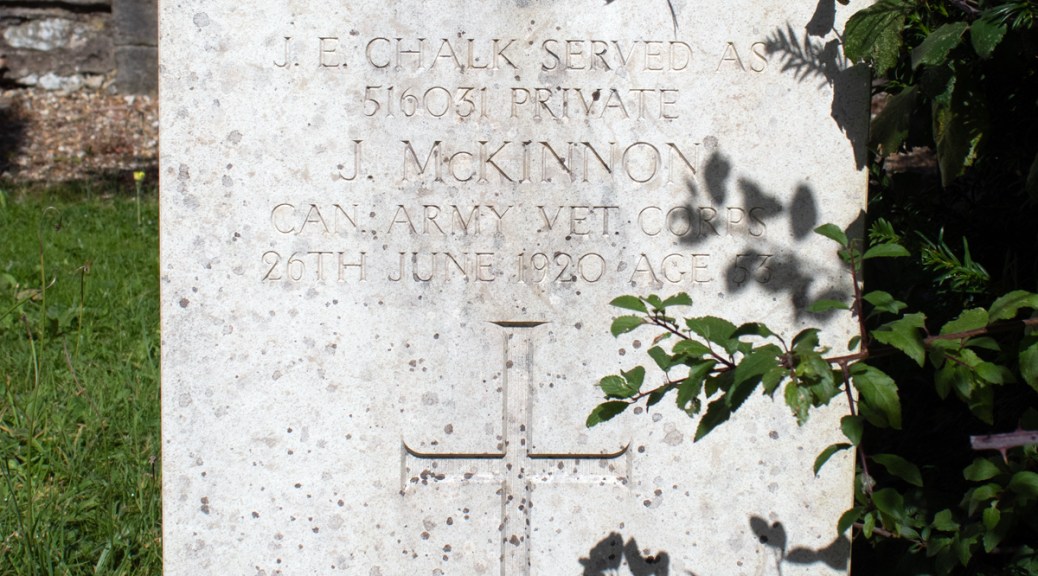
Private John McKinnon, aka James Chalk

Private John McKinnon, aka James Chalk

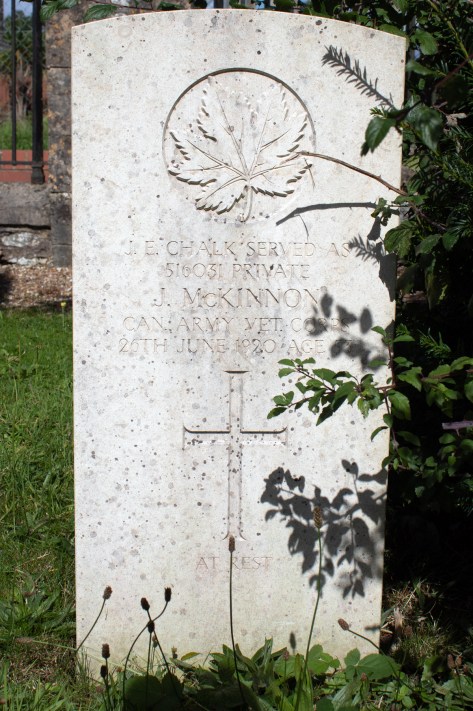
In Mere Cemetery, Wiltshire, is a headstone dedicated to JE Chalk, who served as Private J McKinnon in the Canadian Army Veterinary Corps. He died on 25th June 1920, and gives his age as 53 years old.

Private McKinnon’s service records suggest, however, that he was born on 14th October 1874 in Inverness, Scotland, and give his army name as John. The Commonwealth War Graves Commission give his other name as James Edward Chalk. James seems to have been keen to disguise his background, and it is only with some digging that the real story comes out.

James was the youngest of five children to Edward and Mary Chalk. Edward was a carpenter from Mere, and this is where the family were born and raised.

When he finished his schooling, James found work as a booking clerk. Edward died in the 1880s, and the 1891 census found James living at home with his mother, who had taken on laundry work to help with their finances.

By 1901, Mary and James were living on Water Street, to the south of the town centre. There’s was now an extended household, and included James’ sister Olive. James is noted as being married, and while no marriage records exist, it would seem that his wife, Mary, and their daughter, Ivy, were also living there.

The next census, taken in 1911, suggests James’ life had taken a different turn. Employed as a railway foreman, he was now living with his older sister, Olive, in her home. He is noted as being married with a child, but neither Mary nor Ivy appear in the same census.

At some point in the next five years, James took the decision to move overseas, and create himself a new identity.

John McKinnon was living in Montreal when the call came to join up. He enlisted on 29th April 1916, by which point he was 41 years of age. Assigned to the Canadian Army Veterinary Corps, his service records confirm that he was 5ft 9ins (1.75m) tall, with greying brown hair, grey eyes and a sallow complexion. He was noted as having scars on both legs, and another on the second toe of his right foot.

Private McKinnon’s unit were quick to be dispatched to Britain, and he arrived in Shornecliffe, Kent, on 29th June. He spent the next five months at the army base, and had two spells of a month each in hospital during that time: the first for asthma, the second for bronchitis.

In November 1916, John moved along the coast to Shoreham, West Sussex. His health was badly impacted, though, the medical report stating that ‘his chest is of the emphysematous type but at present free from bronchitis. He will not do well in England.’ John was formally discharged from the army on 15th November 1916.

At this point, John’s already sparse trail goes cold once more. It is possible that he moved to Wiltshire to be nearer to family, although nothing can be confirmed.

James Edward Chalk, who serves as Private John McKinnon, died on 26th June 1920: His service records suggest that he was 45, but he was, in fact, 53 years of age. He was laid to rest in Mere Cemetery, on the outskirts of the town he had called home for so long.


Private Alfred Ribbans

Private Alfred Ribbans

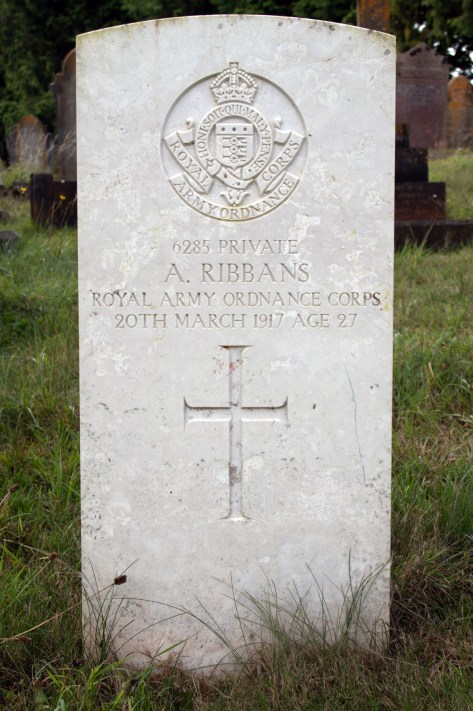
Alfred Ribbans was born in Belvedere, Kent, in the summer of 1889. The sixth of nine children, his parents were Arthur and Sarah Ribbans. William was an iron turner from Ipswich, Suffolk, while his wife had been born in Jersey, Channel Islands. It is unclear how the couple met, but by the 1891 census the family were at No. 8 Coastguard Cottages in Erith.

When he finished his schooling, Alfred followed in his father’s stead, finding employment as a fitter and turner. By the autumn of 1908, he found an opportunity to turn this work into a career, and enlisted in the Royal Army Ordnance Corps. His service records show that, at 19 years of age, he was 5ft 7ins (1.71m) tall, and weighed 132lbs (59.9kg). He had a fair complexion with brown hair and brown eyes. He was also noted as having a scar on his left eyebrow, another on the right side of his upper lip, and two noticeable moles: one on the left side of his navel and the other on the right side of his neck.

Private Ribbans’ initial term of service was for three years. He served on home soil, and when his contract came to an end on 27th October 1911, he was stood down to reserve status. When war broke out he was mobilised again, and by 14th August 1914, he found himself in France. It is unclear exactly where he served, but his time overseas was not to be a lengthy one.

By April 1915 Alfred was back on home soil, suffering from tuberculosis. The contagious nature of the condition meant he was no longer suited to the crowded barracks and billets of the Western Front, and so Private Ribbans was medically discharged from the army.

Alfred returned home to Kent, and, when he recovered, to his job as a fitter. On 3rd July 1916 he married dressmaker Armenia Tuckerman in the parish church in Erith. At the time, the couple were living at 9 Stanmore Road, but soon moved to Totnes in Devon, presumably to help with Alfred’s now-failing health.

The following January, Armenia gave birth to a daughter, Armenia Joy, but the young family’s happiness was to be short-lived: Alfred succumbed to his lung condition on 20th March 1917. He was 27 years of age.

Alfred Ribbans was laid to rest in Paignton Cemetery, Devon.


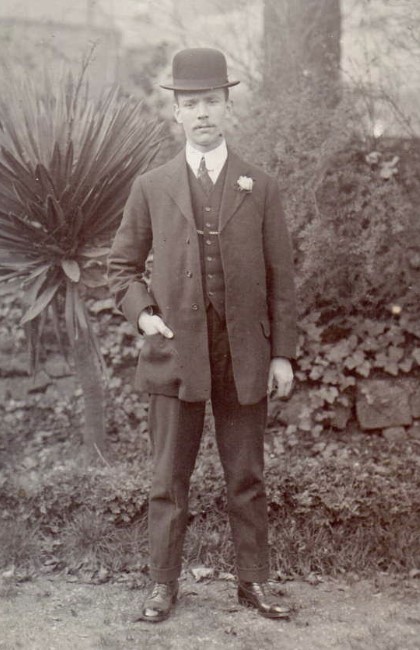
Private Alfred Ribbans
(from ancestry.co.uk)

Petty Officer 1st Class James Brett

Petty Officer 1st Class James Brett

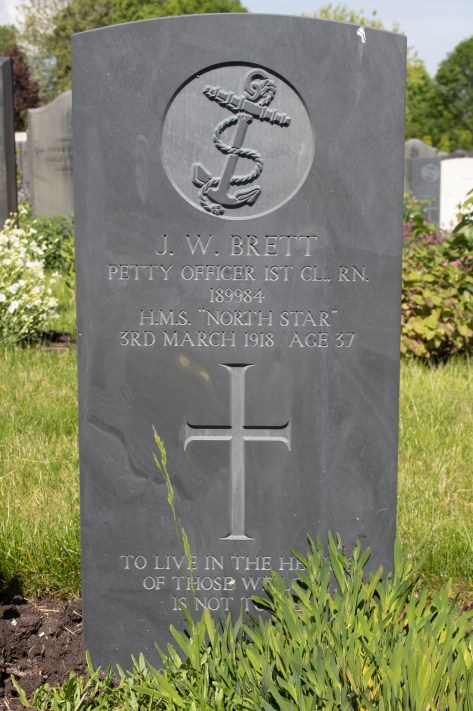
The early life of James Watt Brett is lost in the mists of time. He was born on 25th November 1880 in the Scottish village of Fochabers and when he finished his schooling, he found work as an apprentice draper. He sought bigger and better things, however, and, on 25th August 1896, he joined the Royal Navy.

At just fifteen years old, James was too young to formally enlist. He was given the rank of Boy 2nd Class, however, and dispatched to the training ship HMS Caledonia, for his basic instruction. He remained on board until October 1897, by which point he had been promoted to Boy 1st Class.

Over the next year, James served on two cruisers – HMS Blenheim and HMS Dido. His shore base became HMS Pembroke, the Royal Naval Dockyard in Chatham, Kent, and he would return here time and again in between assignments.

It was while James was serving on Dido that he came of age. Now given the rank of Ordinary Seaman, his records show that he was 5ft 1in (1.54m) tall, with fair hair, blue eyes and a fresh complexion. James would remain on board Dido until January 1902, by which time he had been promoted to the role of Able Seaman.

Over the initial twelve years of his service, James would spend time on eight vessels, and travel the world. His dedication to the navy is clear, although his career was not without its hiccups.

In April 1904, James was promoted again, to the rank of Leading Seaman. The following January he was made Petty Office 2nd Class, although this new role only lasted for a couple of weeks, before he was knocked back down to Able Seaman.

In April 1909, he was again made Leading Seaman and, promoted to Petty Officer 2nd Class once more in January 1910. By October that year, he had risen to Petty Officer 1st Class, by which point his initial contract came to an end.

James immediately re-enlisted, and retained his rank for the remainder of his naval career. At some point after the 1911 census, he married a woman called Annie, and the couple seem to have been based at Burnt Oak Terrace, Gillingham, Kent, although there is no further information about Petty Officer Brett’s new wife.

James seemed to have become more shore-based after his marriage, and he served at HMS Actaeon in Portsmouith, Hampshire, and HMS Pembroke and HMS Wildfire in Kent. By the summer of 1917, he was attached to the Dover Patrol, and assigned to HMS Attentive.

On 3rd March 1918, Petty Officer Brett’s service records note that he was accidentally killed by falling into [a] dry dock at Royal Albert Docks. No further information is available, although it is possible that the accident took place in London. He was 37 years of age.

The body of James Watt Brett was taken back to Kent for burial. He was laid to rest in the military section of the Woodlands Cemetery, Gillingham, not far from where his widow still lived.


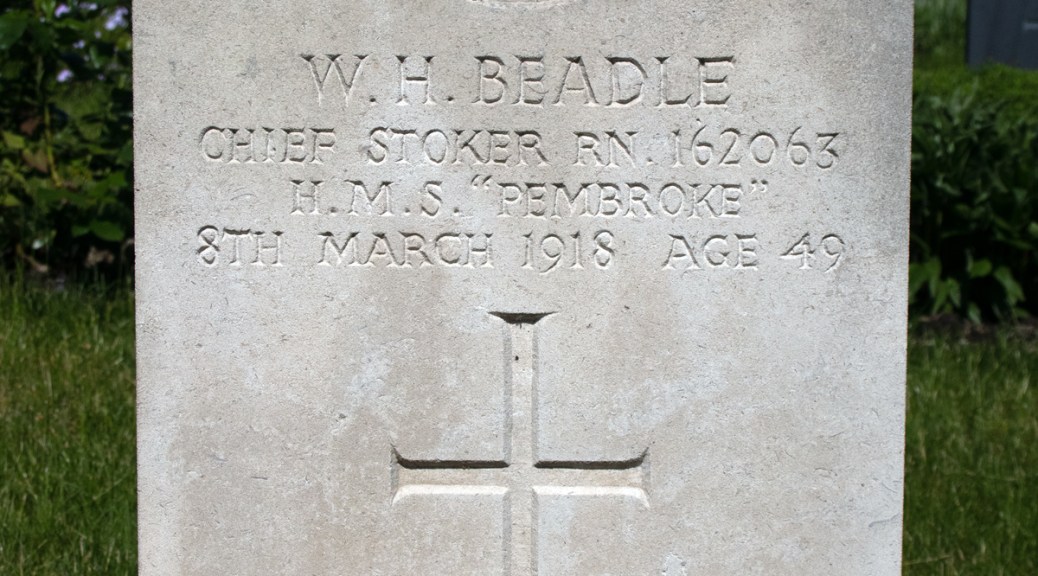
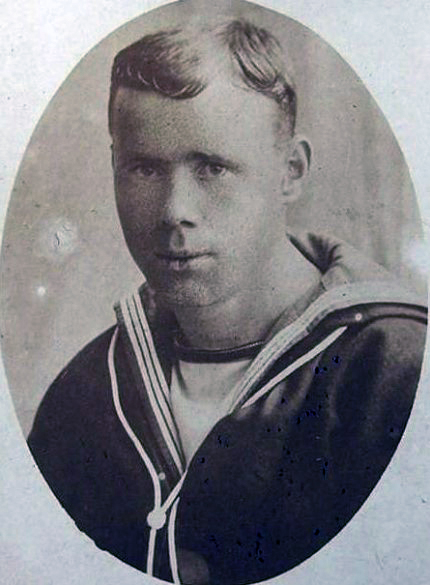
Chief Stoker William Beadle

Chief Stoker William Beadle

William Henry Beadle was born in Heybridge, Essex, on 23rd April 1870. The youngest of three children his parents were William and Sophia Beadle. William Sr was a waterman-turned-labourer, and the young family lived with Sophia’s parents.

When Sophia died in 1875, her widow and their children remained with his in-laws. William Sr died in 1887, and by the time of the 1891 census, his son was living with his now widowed grandmother. The document notes that she was a pauper, but he was a moulder in the local iron works.

William sought bigger and better things and, on 13th August 1891, he enlisted in the Royal Navy as a Stoker 2nd Class. His service records show that, as 21 years of age, he was 5ft 8ins (1.72m) tall, with brown hair, grey eyes and a fresh complexion.

Stoker Beadle was initially sent to HMS Pembroke, the Royal Naval Dockyard in Chatham, Kent, for his training. He would spend the next six months split between there and HMS Wildfire, a shore establishment downriver at Sheerness.

In 1892, William spent six months on board the troop ship HMS Tyne. He returned to Chatham in July of that year, and was promoted to Stoker 1st Class. Over the course of the next eleven years, he would go on to serve on four ships, each time returning to his base port, HMS Pembroke.

William’s service record is pretty much mark free. He was confined to cells for seven days in October 1895, although his offence s unclear. In April 1896 he was promoted to Leading Stoker 2nd Class, and made Leading Stoker 1st Class three years later. In December 1902, while on board the cruiser HMS Diana, William was promoted again, to Acting Chief Stoker, and the following August, his initial contract of service came to an end.

By this point William was a married man. He married Clara Walford in Rochford, Essex, and, while the couple did not go on to have children, there is little additional information about her.

William re-enlisted as soon as his initial twelve-year contract came to an end. In December 1903 he was promoted to Chief Stoker, and he remained at this rank until he war formally retired on 16th August 1913. He had spent more than two decades in the Royal Navy ,and travelled the world: the 1911 census recorded him as one of the crew of HMS Lancaster, moored in Malta.

Chief Stoker Beadle’s time away from the Royal Navy was not to be lengthy and, when war broke out less than a year later, he was called upon once more. He spent nine months back at HMS Pembroke, before being assigned to the new cruiser HMS Calliope. She would be William’s home for the nearly three years, and it was not until March 1918 that he came back to shore.

William’s return to Chatham seemed to coincide with a downturn in his health. He was admitted to the town’s Royal Naval Hospital with nephritis, and this is what would take his life. He died on 8th March 1918: he was 47 years of age.

William Henry Beadle was laid to rest in the military section of Woodlands Cemetery, Gillingham, not far from the naval base he had called home for so long.


Able Seaman Arthur Crisp

Able Seaman Arthur Crisp

Arthur Edward Crisp was born in 16th March 1899 in the Norfolk village of South Creake. The youngest of six children, his parents were blacksmith Henry Crisp and his wife, Sarah.

When war broke out across Europe, young Arthur had already had some experience of seamanship, and was keen to play his part. He joined the Royal Navy on 7th April 1915 and, given his age, he was assigned the rank of Boy 2nd Class. Initially sent to HMS Powerful, he was trained there for three months, rising to the rank of Boy 1st Class.

On 26th July 1915, Arthur was assigned to the battlecruiser HMS New Zealand, and would remain on board for the next two years. During this time, he came of age, and was formally inducted into the Royal Navy as an Ordinary Seaman. His service records show that he was 5ft 5ins (1.65m) tall, with brown hair, grey eyes and a fresh complexion.

His stint on New Zealand also exposed him to naval warfare, as she was heavily involved in the Battle of Jutland in May 1916. Ordinary Seaman Crisp came through, however, and remained part of the battlecruiser’s crew for a further year.

After a short time on shore, where he was based at HMS Victory, the Royal Naval Dockyard in Portsmouth, Hampshire, Arthur’s next posting was on board HMS Wallington. A former trawler, she had been converted to a boom defence vessel, she protected the dockyard in Grimsby. In November 1917, while based in the Lincolnshire town, Arthur was promoted again, rising to Able Seaman.

The following March, Arthur moved again, and was assigned to HMS Attentive, the shore base for the Dover Patrol. He would not remain there for long, however, and was admitted to the Royal Naval Hospital in Chatham, Kent. He passed away on 17th March 1918, from an intriguing combination of gunshot wounds to his chest and pneumonia. He had turned 19 years old the day before.

The body of Arthur Edward Crisp was taken to nearby Gillingham for burial. He was laid to rest in the military section of the town’s Woodlands Cemetery.


Able Seaman Arthur Crisp
(from findagrave.com)

Leading Seaman Reuben Pearce

Leading Seaman Reuben Pearce

In the military section of Woodlands Cemetery, Gillingham, is a headstone marking the grave of Leading Seaman Reuben William Pearce. Little information is available about his early life, although later records suggest that he was born on 30th January 1875 in Plymouth, Devon.

When he completed his schooling, Reuben found work as a hawker. He had his heart set on bigger and better things, however, and, on 3rd June 1890, he signed up to the Royal Navy. Just fifteen years of age, he was too young to formally enlist, but he was accepted with the rank of Boy 2nd Class, and sent off to HMS Impregnable, the training ship based in nearby Devonport, for his induction.

Over the next two-and-a-half years, Boy Pearce learnt his trade. On 4th June 1891, he was promoted to the rank of Boy 1st Class, and the following February he was assigned to his first ship, the corvette HMS Boadicea. It was while he was on board the corvette that Reuben came of age, and he was officially inducted into the Royal Navy as an Ordinary Seaman. His service records show that he was 5ft 6ins (1.68m) tall, with brown hair, blue eyes and a ruddy complexion. He was noted as having an anchor and his initials tattooed on his left arm, with another anchor tattoo on his right.

Reuben enlisted for a twelve-year term of service. During this time, he served on nine vessels, returning to HMS Vivid, the Royal Naval Dockyard in between voyages. He had a mixed career, and, on 1st February 1894, was promoted to Able Seaman. In January 1896, he spent three days in cells, for an unrecorded offence.

In January 1900, whole aboard the gunvessel HMS Rambler, Reuben was promoted to Leading Seaman. Within a day, however, he was back in the cells, where he spent the next 72hrs. This led to an immediate demotion, and he found himself back as an Able Seaman.

When his contract came to an end, Reuben immediately re-enlisted, and he would go on to serve for another thirteen years. In July 1906, he was promoted to Leading Seaman once again, and seemed to have learned the error of his ways, retaining the rank until his passing.

On 15th September 1916, Leading Seaman Pearce was mentioned in despatches. for his service during the Battle of Heligoland Bight. The ship on which he was serving at the time, the battlecruiser HMS Tiger, was heavily involved.

Reuben remained on the Tiger for three-and-a-half years, and during this time, his valour was recognised again, when he was awarded the Medaglia di bronzo al valor militare (Bronze Medal for Military Valour) by the King of Italy. Again, details are unclear, but he was again mentioned in despatches for his service.

By the spring of 1918, Leading Seaman Pearce was billeted on board HMS Hindustan, which was being used as barracks ahead of a planned raised on Zeebrugge and Ostend. On 13th April an accident occurred, and he received a gun shot wound to his leg. This fractured his femur, and, despite being rushed to the Royal Naval Hospital in Chatham, Kent – not far from the dockyard where the Hindustan was moored – he passed away from his injuries later that day. Full details of the incident are unclear, but he was 43 years of age.

Reuben William Pearce was laid to rest in Woodlands Cemetery, Gillingham, not far from the port which had served as his final base.


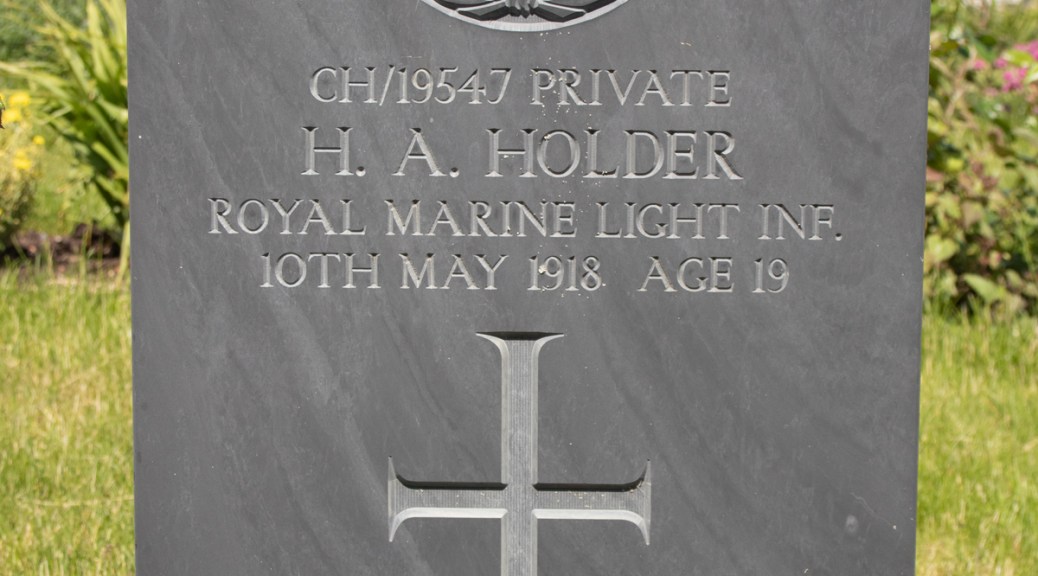
Private Harry Holder

Private Harry Holder

Harry Alfred Holder was born in the summer of 1899, and was the older of two children – both boys – to Harry and Kate. Harry Sr had been widowed a couple of years before, and the extended family included four half-siblings for his new family.

The family had rooms at 16 Warner Street in Southwark, Surrey. By the time of the 1911 census, gad fitter Harry Sr had been widowed a second time, and he and three of his sons were sharing the house with William and Hannah Gayzer and widower Edward Maude.

Harry Jr would have been 15 years old when war broke out, and so too young to serve. He would eventually enlist, however, and had joined the Royal Marine Light Infantry by the spring of 1918. The only documentation relating to his service is his entry on the Commonwealth War Graves Commission Register: Took part in the operations against Zeebrugge on board HMS “Iris II” on 23rd April, 1918.

One of two Mersey ferries to take part in the Zeebrugge raid – the other being called Daffodil – Iris attempted to come alongside the port’s mole, or breakwater, to offload the troops she had on board. An initial attempt to boor failed, and when she came alongside again, a shell burst through the deck where nearly 60 marines were preparing to land. Forty-nine were killed and the rest, including Private Holder, were badly injured.

Iris managed to make her way back to Chatham, Kent, where the Royal Navy had a major dockyard. Most of the survivors were moved to a Royal Naval Hospital in London, but Harry’s injuries were to prove too severe: He succumbed to them on 10th May 1918: he was just 19 years of age.

The body of Harry Alfred Holder was laid to rest in the Naval section of Woodlands Cemetery, Gillingham, Kent, not far from the port in which he had come ashore.


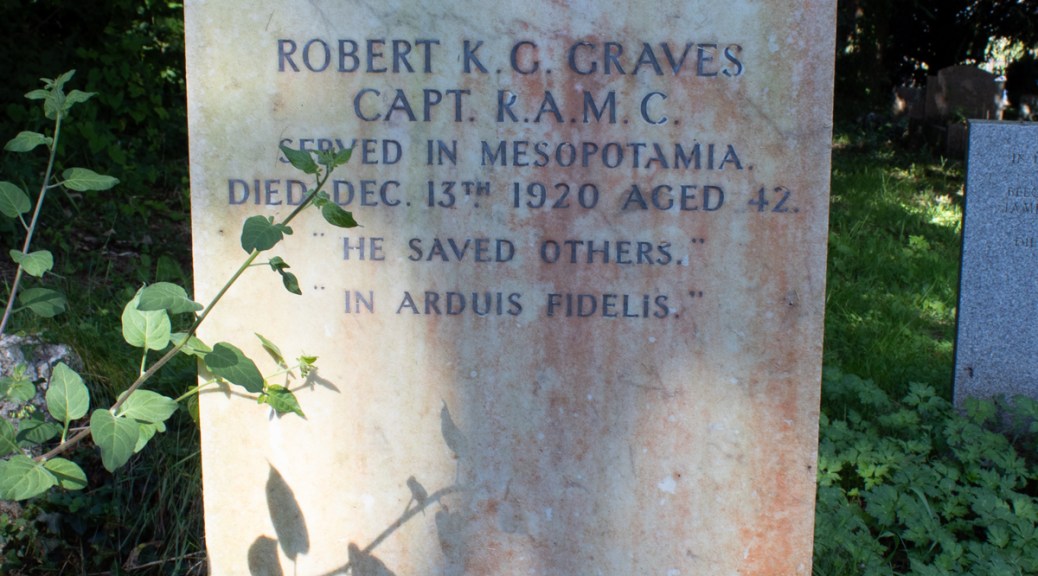
Captain Robert Graves

Captain Robert Graves

Robert Kennedy Grogan Graves was born on 1st January 1878. An announcement in the local newspaper confirmed that “at Baronne Court, County Tipperary, the wife of Lieutenant-Colonel W. Grogan Graves, 82nd Regiment, of a son (prematurely).” Robert was the older of two children, while his parents were William Graves, a Justice of the Peace in Ireland, and his wife, Georgianna Graves.

William died in 1890, and Georgianna moved the family to London. The 1891 census found her residing at the Golden Hotel in St Martin in the Fields, while her two boys, Robert and his younger brother, Geoffrey, were boarding students at Francis Napier’s classics school on Shooter’s Hill Road in Kidbrooke, Kent.

Robert found his calling through education. He studied medicine, and by January 1896 he was a student at St George’s Hospital in Tooting, Surrey.

By 1906 Robert had set himself up in an infirmary on Southgate Street in Gloucester, Gloucestershire. That same year, he married Kathleen Schofield: the couple went on to have two children, Robert Jr in 1912, and Bernard the following year.

Graves, Robt. Kennedy Grogan, Scison Lodge, Clevedon, Somerset (Tel. 11 Y Clevedon) – MRCS, LRCP London 1904; (St Geo.); Hon, Med, Off. Clevedon Cott. Hosp.; Med. Off Mutual Insur. N.Y. & Clevedon Hydro. Estab.; late Sen. Ho. Surg. & Asst. Ho. Surg., & Surg. Gloucester Co. Infirm., & Asst. Med. Regist. & Obst. Clerk St Geo. Hosp.

[The Medical Directory, 1910]

Robert had set himself up well during his life. The 1911 census found him and Kathleen – who was better known by her middle name, Gladys – living in their 17-room house on Linden Road in Clevedon. They afforded themselves three servants, including a housemaid, a cook and a motor driver. By the outbreak of war, Robert has an entry in the town’s Kelly’s Directory, and seemed to be a focal member of the community, joining the local Grand Lodge in September 1908.

Robert’s time in the army, is hard to piece together. He joined the Royal Army Medical Corps as a Captain, and appears to have been connected to the air force. His headstone suggests that he served in Mesopotamia, but when and exactly where, however, is lost to time.

After the war, Robert returned to Britain. Leaving the Somerset coast, however, he and Kathleen appear to have set themselves up in Dorset. He died, through causes not detailed, on 12th December 1920, at 42 years of age. His entry on the probate register states:

GRAVES Robert Kennedy Grogan of 1 Charnwood Chambers Seabourne-road West Southbourne Hampshire died 12 December 1920 at The Grange Buckfastleigh Devonshire…

It is unclear whether Charnwood Chambers was his working address, with The Grange being the family’s official home, or if Buckfastleigh served as a place of convalescence.

Robert Kennedy Grogan Graves left an estate totalling £370 14s 7d (approximately £21,100 today) to Kathleen. He was buried in the graveyard of Holy Trinity church, Buckfastleigh.